





1. Introduction
One of the most celebrated results in Complex Analysis is Liouville’s theorem. It states that any bounded entire function
$f:\mathbb {C}\longrightarrow \mathbb {C}$
 must be constant. Liouville’s theorem has spawned a lot of research along the past two centuries, and different versions have been developed in geometric contexts and have inspired important and beautiful research in Geometric Analysis.
In this article, we study Liouville’s theorem and the strong Liouville property (to be defined below) in a geometric context, and to be more precise, on Riemannian cones. Our goal is to test the limits of some known, and one might say, celebrated results on the behavior of harmonic functions on Riemannian manifolds, such as Cheng–Yau Liouville’s theorem and Ni–Tam results on surfaces of finite total curvature. A central contribution of the article is a nonlinear Liouville theorem for p-subharmonic functions on surfaces with a pole, obtained without symmetry assumptions.
To begin our discussion, we give a few definitions. First of all, given a closed
$\left (n-1\right )$
 -dimensional Riemannian manifold
$\left (N,g_{\omega }\right )$
 , we define the topological cone as the (topological) quotient

The equivalence class of
$\left \{0\right \}\times N$
 is called the vertex of the cone.
Let g be a metric defined on the cone M by

where
$\phi $
 is a smooth function such that
$\phi \left (0\right )=0$
 and
$\phi '\left (0\right )=1$
 and suitable behavior at
$r=0$
 (for regularity issues). From now on, we shall call
$\left (M,g\right )$
 a Riemannian cone.
For
$r>0$
 , the Laplace operator in the Riemannian cone is defined as

where
$\Delta _{\omega }$
 is the Laplacian on N. We say that
$u\in C\left (M\right )\cap C^2\left (\left (0,\infty \right )\times N\right )$
 is harmonic if
$\Delta u=0$
 on
$\left (0,\infty \right )\times N$
 .
Liouville’s theorem on
$\mathbb {R}^n$
 (which corresponds to the case
$\phi \left (r\right )=r$
 and
$N=\mathbb {S}^{n-1}$
 with the round metric of curvature 1) asserts that a bounded harmonic function
$u:\mathbb {R}^n\longrightarrow \mathbb {R}$
 is constant. So, we say that a Riemannian cone satisfies Liouville’s theorem if any bounded harmonic function must be constant. This, naturally, raises the question of what is the minimal growth a non-constant harmonic function must have; for instance, in
$\mathbb {R}^n$
 with the Euclidean metric, the answer is “at least linear.”
Besides Liouville’s theorem, we want to discuss a property called strong Liouville property (abbreviated SLP). On a Riemannian cone, we define, for d a positive integer, the spaces

where we denote by
$\left |x\right |$
 the distance from x to the vertex of the cone. A Riemannian cone is said to satisfy the SLP if
$\text {dim}\left (\mathcal {H}_d\right )<\infty $
 for all d.
Before we state our first result (from which applications follow), we need a little more preparation. On a cone, we can use separation of variables to find harmonic functions. Indeed, if
$f_{m,k}$
 is an eigenfunction of the eigenvalue
$\lambda _m^2$
 of the Laplacian
$\Delta _{\omega }$
 of N, it is easy to prove that we can obtain a harmonic function by writing

where
$\varphi _m\in C^2\left (\left (0,\infty \right )\right )\cap C\left (\left [0,\infty \right )\right )$
 which satisfies

We are now ready to state our first result.
Theorem 1.1. Assume
$\phi '\geq 0$
 . Let
$u:M\longrightarrow \mathbb {R}$
 be a harmonic function, and let

Define

Assume there is an
$A\left (R\right )\rightarrow \infty $
 such that
$\varphi _m\left (R\right )\gtrsim A\left (R\right )$
 ,
$m\geq 1$
 . If
$u_R=o\left (A\left (R\right )\right )$
 , then u is constant.
As a consequence of this result, we obtain the following.
Corollary 1.2. We are under the assumptions of Theorem 1.1. If
$0\leq \phi '\left (r\right )\leq \beta $
 , then Liouville’s theorem holds on M. Furthermore, an explicit lower estimate on the growth of the slowest-growing non-constant harmonic function on M can be given in terms of
$\beta $
 and the smallest eigenvalue of the Laplacian on N. In fact, in the case when
$N=\mathbb {S}^{n-1}$
 with the round metric, if

we have that the minimal required growth of a non-constant harmonic function on M must be at least greater than
$ r^{\frac {n-1}{\sqrt {2}\beta ^2 \left (n-2\right )}} $
 (this estimate is not sharp).
Notice that the corollary applies to the case of an open manifold of nonnegative radial curvature (which is given by
$-\phi "/\phi $
 ) and of finite total radial curvature. In the case of nonnegative radial curvature, the estimate on
$\phi $
 is satisfied for
$\beta =1$
 , and then our result is valid for
$n\geq 7$
 . However, observe that if the condition on
$\phi $
 is satisfied for a given
$\beta $
 , then it is also satisfied for any
$\beta '\geq \beta $
 , so by picking an appropriate large enough
$\beta '$
 , it might be shown that our result holds for any
$n\geq 3$
 , with estimates on the growth of the slowest-growing harmonic function depending now on the new appropriately chosen
$\beta '$
 . As special as it is, we shall treat the two-dimensional case on its own.
Also, regarding the previous corollary, Saloff-Coste in [Reference Saloff-Coste10] proved that Liouville’s theorem holds if the manifold satisfies certain geometric-analytic conditions, among them, that the manifold satisfies a doubling condition, that is, for any
$R>0,$
 there is a constant
$\kappa $
 independent of R such that for any two concentric balls
$B_R$
 and
$B_{2R}$
 ,

Using the explicit representation for harmonic functions in a rotationally symmetric open surface, in Section 4.1, we will show an example that violates the previous assumption but for which Liouville’s theorem and the SLP hold.
Before going any further, the reader should notice that in the case where the cone is
$\mathbb {R}^2$
 with the Euclidean metric, it is easy to see that
$A\left (R\right )=R$
 is a good choice. Indeed, for the case of
$\mathbb {R}^2$
 , it is well known that
$\phi \left (r\right )=r$
 , that
$\lambda _m^2=m$
 , and thus that we can take
$\varphi _m\left (r\right )=r^m$
 in equation (1). This implies the sublinear version of Liouville’s theorem (and the reader can see how it follows from Theorem 1.1): Every harmonic function defined on
$\mathbb {R}^2$
 of sublinear growth must be constant.
Our second result is the following.
Theorem 1.3. Let
$\left (M,g\right )$
 be an n-dimensional Riemannian cone with metric

and
$0\leq \phi '\left (r\right ) \leq \beta $
 . Then M satisfies the SLP.
Related to this result, various authors have contributed to give an answer to the question on how fast a non-constant harmonic function should grow, some of them in more general context (we cite a few: [Reference Cortissoz2], [Reference Grigor’yan5], [Reference Kasue, Greene and Yau7], [Reference Saloff-Coste10]). However, the cases considered in this article provide more explicit estimates and examples that might lead to some refinements on known results. Regarding surfaces, our studies include surfaces with no finite total curvature (see the example at the end of Section 3.2; this should be contrasted with the results in [Reference Ni and Tam9]).
1.1. A nonlinear Liouville theorem
In the final section of the article, we extend the approach from [Reference Cortissoz2] to the nonlinear setting by proving a Liouville-type theorem for p-subharmonic functions on complete surfaces with a pole—rotational symmetry is not assumed in this case. We show for
$p\geq 2$
 that if the Gaussian curvature satisfies either

outside a compact set, then any p-subharmonic function with sufficiently slow growth is constant. This result generalizes both Milnor’s theorem for harmonic functions and the Cheng–Yau Liouville theorem, and appears to be new in the literature. It provides a sharp curvature threshold for constancy of p-subharmonic functions, at least for
$p \geq 2$
 .
1.2. Organization of the article
This article is organized as follows. In Section 2, we prove Theorem 1.1, in Section 3, we present some applications, among them a proof of Corollary 1.2, in Section 4, we discuss the SLP, and in Section 5, we present our nonlinear generalization of Liouville’s theorem.
2. Proof of Theorem 1.1
Let
$u:\mathbb {R}^n\longrightarrow \mathbb {R}$
 be a harmonic function. For
$R>0$
 arbitrary, recall that

and

Since
$u_R$
 is smooth, we can expand it as the Fourier series

where
$f_{m,k}$
 is an eigenfunction of the eigenvalue
$\lambda _m^2$
 of the Laplacian
$\Delta _{\omega }$
 of N. From now on, we shall assume that the
$\left \{f_{m,k}\right \}$
 form an orthonormal basis for
$L^{2}\left (N\right )$
 .
The harmonic extension of
$u_R$
 to
$M_R$
 , and thus, by uniqueness, u on
$M_R$
 (see Theorem 3 in [Reference Cortissoz3]), is given by

Indeed, the proof is exactly the same as that given in [Reference Cortissoz3] for the Dirichlet problem at infinity. First, we must show that the sum converges in the
$L^2$
 -sense for every
$r\leq R$
 . Here, we need the fact that the
$\varphi _m$
 ’s can be chosen to be nonnegative and nondecreasing: that this can be done is shown in [Reference Cortissoz3]. Therefore,
$0\leq \varphi _m\left (r\right )/\varphi _m\left (R\right )\leq 1$
 for
$0\leq r\le R$
 , and, from having convergence at R, our assertion follows immediately. Next, we must show that the boundary condition at
$\partial M_R$
 is met as
$r\rightarrow R$
 , and for this we also ask the reader to consult [Reference Cortissoz3]. From now on, we shall assume, without loss of generality, that
$c_{0,0}=0$
 .
Thus far, we have shown that in
$M_R$
 , u can be written as follows. We shall prove that u can be represented, in the whole of M, as

where

is the Fourier expansion of u restricted to
$\partial M_1$
 . By evaluating (2) at
$R=1,$
 we obtain (3).
Hence, by considering (2) at any
$R>1$
 and evaluating at
$r=1$
 and comparing with (3) when evaluated at
$r=1$
 , by uniqueness, we must have that

but then, it follows that (3) represents u for any
$R\geq 1$
 , and as this identity is already valid for
$R<1$
 , our claim is proved.
Now we can use Plancherel’s theorem to compute

but if we assume that
$u\left (\omega , R\right )=o\left (A\left (R\right )\right )$
 , we must have that

which, under the hypotheses of the theorem, that is, because of the fact that
$\varphi _m\left (R\right )\gg A\left (R\right )$
 ,
$m\geq 1$
 , it must hold that
$c_{m,k,1}=0$
 for all
$m,k$
 , except possibly for
$m=k=0$
 , that is, u must be constant.
The argument above has some bearing in the discussion of the SLP for Riemannian cones, as we shall see in Section 4 below.
3. Applications
3.1. The two-dimensional case
Before going into the applications of Theorem 1.1 as stated in the corollary, we discuss the case of dimension 2, which is not included in any of them. That is, we discuss the case of
$\mathbb {R}^2$
 with a metric of the form

More general cases are discussed in [Reference Cortissoz2], but we want to recall a few facts and place them in this new framework (also, the reader should put this discussion in the context of Milnor’s celebrated paper [Reference Milnor8]).
First of all, the representation (3) is valid for any harmonic function. Thus, to get the slowest possible non-constant harmonic function on
$\mathbb {R}^2$
 with the given metric, we need to bound
$\varphi _m$
 , and in this case, the radial equation is given by

and it can be explicitly solved, and so we have

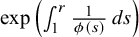
Therefore, we can take as A the function
$\exp \left (\int _1^r\frac {1}{\phi \left (s\right )}\,ds\right )$
 , and if the Gaussian curvature satisfies
${K\geq 0}$
 , then
$\phi \left (r\right )\leq r$
 , and hence we recover Liouville’s theorem in the case of nonnegative Gaussian curvature: a harmonic function of sublinear growth must be constant.
On the other hand, notice that if
$\phi \left (r\right )\sim r^{\beta }$
 with
$0<\beta <1$
 , we see that there cannot be non-constant harmonic functions of polynomial growth, and, further, we also get that the slowest-growing non-constant harmonic function grows at least as

The previous analysis is related to the following fact. Being harmonic is a conformal invariant in dimension 2. Since the functions of the form
$r^me^{\pm m i\theta }$
 generate the space of harmonic functions in
$\mathbb {R}^2$
 , one should expect that
$\exp \left (m\int _1^{r}\frac {1}{\phi \left (s\right )}\,ds\right )e^{\pm i m\theta }$
 generates it on a surface with a rotationally symmetric metric (see also [Reference Bravo, Cortissoz and Peters-Stein1]).
3.2. The case of
$\phi ' \leq \beta $


This case includes that of nonnegative radial curvature and also that of finite total radial curvature. So, let us assume that
$\phi '\leq \beta $
 (recall that, in any case, we are assuming that
$\phi '\geq 0$
 ). To apply the previous theorem, we need to find what works as
$A\left (r\right )$
 in this case. To do so, let us write

with
$B=\varphi _m\left (1\right )$
 , for
$s\geq 1$
 , and
$x_m\left (t\right )$
 a smooth function. As shown in [Reference Cortissoz3],
$x_m\left (t\right )$
 satisfies the Riccati equation

Since the
$\varphi _m$
 ’s are nondecreasing (by the arguments in [Reference Cortissoz3]), it follows that
$x_m'\left (t\right )\geq 0$
 which is a basic but important observation.
Let

At any given time, either

that is,

or

Our choice of
$\eta $
 guarantees that

We shall show the following. Assume that at time
$t=t_0$
 the following estimate holds:

then there is an
$\epsilon>0$
 such that the same estimate is valid on
$\left (t_0,t_0+\epsilon \right )$
 . To do so, choose
$\epsilon>0$
 such that either (5) or (6) is valid. In the first case, (7) follows immediately. In the second case, we estimate as follows. Let
$\tau \in \left (t_0,t_0+\epsilon \right )$
 , then

Notice that by continuity, estimate (7) holds on a closed set, and that this set is nonempty, since the estimate is satisfied when
$t=0$
 . Therefore, the estimate holds for all
$t\in \left [0,\infty \right )$
 . Hence, we have

Thus, we can take

and this gives

where

This shows that

and, noticing that the
$a_m$
 ’s form an increasing sequence, if a harmonic function is
$o\left (A\left (R\right )\right )$
 with

then it must be constant. Therefore, Liouville’s theorem will hold as soon as
$\displaystyle \int _1^{\infty } \frac {1}{\phi \left (s\right )}\,ds =\infty $
 . But if
$\phi '\left (r\right )\leq \beta $
 , then
$\phi \leq \beta r$
 , and in consequence, Liouville’s theorem holds.
We now examine what this says about Liouville’s theorem for rotationally symmetric metrics in
$\mathbb {R}^n$
 . In this case, we have the round metric on
$N=\mathbb {S}^{n-1}$
 , and it is well known that
$\lambda _1^2=n-1$
 . Thus, we can take

Just to show a simple estimate (without being sharp), notice that

Therefore, if

we can take

and hence, since it is not difficult to see that
$\eta _m\geq \eta _1$
 , this yields

We have obtained an estimate

using the assumption that
$\phi \left (r\right )\leq \beta r$
 . This proves our estimate for the slowest-growing harmonic function in the case considered and provides a proof of Corollary 1.2.
When the radial curvature is nonnegative we have that
$0\leq \phi \left (r\right )\leq r$
 , so we can take
$\beta =1$
 and recover Liouville’s theorem for bounded harmonic functions. Furthermore, if
$\phi \left (r\right )=o\left (r\right )$
 from estimate (8), it can be deduced that harmonic functions of at most polynomial growth are constant.
3.2.1. Examples
To see the reach of the previous estimates, consider the following example:

In this case
$\beta =1$
 , and thus Liouville’s theorem holds. Moreover, any non-constant harmonic function must grow faster than
$r^{\frac {1}{\sqrt {2}}\frac {n-1}{n-2}}\sim r^{0.7071\dots }$
 for n large. Notice that here Cheng–Yau does not apply since the radial curvature is given by

From Gauss equation, it is not difficult to see that this term dominates the expression for the radial Ricci tensor, so the radial part of the Ricci tensor is sometimes negative (even outside any compact set).
In the case of surfaces, notice that a non-constant harmonic function must be at least of quadratic growth, because, in this case, the slowest possible growth for a harmonic function is given by (see [Reference Bravo, Cortissoz and Peters-Stein1])

Compare this estimate with Theorem 4.3 in [Reference Saloff-Coste10]. Notice also that a surface with the metric described above does not have finite total radial curvature. Indeed,
$K=\sin r/\left (r+\sin r\right )$
 , and hence

However, it does satisfy the SLP as well. The reader should also compare this with the work developed in [Reference Ni and Tam9], where the case of surfaces of finite total curvature is covered.
Of course, the previous observations raise the question of what would be a sharp assumption on the curvature of an open Riemannian surface
$M^2$
 so that it satisfies the SLP.
4. The strong Liouville property
First of all, observe that the fact that we can expand any harmonic function as (3) and an application of Plancherel’s theorem, just as is done in (2), shows that the space of harmonic functions whose growth is slower than
$r^d$
 is spanned by the set

Thus, under the assumption that
$\phi '\left (r\right )\leq \beta $
 , the dimension of the space of harmonic functions of growth
$r^d$
 is finite-dimensional.
Next, observe that, since
$\lambda _m\rightarrow \infty $
 as
$m\rightarrow \infty $
 , from estimate (8), we obtain for m large enough

and thus

for m large enough, which immediately shows that SLP holds.
Here, we can show the following family of examples, where any bounded harmonic function must be constant, but the SLP does not hold: in particular,
$\text {dim}\left (\mathcal {H}_1\right )=\infty $
 . Take
$\mathbb {R}^n$
 with a metric of the form

with
$\phi \left (r\right )\sim r\log r$
 for r large, with
$\phi '\geq 0$
 . We give a short argument for this. From the Riccati equation (4), and the fact that
$x_m'\left (t\right )\geq 0,$
 we can deduce that

so that

Therefore,

and our assertion follows.
4.1. On the doubling condition: An example in dimension 2
Here, we show an example of a metric in
$\mathbb {R}^2$
 for which the doubling condition, as described in the introduction does not hold, but for which both, Liouville’s theorem and the SLP hold.
Let
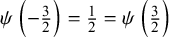
$\psi :\mathbb {R}\longrightarrow \left [0,1\right ]$
 be a standard bump function such that
$\psi \equiv 1$
 on
$\left [-1,1\right ]$
 ,
$\text {supp}\left (\psi \right )\subset \left [-2,2\right ]$
 , increasing in
$\left [-2,-1\right )$
 , decreasing in
$\left (1,2\right ]$
 , with
$\psi \left (-\frac {3}{2}\right )=\frac {1}{2} =\psi \left (\frac {3}{2}\right )$
 , and symmetric with respect to
$r=0$
 . Define

It is not difficult to show that there is a constant such that

These two inequalities show that
$\mathbb {R}^2$
 with the metric

satisfies Liouville’s theorem and the SLP.
However, the exponential growth in volume provided by the second sum on the right-hand side of (10) does not allow for the doubling property to hold. In fact,

and

Therefore,

This shows that, although sufficient, the doubling condition is not necessary for Liouville’s theorem or the SLP to hold.
5. A nonlinear Liouville’s theorem: The case of the p-Laplacian
Having established Liouville-type results for harmonic functions, we now explore their nonlinear analogs for the p-Laplacian, which generalize classical theorems under sharper curvature conditions.
In this section, we will consider
$\mathbb {R}^2$
 with a metric of the form

The p-Laplacian of a function u is given by

The p-Laplacian comes from the Euler–Lagrange equations satisfied by the functionals

The case
$p=2$
 corresponds to the usual Laplacian, and hence, the p-Laplacian appears as a natural, nonlinear, generalization of the Laplacian.
Although most classical Liouville-type theorems are for the Laplacian, here we extend the method used in [Reference Cortissoz2] to the nonlinear setting of the p-Laplacian. We begin with the following general comparison principle. In order to state our basic comparison result, we introduce the notation

Theorem 5.1. Let
$u:\mathbb {R}^2\longrightarrow \mathbb {R}$
 , with
$\mathbb {R}^2$
 endowed with a smooth complete Riemannian metric given in polar coordinates by (11). Assume that its Gaussian curvature K satisfies

outside a compact subset.
Let

If
$u\in C^1\left (\mathbb {R}^2\right )$
 is p-subharmonic (i.e.,
$\Delta _p u\geq 0$
 in the weak sense) and

then u must be constant.
For the proof, we shall need the following computation.
Lemma 5.2. Let g be a smooth Riemannian metric on
$\mathbb {R}^2$
 of the form (11), where
$\phi $
 is not necessarily radial. Let
$u = u(r)$
 be a radial function. Then the p-Laplacian of u satisfies

Proof. Since
$u = u(r)$
 , we have
$\nabla u = u'(r) \partial _r$
 , so
$|\nabla u| = |u'(r)|$
 , and

We write
$X = |u'(r)|^{p-2} u'(r) \partial _r$
 . Then, in polar coordinates, the divergence of a radial vector field
$X^r \partial _r$
 is

Therefore,

Expanding using the product rule,

Finally, factor out
$|u'(r)|^{p-2}$
 to obtain

We are ready to give a proof of Theorem 5.1. Using Lemma 5.2, it is easy to prove that if for
$r\geq a,$


and

then h is a p-supersolution. Indeed, by the Sturm comparison theorem (see [Reference Cortissoz2]),

and hence

which shows that

Let
$R_1>0$
 and
$\delta>0$
 . Consider the function

Clearly
$\Delta _p v\leq 0$
 . On the other hand, by the hypothesis, there is
$R_2>R_1$
 , which depends on
$\delta $
 , such that

and hence, by the comparison principle for the p-Laplacian, in the annulus
$R_1\leq r\leq R_2$
 ,
$u\leq v$
 . Pick any
$R>R_1$
 ; the previous estimates imply, by taking
$\delta>0$
 small enough, that the maximum of u in
$B_R$
 is reached at an interior point: therefore, by the strong maximum principle for p-subharmonic functions (see Theorem 4.2 in [Reference Goffi and Pediconi4]), u must be constant.
We apply Theorem 5.1 to show the following.
Theorem 5.3. Let
$\mathbb {R}^2$
 endowed with a complete metric g of the form (11). Let
$p\geq 2$
 , and let assume that outside a compact subset the Gaussian curvature K of g satisfies either
-
(i)
$$\begin{align*}K\geq -\frac{p-1}{r^2\log r}, \end{align*}$$
-
(ii) or
$$\begin{align*}K\geq -\frac{\left(p-1\right)\left(p-2\right)}{r^2}. \end{align*}$$


Then every p-subharmonic
$u\in C^1\left (\mathbb {R}^2\right )$
 satisfying

is constant.
Proof. Let
$R>0$
 be such that if
$r\geq R$
 (i) holds, and let
$z\left (r\right )=\left (r\log \left (\frac {r}{R}\right )\right )^{p-1}$
 . Then

Also,

which goes to
$\infty $
 as
$r\rightarrow R$
 . Hence, by Sturm’s comparison theorem, for all
$\theta \in \mathbb {S}^1$
 ,

and hence

is a p-subharmonic function. Thus, by Theorem 5.1, the result follows if (i) holds.
If (ii) holds for
$r\geq R$
 , just notice that

and the proof is the same as in the case presented above.
Remark. When
$p> 2$
 , condition (ii) implies condition (i), since

Nevertheless, we chose to state both conditions explicitly for conceptual clarity. When
$p = 2$
 , condition (i) becomes exactly Milnor’s curvature criterion for harmonic functions, while condition (ii) corresponds to the classical Cheng–Yau condition. Thus, the theorem simultaneously recovers these two foundational results as special cases of a unified nonlinear framework.
Related to our results is the beautiful work of Holopainen in [Reference Holopainen6] who provided a volumetric condition for a complete manifold to be p-parabolic (i.e., every bounded p-harmonic function is constant). Holopainen’s criterion, via volume comparison theorems, can be translated into global curvature criteria for p-parabolicity, extending the celebrated theorem of Cheng and Yau.
Acknowledgements
The authors also wish to thank the referee for suggestions that helped improve the final manuscript.

 Open access

