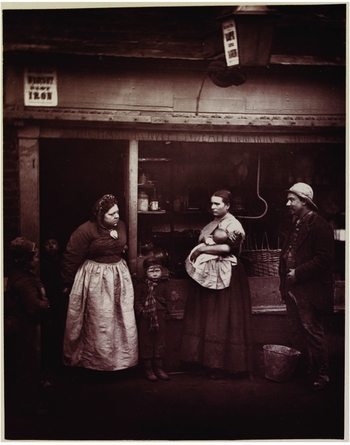
Introduction
In 1872, Blanchard Jerrold and Gustave Doré began publishing their lavish travelogue, London, a Pilgrimage. Much renowned for his illustrations of Divine Comedy, Don Quixote, Paradise Lost, Idylls of the King, and other significant literary texts, Doré's considerable reputation as an artist fetched him a staggering sum of ten thousand pounds as payment for his work in London, a Pilgrimage.Footnote 1 Jerrold, responsible for conceptualizing the project, was an established liberal playwright and journalist, often contributing pieces to the Daily News, Illustrated London News, and Athenaeum. Footnote 2 Looking for interesting material, Jerrold and Doré traveled all over London; Doré often made notes on the spot and finished the illustrations later. Seeking to situate their work within the field of social exploration, Jerrold and Doré referenced Henry Mayhew's reformist journalistic series, London Labour and the London Poor. Jerrold claimed that their social investigation would reproduce for contemporary readers Mayhew's categories of “those who work, those who cannot, [and] those who won't work” (“Frontmatter”). Volumes of London, a Pilgrimage, however, were reviewed as gift-books in various periodicals; the Examiner, for example, reviewed it in the “Christmas-Books” section, indicating that these volumes, which contained pictures of lower-class shanties and miserable, under-fed people, were being gifted and enjoyed (“Christmas-Books”).Footnote 3
The case of London, a Pilgrimage being read as a gift-book was not anomalous. In 1877, John Thomson and Adolphe Smith began publishing Street Life in London, a photo-textual exploration of London, its “highways” and “byways,” claiming originality in the sphere of reformist writing by virtue of their use of photography (“Preface” i).Footnote 4 Photography, the authors claimed, would allow for a more accurate representation and save them from the charges of either exaggerating or under-representing reality. Already quite well known for his ethnographic photographs of China and East Asia, Thomson's collaboration with the socialist journalist Smith showcased the peculiar mix of reformist rhetoric with late-Victorian consumer culture.Footnote 5 The authors of Street Life in London also professed to be carrying forward Mayhew's legacy of producing knowledge and social concern about the “humbler classes”; they cited the continued presence of poverty despite the increase in “national wealth” as reason for their work's public relevance (“Preface” i). That same year, however, Street Life in London was reviewed in the Athenaeum as a “Gift-Book” (“Gift-Books”). While the rhetoric of social reformation in Street Life in London ensured its place within the genre of nineteenth-century social investigative writing, clearly its images of poverty also functioned as leisure-time commodities.Footnote 6
London, a Pilgrimage and Street Life in London together present an interesting case: the narrators in these texts reference the reformist material that had preceded them indicating their desire to position this work as socially relevant, but these texts were also being sold and consumed as luxury items.Footnote 7 Doré's engravings and Thomson's photographs ensured that each monthly volume would fetch a high price. The images in these texts were not only sources of visual information that created social awareness; they were also lavish productions that added value to the texts as commodities. To condemn such acts of representation as exploitative potentially obfuscates the reformist purpose of these Victorian texts, which is to find misery where it exists and bring it to public attention. It may be more productive to consider the act of producing texts such as Street Life and London, a Pilgrimage as gift-books to reveal a distinctly Victorian tension between curiosity and justice, between epistemological and ethical desires.
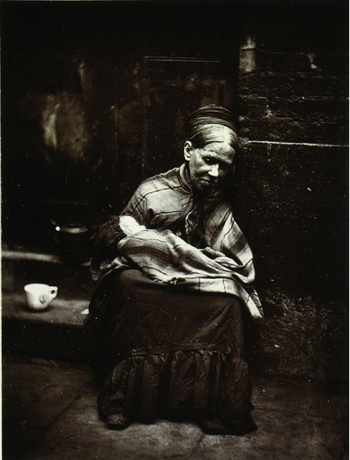
Consider, for instance, the famous photograph from Street Life entitled “The Crawlers,” which shows an old, lower-class woman sitting on the steps of St. Giles holding an infant in her arms (Figure 8). Smith's accompanying text informs readers that she is too feeble to move even when it rains. When she does move, she is restricted to a slow crawl. The only form of employment available to her is babysitting for which she earns only tea and bread. The infant is ill, and death seems inevitable both for the child and its caretaker exposed to cold wind and rain for hours. What pleasures possibly could have inhered in perusing details of such misery? A few answers immediately spring to mind. Such a picture may have gratified reformist zeal to arouse guilt in the viewer and thus to urge reform. It may have offered a guilty pleasure, an almost sadomasochistic pleasure in looking at the abject. Additionally, it may have satisfied an empty voyeurism that sought satiation simply by looking at the new and the strange. Yet the social fact of these books being gifted – purchased and distributed as products fit for leisure-time consumption – indicates that there is another, more complex dynamic at play.
John Thomson, The Crawlers. Albumen Print. 1877. Victoria and Albert Museum, London.

Texts such as London, a Pilgrimage and Street Life in London produce the pleasures of liberal guilt; they not only gratify reformist desire to eradicate social injustice but also produce pleasure in finding more injustice to be eradicated. Furthermore, a rhetoric of social justice frames that search for newer sources of misery to be eradicated and thereby validates the curiosity of the social investigators and the reading public. In this essay, I trace moments of dissonance within text and image and between text and image as indicative of the interplay of these disparate spectatorial motivations.
The mixed motivations of curiosity and social justice, and of liberal guilt and pleasure complicate extant critical accounts of the politics of reformist writing in the nineteenth century. As a result of various modernizing forces, the nineteenth century witnessed the formation of the city or the urban space, as it is understood today. Industrialization, modern forms of transportation (especially the railways), and the mass migration of rural populations to urban centers in search of work all created cities that were centers of economic prosperity and political hubs. These same factors also led to overcrowding, sanitation problems, and crime infestation. It is in such a context that social investigation as a genre first appears on the scene. The genre, loosely defined, can be considered an assorted mix of parliamentary reports, popular journalism, and fictional pieces in literary periodicals, all tackling the issues of urban poverty and the condition of the lower classes with ostensibly reformist intent. Generally speaking, social investigations in the nineteenth century were attempts on the part of Victorians to understand the magnitude and diversity of the cities they inhabited as well as to comprehend the kinds of interventions required to address social ills.
Modern critics have seen these texts as variously engaged in social control and discipline, as involved in the larger process of social reform, and as sites for producing transgressive readings of bourgeois norms. Critics such as Mary Poovey, Catherine Gallagher, and Pamela K. Gilbert have read these texts as participating in the creation of a surveillance society wherein various social categories came under the controlling eyes of the authorities. Poovey especially focuses on the texts’ ideological construction of poverty and their concomitant definition of middle-class subjectivity. Social investigators’ frequent association of animality, primitiveness, nomadism, crime, poverty, disease, and moral and physical decay served to distance their middle-class readers from the poor as well as construct the poor as social groups that needed to be monitored and controlled.Footnote 8 Moreover, viewed through the lens of middle-class normative behavior, the poor were placed in a permanent position of lack which further served to bolster bourgeois social mores. Extending the same line of thought, critics such as Lynda Nead and Simon Joyce have suggested that the invisibility of the poor was a source of fear and that reformist texts sought to make the poor visible and hence open to observation as well as to social interventions.
Other critics such as Eileen Yeo, E. P. Thompson, Gertrude Himmelfarb, Richard Maxwell, and Deborah Nord treat the progressive posturing of these texts more sympathetically and have claimed they were less invested in social regulation and more earnest about inspiring and sustaining the liberal social agenda of reform. Numerous individual and institutional charitable efforts resulted from the upper classes’ guilty knowledge that the prosperity and happiness of one section of society depended on the misery and suffering of the other. Reformers, according to these critics, directed public attention towards the lives and hardship of the working classes as well as successfully represented the poor as possessing a vibrant, viable culture of their own.
There is another body of scholarship, however, that moves beyond this particular polarity of critical opinion by foregrounding how the slums became the loci of bourgeois fears and desires. Critics such as Christopher Herbert, Peter Stallybrass and Allon White, and Seth Koven have observed that the more the middle classes regulated their own bodies and impulses, the more obsessed they were with the slums and their transgressive possibilities. The slums became a space of freedom from repressive bourgeois norms for those who ventured into it for philanthropy, adventure, or social and sexual experimentation.Footnote 9 According to these critics’ accounts, in describing London's lower class, these observers not only implicated the culture of the upper classes but also offered it up for critique.
In this essay, I attend to class identity and emotion in the manner of the third body of scholarship noted above by suggesting connections between curiosity – the desire to look at and learn about the poor and how they live – and the ethical pleasures of the reformist project. I ask the following questions: when the reformist social agenda makes it impossible to look away from suffering, what are the implications of looking for more? How does this act of looking construct a certain kind of liberal subject? Clearly, there is a relationship – heretofore unexplored – between reform and the pleasures of looking that hinges on a search for novelty. London, a Pilgrimage and Street Life in London are significant in that they help reposition the critical discussion about reformist writing in the nineteenth century by allowing me to foreground how the search for new spectacles that could thrill merged with the search for fresh miseries that could move.
Looking and Feeling
By and large, the latter half of the nineteenth century was characterized by the general public desire for the spectacular. Scholars such as Jonathan Crary, Vanessa Schwartz, and Tom Gunning have broadly identified various historical and cultural factors contributing to the desire for images and visual attractions: urbanization, the rise of consumer culture, and colonial exploration. The expansion of the city allowed a range of sights to become available to the urban traveler; visual displays to incite spending became the norm of nineteenth-century consumer culture, and the cataloging of colonial territories and populations all gave rise to the general predilection for visual spectacle. In this essay, I attempt to understand the Victorian publics urge for the spectacular, specifically, the desire (as evidenced by the use of these images as gifts) to view images of suffering lower classes, through the critical lens of scopophilia. As a term, scopophilia implies voyeurism and the pleasure that arises from looking at another as an object.Footnote 10 The advantages of understanding scopophilia as “a mechanics of viewing” are manifold: it focuses our attention on the consumption of images and thereby “forces us to reflect on the ways in which the spectator is positioned by the camera's eye” (Samuel 373). It allows a consideration of the gaze as desiring, as taking pleasure in a distanced and objectified other. It also foregrounds the inequality inherent in the field of vision by indicating who can look and who is looked at. My usage of scopophilia – a term still widely used within psychoanalytical studies – is, however, not an attempt to erase historical specificity. Definitely, scopophilic looking in the nineteenth century and the scopophilic gaze, which Laura Mulvey locates in Hollywood cinema, are rooted in the historical moment in which they take shape.Footnote 11 The very transition in mediums of representation, from still images like engravings and photographs to realist, narrative-based cinema, created different viewing conditions and affective patterns.
Thus, nineteenth-century practices of circulating and collecting images pertaining to topics as diverse as the Crimean war, the mentally ill, and the indigenous people from the far-flung spaces of the empire should be understood as cultural instances of the public scopophilic tendencies, as historically grounding the psychoanalytical usage of the term.Footnote 12 The theorizations of the modern urban spectator as a flâneur, by critics such as Susan Buck-Morss and Deborah Parsons, moreover, suggest the pleasures inherent in a voyeuristic consumption of city-scenes. The prevalence, moreover, of such practices in Victorian society suggests that the images of poverty in texts such as London, a Pilgrimage and Street Life in London also operated within a framework of scopophilic desire and spectacular gratification. However, when the circulation of images is considered as symptomatic of a genuine interest in reform, a more complicated viewer response than sheer desire for the spectacular needs to be formulated. This section is, then, dedicated to an exploration of the diverse affective intentions of the reformist spectacle.
The mechanical reproduction of images on a mass-scale made scenes of suffering easily available to consumers. At the same time, the introduction of distance – both spatial and temporal – between the spectator and the sufferer introduced a disjunction between the act of viewing suffering and the moral impulse to alleviate it. Building on Adam Smith's theory of sympathy, both Luc Boltanski and Julie Ellison, despite their diverse methodological approaches, have suggested that distance between the sufferer and the spectator complicates the possibility of action since no real avenue of direct action seems available (16).Footnote 13 The spectators faced with descriptions of distant tribulations of the poor have no direct or clear course of action as even moral responsibility becomes uncertain. With the mass production of images of poverty and their circulation among nineteenth-century British audiences, viewers were faced with images of poverty but had no recourse to immediate and effective action. The viewer, then, was placed in a position of moral impotence that produced, what we today call “liberal guilt.” This is to suggest that the feeling of impotence was an effect of the texts and the condition of their circulation. While there were several avenues for reform-minded individuals, this particular configuration of liberalism indulged in reformist rhetoric but ultimately capitalized on the guilt of the consumer.
Ellison traces the genealogy of “liberal guilt” back to Adam Smith's Theory of Moral Sentiments. She observes that late eighteenth-century moral philosophers, like Frances Hutcheson, David Hume, and, especially, Smith created “the culture of systems so important to the modern individual's feeling of being meaningfully related to remote locations and cultures” (12). As she traces the beginnings of modern liberal guilt in eighteenth-century moral philosophy and the period's culture of sentiment, however, she privileges a version of Smithian sympathy, which does not account for distance and the mediated nature of the sympathetic process in Smith's work. This particular interpretation of Smith understands looking as a mutual act. The spectator looks at the suffering individual and vice-versa; both parties – through an act of sympathy – imagine themselves in the position of the other. The spectator experiences a weakened but similar degree of emotion that the suffering individual feels and the sufferer articulates his/her pain in a manner that is less excessive and hence more comprehensible. Conversely, critics such as Jean-Christophe Agnew and David Marshall have suggested that the Smithian subject is a self-absorbed spectator inserting his subjectivity into a given situation. Smith writes, “It is the impressions of our own senses only, not those of his [sufferer], which our imaginations copy” (11). Distance does not foil the Smithian sympathetic process; it is, in fact, intrinsic to it. The sympathetic spectator is – as Laura Hinton has noted – a “scopophiliac” (25). In exploring the affective dynamics of sympathetic looking, I focus especially on the voyeuristic aspect of scopophilia foregrounding thus the acquisitive gaze and the significance of distance in this process.
While Ellison and Boltanski see the mass reproduction and circulation of images of suffering as inextricably tied to guilt, it is difficult to explain the spurt of published material on the urban poor in late-nineteenth-century England by simply assuming that it made the upper and middle classes feel bad. It is even more difficult to imagine such material circulating as gifts, as lavishly produced commodities, unless one conjectures that it felt good to feel bad. Mike Goode has suggested that an “erotics of ethics,” particularly motivated by “the pleasures of injustice” (the pleasure of experiencing guilt and, in turn, of feeling one's own justness affirmed), produces the need to discover more instances of injustice (167).Footnote 14 It may be possible to situate these erotics of ethics within late-Victorian liberal reformist discourse and its demonstrations of sympathy. Liberal guilt within this context of, to use Ellison's phrase, “expanded representational conditions,” is a performance, an indulgent affirmation of the spectator's ethical self; depending on distance between the spectating subject and the sufferer, the sympathetic process becomes a means of affirming the ethical liberal self. In such a scenario, the scopophilic urge for novelty overlaps with the new guilt emerging when fresh categories of suffering are discovered. Liberal politics can be seen to produce its own sets of pleasures tied to its impotence. Devoid of any productive solutions to the misery they witness, spectators resort to guilt as a means of demonstrating social commitment, a commitment that ironically comforts only the spectators.
One way of understanding this relationship between liberal guilt and the pleasures of impotent sympathy is to contextualize it within the change in liberal thought from the mid- to late-nineteenth century. Liberal ideas flourished in the equipoise of the mid-nineteenth century; liberals valorized the free market, individual freedom, and local self-governance. The final third of the nineteenth century can be accurately characterized as transitioning from classic liberalism, which depended on the private charities of individuals (or on philanthropic capitalism), to New Liberalism, which demanded more structural changes. The seeds of the welfare state were present but they would take concrete shape only in the next century. So, while it became increasingly clear that the model of individual charity was defunct, effective alternatives had not fully materialized. It was increasingly difficult for social reformers to assign blame for the conditions of the poor to “individual desire or [to] defects,” such as alcoholism, idleness, and immorality, and thus more difficult to imagine reform as rescuing individuals. In short, while mid-century thinkers were more hopeful about individual agency in resolving social ills, late-Victorian liberals were more aware of the systemic nature of oppression. Daniel Born observes, “In the later phase of Victorian liberal development, a registry of transgressions committed is much more the norm than sanguine promises of liberation” (13).
Understood within the context of late-nineteenth-century liberalism, the evocation and performance of guilt in London, a Pilgrimage and Street Life takes on fresh significance. The text guides readers not only how to view suffering, but also how to respond to it. Describing the plight of children rescued from the streets, Jerrold's language is heavy with emotion:
Such scenes, upon which my eyes have tended to fall so often – I hope not uselessly – lift the heart almost to the throat. The strong man in suffering is one thing: the ill-treated woman is another: but children like this, when they open their eyes, stab you with the thanks that beam in their young looks. You stand a criminal before them: as particeps criminis in the fiendish blows the world has struck upon them, lying cradleless upon the bare stones. (186, my emphasis)
Within the passage, which seems modeled on the Smithian sympathetic process, Jerrold guides the readers’ eyes from one figure of suffering to another to accentuate the feeling of increasing misery, ending with the most helpless figure of the suffering child. Faced with the “eyes” of the helpless children, the narrator is choked with emotion. The child's innocent thanks “stabs” the narrator; guilt here is expressed through an imagery of intense physical pain and the fear that reproducing such imagery may be as “useless” as the suffering itself. He positions the reader (“you”) as a fellow participant in an unfair social system which ignores the plight of children. Through a vocabulary of shame in this passage, the narrator performs his emotional state and attempts to evoke similar reactions in his readers. The text models for its readers the appropriate way of seeing misery: looking at suffering has to be accompanied by a demonstration of affect.
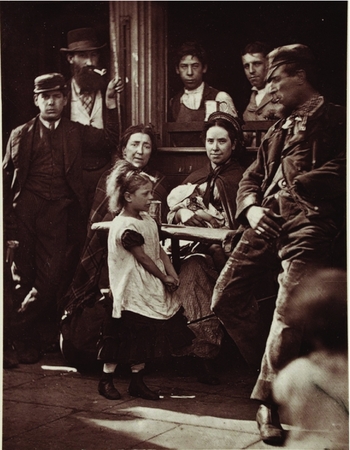
In Street Life in London, the text similarly evokes guilt in its audience by attempting to control how they understand the photographs. In this instance, the textual narrative, as Barthes would say, “anchors” the accompanying image within a set of connotations to arouse pathos (Image 39–40). The photograph itself represents a group of people sitting together, quite aware that they are being photographed (Figure 9). A little girl has seemingly wandered in front of the group. While the presence of the child in a white pinafore with her hands folded as if in prayer catches the viewers’ attention, Smith uses this visual detail to frame the image by imagining this girl to have entered the group to claim her alcoholic father and to save him from his degenerate companionsFootnote 15:
There is no sight to be seen in the streets of London more pathetic than this oft-repeated story – the little child leading home a drunken parent. Well may those little faces early bear the stamp of the anxiety that destroys their youthfulness, and saddens all who have the heart to study such scenes. Inured to a life crowded with episodes of this description, the pot boy stands in the background with immoveable countenance, while at his side a well-to-do tradesman has an expression of sleek contentment, which renders him superior to the misery around. (105)
Smith's interpretation of the photograph asks the reader to view the image within the context of the recurrent references in reformist writing to the working class’ addiction to alcohol. By claiming it to be an “oft-repeated story,” Smith underscores the generalizable nature of the scene. His interpretation represents this particular group of working-class individuals and, by metonymic association all working-class individuals, as objects of reform and rescue. Moreover, Smith, like Jerrold, also focuses on the figure of the child to evoke sympathy in the reader; he is certain that her careworn countenance will “sadden” the reader. However, at the same time that Smith's narrative garners audience's sympathy for the child, it also ensures that they will feel superior to the two figures within the photograph who do not evince any concern whatsoever: the boy who is “inured” to such scenes of misery and the tradesman who stands in for selfish prosperity.Footnote 16 They are spectatorial subjects who do not respond sympathetically; the text refers to the unresponsive boy and the tradesman as instances of how not to look at suffering.
John Thomson, Hookey Alf of Whitechapel. Albumen Print. 1877. Victoria and Albert Museum, London.

In seeking to evoke guilt, the narratorial motivation in these texts becomes increasingly scopophilic in nature: it takes the shape of an inquiry to discover newer spectacles of suffering for the readers. The reformist spectacle displays the existence of both scopophilic and reformist motivations. While reformist and scopophilic looking certainly cannot be collapsed into one category, the complicated nature of the reformist spectacle foregrounds the vital overlaps between these seemingly distinct motivations.
Novelty becomes a significant element in this type of work: while fully aware that they approached a subject that had been “ably and amply treated” by their predecessors Mayhew and Greenwood, Smith and Thomson felt that the subject of urban poverty was so “vast” and characterized by such “rapid variations” that the subject remained “inexhaustible” and hence, by inference, new and interesting (“Preface” i). Their real claim to originality, however, lay in their use of photography “to portray the harder phases of life” as, according to Smith and Thomson, this new technology had not been employed before in reformist writing.Footnote 17 “Armed with notebook and camera,” Smith and Thomson claimed innovation on the basis of forays into “the back streets and courts” where the “struggle for life” had yet to be observed (“Preface”).
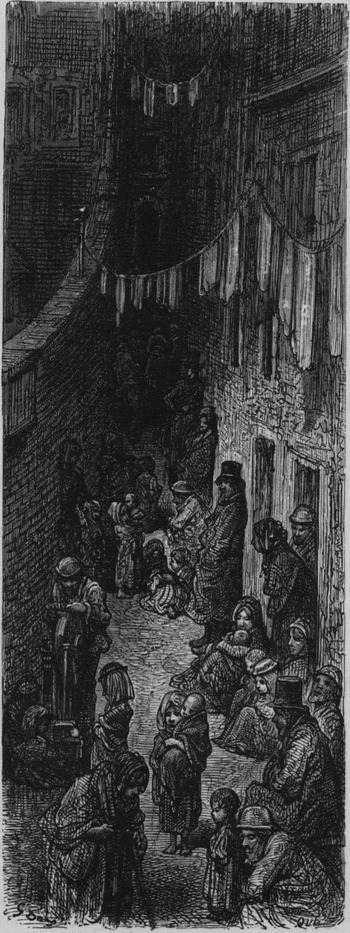
The search for heretofore undiscovered suffering, which would move readers/viewers in noticeably new ways, similarly guides Jerrold and Doré's choice of sites and situations when portraying the East End. They dwell at length on the workhouse, the Newgate prison, and the Whitechapel area known for its criminal activity. The main intent behind their representation of the East End thus was to provide the upper-class reader with access to the kinds of scenes that they would not encounter in everyday life. The back alley that Doré depicts (Figure 10) swarming with people is an instance of the typical urban spaces that upper-class readers would not experience personally. In this particular engraving, Doré presents the spectator with a view of a narrow alley between two rows of houses. This narrow space is crammed full with women and young girls carrying infants in their arms, men at work and lounging against walls, and children huddled together, perhaps involved in a game. A few individuals seem to look back at the viewer while most others seem oblivious to the presence of an observer. A clothesline hangs over these people indicating that this might be the only open space that they have access to; the relaxed poses of individuals casually sitting and standing out in the street suggests this crowded public area might be more acceptable as a living space than the rooms inside the houses. The alley seems to get narrower as the eye follows it to its end until it becomes just a tunnel through which nothing is visible. Jerrold's text tells the readers that it is morning but there is no light in this lane; the darkness through the tunnel seems to corroborate the sunless, dingy nature of the alley. Back-alleys such as the one depicted in this engraving and the people who inhabited them became visible to readers who would not venture into these noisome areas in person; the image facilitated a sort of class tourism. Doré's engraving achieves both purposes of creating concern regarding poor housing as well as gratifying upper-class curiosity regarding the urban underbelly.
Gustave Doré, Orange Court - Drury Lane. Wood Engraving. 1872. Digital Collection and Archives, Tufts University.

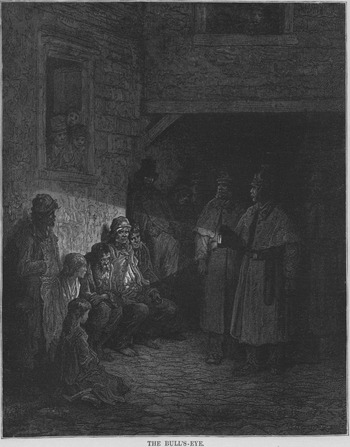
Jerrold and Doré's visit to Whitechapel accompanied by a detective displays a similar blend of reformist and touristic energies. In the policeman's company, Doré and Jerrold witness his “bull's-eye turned on extraordinary faces and figures” (138). As they travel further into the interiors of Whitechapel, Jerrold's narrative is increasingly tinged with potential danger. He mentions traveling into “strange, dark byeways,” and describes the “natives” looking at them as “the Japanese looked upon the first European travellers” (144). The racial imagery he employs suggests imagining these spaces as rife with the possibility of harm and injury. His instructions to the like-minded sound like a travel guide for the “adventurous”: “You adopt rough clothes. You select two or three companions who will not flinch before the humours and horrors of Tiger Bay; and you commit yourself to the guidance of one of the intelligent and fearless heads of the detective force” (142). Jerrold argues that a direct experience of areas such as Whitechapel was imperative for legislative change; he claims that he learnt more from his personal experience of impoverished areas in one night than any amount of “blue-book or treatise reading” could have taught him (138). In keeping with the tone of reform texts of the times, Jerrold emphasized the experiential quality of his text. His readers, it is implied, will learn more about the East End from his writing because it is an eye-witness account as opposed to the official surveys of the city. Yet, even as he emphasizes the need for reform, the unmistakably touristic quality of Jerold's tone indicates the mixed stakes of his work.
The illustration that accompanies this section is in much the same vein. Entitled “Bull's Eye” (Figure 11), the picture shows the group of poor individuals cringing as the detective's flashlight falls on them. The composition of the image itself suggests intermingling of reform and voyeurism in inextricable ways – something that might explain why this same composition was repeatedly used in popular journalism of the age. In this proto-photographic engraving, the light that falls from the flashlight on the poor acts as a metaphor for reform as it literally brings the misery of the lower classes to light. Surrounded on all sides by darkness, the actual conditions of the poor are made visible by the light falling on them. Yet it is at best a mixed metaphor: the flashlight illuminating the poor also suggests how the reformist exposure of poverty gratified the upper-class desire to look at the poor who may have otherwise remained invisible in the dark.
Gustave Doré, The Bull's Eye. Wood Engraving. 1872. Digital Collection and Archives, Tufts University.

The poor, however, were not always as shameful and cringing as the “Bull's Eye” seems to suggest but in fact were often actively resentful of the upper-class observers in their area. Jerrold notes several instances where the lower-class individuals quite colorfully expressed their resentment of Jerrold and Doré's intrusive presence. He refers to bemused and often hostile glances from working men as he and Doré stand and study them (24). He notes of his tour of Whitechapel with Doré, “We were spies upon them; men of better luck whom they were bound to envy, and whose mere presence roused the rebel in them” (149). Similarly, Thomson's photographic apparatus must have drawn attention to him, as he and Smith roamed the streets of London. While it is clear that these observers themselves did not go unnoticed, their texts distance the poor from the spectators and efface any hostility towards upper-class observers, thus rendering the poor static and, hence, more appropriate objects of sympathy.
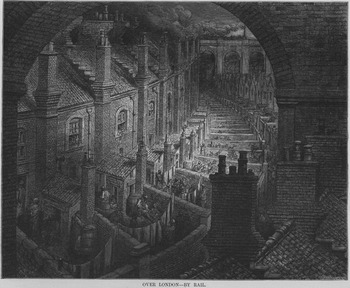
Distance and proximity co-exist in the same text, in fact, within the same image; the spectators are simultaneously pushed to delve deeper into the conditions of the poor and distanced from the scenes in front of them. The illustration entitled “Over London – By Rail” (Figure 12) is an especially good example of the mixed nature of the reformist spectacle. Doré captures the cramped slum-dwellings adjacent to a railway line; the interminable row of backyards teeming with people even at night conveys the oppressiveness and monotony of working-class existence. While many of the spectators may have traveled on similar routes and likely witnessed similar scenes, the representation of the untenable housing conditions of the poor in an engraving forces them to give it more than a fleeting glance. Doré conveys the insalubrious nature of these living spaces by showing smoke billowing from another railway engine at a distance and ominously moving towards these quarters. The clothes hanging on the clothes-line seem already covered with soot, making the strenuous efforts to wash clothes seem poignantly ineffectual. The image acts as a strong critique of housing conditions of the poor. At the same time, the engraving simulates a view from a train window, so the poor themselves are presented with no individual detail. Viewers look at this scene from within the railway carriage – protected from the squalor of the area – as well as from a height that provides them with a vantage point wherefrom they look down at the poor. While “Over London – By Rail” demands the audience's sympathies by forcing them to look at urban poverty, it also reproduces their distance from the scene of suffering. The view from a train window reminds spectators – as does the mass-produced nature of the engraving – of their distance from the scene; removed from the scene, the audience can only look and the very act of looking at images of poverty must be sufficient demonstration of being conscientious spec tators.
Gustave Doré, Over London - By Rail. Wood Engraving. 1872. Digital Collection and Archives, Tufts University.

The connections between scopophilia and reform emerge even more clearly in Doré and Jerrold's claim to look for pictures in their journey through the metropolis. Even in a slum as wretched as St. Giles, they hope to find “pleasant images,” yet they claim that they do not want the pleasure in looking at these images to injure “the sense of public duty” (3). Ironically, the search for a picture of suffering that would have an affective impact on the audience also meant looking for poverty that was visually pleasing. Aestheticization of suffering became a tactic that allowed the viewer to look at poverty in a distanced manner as well as to derive pleasure from that act. We see this most clearly in Jerrold's account of a walk that he and Doré took towards London Bridge. He writes of groups of poor women and children huddled together in sleep. Illuminated by moonlight and with the dome of St. Paul's visible in the background, poverty itself becomes fodder for an artistic imagination. The scene causes Doré to exclaim, “And they say London is an ugly place!” (6). While viewers may respond with sympathy or even moral outrage, the risk inherent in the aestheticization of suffering is that it may induce a moral quiescence in the viewers. Or, as Susan Sontag suggests, pleased by the spectacle, the audience may simply want the scene or the individual to remain unchanged (81).
Indeed, poverty itself in London, a Pilgrimage, is categorized into picturesque and unpicturesque – a division that speaks to how the text catered to scopophilic desires of the upper classes.Footnote 18 Although this type of looking may also be characterized as aesthetic in nature, blurring the boundaries between aesthetic and scopophilic looking proves to be more productive in this case. Scopophilia foregrounds the acquisitive, desiring nature of the gaze at work in a way that Kantian “disinterestedness” does not (13). In the “Preface” to London, a Pilgrimage, Jerrold claims that he and Doré sought the picturesque in urban poverty: “The work-a-day life of the metropolis, that to the careless or inartistic eye is hard, angular, and ugly in its exterior aspects,” offered them “pictures at every street corner” (xxxi). Yet, when it comes to active expressions of want on the faces of workers, Doré admits they become less picturesque. Their faces have a “hungry, hunted look”; their bitterness and discontent make them “ugly” (15). In other words, not all poverty produces a pleasure in looking; some cannot be made into a picture to be looked at in the comfort of home. Other than the tramps, costermongers, and flower-girls, the genteel poverty of lower-class individuals makes them seem like shabbier versions of the middle class; their very similarity in apparel pronounces the divide between the two classes. The lemonade vendor, for instance, wears clothes that seem to be of “a prosperous middle-class man – gone to shreds and patches”; it is “misery advertised” (36). The existence of similarity in difference between middle-class apparel and the lemonade vendor's clothes disallows the possibility of distancing his poverty as picturesque. Even within the reformist framework of the text, then, there is a process of selection at work which displays poverty that is of more visual interest, more dramatic.
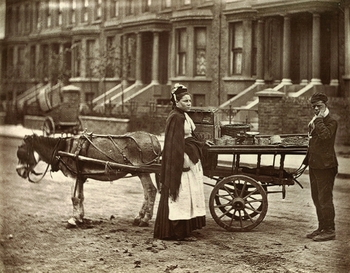
While Thomson's photographs in Street Life appear to employ codes of representation that can more aptly be described as ethnographic than as aesthetic, they also replicate the optical hierarchy of watchers and watched noticeable in many of Doré's illustrations. The technological needs of Thomson's photography required his subjects to be completely still for a substantial period of time, at least ten minutes, so that a satisfactory photograph might be obtained.Footnote 19 The photographer's apparatus and his social status worked together to impose a state of passivity on his models; once captured on film, the individuals are in permanent stasis available for the viewing pleasure of the reader. One also can assume that the averted gaze of his subjects in most of his photographs was by his direction. Thomson's pictures of lower-class life use codes of ethnographic photography, such as photographing individuals in typical poses, or posing them with objects of their occupation.Footnote 20 The pictures thereby suggest similarity between London's street folk and those inhabiting far spaces of the empire. Such presentation allowed, even encouraged, the audience to imagine distance between them and those presented as if far-removed from the viewers’ local reality.
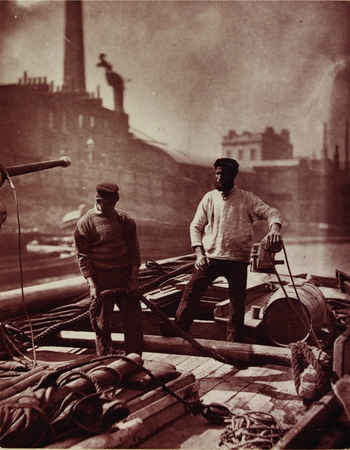
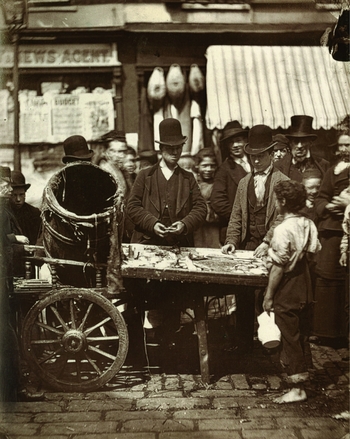
Class and social status, in fact, were encoded within photographic practice itself: while upper-class photographers felt free to roam into lower-class neighborhoods to photograph people and places, the presence of photographers in upper-class areas was declared to be a public nuisance. Liz Wells notes that photographers were required to obtain licenses to photograph in many areas and that the photographic press criticized those who photographed “respectable people” without their consent (77). So, in direct contrast to the cultural regulation of photographic practices within the middle- and upper-class social sphere, the in situ nature of Thomson's photographs of fruit-sellers, workers on barges, cheap fish sellers, and the like allowed the viewers to imagine looking at lower-class individuals at work without their gaze being returned, something that – going by Jerrold and Doré's experiences in the East End – may not have been possible in real life (see Figures 13, 14, and 15).
John Thomson, The Street Fruit Trade. Albumen Print. 1877. British Library of Political and Economic Science, London School of Economics.

John Thomson, Workers on “the Silent Highway.” Albumen Print. 1877. Victoria and Albert Museum, London.

John Thomson, The Cheap Fish of St. Giles's. Albumen Print. 1877. British Library of Political and Economic Science, London School of Economics.

The generic captions such as “Covent Garden Laborers,” “Flying Dustmen,” and “London Cabmen,” that present the individuals being photographed as representative of their occupations, display the adherence of the text to ethnographic codes of representation. The politics of naming at work within Smith's narrative accompanying the photographs follow the ethnographic codes to further objectify the individuals in the photographs. While the text validates the individuality of the spectator-subject, the individuals are made available as exhibits. For instance, in a move that revealed its class affiliations, the text frequently named the economic or administrative officials in the photographs, but not the lower-class workers. In the section entitled “Public Disinfectors,” Smith applauds the courage of these workers who “daily risk their lives to save the community at large from epidemics” (20). Yet the workers in the photographs remain unnamed while the Inspector is named and located in a particular district. The poor, it would seem from Smith's commentary, were presented only to be seen and not heard.
Productive Dissonance
In the previous section of this essay, I showed how the reformist spectacle facilitated the visual appropriation of lower-class subjects and enabled scopophilic pleasure to exist alongside reformist intention. This section focuses on the unresolved tussle between guilt and pleasure and how it destabilizes the visual hierarchy imbued in the two texts under consideration. I suggest that the presence of the twin intents of reform and scopophilic gratification in London, a Pilgrimage and Street Life introduces tensions or dissonance within text and image as well as between text and image. Dissonance should be understood as the fruitful instability that is introduced into the spectator's viewing position – when the spectator's detached looking is disrupted, or when the figures represented in images cannot be objectified. Its various configurations include: the internal contradictions of a text that reveal the multiplicity of authorial intentions, the surplus of affect in an image that interrupts the distance between the spectators and the scene in front of them, and the contest of meaning between the image and the accompanying narrative. Whatever the shape it takes, the effect of dissonance is to render the viewing pleasure of the audience more problematic.
Consider, for instance, the tension between Smith's generic presentation of the poor and the particularity of Thomson's photographs. The tendency in Smith's commentary to erase individual difference and see the poor as interchangeable representative specimens comes across in the section, “The Water Cart.” Smith does not identify the man in the picture but instead inserts the story of another watering-man whom he did meet. The sections where individuality can be located such as “The Dramatic Shoe-Black” or “‘Tickets’ The Card Dealer” are life-narratives of generally well-to-do individuals who fell on bad days through a peculiar turn of events. Their individuality comes across as non-threatening, almost benign. It does nothing to relate the circumstances of these individuals to the larger conditions of the working classes. Moreover, Smith narrates stories of persons who are not angry or bitter but resigned to their lot and very grateful for what they receive. These narratives not only fulfill the readers’ desire for pathos by detailing the privations of the poor, but also provide readers with the satisfaction of belonging to a society that cares for its poor. Typically, the stories about poor individuals have happy endings: an act of private charity rescues these individuals from their dire situation. Through these parable-like stories of the deserving poor, Smith's narrative presents a stereotypical version of poverty which at once caters to liberal sentiment and effaces rather than foregrounds the individuality of these people. The mix of generic portraiture with elements of individuality is such that persons like Tickets, the card dealer, and Jacobus Parker, the shoe-black, can interest the reader as urban characters without this interest leading to any substantial discussion about social inequalities. As Smith does not situate these individuals within their social location, their singularity rather than their typicality becomes the narrative's point.
Thomson's own commentary on his photographs, however, which shows up in two sections of Street Life, is very different from Smith's presentation. In sections entitled “London Nomades” and “Street Floods in Lambeth,” Thomson not only names the people in his photographs but also presents their specific stories. In the latter case, especially, Thomson photographed the people affected by the floods rather than present readers with an impersonal photograph of “a street under water” (18). While Thomson refers in detail to the destruction caused by the flood water in the area, his photograph does not represent the misery and the filth referred to in the text (Figure 16). Thomson's stated aim in photographing people is to present the readers with a visual record of the “permanent injury” that the floods have inflicted on the inhabitants of Lambeth (18). But his decision not to represent the actual filth that he refers to in the accompanying text seems more complex. On the one hand, these photographs were being produced for an upper-class readership as keepsakes, so Thomson may have wished to keep invisible anything unseemly that might have offended the sensibilities of his readers.Footnote 21 On the other hand, he may have attempted a more humanistic presentation of the lower-class subjects by emphasizing the need to focus on them and their specific tribulations, an approach that stands in contrast to Smith's more generic presentation.
John Thomson, Street Floods in Lambeth. Albumen Print. 1877. Victoria and Albert Museum, London.

Again, the very indexicality of Thomson's photographs differentiates it from the existing representations of poverty in the period's art-photography.Footnote 22 Unlike the sentimentalized and fabricated representation of poverty in T. J. Barnardo reformist propaganda or Oscar Rejlander's “art” photographs, Thomson's photographs present their lower-class subjects in a realistic, or rather, minimally stylized manner (see Figures 17 and 18). James Ryan has argued that Thomson's photographs draw upon the art photographic representations of poverty of the period, such as Rejlander's studio pictures of children dresses as ragged urchins which circulated in the 1850s and 1860s, but this effaces some significant differences between the two (175–76). Despite the fact that Thomson, like Rejlander, posed his subjects for the photographs, his photographs are of actual lower-class subjects instead of twice-removed photographs of people performing poverty in the constructed environment of the studio. Although terms such as “documentary” need to be used with qualifications, it is quite accurate to claim that Thomson's proto-documentary style provides a less staged representation of the lower classes than either Barnardo's or Rejlander's. So, while Thomson's photographs’ meanings emerge in negotiation with the generic captions and text accompanying them, they – by their very indexicality – also achieve what Smith's commentary does not. The photographs of lower-class individuals have a particularity imbued in them that cannot be erased by the accompanying text even as it frames these images with a generalized description.
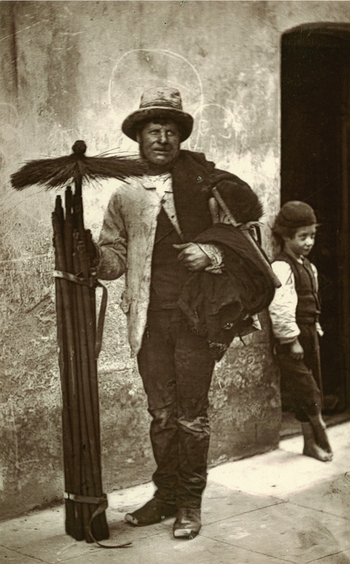
John Thomson, The Temperance Sweep. Albumen Print. 1877. British Library of Political and Economic Science, London School of Economics.

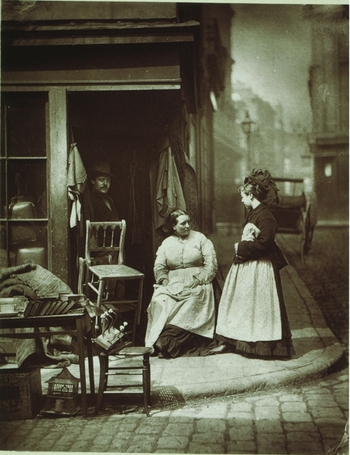
John Thomson, Old Furniture. Albumen Print. 1877. Victoria and Albert Museum, London.

Also, despite the proto-documentary style that characterizes most of Thomson's photographs, the variety of his photographs in Street Life suggests Thomson's attempts to evoke an affective response in his audience. The section entitled “The Temperance Sweep,” for instance, narrates the story of a chimney sweep named John Day who was once given to drink but gave it up to become not only a well-off master sweep but also an advocate for temperance. The photograph accompanying this section shows a chimney sweep, perhaps the same individual, standing with his cleaning equipment (Figure 17). At first glance, this photograph seems to follow ethnographic codes of representation adapted to an urban locale: the chimney sweep shown with the tools of his trade. However, a more careful look at the wall behind the sweep reveals a line etched around the sweep's hat creating the effect of a halo. The disjunction between the angelic connotations of the halo and the rough appearance of the chimney sweep not only captures the viewers’ attention, but also unsettles the general stereotype of the chimney sweep as a callous urban type.Footnote 23 The image presents this lower-class individual as an embodiment of the liberal dream: a reformed and productive member of the working classes.
Peter Bacon Hales sees photographs such as “The Temperance Sweep” as happy accidents where the dynamism of street life had triumphed over Thomson's “meddling” (300). For Hales, most of Thomson's photographs feature individuals in stereotypical and awkward poses. For Stephen White, however, Street Life displays Thomson's skill in posing people in “a natural way that appeared entirely spontaneous” (31). The photographs themselves present a case far more complicated than either Hales or White allows. The question one needs to ask is not whether the photographs seem posed and artificial but instead what might be the function of such fashioning of urban reality? While photographs such as “The Temperance Sweep” do take recourse to Victorian sentimentality to frame a more grimy reality, their effect needs to be gauged within the larger intention of a reformist text to evoke an affective response from its audience.
A powerful example of how photographs in Street Life were composed to evoke an affective response in their viewers is found in the section entitled “Old Furniture.” Smith tells the reader about a second-hand furniture store/stall located on Church Lane that catered to the inhabitants of that neighborhood. The store-owner's custom of displaying his merchandise out on the street attracted the attention of the street-folk who were used to “transacting all their business in the open street” (128). Due to urban planning measures which condemned the street as an “unwholesome, overcrowded thoroughfare” and led to the destruction of houses on both sides of the street, the inhabitants were compelled to move to other places (128). With the exodus of his original customers, the shop-owner, too, was finally forced to shut down and migrate elsewhere. Thomson's photograph (Figure 18) shows a group of people sitting and standing around the store. The viewer can see pieces of second-hand furniture being displayed on the street. The furniture on the pavement seems incongruous with its surroundings and would surely have struck a chord with its middle-class audience for whom the sale of furniture – in a very material way – connoted social decline.
It is also important to realize that the photograph displays the store and people on Church Lane before the urban planning measures took effect. So, it serves as a visual record of a place that now does not exist. While, according to Smith, the photograph serves as “a striking contrast to the improvements” which were about to be realized (128) – that is, the photograph itself acts as a testament to the efficacy of reform – the placement of pieces of furniture and people in Thomson's photograph suggests more. The photograph turns the metonymic conjunction of the people in the frame and the old furniture on the streets into a metaphorical equivalence: the incongruity of the furniture on the street reflects the incongruous position of the lower-class people in a city in the throes of modernization. The old furniture moved from one place to another becomes a metaphor for the people forced to move as modernity inexorably impinges on their living spaces. The photographic image is thus charged with meanings that exceed its textual framing. This surplus of meanings destabilizes or at least complicates the possibility of viewing the people represented in these photographs as objects; by asking for a sympathetic response, these images interrupt the process of voyeuristic appropriation.
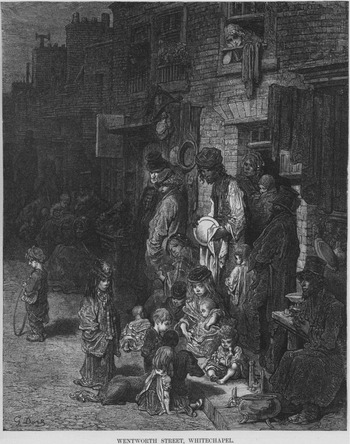
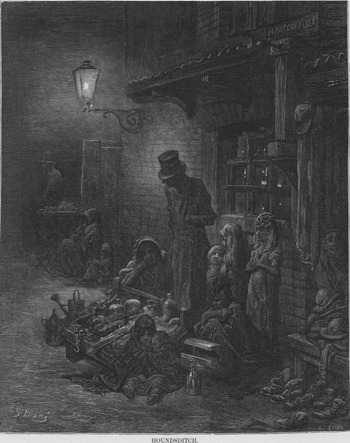
The same tussle between reformist and scopophilic desires is visible in the dissonance between Doré's engravings and Jerrold's text. While some critics see Doré's engravings as either unsympathetically representing lower-class culture in London or enabling class voyeurism, reading Doré's engravings along with Jerrold's text produces a fresh sense of London, a Pilgrimage as a sum of disparate parts with each part creating the potential for a diverse set of interpretations that may not be resolved into an either-or scenario.Footnote 24 The most fruitful instances of the tension between text and image in London, a Pilgrimage may be found in the sections devoted to the working classes. For example, Jerrold takes the reader on a tour of London's East End, pointing out the walks towards Whitechapel and Shoreditch which will “best repay the London visitor” (124). Planning a veritable travel itinerary, he advises readers to “saunter through the extensive vegetable market of Spitalfields,” take “a turn in Houndsditch,” “pause where Whitechapel joins Aldgate” to watch the “pale work-folk who flit to and fro,” and so on (124–25). Jerrold's tone is touristic: he encourages the “West End Londoner” to see this accumulation of overhanging clothes, vegetables, stalls, people of different races, and even ragged children as picturesque (124). The cumulative impact of his narrative is to transform a lower-class social space into a place of visual delight. Any suggestions of the ill effects of poverty are effaced by Jerrold's emphasis on the energy and innovation, the “valiant cheeriness,” and a “readiness to laugh” that he sees in the market (125). The visual evidence that surfaces in Doré's engravings for this section, however, stands in stark contrast to Jerrold's chatty, tour-guide commentary.Footnote 25 Doré's engravings entitled “Wentworth Street, Whitechapel” and “Houndsditch” give rise to a polyvalence of signification (Figures 19 and 20). Certainly, “Houndsditch” may be seen as belonging to the genre of the lower picturesque wherein decrepitude becomes a source of visual delight.Footnote 26 But its depiction of a poor family sitting on the pavement, the children huddled under a small piece of cloth, the mother in a pose indicating her anxiety, clearly calls upon the viewer for another kind of affective response. Where Jerrold's text effaces the misery of poverty, Doré's engraving evokes pathos by making the suffering of a family visible to the viewer.
Gustave Doré, Wentworth Street, Whitechapel. Wood Engraving. 1872. Digital Collection and Archives, Tufts University.

Gustave Doré, Houndsditch. Wood Engraving. 1872. Digital Collection and Archives, Tufts University.

Similarly, in the “Wentworth Street, Whitechapel” engraving, the good cheer that Jerrold refers to in his text is missing. Rather, the lower-class individuals look downcast and almost sullen. The bare-foot children that Jerrold mentions are present in Doré's engraving as well, but here a little girl with a younger infant on her lap looks directly at the viewer. There are other figures in this image too who return the spectator's gaze: a young boy looks back almost suspiciously at the viewer; a woman has turned her head as if suddenly aware of the viewer's presence. The placement of such figures within the image interrupts the possibility of looking at them as passive objects. Instead the effect is to interpellate the viewer into the image as a figure who, by contrast, ought to act.
Certainly, some may argue that the returned gaze in this and other such images does not have critical value, that it does not have the power to disturb the viewer. Griselda Pollock, in particular, argues that the returned gaze allowed upper-class viewers to enjoy entering dangerous spaces vicariously and to perform the exchange of looks without actually being threatened. According to Pollock, “The viewer enjoys the place of the third look as protected witness, on the edges of a voyeurism where the threat of the spaces and their populations is evoked but contained, suspended in the inanimate permanence of the still visual image” (36). But while Pollock's point about the viewer enjoying the pleasures of voyeuristic looking is valid, the returned gaze in Doré's engravings of the East End is also evidence of resistance against spectacularization. The act of looking back as recorded in the image disallows the possibility of an unengaged glance. The returned gaze attracts and holds the viewer's attention; it has the effect of interrupting the viewer's voyeurism simply by foregrounding it.
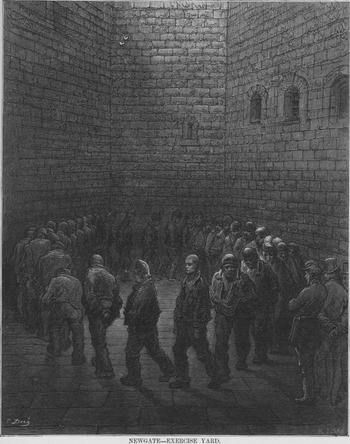
A similar dynamic is apparent in the section which details Jerrold and Doré's visit to the Newgate prison. In this section, Jerrold elaborates on the criminal sections of society that are beyond reform. “They are the despair of social reformers,” Jerrold claims, as “he who has once taken a liking to the bread of idleness, is beyond redemption as a citizen” (135). So, instead of a possibility of rehabilitating the men that he sees at Newgate prison, Jerrold dwells on how the criminal instinct is intrinsic to their nature. In fact, the very title “Under Lock and Key” frames the discussion of prison and criminality within the larger assurance to the readers that these dangerous social elements had been indeed contained. At first glance, Doré's engraving “Newgate-Exercise Yard” (Figure 21) seems to further the fantasy of containment in Jerrold's text. The image facilitates the reader's voyeurism in looking at prisoners without any threat of social interaction. Indeed, the two prison guards surveying the prisoners as they exercise in the yard may stand in for the viewer, and their placement reproduces within the image the visual hierarchy that the image will produce in its circulatory life.
Gustave Doré, Newgate-Exercise Yard. Wood Engraving. 1872. Digital Collection and Archives, Tufts University.

At the same time, the image is in tension with the text that accompanies it. Doré's representation of the high-walled prison-yard, closed on all sides around the prisoners with bowed heads who walk single file in a circle conveys the oppressive presence of penal discipline and its impact on the despondent prisoners. As in the Whitechapel engraving, here, too, the viewer's gaze is returned. One of the prisoners seems ready to walk towards the viewer, and his almost frontal position breaks the monotony of the circle. His gaze at the viewer complicates the possibility of scopophilic pleasure. Moreover, if the guards stand in for the spectator, then they also indicate the spectator's complicity in this penal form of discipline and surveillance. Thus, the interpretive possibilities imbued in the polyvalent nature of the image produce a social critique through the spectacle of social discipline. Reading the image in this manner reveals a productive discord: the normative stance of the text is simultaneously corroborated and contested by the image as it reveals how the scopophilic gaze that objectifies, that transforms urban poverty and suffering into visual pleasure, co-exists with the reformist desire for social justice.
Such productive discord may be produced via information or through the invocation of an affective response, but the overall effect is to prevent the spectator from symbolically possessing the people represented in these images as mere objects. The impact of this discord, however, can only be understood in ironic terms. Looking, in these instances, interpellates the viewer into action, but in response the viewer is only immersed in guilt. The viewers’ guilt in their inaction becomes their only action.
Conclusion
The nineteenth-century liberal emphasis on personal responsibility produced guilt as a response to social inequities too complicated and too pervasive to be cured by individual effort. At the same time, instead of being just an internal, psychological state, guilt was grounded in social relations. The evocation and performance of guilt in a reform text established its social credibility. As an affective response, guilt reassured the readers of a reform text about their social conscience. Scholars including Born, Boltanski, and Lauren Berlant have argued that guilt can be a politically active emotion instead of a passive, self-serving emotional state, and that it can be linked to material practice.
Nevertheless, although London, a Pilgrimage and Street Life in London have moments that are socially progressive, the very framework of the production and distribution of these texts contains their political potential, including the political potential of the guilt they inspired. The circulation and consumption of misery as luxury items within the domestic space indicates the cultural usage of these texts as “liberal porn”; it suggests an economy of pleasure that depended on images of suffering and on evocation of guilt. Whether these texts evoked maudlin sympathy in the reader/viewer or a more active resentment against the social system, the spectator's relationship with these texts was ultimately self-serving; these texts produced pleasure through the affirmation of the spectator's ethical self.
It is fitting to end with Smith's critique of consumer culture, which depended not only on the labor of workers but also on actual physical pain. Describing the Covent Garden flower market, Smith speaks of those workers who through ill-health or lack of physical strength are consigned to the task of cutting and sorting flowers and preparing them for transportation. He mentions his conversation with one worker who worked in a windowless basement cellar surrounded with mounds of flowers. The constant and intense scent of the flowers caused him chronic headaches, affected his vision, and even endangered his life with the constant possibility of asphyxiation. Through this particular story, Smith foregrounds the grief and hardship that underlie the commodity culture enjoyed by the upper classes and arouses guilt in readers for taking pleasure in the beauty of flowers made available through the misery of another. Ironically, however, while the text critiques the depredatory aspect of commodity culture, it disavows its own nature as a commodity that also capitalizes on the distress of others. The images of poverty, of people battling adverse circumstances, in London, a Pilgrimage and Street Life in London are also forms of spectatorial gratification embedded within a liberal reformist worldview. The act of witnessing suffering, in these texts, is inextricably enmeshed with liberal guilt and pleasurable consumption.