Introduction
Sweetpotato production in the United States is concentrated in the Southeast and in California. In 2017, US sweetpotato producers planted >65,000 ha of sweetpotato with an estimated value in excess of $732 million (USDA-NASS 2018). In Mississippi specifically, producers planted >12,000 ha of sweetpotato with an estimated value of more than $114 million (USDA-NASS 2018). In the southeastern United States, sweetpotato is frequently rotated with glyphosate-resistant (GR) corn (Zea mays L.), cotton (Gossypium hirsutum L.), and soybean [Glycine max (L.) Merr.]. As a result, sweetpotato producers must also manage GR weeds during the early season with burndown herbicide applications and mechanical field preparation operations. Among these difficult-to-control GR weeds is horseweed [Conyza canadensis (L.) Cronq.], which Koger et al. (Reference Koger, Poston, Hayes and Montgomery2004) reported to be GR in Mississippi in 2001 and 2002.
Saflufenacil, a protoporphyrinogen oxidase (PPO) inhibitor, can be used in row crops to control GR horseweed prior to planting. Budd et al. (Reference Budd, Soltani, Robinson, Hooker, Miller and Sikkema2016) reported that saflufenacil alone at 25 and 36 g ha–1 provided 90% and 95% control, respectively, of GR horseweed 8 wk after application. Similarly, Mellendorf et al. (Reference Mellendorf, Young, Matthews and Young2013) reported that saflufenacil rates of 50 to 125 g ha–1 resulted in at least 98% GR horseweed control. Owen et al. (Reference Owen, Mueller, Main, Bond and Steckel2011) reported that 25 and 50 g ha–1 saflufenacil applied 7 to 14 d before planting cotton provided 92% and 96% GR horseweed control, respectively. A sweetpotato-specific crop rotation interval for saflufenacil has not been determined. As a result, sweetpotato is included as an “other crop” on the product label and has a rotational restriction of 4 to 9 mo for saflufenacil rates of 25 to 150 g ai ha–1, respectively (Anonymous 2017b). Sweetpotato tolerance to other PPO-inhibiting herbicides including flumioxazin and fomesafen applied pre-transplanting has been well documented (Barkley et al. Reference Barkley, Chaudhari, Jennings, Schultheis, Meyers and Monks2016; Kelly et al. Reference Kelly, Shankle and Miller2006; Meyers et al. Reference Meyers, Jennings, Schultheis and Monks2010, Reference Meyers, Jennings and Monks2013).
Rimsulfuron and thifensulfuron-methyl are acetolactate synthase inhibitors that interfere with the biosynthesis of the branched-chain amino acids isoleucine, leucine, and valine (Shaner Reference Shaner2014). The pre-mix of rimsulfuron and thifensulfuron-methyl is registered for preplant weed control in field corn, cotton, peanut (Arachis hypogaea L.), and soybean (Anonymous 2017a). The current rotational restriction for rimsulfuron/thifensulfuron is 1.5 and 18 mo for rates of up to 18/18 g ha–1 and between 18/18 to 32/32 g ha–1, respectively (Anonymous 2017a). Acetolactate synthase–inhibitor herbicides have been investigated for use in sweetpotato, but the vast majority of investigations have focused on broadcast applications made over the top of the crop after transplanting (Dittmar et al. Reference Dittmar, Monks, Jennings and Schultheis2013; MacRae et al. Reference MacRae, Monks, Batts and Thornton2007a, Reference MacRae, Monks, Batts, Thornton and Schultheis2007b; Meyers and Shankle Reference Meyers and Shankle2016). Published research results reporting sweetpotato tolerance to rimsulfuron and thifensulfuron-methyl are limited. MacRae et al. (Reference MacRae, Monks, Batts and Thornton2007a) applied thifensulfuron to ‘Beauregard’ sweetpotato 1 to 8 wk after transplanting (WAP) at rates of 1.1 to 8.5 g ai ha–1 and reported that applications made 1 and 2 WAP reduced No. 1 sweetpotato yield by at least 25%.
The objective of this research was to determine the influence of saflufenacil and rimsulfuron/thifensulfuron-methyl applied before transplanting on sweetpotato crop tolerance, yield, and quality.
Materials and Methods
Field studies were conducted at the Pontotoc Ridge–Flatwoods Branch Experiment Station in Pontotoc, MS, in 2016 (34.1378°N, 89.0081°W) and 2017 (34.1426°N, 88.9945°W). Plot size was three rows wide by 9.1 m long with a between-row spacing of 1 m and in-row plant spacing of 30 cm. ‘Beauregard’ sweetpotato slips were mechanically transplanted on June 30, 2016, into a Bude silt loam (fine-silty, mixed, thermic Glossaquic Fragiudalfs) with pH 7.5 and 1.2% organic matter, and on June 20, 2017, into an Atwood silt loam (fine-silty, mixed, thermic Typic Paleudalfs) with pH 6.5 and 1.5% organic matter. Saflufenacil (Sharpen; BASF Corp., Research Triangle Park, NC 27709) treatments consisted of a factorial of two rates (25 or 50 g ai ha–1) by three application timings [0, 3, or 6 wk before transplanting (WBP)]. Rimsulfuron/thifensulfuron-methyl (LeadOff; DuPont, Wilmington, DE 19805) treatments consisted of a factorial of two rates (18/18 or 35/35 g ai ha–1) by two application timings (3 or 6 WBP). A nontreated check was included for comparison. The experiment design was a randomized complete block with four replications. Saflufenacil and rimsulfuron/thifensulfuron-methyl treatments were randomized within the same field and shared a nontreated check.
Applications made at 3 and 6 WBP were broadcast prior to mechanical field preparation to level soil covered with a mixture of winter annual weed species. At 1 WBP, the field was tilled and hipped to form ridged planting rows. Saflufenacil was applied at 0 WBP; applications were broadcasted over ridged planting rows within 1 d before transplanting. All herbicide applications were applied with a tractor-mounted, CO2-pressurized sprayer calibrated to deliver 140 L ha–1 at 138 kPa and fitted with six 8002 XR nozzle tips (Teejet 8002 XR; Teejet Technologies, Springfield, IL). After transplanting, the entire study received 1.1 kg ai ha–1 clomazone (Command 3 ME; FMC Corp, Philadelphia, PA 19104). In 2016, the entire field was between-row cultivated 4 WAP, followed by 800 g ai ha–1 S-metolachlor (Dual Magnum; Syngenta Crop Protection, LLC, Greensboro, NC 27419). In both years, the entire study was treated with clethodim (SelectMax; Valent USA Corp, Walnut Creek, CA 94596) at 105 g ai ha–1 plus 1% (v/v) crop oil concentrate as needed to control emerged annual and perennial grasses. All plots were hand-weeded weekly until vine closure and then as needed through harvest.
Data collection included visual crop injury on a scale of 0 (no crop injury) to 100% (crop death) (Frans et al. Reference Frans, Talbert, Marx, Crowley and Camper1986). In 2016, injury was rated 1, 2, 4, 5, and 6 WAP. In 2017, injury was rated 4, 6, 8, 10, and 15 WAP. At 118 d after planting in 2016 and 121 d after planting in 2017, the center row of each three-row plot was harvested with a single-row chain digger and hand-graded into Jumbo (≥8.9 cm diam), No. 1 (≥4.4 cm but <8.9 cm), canner (≥2.5 cm but <4.4 cm), and cull (misshapen roots of No. 1 size or larger), and weighed (USDA 2005). Marketable yield was calculated as the aggregate of Jumbo, No. 1, and canner grades.
With the exception of the nontreated check, data for saflufenacil and rimsulfuron/thifensulfuron were analyzed separately. Data were subjected to ANOVA by SAS (SAS/STAT® 9.4; SAS Institute Inc., Cary, NC 27513) Proc GLM with the fixed effect of saflufenacil or rimsulfuron/thifensulfuron-methyl rate, application timing, and their respective rate-by-timing interaction. Year and replication within year were included as random effects when data were combined across both years; otherwise, replication was the only random effect. Means were separated by Fisher’s protected LSD (P ≤ 0.05). Arcsin square-root transformed data were analyzed for visible sweetpotato injury and presented as nontransformed data for discussion purposes. Yield data from the nontreated check were included in the analysis; however, crop injury data from the nontreated check treatment were not included in the data analysis because of zero variance.
Results and Discussion
Sweetpotato Tolerance
Because of a treatment-by-year interaction for both saflufenacil and rimsulfuron/thifensulfuron-methyl, sweetpotato crop injury data were analyzed separately by year.
Saflufenacil
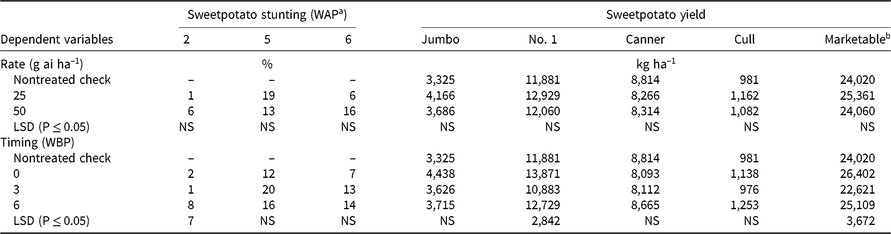
Because of a lack of saflufenacil application rate-by-timing interaction within each year, the main effect of rate was analyzed across all timings and the main effect of timing was analyzed across all rates. Injury in 2016 was generally greater than in 2017 (Table 1), with as much as 20% stunting, which peaked 5 WAP. However, stunting did not differ between rates (Table 1). Although not biologically meaningful, stunting at 2 WAP was statistically greater when saflufenacil was applied at 6 WBP (8%) than at 3 WBP (1%). Stunting in 2017 was consistently minimal (≤4% stunting) throughout the study (data not shown). These results are similar to those reported by Barkley et al. (Reference Barkley, Chaudhari, Jennings, Schultheis, Meyers and Monks2016) for pre-transplanting applications of the PPO inhibitor fomesafen, which resulted in <13% crop injury to ‘Covington’ and ‘Evangeline’ sweetpotato when applied at 0.28 to 0.84 kg ha–1 alone or followed by S-metolachlor.
Effect of saflufenacil rate and application timing on sweetpotato stunting in 2016 and yield pooled across 2016 and 2017 at Pontotoc, MS.

a Abbreviations: NS, not significant; WAP, wk after transplanting; WBP, wk before transplanting.
b Marketable: This column provides the sum of Jumbo, No. 1, and canner sweetpotatoes as related to the respective dependent variables.
Rimsulfuron/thifensulfuron-methyl
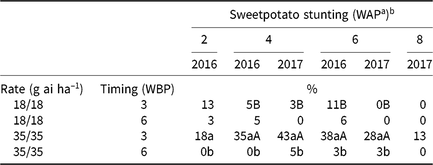
Because of a rimsulfuron/thifensulfuron-methyl application rate-by-timing interaction, the effect of rate was analyzed by each application timing and the effect of application timing was analyzed by each rate. When rimsulfuron/thifensulfuron-methyl was applied at 18/18 g ha–1 3 or 6 WBP in 2016, sweetpotato stunting 2 to 6 WAP was ≤13% and did not differ by application timing (Table 2). However, when rimsulfuron/thifensulfuron-methyl was applied at 35/35 g ha–1, stunting did differ by application timing. Applications made 3 WBP resulted in 18% stunting 2 WAP, and stunting injury increased to 35% and 38% at 4 and 6 WAP, respectively. When 35/35 g ha–1 rimsulfuron/thifensulfuron-methyl was applied 6 WBP, stunting from 2 to 6 WAP was ≤3%. In 2016, when rimsulfuron/thifensulfuron-methyl was applied 6 WBP, there was no difference in stunting between 18/18 and 35/35 g ha–1. However, when applied at 3 WBP, 35/35 g ha–1 rimsulfuron/thifensulfuron-methyl resulted in greater stunting at 4 and 6 WAP (35% and 38%, respectively) than 18/18 g ha–1 (5% and 11%, respectively).
Effect of rimsulfuron/thifensulfuron-methyl rate by application timing and effect of application timing by rate on sweetpotato stunting at Pontotoc, MS, in 2016 and 2017.

a Abbreviations: WAP, wk after transplanting; WBP, wk before transplanting.
b Means within columns followed by the same lowercase or uppercase letter are not significantly different according to Fisher’s Protected LSD at P ≤ 0.05 for the effect of application timing by rate (3 or 6 WBP for the 35/35 g ai ha–1 rate) and rate by timing (18/18 or 35/35 g ai ha–1 for treatments applied 3 WBP), respectively. The nontreated check was not included in the statistical analysis.
In 2017, when rimsulfuron/thifensulfuron-methyl was applied at 18/18 g ha–1, stunting did not differ by application timing and was ≤3% from 4 to 8 WAP (Table 2). When applied at 35/35 g ha–1, applications made 3 WBP resulted in greater stunting at 4 and 6 WAP (43% and 28%, respectively) than applications made 6 WBP (5% and 3%, respectively). At 8 WAP, stunting was reduced to 13% and 0% for applications made 3 and 6 WBP, respectively, and stunting did not differ by application timing. When rimsulfuron/thifensulfuron-methyl was applied 6 WBP, there was no difference in stunting between 18/18 and 35/35 g ha–1. However, when applied at 3 WBP, 35/35 g ha–1 rimsulfuron/thifensulfuron-methyl resulted in greater stunting at 4 and 6 WAP (43% and 28%, respectively) than 18/18 g ha–1 (3% and 0%, respectively). At 8 WAP, stunting did not differ by application rate for either of the two application timings.
MacRae et al. (Reference MacRae, Monks, Batts and Thornton2007a) reported significant rate and application timing effects of thifensulfuron applied to ‘Beauregard’ sweetpotato at 4, 6, or 8 WAP. Crop stunting increased linearly or quadratically from 0 to 8.5 g ha–1 thifensulfuron, and at 4.3 g ha–1, stunting injury 2 wk after treatment was 23%, 17%, and 12% for applications made 4, 6, and 8 WAP, respectively (MacRae et al. Reference MacRae, Monks, Batts and Thornton2007a).
Sweetpotato Yield
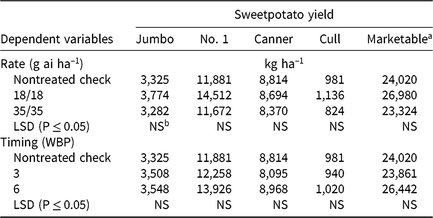
Because of a lack of treatment-by-year interaction, data for all grades of sweetpotato were analyzed across both 2016 and 2017. Jumbo, No. 1, canner, cull, and marketable yield of the nontreated check were 3,325, 11,881, 8,814, 981, and 24,020 kg ha–1, respectively (Table 3).
Effect of rimsulfuron/thifensulfuron-methyl rate and timing on sweetpotato yield at Pontotoc, MS, pooled across 2016 and 2017.

a Marketable: This column provides the sum of Jumbo, No. 1, and canner sweetpotatoes as related to the respective dependent variables.
b Abbreviations: NS, not significant; WBP, wk before transplanting.
Saflufenacil
Because of a lack of saflufenacil rate-by-timing interaction, the main effect of rate was analyzed across all application timings and the main effect of application timing was analyzed across all rates. Compared to the nontreated check, saflufenacil applications did not result in a reduction of any grade of sweetpotato regardless of rate or timing (Table 1).
Rimsulfuron/Thifensulfuron-methyl
Jumbo, No. 1, canner, cull, and marketable yields did not demonstrate a significant rate-by-application timing interaction. Therefore, the main effect of rate was analyzed across all application timings and the main effect of application timing was analyzed across all rates. Relative to the nontreated check, yields of all grades of sweetpotato did not differ by rimsulfuron/thifensulfuron-methyl application rate or timing (Table 3).
Sweetpotato displayed good crop tolerance to saflufenacil. Although as much as 20% stunting was observed in one of two years, sweetpotato yield and quality were not reduced by saflufenacil. The current label restricts transplanting sweetpotato into fields treated with 25 and 50 g ha–1 saflufenacil for 4 and 5 mo, respectively. Based upon results from the present study, those plant-back restrictions may be excessive and saflufenacil should be considered as an effective herbicidal active ingredient in the management of GR horseweed during preplanting burndown applications up to and including the week of sweetpotato transplanting. The present study was limited to 25 and 50 g ha–1 rates, which are recommended for preplant, burndown control of GR horseweed. These finding are similar to those reported for pre-transplanting applications of PPO-inhibitor herbicides flumioxazin (Kelly et al. Reference Kelly, Shankle and Miller2006; Meyers et al. Reference Meyers, Jennings, Schultheis and Monks2010, Reference Meyers, Jennings and Monks2013), and fomesafen (Barkley et al. Reference Barkley, Chaudhari, Jennings, Schultheis, Meyers and Monks2016; Meyers et al. Reference Meyers, Jennings and Monks2013), which have been reported to have excellent crop safety while providing efficacious weed control.
Sweetpotato tolerance to rimsufuron/thifensulfuron-methyl was acceptable with the exception of 35/35 g ha–1 applied 3 WBP, which resulted in stunting in excess of what producers and herbicide registrants would tolerate. Despite stunting as great as 43% from this treatment, sweetpotato yield was not reduced by this or any other rimsulfuron/thifensulfuron-methyl rate or application timing. Results from the present study suggest that rimsulfuron/thifensulfuron-methyl applications of up to 35/35 g ha–1 made at least 6 WBP and of 18/18 g ha–1 made at least 3 WBP have little impact on sweetpotato crop growth and development and may be a safe burndown option. This study was conducted on silt loam soil with ‘Beauregard’ sweetpotato. Soil texture and cultivars in other sweetpotato production locations may vary, and data from the present study may not be transferable to other sweetpotato production environments.
Acknowledgments
We thank the crew at the Pontotoc Ridge–Flatwoods Branch Experiment Station for their help in transplanting, maintaining, harvesting, and grading this study: Lane Jaggers, Jeff Main, Jerry Sartin, and Randy Swords. This research received no specific grant from any funding agency, commercial, or not-for-profit sectors. No conflicts of interest have been declared. This publication is a contribution of the Mississippi Agricultural and Forestry Experiment Station.