1 Introduction
Piecewise monotone maps of the interval with some hyperbolicity have been investigated as simple models of the so-called chaotic dynamical systems. For such a map, one of the key tools for investigating its ergodic properties is the corresponding Perron–Frobenius operator, whose spectrum may reflect information about the measurable dynamics associated to its absolutely continuous (with respect to the Lebesgue measure) invariant probability measures (abbreviated to a.c.i.p.m.). In the case where a map is piecewise
 $C^2$
and piecewise expanding, the Perron–Frobenius operator defined on a Banach space of suitable functions (e.g. functions of bounded variation) is a linear bounded operator, whose spectral radius is
 $1$
and this value is actually an eigenvalue, which yields the existence of an a.c.i.p.m. (see [Reference Lasota and Yorke18]). Furthermore, the Perron–Frobenius operator is to be quasi-compact, that is, there is a real number
 $0 < r < 1$
such that a spectral value whose modulus greater than r is an isolated eigenvalue with finite multiplicity (the infimum of such numbers is called the essential spectral radius). If
 $1$
is a simple eigenvalue, then there exists a unique a.c.i.p.m. and the measurable dynamics associated to the a.c.i.p.m. is ergodic (see [Reference Li and Yorke19]). Moreover, if the modulus of any other eigenvalue is less than
 $1$
, a simple eigenvalue
 $1$
is the leading eigenvalue (in the sense of its modulus) and we have exponential decay of correlations for suitable observables (see e.g. [Reference Baladi2, Reference Boyarsky and Góra6, Reference Hofbauer and Keller15]). In this case, we say that the Perron–Frobenius operator has a spectral gap property and it can be applied to show several limit theorems via perturbation theory, for which the analyticity of the leading eigenvalue of the perturbed Perron–Frobenius operator plays an important role (see e.g. [Reference Boyarsky and Góra6, Reference Hofbauer and Keller15]).
In contrast to the case of the leading eigenvalue, the properties of the other isolated eigenvalues greater than the essential spectral radius, called non-leading eigenvalues in this paper, may still remain unclear, including their existence. In [Reference Dellnitz, Froyland and Sertl12], Dellnitz, Froyland and Sertl constructed a family of piecewise linear expanding Markov maps on the interval each of whose Perron–Frobenius operator on the space of functions of bounded variation has a positive non-leading eigenvalue. In [Reference Butterley, Kiamari and Liverani7], Butterley, Kiamari and Liverani investigated an asymptotic expansion of a correlation function for suitable observable in the case of piecewise linear expanding Markov maps or piecewise full branched expanding maps. In particular, they gave an example of a piecewise linear map such that its Perron–Frobenius operator on a space of suitable functions has an isolated eigenvalue whose algebraic multiplicity and index both are
 $2$
(see §2 for notation).
In this paper, we investigate some properties of non-leading eigenvalues of the Perron–Frobenius operators for beta-maps defined on the space of functions of bounded variation, each of which has a spectral gap property. The beta-maps are defined by
 $\tau _\beta (x)=\beta x$
(mod
 $1$
),
 $x\in [0,1]$
,
 $\beta \in (1,\infty )$
, and have been well studied after [Reference Rényi21] in the context of ergodic theory and number theory since each map generates an expansion of a real number in
 $[0,1]$
whose base is
 $\beta $
, called the greedy expansion (see e.g. [Reference Blanchard4, Reference Dajani and Kraaikamp10, Reference Parry20]). The advantage of the map is that several quantities related to the Perron–Frobenius operator can be given in concrete terms, such as a normalized eigenfunction corresponding to the leading eigenvalue
 $1$
, that is, the density function of a unique a.c.i.p.m. [Reference Gelfond14, Reference Parry20, Reference Rényi21]. In fact, our main results are derived from the two explicit formulae which we describe in detail in the following.
The first explicit formula is for the dynamical zeta function of a beta-map, derived from the result for a beta-shift by Takahashi [Reference Takahashi24]. As we see in §2, it is regarded as a sort of Fredholm determinant of the Perron–Frobenius operator, which enables us to investigate isolated eigenvalues of the Perron–Frobenius operators via zeros of a certain analytic function on the open disk whose radius is
 $\beta $
(Theorem 2.6). Using this fact, we show in Theorem 2.12 that the set of
 $\beta $
such that the corresponding Perron–Frobenius operator has at least one non-leading eigenvalue is open and dense in
 $(1,\infty )$
. Furthermore, we establish the Hölder continuity of each non-leading eigenvalue as a function of
 $\beta $
(Theorem 3.1). In particular, we show that any non-leading eigenvalue is continuous but non-differentiable as a function of
 $\beta $
, which shows in some sense a fractal property of non-leading eigenvalues. We note that an analogy of this result was conjectured by Flatto, Lagarias and Poonen in [Reference Flatto, Lagarias and Poonen13], whose statement is that the maximal modulus of any non-leading eigenvalue is nowhere differentiable as a function of
 $\beta $
.
The second explicit formula is for the value of an eigenfunctional for an isolated eigenvalue of the Perron–Frobenius operator applied to the indicator function of each interval (Proposition 4.2). Using this formula, we provide three applications in §4. As the first application, we characterize isolated eigenvalues of the Perron–Frobenius operator from the differentiability of a certain function related to the greedy expansion, which is introduced as motivated by the explicit formula for an eigenfunctional (Theorem 4.3(4) and (5)). As the second application, we show that an eigenfunctional corresponding to each non-leading eigenvalue cannot be expressed by any complex measure (Theorem 4.5), which is in contrast to the case of the leading eigenvalue
 $1$
since an eigenfunctional corresponding to
 $1$
can be expressed by the Lebesgue measure. As the third application, we construct a family of step functions each of whose correlation function decays exponentially in the rate actually less than the modulus of the second eigenvalues (in the sense of their modulus) under the assumption that all the second eigenvalues are simple (Theorem 4.6). Concerning this result, in the Appendix, we provide three examples of a countable family of
 $\beta $
each of which satisfies the above assumption.
This paper is organized as follows. In §2, we summarize basic notions used throughout this paper and show that the set of
 $\beta $
such that the corresponding Perron–Frobenius operator has at least one non-leading eigenvalue is open and dense in
 $(1,\infty )$
. In §3, we establish the Hölder continuity of each non-leading eigenvalue as a function of
 $\beta $
. In §4, we show an explicit formula for an eigenfunctional of the Perron–Frobenius operator and provide its three applications. In the Appendix, we construct three examples of countable sets of
 $\beta $
such that the second eigenvalues of the Perron–Frobenius operator are simple.
2 Preliminaries and known results
In this section, we summarize some notions used throughout the paper. In §2.1, we recall some basic properties of beta-maps. In §2.2, we define the Perron–Frobenius operator for a beta-map and refer to its spectral decomposition. In §2.3, we describe the analytic properties of the dynamical zeta function of a beta-map, which is regarded as a sort of ‘Fredholm determinant’ of its Perron–Frobenius operator.
2.1 Basic properties of beta-maps
For a real number
 $\beta>1$
, the beta-map
 ${\tau _\beta :[0,1]\to [0,1]}$
is defined by
 $$ \begin{align*}\tau_\beta(x)=\beta x-[\beta x]\end{align*} $$
for
 $[0,1]$
, where
 $[y]$
denotes the integer part of
 $y\geq 0$
. It is well known that the map
 $\tau _\beta $
gives the greedy expansion of
 $x\in [0,1]$
as follows. Since
 $$ \begin{align*}x=\frac{[\beta x]}{\beta}+\frac{\tau_\beta(x)}{\beta}\end{align*} $$
for
 $x\in [0,1]$
, we have
 $$ \begin{align*}\tau_\beta^{n}(x)=\frac{[\beta \tau_\beta^n(x)]}{\beta}+\frac{\tau_\beta^{n+1}(x)}{\beta}\end{align*} $$
for
 $n\geq 0$
. Here, we regard
 $\tau _\beta ^0(x)$
as x. By using the above equations inductively, we obtain
 $$ \begin{align*}x=\sum_{n=1}^N\frac{[\beta\tau_\beta^{n-1}(x)]}{\beta^n}+\frac{\tau^N_\beta(x)}{\beta^N}\end{align*} $$
for
 $N\geq 1$
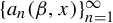
. Set
 $a_n(\beta ,x)=[\beta \tau _{\beta }^{n-1}(x)]$
for
 $n\geq 1$
. Taking
 $N\to +\infty $
in the right-hand side of the above equation provides the greedy expansion of x:
 $$ \begin{align*}x=\sum_{n=1}^\infty\frac{a_n(\beta, x)}{\beta^n}.\end{align*} $$
A real number
 $x\in [0,1]$
is said to be simple if there is a positive integer
 $n_0\geq 1$
such that
 $\tau _\beta ^{n_0-1}(x)\in \{1/\beta ,\ldots ,[\beta ]/\beta \}$
. In this case, we have
 $a_n(\beta , x)=[\beta \tau _{\beta }^{n-1}(x)]=0$
for all
 $n\geq n_0+1$
. We define the non-negative function
 $L=L_\beta :[0,1]\to \mathbb {N}\cup \{0\}$
by
 ${L(x)=n_0}$
if x is simple and
 $L(x)=\infty $
otherwise. Here,
 $\beta>1$
is said to be simple if
 $L(1)$
is finite.
In some situations, it is more useful to consider the quasi-greedy expansion of x defined as follows. If
 $\beta>1$
is simple, we set
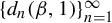
 $$ \begin{align*}\{d_n(\beta,1)\}_{n=1}^\infty=\overline{a_1(\beta,1)\cdots a_{L(1)-1}(\beta,1)({a}_{L(1)}(\beta,1)-1)}^{\infty},\end{align*} $$
where
 $\overline {b_1\cdots b_k}^\infty $
denotes the infinite concatenation of a k-length word
 $b_1\cdots b_k$
for
 $k\geq 1$
with non-negative integers
 $b_1,\ldots ,b_k$
. If
 $\beta>1$
is non-simple, we set
 $\{d_n(\beta ,1)\}_{n=1}^\infty =\{a_n(\beta ,1)\}_{n=1}^\infty $
. By the definition of the sequence
 $\{d_n(\beta ,1)\}_{n=1}^\infty $
, we have that
 ${1=\sum _{n=1}^\infty }d_{n}(\beta ,1)/\beta ^n$
, which is called the quasi-greedy expansion of
 $1$
. For simple
 $x\in (0,1)$
, we define
 $$ \begin{align*}\{d_n(\beta,x)\}_{n=1}^\infty=a_1(\beta,x)\cdots a_{L(x)-1}(\beta,x)({a}_{L(x)}(\beta,x)-1)d_1(\beta,1)d_2(\beta,1)\cdots.\end{align*} $$
By setting
 $\{d_n(\beta ,x)\}_{n=1}^\infty =\{a_n(\beta ,x)\}_{n=1}^\infty $
for non-simple
 $x\in (0,1)$
, we also have that
 ${x=\sum _{n=1}^\infty }d_{n}(\beta ,x)/\beta ^n$
, which is called the quasi-greedy expansion of
 $x\in (0,1]$
.
For
 $x\in [0,1]$
, the coefficient sequence
 $\{a_n(\beta ,x)\}_{n=1}^\infty $
is a one-sided infinite sequence of non-negative integers in
 $\{0,1,\ldots ,[\beta ]\}^{\mathbb {N}}$
. We equip the set
 $\{0,1,\ldots ,[\beta ]\}^{\mathbb {N}}$
with the lexicographic order
 $\prec $
, which is defined by
 $\{p_n\}_{n=1}^\infty \prec \{q_n\}_{n=1}^\infty $
if there is a positive integer
 $m\geq 1$
such that
 $p_n=q_n$
for
 $1\leq n<m$
and
 $p_m<q_m$
for
 $\{p_n\}_{n=1}^\infty , \{q_n\}_{n=1}^\infty \in \{0,1,\ldots ,[\beta ]\}^{\mathbb {N}}$
. Note that this is a total order and its order topology coincides with the product topology derived from the discrete topology on
 $\{0,1,\ldots ,[\beta ]\}$
. Since the function
 $x\mapsto \{a_n(\beta ,x)\}_{n=1}^\infty $
preserves the order relation, the limit
 $\lim _{y\nearrow x}\{a_n(\beta ,y)\}_{n=1}^\infty $
exists. By the definition of the quasi-greedy expansion of x, we can see that
 $\{d_n(\beta ,x)\}_{n=1}^\infty =\lim _{y\nearrow x}\{a_n(\beta ,y)\}_{n=1}^\infty $
. The next propositions are due to Parry [Reference Parry20] (see also [Reference Blanchard4]), which are key tools for proving the main results in this paper.
Proposition 2.1. Let
 $\beta>1$
be a non-integer. For a sequence of integers
 $\{w_i\}_{i=1}^\infty \in \{0,1,\ldots , [\beta ]\}^{\mathbb {N}}$
, there is
 $x_0\in [0,1)$
such that
 $w_n=a_n(\beta ,x_0)$
for all
 $n\geq 1$
if and only if
 $$ \begin{align*}\{w_{i+n}\}_{n=1}^\infty\prec\{d_n(\beta,1)\}_{n=1}^\infty\end{align*} $$
for all
 $i\geq 0$
.
Proposition 2.2. Let N be a positive integer. For a sequence of non-negative integers
 $\{w_i\}_{i=1}^\infty \in \{0,1,\ldots , N\}^{\mathbb {N}}\setminus \{1\overline {0}^\infty \}$
, there is
 $\beta>1$
such that
 $w_n=a_n(\beta ,1)$
for all
 $n\geq 1$
if and only if
 $$ \begin{align*}\{w_{n+i}\}_{n=1}^\infty\prec \{w_n\}_{n=1}^\infty\end{align*} $$
for all
 $i\geq 1$
.
2.2 Perron–Frobenius operators
This subsection is devoted to summarizing the basic properties of the Perron–Frobenius operator for a beta map and its spectral decomposition (see e.g. [Reference Baladi2, Reference Baladi and Keller3, Reference Boyarsky and Góra6, Reference Lasota and Yorke18, Reference Suzuki23]). For a function
 $f:[0,1]\to \mathbb {C}$
, we define the total variation
 $\operatorname {var}(f)$
by
 $$ \begin{align*} \operatorname{var}(f)&=\sup \bigg\{\kern-2pt\sum_{i=1}^n|f(x_i)-f(x_{i-1})|\ ;\ n\geq1, x_0=0, x_n=1 \\&\qquad\qquad\text{ and }x_i\in[0,1] \text{ with } x_{i-1}<x_i \text{ for } 1\leq i\leq n\bigg\}. \end{align*} $$
Let us denote by
 $BV$
the set of functions of bounded variation, that is,
 $$ \begin{align*}BV=\{f:[0,1]\to\mathbb{C}\ ;\ \operatorname{var}(f)<\infty\}.\end{align*} $$
We endow the space
 $BV$
with the norm
 $$ \begin{align*}\|f\|_{BV}=\operatorname{var}(f)+\sup_{x\in[0,1]}|f(x)|.\end{align*} $$
Then,
 $(BV, \|\cdot \|_{BV})$
is a Banach space (see e.g. [Reference Baladi2]). The Perron–Frobenius operator
 ${\mathcal {L}_\beta :BV\to BV}$
is defined by
 $$ \begin{align*}\mathcal{L}_\beta f(x)=\frac{1}{\beta}\sum_{x=\tau_\beta(y)}f(y)\quad (x\in[0,1])\end{align*} $$
for
 $f\in BV$
. Note that the Perron–Frobenius operator is linear bounded on
 $BV$
and satisfies the following dual property:
 $$ \begin{align*}\int_{0}^1 \mathcal{L}_\beta f\cdot g\,dl=\int_0^1f\cdot g\circ\tau_\beta\,dl\end{align*} $$
for
 $f\in BV$
and
 $g\in L^\infty (l)$
, where l denotes the Lebesgue measure on
 $[0,1]$
(see e.g. [Reference Baladi2, Reference Boyarsky and Góra6]). Since the beta-map
 $\tau _\beta $
is a piecewise-linear and piecewise-expanding map, the corresponding Perron–Frobenius operator is quasi-compact, that is, a spectrum
 $\unicode{x3bb} \in \mathbb {C}$
with
 $|\unicode{x3bb} |>1/\beta $
is an isolated eigenvalue with finite multiplicity (see e.g. [Reference Baladi2, Reference Baladi and Keller3, Reference Boyarsky and Góra6, Reference Hofbauer and Keller15, Reference Hofbauer and Keller16]).
In terms of applications, it is more useful for us to introduce a quotient space of
 $BV$
, on which functions are identified if they coincide with each other except on some countable set. Let
 $$ \begin{align*}\mathcal{N}=\{f\in BV\ ;\text{ there exists }\text{ a countable set }N \text{ such that } f(x)=0 \text{ for }x\in[0,1]\setminus N\}.\end{align*} $$
Note that the space
 $\mathcal {N}$
is a closed linear subspace in
 $BV$
. Then, we can define the quotient Banach space
 $(\widehat {BV}, \|\cdot \|_{\widehat {BV}})$
, where
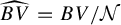 $\widehat {BV}=BV/\mathcal {N}$
and
 $\|f\|_{\widehat {BV}}=\inf _{g\in \mathcal {N}}\|f+g\|_{BV}$
for
 $f\in \widehat {BV}$
. As in the case of
 $BV$
, the Perron–Frobenius operator defined on
 $\widehat {BV}$
is linear bounded (see e.g. [Reference Baladi2, Reference Boyarsky and Góra6]). By abuse of notation, we denote the Perron–Frobenius operator defined on
 $\widehat {BV}$
by
 $\mathcal {L}_\beta $
. Furthermore, its spectrum outside of the disk of radius
 $1/\beta $
coincides with that of the Perron–Frobenius operator on
 $BV$
(see [Reference Baladi2, Proposition 3.4]).
Denote by
 $\widehat {BV}^*$
the set of complex-valued linear functionals on
 $\widehat {BV}$
. Let us define the dual operator of the Perron–Frobenius operator
 $\mathcal {L}_\beta ^*:\widehat {BV}^*\to \widehat {BV}^*$
by
 $$ \begin{align*}\mathcal{L}_\beta^*(\nu(f))=\nu(\mathcal{L}_\beta f)\end{align*} $$
for
 $\nu \in \widehat {BV}^*$
and
 $f\in \widehat {BV}$
.
For an eigenvalue
 $\unicode{x3bb} \in \mathbb {C}$
of
 $\mathcal {L}_\beta $
, the geometric multiplicity of
 $\unicode{x3bb} $
is the dimension of the eigenspace
 $\{f\in \widehat {BV}; (\unicode{x3bb} I-\mathcal {L}_\beta )f=0\}$
, where I denotes the identity map. The (algebraic) multiplicity of
 $\unicode{x3bb} $
is the dimension of the generalized eigenspace
 $\{f\in \widehat {BV}; \text{there exists } n\geq 1 \text { such that } (\unicode{x3bb} I-\mathcal {L}_\beta )^n f=0\}$
. We call the value
 $\sup \{n\geq 1; (\unicode{x3bb} I-\mathcal {L}_\beta )^n f=0\ \text {for some}\ f\in \widehat {BV}\ \text {with}\ f\neq 0\}$
the index of
 $\unicode{x3bb} $
.
Note that the map
 $\tau _\beta $
has a unique invariant probability measure
 $\mu _\beta $
absolutely continuous with respect to the Lebesgue measure, which yields that
 $1$
is a simple eigenvalue of
 $\mathcal {L}_{\beta }$
(see [Reference Rényi21]). Furthermore, since the measurable dynamics
 $(\tau _\beta , \mu _\beta )$
is exact (see e.g. [Reference Bowen5]), we have that there is no isolated eigenvalue on the unit circle except the leading eigenvalue
 $1$
.
For isolated eigenvalues of
 $\mathcal {L}_\beta $
, we have the following proposition.
Proposition 2.3. [Reference Suzuki23, Theorem 3.3]
Let
 $\unicode{x3bb} \in \mathbb {C}$
be an isolated eigenvalue of
 $\mathcal {L}_\beta $
with multiplicity
 $M\geq 1$
. Then, the geometric multiplicity of
 $\unicode{x3bb} $
is
 $1$
and the index of
 $\unicode{x3bb} $
is equal to M.
Since
 $\mathcal {L}_\beta $
is quasi-compact on
 $\widehat {BV}$
, for
 $\theta \in (1/\beta , 1)$
, the spectral decomposition of
 $\mathcal {L}_\beta $
is given by

for
 $f\in \widehat {BV}$
, where
 $\unicode{x3bb} _i$
is an isolated eigenvalue with finite multiplicity
 $M_i$
with
 $|\unicode{x3bb} _i|>\theta $
,
 $h_i$
is the vector of a basis
 $(h_{i,1},\ldots , h_{i,M_i})$
for the corresponding generalized eigenspace,
 $J_i$
is a Jordan matrix composed by one Jordan block whose diagonals are
 $1$
, and
 $\nu _i$
is the vector of eigenfunctionals
 $(\nu _{i,1},\ldots ,\nu _{i,M_i})$
satisfying
 $\nu _{i,j}(h_{k,l})=1$
if
 $i=k$
and
 $j=l$
, and
 $\nu _{i,j}(h_{k,l})=0$
otherwise. Here, the linear operator
 $\mathcal {P}$
has the spectral radius less than or equal to
 $\theta $
.
2.3 Dynamical zeta functions
In this subsection, we see that the dynamical zeta function of the map
 $\tau _\beta $
can be extended to an analytic function given by the generating function of the coefficient sequence of the beta-expansion of
 $1$
. The dynamical zeta function
 $\zeta _\beta (z)$
of
 $\tau _\beta $
is formally defined by
 $$ \begin{align*}\zeta_{\beta}(z)=\text{exp}\bigg(\kern-2pt\sum_{n=1}^{\infty}\frac{z^{n}}{n}\sum_{x=\tau_\beta^n x}\frac{1}{|(\tau_\beta^n)'(x)|}\bigg).\end{align*} $$
Note that the fact that
 $|(\tau _\beta ^n)'|=\beta ^n$
for
 $n\geq 1$
yields
 $$ \begin{align} \zeta_\beta(z)=\text{exp}\bigg(\kern-2pt\sum_{n=1}^{\infty}\frac{z^{n}}{n}\frac{\#\text{Fix}(\tau_{\beta}^{n})}{\beta^n}\bigg), \end{align} $$
where
 $\text {Fix}(\tau _\beta ^n)$
denotes the set of all fixed points of
 $\tau _\beta ^n$
and
 $\# A$
denotes the cardinality of A. By applying [Reference Baladi and Keller3, Theorem 2] to our setting, we have the following theorem.
Theorem 2.4. (Application of [Reference Baladi and Keller3, Theorem 2])
-
(1) The dynamical zeta function
 $\zeta _\beta (z)$
converges absolutely in the open unit disk. In particular, it is analytic on the unit disk. Furthermore, it can be extended to
$\{z\in \mathbb {C}\; |z|<\beta \}$
as a meromorphic function.
-
(2) For
$\unicode{x3bb} \in \mathbb {C}$
with
$1/\beta <|\unicode{x3bb} |\leq 1$
,
$\unicode{x3bb} $
is an isolated eigenvalue of the Perron–Frobenius operator
$\mathcal {L}_\beta $
with multiplicity M if and only if
$\unicode{x3bb} ^{-1}$
is a pole of the dynamical zeta function
$\zeta _\beta (z)$
in
$\{z\in \mathbb {C}\ ;\ |z|<\beta \}$
with multiplicity M.



This theorem enables us to investigate the properties of the isolated eigenvalues of
 $\mathcal {L}_\beta $
via those of the poles of
 $\zeta _\beta (z)$
. In the case of beta-maps, it is known that the analytic continuation of
 $\zeta _\beta (z)$
can be given by the generating function of the coefficient sequence
 $\{a_n(\beta ,1)\}_{n=1}^\infty $
. Let us define the power series
 $\phi _\beta (z)$
by
 $$ \begin{align*}\phi_\beta(z)=\sum_{n=1}^\infty\frac{a_n(\beta,1)}{\beta^n}z^n.\end{align*} $$
It is easily seen that the convergence radius of
 $\phi _\beta (z)$
is at least
 $\beta $
. The following theorem due to Flatto, Lagarias and Poonen [Reference Flatto, Lagarias and Poonen13], derived from the result by Takahashi [Reference Takahashi24] for a beta-shift, shows an explicit formula for the analytic continuation of
 $\zeta _\beta (z)$
(see also [Reference Ito and Takahashi17, Reference Suzuki22]).
Theorem 2.5. [Reference Flatto, Lagarias and Poonen13, Theorem 2.3]
For
 $z\in \mathbb {C}$
with
 $|z|<1$
, we have
 $$ \begin{align*}\zeta_\beta(z)=\frac{p_\beta(z)}{1-\phi_\beta(z)},\end{align*} $$
where
 $p_\beta (z)=1-(z/\beta )^{L(1)}$
if
 $\beta $
is simple and
 $p_\beta (z)=1$
if
 $\beta $
is non-simple.
As a consequence of Theorems 2.4 and 2.5, we have the following theorem.
Theorem 2.6. A complex number
 $\unicode{x3bb} $
with
 $1/\beta <|\unicode{x3bb} |\leq 1$
is an isolated eigenvalue of
 $\mathcal {L}_\beta $
with multiplicity
 $M\geq 1$
if and only if
 $\unicode{x3bb} ^{-1}$
is a zero of
 $1-\phi _\beta (z)$
with multiplicity
 $M\geq 1$
.
In some situations, it is more applicable to use the power series
 $$ \begin{align*} \hat{\phi}_\beta(z)=\sum_{n=1}^\infty\frac{d_n(\beta,1)}{\beta^n}z^n \end{align*} $$
instead of
 $\phi _\beta (z)$
, due to the left continuity of the map
 $\beta \mapsto \{d_n(\beta ,1)\}_{n=1}^\infty $
. Note that the convergence radius of
 $\hat {\phi }_\beta (z)$
is at least
 $\beta $
. The following proposition states that zeros of
 $1-\hat {\phi }_\beta (z)$
each of whose modulus is less than
 $\beta $
coincides with those of
 $1-\phi _\beta (z)$
.
Proposition 2.7. For
 $z\in \mathbb {C}$
with
 $|z|<\beta $
, it is a zero of
 $1-\hat {\phi }_\beta (z)$
if and only if it is a zero of
 $1-\phi _\beta (z)$
.
Proof. If
 $\beta>1$
is non-simple, the statement immediately follows from the fact that
 $\{d_n(\beta ,1)\}_{n=1}^\infty =\{a_n(\beta ,1)\}_{n=1}^\infty $
, which yields
 $\hat {\phi }_\beta (z)=\phi _\beta (z)$
.
If
 $\beta>1$
is simple, by the definition of the sequence
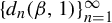 $\{d_n(\beta ,1)\}_{n=1}^\infty $
, we obtain
 $$ \begin{align*} \begin{aligned} \hat{\phi}_\beta(z) &=\sum_{n=1}^\infty\frac{d_n(\beta,1)}{\beta^n} \\ &=\bigg(1+\bigg(\frac{z}{\beta}\bigg)^{L(1)}+\bigg(\frac{z}{\beta}\bigg)^{2L(1)}+\cdots\bigg)\bigg(\sum_{n=1}^{L(1)}\frac{a_n(\beta,1)}{\beta^n}z^n-\bigg(\frac{z}{\beta}\bigg)^{L(1)}\bigg) \\ &=\frac{1}{1-(z/\beta)^{L(1)}}\bigg(\phi(z)-\bigg(\frac{z}{\beta}\bigg)^{L(1)}\bigg) \end{aligned} \end{align*} $$
for
 $z\in \mathbb {C}$
with
 $|z|<\beta $
, which shows
 $$ \begin{align*} 1-\hat{\phi}_\beta(z)=\frac{1}{1-(z/\beta)^{L(1)}}(1-\phi_\beta(z)) \end{align*} $$
for
 $z\in \mathbb {C}$
with
 $|z|<\beta $
. This finishes the proof.
In the rest of this section, as an application of Theorem 2.6 and several results from [Reference Flatto, Lagarias and Poonen13], we show that the set of
 $\beta $
such that the corresponding Perron–Frobenius operator
 $\mathcal {L}_\beta $
has at least one non-leading eigenvalue is open and dense in
 $(1,\infty )$
. Let us define the power series
 $\psi _\beta (z)$
by
 $$ \begin{align*}\psi_\beta(z)=1+\sum_{n=1}^\infty\frac{\tau_\beta^n(1)}{\beta^n}z^n.\end{align*} $$
Since
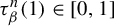 $\tau _{\beta }^n(1)\in [0,1]$
for
 $n\geq 1$
, the convergence radius of
 $\phi _\beta (z)$
is greater than or equal to
 $\beta $
. We need the following lemma, whose proof is based on a basic calculation derived from the definition of the coefficient sequence of the greedy expansion of
 $1$
.
Lemma 2.8. [Reference Suzuki22, Proposition 4.1(1)]
For
 $z\in \mathbb {C}$
with
 $|z|<\beta $
, we have
 $$ \begin{align*} 1-\phi_{\beta}(z)=(1-z)\psi_\beta(z). \end{align*} $$
The proof of the following lemma is given in [Reference Flatto, Lagarias and Poonen13].
Lemma 2.9. [Reference Flatto, Lagarias and Poonen13, Theorem 7.1]
There is a dense set of
 $\beta $
such that the meromorphic function
 $\zeta _\beta (\beta z)$
has infinitely many poles in
 $(-1,0)$
.
By Theorem 2.5, and Lemmas 2.8 and 2.9, we immediately have the following lemma.
Lemma 2.10. There is a dense set of
 $\beta $
such that the analytic function
 $1-\phi _\beta (z)$
has infinitely many zeros on
 $(-\beta , 0)$
.
The next lemma ensures the uniform convergence of the function
 $\psi _{\beta }(z)$
on the open disk whose radius is less than
 $\beta $
.
Lemma 2.11. [Reference Flatto, Lagarias and Poonen13, Lemma 3.3]
For a simple
 $\beta _0\in (1,\infty )$
, we have
 $$ \begin{align*}\lim_{\beta\nearrow\beta_0}\psi_\beta(\beta z)=\psi_{\beta_0}(\beta_0 z)/(1-(\beta_0 z)^{L_{\beta_0}(1)+1}), \ \ \lim_{\beta\searrow\beta_0}\psi_\beta(\beta z)=\psi_{\beta_0}(\beta_0 z) \end{align*} $$
uniformly on any compact subset of
 $\{z\in \mathbb {C}\ ;\ |z|<\beta _0\}$
. For a non-simple
 $\beta _0\in (1,\infty )$
, we have
 $$ \begin{align*}\lim_{\beta\to\beta_0}\psi_\beta(\beta z)=\psi_{\beta_0}(\beta_0 z)\end{align*} $$
uniformly on any compact subset of
 $\{z\in \mathbb {C}\ ;\ |z|<\beta _0\}$
.
The main result of this section is the following theorem.
Theorem 2.12. For
 $N\geq 1$
, the set of
 $\beta $
such that
 $1-\phi _\beta (z)$
has at least N zeros in the unit open disk is open and dense in
 $(1,\infty )$
. In particular, the set of
 $\beta $
such that
 $\mathcal {L}_\beta $
has at least one non-leading eigenvalue is open and dense in
 $(1,\infty )$
.
Proof. For a positive integer
 $N\geq 1$
, let
 $\mathcal {A}_N$
be the set of
 $\beta $
such that the meromorphic function
 $\zeta _\beta (\beta z)$
has at least N poles in the open unit disk, that is,
 $1-\phi _\beta (\beta z)$
has at least N zeros in the unit open disk. For
 $\beta _0\in \mathcal {A}_N$
, take arbitrary N zeros of
 $1-\phi _{\beta _0}(\beta _0 z)$
in the unit open disk. By Lemmas 2.8, 2.11 and Hurwitz’s theorem, we can take an open interval I including
 $\beta _0$
such that for
 $\beta \in I$
, the analytic function
 $1-\phi _\beta (\beta z)$
has at least N zeros in the unit open disk, which yields that the set
 $\mathcal {A}_N$
is open. We note that the set of
 $\beta $
such that
 $1-\phi _\beta (\beta z)$
has infinitely many zeros on
 $(-1, 0)$
is dense by Lemma 2.10 and included in the set
 $\mathcal {A}_N$
, which shows that the set
 $\mathcal {A}_N$
is dense in
 $(1,\infty )$
. This finishes the proof.
Remark 2.13. In [Reference Flatto, Lagarias and Poonen13, §6], Flatto, Lagarias and Poonen constructed a countable set of numbers, called Eneström numbers, such that the corresponding meromorphic function
 $\zeta _\beta (\beta z)$
has no pole in
 $\{z\in \mathbb {C}\ ;|z|<1\}$
. This means that the Perron–Frobenius operator
 $\mathcal {L}_\beta $
has no non-leading eigenvalue when
 $\beta $
is an Eneström number, whose typical example is the golden ratio (see [Reference Flatto, Lagarias and Poonen13, Theorem 6.1]).
3 Non-differentiability of non-leading eigenvalues
In this section, we investigate the Hölder continuity of each non-leading eigenvalue
 $\unicode{x3bb} _\beta $
of the Perron–Frobenius operator
 $\mathcal {L}_\beta $
as a function of
 $\beta $
. In particular, we show in Theorem 3.1 that the function
 $\beta \mapsto \unicode{x3bb} _\beta $
is non-differentiable, which shows, in some sense, a fractal property of non-leading eigenvalues.
Let
 $\beta _0>1$
be a non-integer. By Theorem 2.6 and Lemma 2.8, we know that
 $\unicode{x3bb} $
is a non-leading eigenvalue of
 $\mathcal {L}_{\beta _0}$
with multiplicity
 $M\geq 1$
if and only if
 $\unicode{x3bb} ^{-1}$
with
 $1<|\unicode{x3bb} ^{-1}|<\beta _0$
is a zero of
 $\psi _{\beta _0}(z)$
with multiplicity
 $M\geq 1$
. Let
 $\unicode{x3bb} _{\beta _0}$
be a non-leading eigenvalue of
 $\mathcal {L}_{\beta _0}$
with multiplicity
 $M\geq 1$
. By Lemma 2.11 and Hurwitz’s theorem, we know that there are open neighbourhoods
 $U_{\beta _0}$
of
 $\beta _0$
,
 $\tilde {V}_{\beta _0}$
of
 $\unicode{x3bb} _{\beta _0}^{-1}$
and a set of complex numbers
 $\{\unicode{x3bb} _\beta ^{-1}\}_{\beta \in U_{\beta _0}}$
such that
 $\unicode{x3bb} _{\beta }^{-1}$
is a zero of
 $\psi _{\beta }(z)$
for
 $\beta \in U_{\beta _0}$
and the function
 $\beta \in U_{\beta _0}\mapsto \unicode{x3bb} _\beta ^{-1}\in \tilde {V}_{\beta _0}$
is continuous at
 $\beta _0$
. Then, the function
 $\beta \in U_{\beta _0}\mapsto \unicode{x3bb} _\beta \in V_{\beta _0}$
is also continuous at
 $\beta _0$
and any
 $\unicode{x3bb} _\beta $
in
 $V_{\beta _0}$
is a non-leading eigenvalue of
 $\mathcal {L}_\beta $
for
 $\beta \in U_{\beta _0}$
, where
 $V_{\beta _0}=\{z^{-1}\in \mathbb {C};\;z\in \tilde {V}_{\beta _0}\}$
. Note that there may exist infinitely many functions as above in the case of
 $M\geq 2$
, while we take one from them and investigate its Hölder continuity throughout this section. The main theorem of the section is the following theorem.
Theorem 3.1. Let
 $\beta _0\in (1,\infty )$
be a non-integer and let
 $\unicode{x3bb} _{\beta _0}$
be a non-leading eigenvalue of
 $\mathcal {L}_{\beta _0}$
with multiplicity
 $M\geq 1$
. Let
 $\beta \in U_{\beta _0}\mapsto \unicode{x3bb} _\beta \in V_{\beta _0}$
be a function as defined above.
-
(1) Assume that
${\gamma _1:=\liminf _{n\to \infty }\sqrt [n]{\lim _{x\to 1}\tau _{\beta _0}^n(x)}}>0$
and set Then, for any
$\alpha <\alpha _1$
, the function
$\beta \in U_{\beta _0}\mapsto \unicode{x3bb} _\beta \in V_{\beta _0}$
is
$\alpha $
-Hölder continuous from the left at
$\beta _0$
. -
(2) Assume that
${\gamma _2:=\liminf _{n\to \infty }\sqrt [n]{1-\tau _{\beta _0}^n(1)}}>0$
and set Then, for any
$\alpha <\alpha _2$
, the function
$\beta \in U_{\beta _0}\mapsto \unicode{x3bb} _\beta \in V_{\beta _0}$
is
$\alpha $
-Hölder continuous from the right at
$\beta _0$
. -
(3) Let
Then, for any
$\alpha>\alpha _0$
, the function
$\beta \in U_{\beta _0}\mapsto \unicode{x3bb} _\beta \in V_{\beta _0}$
is not
$\alpha $
-Hölder continuous at
$\beta _0$
. In particular, it is non-differentiable at
$\beta _0$
.









If
 $\beta _0>1$
is a Parry number, that is,
 $\beta _0>1$
is a number such that the orbit
 $\{\tau _{\beta _0}^n(1)\}_{n=1}^\infty $
of
 $1$
is a finite set, we can easily see that the quantities
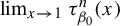 ${\lim _{x\to 1}\tau ^n_{\beta _0}(x)}$
and
 $1-\tau _{\beta _0}^n(1)$
are bounded below by some positive constant for any
 $n\geq 1$
. This shows
 $\gamma _1=\gamma _2=1$
, which yields
 $\alpha _0=\alpha _1=\alpha _2$
, where the constants are those as defined in Theorem 3.1. Hence, we have the following corollary.
Corollary 3.2. If
 $\beta _0$
is a Parry number, the function
 $\beta \in U_{\beta _0}\mapsto \unicode{x3bb} _\beta \in V_{\beta _0}$
is
 $\alpha $
-Hölder continuous at
 $\beta _0$
if
 $\alpha <\alpha _0$
and is not
 $\alpha $
-Hölder continuous at
 $\beta _0$
if
 $\alpha>\alpha _0$
, where
 $\alpha _0$
is the constant as defined in Theorem 3.1(3).
Remark 3.3. (1) In [Reference Flatto, Lagarias and Poonen13, Theorem 3.1], Flatto, Lagarias and Poonen showed that the modulus
 $M(\beta )$
of the second eigenvalue(s) is continuous as a function of
 $\beta $
, which is a consequence of Lemma 2.11. From numerical experiments in the case of
 $1<\beta <2$
(see [Reference Flatto, Lagarias and Poonen13, Figure 1]), they conjectured that
 $M(\beta )$
is nowhere differentiable for
 $\beta \in (1,\infty )$
. The statement of Theorem 3.1(3) may support this conjecture, while our result does not directly provide a positive answer to this conjecture since the non-differentiability of each second largest eigenvalue as a function of
 $\beta $
does not imply that of its modulus as a function of
 $\beta $
in general.
(2) In the context of open dynamical systems, Carminati and Tiozzo in [Reference Carminati and Tiozzo8] gave the value of the Hausdorff dimension of the set
 $K(t)$
of points whose orbit for the doubling map on the circle does not intersect the interval
 $(0,t)$
using the fact that the topological entropy of the map on
 $K(t)$
is given by a positive zero of a certain power series defined by the kneading sequence of t. Our strategy for the proof here is similar to that in [Reference Carminati and Tiozzo8], although the calculations for the Hölder exponent of the function
 $\beta \in U_{\beta _0}\mapsto \unicode{x3bb} _{\beta }\in V_{\beta _0}$
is more involved due to the fact that
 $\unicode{x3bb} _{\beta _0}$
is not necessary a positive number.
For the proof of Theorem 3.1, we need the following lemma.
Lemma 3.4. Let
 $\unicode{x3bb} _{\beta _0}$
be a non-leading eigenvalue of
 $\mathcal {L}_{\beta _0}$
with multiplicity
 $M\geq 1$
. Then, we have the following.
-
(1) There is an analytic function
$g_{\beta _0}(z)$
defined on some neighbourhood
$N_{\beta _0}$
of
$\unicode{x3bb} _{\beta _0}$
such that and
$g_{\beta _0}(z)\neq 0$
for
$z\in N_{\beta _0}$
.
-
(2) There is an analytic function
$\widehat {g}_{\beta _0}(z)$
defined on some neighbourhood
$\widehat {N}_{\beta _0}$
of
$\unicode{x3bb} _{\beta _0}$
such that and
$\widehat {g}_{\beta _0}(z)\neq 0$
for
$z\in N_{\beta _0}$
.


Proof. (1) Since
 $\unicode{x3bb} _{\beta _0}^{-1}$
is a zero of
 $1-\phi _{\beta _0}(z)$
with multiplicity
 $M\geq 1$
, there is an analytic function
 $f_{\beta _0}(z)$
defined on some neighbourhood
 $\mathcal {N}_{\beta _0}$
of
 $\unicode{x3bb} _{\beta _0}^{-1}$
such that

and
 $|f_{\beta _0}(z)|>0$
if
 $z\in \mathcal {N}_{\beta _0}$
. For
 $z\neq 0$
with
 $z^{-1}\in \mathcal {N}_{\beta _0}$
, we have

By taking
 $g_{\beta _0}(z)=(-1)^M f_{\beta _0}(z^{-1})/(z\unicode{x3bb} _{\beta _0})^M$
and
 $N_{\beta _0}=\{z^{-1}: z\in \mathcal {N}_{\beta _0}\setminus \{0\}\}$
, we have the conclusion.
(2) By replacing
 $\phi _{\beta _0}(z), g_{\beta _0}(z)$
and
 $N_{\beta _0}$
with
 $\widehat {\phi }_{\beta _0}(z), \widehat {g}_{\beta _0}(z)$
and
 $\widehat {N}_{\beta _0}$
, respectively, in the above calculations, we have the conclusion as in the same way of the proof of part (1).
Proof of Theorem 3.1
(1) Let
 $\unicode{x3bb} _{\beta _0}$
be a non-leading eigenvalue of
 $\mathcal {L}_{\beta _0}$
with multiplicity
 $M\geq 1$
. Since the map
 $\beta \mapsto \{d_n(\beta ,1)\}_{n=1}^\infty $
is strictly increasing and left-continuous by [Reference de Vries, Komornik and Loreti11, Proposition 2.3], for
 $\beta $
sufficiently close to
 $\beta _0$
with
 $\beta <\beta _0$
, there is a positive integer
 ${N\geq 1}$
such that
 $\{d_n(\beta ,1)\}_{n=1}^N =\{d_n(\beta _0,1)\}_{n=1}^N$
and
 $d_{N+1}(\beta ,1)<d_{N+1}(\beta _0,1)$
. By Lemma 3.4(2), there is an analytic function
 $\widehat {g}_{\beta _0}(z)$
defined on some neighbourhood
 $\widehat {N}_{\beta _0}$
of
 $\unicode{x3bb} _{\beta _0}$
such that

and
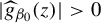 $|\widehat {g}_{\beta _0}(z)|>0$
for
 $z\in \widehat {N}_{\beta _0}$
.
Take
 $\varepsilon>0$
so small that
 $|\beta _0\unicode{x3bb} _{\beta _0}|>(1+\varepsilon )^2$
. Assume that
 $\beta <\beta _0$
is sufficiently close to
 $\beta _0$
so that
 $|\beta _0\unicode{x3bb} _{\beta _0}|/|\beta \unicode{x3bb} _\beta |<1+\varepsilon $
and
 $|\widehat {g}_{\beta _0}(\unicode{x3bb} _{\beta _0})|/|\widehat {g}_{\beta _0}(\unicode{x3bb} _{\beta })|<1+\varepsilon $
. On one hand, since

together with equation (3.1), we have

where
 $C_1$
and
 $C_2$
are the constants that are independent of
 $\beta $
given by

On the other hand,
 $$ \begin{align*} \beta_0-\beta &=\sum_{n=1}^\infty \frac{d_n(\beta_0,1)}{\beta_0^{n-1}}-\sum_{n=1}^\infty \frac{d_n(\beta,1)}{\beta^{n-1}} \\ &=\sum_{n=1}^\infty \frac{d_n(\beta_0,1)}{\beta_0^{n-1}} -\sum_{n=1}^\infty \frac{d_n(\beta,1)}{\beta_0^{n-1}} +\sum_{n=1}^\infty \frac{d_n(\beta,1)}{\beta_0^{n-1}} -\sum_{n=1}^\infty \frac{d_n(\beta,1)}{\beta^{n-1}} \\ &=\sum_{n=N+1}^\infty \frac{d_n(\beta_0,1)}{\beta_0^{n-1}} -\sum_{n=N+1}^\infty \frac{d_n(\beta,1)}{\beta_0^{n-1}} +\sum_{n=2}^\infty d_{n}(\beta,1)\frac{\beta^{n-1}-\beta_0^{n-1}}{\beta_0^{n-1}\beta^{n-1}}, \end{align*} $$
which yields
 $$ \begin{align} \beta_0-\beta &\geq\bigg(\sum_{n=2}^\infty d_n(\beta,1)\frac{(n-1)\beta_0^{n-2}}{\beta^{n-1}\beta_0^{n-1}}\bigg)^{-1}\bigg(\lim_{x\to1}\tau_{\beta_0}^N(x)-\frac{d_{N+1}(\beta_0,1)}{\beta_0}\bigg)\frac{1}{\beta_0^{N-1}} \nonumber\\&\geq C_3^{-1}\cdot\lim_{x\to1}\tau_{\beta_0}^{N+1}(x)\cdot\frac{1}{\beta_0^{N+1}}, \end{align} $$
where
 $$ \begin{align*}C_3=\sum_{n=1}^\infty n [\beta_0]\bigg(\frac{1+\varepsilon}{\beta_0}\bigg)^n_.\end{align*} $$
Together with the above inequalities, we obtain

for
 $0<\alpha <1/M$
. Since
 $1-M\alpha>0$
, we know that
 $(\beta _0-\beta )^{1-M\alpha }\to 0$
as
 $\beta \to \beta _0$
, which guarantees that the first term of the right-hand side of the inequality (3.4) is bounded above by some positive constant independent of
 $\beta $
sufficiently close to
 $\beta _0$
. Concerning the second term on the right-hand side of inequality (3.4), by the definition of
 $\alpha _1$
, we have

for
 $0<\alpha <\alpha _1$
if
 $\beta $
is sufficiently close to
 $\beta _0$
and
 $\varepsilon $
is sufficiently small since
 ${\unicode{x3bb} _\beta \to \unicode{x3bb} _{\beta _0}}$
and
 $N \to \infty $
as
 $\beta \to \beta _0$
. This shows that the second term on the right-hand side of inequality (3.4) is bounded above by some constant if
 $\beta $
is sufficiently close to
 $\beta _0$
, which concludes that there is a positive constant
 $C'$
such that

for any
 $\beta $
sufficiently close to
 $\beta _0$
. This gives the conclusion.
(2) We have the desired result in the same way as part (1). Let
 $\unicode{x3bb} _{\beta _0}$
be a non-leading eigenvalue of
 $\mathcal {L}_{\beta _0}$
with multiplicity
 $M\geq 1$
. Since the map
 $\beta \mapsto \{a_n(\beta ,1)\}_{n=1}^\infty $
is strictly increasing and right-continuous by [Reference de Vries, Komornik and Loreti11, Proposition 2.2], for
 $\beta \in U_{\beta _0}$
sufficiently close to
 $\beta _0$
with
 $\beta>\beta _0$
, there is a positive integer
 $N\geq 1$
such that
 $\{a_n(\beta ,1)\}_{n=1}^N =\{a_n(\beta _0,1)\}_{n=1}^N$
and
 $a_{N+1}(\beta ,1)>a_{N+1}(\beta _0,1)$
. By Lemma 3.4(1), there is an analytic function
 $g_{\beta _0}(z)$
defined on some neighbourhood
 $N_{\beta _0}$
of
 $\unicode{x3bb} _{\beta _0}$
such that

and
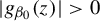 $|g_{\beta _0}(z)|>0$
,
 $z\in N_{\beta _0}$
.
Take
 $\varepsilon>0$
so small that
 $|\beta _0\unicode{x3bb} _{\beta _0}|>(1+\varepsilon )^2$
. Assume that
 $\beta>\beta _0$
is sufficiently close to
 $\beta _0$
so that
 $\beta /\beta _0$
,
 $|\beta \unicode{x3bb} _{\beta }|/|\beta _{0}\unicode{x3bb} _{\beta _{0}}|<1+\varepsilon $
and
 $|g_{\beta _0}(\unicode{x3bb} _{\beta })|/|g_{\beta _0}(\unicode{x3bb} _{\beta _0})|<1+\varepsilon $
. By replacing
 $\widehat {\phi }_{\beta _0}$
with
 $\phi _{\beta _0}$
in the calculations for obtaining inequality (3.2), we have

where
 $D_1$
and
 $D_2$
are the constants that are independent of
 $\beta $
given by

Similarly, by replacing the sequences
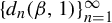 $\{d_n(\beta ,1)\}_{n=1}^\infty $
and
 $\{d_n(\beta _0,1)\}_{n=1}^\infty $
with the sequences
 $\{a_n(\beta ,1)\}_{n=1}^\infty $
and
 $\{a_n(\beta _0,1)\}_{n=1}^\infty $
, respectively, in the calculations for obtaining inequality (3.3), we have
 $$ \begin{align} \beta-\beta_0 &\geq\bigg(\sum_{n=2}^\infty a_n(\beta_0,1)\frac{(n-1)\beta^{n-2}}{\beta^{n-1}\beta_0^{n-1}}\bigg)^{-1}\bigg(\sum_{n=N+1}^\infty\frac{a_n(\beta,1)}{\beta^{n-1}}-\sum_{n=N+1}^\infty\frac{a_n(\beta_0,1)}{\beta^{n-1}}\bigg) \nonumber\\&\geq\bigg(\sum_{n=2}^\infty [\beta_0]\frac{(n-1)}{\beta_0^{n}}\bigg)^{-1}(\tau_\beta^N(1)-\tau_{\beta_0}^N(1))\frac{1}{\beta^{N}}. \end{align} $$
Since
 $$ \begin{align*} &\tau_\beta^N(1)-\tau_{\beta_0}^N(1) \\ &\quad\geq \frac{a_{N+1}(\beta_0,1)+1}{\beta}-\tau_{\beta_0}^N(1) \\ &\quad\geq\frac{a_{N+1}(\beta_0,1)+1}{\beta}-\frac{a_{N+1}(\beta_0,1)+1}{\beta_0}+\frac{a_{N+1}(\beta_0,1)+1}{\beta_0}-\tau_{\beta_0}^N(1) \\ &\quad=-\frac{a_{N+1}(\beta_0,1)+1}{\beta\beta_0}(\beta-\beta_0) +(1-\tau_{\beta_0}^{N+1}(1))\cdot\frac{1}{\beta_0}, \end{align*} $$
together with inequality (3.7), we obtain
 $$ \begin{align*}\beta-\beta_0\geq D_3^{-1} (1-\tau_{\beta_0}^{N+1}(1))\cdot\frac{1}{\beta_0^{N+1}(1+\varepsilon)^{N+1}},\end{align*} $$
where
 $D_3$
is a positive constant independent of any
 $\beta $
sufficiently close to
 $\beta _0$
. This and inequality (3.6) give

Since
 $1-M\alpha>0$
, we know that
 $(\beta -\beta _0)^{1-M\alpha }\to 0$
as
 $\beta \to \beta _0$
, which ensures that the first term on the right-hand side of inequality (3.8) is bounded above by some positive constant independent of
 $\beta $
sufficiently close to
 $\beta _0$
. As in the same way of the estimation of the second term of inequality (3.4), we have that

if
 $\beta $
is sufficiently close to
 $\beta _0$
and
 $\varepsilon $
is sufficiently small since
 $\unicode{x3bb} _\beta \to \unicode{x3bb} _{\beta _0}$
, and
 $N \to \infty $
as
 $\beta \to \beta _0$
. This shows that there is some positive constant
 $D'$
satisfying

for any
 $\beta $
sufficiently close to
 $\beta _0$
, which gives the conclusion.
(3) Let
 $\{l(N)\}_{N=1}^\infty $
be a sequence of positive integers such that
 $l(N)<l(N+1)$
and
 $d_{l(N)}(\beta _0,1)>0$
for any
 $N\geq 1$
satisfying
 $d_i(\beta _0,1)=0$
if
 $i\notin \{l(N)\}_{N=1}^\infty $
. Note that we can take such a sequence since for every
 $n\geq 1$
, there is
 $n_0$
with
 $n_0\geq n$
such that
 $d_{n_0}(\beta _0,1)>0$
by the definition of the quasi greedy expansion of
 $1$
.
For each
 $N\geq 1$
, take the positive number
 $\beta _N>1$
satisfying
 $$ \begin{align*}1=\sum_{n=1}^{l(N)}\frac{d_n(\beta_0,1)}{\beta_N^n}.\end{align*} $$
By Proposition 2.2, we know that each
 $\beta _N$
is a simple Parry number satisfying
 $\{a_n(\beta _N,1)\}_{n=1}^{l(N)}=\{d_n(\beta _0,1)\}_{n=1}^{l(N)}$
and
 $a_n(\beta _N,1)=0$
for
 $n\geq l(N)+1$
. Note that
 $\beta _N<\beta _{N+1}$
for
 $N\geq 1$
and
 ${\lim _{N\to \infty }}\beta _N=\beta _0$
. Since
 $$ \begin{align*}\beta_0-\beta_N=\sum_{n=l(N)+1}^\infty\frac{d_{n}(\beta_0,1)}{\beta_0^{n-1}}-\sum_{n=2}^{l(N)} d_n(\beta_0,1)\frac{\beta_0^{n-1}-\beta_N^{n-1}}{\beta_{0}^{n-1}\beta_N^{n-1}},\end{align*} $$
we have
 $$ \begin{align} \begin{aligned} \beta_0-\beta_N\leq \sum_{n=l(N)+1}^\infty\frac{d_{n}(\beta_0,1)}{\beta_0^{n-1}}\leq E_1 \frac{1}{\beta_0^{l(N+1)}}, \end{aligned} \end{align} $$
where
 $$ \begin{align*}E_1=\frac{[\beta_0]}{1-1/\beta_0}.\end{align*} $$
By Lemma 3.4(2), we know that there is an analytic function
 $\widehat {g}_{\beta _0}(z)$
defined on some neighbourhood of
 $\unicode{x3bb} _{\beta _0}$
such that

and
 $|\widehat {g}_{\beta _0}(\unicode{x3bb} _{\beta _0})|>0$
for any
 $\beta $
sufficiently close to
 $\beta _0$
. Since

for
 $N\geq 1$
, we obtain

for
 $N\geq 1$
. Hence,

By the fact that
 $1-M\alpha>0$
, the second term of the right side of the above inequality is bounded below by some constant independent of
 $\beta _N$
for sufficiently large
 $N\geq 1$
.
In the following, we show that there is an increasing sequence
 $\{N_i\}_{i=1}^\infty $
of positive integers such that

as
 $i\to \infty $
if
 $\alpha>\alpha _0$
. From inequality (3.11), this yields that

as
 $i\to \infty $
, since
 $|\widehat {g}_{\beta _0}(\unicode{x3bb} _{\beta _{N_i}})|\to |\widehat {g}_{\beta _0}(\unicode{x3bb} _{\beta _0})|>0$
as
 $i\to \infty $
, which gives the conclusion.
Sublemma 3.5. There are a positive constant C and a strictly increasing sequence
 $\{l^{\prime }(M)\}_{M=1}^\infty $
of positive integers with
 $d_{l'(M)}(\beta _0,1)>0$
for
 $M\geq 1$
such that

for any
 $M\geq 1$
.
Proof. Set

for
 $j\geq 1$
. First, we show that there are a positive constant C and a strictly increasing sequence
 $\{j_k\}_{k=1}^\infty $
of positive integers such that
 $|\tau _{j_k}|>C$
for
 $k\geq 1$
. Assume that
 $|\tau _j|\to 0$
as
 $j\to \infty $
. By definition, we know that
 $\beta _0\unicode{x3bb} _{\beta _0}\tau _j-d_{j}(\beta _0,1)=\tau _{j+1}$
for
 $j\geq 1$
. Then,
 $d_{j}(\beta _0,1)\leq |\beta _0\unicode{x3bb} _{\beta _0}\|\tau _j|+|\tau _{j+1}|\to 0$
as
 $j\to \infty $
, which ensures that there is a positive integer
 $j_0$
such that
 $d_{j}(\beta _0,1)=0$
for any
 $j\geq j_0$
. By the definition of the quasi-greedy expansion of
 $1$
, however, we know that for any
 $n\geq 1$
, there is
 $n_0\geq n$
such that
 $d_{n_0}(\beta _0,1)>0$
, which shows the contradiction.
If there is a strictly increasing sequence of positive integers
 $\{k_M\}_{M=1}^\infty $
satisfying
 $d_{j_{k_M}}(\beta _0,1)>0$
for any
 $M\geq 1$
, we have the conclusion by taking
 $l^{\prime }(M)=j_{k_M}$
for
 $M\geq 1$
.
If there is
 $k_0$
such that
 $d_{j_k}(\beta _0,1)=0$
for any
 $k\geq k_0$
, we can take the desired sequence as follows. Let
 $l^{\prime }(1)=\min \{n>j_{k_0}; d_n(\beta _0,1)>0\}$
. Since
 $d_n(\beta _0,1)=0$
for
 $j_{k_0}\leq n<l^{\prime }(1)$
, we have

since
 $|\beta _0\unicode{x3bb} _{\beta _0}|>1$
. Set
 $k_1$
so that
 $j_{k_1}=\min \{n>l^{\prime }(1); n\in \{j_k\}_{k=1}^\infty \}$
. We know that
 $d_{j_{m}}(\beta _0,1)=0$
for
 $m\geq k_1$
. Let
 $l^{\prime }(2)=\min \{n>j_{k_1}{\kern-1pt}; d_n(\beta _0,1)>0\}$
. Similarly to the calculation for
 $\tau _{l^{\prime }(1)}$
, we have

Inductively, by taking
 $$ \begin{align*}l^{\prime}(M)=\min\{n>j_{k_{M-1}}\ ;\ d_n(\beta_0,1)>0\}\end{align*} $$
and
 $\{k_M\}_{M=1}^\infty $
so that
 $$ \begin{align*}j_{k_M}=\min\{n>l^{\prime}(M)\ ;\ n\in\{j_k\}_{k=1}^\infty\}\end{align*} $$
for
 $M\geq 1$
, we have that
 $d_{l^{\prime }(M)}(\beta _0,1)>0$
and
 $\tau _{l^{\prime }(M)}>C$
for
 $M\geq 1$
, which finishes the proof.
Proof of Theorem 3.1, continued
Let
 $\{l^{\prime }(M)\}_{M=1}^\infty $
be the sequence as in the above sublemma. For
 $M\geq 1$
, we define the formal power series
 $P_M(z)$
by

We note that the convergence radius of
 $P_M(z)$
is at least
 $|\beta _0\unicode{x3bb} _{\beta _0}|>1$
. Let
 $\varepsilon $
be any positive number with
 $1+\varepsilon <|\beta _0\unicode{x3bb} _{\beta _0}|$
. Since

for any
 $M\geq 1$
and
 $z\in \mathbb {C}$
with
 $|z|\leq 1+\varepsilon $
, we have that
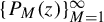 $\{P_M(z)\}_{M=1}^\infty $
is a normal family on
 $\{z\in \mathbb {C}; |z|<1+\varepsilon \}$
. Together with the fact that there is a positive constant C such that
 $|P_M(1)|>C$
for any
 $M\geq 1$
by Sublemma 3.5, we have that there are a positive number
 $\delta '>0$
and a strictly increasing sequence
 $\{M_i\}_{i=1}^\infty $
of positive integers such that
 $|P_{M_i}(z)|\geq C/2$
for any
 $z\in \mathbb {C}$
with
 $|z-1|<\delta '$
.
Take an increasing sequence
 $\{N_i\}_{i=1}^\infty $
of positive integers so that
 $l(N_i)=l'(M_i)$
for
 ${i\geq 1}$
. Let
 $\delta $
be a positive number so small that
 $\delta <\min \{\delta ',\varepsilon \}$
and
 $\beta _0^{M\alpha _0}(1-\delta )/|\beta _0\unicode{x3bb} _{\beta _0}|>1$
. For
 $i\geq 1$
so large as
 $|1-(\unicode{x3bb} _{\beta _0}/\unicode{x3bb} _{\beta _{N_i}})|<\delta $
, we have

Together with inequality (3.10), we obtain

for
 $i\geq 1$
and
 $\alpha>0$
. Since

for
 $\alpha>\alpha _0$
, we have that the right-hand side of inequality (3.12) goes to infinity as
 $i\to \infty $
if
 $\alpha>\alpha _0$
, which ends the proof.
Remark 3.6. In the proof of Theorem 3.1(3), we in fact show that the function
 $\beta \in U_{\beta _0}\mapsto \unicode{x3bb} _{\beta }\in V_{\beta _0}$
is not
 $\alpha $
-Hölder continuous from the left at
 $\beta _0$
if
 $\alpha>\alpha _0$
. Establishing the same result for the right continuity seems to be a more delicate problem and it may depend on the coefficient sequence of the quasi-greedy expansion of
 $1$
.
4 Properties of eigenfunctionals
In this section, we relate the value of every eigenfunctional of
 $\mathcal {L}_\beta $
applied to the indicator function of an interval to the greedy expansion (Proposition 4.2) and give its three applications. The following lemma is a key tool for obtaining the main results in this section.
Lemma 4.1. Let
 $n\geq 0$
be a non-negative integer. Then, we have
 $$ \begin{align*} \mathcal{L}_\beta \mathbf{1}_{[0,\tau_\beta^n(x)]}=\frac{a_{n+1}(\beta,x)}{\beta}\mathbf{1}_{[0,1]}+\frac{1}{\beta}\mathbf{1}_{[0,\tau_\beta^{n+1}(x)]}, \end{align*} $$
where
 $\mathbf {1}_A$
denotes the indicator function of A.
Proof. By the definition of
 $\mathcal {L}_{\beta }$
, for
 $a\in [0,1]\setminus \{\tau ^{n+1}_\beta (x)\}$
, we have
 $$ \begin{align*}\begin{aligned} \beta\mathcal{L}_{\beta}\mathbf{1}_{[0,\tau_{\beta}^{n}(x)]}(a) &=\#\{b\in[0,\tau_{\beta}^n(x)]\ ;\ a=\tau_{\beta}(b)\} \\&= \begin{cases} a_{n+1}(\beta,x)+1 &(a<\tau_\beta^{n+1}(x)), \\a_{n+1}(\beta,x) & (a>\tau_\beta^{n+1}(x)), \\ \end{cases} \end{aligned}\end{align*} $$
since the map
 $\tau _{\beta }$
is bijective on
 $[i/\beta ,(i+1)/\beta )$
for
 $0\leq i \leq [\beta ]-1$
. This shows that
 $$ \begin{align*}\mathcal{L}_\beta \mathbf{1}_{[0,\tau_\beta^n(x)]}=\frac{a_{n+1}(\beta,x)}{\beta}\mathbf{1}_{[0,1]}+\frac{1}{\beta}\mathbf{1}_{[0,\tau_\beta^{n+1}(x)]},\end{align*} $$
which finishes the proof.
Proposition 4.2. Let
 $\unicode{x3bb} \in \mathbb {C}$
be an isolated eigenvalue of the Perron–Frobenius operator
 $\mathcal {L}_{\beta }$
with
 $|\unicode{x3bb} |>1/\beta $
and let
 $\nu \in \widehat {BV}^*$
be an eigenfunctional corresponding to
 $\unicode{x3bb} $
. Then, for
 $x\in [0,1]$
, we have
 $$ \begin{align*}\nu(\mathbf{1}_{[0,x]})=\nu(\mathbf{1}_{[0,1]})\sum_{n=1}^{\infty}\frac{a_n(\beta, x)}{\beta^n\unicode{x3bb}^n}.\end{align*} $$
In addition,
 $\nu (\mathbf {1}_{[0,1]})\neq 0$
.
Proof. Since
 $\nu $
is an eigenfunctional of the Perron–Frobenius operator
 $\mathcal {L}_\beta $
, we know that
 $$ \begin{align*}\nu(f)=\frac{(\mathcal{L}_\beta^*\nu)(f)}{\unicode{x3bb}} =\frac{\nu(\mathcal{L}_\beta f)}{\unicode{x3bb}}\end{align*} $$
for
 $f\in \widehat {BV}$
. By Lemma 4.1, we have
 $$ \begin{align*} \nu(\mathbf{1}_{[0, \tau_\beta^n(x)]}) &=\frac{\nu(\mathcal{L}_\beta \mathbf{1}_{[0, \tau_\beta^n(x)]})}{\unicode{x3bb}} \\ &=\frac{1}{\unicode{x3bb}}\bigg(\nu\bigg(\frac{a_{n+1}(\beta, x)}{\beta}\mathbf{1}_{[0,1]}+\frac{1}{\beta}\mathbf{1}_{[0,\tau_\beta^{n+1}(x)]}\bigg)\bigg) \\ &=\frac{a_{n+1}(\beta, x)}{\beta\unicode{x3bb}}\nu(\mathbf{1}_{[0,1]})+\frac{\nu(\mathbf{1}_{[0,\tau_\beta^{n+1}(x)]})}{\beta\unicode{x3bb}} \end{align*} $$
for
 $n\geq 0$
and
 $x\in [0,1]$
. By using this formula inductively, we obtain
 $$ \begin{align} \nu(\mathbf{1}_{[0,x]}) &=\frac{a_{1}(\beta, x)}{\beta\unicode{x3bb}}\nu(\mathbf{1}_{[0,1]})+\frac{\nu(\mathbf{1}_{[0,\tau_\beta^{}(x)]})}{\beta\unicode{x3bb}}\nonumber\\ &= \frac{a_{1}(\beta, x)}{\beta\unicode{x3bb}}\nu(\mathbf{1}_{[0,1]})+\frac{a_{2}(\beta, x)}{\beta^2\unicode{x3bb}^2}\nu(\mathbf{1}_{[0,1]})+\frac{\nu(\mathbf{1}_{[0,\tau_\beta^{2}(x)]})}{\beta^2\unicode{x3bb}^2}\nonumber\\ &=\cdots \nonumber\\ &=\sum_{n=1}^N\frac{a_n(\beta, x)}{\beta^n\unicode{x3bb}^n}\nu(\mathbf{1}_{[0,1)})+\frac{\nu(\mathbf{1}_{[0,\tau_\beta^{N+1}(x)]})}{\beta^{N+1}\unicode{x3bb}^{N+1}} \end{align} $$
for
 $N\geq 1$
. Note that
 $|\beta \unicode{x3bb} |>1$
since
 $1/\beta <|\unicode{x3bb} |\leq 1$
. Together with the fact that
 $$ \begin{align*}|\nu(\mathbf{1}_{[0,\tau_\beta^m(x)]})|\leq\|\nu\|\cdot(|\mathbf{1}_{[0,\tau_\beta^m(x)]}|_{\infty}+\operatorname{var}(\mathbf{1}_{[0,\tau_\beta^m(x)]}))\leq2 \|\nu\|\end{align*} $$
for
 $m\geq 0$
, where
 $\|\cdot \|$
denotes the operator norm on
 $\widehat {BV}^*$
, taking
 $N\to \infty $
in the right-hand side of equation (4.1) gives
 $$ \begin{align} \nu(\mathbf{1}_{[0,x]})=\nu(\mathbf{1}_{[0,1]})\cdot\sum_{n=1}^{\infty}\frac{a_n(\beta, x)}{\beta^n\unicode{x3bb}^n}, \end{align} $$
as desired.
We shall prove that
 $\nu (\mathbf {1}_{[0,1]})\neq 0$
. Let
 $h\in \widehat {BV}$
be an eigenfunction of
 $\mathcal {L}_\beta $
corresponding to
 $\unicode{x3bb} $
. Since the geometric multiplicity of the eigenspace of
 $\mathcal {L}_\beta $
corresponding to
 $\unicode{x3bb} $
is equal to
 $1$
by Proposition 2.3, we know that
 $\nu (h)\neq 0$
for any eigenfunctional
 $\nu \in \widehat {BV}^*\setminus \{0\}$
corresponding to
 $\unicode{x3bb} $
. By [Reference Suzuki23, Theorem 3.2], the eigenfunction h has the form
 $$ \begin{align*}h=C \sum_{m=0}^\infty\frac{\mathbf{1}_{[0,\tau_\beta^m(1)]}}{\beta^m\unicode{x3bb}^m},\end{align*} $$
where C is a non-zero constant. Together with equation (4.2), we obtain
 $$ \begin{align*} \nu(h) =C\cdot \sum_{m=0}^\infty\frac{\nu(\mathbf{1}_{[0,\tau_\beta^m(1)]})}{\beta^m\unicode{x3bb}^m} =\nu(\mathbf{1}_{[0,1]})\cdot C\cdot\sum_{m=0}^\infty\sum_{n=1}^\infty \frac{a_n(\beta, \tau^m_{\beta}(1))}{\beta^{m+n}\unicode{x3bb}^{m+n}}, \end{align*} $$
which concludes that
 $\nu (\mathbf {1}_{[0,1]})\neq 0$
.
Let
 $\unicode{x3bb} \in \mathbb {C}$
be a complex number with
 $1/\beta <|\unicode{x3bb} |\leq 1$
. As motivated by the formula for an eigenfunctional of
 $\mathcal {L}_\beta $
in Proposition 4.2, we investigate the complex-valued function
 $F_\unicode{x3bb} :[0,1]\to \mathbb {C}$
defined by
 $$ \begin{align} F_\unicode{x3bb}(x)=\sum_{n=1}^{\infty}\frac{a_n(\beta, x)}{\beta^n\unicode{x3bb}^n} \end{align} $$
for
 $x\in [0,1]$
. The main result of this section is the following characterization for
 $\unicode{x3bb} \in \mathbb {C}$
and
 $F_\unicode{x3bb} $
.
Theorem 4.3. Let
 $\unicode{x3bb} \in \mathbb {C}$
be a complex number with
 $1/\beta <|\unicode{x3bb} |\leq 1$
. Then, we have the following.
-
(1) The function
$F_\unicode{x3bb} (x)$
is right-continuous on
$[0,1)$
. -
(2) The function
$F_\unicode{x3bb} (x)$
is left-continuous at any non-simple
$x\in (0,1]$
. -
(3) The function
$F_\unicode{x3bb} (x)$
is left-continuous at any simple
$x\in (0,1]$
if and only if
$\unicode{x3bb} $
is an isolated eigenvalue of
$\mathcal {L}_\beta $
. -
(4) If
$\unicode{x3bb} $
is the leading eigenvalue
$1$
of
$\mathcal {L}_\beta $
, then
$F_\unicode{x3bb} (x)=x$
. In particular, it is differentiable on
$[0,1]$
. -
(5) If
$\unicode{x3bb} $
is a non-leading eigenvalue of
$\mathcal {L}_\beta $
, then
$F_\unicode{x3bb} (x)$
is not Lipschitz continuous on
$[0,1]$
. In particular, it is nowhere differentiable on
$[0,1]$
.


Proof. (1) By definition, the function
 $$ \begin{align*}x\in[0,1)\mapsto a_{n}(\beta, x)=[\beta\tau_\beta^{n-1}(x)]\in\{0,\ldots,[\beta]\}\end{align*} $$
is right continuous for each
 $n\geq 1$
. Since
 $\sum _{n=1}^N a_n(\beta , x)/(\beta \unicode{x3bb} )^n$
converges uniformly for
 $x\in [0,1]$
as
 $N\to \infty $
, we have that the limit
 $F_\unicode{x3bb} (x)=\sum _{n=1}^\infty a_n(\beta , x)/(\beta \unicode{x3bb} )^n$
is also right continuous on
 $[0,1)$
.
(2) Assume that
 $x_0\in (0,1]$
is non-simple, that is,
 $\tau _\beta ^m(x_0)\notin \{1/\beta ,\ldots ,[\beta ]/\beta \}$
for any
 $m\geq 0$
. In this case, left continuity of all the functions
 $$ \begin{align*}x\in(0,1]\mapsto a_{n}(\beta, x)=[\beta\tau_\beta^{n-1}(x)]\in\{0,\ldots,[\beta]\}\end{align*} $$
at
 $x_0$
for any
 $n\geq 1$
gives the conclusion since
 $\sum _{n=1}^N a_n(\beta , x)/(\beta \unicode{x3bb} )^n$
converges uniformly for
 $x\in (0,1]$
as
 $N\to \infty $
. This yields the limit
 $F_\unicode{x3bb} (x)=\sum _{n=1}^\infty a_n(\beta , x)/(\beta \unicode{x3bb} )^n$
is also left continuous at non-simple
 $x_0$
.
(3) Assume that
 $x_0\in [0,1]$
is simple, that is, there is a positive integer
 $L(x_0)\geq 1$
such that
 $\tau _\beta ^{L(x_0)-1}(x_0)\in \{1/\beta ,\ldots ,[\beta ]/\beta \}$
. Then, the
 $\beta $
-expansion of
 $x_0$
is finite, that is,
 $$ \begin{align*}x_0=\sum_{n=1}^{L(x_0)}\frac{a_n(\beta, x_0)}{\beta^n}.\end{align*} $$
By the left-continuity of the digit sequence
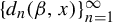 $\{d_n(\beta ,x)\}_{n=1}^\infty $
of the quasi-greedy expansion as noted in §2, the limit of the digit sequence of the greedy expansion from the left is equal to that of the quasi-greedy expansion. This yields
 $$ \begin{align*}F_\unicode{x3bb}(x_0)=\sum_{n=1}^{L(x_0)}\frac{a_n(\beta, x_0)}{\beta^n\unicode{x3bb}^n}\end{align*} $$
and
 $$ \begin{align*} \lim_{x\nearrow x_0}F_\unicode{x3bb}(x_0) &=\sum_{n=1}^\infty\frac{d_n(\beta,x_0)}{\beta^n\unicode{x3bb}^n} \\ &=\sum_{n=1}^{L(x_0)}\frac{a_n(\beta, x_0)}{\beta^n\unicode{x3bb}^n}-\frac{1}{\beta^{L(x_0)}\unicode{x3bb}^{L(x_0)}}+\frac{1}{\beta^{L(x_0)}\unicode{x3bb}^{L(x_0)}}\sum_{n=1}^\infty\frac{d_n(\beta, 1)}{\beta^n\unicode{x3bb}^n}. \end{align*} $$
Hence, it is sufficient to show that
 $$ \begin{align*}-\frac{1}{\beta^{L(x_0)}\unicode{x3bb}^{L(x_0)}}+\frac{1}{\beta^{L(x_0)}\unicode{x3bb}^{L(x_0)}}\sum_{n=1}^\infty\frac{d_n(\beta,1)}{\beta^n\unicode{x3bb}^n}=0,\end{align*} $$
namely,
 $$ \begin{align*}1=\sum_{n=1}^\infty\frac{d_n(\beta,1)}{\beta^n\unicode{x3bb}^n}=\hat{\phi}_\beta(\unicode{x3bb}^{-1}).\end{align*} $$
Since
 $\unicode{x3bb} $
is an isolated eigenvalue of
 $\mathcal {L}_\beta $
, by Theorem 2.6, we know that
 ${1-\phi _\beta (\unicode{x3bb} ^{-1})=0}$
. Hence,
 $1-\hat {\phi }_\beta (\unicode{x3bb} ^{-1})=0$
follows from Proposition 2.7, which gives the conclusion.
(4) Let
 $\unicode{x3bb} =1$
. By the definition of the beta-expansion of
 $x\in [0,1]$
, we have
 $$ \begin{align*}F_1(x)=\sum_{n=1}^\infty\frac{a_n(x)}{\beta^n}=x,\end{align*} $$
which yields the conclusion.
(5) Let
 $\unicode{x3bb} $
be a non-eigenvalue of
 $\mathcal {L}_\beta $
. In the case of
 $x=0$
, by taking
 $x_N=1/\beta ^N$
for
 $N\geq 1$
, we have
 $$ \begin{align*}\bigg|\frac{F_\unicode{x3bb}(x_N)-F_\unicode{x3bb}(0)}{x_N-0}\bigg|=\beta^N\bigg|\frac{1}{\beta^N\unicode{x3bb}^N}\bigg|=\frac{1}{|\unicode{x3bb}|^N}\to\infty\end{align*} $$
as
 $N\to \infty $
, which provides the conclusion at
 $x=0$
.
Let
 $x_0\in (0,1]$
. Assume that the function
 $F_\unicode{x3bb} (x)$
is Lipschitz continuous from the left at
 $x_0$
, that is, there are a positive constant
 $C>0$
and
 $\delta>0$
such that
 $$ \begin{align*}|F_\unicode{x3bb}(x)-F_\unicode{x3bb}(x_0)|\leq C|x-x_0|\end{align*} $$
for any
 $x\in (x_0-\delta , x_0]$
.
We shall show that
 $$ \begin{align*}F_\unicode{x3bb}(x)=\sum_{n=1}^\infty\frac{a_n(\beta,x)}{\beta^n\unicode{x3bb}^n}=\sum_{n=1}^\infty\frac{d_n(\beta,x)}{\beta^n\unicode{x3bb}^n}\end{align*} $$
for
 $x\in (0,1]$
. If x is non-simple, we have the result by the fact that
 $\{d_n(\beta ,x)\}_{n=1}^\infty =\{a_n(\beta ,x)\}_{n=1}^\infty $
. If x is simple, by the definition of the sequence
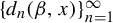 $\{d_n(\beta ,x)\}_{n=1}^\infty $
and by Proposition 2.7, we have
 $$ \begin{align*} \sum_{n=1}^\infty\frac{d_n(\beta,x)}{\beta^n\unicode{x3bb}^n}&= \sum_{n=1}^{L(x)}\frac{a_n(\beta,x)}{\beta^n\unicode{x3bb}^n}-\frac{1}{(\beta\unicode{x3bb})^{L(x)}}+\sum_{n=1}^\infty\frac{d_n(\beta,1)}{\beta^n\unicode{x3bb}^n}\frac{1}{(\beta\unicode{x3bb})^{L(x)}} \\ &=\sum_{n=1}^{L(x)}\frac{a_n(\beta,x)}{\beta^n\unicode{x3bb}^n}- \frac{1}{(\beta\unicode{x3bb})^{L(x)}}+\frac{1}{(\beta\unicode{x3bb})^{L(x)}} \\ &=\sum_{n=1}^{\infty}\frac{a_n(\beta,x)}{\beta^n\unicode{x3bb}^n},\end{align*} $$
which gives the desired result.
Since
 $\{d_n(\beta ,x_0)\}_{n=1}^\infty $
is the digit sequence of the quasi-greedy expansion of
 $x_0$
, there is a sequence of positive integers
 $\{l(k)\}_{k=1}^\infty $
such that
 $l(k)<l(k+1)$
for any
 $k\geq 1$
and
 $d_{l(k)}(\beta ,x_0)>0$
for all
 $k\geq 1$
. By Proposition 2.1, we can take a number
 $x_k$
for
 $k\geq 1$
whose greedy expansion is given by
 $x_k=\sum _{n=1}^{l(k)}d_n(\beta ,x_0)/\beta ^n$
. Note that
 $x_k<x_{k+1}$
for
 ${k\geq 1}$
and
 $\lim _{k\to \infty }x_k=x_0$
. For sufficiently large k so that
 $x_k\in (x_0-\delta , x_0]$
, we have
 $$ \begin{align*} \bigg|\frac{F_\unicode{x3bb}(x_k)-F_\unicode{x3bb}(x_0)}{x_k-x_0} \bigg| &\geq \frac{|F_\unicode{x3bb}(x_{k+1})-F_\unicode{x3bb}(x_k)|}{|x_k-x_0|}-\frac{|x_{k+1}-x_0|}{|x_k-x_0|}\frac{|F_\unicode{x3bb}(x_{k+1})-F_\unicode{x3bb}(x_0)|}{|x_{k+1}-x_0|} \\ &\geq\frac{1-1/\beta}{[\beta]}\frac{(\beta|\unicode{x3bb}|)^{-l(k+1)}}{(\beta)^{-l(k+1)}}-C \\ &= \frac{1-1/\beta}{[\beta]}\frac{1}{|\unicode{x3bb}|^{l(k+1)}}-C\to\infty \end{align*} $$
as
 $k\to \infty $
, which gives the contradiction.
Remark 4.4. By using the equation
 $$ \begin{align*}\frac{a_n(\beta,x)}{\beta^n}=\frac{\tau^{n-1}_\beta(x)}{\beta^{n-1}}-\frac{\tau^{n}_\beta(x)}{\beta^{n}}\end{align*} $$
for
 $n\geq 1$
and
 $x\in [0,1]$
, we obtain
 $$ \begin{align*} F_\unicode{x3bb}(x)&=\sum_{n=1}^\infty\frac{a_n(\beta,x)}{\beta^n\unicode{x3bb}^n}=\sum_{n=1}^\infty\frac{\tau^{n-1}_\beta(x)}{\beta^{n-1}\unicode{x3bb}^n}-\sum_{n=1}^\infty\frac{\tau^{n}_\beta(x)}{\beta^{n}\unicode{x3bb}^n} \\ &=\frac{x}{\unicode{x3bb}}+\bigg(\frac{1}{\unicode{x3bb}}-1\bigg)\sum_{n=1}^\infty\frac{\tau^{n}_\beta(x)}{\beta^{n}\unicode{x3bb}^n} \end{align*} $$
for
 $x\in [0,1]$
. We note that the function
 ${\rho _\beta (x)=\sum _{n=1}^\infty ({\tau ^{n}_\beta (x)}/{\beta ^{n}\unicode{x3bb} ^n})}$
appearing on the right-hand side of the above equation can be regarded as a version of the Takagi function, which is obtained if we replace
 $\beta \unicode{x3bb} $
with
 $2$
and the map
 $\tau _\beta $
with the tent map in the definition of
 $\rho _\beta (x)$
. The Takagi function is known as a typical example of a singular function as it is continuous but nowhere differentiable everywhere, which has been investigated in the context of fractal geometry (for more detail, see [Reference Allaart and Kawamura1]).
As an application of Theorem 4.3(5), we show that an eigenfunctional corresponding to each non-leading eigenvalue cannot be expressed by any complex measure. This is in contrast to the case of the leading eigenvalue
 $1$
since by Theorem 4.3(4), the normalized eigenfunctional of the leading eigenvalue
 $1$
is expressed by the Lebesgue measure.
Theorem 4.5. Let
 $\beta>1$
be a non-integer and let
 $\unicode{x3bb} \in \mathbb {C}$
be a non-leading eigenvalue of the Perron–Frobenius operator
 $\mathcal {L}_{\beta }$
. Then, for any corresponding eigenfunctional
 ${\nu \in \widehat {BV}^*}$
, there is no complex-valued measure m such that
 $$ \begin{align*}\nu(f)=\int_{0}^1 f\, dm\end{align*} $$
for
 $f\in \widehat {BV}$
.
Proof. Let
 $\unicode{x3bb} $
be a non-leading eigenvalue of
 $\mathcal {L}_\beta $
and let
 $\nu _\unicode{x3bb} $
be the corresponding eigenfunctional with
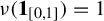 $\nu (\mathbf {1}_{[0,1]})=1$
. Assume that there is a complex-valued measure m such that
 $\nu _\unicode{x3bb} (f)=m(f)$
for any
 $f\in \widehat {BV}$
. By taking
 $f=\mathbf {1}_{[0,x]}$
for
 $x\in [0,1]$
, we obtain
 $$ \begin{align*}m([0,x])=m(\mathbf{1}_{[0,x]})=\nu_\unicode{x3bb}(\mathbf{1}_{[0,x]})=F_\unicode{x3bb}(x).\end{align*} $$
Since m is a complex measure, the function
 $m([0,x])$
for
 $x\in [0,1]$
is of bounded variation. In particular, it is differentiable for almost every
 $x\in [0,1]$
with respect to the Lebesgue measure. This contradicts the fact that
 $F_\unicode{x3bb} (x)$
is nowhere differentiable on
 $[0,1]$
followed from Theorem 4.3(5).
In the rest of this section, we consider a real number
 $\beta \in (1,\infty )$
for which the corresponding Perron–Frobenius operator has at least one non-leading eigenvalue. Let
 $M(\beta )=\max \{|\unicode{x3bb} |\; \unicode{x3bb} \in \mathbb {C}\ \text { is a non-leading eigenvalue}\}$
. Note that
 $1/\beta < M(\beta )<1$
since the modulus of each non-leading eigenvalue is in
 $(1/\beta , 1)$
and eigenvalues are isolated in the set
 $\{z\in \mathbb {C}\ ;\ 1/\beta <|z|\leq 1\}$
. We say that a non-leading eigenvalue
 $\unicode{x3bb} \in \mathbb {C}$
is sub-leading if its modulus is equal to
 $M(\beta )$
. For a function
 $f\in \widehat {BV}$
, we say that f has a good decay rate of correlations if there are a positive constant
 $C>0$
and a positive number
 $\alpha $
with
 $1/\beta \leq \alpha <M(\beta )$
such that
 $$ \begin{align*}\|\mathcal{L}_\beta^n f\|_{\widehat{BV}}\leq C\alpha^n\end{align*} $$
for
 $n\geq 1$
. Note that if a function
 $f\in \widehat {BV}$
has a good decay rate of correlations, then
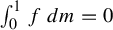 $\int _0^1 f\, dm=0$
and it holds
 $$ \begin{align*}\bigg|\kern-2pt\int_{0}^1f \cdot g\circ\tau_\beta^n\,d\mu_\beta-\int_0^1f\, d\mu_\beta\int_0^1g\,d\mu_\beta \bigg|\leq C|g|_\infty \alpha^n\end{align*} $$
for
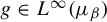 $g\in L^\infty (\mu _\beta )$
and
 $n\geq 1$
by the spectral decomposition equation (2.1) of
 $\mathcal {L}_\beta $
(see e.g. [Reference Baladi2, Reference Boyarsky and Góra6, Reference Hofbauer and Keller16]). The following result gives a sufficient condition that a step function has a good decay rate of correlations.
Theorem 4.6. Let
 $\beta \in (1,\infty )$
be a real number such that the corresponding Perron–Frobenius operator
 $\mathcal {L}_{\beta }$
actually has a non-leading eigenvalue. Assume that all the sub-leading eigenvalues
 $\{\unicode{x3bb} _i\}_{i=1}^N$
are simple. Then, a step function
 $f:[0,1]\to \mathbb {C}$
of the form
 $$ \begin{align*}f(x)=\sum_{i=0}^{N+K}c_i\mathbf{1}_{[0,x_i]}(x)\end{align*} $$
for
 $x\in [0,1]$
, where
 $K\geq 1$
,
 $c_i\in \mathbb {C}$
for
 $0\leq i\leq N+K$
and
 $x_i\in [0,1]$
for
 $1\leq i\leq N+K$
with
 $x_j\neq x_k$
if
 $j\neq k$
, has a good decay rate of correlations if the coefficients
 $\{c_i\}_{i=0}^{N+K}$
are a solution of the following
 $(N+1)\times (N+K+1)$
matrix equation:

where
 $F_{\unicode{x3bb} _i}(x)$
is the function defined by

for
 $x\in [0,1]$
and
 $1\leq i\leq N$
.
Remark 4.7.
-
(1) In [Reference Collet and Eckmann9, §9.2], the authors provide an example of a piecewise linear unimodal Markov map for which isolated eigenvalues and the corresponding eigenfunctions of its Perron–Frobenius operator can be given explicitly. As an application, they also gave locally constant functions that have a good decay rate of correlations in the sense of this paper. From the above theorem, we can provide additional examples of a larger class of step functions which have a good decay rate of correlations in the setting of beta-maps.
-
(2) The assumption that all the sub-leading eigenvalues are simple seems to hold in many cases, including the case of Parry numbers less than
$3$
whose beta conjugates are not units (see [Reference Verger-Gaugry25, Corollary 3.9]). In the Appendix, we construct a countable set of
$\beta $
with
$\beta>3$
such that all sub-leading eigenvalues of the corresponding Perron–Frobenius operator are simple.


Proof of Theorem 4.6
Since the dimension of the solution space of an
 $(N+1)\times (N+K+1)$
-matrix is at least K, there exactly exists an
 $(N+K+1)$
-dimensional vector satisfying equation (4.4). We shall show a step function
 $f(x)=\sum _{i=0}^{N+K}c_i\mathbf {1}_{[0,x_i]}(x)$
, whose coefficients
 $\{c_i\}_{i=0}^{N+K}$
satisfying equation (4.4), belongs to the kernel of the normalized eigenfunctional
 $\nu _{\unicode{x3bb} _i}$
of
 $\unicode{x3bb} _i$
for
 $1\leq i\leq N$
with
 $\nu _{\unicode{x3bb} _i}(\mathbf {1}_{[0,1]})=1$
and
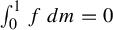 $\int _0^1 f \,dm=0$
. By calculating the inner product of the first raw of the matrix given in equation (4.4) and the vector
 $(c_0, \ldots , c_{N+K})$
, we have
 $$ \begin{align*}\int_{0}^1 f dm=\sum_{i=0}^{N+K} c_ix_i=0.\end{align*} $$
Furthermore, by Proposition 4.2 and equation (4.4), we obtain

for
 $1\leq j\leq N$
. By the spectral decomposition equation (2.1) of the Perron–Frobenius operator
 $\mathcal {L}_\beta $
, we know that the terms for the leading eigenvalue
 $1$
and the subleading eigenvalues
 $\{\unicode{x3bb} _i\}_{i=1}^N$
in the sum of the right-hand side of equation (2.1) vanish, which finishes the proof.
Acknowledgements
The author would like to thank Hiroki Sumi, Hiroki Takahasi and Masato Tsujii for their valuable comments. This work was supported by JSPS KAKENHI Grant Number 20K14331 and 24K16932.
A Appendix. Examples
This appendix is devoted to giving three examples of countable sets of
 $\beta $
such that all subleading eigenvalues of
 $\mathcal {L}_\beta $
are simple.
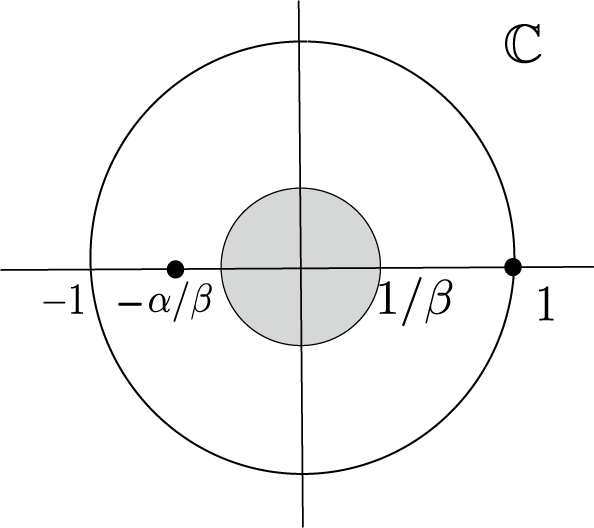
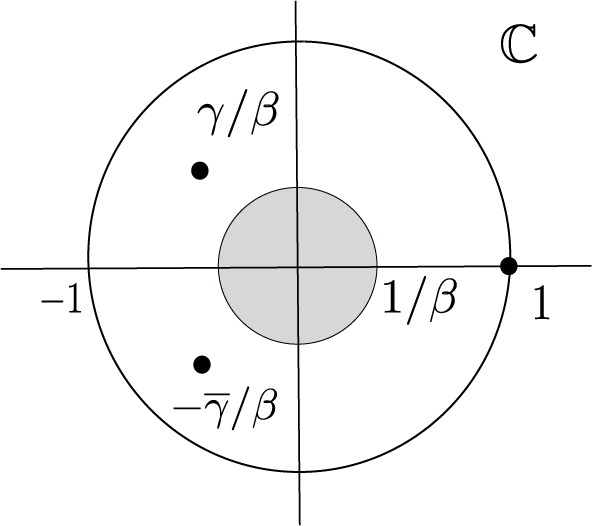
Example A.1. For a positive integer
 $n\geq 3$
, we give an example of
 $\beta \in (n,n+1)$
such that it is a simple Parry number, and the Perron–Frobenius operator
 $\mathcal {L}_\beta $
has only one non-leading eigenvalue on the negative axis, which is simple (see Figure A1). We define the polynomial
 $p_n(x)$
by
 $$ \begin{align*}p_n(x)=x^4-nx^3-(n-1)x^2-n.\end{align*} $$
Since
 $$ \begin{align*}p_n^{\prime}(x)=x(4x^2-3nx-2(n-1)),\end{align*} $$
the function
 $p_n(x)$
for
 $x\in \mathbb {R}$
has the two local minima at
 $$ \begin{align*}x^+:=\frac{3n+\sqrt{9n^2+8(n-1)}}{8}>\frac{3n}{2}\quad \text{and}\quad x^-:=\frac{3n-\sqrt{9n^2+8(n-1)}}{8}>-1 \end{align*} $$
and the local maximum at
 $0$
. Hence, the function
 $p_n(x)$
is increasing on
 $(x^-,0)$
and
 $(x^+,+\infty )$
, and is decreasing on
 $(-\infty , x^{-}]$
and
 $[0,x^+]$
. Since
 $p_n(0)=-n<0$
and
 $p_n(-1)=2-n<0$
, the function
 $p_n(x)$
has two real solutions
 $\beta $
with
 $3\leq n<\beta <n+1$
and
 $-\alpha $
with
 $-\alpha <-1$
. In addition,
 $p_n(x)$
has two complex solutions
 $\gamma , \bar {\gamma }\in \mathbb {C}$
satisfying
 $\beta (-\alpha )|\gamma |^2=-n$
, which yields
 $$ \begin{align*}|\gamma|^2=\frac{n}{\beta\alpha}<\frac{n}{n\cdot1}=1.\end{align*} $$
By the fact that
 $\beta $
satisfies
 $$ \begin{align*}1=\frac{n}{\beta}+\frac{n-1}{\beta^2}+\frac{0}{\beta^3}+\frac{n}{\beta^4},\end{align*} $$
we have that
 $a_1(\beta ,1)=n$
,
 $a_2(\beta ,2)=n-1$
,
 $a_3(\beta ,1)=0$
and
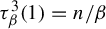 $\tau _\beta ^3(1)=n/\beta $
by the definition of the map
 $\tau _\beta $
. Since
 $p_n(x)=x^4(1-\phi _\beta (\beta /x))$
for
 $x\in \mathbb {R}$
with
 $|x|<\beta $
, we have that
 $1-\phi _\beta (z)$
has a unique zero
 $-\beta /\alpha \in (-\beta ,-1)\subset \{z\in \mathbb {C}; 1<|z|<\beta \}$
, which yields
 $-\alpha /\beta \in (-1,-1/\beta )$
is a unique non-leading eigenvalue of
 $\mathcal {L}_\beta $
, which is simple.


The spectrum of
 $\mathcal {L}_\beta $
in Example A.2.

Example A.2. For a positive integer
 $n\geq 4$
, we give an example of
 $\beta \in (n,n+1)$
such that it is a simple Parry number and the Perron–Frobenius operator
 $\mathcal {L}_\beta $
has two complex non-leading eigenvalues, which are simple (see Figure A2). We define the polynomial
 $q_n(x)$
by
 $$ \begin{align*}q_n(x)=x^4-nx^3-(n-1)x-n.\end{align*} $$
Since
 $$ \begin{align*}q_n^{\prime}(x)=4x^3-3nx^2-(n-1)\end{align*} $$
and
 $$ \begin{align*}q_n^{\prime\prime}(x)=6x(2x-n),\end{align*} $$
the equation
 $q_n^{\prime }(x)=0$
has only one real solution
 $x^+\in (n/2, \infty )$
by the fact that
 $q_n^{\prime }(0)=-(n-1)<0$
. This shows that
 $q_n^{\prime }(x)<0$
for
 $x\in (-\infty , x^+)$
and
 $q_n^{\prime }(x)>0$
for
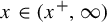 $x\in (x^+,\infty )$
. Hence, we have that the function
 $q_n(x)$
for
 $x\in \mathbb {R}$
has the local minimum at
 $x^+$
, which yields that it is decreasing on
 $(-\infty , x^+)$
and increasing on
 $(x^+,\infty )$
. Since
 $q_n(-1)=n>0$
,
 $q_n(1)=-3n+2<0$
,
 $q_n(n)<0$
and
 $q_n(n+1)>0$
, the equation
 $q_n(x)=0$
has the two real solutions,
 $\beta $
with
 $n<\beta <n+1$
and
 $-\alpha $
with
 $0<\alpha <1$
. Furthermore, it has complex solutions
 $\gamma , \bar {\gamma }\in \mathbb {C}$
satisfying
 $\beta (-\alpha )|\gamma |^2=-n$
, which implies
 $$ \begin{align*}|\gamma|^2=\frac{n}{\alpha\beta}>\frac{n}{(n+1)\alpha}>1,\end{align*} $$
since
 $\alpha <n/(n+1)$
by the fact that
 $$ \begin{align*} q_n\bigg(-\frac{n}{n+1}\bigg) &>\frac{n^4}{(n+1)^3}+\frac{n(n-1)}{n+1}-n \\ &=\frac{n^4-2n(n+1)^2}{(n+1)^3}>0. \end{align*} $$
Since
 $$ \begin{align*}1=\frac{n}{\beta}+\frac{0}{\beta^2}+\frac{n-1}{\beta^3}+\frac{n}{\beta^4},\end{align*} $$
we have that
 $a_1(\beta ,1)=n$
,
 $a_2(\beta ,1)=0$
,
 $a_3(\beta ,1)=n-1$
and
 $\tau _\beta ^3(1)=n/\beta $
by the definition of the map
 $\tau _\beta $
. Since
 $q_n(x)=x^4(1-\phi _\beta (\beta /x))$
for
 $x\in \mathbb {R}$
with
 $|x|<\beta $
, we have that
 $1-\phi _\beta (z)$
has two zeros
 $-\beta /\gamma $
and
 $-\beta /\bar {\gamma }$
with
 $1<|\gamma |<\beta $
, which yields
 $-\gamma /\beta $
and
 $-\bar {\gamma }/\beta $
are non-leading eigenvalues of
 $\mathcal {L}_\beta $
, which are simple.
Example A.3. For a positive integer
 $n\geq 4$
, we give an example of
 $\beta \in (n,n+1)$
such that it is a non-simple Parry number and the corresponding Perron–Frobenius operator
 $\mathcal {L}_\beta $
has only one non-leading eigenvalue on the negative axis, which is simple (see Figure A1). We define the polynomial
 $r_n(x)$
by
 $$ \begin{align*}r_n(x)=x^4-(n+1)x^3+nx-(n-1).\end{align*} $$
Note that
 $$ \begin{align*}r_n^{\prime}(x)=4x^3-3(n+1)x^2+n\end{align*} $$
and
 $$ \begin{align*}r_n^{"}(x)=6x(2x-(n+1)).\end{align*} $$
Since
 $r_n^{"}(x)=0$
if and only if
 $x=0$
or
 $(n+1)/2$
, the function
 $r^{\prime \prime }_n(x)$
for
 $x\in \mathbb {R}$
has the local maximum at
 $0$
and the local minimum at
 $(n+1)/2$
, the function
 $r^{\prime }_n(x)$
for
 $x\in \mathbb {R}$
is decreasing on
 $(0,(n+1)/2)$
and increasing on
 $(-\infty , 0)\cup ((n+1)/2, \infty )$
. By the fact that
 $r_n^{\prime }(0)=n>0$
and
 $r^{\prime }_n((n+1)/2)<r^{\prime }_n(1)=1-2n<0$
, the equation
 $r_n^{\prime }(x)=0$
for
 $x\in \mathbb {R}$
has the three real solutions
 $x_1, x_2$
and
 $x_3$
with
 $x_1<0<x_2<1<x_3$
. In fact, we can see that
 $x_2<1-1/n$
by the calculation:
 $$ \begin{align*} r_n^{\prime}\bigg(1-\frac{1}{n}\bigg) &=4\bigg(1-\frac{1}{n}\bigg)^3-3(n+1)\bigg(1-\frac{1}{n}\bigg)^2+n \\ &<4-3(n+1)\frac{9}{16}+n=\frac{37-11n}{16}<0, \end{align*} $$
since
 $n\geq 4$
. Note that the function
 $r_n(x)$
for
 $x\in \mathbb {R}$
has the local minimum at
 $x_2$
and increases on
 $(x_2, 1)$
. Together with the fact that
 $0<x_2<1-1/n$
, we obtain
 $$ \begin{align*}r_n(x_2)=1-n(1-x_2)-x_2^3((n+1)-x_2)<1-n(1-x_2)<0,\end{align*} $$
which implies that the equation
 $r_n(x)=0$
has exactly two real solutions
 $\beta>0$
and
 ${-\alpha <0}$
. Since
 $r_n(n)<0$
,
 $r_n(n+1)>0$
and
 $r_n(-1)=3-n<0$
, we obtain that
 ${\beta \in (n,n+1)}$
and
 $-\alpha <-1$
. By the relation between the roots and the coefficients of the equation
 $r_n(x)=0$
, the remaining two complex solutions
 $\gamma , \bar {\gamma }\in \mathbb {C}$
satisfy
 $$ \begin{align*}|\gamma|^2=\frac{n-1}{\alpha\beta}<\frac{n-1}{n}<1,\end{align*} $$
which yields that
 $|\gamma |<1$
. Since
 $$ \begin{align*}1=\frac{n}{\beta}+\frac{n}{\beta^2}+\frac{0}{\beta^3}+\frac{n-1}{\beta^4}+\frac{n-1}{\beta^5}+\cdots,\end{align*} $$
we have that
 $a_1(\beta ,1)=a_2(\beta ,1)=n$
,
 $a_3(\beta ,1)=0$
and
 $a_{4+k}(\beta )=n-1$
for any
 $k\geq 0$
by the definition of the map
 $\tau _\beta $
.
Since
 $r_n(x)=(x^4-x^3)(1-\phi _\beta (\beta /x))$
for
 $x\in \mathbb {R}$
with
 $|x|<\beta $
, we have that
 $1-\phi _\beta (z)$
has a unique zero
 $-\beta /\alpha \in (-\beta ,-1)\subset \{z\in \mathbb {C}; 1<|z|<\beta \}$
, which yields
 $-\alpha /\beta \in (-1,-1/\beta )$
is a unique non-leading eigenvalue of
 $\mathcal {L}_\beta $
, which is simple.