Implications
This work is an initial attempt in finding a new nonconventional feed ingredient for feeding ruminants. The utilization of fleabane (FB), which is classified as weed in livestock rations will have positive impact in reducing livestock feed costs and the overall livelihood of rural farmers. Results of this research showed the advantages of feeding FB to growing lambs as indicated in animals’ general performance and feed conversion ratios.
Introduction
In the Palestine Authority, as in many other Middle East countries, there is an acute shortage of conventional feedstuffs for livestock. The high cost of grain feed is one of the major obstacles facing lamb fattening projects (Abo Omar, Reference Abo Omar2002).
Fleabane (FB, Conyza bonariensis) is a perennial native summer plant of the family Asteraceae, considered in all agrosystems as a weed. This weed is part of the local rangelands and had been grazed by ruminants since ages. It plays an important role in supplying CP to grazing ruminants and contributes a significant proportion of herbage fed to ruminants. Often, it is plucked or cut and either fed as fresh or conserved fodder. This weed is widely available in local rangelands from northern to southern areas of Palestine. It is characterized by its adaptation to arid and semiarid conditions and low precipitation. This weed prevails in cultivated lands and may become a weed that increases the cost of cultivation for most of the farmers. Exploiting this weed as a nonconventional feed will reduce cost of ruminant feed and decrease its impact as a weed. However, no information is available on its nutritive value and its potential use as part of ruminants’ diets.
There has been some interest in including C. bonariensis in diets of ruminants, and so far no real attempt has been made to evaluate its agronomic requirements or nutritional value. Laboratory analyses of C. bonariensis suggest a high nutritive value (J Abo Omar, unpublished data). CP (20%), NDF (62%), ADF (38%), Ca (0.7%), Fe (200 mg/kg), K (1.0%) and Mg contents (0.1%) are comparable to other forages commonly fed to ruminants. It was reported that this weed has the ability to act as a natural antioxidant, which makes this herb advantageous to animals consuming this weed (Nasir and Ali, Reference Nasir and Ali1981) and is also of good palatability (Stubbendieck and Conard, Reference Stubbendieck and Conard1989).
However, no literature is available about the potential of this weed as a ruminant feed. A close investigation of the possible role of this weed in ruminant feeding is quite desirable.
The objectives of this study were to investigate the nutritive value of C. bonariensis and the effects of partial replacement of barley grain by C. bonariensis weed on the feed intake, growth performance and carcass characteristics of Awassi fattening lambs.
Material and methods
C. bonariensis growing naturally was sampled for chemical analysis. Whole plants were cut ∼7 cm above ground. The weed was harvested from a rangeland close to the study site at north of Tulkarm city at the end of summer at soft pod stage. The weed was sun dried, chopped into pieces of 1 cm length before ration formulation. The study site is considered as a semiarid area at an altitude of 150 m. The soil within the area is sandy loam. The annual rainfall is 500 mm in a season beginning from October until April.
Animals and diets
Care, handling and sampling procedures were approved by the An Najah National University (Nablus, Palestine), Animal Care and Use Committee before initiation of the trial.
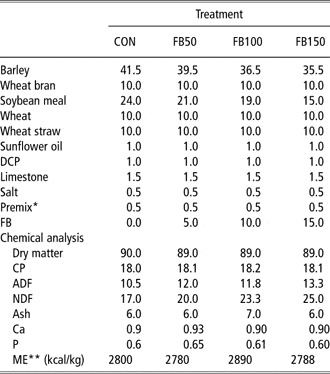
This experiment was conducted at a private farm near Tulkarm city/Palestinian territories. A total of 24 weaned male Awassi lambs, with a mean weight of 20.3 kg (s.d. = 2.0 kg) and ∼3 months of age were used. Experimental treatments were given to animals by stratified randomization on the basis of live BW, resulting in four groups of lambs with a similar distribution of initial BW. Lambs were fed individually and each lamb was considered as a replicate. Lambs were fed cereal–soybean-based total mixed rations (Table 1), where barley and soybean meal were partially substituted by FB at the following levels:
The diet ingredients and chemical composition of experimental feeds given to Awassi lambs (%)

CON = control; FB = fleabane; DCP = digestible crude protein; ME = metabolizable energy.
Diets were: (1) no FB (CON; n = 6), (2) 50 g/kg FB (FB50; n = 6), (3) 100 g/kg FB (FB100; n = 6) and (4) 150 g/kg FB (FB150; n = 6) of the total mixed diet.
*Composition per 1 kg contained, vitamin A, 2 000 000 IU; vitamin D3, 40 000 IU; vitamin E, 400 IU; Mn, 12.8 mg; Zn, 9.0 mg; I, 1.56 mg; Fe, 6.42 mg; Co, 50 mg; Se, 32 mg plus an antioxidant.
**ME, based on tabular values (National Research Council (NRC, 1985).
1. A control group without FB (CON; n = 6).
2. A 50 g FB/kg DM diet group (FB50; n = 6).
3. A 100 g FB/kg DM diet group (FB100; n = 6).
4. A 150 g FB/kg DM diet group (FB150; n = 6).
All diets were isonitrogenous/isocaloric, formulated to have 18% CP (DM basis) according to National Research Council (NRC, 1985).
Lambs were housed individually in 1 m × 1 m pens. Fresh drinking water was always made available.
Experimental procedure
After 6 days of adaptation to the control diet, each group received the corresponding experimental diet. The amounts of feed offered and refused were weighed daily and samples were collected for subsequent analyses. The amount of feed offered was adjusted daily on the basis of the previous day's intake, allowing refusals of 15% to 20%. Animals were weighed before morning feeding twice a week until slaughter.
At the end of the growth trial (63 days), animals from all the groups were slaughtered.
Measurements at slaughter
Each lamb's BW was recorded before slaughter. After removing and weighing omental and mesenteric fat (OMF), weights of the different components of offal were recorded. These included skin, head, feet, heart, lungs and trachea, the digestive tract, liver and kidneys. All the components of the digestive tract (reticulo-rumen, omasum, abomasum and intestine) were weighed with digestive contents. The digestive tract contents’ weight were also recorded. Its weight was subtracted from BW to obtain empty body weight (EBW). Carcasses were weighed warm (WCW) and cold (CCW) after storage for 24 h at 4°C. The commercial dressing percentage (CDP) was calculated as

Carcass cutting and dissection
Each carcass was split longitudinally in halves. The left half carcass was cut according to Colomer-Rocher et al. (Reference Colomer-Rocher, Morand-Fehr and Kirton1987) into shoulder, long leg, ribs, flank and neck. Every part was weighed and dissected into fat, muscles and bones. Other tissues such as tendons and lymph nodes were separated as waste. Pelvic and kidney fats were removed and their weights were recorded.
Laboratory analyses
Samples of diets and FB (whole plant samples that included stems, leaves, flowers and capsules) were dried (50°C), ground (1-mm screen) and stored for subsequent analyses. Dry matter (DM) was determined by drying at 105°C until constant weight. The mineral content was then determined by ashing at 600°C for 8 h. Nitrogen was determined by the Kjeldahl method (CP = n × 6.25; Association of Analytical Communities (AOAC, 1990). NDF and ADF were determined according to Van Soest et al. (Reference Van Soest, Robertson and Lewis1991).
The samples were analyzed for the mineral elements using atomic absorption spectrophotometer (Shimadzu 650 model), whereas K and Na were determined using flame photometry.
Statistical methods
Data were tested using ANOVA (SAS Institute, 1988). Significant means were subjected to orthogonal polynomial test at P < 0.05 level.
Results
General observations
FB is an erect perennial rough stem branching extensively at the base of the plant with tapered leaves covered in stiff hairs, 20 to 75 cm in height. Found from spring to autumn, it is most prevalent in summer months. Narrow leaves are gray to green in color, measuring 2 to 6 cm in length, coarsely toothed and covered in fine hairs. Upper leaves are smaller and linear.
Nutrient composition of C. bonariensis
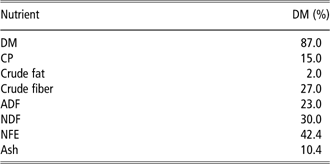
The composition of nutrients in C. bonariensis is presented in Table 2. The FB contents of organic matter, CP, NDF, ADF and lignin were 89.6%, 15%, 62%, 38% and 10%, respectively.
Chemical composition of fleabane used in the experiment
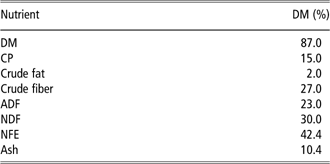
DM = dry matter; NFE = nitrogen-free extract.
Feed intake, live weight gain and feed conversion ratio
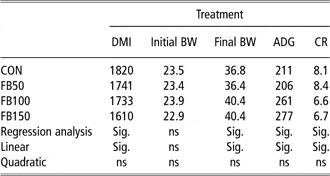
DM intake, average daily gain (ADG) and feed conversion ratio were significantly affected by the inclusion of FB. Intake was lower (P < 0.05) in lambs fed the highest levels of FB diets (Table 3). However, the aggregate mean daily gain over the whole growth period was greater (P < 0.05) for the 100 and 150 g FB/kg DM diet than that for the 50% FB and control diets (Table 3). The 100 and 150 FB/kg diet had the highest (P < 0.05) conversion ratio (6.6 and 6.7 kg feed/kg BW gain). Regression analysis showed a linear significant effect.
DMI, ADG and CR of Awassi lambs fed different levels of FB

DMI = dry matter intake; ADG = average daily gain; CR = conversion ratio; FB = fleabane.
EBW, dressing percentage and offal weights
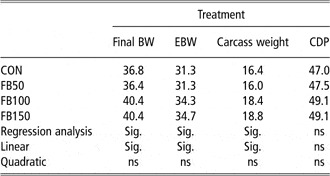
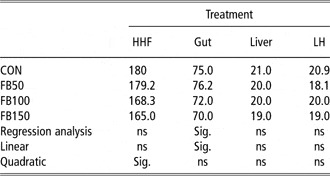
EBW and carcass weights were affected by feeding FB. These were linearly increased with the increasing level of FB (Table 4). However, the dressing percentage was not affected by FB feeding. Offal weights when expressed as g/kg EBW showed that the lungs and heart (LH) and liver organ weights were comparable among lambs in all experimental groups. However, the highest level of FB had significant linear and quadratic effects on gut and hide, head and feet (HHF) weights, respectively (Table 5).
Slaughter BW, EBW and DP of Awassi lambs fed different levels of FB

EBW = empty body weight; DP = dressing percentages; FB = fleabane; CDP = commercial dressing percentage; CON = control.
Offal weights (g/kg EBW) of Awassi lambs fed different levels of FB

EBW = empty body weight; FB = fleabane; HHF = hide, head and feet; LH = lungs and heart; CON = control.
Carcass tissue composition and fat repartition
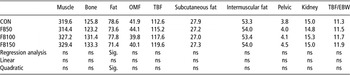
Muscle and bone tissue mean weights when expressed as g/kg EBW were not affected by FB feeding (Table 6). Animals of 150 g FB/kg DM diet had relatively lower carcass fat (P < 0.05) compared with those receiving zero and other levels of FB diets.
Carcass tissues and fat depots weights (g/kg EBW) of Awassi lambs fed different levels of FB

EBW = empty body weight; FB = fleabane; OMF = omental and mesenteric fat; TBF = total body fat; CON = control.
Carcass fat deposition did not vary with the addition of FB in the ration. A similar trend was observed in weights of total body fat, OMF, subcutaneous, intermuscular, pelvic and kidney fats.
Discussion
Laboratory analyses of C. bonariensis suggest a high nutritive value. The nutrient values were comparable to the results reported by previous research (J Abo Omar, unpublished data; Nasir and Ali, Reference Nasir and Ali1981).
As expected, the DM intake was declined as the level of FB increased. This result contrasts that of Stubbendieck and Conard (Reference Stubbendieck and Conard1989) who reported the fair palatability of FB. The anti-nutritional factors such as tannins, trypsin inhibitors and other phenolic compounds in FB might be the reason behind the intake depression. The significant linear increase in ADG in lambs fed 100 and 150 g FB/kg DM diet compared with lambs in the other two groups might be a result of some components in the FB, such as the natural antioxidants (Nasir and Ali, Reference Nasir and Ali1981).
The relatively low gain in Awassi lambs in this experiment can be explained by the short fattening period and on the other hand the low rate of gain of the small-sized Awassi breed compared with other heavy lamb breeds (Haddad et al., Reference Haddad, Nasr and Muwalla2001). Several nonconventional feeds resulted in similar ADG results (Abo Omar, Reference Abo Omar2002; Obeidat et al., Reference Obeidat, Abdullah and Al-Lataifeh2008; Zaza, Reference Zaza2008).
Lambs were slaughtered at different weights and had different EBW. Thereafter, lambs’ tissues and organs that were tested were quantified (g/kg EBW). These parameters depend on slaughtering BW (Fehr et al., Reference Fehr, Sauvant, Delage, Dumont and Roy1976; Marinova et al., Reference Marinova, Banskalieva, Alexandrov, Tzvetkova and Stanchev2001; Mourad et al., Reference Mourad, Gbanamou and Balde2001; Naser, Reference Naser2009). Weights (g/kg EBW) of gut and HHF were lower in lambs fed the highest level of FB. However, weights of liver and LH were the same in lambs in different experimental groups. Thonney et al. (Reference Thonney, Taylor, Murray and McClelland1987) reported a gut weight decline with maturity. Volatile fatty acids and other nutrients produced by fermentation in the case of feeding of FB diet were probably not determinant for visceral organs’ development (Ortigues and Doreau, Reference Ortigues and Doreau1995). Heavier mass of some tissues such as liver, kidney and gut was expected because of the high metabolic activity of these tissues. Such an observation was not detected in this experiment. The weight of offal components rich in bone and/or with a low metabolic activity (HHF) was decreased with FB feeding. This result is in disagreement with previous research where early maturing parts (Wallace, Reference Wallace1948; Prud'hon, Reference Prud'hon1976) are less affected by feeding in growing animals (Kamalzadeh et al., Reference Kamalzadeh, Koops, van Bruchem, Tamminga and Zwart1998).
Muscle and bone tissue weights when expressed as g/kg EBW were not affected by the FB supplemental level. Animals fed the 100 and 150 g FB/kg diets had lower carcass fat compared with other animals. This result is in agreement with the phenomenon that bone is a tissue with early development in all animal species and does not depend on feeding at older ages. In contrast, fat depots depend on nutrient utilization (Atti et al., Reference Atti, Rouissi and Mahouachi2004). The lower fat content observed in this study agrees with reports of Thonney et al. (Reference Thonney, Taylor, Murray and McClelland1987), where male sheep had less fat depots, but contrasts the previous reports by Marinova et al., (Reference Marinova, Banskalieva, Alexandrov, Tzvetkova and Stanchev2001) and Atti et al., (Reference Atti, Rouissi and Mahouachi2004), where sunflower oil supplementation led to a decrease of the relative amount of meat carcass and an increase in fat content. The dissectible fat distribution was not affected by the regimen in this work. In fact, different adipose tissues were similar for all diet groups.
Intermuscular and abdomen fat depositions were not affected by FB feeding. Marinova et al. (Reference Marinova, Banskalieva, Alexandrov, Tzvetkova and Stanchev2001) reported an increase in intermuscular fat as a result of sunflower oil supplementation.
Conclusion
It can be concluded that FB, a widespread weed in local territories, is a potential nonconventional feed and can be used in ruminant rations without any negative effects. Most of the tested parameters in the lambs fed with FB were similar or even better than that in control lambs that were fed commercial growing diets; therefore, some economical advantages can be achieved through feeding FB.
Acknowledgments
Authors are thankful to Dr Feras Sawalha and Dr Hassan Abu Qaoud from the Faculty of Agriculture, An Najah National University for their help in revising the manuscript and statistical analysis.