Dextro-transposition of the great arteries and intact ventricular septum associated with persistent pulmonary hypertension is uncommon and associated with poor outcomes.Reference Kirklin, Blackstone, Tchervenkov and Castaneda 1 Several therapeutic interventions have been described to improve systemic oxygen delivery and reduce oxygen consumption including balloon atrial septostomy, prostaglandin infusion to maintain ductal patency, inotropic support,Reference Chang, Wernovsky, Kulik, Jonas and Wessel 2 inhaled nitric oxide,Reference El-Segaier, Hellstrom-Westas and Wettrell 3 , Reference Jaillard, Belli and Rakza 4 epoprostenol,Reference Kovach, Ibsen, Womack, Steusse and Law 5 bosentanReference Goissen, Ghyselen and Tourneux 6 , and extracorporeal membrane oxygenation.Reference Jaillard, Belli and Rakza 4 , Reference Luciani, Chang and Starnes 7 , Reference Trittenwein, Furst and Golej 8 We present three patients with dextro-transposition of the great arteries, intact ventricular septum, and refractory persistent pulmonary hypertension of the newborn supported with extracorporeal membrane oxygenation preoperatively, separated from bypass following their arterial switch operation and survived to discharge with favourable long-term follow-up.
Case presentations
Case 1
A term male newborn was diagnosed postnatally with dextro-transposition of the great arteries and intact ventricular septum with a large atrial septal defect and patent ductus arteriosus. He remained hypoxaemic with evidence of low systemic oxygen delivery likely secondary to pulmonary hypertension in spite of escalation in support. Given continued evidence of cardiogenic shock, he underwent veno-arterial extracorporeal membrane oxygenation cannulation on day of life 1 and arterial switch operation on day 8 of support. He was separated from bypass successfully, albeit with evidence of pulmonary hypertension requiring sedation, neuromuscular blockade, mechanical ventilation, inhaled nitric oxide, and inotropic support. He was extubated on postoperative day 9 and discharged on postoperative day 12. At the most recent follow-up visit, he was 5 years old and doing well. He has no evidence of adverse sequelae related to extracorporeal support.
Case 2
A near-term male infant – 37 weeks’ gestation – was diagnosed postnatally with dextro-transposition of the great arteries and intact ventricular septum and restrictive atrial septum. Following intubation and initiation of prostaglandin E1, balloon atrial septostomy was performed. In spite of initiation of inhaled nitric oxide and significant escalation in support, he developed evidence of cardiogenic shock and underwent initiation of veno-arterial extracorporeal membrane oxygenation on day of life 3. After an arterial switch operation on extracorporeal support day 3, he was separated successfully from bypass and returned to the ICU with an open sternum, on inhaled nitric oxide and inotropic support. Following delayed sternal closure on postoperative day 12, the patient had ongoing respiratory failure, persistent chylothorax, and pulmonary hypertension. Thus, an open lung biopsy was performed, which revealed diffuse arterial wall and venous intima thickening, as well as pulmonary interstitial glycogenosis. Given these findings, he was treated with a course of systemic steroids, extubated on postoperative day 40, and transitioned from inhaled nitric oxide to sildenafil and bosentan. These medications were weaned gradually and discontinued 5 months after discharge. At his last follow-up visit, he was 7 years old. He has mild right-ventricular outflow tract obstruction with no evidence of adverse sequelae related to extracorporeal support.
Case 3
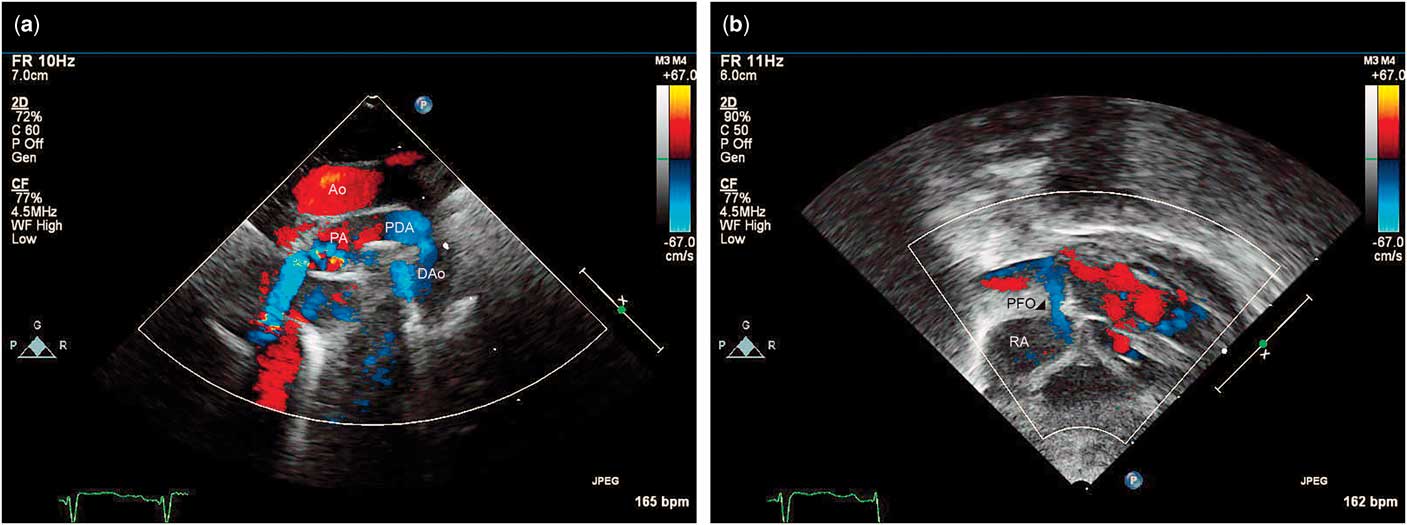
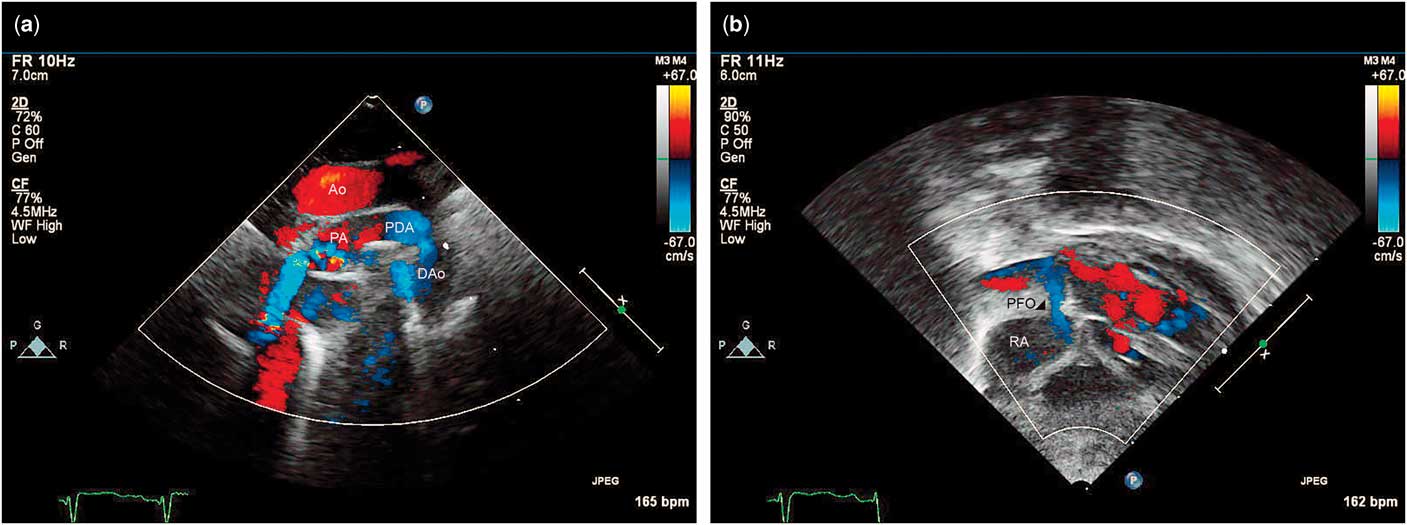
A premature twin male infant – 35 weeks’ gestation – was postnatally diagnosed with dextro-transposition of the great arteries and intact ventricular septum with right to left flow across a restrictive patent foramen ovale, as well as right to left ductus arteriosus flow (Fig 1). He was intubated and treated with surfactant followed by initiation of prostaglandin E1, inhaled nitric oxide, inotropic support, and balloon atrial septostomy. On day of life 2 – because of evidence of cardiogenic shock – he was urgently placed on veno-arterial extracorporeal membrane oxygenation and developed posterior subdural haematoma while on support. He underwent an arterial switch operation on support day 8 and was successfully separated from bypass. The postoperative course was favourable, allowing weaning and discontinuation of inhaled nitric oxide, and inotropic support followed by extubation on postoperative day 3. At his last follow-up visit, he was 8 years old, and asymptomatic with evidence of mild pulmonary and aortic insufficiency. He has no evidence of adverse sequelae related to extracorporeal support or the subdural haematoma.
( a ) Suprasternal notch long-axis colour flow Doppler view showing a patent ductus arteriosus (PDA) with evidence of pulmonary artery (PA) to descending aorta (DAo) flow. ( b ) Subcostal coronal colour flow Doppler view showing right atrium (RA) to left atrium flow across the patent foramen ovale (PFO). Both flow patterns may occur in the context of pulmonary hypertension.
Discussion
Transient postnatal elevation of pulmonary vascular resistance is common and relatively benign. However, persistent pulmonary hypertension of the newborn defined as failure to achieve or sustain the normal decrease in pulmonary vascular resistance at birth may lead to severe hypoxaemia and need for aggressive cardiorespiratory support including – albeit less frequent following introduction of inhaled nitric oxide – extracorporeal oxygenation. Persistent pulmonary hypertension refractory to medical management and – when indicated – balloon atrial septostomy in neonates with dextro-transposition of the great arteries and intact ventricular septum significantly increases the mortality of these patients, with preoperative mortality rates of up to 28.6%Reference Roofthooft, Bergman, Waterbolk, Ebels, Bartelds and Berger 9 as compared with the reported mortality rates of the transposition of the great arteries population of <5%.Reference Khairy, Clair and Fernandes 10
At the most severe end of the spectrum are patients who require extracorporeal oxygenation preoperatively because of progressive cardiogenic shock and risk for end-organ injury and cardiac arrest. These cases are uncommon, especially with introduction of inhaled nitric oxide and other potent pulmonary vasodilators. However, such patients require a thoughtful approach with regard to the timing and mode of support (veno-arterial vs. veno-venous), management on extracorporeal support, and timing of the arterial switch operation. Unfortunately, only few reports are available on these patients, and none of them describe successful separation from bypass following arterial switch operation with favourable long-term outcomes.Reference Jaillard, Belli and Rakza 4 , Reference Luciani, Chang and Starnes 7 , Reference Trittenwein, Furst and Golej 8 Each of our patients showed clinical and biochemical signs of progressive shock leading to oxygen debt in spite of significant escalation of support. To prevent irreversible end-organ injury and cardiac arrest with further escalation of conventional support, veno-arterial extracorporeal membrane oxygenation was initiated. Veno-arterial rather than veno-venous support was thought to be indicated in our patients because of the degree of cardiogenic shock. However, if oxygen delivery meets uptake needs, veno-venous support may be beneficial as it would lead to return of oxygenated blood into the right atrium and from there mostly into the right ventricle and aorta while sparing the carotid artery.
Timing of initiation of extracorporeal support is critical, as shown by Gill et alReference Gill, Neville, Khan, Cox and Lally 11 who studied neonates with meconium aspiration syndrome cannulated for extracorporeal support between 1989 and 1998. They found that delay in cannulation while assessing the effects of inhaled nitric oxide and high-frequency ventilation was associated with an increase in mortality and prolongation of hospital stay.
The pathophysiology of complete transposition of the great arteries places neonates with persistent pulmonary hypertension at a disadvantage in comparison with a neonate with normal cardiac anatomy because of high-volume physiological shunting and the dependency of effective pulmonary blood flow on small-volume anatomical shunting via the patent ductus arteriosus and atrial septal defect.
While correcting the anatomy in the operating room is the ultimate goal, cardiopulmonary bypass and cross-clamping of the aorta may cause further increase in pulmonary vascular resistance, as well as myocardial inflammation and low cardiac output syndrome, leading to risk of further end-organ injury postoperatively. We believe that preoperative extracorporeal support in these patients provides optimisation of end-organ function, facilitates protective mechanical ventilation and safe administration of pulmonary vasodilators, and haemodynamic unloading of the pulmonary vascular tree before the unavoidable operation-related insults. The shortest duration of support that provides normalisation of end-organ function, discontinuation of vasopressors, and weaning ventilator settings is preferred as a bridge to the arterial switch operation to avoid complications related to the support.
Conclusion
Patients with dextro-transposition of the great arteries and intact ventricular septum and pulmonary hypertension with refractory hypoxaemia and haemodynamic compromise may benefit from a period of stabilisation on extracorporeal support before their arterial switch operation. An attempt should be made to separate such patients from cardiopulmonary bypass rather than transitioning back to extracorporeal support at the conclusion of a successful operation.
Acknowledgements
The authors would like to acknowledge the critical care, cardiology, cardiothoracic surgery and perfusion divisions who successfully cared for these patients.
Financial Support
This research received no specific grant from any funding agency or from commercial or not-for-profit sectors.
Conflicts of Interest
None.
Ethical Standards
This article does not contain any studies with human participants performed by any of the authors.