Introduction
The recent trend of single fresh embryo transfer or freeze-all strategy has dramatically increased the number of surplus embryos cryopreserved for future replacement. The first pregnancy and delivery with cryopreserved embryos was carried using a slow freezing method following warming and embryo transfer (Trounson and Mohr, Reference Trounson and Mohr1983; Zeilmaker et al., Reference Zeilmaker, Alberda, van Gent, Rijkmans and Drogendijk1984). At this time, technology improvement and the use of embryo vitrification have dramatically improved post-thawing embryo survival, compared with use of the slow freezing method (Lin et al., Reference Lin, Su, Lee, Lin and Lo2010; Rienzi et al., Reference Rienzi, Gracia, Maggiulli, LaBarbera, Kaser, Ubaldi, Vanderpoel and Racowsky2016).
The applied vitrification method combines ultra-rapid cooling with high cryoprotectant concentration and minimal volume method to form a glass-like structure that avoids the formation of ice crystals that might cause cooling injuries (Lane et al., Reference Lane, Bavister, Lyons and Forest1999; Kuwayama et al., Reference Kuwayama, Vajta, Kato and Leibo2005; Hendriks et al., Reference Hendriks, Roelen, Colenbrander and Stout2015). The cryo-carrier/vitrification device consists of a strip of transparent film/polystyrene medical plastic attached to a plastic handle that is resistant to liquid nitrogen. The design allows loading of oocytes/embryos on a cryo-carrier device with a minimum volume (about 0.1 µl), providing rapid cooling and warming rates that will finally lead to a good survival rate (Vajta and Kuwayama, Reference Vajta and Kuwayama2006; Saragusty and Arav, Reference Saragusty and Arav2011; Arav, Reference Arav2014).
The number of oocytes/embryos mounted in one cryo-carrier is usually determined by the embryologist in accordance with the patient and IVF treatments characteristics. For instance, patients scheduled for a subsequent single embryo will have their embryos cryopreserved in singles per one device. Alternatively, older patients, those with repeated IVF failures, or those requiring cryopreservation pre-PGD intervention, will have multiple embryos cryopreserved per one device. In accordance with different manufacturer’s instructions, the recommended number of oocytes/embryos that should be loaded onto single cryo-carrier for vitrification varies between one and four (Kitazato Corporation; Vitrification Cryotop™.http://www.kitazato-dimed.com/vitrification-Cryotop™/Cryotop™-open-system/). Moreover, S-Cryolock™’s instructions indicate loading only up to two embryos on a single device (Irvine Scientific; Vitrification S-Cryolock™ http://www.irvinsci.com/assisted-reproductive-technology/art-media-and-products/vitrification/). As the cost of the device is not negligible and to maximize the procedure in terms of time and resources, the amount of embryos loaded in one device must be adapted to the treatment needs.
Prompted by the aforementioned observations, and the lack of information regarding the optimum number of oocytes/embryos allowed to be loaded on single cryo-carrier, we aimed to evaluate and compare the cryo-survival outcomes of embryos vitrified following loading one, two or three embryos on a single device, as experienced in our routine IVF programme.
Materials and methods
This was a single centre cohort retrospective study performed at Sheba Medical Center. Embryo vitrification was introduced in our laboratory in 2009. Data collected from patients whose vitrified embryos underwent the warming cycle between September 2016 until January 2020 were analyzed. Exclusion was made for cycles in which more than one cryo-carrier was thawed, however the distribution of embryos between thawed cryo-carriers was inconclusive. Embryo cryopreservation had been performed on days 2–3 or days 5–6 post fertilization. In total, 2217 embryo-warming cycles were divided into two groups. The first group included 1638 cycles with 3046 cleavage stage warmed embryos and the second group included 579 cycles with 695 warmed blastocysts. Each group was then divided into three subgroups according the number of embryos loaded onto one cryo-carrier. Patient cycles, mean patients age and post warmed embryo number for each group/subgroup are presented in Table 1. The study was approved by the institutional research ethics board of Sheba Medical Center.
Study group characteristics based on the number of embryos per single cryo-carrier

Group A – Cleavage stage embryos.
Group B – Blastocyst stage embryos.
* Compared 1 or 2 embryos per cryo-carrier to three embryos per cryo-carrier for group A.
** Compared 1 embryo per cryo-carrier to two embryo per cryo-carrier for group B.
Embryo cryopreservation was performed on days 2–3 or days 5–6 post fertilization. The decision on the number of embryos in a single cryo-carrier was dependent mainly on future warming treatment characteristics. The number of cleavage stage embryos per one device was determined based on patients’ characteristics, in which those with repeated IVF failures, older patients, or those requiring cryopreservation pre-PGD intervention, had multiple embryo freezing per one device. Blastocysts were cryopreserved for couples only in older patients (>40 years old) or those with repeated implantation failure. In accordance with our laboratory procedure, only high quality embryos were suitable for cryopreservation and had the following morphological properties: 4 cells on day 2, 6–8 cells on day 3, partial compaction/full compaction on day 4, all with up to 10% fragmentation, absence of vacuoles and up to minimal asymmetric blastomeres. Grading of blastocysts was in accordance with Gardner’s method (Gardner et al., Reference Gardner, Lane, Stevens, Schlenker and Schoolcraft2000), based on the assessment of the inner cell mass and trophectoderm appearance. Only types A and B blastocysts were vitrified.
The vitrification–warming method was carried using a vitrification and warming kit (CooperSurgical Medical Devices. SAGE™ Vitrification Kit.https://fertility.coopersurgical.com/products/sage-vitrification-kit/) and Cryotop™ device (Vitrification Cryotop™ http://www.kitazato-dimed.com/vitrification-Cryotop™/Cryotop™ -open-system/) in accordance with the manufacturer’s instructions, the vitrification procedure was conducted at room temperature. Transfer of embryos to the next solution was carried out taking over a minimal volume of the previous medium/solution. Early cleavage stage and blastocyst stage embryos were equilibrated in a single 80-µl drop of equilibration solution (ES) for 10–13 min. The equilibration time was defined by re-expansion of the embryos (usually days 2–4 embryos required 10 min for re-expansion, blastocysts required 12–13 min for re-expansion). Each drop contained the same number of embryos that would be loaded onto a single cryo-carrier. For instance, when freezing three embryos on one cryo-carrier, these were incubated together in one drop of 80-µl ES for 10 min.
The vitrification step was followed by transfer of embryos continuously between four drops of about 20–30 µl vitrification solution for 45 s before loading the embryos ono the device (first drop 5 s, second drop 5 s, third drop 10 s and finally fourth drop for 25 s). Embryos were loaded onto the device followed by removal of the remaining medium volume by aspiration. Immediately after aspiration of the minimal volume, the Cryotop™ was plunged into liquid nitrogen. The above vitrification steps that included loading embryos onto the cryo-carrier and plunging into liquid nitrogen were completed in about <90 s but did not exceed 110 s. For warming, the Cryotop™ was removed from the liquid nitrogen and instantly placed in 1 M sucrose solution at 37°C. After 1 min, the embryo were placed in 0.5 M sucrose for 4 min followed by washing for 9 min in 3-(N-morpholino)propanesulfonic acid (MOPS) solution [MOPS solution (ART-8030-C) is a MOPS-buffered solution of modified human tubal fluid containing non-essential and essential amino acids, gentamicin sulphate (0.01 g/l) and 12 mg/ml human albumin].
Efficiency and survival rate outcomes were recorded as follows:
-
Full intact warmed embryos survival rate = the number of fully survived embryos number/number of total thawed embryos.
-
Partial survived embryos rate = the number of partial survived embryos/number of total thawed embryos.
Some of the survived embryos had degraded cells. If the embryo demonstrated at least 70% of intact cell (up to 30% degraded cell), it was considered viable (partial survived embryos) and was transferred or either biopsied for PGD. Embryos showing less than 70% of essential cells, were considered non-viable and were discarded. Total survival rate = full intact warmed embryos + partial survived embryos /total thawed embryos. Post-vitrification survival rate assessment was performed for three subgroups: one, two or three embryos vitrified on a single cryo-carrier.
Data were expressed as percentages of full/partial survival rate. The chi-squared test/t-test were used to analyze the differences between groups/subgroups. A linear regression was conducted to assess the association between the percentages of full/partial survival rate of cleavage stage and blastocysts stages embryos and patients’ age. A P-value ≤ 0.05 was considered significant.
Results
Between September 2016 and January 2020, 974 patients underwent 1896 embryo-warming cycles, consisting of 3741 embryos. The total survival rate was 94.8%. Post-vitrification survival rate assessment was performed for three subgroups: one, two or three embryos vitrified on a single cryo-carrier.
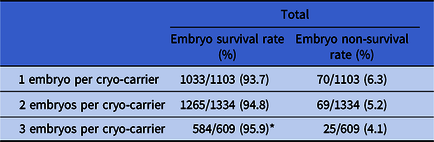
Cleavage stage embryos that were frozen in a single embryo per single cryo-carrier had a 93.7% survival rate, similar (P < 0.217) to cases of two embryos vitrified in a single cryo-carrier (94.8% survival rate). The survival rate of the subgroup of three embryos per single cryo-carrier was 95.9%, significantly higher compared with those vitrified as singles (P < 0.039), and non-significantly higher compared with those vitrified as couples (P < 0.289; Table 2). Warmed blastocysts obtained similar survival rates of 94.4% and 94% when vitrified in singles or couples respectively (Table 2).
Cleavage stage (A) and blastocyst (B) post-vitrification survival rate in accordance with the different subgroups: one, two or three embryos vitrified on asingle cryo-carrier
(A)

* P < 0.05 compared with one embryo per cryo-carrier subgroup.
(B)

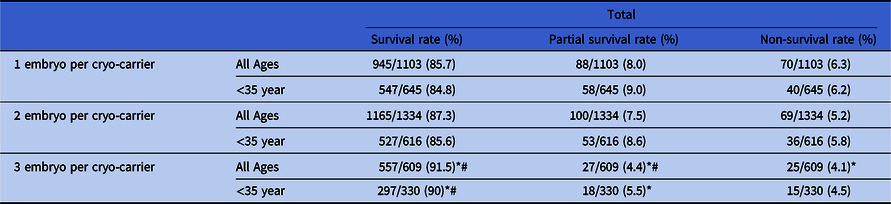
Some of the survived embryos demonstrate degraded cells. If the embryo demonstrated at least 70% of intact cell (up to 30% of degraded cell), it was considered viable and was either transferred or biopsied for PGD. When analyzing only post warmed full intact cleavage stage embryos, excluding partial intact or less than 70% intact cell (non-viable) embryos, the survival rate for three embryos per single cryo-carrier obtained was 91.5%, significantly higher compared with one (85.7%, P < 0.0002), or two embryos (87.3%, P < 0.004) per single cryo-carrier (Table 3). As age distribution between two or three embryos per single cryo-carrier was significantly different (P = 0.0012, Table 1), we further analyzed only patients under the age of 35 and revealed similar results: the survival rate for three embryos per single cryo-carrier was 90%, significantly higher compared with one (84.8%, P < 0.016), or two embryos (85.6%, P < 0.04) per single cryo-carrier (Table 3).
Cleave stage (A) and blastocyst (B) post-vitrification survival rate in accordance with the different subgroups: one, two or three embryos vitrified on a single cryo-carrier, stratified to full and partially survived embryo and to all and those <35 years old
(A)

* P < 0.05 compared with one embryo per cryo-carrier subgroup.
# P < 0.05 compared with two embryos per cryo-carrier subgroup.
(B)

*P < 0.05 compared with one embryo per cryo-carrier subgroup.
For further evaluation, we compared post-vitrification survival rates of blastocyst stage embryos. While comparing the post-vitrification survival rates in embryos at the blastocyst stage (days 5–6), based on the number of embryos per single cryo-carrier, no between group differences were observed (Table 2). However, when analyzing only post warmed full intact embryos, excluding partial intact or less than 70% intact cell (non-viable) embryos at the blastocyst stage, the survival rate for two embryos per single cryo-carrier obtained was 76.6%, significantly lower compared with one (Table 3) (87.9%, P < 0.019).
Linear regression could not demonstrate any effect of patients’ age on the percentages of full/partial survival rates of cleavage stage and blastocyst stages embryos.
Discussion
In the present study we confirmed the previous reported high post-vitrification survival rates of embryos at both the cleavage and blastocyst stages (Alpha Scientists In Reproductive Medicine, 2012; ESHRE Special Interest Group of Embryology and Alpha Scientists In Reproductive Medicine, 2017). Moreover, cryo-preserving three cleavage stage embryos per single cryo-carrier gave the highest full intact embryo survival rate (91.5% vs. 85.7% and 87.3% for one or two embryos per single cryo-carrier, respectively), post warmed full intact blastocyst survival rate for two blastocysts was significantly lower compared with one blastocyst (76.7% vs 87.9%, P < 0.0193) per single cryo-carrier.
While we could not find studies that evaluated the optimum embryo number in a single cryo-carrier, animal studies have revealed that culturing embryos in groups significantly increased blastocyst cell number and raised embryo viability (Donnay et al., Reference Donnay, Van Langendonckt, Auquier, Grisart, Vansteenbrugge, Massip and Dessy1997; O’Doherty et al., Reference O’Doherty, Wade, Hill and Boland1997). Moreover, embryo density (embryo-to-volume ratio), calculated as the volume of culture medium divided by the number of embryos, is known to affect embryo development and viability (Reed, Reference Reed, Smith, Swain and Pool2012). This positive effect was suggested to be the result of paracrine factor(s) produced by the embryos that could support development. Ebner et al. (Reference Ebner, Shebl, Moser, Mayer, Arzt and Tews2010) prospectively compared single and grouped cultures and found group culture improved both compaction and blastulation, as well as overall blastocyst quality. Lehner et al. (Reference Lehner, Kaszas, Murber, Rigo, Urbancsek and Fancsovits2017) found that culture of five or six cleaved embryos in a volume of 25 μl resulted in an increased average blastomere number, with the highest good quality rate.
In contrast with embryo group culture, during the vitrification and thawing processes, it is not the culture conditions or paracrine factor(s) that should be considered. Vitrification and thawing steps and embryo density within the ES volume are factors that might play a crucial role. To overcome the possible damage to the cryopreserved cells by very rapid cooling (cold shock) or by low temperature (chilling injury), the presence of cryoprotectants in the freezing solutions is essential (Fuller, Reference Fuller2004). These solutes possess favourable properties such as high solubility and cellular permeability and relatively low toxicity. For embryo vitrification, cryoprotectants must be used in fairly high concentrations to prevent ice formation, but not too high, to avoid cell toxicity. ES is a MOPS-buffered solution containing various cryoprotectants, e.g. 7.5% each of DMSO and ethylene glycol (www.fertility.coopersurgical.com). When the embryo is placed in ES, intracellular water is osmotically replaced with cryoprotectants and the system reaches equilibration. During this process, the cells shrink and re-swell/re-expand when equilibration is accomplished. The degree to which cells shrink and re-expend after addition of cryoprotectant depends on the concentration of the cryoprotectant and the relative permeability of the cell membrane for water and cryoprotectant (Kleinhans, Reference Kleinhans1998). Upon thawing, removal of the cryoprotectant has the opposite effect on cells: they first swell and then shrink again. This may lead to damage if the cells expand redundantly. Damage due to over-swelling of cells can be prevented by stepwise removal of the cryoprotectant by following the warming protocol. Therefore, the successful utilization of vitrification for IVF requires a balance of three major properties: cryoprotectant concentration; rapid cooling and warming that eliminates prolonged exposure to cryoprotectant-containing solution; and low medium volume that prevents intracellular crystallization of water (Zacà and Borini, Reference Zacà and Borini2017). During the vitrification procedure, cleavage stage embryos are equilibrated in a single 80-µl drop of ES for 10 min. It might be speculated that loading only one cleaved embryo exposes its blastomeres to higher ES volume, which means higher cryoprotectant concentration/load per embryo compared with adding two or more embryos, and this might be detrimental to subsequent post-thawing survival rates.
Blastocysts, conversely, consist of two cell layers within a fluid-filled sphere (blastocoele). Because blastocysts contains more fluid relative to cleavage stage embryos, during the ES step, the process of fluid exchange to reach balance is slower. In fact, sometimes a 13-min incubation time is not even enough for re-expansion. If the blastocyst does not fully replace water with the cryoprotectant substance, the cells will be more exposed to freezing damage compared with cryoprotectant toxicity. In this case, incubation of two rather than one blastocyst might result in too low an ES volume per trophectoderm/inner cell mass cells and cavity, which might also be detrimental.
Therefore, embryo/blastocyst density should probably be limited to a strict range that facilitates cryo-kinetics. Every change, low (one or two cleavage stage embryos) or high (two blastocysts) cell numbers, may interfere with the process and result in a lower post-thawing survival rate.
In conclusion, in the present study we demonstrated that post-thawing survival rate following vitrification was affected by embryo/blastocyst density in the vitrification solution, with an optimum range of three cleaved embryos or one blastocyst per single cryo-carrier. Therefore, prior to vitrification, and specifically in older patients, for those with repeated IVF failures, or those requiring cryopreservation pre-PGD intervention, special attention should be directed to the number of embryos loaded in one device. Further studies are required to validate the observations described here regarding optimum number of cleavage stage or blastocyst stage embryos that should be loaded onto a single cryo-carrier vitrification device.
Acknowledgements
The authors would like to thank Moran Madari for her contributions to data collection and secretarial assistance.
Financial support
This research did not receive any specific grant from funding agencies in the public, commercial, or not-for-profit sectors.
Conflict of interest
The authors report no financial or commercial conflicts of interest.
Ethical standards
The study was approved by the institutional research ethics board of Sheba Medical Center.