Introduction
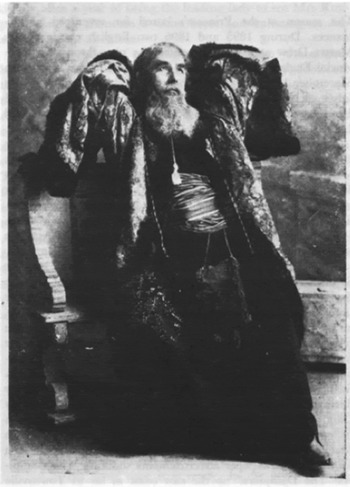
Alfred Dampier (1843–1908) was a British provincial actor who made his later career principally in Australia and New Zealand.Footnote 1 One aspect of his work, which to date has only received brief mention, was his presentation across many years of ‘Friday Night Shakespeare’, which saw the production of Shakespeare exclusively on Friday nights.Footnote 2 As was customary practice at the time, he chose Saturdays to open a new season of one of the melodramas that were the backbone of his repertoire, but often closed its predecessor on Thursday, thereby freeing up Friday evening for a very different kind of theatrical offering. Between the mid-1870s and the early 1900s, while presenting and starring in many Australian plays – including stage versions of the classic Australian novels For the Term of His Natural Life and Robbery under Arms,Footnote 3 other popular melodramas such as The Count of Monte Cristo, East Lynne and The Three Musketeers, as well as more upmarket ‘literary’ scripts including his own versions of Faust and Les Misérables (titled Jean Valjean) – Dampier and his company were widely acclaimed in all the Australasian colonies for their commitment to ‘the Bard’, including presenting what has been claimed to be the first-ever full-length professional performance of a Shakespearean play (Hamlet) in Perth, on Friday 23 April 1897.Footnote 4 Hamlet was always Dampier's most frequently performed and best-received character, followed by Shylock in The Merchant of Venice (Figure 1). In addition, at least up until his disastrous bankruptcy in 1894, his company also attempted As You Like It, Othello, Macbeth and Romeo and Juliet.
Posed photograph of Dampier as Shylock. Shakespearean Quarterly (Sydney), January 1924, p. 28. Courtesy Fryer Library, University of Queensland.

There were numerous other Shakespearean performers in Australia and New Zealand in the same era, but in general their careers or tours were of relatively short duration and/or predominantly in one city or colony. Consequently, in these years, audiences in Australia and New Zealand (other than, perhaps, in Sydney or Melbourne) were more likely to have seen a Dampier Shakespeare production than any other. In 1900, from the perspective of Tasmania, the Hobart Mercury lamented that ‘Mr. Dampier has, during the last decade, stood almost alone as an exponent of Shakespeare in these colonies’.Footnote 5 His low profile in the history of Shakespeare in Australia is therefore somewhat surprising: John Golder and Richard Madelaine, in O Brave New World: Two Centuries of Shakespeare on the Australian Stage (2001), lament that Dampier is one of several late colonial figures who ‘deserve more space than this volume permits’,Footnote 6 while Kathryn Flaherty's Ours as We Play It: Australia Plays Shakespeare (2011) offers a predominant but not exclusive focus on recent stagings and does not mention Dampier at all.Footnote 7
This article considers the impact of Dampier's Shakespeare productions on these late colonial societies. It uses biographical claims, still photographs, newspaper reviews and a surviving accounts book to examine how, in a colonial cultural context, patterns emerged of self-presentation, observation, emphases and silences; it was through these modes that both actors and reviewers sought to insert themselves more prominently into the Antipodean settler social hierarchy and sought reassurance that a shared pan-imperial sophistication survived there (though sometimes acknowledging and lamenting how crippling geographical dispersion could be).
Acting style
A useful initial framing question with which to begin, given the many approaches one might take in evaluating data to imagine onstage ‘the Dampiers’ (as publicity described them) is: which of the competing stylistic approaches to performing Shakespeare in the last quarter of the nineteenth century did they follow? As we shall see, this is not merely taxonomic: Dampier's austere, ‘reverential’ performances of ‘the Immortal Bard’Footnote 8 – at a time when the few other leading actors and companies who were attempting Shakespeare's major plays moved towards spectacularly costumed, staged and heavily cut adaptations – was a strategic decision to improve his, his family's and his company's respectability and status within Australian late colonial society and to appeal to a prestigious (if less numerous) audience. It was part of a wider strategy which also enabled him, while claiming to be adapting ‘classic novels’ for the stage, to freely rewrite Robbery under Arms as a thinly disguised version of the saga of the Kelly gang of bushrangers during the years when plays on that topic had been banned.Footnote 9 It also gave him the scope to present stories about convicts (Les Misérables, For the Term of His Natural Life) at a time when colonial Australia was keen to erase from memory the circumstances of its own real-life origins.
Douglas McDermott, who has briefly considered Dampier as a Shakespearean, suggested that he ‘remained faithful to the style of [G. V.] Brooke’, a major Australian colonial tragedian of the ‘old school’ in the 1850s.Footnote 10 Brooke (1818–66) did perform in the English provinces from 1861 to 1865, near the end of his career,Footnote 11 which is where and about when Alfred Dampier started as a professional actor. It is possible the younger man saw the older perform, but it is improbable that there was any influence, direct or indirect. Tastes had moved on, both in England and in Australia. Alfred Dampier was not of Brooke's generation: he was only twenty-nine when he first appeared in Melbourne and, as discussed in detail below, had earlier trained in England and Scotland for about a decade in companies that adopted contemporary styles responding to new artistic preferences.
Most actors in the second half of the nineteenth century who decided to make their future careers in Australasia, including Dampier, came from England after solid provincial, though seldom metropolitan, success. Nevertheless, once in the colonies, they puffed to the point of mendacity their alleged standing in the imperial centre of culture and advertised that they were offering glimpses of the latest London stories and styles of performance. Training and tradition were imported, not national; the acting and production styles of the arrivistes were, as they proudly proclaimed, shaped by recent fashions elsewhere.
Equally, as I have argued elsewhere, it is in any case difficult to discern a colonial ‘tradition’ of performance.Footnote 12 From the 1850s gold rushes onwards, there were dozens of visiting British (and, less frequently, American) stars undertaking world tours. Australian audiences could see and hear for themselves what more recent trends in styles of performance and staging were, while part of their own identity as citizens of the empire required admiring and approving of what they presumed was à la mode in London. Admittedly, there did also remain an enthusiasm amongst some audiences in Australasia for what was referred to (in relation to G. V. Brooke's generation and earlier) as the ‘robust’ style of acting, long after it fell from favour in England. This enabled, for example, the old British Shakespearean actor William Creswick (1813–88) to undertake a successful Australasian tour from 1877 to 1880, posing ‘with dignity and deliver[ing] blank verse in telling style’. But colonial theatre managements were still reluctant to engage him or rent him their theatres.Footnote 13
Dampier's acting training
Alfred Dampier (though English, not Scottish) is first mentioned in the theatrical newspapers at the Glasgow Theatre Royal in October 1865 playing Hawkshaw in The Ticket-of-Leave Man. This is the starring role of what was often claimed to be the first detective character in English fictional narrative; so clearly Dampier, then aged twenty-two, was already a few years into his professional career. The Era thought his ‘grandiloquent’ performance was better suited to high melodrama than to Tom Taylor's matter-of-fact sleuth.Footnote 14 This does sound like robust old-school acting but, during his years in the British provinces, Dampier came under the influence of the legendary Charles Calvert, virtually the only regional actor–manager of national and international significance at this time, whose Shakespearean revivals at the Manchester Prince's Theatre from 1864 to 1874 were widely acclaimed.Footnote 15 Dampier was engaged by Calvert for his touring company; The Era reported on them in 1867 in Newcastle upon Tyne, with Dampier playing Antony's friend Scarus in Antony and Cleopatra and the title role in Julius Caesar to Calvert's Brutus.Footnote 16
Charles Calvert, according to his Dictionary of National Biography entry,Footnote 17 was ‘a careful student of Shakespeare’, and his emphasis on fine elocution, attention to textual interpretation and historical ‘correctness’ can all be found noted and admired by reviewers of Dampier's Australian Shakespeares, as we shall see. Dampier himself whittled back his acting style from grandiloquence to a studious ‘scholarly’ reserve that paradoxically, as The Era had suggested, was also well suited to the mid-century melodramas which were his company's core repertoire, giving them a (for the time) ‘realistic’ understatement to balance the strong situations and sensational climaxes of the narratives.
Dampier claimed to be a friend of Henry Irving (who was five years older but also played predominantly in the English provinces in the 1860s), though Nigel Pearn, who undertook a detailed search of the theatrical newspapers of the time, failed to uncover any evidence that Irving and Dampier ever played together.Footnote 18 Nevertheless, both were often associated with Calvert's companies and doubtless Dampier had numerous opportunities to see and learn from Irving in performance. This was the mid-1860s contemporary tradition in which Alfred Dampier trained and first performed Shakespeare and which, in turn, he tutored and directed the Australian actors who performed with him, particularly his own family: wife Katherine Russell and daughters Lily and Rose.
However, positioning Alfred Dampier under the stylistic umbrella of Charles Calvert and Henry Irving in the 1860s does not narrow our understanding of his acting style as precisely as we might hope, since other artists with similar backgrounds were described differently. A figure who provides a useful contrast to Dampier's approach to Shakespeare is George Rignold (c.1834–1912), who also started in the British Midlands and got his big chance in 1875 when he was chosen by Calvert to play Henry V in the New York season of the latter's legendary production of that play which had premiered in Manchester three years earlier. This spectacular ‘tableau Shakespeare’ employed dozens of silent extra actors, and cut and rearranged the script to offer a series of pictures of famous events and places: ‘The Throne Room in the Palace at Westminster’, ‘The Siege of Harfleur’, ‘The Battle of Agincourt’, and ‘Interior of the Cathedral at Troyne’ (where, unassisted by Shakespeare, King Henry married Princess Katherine of Valois). Rignold played Henry across the USA and in Australia in 1876 before unsuccessfully attempting a London season.Footnote 19
Rignold was, by all accounts, a much more flamboyant actor than Dampier, possibly reflecting the fact that Charles Calvert himself had moved on from the austere 1860s stagings in which Dampier had performed. Veronica Kelly, in a 2000 article that offers the only substantial critical analysis of Dampier, locates him usefully as a ‘respected and influential performer of predominantly middle-class constructions of [European Australian] masculinity’. Drawing on the film critic Richard Dyer's distinction between stars (‘performers whose “public personality” transcends and informs their dramatic vehicles’) and actors (‘artist[s] involved in virtuoso displays of mimesis’), Kelly places Henry Irving in the first category as ‘star’ and Alfred Dampier in the second as an ‘actor’.Footnote 20
This binary at times blurs more subtle stylistic variations, but for Dampier the distinction is useful; mimetic self-effacement is evident and precise in reviews from the time of his first performances in Australia in 1873. The Australasian Sketcher described him as ‘[n]ot a genius’ but rather ‘a good, careful, intelligent, painstaking actor’.Footnote 21 Reviews of George Rignold were very different and show that he clearly aimed for Antipodean star status. Rignold's Shakespearean productions adopted Calvert's later ‘tableau revision’ format rather than Dampier's textually conservative (and, as he overtly advertised, ‘reverential’) performance style.Footnote 22 Dampier was also famed for travelling widely throughout the Australian colonies, whereas Rignold settled in Sydney, revived there his most famous role and added others – Julius Caesar, Macbeth, Falstaff, Bottom and Othello – but toured less frequently.Footnote 23
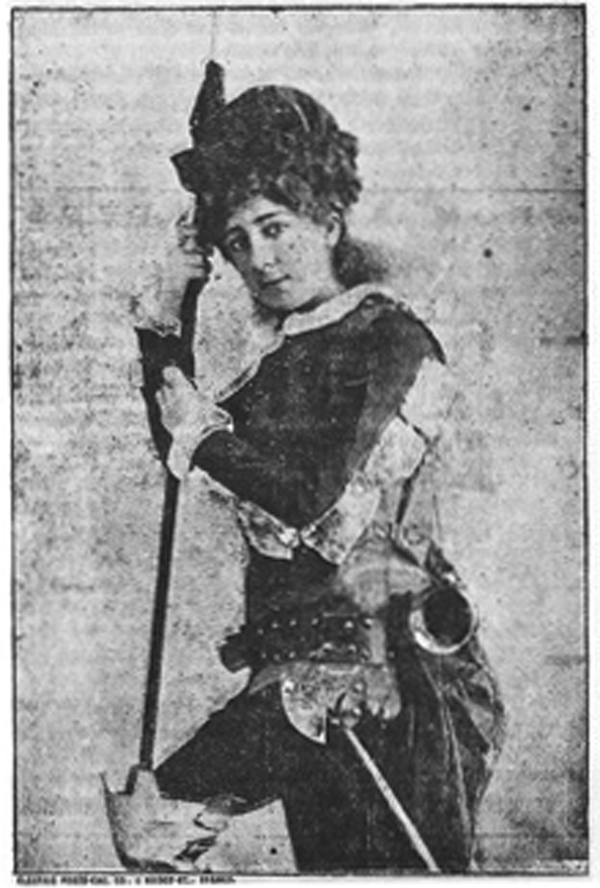
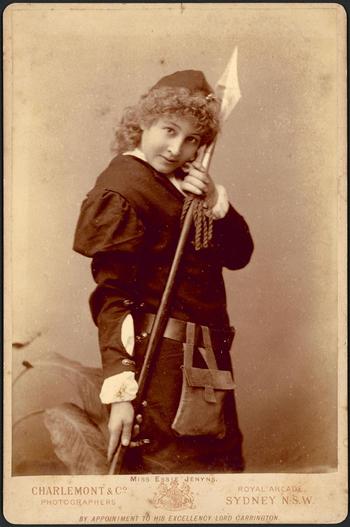
Perhaps an even clearer example of how the Dampier company ‘style’ differed from others is suggested by two superficially similar photographs almost mirror reverse to one another: Lily Dampier as Rosalind in As You Like It (Figure 2) and her contemporary, Australian-born Essie Jenyns (1866–1920), in the same role in W. J. Holloway's production a few years earlier (Figure 3). From 1885 to 1888, Jenyns dressed in expensive Paris fashions (after visiting England and France as a teenager) and supposedly based her acting style on Sarah Bernhardt's performances in melodrama roles and the American actor Mary Anderson's interpretations of Shakespeare's heroines.Footnote 24
‘Miss Lily Dampier’. Lorgnette (Melbourne), December 1894. Courtesy Fryer Library, University of Queensland.

(Colour online) ‘Essie Jenyns’, publicity postcard. Courtesy National Library of Australia.

In the photograph, Jenyns's Rosalind adopts a ‘provocatively coy’ pose.Footnote 25 She holds the shaft of her lance close to her bosom, her hips tilt forward, and a bag is slung around her waist in front of her thighs. Male critics, while also acknowledging Jenyns's intelligence, acting talent and contralto voice, responded overtly to this ‘innocent’ sexuality:
Twelfth Night has been doing another season and another success at the Sydney Criterion. We did not go to see it this time, because when last we attended we went home in a rowdy and clamorous condition from over-excitement, and went to sleep under the shower-bath, with our best hat held in both hands against our chest and a sweet smile on our features. But we will be on hand to witness Cymbeline next Saturday … As far as we can recollect, Essie Jenyns disguises herself as a boy in this drama, and lives with three bears in a cave, and we wouldn't miss that for anything.Footnote 26
In contrast, Lily Dampier's gaze is reserved and wary, she leans on her staff rather than embracing it, her downstage arm crosses her body to conceal her bodice from the viewer, her costume is relatively shapeless and rustic and its potentially suggestive elements (leather belt, scabbard, hunting horn slung at her side) are subdued. Her stance, though showing the shape of her legs in a ‘breeches’ role, is purposeful.Footnote 27 Again, the star/actor distinction obtains; Lily Dampier was acclaimed by reviewers, but in language very different from that applied to Essie Jenyns: Jenyns was sexualized, Lily was professionalized and scholarly. For example, ‘Miss Dampier's … was a magnificent performance, and realized all that the student of the play could conjure up to himself of Shakespeare's ideal’,Footnote 28 and ‘Miss Lily Dampier gave an easy, intelligent, and well-studied reading’.Footnote 29 This analysis of the two photographs finds echoes in the subsequent careers of each actor. In 1888, after three years of what Janette Gordon-Clark called her ‘sensuous attractiveness’, Essie Jenyns turned twenty-one and soon after escaped from her step-father Holloway's tyranny, married the young heir to a brewery fortune and never returned to the stage.Footnote 30 Lily, by contrast, in awe of her father and unable to break away (even concealing from him for several years her first marriage to an actor in the company), remained with the Alfred Dampier organization until his death in 1908 and, with her second husband, Alfred Rolfe, went on exploiting the same repertoire until her own death only seven years later.Footnote 31
Yet another difference is that – unlike the Holloway–Jenyns or Rignold productions – Alfred Dampier's Shakespeares were, as far as we can discern from reviews, played in front of two-dimensional backdrops with few set pieces and no extras. As early as 1866, when he played Romeo in Birmingham, the Daily Post had lamented, ‘The mise en scène, as usual with modern Shakespearean productions, was of the very baldest and homeliest character’.Footnote 32 Dampier's was not a wealthy organization (except for a few years after 1886 which, as noted earlier, ended in bankruptcy), and what capital he could raise went on sets, stage machinery, costume and effects for spectacle melodramas rather than for visualizing the Bard.
Respectability and empire: artists’ self-fashionings, critics’ imagined communities
Examining Alfred Dampier's Shakespearean Fridays reveals extensive evidence of the difficulty of establishing what Thomas Postlewait has succinctly called ‘the authenticity of sources and the reliability of eyewitnesses’.Footnote 33 As professional performers, the Dampiers were engaged in a lifelong exercise in selective self-presentation designed to maximize their public appeal. Meanwhile colonial commentators in response were performing their own wit and sophistication, imagining themselves as carriers of cultural memory, and as community leaders who were improving public appreciation of British high cultural taste and proselytising its existence in the seats around them. In such a mutually dependent relationship, neither artists nor reviewers were reliable witnesses.
A simple example, more easily considered now that birth and/or christening records are readily available online, is actors’ ages. Claiming to be younger than you were was a vanity conventionally attributed to ‘society’ women (most famously, by Lady Bracknell in The Importance of Being Earnest: ‘London society is full of women of the very highest birth who have, of their own free choice, remained thirty-five for years’.Footnote 34) Women actors had obvious reasons to claim to be younger than they were, but men too needed to extend as far as they could the illusion that they plausibly could play youthful heroic roles. Alfred Dampier did so, in biographical notes progressively lowering his age from his true birth year (1843). He claimed to be four years’ younger by the time he attempted the ‘dashing bushranger’ Captain Starlight in Robbery under Arms in 1890, in which his role was romantically entwined with the heroine ‘Aileen Marston’ – played by his daughter.Footnote 35 (Dampier also pretended – spuriously – that he was a descendant ‘in a direct line from the Buccaneer Captain William Dampier, probably the first white man to set foot on our soil’.Footnote 36)
Both Lily and Rose were promoted as child prodigies, so it was the Dampier parents who attributed to their daughters a later birth year, rather than the girls themselves. But, within the family, Lily at least did know her true age: the family celebrated her ‘twentieth’ birthday on 11 January 1889, as was reported in the Melbourne theatrical gossip magazine Lorgnette.Footnote 37 She was in fact twenty-one – then the age of majority, and so able to marry without her parents’ consent. This would have serious consequences later the same year when an actor in the company persuaded her to marry him secretly, using as an argument that, because (as he thought) she ‘was not of age’, the ceremony was only ‘a betrothal vow’ without legal force. Three years later, the divorce proceedings slid around this ambiguity.Footnote 38
A different evasion, by Dampier's wife and Lily's mother, Katherine Russell, also had unexpected and possibly unwelcome consequences. To be an ‘actress’ was at that time a dubious calling and, perhaps seeking a respectability overseas denied her in England, Russell was said in promotional material published in Australia to have ‘appeared as a famous pianist, at the Town Hall concerts, Birmingham, and elsewhere in England’,Footnote 39 but not as what she in fact had been: a professional dancer and comedienne. Consequently, her subsequent colonial stage career was assumed by commentators to have occurred simply because she had married an actor. Reviewers at the start of her Antipodean career regularly patronized her as a novice, finding her performances inept or at best ‘satisfactory’.Footnote 40
In fact, two Russell sisters, Lucy and Kate, started performing in Birmingham in June 1866 in an English provincial company in which Alfred Dampier was by then a leading actor and sometimes playwright. The Era thought Kate was a ‘great success’ in farce; she even partnered a young W. S. Gilbert, no less, ‘fill[ing] up the intervals, for relief and humour, by their usual amount of fun and drollery’.Footnote 41 Dampier was building his reputation in Shakespeare during this time in Birmingham, playing Romeo in July, followed by Iago. Kate's roles are not recorded, but she mostly played comedy, her sister Lucy being preferred ‘in roles requiring grace, beauty and fascination’.Footnote 42 Dampier and Russell married in Birmingham on 28 August 1866 at the end of the season there. Russell is mentioned less frequently after then, although she was Cupid in Faint Heart Ne'er Won Fair Lady in Middlesbrough in April 1867 and soon after Dampier scripted a version of Faust in which she had her first recorded starring role as Marguerite – probably a strategic move designed partly to allow Katherine to sing Schubert's ‘Gretchen at the Spinning Wheel’, since she was often commended more for her musicianship than for her acting.Footnote 43 Lily's birth on 11 January 1868, followed by Rose's two years later, probably limited her professional opportunities for several years, but ‘Miss Kate Russell, a clever dancer and serio-comic vocalist’, gave solo concerts in Birmingham (at the ‘concert hall’, 1868), Newcastle upon Tyne (1869), Brighton and again Birmingham (at the ‘steam clock concert hall’, 1872)Footnote 44 – presumably accompanying herself on the piano, if the ‘famous pianist’ claim had any basis whatsoever. But nothing of her impressive eight years as a singing and dancing comedienne in England seems ever to have been commented on during her subsequent thirty-plus years performing in the colonies. Respectability came at a price.
By the time Alfred, Katherine and their two infant daughters arrived in Melbourne in 1873, he had mastered many mid-century popular melodrama roles as well as several major and many minor Shakespearean parts and had some success as a playwright. We can infer that Katherine Russell intended to reposition herself (financial necessity permitting) as only an occasional actress and that Lily and Rose were to be groomed for success in their parents’ company as soon as possible. When, after three years’ acting and stage-managing for the Melbourne Theatre Royal (the contract which had brought them to Australia), Alfred and Kate decided to establish a family company, they had assembled many ingredients for success which were realized over the next thirty years: a stock of popular plays plus, particularly from the 1880s onwards, Australian works. These would be the backbone of his company's repertoire throughout its existence.Footnote 45 In addition, Dampier had, while still in England, achieved at least professional competence as Julius Caesar, Iago, Romeo, Richard III, Macduff and Malvolio, as well as unnamed parts in King Lear and A Midsummer Night's Dream – the first six suggesting versatility (military leader, two villains, juvenile hero, mature hero, comic fool) rather than a star's ‘line’.Footnote 46
Dampier's Shakespearean Fridays were acclaimed from the outset but provide numerous examples which show that the evidence provided by reviewers needs cautious and qualified consideration. In 1876, soon after the Dampiers set out on their own, they undertook a New Zealand tour. Alfred played with a stock company, only occasionally introducing the then eight-year-old Lily as a performer of minor roles. When he performed Hamlet at the recently opened Theatre Royal in Christchurch, the critics for two local newspapers – the Lyttleton Times and The Press – each offered long, careful descriptions of Dampier's vocal and physical rendition of the Prince of Denmark, including each significant interpretative ‘point’ in succession through the text (with relatively brief mention of the other performers and staging). The Times referred to Dampier's ‘new readings’ of the role and noted approvingly that ‘when speaking of the o'er hanging firmament, by leaving the room and going on to the ramparts, he makes it clear that he is addressing the starry sky over head’.Footnote 47 The Press delighted in Dampier's ‘melodious’ voice and his ‘finished and scholarly’ performance, and also commented on his ‘fresh’ but ‘true’ and ‘decidedly correct’ interpretations:
His next point was after the ghost has disclosed the manner of the murder, when Hamlet exclaims, ‘My prophetic soul! My uncle.’ Mr Dampier in speaking these lines makes them interrogative. He shows the audience what is obviously the true intent, that Hamlet has a half-formed suspicion in his mind that his uncle has done the deed, but it lacks confirmation. Hence his question. This is new to us here, but is decidedly correct … In the soliloquy ‘To be or not to be,’ Mr Dampier comes forward as if communicating with himself on the weighty matters contained in it, which has a very good effect, and is decidedly correct. This, with the other soliloquys, was spoken while pacing up and down as a man naturally would do, and not as if recited for a prize.Footnote 48
These accounts give useful insights into stage interpretation of the script but, unfortunately for these two critics, their reports of the way in which the performance was received were quickly challenged. The following day The Press published a letter from one F. W. Parsons, ‘recently arrived from Melbourne’, where, as mentioned, Dampier had been based for several years.Footnote 49 Parsons had been present during the same performance and, after establishing his credentials as ‘an ardent admirer of Shakespeare's plays’ and briefly echoing the reviewer's appreciation of the acting of ‘my old favourite, Mr Dampier’, turned his attention to the conditions of performance, about which he was much less complimentary. He complained that the entrance to and exit from the pit was through a narrow doorway and across a bare wooden floor and that the consequent noise and confusion were ‘really very annoying for those who go to hear and enjoy’. Babies had made ‘one continual squall’ throughout the performance, leading to ‘cries from the crowd “Sit on it”’. To prevent this, he recommended ‘a charge of one guinea for every child in arms’. The scene shifters, he continued ambiguously, ‘would also do well to become better acquainted with the back of a stage before they venture to come too near the footlights’. Parsons particularly noted,
I would also beg to suggest that dogs be not allowed in any part of the theatre. Last night, as Mr Dampier was in the middle of one of his best scenes, a dog made his appearance on the stage, at once causing the vulgar to shout and laugh out … Mr Dampier, I consider, had much to put up with, what with dogs (one upon the stage and one which had got into the orchestra) whining and barking to get free.Footnote 50
There had been no mention of dogs, backstage chaos, extraneous noise or audience interjections in the Press review, while the Times made only brief and ambiguous mention of such distractions at the very end of its detailed sixteen-column-inch account and the next day hastened to emphasize that the complaint ‘about the want of matting in the interior is about to be removed’.Footnote 51 Both reviewers did, however, excoriate the Christchurch public for failing to demonstrate their city's sophistication by attending both this and other Dampier offerings in sufficient numbers; this shows how critics saw themselves as responsible for ensuring that, when theatre companies came, they prospered and so increased the likelihood of similar companies touring there. In addition, the critics could then point to crowded houses, particularly for ‘literary’ drama, as a measure of their community's cultural progress and their own influence on it. ‘The attendance last evening … on the occasion of the first production in Christchurch of “Jean Valjean,” was by no means creditable to the playgoers of this city’, the Lyttleton Times fumed.Footnote 52
It was Hamlet that most clearly gave reviewers the opportunity to acclaim the performer, perform their own sophistication and claim cultural status for their own community. In Hobart in 1900, Dampier was acclaimed by the Mercury in language that echoed what had been said since he first performed the Prince in Australasia more than twenty years earlier: studious interpretation rather than spectacular staging, restraint rather than flamboyance, and careful recitation of the text:
elocution, every line, filled with philosophy being illuminated by the scholarly interpretation and charming declamation of the actor. The ‘modesty of nature’ was never ‘o'erstepped,’ and every line was so admirably articulated that the full meaning fell upon the ear and rested in the mind … The audience was comprehensively significant of homage to the immortal Bard, and of confidence in Mr. Dampier to do justice to his masterpiece, for it included old and young – even juveniles – the clergy and the laity, the frequenter of the dress circle and the intelligent street boy whose applause in the right places is so delightful to hear. There was a large audience …Footnote 53
However accurate or not this was as reportage, the critic clearly wanted to make assertions about their own community, about colonial society and about the role of ‘Shakespeare’ in it. Audience responses to Shakespeare were used as evidence for the cultural maturity of the local metropolis through their own estimate of the size of the audience (‘large’), through claims about its diversity (‘old and young – even juveniles’, ‘clergy’ and ‘laity’), and by reporting audible appreciation from both the dress circle and the ‘intelligent street boy’ presumably in the pit or gallery, asserting the socially cohesive power of ‘the Bard’.
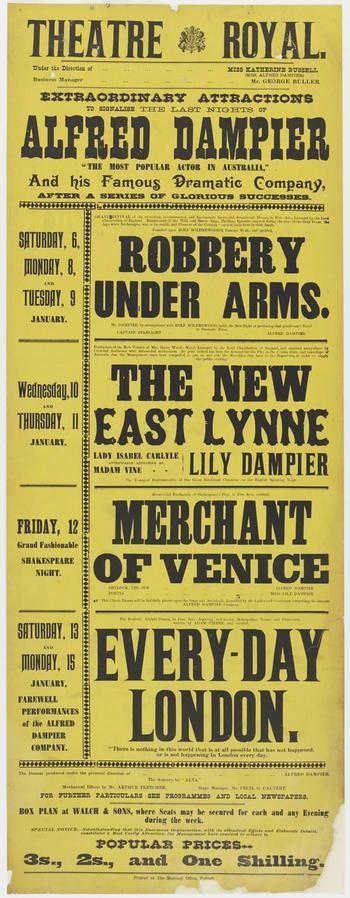
Again, this newspaper critic devoted many column inches to demonstrating their own sophistication by analysing a production's approach to the play. When Dampier followed his Friday night Hamlet with The Merchant of Venice a week later (see Figure 4), the Hobart reviewer again noted appreciatively that there was ‘a satisfactorily large audience’ and then, ‘If the avarice and mercilessness of Shylock are painted in strong colours, so are the rancour and uncharitableness of Antonio the Christian and his friends.’ Dampier was ‘scholarly’; ‘Every line was “read” and interpreted in finished elocution’ and he ‘toned down considerably [Shylock's] vehemence … [he was] more thoughtful, deliberate, and determined than passionate’.
(Colour online) Playbill, ‘Alfred Dampier … and his famous dramatic company’, Theatre Royal, Hobart. Mercury Office, [1900]. No. 54, J. W. B. Murphy Theatrical Poster Collection. Courtesy Tasmanian Archive and Heritage Office.

Reviewers also liked to demonstrate to their readers their knowledge of London players and productions. Throughout his career, Alfred Dampier traded on the story (as mentioned above, possibly untrue) that he and Henry Irving had been fellow jobbing actors learning their trade under Charles Calvert at the Manchester Theatre Royal and the Prince's Theatre in the mid-1860s. Building on Dampier's own self-promoting publicity, colonial Hobart proudly claimed its equivalence:
Mr Dampier is one of the leading Australian actors of the legitimate drama, and is also acknowledged in England and America to have few compeers. He has appeared as Hamlet nearly 2,000 times, and some time ago, when visiting America, he played a record engagement of ten performances of Hamlet in one week, including three matinees and a Sunday evening. It is some years now since Sir Henry Irving and Mr. Dampier played several seasons together in the Old World, and strange that now, after so long a time, they both hold the premier positions as Shakespearean exponents – Sir Henry Irving, London, and Mr. Alfred Dampier in Australia.Footnote 54
A final piece of evidence which gives us additional insight into Friday Night Shakespeare (and further exposes the cultural prejudices in written reviews) is a surviving account book for the Dampier company for the period from December 1899 to September 1900.Footnote 55 This allows us to compare the box office takings for three seasons – Hobart, Melbourne and Sydney – and demonstrates how we need to limit and specify any conclusions we might draw from the innumerable commentators at the time who lamented the decline of the ‘serious’ or ‘legitimate’ drama, particularly Shakespeare. For example, when Dampier played Merchant of Venice in Brisbane, a local critic boasted of his own city's alleged pleasingly ‘good’ attendance, which he brazenly compared to Melbourne and Sydney, where he claimed that the Bard was ‘played before the thinnest of audiences’.Footnote 56 This, as we also saw in Hobart, was parochial puffery: evidence-free assertions that Australia's smaller capital cities were more sophisticated than the two large metropolises which then dominated Australian cultural life.
The account book gives the lie to the Brisbane critic's claim. In Hobart, Hamlet and The Merchant of Venice each took £29, more than respectable for a small city and in fact only excelled by the last night of For the Term of His Natural Life (which managed £32), the second night of The Three Musketeers (£36), and the best night of three for Robbery under Arms (£34). In Melbourne, Dampier worked his popular repertoire hard for the first six weeks before offering Hamlet, which managed a very respectable house of £109. This was a much better return than for all but the opening nights for each of the melodramas, while Merchant of Venice managed £68 and a second night of Hamlet made £66 – again well above the average for the admittedly much longer runs for the other plays. In Sydney, Dampier presented melodramas for eleven weeks before supplementing them with Merchant, Hamlet and Macbeth. Each of these managed a respectable box office return, generally better than any non-Shakespeare did on any night except Saturday. While Shakespearean box office income was enlarged by school student attendances (a puff piece in the Hobart Mercury had noted, ‘We are requested to state that masters of schools and colleges may make special arrangements for their pupils witnessing the performance’Footnote 57), this was probably more than offset by the numbers willing to pay to sit in the expensive seats. While few Shakespeare productions managed more than a few nights in a season, the contribution of Dampier's Shakespearean Fridays to late colonial and early federation Australian culture was significant: a prestige occasion for a crowded dress circle of devotees.
Alfred Dampier and his family worked on just the wrong side of the age of mechanical reproduction. (His exact contemporary, the above-mentioned W. J. Holloway who directed and tyrannized Essie Jenyns, was more lucky: there is a 1910 sound recording of him performing ‘O What a Rogue and Peasant Slave Am I’ available on YouTube).Footnote 58 Dampier did record Tennyson's ‘Charge of the Light Brigade’ for a visiting Edison showman as early as 1890,Footnote 59 but the wax cylinder is not known to have survived and, while early film realizations of some of the plays he staged were made by Lily and her husband Alfred Rolfe after Dampier's death in 1908, none have survived. We have some artists’ sketches and a reasonable number of posed photographs for Alfred, Lily, Rose, Katherine and some of their regular associates, but no personal papers and no company archives apart from that one account book – nine months’ financial records for a company that survived for thirty years. For details of their work and impact we are therefore forced to rely almost exclusively on press advertisements and reviews, applying all the limitations and qualifications I have noted.
There is, however, one tantalizing, if tenuous, visual link back to the performance style of the Alfred Dampier Shakespeares. For three films they made in 1911, Lily Dampier and Alfred Rolfe hired as actors Raymond Longford and Lottie Lyell – later to become the most famous director and star respectively of the Australian silent-cinema era.Footnote 60 Their classic film is The Sentimental Bloke, made in 1918 based on C. J. Dennis's poem. In it, the working-class bloke, Bill, and his only slightly more aspirational girlfriend, Doreen, go to see Romeo and Juliet at a Sydney theatre. I have been unable to find any evidence of any professional company that year performing the play, so presumably Longford and Lyell staged the sequences themselves (the theatre and the names of the actors in the play-within-the-film have not to my knowledge ever been identified). Longford's distinctive style as a director of film actors was to contrast what he claimed as casual Australian working-class ‘real life’ behaviour with what he saw as the artificial acting and emotions of the live stage. Consequently, he edited the sequence for histrionic comic effect. Nevertheless, the actors do not burlesque the action – the sword fights are impressively realized – so it is plausible that the staging, costumes, postures, gestures and movement are echoes of the Shakespeares of Alfred and Lily Dampier.Footnote 61 The Sentimental Bloke’s Romeo and Juliet fragments are simply dressed and staged, though with ‘strong’ entrances and exits (e.g. by crossing stage right before exiting left, allowing for a long-viewed accelerating departure), while the frontal acting is clearly in the service of voices we can only imagine.
In summary, then, the paradox in imagining the Dampiers’ Shakespearean Fridays in performance is that we have to conceptualize the work of a company which in all genres avoided flamboyant acting, which lacked the financial resources for lavish scenic effects, which played predominantly and highly successfully to the lower-class pit and gallery while sometimes struggling to fill the dress circle – except in Shakespeare.Footnote 62 Presenting the Bard took the same approach upmarket with different intent and effect. Eschewing sexy or spectacle stagings in favour of respectability, reverential to the point of scholarly coldness, the Dampier company's Shakespeares (while certainly a personal preference and enthusiasm) worked strategically to raise their own social standing without great expense other than rehearsal time, prompted commentators to perform their own cultural eminence and proselytizing power, and allowed predominantly British settler societies in the South Pacific opportunities to imagine themselves closer to the sophistication of ‘Home’.