




No CrossRef data available.
Article contents
Outcome of the construction of a Blalock–Taussig shunt in adolescents and adults
Published online by Cambridge University Press: 13 July 2005
Abstract
Aims: The purpose of our study was to ascertain the outcome of the construction of a Blalock–Taussig shunt in patients aged 12 years and over. Patients and methods: We identified 21 patients in whom a Blalock–Taussig shunt had been constructed subsequent to the age of 12 years. Of the patients, 9 were female, and their median age was 18.5 years, with a range from 12 to 46 years. All had usual atrial arrangement, and the atrioventricular connections were concordant in 11, with univentricular atrioventricular connection in 10. Pulmonary atresia was present in 8 (38 per cent), and pulmonary stenosis, either valvar or subvalvar, in 13. An interposition graft had been placed between the subclavian and pulmonary arteries in 16 patients, and an end-to-side anastomosis between the arteries in 5. Results: One patient had died in hospital, while 4 patients had died during the period of follow-up after initial construction of the shunt. Long-term follow-up was available in 86 per cent of patients. In the 3 patients lost to follow-up, the shunt had been known to be functioning at periods of 4, 8, and 10 years, respectively. Actuarial freedom from death after a period of 17 years was 76 per cent. In 8 patients, a period of 10 years had elapsed with the shunt patent, and a further 10 had a patent shunt after 5 years follow-up. Symptomatic improvement was reported in 16 (76 per cent) patients, although adverse cardiac events had occurred during follow-up in 17, including congestive heart failure in 3, atrial fibrillation in 3, and endocarditis in 2. In 2 patients, it had been possible to proceed to biventricular repair, one with tetralogy of Fallot, and the other having a Rastelli procedure. Further in 3 patients, it had been possible to construct the Fontan circulation, or one of its variants. One patient has undergone cardiac transplantation, while 2 are awaiting transplantation. Conclusions: Symptomatic improvement can be achieved by construction of a Blalock–Taussig shunt in older subjects, and the risks of surgery are low. Later repair may be feasible in some patients, but adverse cardiac events may follow the increased volume load on the systemic ventricle.
Information
- Type
- Original Article
- Information
- Copyright
- © 2005 Cambridge University Press
Blalock and Taussig1 first described direct end-to-side anastomosis of a subclavian artery to a pulmonary artery as palliation for cardiac malformations in which there was reduced flow of blood to the lungs because of pulmonary stenosis or atresia in the setting of a right-to-left shunt at ventricular level. More recently, it has become customary to use interposition grafts of polytetrafluoroethylene,2–5 thus avoiding transection of the subclavian artery. In young patients with cyanotic congenital cardiac disease, construction of both the classical and modified variants of the Blalock–Taussig shunt has become a safe and effective palliative procedure, with high rates of patency over the early and medium term.2–5 The majority of reports describing construction of such shunts, however, have addressed shunts constructed in infants and children. We have been unable to find any report addressing the outcome for shunts constructed in patients at an older age.
With this deficiency in mind, therefore, we have collated our observations over the medium to long term in patients in whom classical or modified Blalock–Taussig shunts were constructed beyond the age of 12 years. One reason for undertaking our analysis is to provide evidence for decision-making in certain older patients where several surgical options are possible. Examples would be young adults with univentricular atrioventricular connections, such as tricuspid atresia or double inlet left ventricle, associated with obstruction of the subpulmonary outflow tract, or those with pulmonary atresia with intact ventricular septum and a hypoplastic right ventricle, where the potential surgical options include construction of a modified Blalock–Taussig shunt, a classical or bi-directional Glenn procedure, or construction of the Fontan circulation in one of its modifications. There will also be patients with reduced pulmonary blood flow where the pulmonary arterial anatomy or pressure, or the pulmonary vascular resistance, preclude construction of a cavopulmonary anastomosis, but may permit insertion of a Blalock–Taussig shunt. The risks and benefits of each approach need to be compared in order to make optimal decisions for treatment.
Patients and methods
The sole criterion for inclusion was that the patient be aged at least 12 years at the time of construction of the Blalock–Taussig shunt. Using this criterion, we searched the database at the Royal Brompton Hospital, and thereafter conducted a retrospective analysis, searching for the period of 20 years between September 1972 and September 1992. We identified a total of 21 patients. In all patients, the initial cardiac diagnosis, along with the anatomy of the pulmonary arteries, and the presence of any additional sources of flow of blood to the lungs, were confirmed by cardiac catheterisation and cineangiography prior to construction of the shunt, the majority also undergoing cross sectional echocardiography. Demographic data included full sequential diagnosis, the year of construction of the Blalock–Taussig shunt and any subsequent operations, the size, site and type of shunt, and the clinical state after construction of the shunt, including any change in symptoms, any cardiac events, and the timing of such events (Table 1).
Table 1. Demographic data of the patients in whom we constructed a Blalock–Taussig shunt.

The median age at the time of construction of the Blalock–Taussig shunt was 18.5 years, with a range from 12 to 46 years. Of the 21 patients, 9 (43 per cent) were female. All had usual atrial arrangement, with concordant atrioventricular connections in 11 (52.4 per cent), double inlet left ventricle in 7 (33.3 per cent), double inlet right ventricle in 1, and absence of the right atrioventricular connection, with the left atrium connected to a dominant left ventricle, in other words classical tricuspid atresia, in 2. The ventriculoarterial connections were concordant in 3 (14.3 per cent), discordant in 10 (47.7 per cent), double outlet from the right ventricle in 3, double outlet from the left ventricle in 1, and single outlet in 4 (19 per cent). Pulmonary atresia was present in 8 (38 per cent), and pulmonary valvar stenosis, and/or obstruction of the subpulmonary outflow tract, in the remainder. Hypoplasia of the left pulmonary artery was found in 7, and atresia in 1. The right pulmonary artery was absent in 1, and hypoplastic in 5. One pulmonary artery was considered to be hypoplastic when it was less than half the diameter of the other artery. Major systemic-to-pulmonary collateral arteries were found in 3 patients. Associated cardiac anomalies include ventricular septal defect in 11 (52 per cent), atrioventricular septal defect in 1, common atrium in 1, tetralogy of Fallot in 1, criss cross atrioventricular relationships in 1, and 1 in inferior caval venous thrombosis.
An interposition graft had been placed between the subclavian and pulmonary arteries in 16 patients, the graft having a median size of 8 millimetres, with a range from 4 to 12 millimetres. In 8 patients, the graft had been made of Impra, in 6 Gortex, in 1 Dacron, with the nature of the graft not being documented in the other case. A classical Blalock–Taussig shunt, with end-to-side anastomosis of the subclavian to the pulmonary artery, had been constructed in the other 5 patients. Of the 21 patients, the shunt had been constructed on the left side in 12, and on the right in the remainder.
Statistical methods
Univariate analysis was used to assess potential predictors of surgical mortality, considering age at construction of the shunt, sex, cardiac diagnosis and complications, year of operation, size of shunt, side of shunt, and type of shunt. Logistic regression was used, incorporating the binary variables for outcome of dead or alive. A p value of less than 0.05 was considered to be significant. All statistical analyses were conducted using version 11.5 of the software package of social science. Actuarial analysis of shunt survival and freedom from death was calculated using the method of Grunkemeier and Starr.6
Results
We were able to collate follow-up over the medium or long term in 86 per cent of patients. The 3 cases lost to follow-up, patients 1, 8, and 14, had been known to be alive, with a functioning shunt, at 4, 8, and 10 years subsequent to construction of the shunt, respectively. The median time from construction of the shunt to a corrective or palliative procedure was 12 years, with a range from 0 to 32 years. Of the patients, 8 (38.1 per cent) had completed 10 years, and 10 (47.6 per cent) 5 years with the shunt remaining patent. The actuarial survival for our patients, over a period of 10 years, is shown in Figure 1. One of the patients died in hospital during construction of the shunt. This patient, the 18th in our series, suffered from severe unilateral pulmonary oedema following insertion of an Impra graft between the left subclavian artery and a low pressure collateral artery at the left hilum. Another 4 of the 21 patients died during follow-up after construction of their first shunt. Actuarial freedom from death at 15 years was 76.2 per cent (Fig. 2). Our 9th patient died in congestive cardiac failure with poor left ventricular function, our 13th patient died suddenly 4.5 years after construction of the shunt, and the 17th patient also died suddenly, this time 2 years and 7 months after construction of the shunt. We do not know whether these two patients died from an arrhythmia, or because of occlusion of the shunt. The 19th patient contracted subacute bacterial endocarditis, and died 1 year after insertion of the shunt, while the 10th patient died 5 years after the initial shunt, but also subsequent to a second surgical procedure for revision of the initial shunt, which had become occluded. We considered this final event not as mortality after the first shunt, but rather as the consequence of additional surgery, there being a delay of 1 year after revision of the shunt.
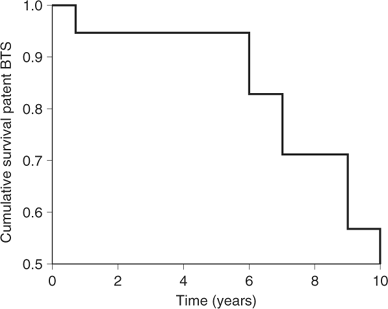
Figure 1. 10 year actuarial survival with patency of the Blalock–Taussig shunt (BTS).
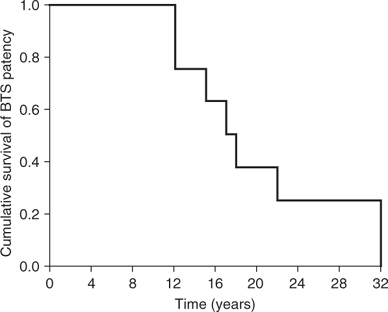
Figure 2. Actuarial survival, or freedom from death, for patients leaving hospital following their first Blalock–Taussig shunt.
Using univariate analysis, we were unable to discover any risk factors associated with death. Over three-quarters of the patients, 16 in all, reported improvement in symptoms, and of the 20 patients surviving surgery, 5 were in Class I of the categorisation of the New York Heart Association, 9 were in Class II, 3 were in Class III, and 3 were in Class IV. Cardiac events were reported by 17 patients during follow-up, with a median time to the event of 4.8 years, and a range from 0 to 32 years. These were polycythemia that required venesection in 3 patients, atrial fibrillation that was controlled on digoxin in 3, shortness of breath with congestive cardiac failure in 3 and subacute endocarditis in 2. In addition, 2 of the patients had undergone biventricular repair, by means of correction of tetralogy of Fallot in one, and the Rastelli operation in the other. Amongst the others, 3 have undergone a Fontan procedure, or one of its variants, and 1 has had cardiac transplantation. An additional 2 patients are awaiting cardiac transplantation.
Discussion
We have shown that a modified Blalock–Taussig shunt can be performed in older patients with a low surgical mortality. The shunt can be expected to provide a minimum of 5 years of effective palliation, and may encourage growth of the pulmonary arteries,7, 8 allowing later definitive repair, in a proportion of patients, initially not deemed suitable for primary correction because of the size of these arteries. Of our overall cohort, 16 patients (76 per cent) were considered to have benefited from construction of the shunt, in that their clinical state, and quality of life, had improved following surgery.
Only 5 of our patients experienced a poor outcome, with 1 dying during construction of the shunt, and another after 4 months in congestive cardiac failure. Another proceeded to a Rastelli operation after 1 year, having become short of breath after construction of the shunt. An additional patient died after 1 year with subacute bacterial endocarditis, and another 1 year after construction of a second Blalock–Taussig shunt, 5 years after the initial procedure.
In those patients whose shunts remained patent for longer than 5 years, eventual clinical deterioration was associated with polycythemia and increasing cyanosis in one-fifth, with some of these patients (14 per cent) requiring repeated venesections. In addition, 3 patients developed atrial arrhythmias, 3 congestive heart failure, and 2 infective endocarditis. A further patient developed pulmonary vascular disease 11 years after construction of the shunt. This unusual complication has also been reported by Hofschire et al.9
The criterions for selecting patients suitable for the Fontan procedure10–13 need to be rigorous. Thus, patients with increased pulmonary artery pressure, irrespective of whether or not the pulmonary vascular resistance is raised, those with atrioventricular valvar regurgitation, and those in higher functional classes of the categorisation of the New York Heart Association all carry a high risk of poor outcome or death. Older age at operation is also associated with higher risk of atrial and ventricular arrhythmias and lower survival.10, 14 In cases where the criterions for a Fontan procedure are not met, construction of a Blalock–Taussig shunt may be the preferred option.
In the short to medium term, the majority of our patients were free of medication, while morbidity as a direct result of the operation was uncommon. This compares favourably with the possible complications of a Fontan procedure, such as arrhythmias, abnormal liver function tests,15 thrombosis, coagulation disorders,16, 17 pleural and pericardial effusions, cerebrovascular accidents,18 and protein losing enteropathy.19 In the longer term, however, because the ventricle is volume-loaded after construction of a Blalock–Taussig shunt, ventricular dysfunction and arrhythmias become an increasing problem.20
A relatively simple procedure, which provides effective palliation over a significant period of time, therefore, always deserves consideration, especially if other options, such as an atriopulmonary or cavopulmonary anastomosis, carry a greater risk, particularly in cases where the pulmonary arterial pressure is elevated. Furthermore, construction of the Blalock–Taussig anastomosis does not require cardiopulmonary bypass, the latter having its own complications.
Our study is limited by its retrospective nature, and because we were unable to make comparison with a contemporaneous matched group of patients undergoing a cavopulmonary, or atriopulmonary connection. Gatzoulis et al.,20 reporting findings from patients treated in Toronto, found that those undergoing the latter procedures had a better prognosis than those undergoing a shunt. In the patients with a Blalock–Taussig shunt, impaired ventricular function because of volume overload prejudiced outcome. This would be influenced by the size of the shunt, and too large a shunt was the cause of death in the one patient in our series who died soon after surgery. Our data, nonetheless, indicates that construction of a modified Blalock–Taussig shunt of suitable size still has a role in palliation in adults with reduced pulmonary blood flow, particularly as the procedure can be carried out with low risk.7
In conclusion, our data shows that construction of a Blalock–Taussig shunt in older patients provides effective palliation in the short to medium term. Death or morbidity are uncommon, and patients are free of medication in the medium term. In the shorter term, but possibly not in the longer term, this compares favourably with the Fontan procedure, where even carefully selected patients have a more than negligible risk of morbidity and mortality.
References
Blalock A, Taussig HB. The surgical correction of malformations in which there is pulmonary stenosis or pulmonary atresia. JAMA 1945; 128: 189–202.Google Scholar
McKay R, de Laval MR, Rees P, Taylor JF, Macartney FJ, Stark J. Assessment of Modified Blalock Taussig shunts using Expanded Polytetrafluoroethylene (Gortex). Ann Thorac Surg 1980; 30: 137–145.Google Scholar
De Leval MR, McKay R, Jones M, Stark J, Macartney FJ. Modified Blalock–Taussig shunts. J Thorac Cardiovasc Surg 1981; 81: 112–119.Google Scholar
Donahoo JS, Gardner TJ, Zahka K, Langford Kidd BS. Systemic pulmonary shunts in neonates and infants using microporous expanded polytetrafluoroethylene: immediate and late results. Ann Thorac Surg 1980; 30: 146–150.Google Scholar
Di Benedetto G, Tiraboschi R, Vanini V, Annecchino P, Gamba A, Parenzan L. Systemic pulmonary artery shunt using PTFE prosthesis (Gortex). Early results and long term follow up on 105 consecutive cases. Thorac Cardiovasc Surg 1981; 29: 143–147.Google Scholar
Grunkemeier GL, Starr A. Actuarial analysis of surgical results: rationale and method. Ann Thorac Surg 1977; 24: 404–408.Google Scholar
Jahangiri M, Lincoln C, Shinebourne E. Does the modified Blalock Taussig shunt cause growth of the contralateral pulmonary artery? Ann Thorac Surg 1999; 67: 1397–1399.Google Scholar
Honda J. Growth of pulmonary arteries and morphological assessment after Blalock Taussig shunts. Nippon Kyobu Geka Gakkai Zasshi. J Jpn Assoc Thorac Surg 1993; 41: 569–577.Google Scholar
Hofschire PJ, Rosenquist GC, Ruckerman RN, Moller JH, Edwards JF. Pulmonary vascular disease complicating the Blalock Taussig anastomosis. Circulation 1972; 56: 124–126.Google Scholar
Fontan F, Kirklin JW, Fernandez G, et al. Outcome after “perfect” Fontan operation. Circulation 1990; 81: 1520–1536.Google Scholar
Mair DD, Hagler DJ, Puga FJ, Schaff HV, Danielson GK. Fontan operation in 176 patients with tricuspid atresia. Results and a proposed new index for patient selection. Circulation 1990; 82 (Suppl 5): 164–169.Google Scholar
Driscoll DJ, Offord KP, Feldt RH, Schaff HV, Puga FJ, Danielson GK. Five to fifteen year follow-up after Fontan procedure. Circulation 1992; 85: 469–496.Google Scholar
Hofbeck M, Singer H, Scharf J, et al. Total cavopulmonary anastomosis: selection criteria related to postoperative results. Thorac Cardiovasc Surg 1993; 41: 28–33.Google Scholar
Cecchin F, Johnstrude CL, Perry JC, Friedman RA. Effect of age and surgical technique on symptomatic arrhythmias after the Fontan procedure. Am J Cardiol 1995; 76: 386–391.Google Scholar
Cromme-Dijkhuis AH, Hess J, Hahlen K, et al. Specific sequelae after Fontan operation at mid and long term follow up. Arrhythmia, liver dysfunction and coagulation disorders. J Thorac Cardiovasc Surg 1993; 106: 1126–1132.Google Scholar
Cromme-Dijkhuis AH, Henkens CM, Bijleveld CM, Hillege HL, Bom VJ, van der Meer J. Coagulation factor abnormalities as possible thrombotic risk factors after Fontan operations. Lancet 1990; 336: 1087–1090.Google Scholar
Jahangiri M, Shore D, Kakkar V, Lincoln C, Shinebourne E. Coagulation factor abnormalities following the Fontan procedure and its modifications. J Thorac Cardiovasc Surg 1977; 113: 989–992.Google Scholar
Du Plessis AJ, Chang AC, Wessel DL, et al. Cerebrovascular accidents following Fontan operation. Paediatr Neurol 1995; 12: 230–236.Google Scholar
Mertens L, Hagler DJ, Sauer U, Somerville J, Gewillig M. Protein-losing enteropathy after the Fontan operation: an international multicenter study. J Thorac Cardiovasc Surg 1998; 115: 1063–1073.Google Scholar
Gatzoulis MA, Munk MD, Williams WG, Webb GD. Definitive palliation with cavopulmonary or aortopulmonary shunts for adults with single ventricle physiology. Heart 2000; 83: 51–57.Google Scholar
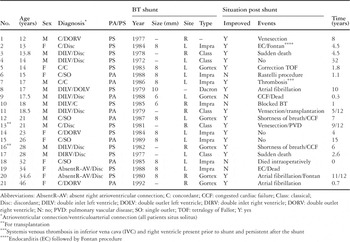
Table 1.

10 year actuarial survival with patency of the Blalock–Taussig shunt (BTS).

Actuarial survival, or freedom from death, for patients leaving hospital following their first Blalock–Taussig shunt.
 You have
Access
- 4
- Cited by