Self-Regulation Therapy (SRT) is a suggestion procedure deriving from a cognitive-behavioral perspective of hypnosis (Spanos & Chaves, Reference Spanos and Chaves1989), which applies techniques to reproduce physical sensations (weight in hand, salivation, etc.) with which patients can obtain a high degree of suggestibility to be able to respond to any suggestion with their eyes open and with a participative attitude, while maintaining a normal conversation with the therapist. This procedure was developed by Amigó in the 1990s and its efficacy has been verified with experimental studies since then until the present-day (Amigó, Reference Amigó1992a; Reference Amigó, Kirsch, Capafons, Cardeña and Amigó1998; Reference Amigó2014).
A previous study has proved an experimentally controlled comparison of responses to hypnosis, SRT and imagination (control) (Moffitt, Reference Moffitt1999). A positive and significant correlation was found between the objective and subjective scores under both experimental conditions. Therefore, SRT is just as efficacious as hypnosis as a suggestion procedure. The advantage of using SRT as a suggestion process as opposed to hypnosis stems from what the previous paragraph states; that is, it is a procedure in which subjects actively participate by keeping their eyes open, and which allows a greater sensation of self-control, and involves fewer typical fears associated with hypnosis, such as fear of losing control, not waking up, being manipulated, etc.
SRT has demonstrated its therapeutic efficacy to treat smoking, obesity, dysmenorrhoea and the fear to fly (see the compilation of these studies in Amigó, Reference Amigó2012; Capafons, Reference Capafons, Kirsch, Capafons, Cardeña and Amigó1998; Capafons & Amigó, Reference Capafons and Amigó1993; Reference Capafons and Amigó1995).
Apart from the therapeutic uses cited, SRT has been employed to reproduce the effects of certain substances, especially stimulants like caffeine, cocaine, ecstasy and ephedrine (Amigó, Reference Amigó1992b; Reference Amigó1993; Reference Amigó1994; Reference Amigó2005). These are experimental single-case designs which demonstrate that a subject under the stimulant effects of a given substance is capable of “imitating them” or reproducing them from suggestion in a drug-free situation and voluntarily. Using suggestion for this very purpose, the literature contemplates the use of suggestion (Bauman, Reference Bauman1970; Fogel & Hoffer, Reference Fogel and Hoffer1962; Granone, Reference Granone1973; Hastings, Reference Hastings2006), although very few experimental studies have been conducted with an alternative suggestion technique to hypnosis; i.e., SRT.
The possibility of reproducing the effects of a stimulant with suggestion is based on the classical conditioning of effects of drugs (Lynch, Stein, & Fertziger, Reference Lynch, Stein and Fertziger1976; O’Brien, Childress, McLellan, & Ehrman, Reference O’Brien, Childress, McLellan and Ehrman1992; Stewart, de Wit, & Eikelboom, Reference Stewart, De Wit and Eikelboom1984). Conditioning the effects of cocaine on animals (Barr et al., Reference Barr, Sharpless, Cooper, Schiff, Paredes and Bridger1983; Post, Lockfeld, Squillage, & Contel, Reference Post, Lockfeld, Squillage and Contel1981) and humans (Muntaner et al., Reference Muntaner, Cascella, Kumor, Nagoshi, Herning and Jaffe1989) has been verified. Among the subjective sensations of cocaine, there are reports on increased euphoria and diminished sedation (Fischman et al., Reference Fischman, Schuster, Resnekov, Shick, Krasnegor, Fennell and Freedman1976), increased vigour and friendliness (Fischman, Reference Fischman and Grabowski1984), stimulation and joy, and concern and confusion (Higgins et al., Reference Higgins, Bickel, Hughes, Lynn, Capeless and Fenwick1990). Not only can one stimulus elicit effects of drugs, but also the context and setting (a room, the people present, the drug injection ritual), and can act as elements of a conditioned compound stimulus which, when repeatedly paired with cocaine injection, elicits similar placebo-conditioned responses to drug-produced ones (O’Brien, Ehrman, & Ternes, Reference O’Brien, Ehrman, Ternes, Goldberg and Stolerman1986; Post et al., Reference Post, Lockfeld, Squillage and Contel1981). The relevance of verbal instructions to modulate placebo responses to drugs like amphetamines (Lyery, Ross, Krugman, & Lyde, Reference Lyery, Ross, Krugman and Lyde1964) and ethanol (Marlatt & Rohsenow, Reference Marlatt, Rohsenow and Mello1980) has also been verified.
SRT, which employs classic conditioning and suggestion mechanisms, is an efficacious method used so that subjects reproduce effects of stimulant drugs. Apart from the aforementioned subjective effects, the possibility of reproducing increased performance in concentration tasks has been observed with SRT (Amigó, Reference Amigó1994), such as the physiological effects of a drug: tachycardia (Amigó, Reference Amigó1992b, Reference Amigó1997), brain activation with brain imaging techniques like SPECT and EEG (Amigó, Reference Amigó2005), the concentration of glutamate in blood (Amigó, Caselles, Micó, & García, Reference Amigó, Caselles, Micó and García2009), and the dynamics of gene regulators like c-fos (Micó, Amigó, & Caselles, Reference Micó, Amigó and Caselles2012) and DRD3 (Amigó, Caselles, & Micó, Reference Amigó, Caselles and Micó2013).
We now go on to describe the procedure. Self-Regulation Therapy is divided into three phases:
-
a. Phase with explanation and basic sensorial recall exercises
In this phase, several sensory recall exercises are used to teach subjects how to voluntarily reproduce various physical sensations (salivation, arm heaviness, leg paralysis, stiff hand) that are initially provoked by real stimuli (sweet in the mouth, a heavy book, etc.). Subjects are asked to associate these sensations with images, words, or other cues that will help them reproduce these sensations later with no physical stimuli. So they acquire the suitable skill and ability to respond to these exercises.
-
b. Training phase
In this phase, basic exercises are repeatedly practiced without having to resort to provoked sensations. They are also done in a different order so that participants respond more easily and quickly while doing them.
-
c. Generalization phase
In this phase, and once participants have completed the training phase with basic exercises, they will be asked to prepare their mind to respond to any other suggestion, even though they have had no former practice; for instance, different emotions, and sensorial and motor experiences, of all kinds. Finally, a closing session will be held. Participants will be told that preparation will be easier and quicker during the following sessions, and that more time will be spent on applying the technique for whatever participants need or desire. A detailed description of this procedure can be found in Amigó (Reference Amigó2014).
The next session is to reproduce the effects of the drug. Firstly, an abbreviated version of SRT is applied. In order to arouse stimulant effects, various strategies are adopted, such as: 1) close your eyes and remember one of your most recent experiences of drug use, who you were with, the atmosphere, the music you hear, etc.; 2) using a “non-deceiving placebo”; that is, put some white powder (sugar or bicarbonate of soda) on the table as a visual stimulus; 3) stage the drug use ritual by pretending you are snorting the white powder; 4) share this session with the friends you normally use drugs with; 5) create an atmosphere, like changing the light or putting on music you associate with the drug; 6) close your eyes and repeat the word “cocaine” in a whisper; 7) describe the drug use sequence (snort then wait for the effects to start, the first effects appear, I can notice them more clearly, etc.); 8) read the list of effects that you wrote down and repeat the sensations in a whisper. See Amigó (Reference Amigó2014) for further details.
To date, studies into cocaine effects reproduction with SRT have been limited to an experimental single-case design (Amigó, Reference Amigó1993) and an exploratory study with a small group (n = 5) of cocaine addicts (Amigó, Zabiky, & García, Reference Amigó, Zabiky and García2007). No studies on reproducing effects of speed with SRT are available. Therefore, an experimental group study is needed to scientifically confirm that reproducing effects of stimulant drugs, e.g., speed and cocaine, is feasible with SRT beyond the single-case or small-sized group studies conducted to date. This would be a previous and fundamental step for the therapeutic usage of this procedure to for example, treat addictions.
Here we present an experimental study to verify the efficacy of SRT to reproduce effects of cocaine and methamphetamine (speed) in a non-clinical sample of drugs users. We also analyzed the personality and situational factors that predict the efficacy of SRT to reproduce effects of cocaine and speed.
Method
Participants
This study included 109 participants (48 males and 61 females), who were students (70%) and employees (30%) from the city of Valencia (east Spain). Their mean age was 24.97 (SD = 5.4) years and their age range was 19–50 years.
Instruments
The Berkeley Personality Profile (BPP; Harary & Donahue, Reference Harary and Donahue1994)
The BPP is a 35-item Likert-type questionnaire with five subscales, each consisting of seven items. These scales measure five personality styles: Expressive, Interpersonal, Work, Emotional and Intellectual. These personality styles are related with the five dimensions of personality that come up repeatedly in the Big Five studies.
Euphoria Scale (ES) (Kjellberg & Bohlin, Reference Kjellberg and Bohlin1974)
It is a 4-item Likert-type response scale with the following self-descriptive adjectives: cheerful, elated, exhilarated, and lively. The scale score goes from 0 (no effect) to 4 (maximum effect).
Depression Scale (DS) (Raskin, Schulterbrandt, Reatig, & McKeon, Reference Raskin, Schulterbrandt, Reatig and McKeon1969; Williams, Reference Williams1990)
A 9-item Likert-type response scale with the following self-descriptive adjectives: blue, downhearted, sad, unhappy, depressed, lonely, troubled, useless, worthless. The scale score goes from 0 (no effect) to 4 (maximum effect).
Self-Regulation Scale (Amigó, Reference Amigó2012; Martínez, Reference Martínez2013)
This scale measures the level of suggestibility reached with SRT and comprises two subscales: 1) Sensorial Experience (SRS-S), which measures the intensity of the sensation suggested from 0 to 4; 2) the Automatism Scale (SRS-A), which measures the level of automatism experienced during each suggestion procedure from 0 to 4. The total score (SRS-T) is obtained by combining the scores of the two scales (total scale); if one score is equal to or is higher than 2 on both scales (sensation and automatism), a score of 1 is obtained in the total scale. The 10 suggestions are: salivation, arms feel heavy, cannot move feet (cannot raise them no matter how hard one tries), stiff hand, joy, tenderness, disgust, stiff arm (cannot fold it, like a plank of wood), cannot move body (unable to get out of chair) and a post-hypnotic-type suggestion (hand becomes tense when the participant picks up a pen later). A study conducted at the University of Valencia (Martínez, Reference Martínez2013) verified that the SRS offers acceptable reliability for the three scores (α = .73 for SRS-T; α = .72 for SRS-S; α = .78 for SRS-A), despite the major difference in types of suggestions. It also presents good construct validity and predicts efficacy to reduce anxiety after an SRT session is run to induce relaxation.
Altered State of Consciousness Scale (Amigó, Reference Amigó2012)
This scale consists in three subscales:
-
a. The dissociation scale. A 10-item scale taken from the Stanford Acute Stress Reaction Questionnaire (SASRQ, Cardeña & Spiegel, Reference Cardeña and Spiegel1993). It measures the subjective sensation of dullness (2 items), derealization (2 items), less awareness of one’s surroundings (2 items), dissociative amnesia (2 items), depersonalization (2 items). Each item is scored from 0 to 4 according to the intensity of the sensation experienced at the time.
-
b. Effects of drugs. It comprises two adjectives, High and Rush. The scale scores go from 0 (no effect) to 4 (maximum effect). These adjectives have been used in a large number of studies on subjective drug effects, quite often in the Visual Analogue Scales (VAS) format.
-
c. Flow. This scale is made up of two items taken from the Spanish version of the Flow State Scale (García, Jiménez, Santos-Rosa, Reina, & Cervelló, Reference García, Jiménez, Santos-Rosa, Reina and Cervelló2008). The flow state is a concept that was presented by Csikszentmihalyi (Reference Csikszentmihalyi1997). Items are: “I have enjoyed the experience and would do it again”, and “It has been a valuable, comforting experience for me”. The idea is to measure the feeling of well-being noted in the 60 minutes before recording it. This sensation of well-being, as a flow experience, is also known as “autotelic experience”. The scale score goes from 0 (no effect) to 4 (maximum effect).
Procedure and Experimental Design
The 109 participants in this study were divided into four groups: Group 1 (G1): Never use illegal drugs (N = 26); Group 2 (G2): Experimentally use cannabis (1–5 times in one’s lifetime). Have never used any stimulant drug (N = 24); Group 3 (G3): Moderate users of drugs. All the participants have used cannabis more than 30 times in their lifetime. Around 50% of this group uses stimulant drugs (N = 29); Group 4 (G4): Regular users of drugs. They all use stimulant drugs (N = 30).
The participants in the four groups completed a questionnaire on sociodemographics data (sex, age, profession, etc.) and also the Berkeley Personality Profile (BP), which assesses the Five Big Personality Factors (Extraversion, Neuroticism, Agreeableness, Conscientiousness and Openness) before intervention. They all (G1, G2, G3, G4) participated in an experimental session in which SRT was applied to produce a state of relaxation. Sessions were carried out in small groups with no more than five participants. At the beginning of the experimental session, participants filled the Euphoria, Depression and Altered State of Consciousness scales. All the scales took the state format; that is, they all asked how you felt at the time. Then they underwent SRT, which finished with relaxation suggestions. Next, they completed the same scales again in the state format, as well as the Self-Regulation Scale (SRS). This is a pre-post nonequivalent groups experimental design. G4 also participated in a second session during which participants received a shortened SRT version to reproduce sensations of cocaine or speed, depending on their preferences. As in the first session, participants completed the Euphoria, Depression and Altered State of Consciousness scales before and after applying SRT. Therefore, a within-subjects experimental design was used for G4. They also participated in small groups with no more than five participants. As G4 was made up of regular cocaine and/or speed users, it was a suitable group with which to reproduce effects of stimulant drugs since clinical experience and former studies have demonstrated that regular, frequent use of such drugs favors the conditioning processes that SRT employs. The other groups either did not use drugs (G1) or used only cannabis (G2 and G3). Only half the participants in G3 had experimented with stimulants. This is why the subjects in this group did not participate in an SRT stimulant effects reproduction session. Nonetheless, G1, G2 and G3 participated in an SRT session to reproduce a state of relaxation. So they can act as the control groups for G4 since it is possible to verify if the stimulant effects reproduced during the SRT session with G4 differed from those produced with an SRT session, which aimed to bring about change of mood, relaxation in this case, in other groups of people. It is a matter of comparing two different moods and checking if the produced stimulant effects clearly differ from the other mood that SRT can induce, and what direction this difference takes. Moreover, when comparing the groups with different levels of drug use, we can also verify if there are any a priori differences in personality or suggestibility in accordance with the level of drug use, which may explain the higher or lower degree of ease with which stimulant effects are reproduced in G4. Therefore, if those participating in G4 effectively reproduce effects of cocaine and speed, we will know that if it is due to them obtaining a higher score than the other groups for suggestibility or for certain personality traits. Finally, in this study we want to confirm that, in G4, the stimulant drug reproduction session using SRT causes different effects of drugs and emotions to another emotional experience, like relaxation. So, with this study, it will be possible to fulfill our objectives, to scientifically confirm two aspects: it is possible to reproduce effects of stimulant drugs, like cocaine and speed, in a non-clinical population with SRT; that this effect is genuine and an authentic effect of drugs, and it differs from other emotional states induced with SRT. The potential uses that this implies are dealt with later.
Results
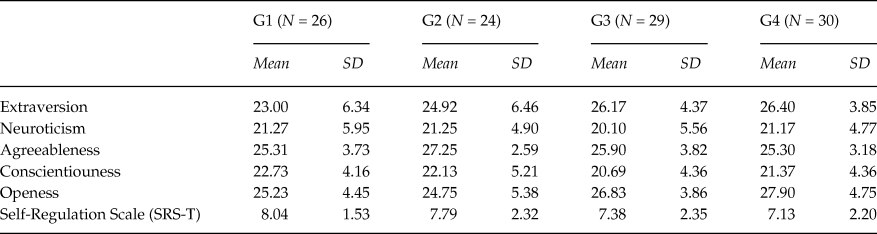
Firstly, checks were made to see if there were significant differences in the study variables between both groups. Table 1 presents the means and standard deviations for all variables of all groups.
Means and standard deviation for all groups (G1, G2, G3 and G4) for the personality variables and the Self-Regulation Scale

G1 = Never use illegal drugs; G2 = Experimentally use cannabis; G3 = Moderate users of drugs; G4 = Regular users of drugs.
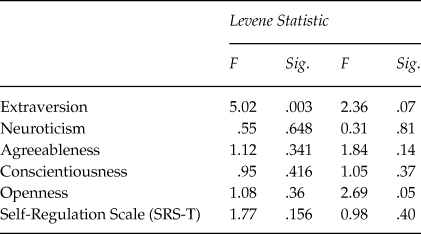
Table 2 presents the one-way ANOVA results for all groups (G1, G2, G3 and G4) for the personality variables (Extraversion, Neuroticism, Openness, Agreeableness and Conscientiousness), and the Self-Regulation Scale (SRS-T).
One-factor ANOVA for all groups (G1, G2, G3 and G4) for the personality variables and the Self-Regulation Scale

No significant difference was found for any variable, although the F for personality factors Extraversion and Openness came close to significance (p = .07 and p = .05, respectively), which is in line with the results obtained in the personality and use of drugs studies (for a review, see Amigó, Reference Amigó2012). Nevertheless, there has to be taken into account the equal variance not assumed for the Extraversion variable, so we must be careful with the interpretation of the results of posterior analysis referred to this variable. The fact that there were no significant differences in the SRS scores is stressed. Hence the level of suggestibility with SRT is not related with use of drugs.
Nonetheless, we decided to verify if there were gender differences in the response to SRT. A significant difference was obtained in the SRS-T score for female participants as the women in this study (t = –2.56; p < .05). They obtained higher scores (
 $\bar X$
= 8.02, SD = 1.85) in SRT than men (
 $\bar X$
= 6.98, SD = 2.37).
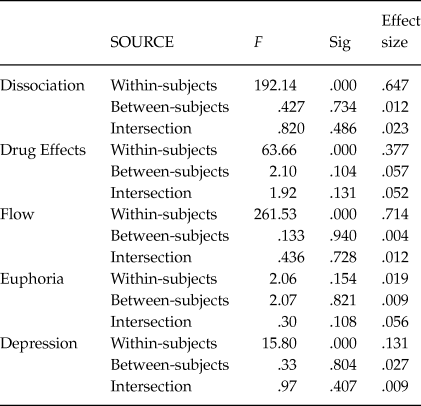
For the state variables, these being Euphoria, Depression and Altered State of Consciousness (Dissociation, Effects of drug and Flow), a repeated measures ANOVA was done for all groups for the relaxation condition, and the results are summarized in Table 3.
Summary of the repeated measures ANOVA results for the state variables for all the groups under the relaxation condition

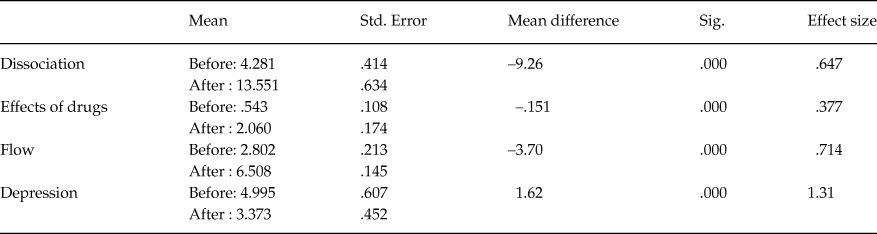
As shown in the table, there are no differences between the groups for any of the variables, but some significant within-subject differences were found for all the variables except Euphoria. Table 4 presents the within-subject mean differences for all the variables, except Euphoria, for all groups and for the relaxation condition. We aimed to check if SRT-induced relaxation modified these variables.
Mean differences before-after the relaxation session for all the groups (G1, G2, G3 and G4)

The Disassociation, Effects of drugs and Flow variables increased after SRT for the relaxation condition, whereas Depression lowered, in all groups (G1, G2, G3 and G4).
After examining the differences between all groups, we went on to pay attention only to G4 (frequent, regular users of cocaine and speed) that is the only one that participated in two different experimental conditions.
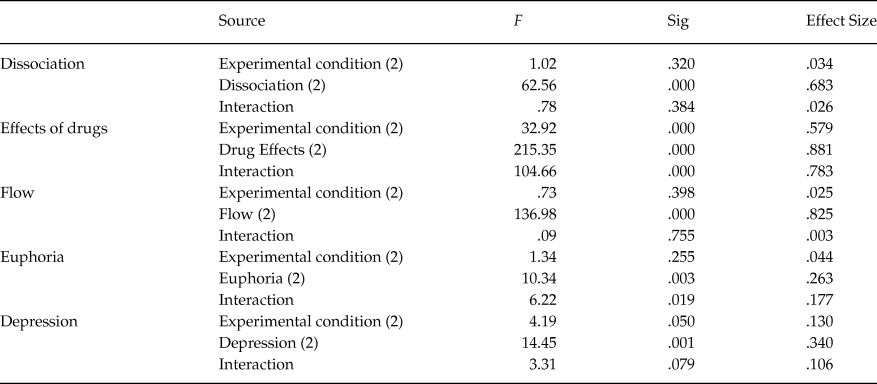
G4 participated in the two experimental conditions: relaxation and drug effects reproduction. Table 5 provides a summary of the two-way repeated measures ANOVA results. One factor is the experimental condition with two levels (Relaxation and Reproduction), while the other factor is each state variable (Dissociation, Effects of drugs, Flow, Euphoria and Depression) with two levels (before and after each session).
Summary of the two-way repeated measures ANOVA results for Group 4 for all the state variables

The number of factor levels is indicated in brackets.
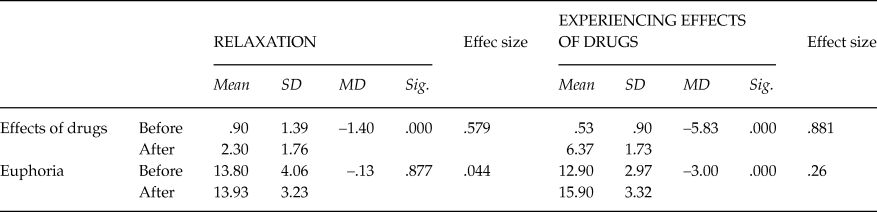
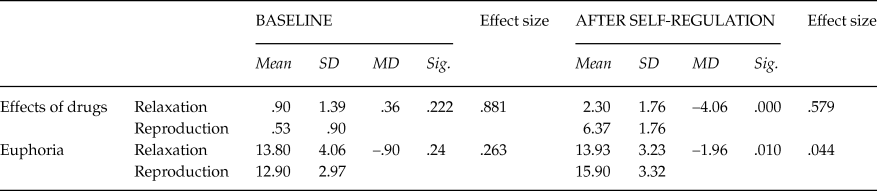
Significant within-subject differences were obtained for all the state variables, but the interaction between the factors was significant in only two (Effects of drugs and Euphoria). Mean differences to know not only the differences between the two experimental conditions in more detail, but also the differences between the pre- and post-measures of each session for these two variables were obtained. Tables 6 and 7 present the results.
Mean differences for Group 4 between the pre- and post-conditions of each session under the two experimental conditions (relaxation and reproduction)

Mean differences for Group 4 between the two experimental conditions (relaxation and reproduction) under the pre- and post-conditions of each session

The results shown in Table 6 indicate that Effects of drugs significantly increased under both the relaxation and reproduction conditions. However Euphoria increased significantly, but only for reproduction.
In Table 7 we can see for the Effects of drugs variable that no significant differences were found in the pre- (baseline) measures of the two sessions. However, significant differences were observed in the post-measure of the sessions, with a more marked increase for the reproduction condition than for the relaxation condition. In other words, under the reproduction condition of effects of drugs, the score of the Effects of drugs variable increased significantly if compared to the score obtained under the relaxation condition. The same result was obtained for the Euphoria variable as its score rose significantly under the reproduction condition of Effects of drugs as opposed to the score obtained under the relaxation condition, even though the size effect was low (.044). Thus the session to reproduce effects of cocaine and speed with SRT had a strong impact and clearly caused Effects of drugs and, to a lesser extent in Euphoria.
Another study objective was to find those factors that best predicted stimulants effects reproduction. To this end, three multiple linear regression analyses were done with successive steps for the participants in G4 (regular users of stimulants). Effects of drugs at the end of the second session, that of reproducing stimulant drugs with the SRT, was taken as the dependent variable, while the Five Big Personality Factors, sex, age and the three SRS scores (sensorial, automatism and total) were taken as independent variables.
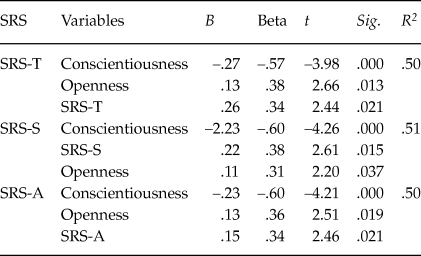
Table 8 offers the multiple linear regression analysis results for G4, and for the three SRS scores.
Results of the multiple linear regression analysis for Group 4 (N = 30) for the three SRS scores (SRS-T, SRS-S and SRS-A)

Independent variables: Extraversion, Neuroticism, Agreeableness, Conscientiousness, Openness, sex, age, SRS-T, SRS-S, SRS-A.
Dependent variable: Effects of Drug at the end of the session.
By not being able to introduce at the same time scores of the SRS-T, SRS-A and SRS-S variables, in the same regression analysis, to avoid multicolliniarity, three regression analysis were made in which, in each one, only one of these variables (SRS-T, SRS-A and SRS-S) was introduced as an independent variable. This is highlighted in the table by observing in the first column of each of the three analyses, the variable used of the SRS scale.
In the first multiple regression analysis, three variables predicted the Effects of Drug score: Conscientiousness (-), Openness and SRS-T. The profile of those people who more intensely reproduce the effects of cocaine and speed is characterized by a low conscientiousness score, being very open to experiences and obtaining a high SRS-T score. A low conscientiousness score can be interpreted as non-conformism or lack of social conventionalisms.
The profile obtained using the SRS-S variable coincided with the former one. However in the second regression analysis with successive steps, the second variable included in the equation was SRS-S, whereas the personality variables were the first to be included in the former analysis.
The profile obtained in the last multiple regression analysis, using the SRS-A score, coincided with the results obtained in the first analysis in which SRS-T was employed as the dependent variable. Likewise, if we consider both the total SRS and the automatism scores, the profile obtained showed that firstly the personality variables Conscientiousness and Openness, and secondly response to SRT, had an effect.
Discussion
In this study, we have been able to verify that a group of regular users of stimulant drugs, such as cocaine and speed, are capable of reproducing the effects of these drugs in a single session by means of the so-called Self-Regulation Therapy (SRT) suggestion procedure.
Nonetheless, these regular, frequent users of stimulant drugs (G4) presented neither higher suggestibility nor differences in personality factors than the subjects in the other study groups. The subjects in the other groups could efficiently use SRT for other therapeutic purposes just as well.
We should bear in mind that the relaxation sessions with SRT brought about significant changes in all the state variables for all the groups, except Euphoria. That is to say, relaxation increased the Altered State of Conscientiousness, the sensation of Flow, it reduced Depression, and also enhanced Effects of drugs!, in such a way that all the subjects, even those who did not use drugs, experienced a sensation of “being drugged” when SRT was applied, and without referring to drugs during the session.
Therefore, is it possible that the stimulant effects reproduction achieved by G4 (regular users of stimulant drugs) is none other than a state of general activation or a change of mood like that which relaxation produces?
It is necessary to compare the effects of the relaxation session using SRT with the effects produced during the drug effects reproduction session (also with SRT) in a within-group design to see if there are any differences, and if so, what type. A two-way repeated measures ANOVA (relaxation/reproduction, before/after the session) provided the answer. Significant differences were found for the interaction of the two factors for the Euphoria and Effects of Drugs variables. On the one hand, these two variables increased more during the stimulant effects reproduction session. On the other hand, and interestingly, a significant difference was found between the measures at the end of the relaxation and the reproduction sessions, but not at the beginning of either session. What this means is that both the Euphoria and Effects of drugs variables, which define stimulant effects well, increased considerably more after a drugs reproduction session than after a relaxation session with SRT.
This result fulfils the objective of the present study because it demonstrates the possibility of reproducing effects of stimulants with SRT, and that these effects differ significantly from those that an SRT session produces to induce relaxation. It can also be stated that STR has induced a state of excitement or general activation, but not a genuine reproduction of the effect of stimulants. On the one hand, the significant differences found in the variables sensitive to effect of stimulant drugs, like Euphoria and Effects of drugs, make us think that the effect is genuine and authentic. Yet on the other hand, a thorough qualitative study of stimulant effects reproduction with SRT shows that the sensations of drugs experienced by participants (painful jaw, restless legs, wanting to smoke, itchy nose, hot hands, boosted self-confidence, feeling high, etc., etc.) are numerous and extremely rich, and reveals a very high subjective sensation of being under the effects of cocaine or speed (Escrig, Reference Escrig2014). Similar effects were obtained when SRT was applied to induce the effect of stimulants such as ecstasy, caffeine, ephedrine, methylphenidate and cocaine (Amigó, Reference Amigó1992b, Reference Amigó1993, Reference Amigó1994, Reference Amigó2005, 2013, Amigó et al., Reference Amigó, Zabiky and García2007).
Another objective of the present study was to check which characteristics of the group of regular users of stimulant drugs could predict greater drug effects reproduction with SRT. Based on the personality variables, the epidemiological (age and sex) variables and SRS performance, a profile has been obtained that predicts the efficacy of reproducing effects of stimulant drugs with SRT by taking the effects of drugs (high and rush) score as the dependent variable when finishing the SRT session. Those participants with a low Conscientiousness score, a high Openness score and a high SRS score are those who produced the most marked effects of drugs scores obtained at the end of the session. Thus, we conclude that the individuals who are more non-conformist and non-conventional, open to experiencing new and special things, and capable of mentally reproducing all kinds of sensations are also better able to reproduce effects of cocaine and speed.
If we consider the three scores that can be obtained with SRS, we can see that SRS-S has a greater influence on efficiently reproducing effects of cocaine and speed, which refers to the intensity with which the suggested sensations in SRT are felt, e.g.: salivation, arm feels heavy, unable to move legs and body, and emotions like joy and tenderness. The more intense these sensations are experienced, the greater the intensity of experiencing SRT-induced high and rush.
This study has some limitations. The number of regular users of drugs (n = 30) limits the scope of the results obtained with multivariate statistical methods, such as multiple linear regression. Working with a bigger group would be worthwhile. It would also be interesting to apply SRT to induce the effect of drugs on moderate users of drugs (G3) to more accurately check whether the level of use of drugs influences the efficacy of drug effects reproduction. The profiles that predict better efficacy in drug effects reproduction are applicable only to the sample type that participated in this study. Amigó and Infanzón (Reference Amigó and Infanzón1999) obtained a profile that predicted the efficacy of reproducing effects of heroin in a group of drug addicts who were on treatment in a drug disintoxication unit: female and locus of internal control. In the future, it will be worth studying which profiles better predict SRT efficacy in other sample types, such as experimental users or in the psychological treatment of emotional disorders. Despite the results obtained from applying SRT in a single session being relevant, it will also be interesting to study the effect of more long-term SRT and participants’ skills to reproduce effects of drugs in other contexts with no supervising researchers. The obtained SRS scores represent the level of suggestibility accomplished with SRT, which are not like the suggestibility scores offered by other types of scales. Finally, it will also be interesting if future studies include basic suggestibility scales.
Despite the limitations indicated, the results of the present study suggest major lines of research and application. There is some evidence for the therapeutic potential of SRT to reproduce effects of drugs. Indeed its efficacy to reduce depression and anxiety, to enhance human potentialities and happiness (Amigó, Reference Amigó1994, Reference Amigó1997), and to reduce craving of drugs, like heroin (Amigó, Reference Amigó1995; Reference Amigó, Kirsch, Capafons, Cardeña and Amigó1998; Amigó & Infanzón, Reference Amigó and Infanzón1999) and cocaine (Amigó et al., Reference Amigó, Zabiky and García2007), has been demonstrated. SRT also has the potential to change our personality to move in a positive direction towards happiness (for example, Amigó et al., Reference Amigó, Caselles, Micó and García2009). It has also been verified that SRT can modify personality in the short term, as has its biological substrate (regulator genes) (Amigó et al., Reference Amigó, Caselles and Micó2013; Micó et al., Reference Micó, Amigó and Caselles2012). Many of these works are case studies or single-case studies with an experimental design. Not only the provisional results of these studies, but also the results obtained herein encourage clinical assays to be done to experimentally verify the efficacy of SRT in other contexts, with therapeutic interventions devised for drug addicts and patients with anxiety disorders and depression, and also in out- and in-patients settings. It is also possible to apply this procedure to young users of drugs to enable them to substitute, at least on occasion, their consumption of drugs for the “psychological” induction of their effects, and to develop strategies to achieve controlled and responsible drug use (Amigó, Reference Amigó2012, Reference Amigó2014).