1. INTRODUCTION
As the ownership of landed property was a ‘crucial aspect of the gendering of space’ in medieval society, most historians recognise the importance of property ownership for women's position in late medieval cities.Footnote 1 But while there is an extensive body of literature on medieval women and property from a juridical perspective, either with a prescriptive focus on law codes and legal instruments, such as wills and marriage contracts, or on the presence of women in law courts,Footnote 2 other basic aspects of the relationship of urban women to real property have received little attention. The actual percentage of women among urban property holders remains difficult to determine, and there are few studies of the participation of women in urban property and capital markets beyond the anecdotal level.Footnote 3 Sources on medieval property markets are often lacking and analysing those that do survive is labour-intensive and methodologically challenging.Footnote 4 This article uses lists of real estate owners called censiers, a source type that has often been neglected in medieval urban history and women's history,Footnote 5 to investigate the gendered distribution of real property in an urban setting and the change in this division over time.
This data offers an original perspective on the longstanding debates about late medieval changes in women's (economic) opportunities and inheritance customs and their possible relation to the Black Death, because no scholar has yet attempted to quantify the gendered distribution of late medieval urban landownership systematically, or to examine long-term changes in this distribution.Footnote 6 For a more nuanced understanding of these changes, this study uses spatial and socio-geographical analysis to compare neighbourhoods with different social profiles. Moreover, this article relates its findings to comparable studies of other European regions, thus situating this research in a comparative framework.
After briefly surveying the historiography, the article introduces the city of Brussels and its property laws, as well as the methodology and sources. Following this, I outline the ways that men and women appeared as landowners in the sources and compare the proportion of female landowners in Brussels with that of other European regions, for example, southern France and England. I argue that the proportion of women as landowners in Brussels was relatively limited despite the region's egalitarian inheritance laws, possibly because inheritance practices directed real estate to sons, and women were more active as sellers than as buyers in the real estate market. Next, I investigate changes in the gendered distribution of land ownership over the late Middle Ages through a spatial analysis that compares women's landownership in different neighbourhoods of the city. The evidence shows that there was a clear and sustained decrease in the proportion of women among Brussels landowners over the late medieval period, which confirms the view that women's economic opportunities declined in the fourteenth and fifteenth centuries. However, the decline was neither linear nor unambiguous. Instead, the decline in female landownership was connected to years of economic crisis and the social standing of women: difficult economic times seem to have intensified the gender inequality in ownership patterns. Social status intersected with gender in this process: the decline of female landowners was especially concentrated in the poorer areas of the city, whereas the women from the highest social groups seem to have held on to their real estate, as the proportions remained relatively unaffected. This study concludes that the social redistribution of urban property during years of economic crisis had an important, and hitherto unrecognised, gendered dimension.
2. WOMEN'S ECONOMIC STATUS AND LANDOWNERSHIP IN LATE MEDIEVAL CITIES
The changing position of women in the late medieval period has been the subject of particularly intense debates. One of the major issues is whether the economic participation of women changed during the fourteenth and fifteenth centuries, especially in north-western Europe, and, if so, how, when and why? Most historians agree that there was a gradual decline over this period because of changing production conditions and labour markets, the growing control of labour by male-dominated craft guilds, and erosion in the role of the household as a production unit, leading to the exclusion of women from high-status employment. With regard to property management, the increased emphasis of families on patrilineal preservation of family property led to limitations to female control of wealth.Footnote 7 Specifically for the Low Countries, the fundamental work of Martha Howell on late medieval Douai showed how families became increasingly concerned with securing property along patrilineal family lines in the midst of increasing economic instability in the fifteenth century. In doing so, they gradually limited women's control of wealth.Footnote 8
In opposition, other historians have argued for a more positive trend in the position of women after the demographic crisis of the Black Death in the middle of the fourteenth century. For late medieval England, Jeremy Goldberg and Caroline Barron, along with others, are exponents of this view.Footnote 9 Until recently, no scholars working on women in the urban Low Countries espoused this view, although historiography on women in the medieval Low Countries is not extensive. However, in a recent article on the Low Countries and England, Tine De Moor and Jan Luiten van Zanden contended that the demographic deficit after the Black Death gave rise to a European marriage pattern in the late medieval Low Countries and England. Characterised by an older age at marriage for both partners and the predominance of nuclear households, this marriage pattern significantly empowered women in late medieval society for various reasons. De Moor and Van Zanden argued that ‘only the upper layers of society … were probably to a large extent immune from these changes’,Footnote 10 and concluded that women's position only began to deteriorate in the sixteenth century.
Although the chronology, causes and effects of the changes in the position of late medieval women remain heavily debated topics, discussions have predominantly revolved around women's work. Other areas of economic opportunity, such as access to credit and property, are less often taken into account. In addition, economic studies of the Low Countries rarely offer data or discussion about women, and if they do, they focus on widows.Footnote 11 Despite this void, women's ownership of property was an important aspect of their economic position. Owning real property substantially increased one's creditworthiness on capital markets.Footnote 12 For the sale of annuities, one of the most important credit instruments in this region, a mortgage on real property was either mandatory (hereditary annuities) or the most common form of security (life annuities) in the late Middle Ages.Footnote 13 Possessing real estate therefore opened up more economic opportunities to these women, which could significantly improve their finances. Furthermore, like labour, women's property ownership could change with the demographic shifts in late medieval Europe. For example, studies of southern France, where female inheritance rights were less favourable than in the Low Countries, have shown that women's access to owning property improved for a short period after the Black Death.Footnote 14
3. A CAPITAL IN THE MAKING: BRUSSELS IN THE LATE MIDDLE AGES
Situated in the duchy of Brabant, the city of Brussels was one of the largest cities of the Low Countries, the most densely urbanised and commercialised region of late medieval Europe, along with northern Italy. In the late fifteenth century, Brussels became the capital of the duchy and grew to include approximately 35,000 inhabitants. From the beginning, Brussels's success in trade, based largely on the luxury cloth industry, caused its growth. At the end of the fourteenth century, the cloth sector experienced a sharp decline, only partially countered by conversion to tapestry production. Meanwhile, Brussels gained increasing importance as it gradually became the political centre of the duchy.Footnote 15
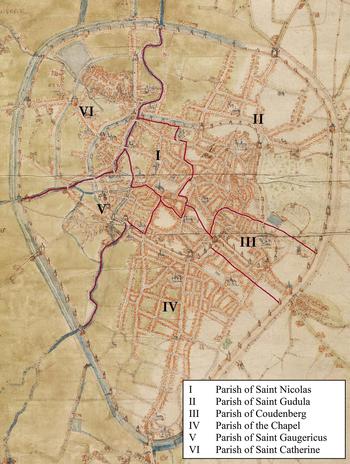
The spatial structure of Brussels offers significant context for a discussion of property ownership. Spatial organisation is an important analytical factor, because the sources usually grouped property owners by parish and location inside or outside of the first city wall. Figure 1 is a map of Brussels showing the parishes and town walls. In 1356, the city of Brussels started to build its second town wall, which became the spatial border of the city and forms the boundary of this study. The new wall enclosed several suburbs that had grown up outside the first wall over the previous centuries. Consequently, the city's structure followed a typical concentric pattern, with the area between the two walls comprised of many residential areas and some semi-rural sections. The heart of the city's economy, the town hall, the cloth halls, and several markets, was located inside the first wall. The elite families of Brussels lived there, along with the duke of Brabant. Surrounded by residential areas, the ducal palace was located in the parish of the Coudenberg. During the late Middle Ages, there were six parishes in the city. Only one of those was situated entirely within the first city wall: the parish of St Nicolas. All the other parishes had one section inside the first city wall and another between the two walls.
Brussels in the late Middle Ages, with indication of the six parishes (author's adaption of the city map of Jacob van Deventer, c. 1560).

All property within the walls of Brussels fell under the jurisdiction of the city's property laws. As in most towns in the region, Brussels's partible inheritance custom granted all children equal inheritance shares, regardless of their age or sex, with the exception of property held in fief. The division in practice was made by mutual agreement, although one could go to the court of the aldermen in case of conflict or to document the division. The actual composition of the inheritance shares could vary, as long as the entitled parties deemed them to be of equal value to one another.Footnote 16 Upon marriage, children received an advance of their inheritance in the form of a marriage gift. Receiving a marriage gift did not exclude women from inheriting their remaining share of the patrimony later in life, in contrast to dowered daughters in most southern European regions.Footnote 17 The same equality was present in the provisions for widows and widowers, as both had the same rights to the marital estate; the survivor received all movable property, half of the real property held in the communal account, and usufruct (lifetime use), of the remaining real property. The surviving spouse also enjoyed usufruct on the personal property of the deceased. During the marriage, a limited communal property regime prevailed. Each of the spouses remained the full owner of his or her personal property, consisting of real property obtained through gifts, testaments, or inheritance. All other property – movable goods and real property acquired during the marriage – was held in communal account. During her marriage, a woman was considered legally incapable and could only perform legal acts under guardianship of her husband. He controlled the marital estate freely, except for his wife's personal property, which he could not manage or alienate without her permission.Footnote 18
However, there was some elasticity in the laws that defined the rights of married women in Brussels; as a public merchant, a married woman was not subject to guardianship in any matter that pertained to her own business, she could enter freely into debts for household necessities, and she could act as a substitute for her husband if he was absent or mentally ill.Footnote 19 In addition, studies of women in the medieval Low Countries have shown that the custom of guardianship was not always followed and married women sometimes managed their own property without guardians, especially in the fourteenth century.Footnote 20 Finally, unmarried women and widows were considered fully legally capable. In other words, city law allowed women a certain degree of economic agency in Brussels, as in other Low Countries cities. Whether women retained that agency was largely dependent on two factors: their marital status and their access to capital or property. While historians of the Low Countries have concentrated on the first condition, this article will highlight women's access to real property through analysis of the censiers.
4. CENSIERS AS A SOURCE FOR LANDOWNERSHIP PATTERNS
‘Le chemin est long; il n'est pas impracticable’ were the closing words of Robert Fossier's typology of censiers,Footnote 21 and they were no exaggeration; censiers are complicated sources.Footnote 22 Perhaps for this reason, few historians who work on medieval cities are familiar with them. Daniel Lord Smail and Joëlle Rollo-Koster used censiers to study women in fourteenth-century Marseilles and Avignon, but in a more limited fashion than this study; both scholars assess the relative proportion of women, without taking marital status, spatial and chronological differences, and other variables into account.Footnote 23 The intent of this article is to make the most of the censiers’ potential: because these documents listed landowners who had to pay a yearly census to an institution, they can provide successive snapshots of (urban) property ownership patterns. Although they provide minimal information on medieval property owners, the sources have clear merits. First, censiers survive for regions and time periods for which there are few large collections of medieval property deeds (such as the northern Netherlands). Second, censiers allow for relatively rapid processing, as long as the historian understands their peculiarities and has developed a method to take these features into account, as I will discuss below.
Systematic use of censiers (cijnsregisters in Dutch) requires a careful study of the content and context, and a methodology that addresses the particular features of each document. Censiers were administrative documents that listed real property owners who had to pay a yearly cens (census or burgage rent) to an institution or private person.Footnote 24 These payments originated in several different ways. Real estate, whether allodial or not, could be given in hereditary ownership to a tenant for payment of a perpetual rent, which could sometimes be redeemed. Any landowner might also sell a hereditary annuity on his or her property for an amount of cash, in order to mobilise its capital value without disposing of it. In this case, he or she pledged to pay a yearly annuity to the buyer of the annuity (the creditor), which could be a private person or an institution. Finally, some feudal landlords collected recognition rents from landowners who fell under their feudal rights, such as the use of a street or river (for example, the duke of Brabant collected these rents from house owners who encroached on the Brussels public road by building a wall, or basement entrance). While all types of rents are listed in the surveys, identification of the type of rent is rarely possible. Scribes used a variety of interchangeable terms to describe all types of rents, without being consistent, and the entries usually focus on the payer, the payment, and the property.
The finer points of the property laws of late medieval Brabant are beyond the scope of this article. However, it is important to emphasise that regardless of the way the cens was created, the payer in late medieval Brussels had extensive rights to the property. The payer or tenant can be considered as the actual landowner, as he or she could freely dispose of the property, build on it, lease it, mortgage it, or pass it on to heirs. When the property was alienated, the cens always remained bound to the property. As such, this study will refer to the payer of a cens as the ‘cens payer’ or ‘owner’. On the other hand, the rights of the cens collector, called ‘landlord’ in this study, were limited to receipt of the payment itself. If the landowner repeatedly failed to make payments, the landlord was entitled to take legal action and repossess the property.
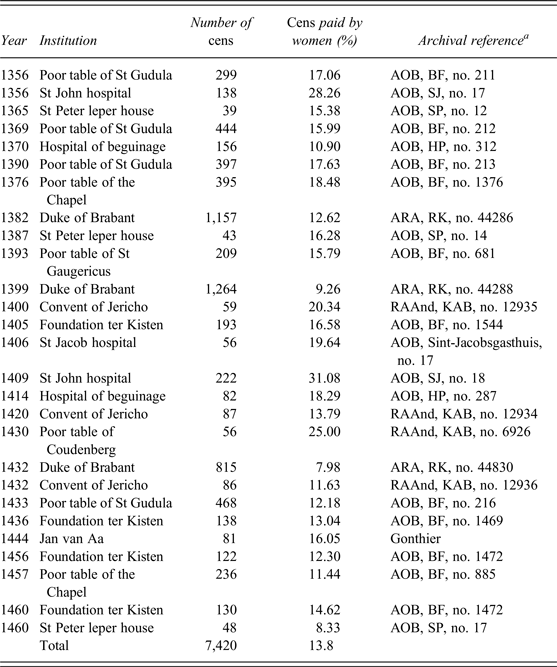
The sources for this study are 27 surveys composed between 1356 and 1460.Footnote 25 They were chosen from almost 80 censiers drawn up by Brussels institutions and individuals that have survived from the fourteenth and fifteenth centuries.Footnote 26 The following criteria informed the selection: the documents had to be dateable, to list property inside the city walls, and to be sufficiently extensive (listing more than 20 properties) and complete. The 27 censiers selected were drawn up by 12 landlords: the duke of Brabant (3 surveys), 10 religious and charitable institutions (23 surveys), and one private individual (the patrician Jan van Aa, 1 survey).
Institutions and private landlords used censiers to administer and supervise the collection of their cens payments. Rather than conducting surveys on a regular basis, rent collectors recorded these only when they deemed it necessary. Because of the survey's practical purpose, the information was often standardised. A typical entry contained the name of the property owner, additional information about him such as family members or profession, description of the property, the payment, and the payment due date(s).Footnote 27 The diligence of some administrators produced censiers with extensive descriptions of the properties, while others only listed the name of the owner and a vague delineation of the land. In short, these 27 censiers from 12 different institutions are not homogeneous, and this, along with their limited information, causes the greatest methodological difficulties.
Analysis of censiers demands a methodology that addresses the particular features of each censier. To construct a valid quantitative analysis from all the selected censiers, information from the registers was collected and restructured into the following well-defined categories: the cens payer(s) (male and female, but only private individuals),Footnote 28 the number of cens plots per payer, the way they paid the census (independently, in a couple, or in a group), information about the marital and social status of the payer(s), and the location of the property. These data were collected by censier, and only dateable information was included; names noted down by the clerks later were not included. Next, the sequential censiers of each institution were compared. This was an extremely important step, because not only did some institutions have different methods of registration, but also the spatial distribution of the cens parcels differed for each institution (this spatial distribution is called the cens circle, or the collection of cens levied by an institution) and the intervals between successive censiers were unique to each institution. The cens of one institution might be concentrated in the city centre, while another institution might levy cens predominantly in the suburbs. Only in the final stage of the analysis, after considering the cens circle of each institution, is it possible to compare registers from different institutions. This approach takes the administrative and geographical characteristics of each survey and institution into consideration. Following this methodology, I will treat these sources as sequential snapshots of landownership patterns in late medieval Brussels.Footnote 29
5. MEN AND WOMEN AS LANDOWNERS IN LATE MEDIEVAL CENSIERS
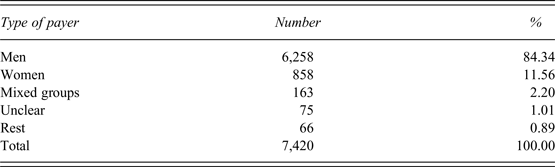
In the 27 censiers composed between 1356 and 1460, there were 6,975 landowners paying cens on 7,420 land plots, and some owners paid cens for several parcels. Of these landowners, 13.9 per cent, or 967 persons, were identifiable as female. There was a similar gender distribution for the 7,420 cens parcels, as Table 1 shows. Men paid cens for 84.3 per cent of the parcels, a large majority, and women were responsible for 11.6 per cent. Groups of men and women paid 2.2 per cent (163 cens). Most women owned a single plot of land, but some women owned several parcels, and several groups of women paid a cens together. The identities of the owners of the remaining 141 parcels are unclear.Footnote 30

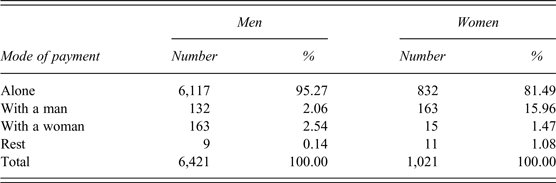
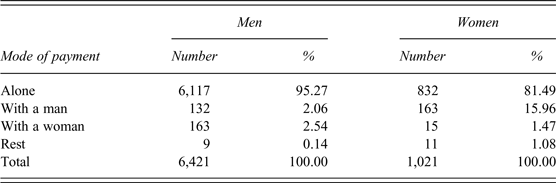
Table 2 shows the way male and female landowners held their land, or at least, the way the clerks registered them as cens payers. Eighty-one per cent of women paid their cens independently. Men were more likely than women to pay their cens independently, although the difference is rather small; 95 per cent of the payments were made by a man on his own. In 16 per cent of the payments made by women (163 cens), women and men paid the sum together. Some were married couples (65 cens), which might indicate that the property in question belonged to the marital communal property owned by both spouses. However, it is more probable that the clerks usually did not list both spouses if communal property was involved; otherwise, one would expect a much larger percentage of couples paying cens together. In the entries that list both husband and wife, the cens was most likely attached to the wife's personal property, and the clerks used this formulation to indicate that the woman was under guardianship. A few explicit descriptions seem to indicate this, such as: ‘Lijsbet Zwerten and Jan van den Driessche, her husband as her guardian.’Footnote 31 Women and one or more male family members (often siblings or children) paid ninety-eight cens, and fifteen cens were paid by groups of women, often from the same family. Lastly, the category ‘rest’ includes people who were paying a cens together with either their children or unidentifiable other people (referred to as ‘coparties’ by the clerks).
Distribution of the cens paid by men and women, by mode of payment (1356–1460)
Source: See Appendix Table 1.
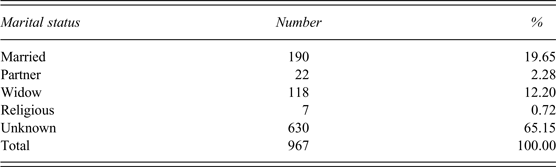
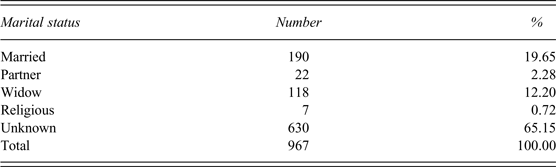
Regarding the Low Countries and other regions of Europe, most studies of medieval female real estate owners focus on widows. The reason for this is well known; often it was only at this point in their lives that women had autonomous access to capital and could act without the supervision of a guardian. While we would thus expect to find a predominance of widows among the 967 women mentioned in the censiers, this is not the case, as Table 3 illustrates. The clerks recorded that 22 per cent of the women were or engaged to their partner, 12 per cent were widows, and for remaining 65 per cent there was no marital status given. Only seven women were identified as religious (either nun or beguine). The absence of information on the marital status for 65 per cent of the women should not be interpreted as a clear indication of the absence of male family members or status as a widow. Rather, women in the Low Countries were regularly identified without marital status: Shennan Hutton found that 45 per cent of the women in the aldermen's registers of fourteenth-century Ghent were identified without a marital status.Footnote 32 While there were likely many widows in this group, there were undoubtedly many unmarried women as well. Ninety of these women were identified by male family members, such as a father or brother, which suggests that they were not (yet) married. After all, the egalitarian inheritance custom in Brussels made it possible for girls to own property, regardless of their marital status. Furthermore, some of these women were probably married, but the clerks did not consider this information relevant for registration. The primary goal of the clerks was to identify the rightful owner of the property, not to record the possible guardianship of the women in question. Despite the lack of marital and social information on female rent payers, it is clear that not all female landowners in Brussels were widows.
Identification patterns for women mirror the lack of information about the marital status of women. The clerks identified 59 per cent of the 967 female landowners without any reference to a man. These women were described solely by their first and last names (40 per cent), with titles indicating a higher social status (18 per cent), or with an occupational or religious affiliation (1 per cent). Another 40 per cent was identified by male family members or (former) husbands, and the final 1 per cent by female family members. This pattern provides additional support for the conclusion that the censier clerks were not particularly concerned about linking women to male family members, a notable exception to the pattern in other European regions, where the identification through male relatives was the norm.Footnote 33 It is possible that clerks named these additional people to indicate the origin of the property, such as including a former husband, for example, to signal that the woman was dealing with property coming from the marital estate. The identification pattern strongly supports the conclusions of Ellen Kittell and Shennan Hutton for cities in Flanders. It was far from unusual for clerks in the medieval Low Countries to omit familial associations or marital status for women, which Kittell and Hutton consider as evidence of the relatively extensive economic opportunities for women in this region.Footnote 34
Although the group of female real estate owners was diverse in terms of their marital status, there were far fewer of them than male owners. Women comprised only 13.8 per cent of the cens payers, either alone or in a group. For a city where egalitarian inheritance was the rule, this share seems surprisingly limited, but the absence of comparable studies of urban property ownership makes assessing the proportion difficult. For the high Middle Ages, one point of comparison is available. Stephen Bensch found that women owned on average 16 per cent of the land in Barcelona between 1100 and 1290, which resembles the share of women in late medieval Brussels.Footnote 35 In this city, the inheritance rights of women resembled those of the Low Countries: a system of equal inheritance based on Visigothic law prevailed, and dowered daughters remained entitled to their share of the inheritance. Despite these provisions, families increasingly used testaments and legal loopholes to divert real property to male heirs, causing women to control less real estate than men.Footnote 36
For the later Middle Ages, comparable studies are equally rare.Footnote 37 Although Daniel Lord Smail (for Marseilles) and Joëlle Rollo-Koster (for Avignon) also used censiers to determine the percentage of women among urban property owners, both dealt with the mid-fourteenth century, an exceptional period, which does not provide an adequate basis for comparison. In both studies, women paid at least 30 per cent of the cens, but a direct comparison of these cities with Brussels would be misleading. Apart from the lack of detail on these female landowners (for example, there is no quantitative analysis of marital status), women in these southern European cities had less favourable inheritance rights than their counterparts in the Low Countries. In most southern European cities, families had greater latitude in distributing their property. Even in regions where a system of equal inheritance between sons and daughters prevailed in theory, such as Marseilles, it was rarely practised due to the many legal instruments to alter this.Footnote 38 The most prominent instrument, next to the testament, was the dowry system: receiving a dowry upon marriage generally excluded girls from a further share in the patrimony.Footnote 39 Daughters’ dowries were moreover increasingly paid in cash from the thirteenth century onwards, whereas real property was directed to sons.Footnote 40
The large share of female landowners in fourteenth-century Avignon and Marseilles was therefore caused by the devastating consequences of the Black Death in the region, which gave women a better chance to acquire land for a short period of time. These conditions probably did not occur in the late medieval Low Countries. Historians have argued that the first and most severe wave of the Black Death, in 1347–1350, had marginal impact on the Low Countries, and later waves did not cause the same demographic and economic disruption as occurred in southern Europe or England.Footnote 41 In Brussels, plague mortality seems to have been minimal in the fourteenth century; there is no trace of an epidemic in the fourteenth-century sources, which even remark on high population density in the 1380s. The city seems to have been spared severe waves of plague until the 1400s.Footnote 42
In contrast to the lack of studies of urban property ownership, there are more of female landowners in rural regions, although as yet not of the late medieval Low Countries. Studies of rural landownership in other European regions often contain the percentage of women owners. On English manors, for example, women held approximately 20 per cent of the land before the Black Death, but that number declined to 10 per cent or less in the sixteenth century. There are substantial differences between this region and Brussels. Not only were the property structures in this rural region very distinct, but the inheritance customs also differed. In the English countryside, inheritance customs favoured men. Moreover, English female landowners were almost always widows.Footnote 43 Nevertheless, it is noteworthy that the proportion of female landowners in Brussels, an urban region with egalitarian inheritance customs, hardly differed from the percentage of women landowners in rural England where women had limited inheritance rights.
Since comparing Brussels to other regions does not explain why there was such a small percentage of female landowners, the reasons must be sought in the sources and Brussels property structures. A primary consideration is whether the registers always recorded the rightful owner(s) of the property. After all, the censiers were administrative documents and clerks might have preferred to write down the name of the (male) head of a household as the payer, rather than the (female) legal owner of the property involved. The marital property laws of Brussels stipulated that a married woman remained the legal owner of her property, but she could only act under the guardianship of her husband. For this reason, it is possible that the clerks registered only the woman's husband as the payer on her property, and therefore failed to mention a substantial group of female property owners in the registers. However, since 20 per cent of the women named were married, omission of married women was certainly not the rule and cannot sufficiently explain the small number of female landowners. Moreover, although censiers were used for administration, they also had a legal function: if the legal contract was missing, a censier could be used to prove the right to the cens. Therefore, it was important to identify the rightful owner, and the clerks based their listings in the censiers on the legal contracts.Footnote 44 To the extent it was possible, cross-checking verified that clerks did not systematically omit the name of a married woman if she was mentioned as a party in the contract.Footnote 45 When the cens was paid on the couple's communal property or on the husband's personal property, the name of the woman was probably not included.
Therefore, the main explanation for the small proportion of women probably involves the methods of acquiring real estate: inheritance or sale. First, the gendered distribution of the property in the censiers suggests that daughters received less real property than sons. Within that regard, it is striking that the share of female landowners in late medieval Brussels was similar to women's share in high medieval Barcelona, where families directed real property to sons despite egalitarian inheritance customs. Historians have argued that families in the late medieval Low Countries gradually adopted more patrilineal strategies towards property. In Douai, as Martha Howell found, they did so by limiting women's rights to manage property in marriage contracts.Footnote 46 Although not used in Douai, another strategy might have been to direct real property to sons, as has been found for other European regions and higher officials in Flanders.Footnote 47 There is, however, no systematic research on family distribution of property in actual practice in the Low Countries. Despite the egalitarian inheritance system of Brussels, families could direct their real property to male heirs by two methods, compensating female heirs with movable property and writing testaments that altered the customary system of inheritance.Footnote 48
The results also suggest that women sold real estate more often than buying it when they were active in the property market. More women than men might have sold real estate, either out of necessity, or because they preferred freeing up capital for investment, for example in annuities, in order to secure a steady income. There have been few studies of the financial strategies of urban medieval women, but many scholars have pointed towards women's preference for life annuities as low-risk investments.Footnote 49 Many women might also have been co-owners of property along with other heirs, which offered an inducement to sell their portion. As buyers, men probably far outnumbered women in Brussels property market. Although they pay little attention to women, studies of property markets in Low Countries cities suggest that there were few women among real estate buyers.Footnote 50 Although these two factors are tentative, they could explain why the percentage of female landowners in Brussels, a city with egalitarian inheritance, was similar to the percentage of women landowners in rural England, where inheritance customs were less favourable to women.
6. CHANGES IN THE PROPORTION OF WOMEN AMONG LANDOWNERS IN LATE MEDIEVAL BRUSSELS
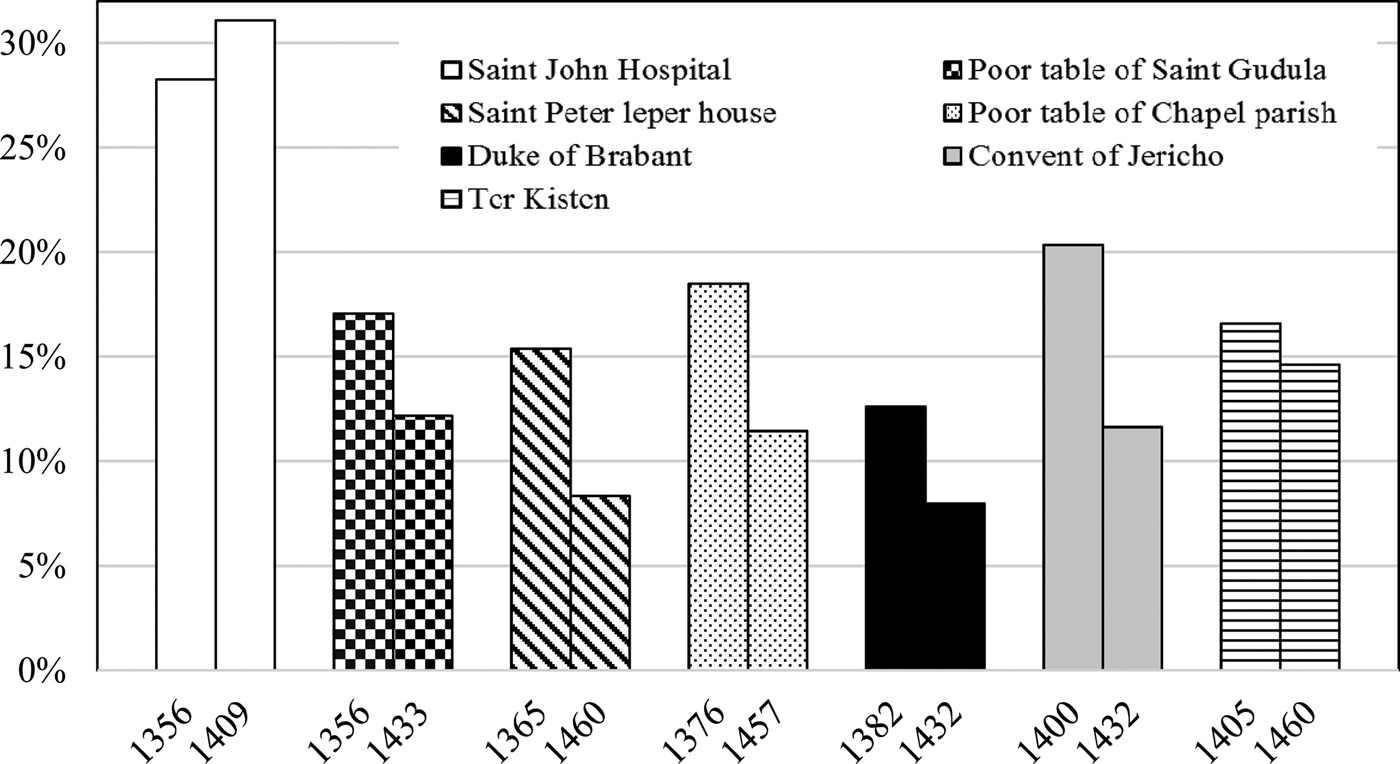
Although they were a minority, there were women among the landowners of late medieval Brussels, and that pattern of female landownership underwent significant changes during the fourteenth and fifteenth centuries. In analysing these changes, the first consideration must be the changes in censiers of the same institution, as the methodology requires. There are successive registers for eight of the twelve institutions, and seven of these have registers from both the fourteenth and fifteenth centuries. Figure 2 displays the proportion of women landowners in the earliest and latest surveys from each of the seven institutions.
Percentage of cens paid by women (both independently and with others) in censiers of the same institution in the fourteenth and fifteenth centuries. See Table 4 for accompanying data.

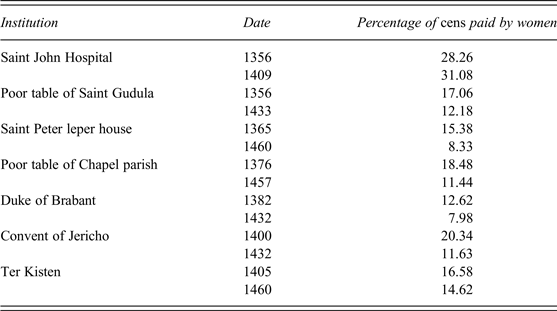
Percentage of cens paid by women (both independently and with others)
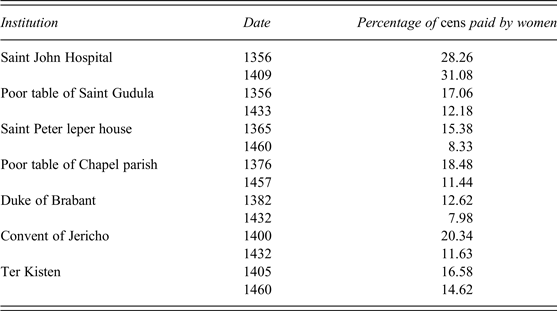
a This table of data accompanies the figures presented in Figure 2.
Source: See Appendix Table 1.
The general evolution in the cens circles of the majority of these institutions (five out of seven) is a clear decline from the fourteenth to fifteenth centuries in the number of women among the payers. Depending on the institution, the decline fluctuated between five and eight percentage points. However, in the registers of two smaller institutions, there is a different pattern. In the registers of Ter Kisten, a foundation of the beguinage, and St John's Hospital, the proportion of women remained relatively stable, probably because both institutions were somewhat exceptional. The percentage of women cens payers for St John's Hospital was exceptionally high. In the 1356 register, women comprised at least 30 per cent of its cens payers, and in the 1409 register, this number increased to 31 per cent, both 10 to 20 percentage points more than the average for the other institutions.Footnote 51 Only one register, for the Coudenberg poor table, had a remotely similar percentage of female landowners. The payers in the Coudenberg register, which will be discussed further below, were almost all from the city's elite. It is likely that elite status characterised many of the female cens payers in the registers of St John's hospital. Some studies point to a link between the hospital and (female) members of the urban elite,Footnote 52 although more research on this institution is needed. The registers of Ter Kisten contained 17 per cent women in 1405, a number that declined to 15 per cent in 1460. This foundation was governed by women and aimed towards women, as it supported poor beguines in Brussels. These features may account for the more consistent percentages of women in the cens circle of this institution.
Despite these two exceptions, the clear pattern is that the number of women registered as owners of landed property encumbered with a cens declined over the late medieval period. Because Brussels was not significantly disrupted by the Black Death in the fourteenth century, it is unlikely that this was the correction for a temporary spike in the percentage of women landowners after the epidemic, as argued for Marseilles and Avignon. Instead, during the late medieval period, women's importance as landowners in late medieval Brussels declined. The mechanisms behind this decline are difficult to pinpoint from the censiers: were women inheriting less property than men? Were they selling more properties than men, either out of necessity, or because they preferred to free up the capital and potentially invest it? The next paragraph looks more closely at the potential causes behind the decline of female landownership. The fact that this decline did not prevail in all the registers indicates that it was not universal, and more variables need to be considered.
7. CLASS MATTERS: COMPARING FEMALE LANDOWNERS IN THE NEIGHBOURHOODS OF THE CHAPEL AND THE COUDENBERG
Juxtaposing data from the censiers with the economic history and social topography of Brussels reveals more about the decline in female ownership. As treatment of the entire period is not possible within the scope of this article, the analysis focuses on a central ‘episode’ in the decline, the period between 1370 and 1440, in two distinct neighbourhoods. These two were selected because they were well documented in the surviving censiers, often for the same institutions. In addition, the two neighbourhoods had distinctly different social profiles. The neighbourhood of the Chapel, a suburban district in the south of the city (IV on Figure 1), was dominated by artisans and workshops. The neighbourhood of the Coudenberg was located in the city centre (III on Figure 1). Lying around the duke's castle, it was the most prosperous district of late medieval Brussels.
After extensive tumult from economic crises, political and social protests and uprisings in the mid-fourteenth century, Brussels experienced relative economic prosperity after 1370. Several censiers dated around 1380 show that women made up between 15 and 19 per cent of the cens payers across the city's neighbourhoods. After 1390, this number started to decline. The decline was mostly concentrated in the areas between the first and the second city walls, the city's suburbs. Although little is known about the social topography of Brussels specifically, studies of other medieval cities in the region have shown that residents in the city centre were more often members of the urban elite and were more prosperous than people living on the city's periphery, who were more likely to be from the middle and lower classes.Footnote 53
The timing of this decline beginning in the 1390s coincides with renewed economic crisis. Many elements of this crisis were not restricted to Brussels, but were tangible throughout the Duchy of Brabant and beyond.Footnote 54 The first signs of a looming crisis in Brussels's cloth trade were already starting to appear in the relatively prosperous period of the 1370s and 1380s. In the 1390s, cloth production and sales fell, and by the end of the century, the crisis was in full swing. As cloth was the most important sector in the urban economy of Brussels, the effects on the city were severe. Enhanced by extremely high grain prices from failed harvests around 1395, the crisis touched the entire city's population. Frequent coin devaluations and a European-wide phenomenon due to a chronic shortage of silver during this period affected purchasing power and caused social unrest.Footnote 55 In 1405, the revenue from urban excise taxes was 22 per cent lower than in 1372. Economic difficulties impacted on the city's inhabitants until the 1430s. There were additional signs of the general impoverishment of the city, such as increasing defaults in the property and credit markets, coin devaluations, increasing grain prices (with very high prices around 1415–1417 and 1430–1431), uprisings (1416 and 1421), and a slow depopulation of the city.Footnote 56 In 1436, the city government issued a number of measures to improve the economy, which included protecting citizen's properties from confiscation when they failed to pay the expenses, such as cens, on their properties. The introduction to the charter speaks volumes; it was done because ‘the city's economy is sick, which has been the case for a long time, and it is becoming more and more weak … to the extent that the number of people is declining, the houses are falling into decay, and the city is largely deteriorating’.Footnote 57
In no neighbourhood was this decline in female landownership more visible and drastic than in the parish of the Chapel (Kapelleparochie), located in the south of the city around the main entry road, the Hoogstraat. Whereas the percentage of female landowners fell in other suburban areas by 3 to 7 percentage points, it fell by 10 percentage points in the Chapel parish. This artisanal and industrial neighbourhood would have suffered especially severely from economic crisis because it was heavily dependent on the textile industry.Footnote 58
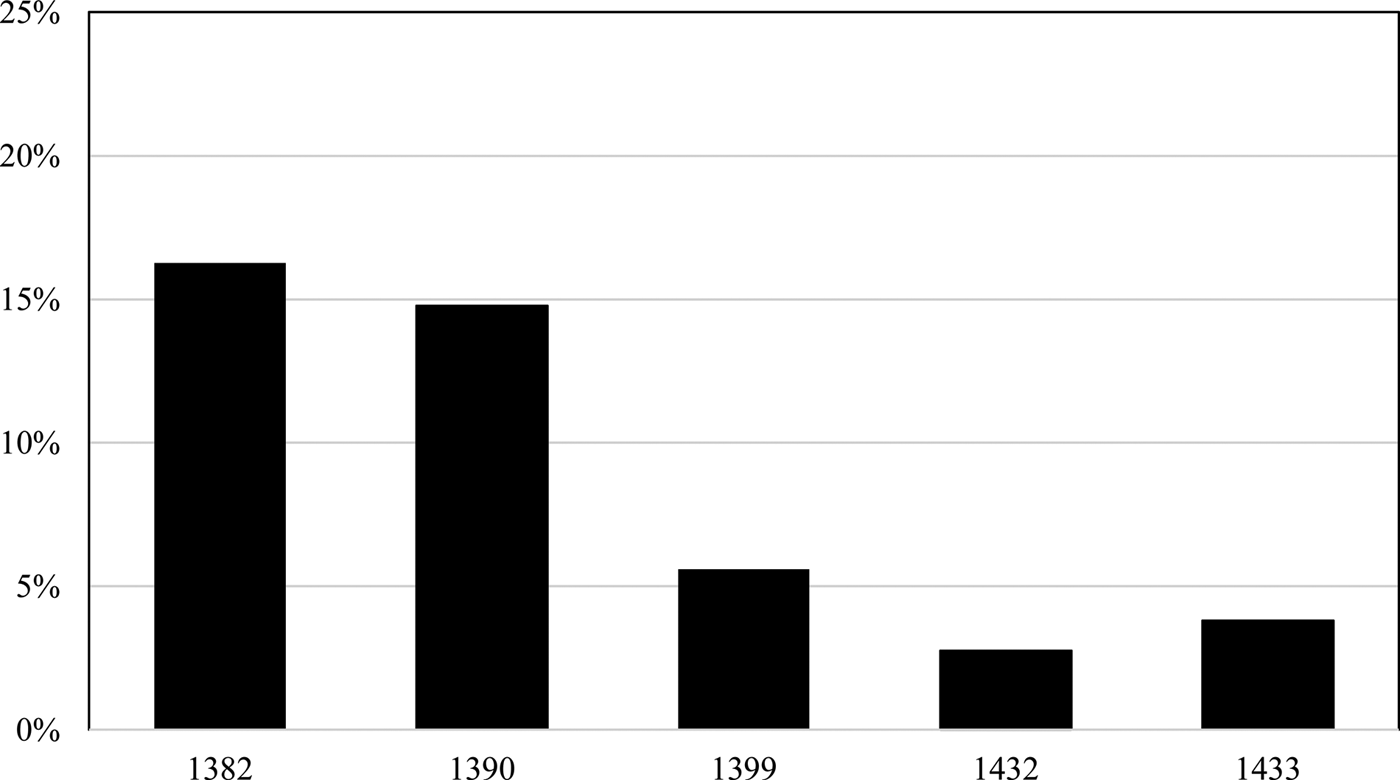
Figure 3 illustrates the change in the percentage of women among landowners in the Chapel across succeeding surveys dating between 1382 and 1433.Footnote 59 The surveys stem from the two institutions that levied the largest number of cens in the city: the duke of Brabant (surveys of 1382, 1399 and 1432) and the St Gudula poor table (surveys of 1390 and 1433).
The percentage of cens paid by women (both independently and with others) in the parish of the Chapel in the registers of the Duke of Brabant (1382, 1399, 1432) and the registers of the poor table of St Gudula (1390, 1433).

After the 1390s the proportion of women among the landowners in the parish of the Chapel shrank noticeably. Since this decline is visible in the surveys of both institutions, it was not a reflection of institutional or administrative changes within a cens circle. Whereas women paid roughly 15 per cent of the cens in 1382 and 1390, their proportion declined to 5 per cent by 1399 and even less by 1432. The number does not seem to have improved significantly until the 1460s, although the lack of censiers of these institutions for the 1440s and 1450s makes the number more difficult to evaluate.
The ducal registers of 1382 and 1399 shed additional light on this rapid and sustained decline of women among landowners in the parish. Six of the twelve women who were cens payers in 1399, were also registered as a payer in 1382. Five of these six belonged to wealthy Brussels families.Footnote 60 While their high social status provided them with the resources to retain their property in trying economic conditions, most ordinary female property owners in 1382 did not have this advantage. Belonging to the city's elite seems to have been less important for male property owners, as only the names of 5 of the 179 male cens payers in 1399 were accompanied by a title. The association of a high social status with female property owners is again apparent in 1432, when only 4 of the 145 cens payers were women, two of whom came from families associated with Brussels elite.Footnote 61 In the register of 1433, only 2 of 52 cens were paid by women: Zuete Ghijsels, whose social standing remains unknown, and the wife of Jacob int Scildeke, who was identified as a female brewer (briedersse). The fact that she was identified by her occupation is extraordinary in itself. She seems to have inherited the property from her father.Footnote 62
In a relatively brief period, the last decade of the fourteenth century, the gendered distribution of real property in the Chapel parish changed profoundly. Since the censiers do not enable a study of the actual property market or inheritance patterns, the exact causes cannot be definitively identified. Nevertheless, the timing and geographical concentration of the decline point towards certain mechanisms. The rapid decline of women among cens payers during a period of crisis suggest that this was not caused by female investment strategies, that is, women preferring to sell their property to free up capital for investment purposes. After all, this was a very unfavourable time for selling real estate or investing in capital: the difficult economic conditions probably led to low real estate prices and a low demand for capital.Footnote 63 Instead, it is more likely that harsh economic circumstances forced more women than men to sell their properties out of necessity,Footnote 64 and that in the meantime, few women received real property through inheritance. Only women with high social status were able to retain their properties.
During the early fifteenth century, the Chapel parish continued to suffer; sources describe the impoverishment and depopulation of the quarter. During these thirty years, women's share among real estate owners in the neighbourhood continued to be minimal, as in 1433 women paid less than 5 per cent of the cens. Several factors may have been at work preventing women from acquiring real property. Inheritance patterns may have shifted, as middling families tried to keep their patrimonies intact during economic hardship by directing their real property to male heirs while compensating women with movable goods. Women might have been less inclined than men to buy real estate and more likely to have to sell their properties out of financial necessity.
The parish of the Coudenberg presents a completely different picture. While the percentage of women among landowners in all quarters of Brussels declined between 1390 and 1440, and the suburbs were particularly affected, the Coudenberg neighbourhood was the one exception. Located around the castle of the duke of Brabant, this was a wealthy neighbourhood. After the 1420s more and more of its residents were members of the Brussels elite or the ducal entourage and professionals working in the ducal court or administration.Footnote 65
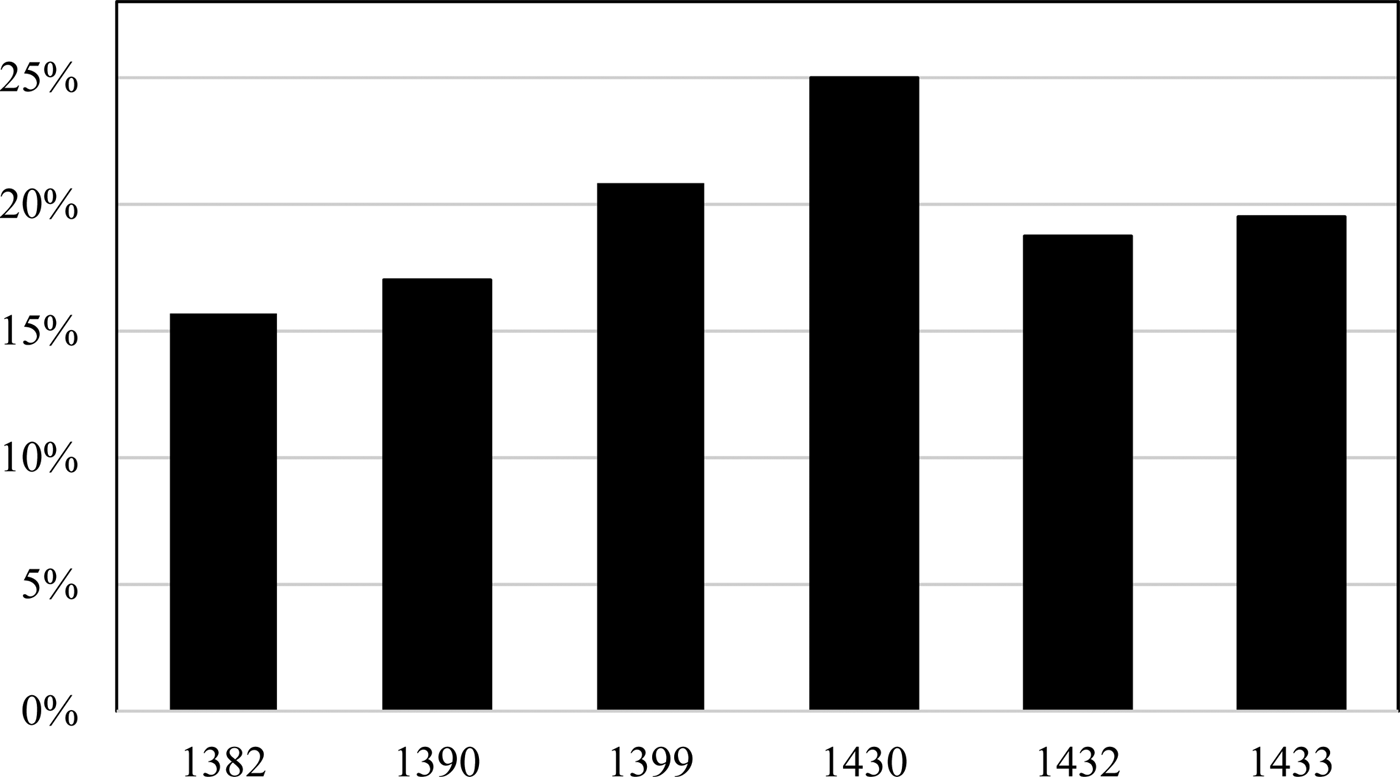
Figure 4 shows the percentage of cens paid by women, based on the same censiers that were used for the analysis of the Chapel parish, those of the duke of Brabant (surveys of 1382, 1399 and 1432) and of the St Gudula poor table (surveys of 1390 and 1433). They are supplemented by a smaller register from the poor table of Coudenberg parish (1430), which contained property only in this part of the city.
The percentage of cens paid by women (both independently and with others) in the parish of Coudenberg in the registers of the Duke of Brabant (1382, 1399 and 1432), the registers of the poor table of St Gudula (1390 and 1433) and the register of the poor table of Coudenberg (1430).

Landownership of women in the elite Coudenberg quarter shows an entirely different evolutionary pattern from that of women in the Chapel and the rest of Brussels. There was no decline in the proportion of women among landowners at all, as the percentage actually grew from 16 to 17 per cent in 1382 to 19 to 25 per cent in the fifteenth century. The profile of female cens payers corresponds to what is known about the inhabitants of this neighbourhood. Some of them were linked to the ducal court through family members, such as the remarried widow Lijsbet van Coeborchts, who was the sister-in-law of the renowned chronicle writer Edmond van Dynther. Others came from elite families, like the widow of city secretary Johannes Daneels. Clerks identified several women with titles conveying their social status, and others with nicknames that made reference to their wealth (such as Margriete van Huesdeyn, called metten Dyamanten or ‘with the diamonds’).Footnote 66 Some women owned extensive properties. Others also owned businesses, such as the widow Katline Petits, who paid a cens for her ‘stalls, bedrooms and haylofts behind her tavern’.Footnote 67 Contracts in the poor table's archives show that Katline had administered this property from 1410.
Most of the cens payers from the Coudenberg came from higher social groups than those in the Chapel. The fact that the proportion of women among real estate owners remained steady, and even increased slightly indicates that these women had sufficient reserves to keep their properties, and even invest in more property, despite the harsh economic climate, and families were able to continue providing their female members with valuable real property.
Beginning in the late fourteenth century, during a prolonged time of economic difficulties for Brussels, owners of land in the city were increasingly male, and the pool of female landowners narrowed to women of the urban elites. The censiers make it clear that the economic crisis had a strong gendered impact on ownership patterns. Only women from the highest social groups of the city withstood the general decline in female landownership. Without a doubt, the unfavourable economic climate had a profound impact upon the ability of people from the lower and middle social groups to obtain and retain real estate. Other studies of medieval property markets have shown that periods of economic decline were marked by social polarisation among property owners; with fewer reserves, less wealthy people were the first to fall short of funds, and so lose the chance to buy or keep real property.Footnote 68 No study has touched upon the gendered dimension of this process, however. Certainly men as well as women from the middle classes were affected by the crisis, but the landownership of women declined more sharply than the landownership of men in the non-elite groups of the city. Only on the Coudenberg, by far the wealthiest neighbourhood of late medieval Brussels, did this sharpened gender inequality in real property ownership not occur.
8. CONCLUSION
Although men paid the large majority of the cens on real property in late medieval Brussels, women on average were responsible for the payment of 14 per cent. In some neighbourhoods of the city, this number rose to 25 per cent. Explanations for the relatively limited proportion of women are most likely to be found in inheritance patterns and gendered participation in property markets, for which more research is needed. Nonetheless, all of these women landowners possessed important resources, and as such, were in a favourable position to participate in the urban economy. This group of female landowners was much more varied in terms of marital status than is often assumed in the historiography. Women identified as widows did not constitute the majority of the women in the sources, as married women and women with no recorded marital status were numerous.
Between 1356 and 1460, women's property ownership was far from stable, as there was a decline in the percentage of women among landowners in late medieval Brussels. The reasons for this decline of female landownership cannot be definitively identified from the censiers, but the results tentatively indicate it was caused by shifts in inheritance patterns or female impoverishment. This suggests that women in Brussels lost access to an important resource for their economic activity, a conclusion that adds support to the argument that economic opportunities declined for women during the late Middle Ages, as has been found by Martha Howell, Shennan Hutton and others. However, the results emphasise that these changes played out differently for women of different social groups. Indeed, the decline in women's landownership was neither linear nor unequivocal, since the decrease accelerated during economic crises and was closely connected to the social status of women. Economic crises affected both sexes, but unevenly; in the resulting social redistribution of property, gender was a significant factor.
While long-term comparison of censiers has offered new insights into the changes in women's economic position from the perspective of landownership, it has also inevitably left many questions unanswered, partly due to a lack of comparable studies. In order to understand the precise mechanisms behind the decline of women's landownership among non-elite groups and the degree to which this case study of the Low Countries compares to other European cities, more research is required. Very little remains known about medieval women's wealth management and their investment strategies on capital and property markets. Case studies of a diverse range of comparable cities are needed to assess how local factors, such as variations in legal and economic structures, impacted on women's access to wealth and economic opportunities. This study recommends that economic activities besides labour should be included in the analysis of the fundamental changes in women's economic opportunities during the late Middle Ages. The findings also emphasise the need to include class as an explicit category of analysis. Social differences between women are not centrally considered in current research on medieval urban women, in part because of the historiographical focus on labour. Because women of different social groups had differing access to property, and therefore to economic opportunities, it is essential to recognise that late medieval changes affected them in divergent ways. Future research on (urban) women's control and management of wealth would therefore benefit from a more explicit analysis of the interaction among social status, marital status, and gender.
ACKNOWLEDGEMENTS
Andrea Bardyn is a Fellow of the Research Foundation - Flanders. The author would like to thank Jelle Haemers, Shennan Hutton, Bram Vannieuwenhuyze, Kaat Cappelle, and the anonymous reviewers for their helpful comments on earlier drafts of this article. For a more extensive discussion of the methodology and the first case on the parish of the Chapel, see Andrea Bardyn, ‘Vermogende vrouwen: Het vastgoedbezit van vrouwen in laatmiddeleeuws Brussel op basis van cijnsregisters (1356–1460)’, Stadsgeschiedenis 9, 1 (2014), 1–24.
Appendix
Overview of censiers with the total number of cens and the percentage of cens paid by women (independently and with others) (1356–1460)