A long-standing debate in second language acquisition concerns the linguistic nature of second language (L2) grammars and the ways in which these grammars differ from those of native speakers. An influential view holds that there are fundamental differences between the grammar of native speakers and adult L2 learners (the fundamental difference hypothesis of Bley-Vroman, Reference Bley-Vroman1990, Reference Bley-Vroman2009). Typical L2 learners differ from native speakers in the timing and amount of input and the learning and processing mechanisms deployed in acquisition, which result in different grammatical representations and end states in L2 learners compared with native speakers (see also DeKeyser, Reference DeKeyser2000; Schachter, Reference Schachter1988). Other researchers contend that L2 learners do not differ substantively from native speakers in their attained linguistic competence (Schwartz & Sprouse, Reference Schwartz and Sprouse1996; White, Reference White2003). This debate has been extended to syntactic and morphological processing (Clahsen & Felser, Reference Clahsen and Felser2006; McDonald, Reference McDonald2006; Ullman, Reference Ullman2001), as several experimental studies have shown that even adult L2 learners who are indistinguishable from native speakers on off-line tasks perform differently from native speakers in on-line processing tasks. Such results have formed the empirical basis of the shallow structure hypothesis (Clahsen & Felser, Reference Clahsen and Felser2006), the processing counterpart of the fundamental difference hypothesis. The shallow structure hypothesis posits that unlike native speakers, who utilize both deep and “good enough” or “shallow” processing, L2 learners rely predominantly on shallow, nonsyntactic processing, guided by lexical, semantic, and discourse factors. Our study contributes to this ongoing debate by investigating the L2 acquisition and processing of English anaphoric expressions by native speakers of Korean.
The interpretation of anaphoric expressions such as reflexives (himself/herself) and pronouns (him/her) is known to be restricted by structural constraints, traditionally called the binding theory. In the classical binding theory (CBT), Chomsky (Reference Chomsky1980, Reference Chomsky1981) posits distinct constraints for different types of noun phrases (NPs). Principle A defines syntactic conditions on the interpretation of reflexives, which are constrained to be referentially dependent on a c-commanding antecedent (Charles, in (1) below) within a local domain, the binding domain (also called the governing category). In contrast, Principle B prohibits a pronoun from taking a c-commanding antecedent within the local domain. Thus in (2), the pronoun him can take the matrix subject Peter as antecedent or may refer to a discourse-salient antecedent, but it cannot refer to Charles, as it binds the pronoun within the binding domain.
-
(1) Peteri said that [Charlesj cut himselfi*/j with the broken mirror].
-
(2) Peteri said that [Charlesj cut himi/*j with the broken mirror].
The formulation of binding principles in CBT leads to the prediction that reflexives and pronouns should always be in complementary distribution. That is, where reflexives occur, pronouns should not, and vice versa. However, this prediction is plagued by well-known counterexamples. For one, the complementary distribution of reflexives and pronouns is not found in languages with long-distance anaphors (e.g., Chinese, Japanese, Korean), where reflexives can overlap in distribution with pronouns. Furthermore, the complementary distribution of reflexives and pronouns fails to hold even in languages like English, which lack long-distance reflexives. A well-known example of this overlapping distribution in English is found in so-called picture NPs in (3) (Chomsky, Reference Chomsky1981).
-
(3) Johni thinks that a picture of himi/himselfi appeared in the morning paper.
Examples such as (3), together with many others, have been taken to imply that syntactic constraints (i.e., the binding principles) may not be sufficient to describe the distribution of reflexives and pronouns even in languages like English, and that extrasyntactic factors should be taken into account in order to understand the full behavior of reflexives and pronouns (Pollard & Sag, Reference Pollard and Sag1992, Reference Pollard and Sag1994; Reinhart & Reuland, Reference Reinhart and Reuland1993).
Most previous studies on the interpretation of reflexives and pronouns by L2 learners investigated these anaphoric expressions in contexts where the distribution of reflexives and pronouns does not overlap. In the study presented in this article, we extend our investigation to contexts such as (3), where complementary distribution of reflexives and pronouns fails to obtain and nonsyntactic factors play important roles in determining the interpretation of these expressions.
The present study fills other gaps in the previous research as well. Previous studies investigating whether L2 learners apply the binding principles in interpreting anaphoric expressions have largely focused on reflexives (Felser & Cunnings, Reference Felser and Cunnings2012; Felser, Sato, & Bertenshaw, Reference Felser, Sato and Bertenshaw2009; Finer & Broselow, Reference Finer and Broselow1986; Hirakawa, Reference Hirakawa1990; Thomas, Reference Thomas1991; White, Hirakawa, & Kawasaki, Reference White, Hirakawa and Kawasaki1996). Few studies have been concerned with pronouns (Lee & Schachter, Reference Lee and Schachter1997; White, Reference White1998). In addition, most existing studies have employed off-line techniques such as truth-value judgment and picture identification. Because these techniques only reveal the final interpretations of anaphoric expressions, they do not provide information on the online processes of antecedent search. Using on-line techniques would enable us to obtain a more comprehensive understanding of the L2 grammar of binding. To address this goal we employed a visual world paradigm eye-tracking study (Tanenhaus, Spivey-Knowlton, Eberhard, & Sedivy, Reference Tanenhaus, Spivey-Knowlton, Eberhard and Sedivy1995) comparing how native English speakers and adult Korean L2 learners of English interpret English reflexives and pronouns in two different syntactic contexts. Our experimental results show that while Korean-speaking learners of English generally assign a nativelike interpretation to reflexives, they experience significant difficulties with pronouns in on-line processing, even for those with advanced English proficiency. We offer possible interpretations of these results, trying to pinpoint the sources of difficulty for L2 learners.
REFLEXIVITY/PRIMITIVES OF BINDING APPROACH TO BINDING THEORY
Native speakers of English have clear judgments on the interpretation of anaphoric expressions such as pronouns (her) and reflexives (herself) in simple sentences, including the fact that the two occur in complementary distribution, as shown in (4). Reflexive objects must have an antecedent within the embedded clause, which is the binding domain, while a pronoun object cannot have an antecedent within it.
-
(4) Maryi thought that [Susanj hurt heri/*j/herself*i/j]
However, the prediction made under the CBT (Chomsky, Reference Chomsky1981, Reference Chomsky1986) that pronouns and reflexives should be in complementary distribution fails to be upheld in certain well-known contexts. The sentences in (5) exemplify contexts where pronouns and reflexives have an overlapping distribution (Pollard & Sag, Reference Pollard and Sag1992, Reference Pollard and Sag1994; Reinhart & Reuland, Reference Reinhart and Reuland1993).
-
(5)
-
a. Johni saw a snake near himi/himselfi.
-
b. Johni thinks that a picture of himi/himselfi appeared in the morning paper.
-
c. Johni boasted that the queen invited Mary and himi/himselfi to tea.
-
Chomsky (Reference Chomsky1981) proposed an account of (5b) by an ad hoc addition to the definition of the binding domain, but the account did not extend to sentences like (5a,c). This has prompted the development of comprehensive alternatives to CBT in works such as those by Pollard and Sag (Reference Pollard and Sag1992, Reference Pollard and Sag1994), Reinhart and Reuland (Reference Reinhart and Reuland1993), and Reuland (Reference Reuland2001, Reference Reuland2011). The alternatives seek to provide a unified account of the sentences in (5) while also explaining why complementary distribution of reflexives and pronouns must hold in cases like (4). The basic insight developed in these alternatives is that reflexives and pronouns are in complementary distribution only in certain situations, contexts where the reflexive has a (structurally prominent) coargument.Footnote 1 Thus, Principle A is about the distribution of reflexives in the context of a (structurally prominent) coargument and not reflexives in general. In this view, what is common to all three sentences in (5) is that the antecedent of the reflexive is not a coargument of the reflexive, as the lexical item that selects the reflexive has a monadic argument structure. Thus, the reflexive in these sentences is not subject to Principle A of the syntactic binding theory and need not be in complementary distribution with pronouns. In (4), however, the reflexive object has a prominent coargument, the embedded subject. Principle A therefore requires the reflexive to be bound within the embedded clause. Since the role of argument structure is prominent in these approaches, we will call these alternatives argument structure (AS) approaches to binding.Footnote 2
The reflexives in (5a–c) do not fall under syntactic binding theory. Therefore, they need to be licensed extrasyntactically. Such extrasyntactically licensed reflexives (or, binding theory exempt reflexives, as Pollard & Sag, Reference Pollard and Sag1992, Reference Pollard and Sag1994, call them) are subject to semantic and/or discourse conditions that go under the rubric of logophoricity (Sells, Reference Sells1987). Thus, sentences containing binding theory exemp reflexives are acceptable as long as the reflexives meet conditions on logophoric licensing. For this reason, these reflexives are also called logophors (or logophoric reflexives). In what follows, we will use the term logophor (or logophoric reflexive) to refer to reflexives that are exempt from syntactic binding theory. We will also employ the term true reflexive to refer to reflexives that are licensed by syntactic binding theory.
We adopt the basic tenets of AS approaches to binding theory rather than those of CBT as the theoretical background for our study. In particular, we adopt the reflexivity framework (Reinhart & Reuland, Reference Reinhart and Reuland1993), or the primitives of binding (POB) framework (Reuland, Reference Reuland2001, Reference Reuland2011). Besides providing an empirically adequate account of the overall distribution of reflexives (true reflexives and logophoric reflexives), the theoretical architecture of this approach makes certain predictions about the time course of anaphor and pronoun resolution in processing that are not made under the CBT, and these predictions have been confirmed experimentally (Koornneef, Reference Koornneef2008, Reference Koornneef, Everaert, Lentz, de Mulder, Nelsen and Zondervan2010).
A key idea of the reflexivity/POB approach to binding is that the syntactic binding principles state conditions under which reflexive predicates are licensed. A predicate is reflexive if (and only if) two of its arguments are coindexed. The binding principles, together with the definition of reflexive-marking, are given in (6):
-
(6) binding principles (Conditions A/B): (Reinhart & Reuland, Reference Reinhart and Reuland1993)Footnote 3
Condition A: A reflexive-marked syntactic predicate is reflexive.
Condition B: A reflexive semantic predicate is reflexive-marked.
reflexive-marked:
A predicate P is reflexive-marked if either P is lexically reflexive or one of its arguments is a SELF-anaphor.
The way the theory accounts for the complementary distribution of reflexives and pronouns is as follows:
-
(7) Maryi thought that [Susanj hurt heri/*j/herself*i/j]
Focusing on the embedded sentence of (7), when the embedded subject Susan and the object are construed as coreferential, the predicate is reflexive. Condition B (of A/B) says such predicates must be reflexive-marked, which calls for a reflexive to be used as object. A pronoun object can in principle enter into coreference with the embedded subject (more on this shortly) but cannot satisfy Condition B since it is not a reflexivizer.Footnote 4 Condition A (of Condition A/B) is satisfied as well when the object is a reflexive. The presence of the reflexive object implies that the predicate is a reflexive (syntactic) predicate, which in turn requires the predicate to be semantically reflexive (that is, for the two arguments to be coindexed). If the reflexive object is coindexed with the matrix subject instead, we will have a violation of this requirement. The reflexive object creates a reflexive (syntactic) predicate, but the predicate is not semantically reflexive since the object is not coindexed with the embedded subject.
Conditions A/B are constraints imposed by the grammar, or syntax. This will have important consequences later, but before turning to the discussion of the licensing of logophoric reflexives that are exempt from syntactic binding theory, a bit more needs to be said about the behavior of pronouns.
In this theory, a pronoun cannot function as a reflexivizer and establish an interpretive dependency with a coargument in the syntax. The question still remains why the pronoun and a coargument (noun phrase) NP cannot independently pick out an identical referent in the discourse, bypassing grammar, which would also result in coreference between the two arguments. If this were possible, the embedded clause in (7) with coreference between the pronoun object and subject should be acceptable. The answer to why this is not possible comes from Rule I (Reinhart, 1983, quoted in Reuland, Reference Reuland2011, p. 124). Rule I gives priority to syntax over discourse in licensing coreferential interpretations. That is, when the two arguments of the predicate of the embedded clause of (7) are intended to corefer, Rule I gives priority to syntax over discourse in encoding the dependency. Syntactic licensing in turn requires the object to be a reflexive, not a pronoun.Footnote 5
This theory thus posits an asymmetry between the licensing of reflexives and pronouns. For reflexives, only syntax is implicated in licensing. For pronouns, knowing that they do not function syntactically as reflexivizers (hence, are incapable of satisfying Condition A/B in the syntax) is not enough to rule out coreference between a pronoun and a coargument. Rule I, an economy principle (interface economy principle), must also be brought into the picture. Thus, according to this theory, the full understanding of the binding behavior of pronouns involves a complex calculation, including the syntactic binding principles (Conditions A/B, as well as the generalized chain condition), the knowledge that coreference between pronoun and a coargument is in principle possible as long as it is achieved in discourse, plus knowledge of the interface economy principle (Rule I) that regulates when discourse-based coreference can and cannot surface.Footnote 6
The theory thus predicts an asymmetry in computational cost between reflexives and pronouns. A well-established finding in child language/first language (L1) acquisition of English and several other languages is that by 3 years of age children are quite accurate with the interpretation of reflexives, abiding by Principle A of the binding theory. However, several studies have shown that the interpretation of pronouns does not conform to Principle B until much later, around age 6, a phenomenon known in the literature as the Delay of Principle B Effect (DPBE), although the pervasiveness or actual magnitude of the phenomenon that is standardly reported has been brought into question (for a review, see Conroy, Takahashi, Lidz, & Phillips, Reference Conroy, Takahashi, Lidz and Phillips2009). In several comprehension-based off-line experiments, children correctly link reflexives with a local antecedent but often choose a local antecedent for pronouns, in violation of syntactic binding theory. Conroy et al. (Reference Conroy, Takahashi, Lidz and Phillips2009) report that when potential experimental confounds are properly controlled, the actual incidence of DPBE is about 15%–30%, and not around 84% as reported in some previous studies. Even if the effect is smaller than previously claimed, the authors concur that this is a real effect. Clackson, Felser, and Clahsen (Reference Clackson, Felser and Clahsen2011) conducted a study on the processing of both Principles A and B by 6- to 9-year-old English-speaking children and confirmed that the children were temporarily more distracted than adults by a gender matching inaccessible antecedent in the case of both reflexives and pronouns.Footnote 7 Adults were not significantly distracted by a gender matching inaccessible antecedents in the case of reflexives, but children were; however, both groups were significantly distracted by a gender matching inaccessible antecedent in the case of pronouns.
Delay of Principle B may be attributed to two potential reasons: children are less competent than adults in attending to multiple factors (Clackson et al., Reference Clackson, Felser and Clahsen2011), and computation of binding for pronouns requires holding more factors in attention than does the computation of binding for reflexives (Reinhart & Reuland, Reference Reinhart and Reuland1993; Reuland, Reference Reuland2001, Reference Reuland2011). The first seems to be related to development and does not necessarily have implications for the correct theory of binding. The second does because it implies that an adequate theoretical account of binding should offer a rationale for why pronoun binding requires attention to more factors than reflexive binding. The CBT does not provide a straightforward answer, but the reflexivity framework does, and this is another reason, besides better overall empirical coverage, that led us to choose this framework as our theoretical background. In sum, the reflexivity/POB approach to binding provides a principled account of the full range of the distribution of pronouns and reflexives. It does so by viewing the binding principles as syntactic licensing constraints on reflexive predicates and by allowing modules other than syntax to function in the determination of coreference relations.
In this approach, reflexives bound by noncoargument antecedents are assumed to be licensed extrasyntactically, subject to certain logophoric conditions (Sells, Reference Sells1987). An important point about logophoric licensing is that it is in complementary distribution with syntactic licensing. That is, a reflexive that is in an environment to be licensed syntactically must be licensed by syntax. If the licensing fails, then the output is ungrammatical. It is not possible for such reflexives to bypass syntactic licensing and be sanctioned as logophoric reflexives. Sentence (8) illustrates the point just made.
-
(8) *Maryi thinks that Bill likes herselfi.
Sentence (8) is ill formed because the reflexive object herself fails to satisfy Condition A/B, since the predicate likes is reflexive marked (by the reflexive object) but is not semantically reflexive. Since reflexives like herself can also be licensed as logophors in this approach, the question arises why logophoric licensing fails in this case. The answer cannot be that logophoric conditions that could license herself as a logophoric reflexive are absent in (8). The reflexive occurs in a typical logophoric context, the embedded complement of a verb of thinking, which makes the intended antecedent Mary a SELF in the sense of Sells (Reference Sells1987) and thus a potential licensor of logophoric reflexives. The reason that (8) is unacceptable must be that logophoric licensing is not available when syntactic licensing is. Syntactic licensing applies and fails in the embedded clause in (8), and the result cannot be saved by logophoric licensing.
The nonoverlapping distribution of true reflexives and logophoric reflexives is encoded in Rule L (Reuland, Reference Reuland2011, p. 170), which says that if two coreferential NPs B and A can enter into syntactic licensing (which Reuland takes to involve A-chain formation), then it must. Given this, the licensing of logophoric reflexives presupposes knowledge of the conditions under which syntactic licensing holds. It is only when the syntactic conditions for licensing of reflexives are absent that the binding system switches to discourse. In the discourse module, appropriate logophoric conditions must be available in order for the syntactically exempt reflexive to be licensed as a logophor. In the absence of such conditions, a pronoun instead of a logophoric reflexive will be used to indicate coreference. The theory thus posits that a more complex computation is involved in the licensing of logophoric reflexives compared to that of true reflexives. Koorneef (Reference Koornneef2008) showed that the prediction that logophors tax more processing resources than true reflexives is supported by on-line measures. We therefore expect the added complexity of logophoric licensing to be manifested in real-time processing measures.
Reflexives in picture NPs are logophors, and are predicted not to have a complementary distribution with pronouns. However, pronouns are not always interchangeable with reflexives in such contexts, as (9) shows (Chomsky, Reference Chomsky1986).
-
(9)
-
a. The childreni heard stories about themselvesi/themi.
-
b. The childreni told stories about themselvesi/*themi.
-
Chomsky (Reference Chomsky1986) observed that when the implicit possessor of the noun is understood as identical to the referent of the subject of the sentence, pronouns are disallowed in picture NPs. In (9a), the stories the children heard were not likely to be told by the children, whereas in (9b), they were. Assuming that the possessor is represented as PRO, Chomsky reasoned that (9b) would lead to a violation of Principle B, since PRO is coindexed with the subject, which is also coindexed with the pronoun inside the NP. While Chomsky may be correct about the relative distribution of reflexives and pronouns in sentences like (9a,b), the interpretation of the implicit possessor may not be the only factor that regulates when speakers prefer a pronoun over a reflexive, as will become clear when we discuss our experiments.
Finally, it is important to note that the tendency for native English speakers to use pronouns for discourse binding and logophoric reflexives for sentence-internal binding when these expressions occur as complements of picture nouns cannot be a result of syntactic binding theory. In particular, sentence-internal binding for pronouns is permitted by syntactic binding theory regardless of whether the pronoun is a possessor or a complement.Footnote 8 Therefore, if any tendency to use logophoric reflexives and pronouns in nonoverlapping ways is found, the reason for the tendency must be found outside of syntax. We suspect that a discourse strategy of using different anaphoric expressions for different interpretations is at play here. Because there is an option with complements (for possessors, there is no option, since possessive reflexives do not exist in English), speakers can exploit the optionality to minimize ambiguity of intended reference. We will have more to say about this particular discourse strategy in the discussion section.
The following summary lists the key points of the theoretical background we adopt in this paper.
-
• Syntax is not the only module involved in establishing referential dependencies (or coreferential interpretations).
-
• True reflexives (subject to Conditions A/B) are licensed in syntax, whereas exempt/logophoric reflexives are licensed extragrammatically.
-
• Pronouns cannot enter into a referential dependency with coarguments in the syntax but may establish coreferential interpretations with coarguments in discourse.
-
• Rule I regulates when discourse-based coreference of pronouns and coarguments may surface and when it cannot. In most cases, coreference with coarguments is ruled out by Rule I.
-
• Pronoun licensing is more complex than the licensing of true reflexives since the latter only involves syntax while the former involves syntax and discourse.
-
• True reflexives and logophoric reflexives are in complementary distribution. This is guaranteed by Rule L, which prohibits logophoric licensing when syntactic licensing can obtain.
-
• Syntactic binding theory allows logophoric reflexives and pronouns to have overlapping distributions. However, extragrammatical discourse principles may cause preference for one over the other in particular contexts.
The native language of the L2 learners we tested in this study is Korean. Korean and English are largely similar in terms of the binding properties of reflexives and pronouns bound by coarguments. The behavior of logophoric reflexives in picture NPs is largely similar as well. However, the interpretive properties of possessor versus complement pronouns in picture NPs in English do not carry over to Korean. Therefore, before turning to studies on the L1 and L2 acquisition and processing of anaphoric expressions, we provide a brief background on the binding system of Korean.
BINDING IN KOREAN
As is well-known, Korean possesses a rich inventory of reflexives that includes both longdistance (caki, casin) and local (caki-casin, pronoun-casin) anaphors. Its pronoun system also differs from English. Korean is a radical pro-drop (argument drop) language with pervasive use of null pronouns, with overt pronouns used mostly for emphasis or contrast. Pronouns, overt or null, cannot be bound locally by coarguments, just as in English. Local binding requires reflexives.
Reflexives in Korean can sometimes be bound by discourse antecedents, a point that is relevant in computing possible transfer effects in the tasks that we employed in this study.Footnote 9 However, discourse binding of reflexives is quite limited. Only a reflexive that is a (matrix) subject can enter into discourse binding. A nonsubject reflexive cannot be discourse bound, which is shown below.
-
(10)


The binding theory adopted in this study predicts this pattern. A reflexive that occurs as subject does not have a prominent coargument. Hence it is predicted to be exempt from syntactic binding theory. Under the right discourse conditions, a syntactically unbound subject reflexive can be licensed as a logophoric reflexive bound by discourse antecedents. This is what we see in (10a) above. In (10b) by contrast, the reflexive is an object. The subject is a prominent coargument of the reflexive object. Thus, syntactic binding theory applies and requires the reflexive object to be bound within the local clause, ruling out discourse binding that bypasses the subject.
The properties of Korean reflexives and pronouns in picture NPs need to be discussed as well, since we also tested them in our study. Our hypothesis is that reflexives in picture NPs are logophors, so that the choice of antecedents is not determined by syntactic binding theory. The question we are interested in is whether Korean and English differ in regard to the interpretation of pronouns and logophoric reflexives contained in picture NPs. The minidiscourse in (11) is similar to the stimuli we used in the study. While the discourse makes the subject NP of the first sentence Cheli a likely antecedent of the anaphoric expression contained in the picture NP, reflexives are not easily construed with the discourse antecedent Cheli. Among reflexives, caki seems to allow discourse binding to a greater degree than the other two reflexives but not to the same degree as a pronoun (11b).Footnote 10
-
(11)

Now, while reflexives in picture NPs do not seem to differ drastically in the two languages, the interpretive properties of pronouns are different. The interpretive preferences of pronouns in picture NPs in English differ depending on whether the pronoun occurs as a possessor (12a) or a complement (12b). While a pronoun possessor allows sentence-internal binding (=i) and discourse binding (=j) equally, a pronoun in complement position of a picture noun favors discourse binding strongly. When the sentence-internal binding interpretation is intended, speakers tend to use reflexives instead.
-
(12)
-
a. Mickeyi was holding hisi/j picture.
-
b. Mickeyi was holding a picture of him*?i/j.
-
This difference is not found in Korean. As shown in (11b), a pronoun in picture NPs in Korean does not show a preference for discourse binding over sentence-internal binding. This may be because a form like ku-uy casin (“he-gen picture”) is ambiguous between a structure where the pronoun is a complement and one where it is a possessor. Possessors can be null in Korean and both possessors and complements are marked with the genitive particle –uy. Because there is always a parse where the gen-marked pronoun is a possessor, and pronouns in possessor position fail to display a preference for one of the two available interpretations, it is not surprising that pronouns in picture NPs in Korean fail to show a preference for discourse binding. It is possible therefore that if L2 learners are transferring their knowledge of Korean, they may not choose a high proportion of discourse bound readings for pronouns in picture NPs.
BINDING PRINCIPLES IN ADULT NATIVE LANGUAGE PROCESSING
In the psycholinguistic literature, several studies have investigated how native speakers establish the reference of pronouns and reflexives during on-line sentence comprehension, using a variety of techniques (Badecker & Straub, Reference Badecker and Straub2002; Clifton, Kennison, & Albrecht, Reference Clifton, Kennison and Albrecht1997; Harris, Wexler, & Holcomb, Reference Harris, Wexler and Holcomb2000; Kaiser, Runner, Sussman, & Tanenhaus, Reference Kaiser, Runner, Sussman and Tanenhaus2009; Kennison, Reference Kennison2003; Nicol & Swinney Reference Nicol and Swinney1989; Runner, Sussman, & Tanenhaus, 2003, Reference Runner, Sussman and Tanenhaus2006; Sturt, Reference Sturt2003; Xiang, Dillon, & Phillips, Reference Xiang, Dillon and Phillips2009). Many of these studies investigated whether the binding principles act as an early filter to exclude grammatically illicit antecedents for reflexives and pronouns. With regard to (true) reflexives, the results generally indicate that native speakers deploy the binding constraints early in processing, linking reflexives to structurally appropriate antecedents quickly, although later processing stages might be affected by syntactically and pragmatically salient NPs that do not abide by the binding theory (Nicol & Swinney, Reference Nicol and Swinney1989; Sturt, Reference Sturt2003; Xiang, Dillon, & Phillips, Reference Xiang, Dillon and Phillips2009; cf. Badecker & Staub, Reference Badecker and Straub2002). By contrast, studies that examined the online processing of pronouns have yielded more mixed results. Although there are studies that found that Principle B immediately constrains native language processing so that only grammatically licit antecedents are considered for pronouns (Clifton et al., Reference Clifton, Kennison and Albrecht1997; Nicol & Swinney, Reference Nicol and Swinney1989), other studies found that grammatically illicit antecedents may interfere with the antecedent search process for pronouns (Badecker & Straub, Reference Badecker and Straub2002; Kennison, Reference Kennison2003). These findings are not surprising from the perspective of the reflexivity/POB approach, in which licensing reflexives requires only syntax-level dependency formation, but interpreting pronouns involves a more complex computation encompassing multiple levels of analysis.
The processing of anaphoric expressions in picture NPs has received less attention in the literature. Kaiser et al. (Reference Kaiser, Runner, Sussman and Tanenhaus2009) examined the role of structural and semantic constraints on online reference resolution of pronouns and reflexives in picture NPs with and without possessors. Adopting the CBT as the theoretical background, they showed an asymmetrical degree of sensitivity of reflexives and pronouns to the binding principles. They found that reflexives are primarily constrained by syntactic binding theory (although they are sensitive to semantic information as well); whereas, for pronouns there is more evenly matched competition between constraints imposed by syntactic binding theory and semantic information. Runner et al. (Reference Runner, Sussman and Tanenhaus2006), which mainly investigated picture NPs with possessors, concluded that the reflexives in this context are binding-theory exempt logophors, since they found that they are sometimes assigned interpretations that violated syntactic binding theory (i.e., they are sometimes construed as coreferential with antecedents outside the picture NP even in the presence of possessors, an option disallowed by the binding theory). They also found that although the final interpretations assigned to pronouns in this context are consistent with the binding theory (i.e., pronouns are generally interpreted as coreferential with antecedents outside the picture NP), binding theory incompatible antecedents (i.e., the possessor of the picture NP) are also considered as potential antecedents at an early stage of processing.
With this background in mind, we now turn to studies on L2 acquisition and processing of binding.
L2 ACQUISITION AND PROCESSING OF BINDING PRINCIPLES
Most studies on the L2 acquisition of binding principles have been concerned with reflexives (Finer & Broselow, Reference Finer and Broselow1986; Hirakawa, Reference Hirakawa1990; Thomas, Reference Thomas1991; White et al., Reference White, Hirakawa and Kawasaki1996, among many others). As White (Reference White1998) notes, this is in part because there are recurring cross-linguistic differences in the binding of reflexives in terms of binding distance (i.e., local vs. long-distance reflexives) and antecedent orientation (presence vs. absence of subject orientation). The space of variation found in the grammar of reflexives has been attributed to parameters of universal grammar (Manzini & Wexler, Reference Manzini and Wexler1987) and linked to the question of the learnability of parametric variation. Some of these studies tested whether native speakers of languages with subject-oriented long-distance reflexives can acquire the properties of English reflexives, which have a less restricted antecedent orientation (Finer & Broselow, Reference Finer and Broselow1986; Hamilton, Reference Hamilton1998; Hirakawa, Reference Hirakawa1990), while others tested whether speakers of English can acquire the properties of subject-oriented long-distance reflexives in East Asian languages (Christie & Lantolf, 1998; Thomas, Reference Thomas1995; White et al., Reference White, Hirakawa and Kawasaki1996; Yuan, Reference Yuan1998). Although the results of these studies are not entirely consistent with each other, there is evidence that L2 learners are able to acquire the properties of reflexives in both local and long-distance binding languages. One reason the results vary from study to study may have to do with the methodologies used. All of the aforementioned studies used off-line tasks, such as truth-value judgment tasks, acceptability judgment tasks, and picture identification tasks. As White, Bruhn-Garavito, Kawasaki, Pater and Prévost (Reference White, Bruhn-Garavito, Kawasaki, Pater and Prévost1997) argued, the way in which tasks are set up (e.g., pictures vs. stories as contextual information in the case of truth-value judgment tasks) and the specific cognitive demands imposed by the task itself may have an impact on the pattern of obtained responses.
Compared with Principle A, studies of Principle B in L2 acquisition are quite scarce. Lee and Schachter (Reference Lee and Schachter1997) tested knowledge of both Principles A and B in Korean-speaking L2 learners of English ranging from 6–7 years of age to adults, using a version of the picture-based truth-value judgment task employed in Chien and Wexler's (Reference Chien and Wexler1990) study of L1 acquisition. They found the following: 6- to 7-year-old children had overall knowledge of Principle A but were very inaccurate with Principle B (much like L1 children); 8- to 10-year-olds were accurate on Principle A and had some knowledge of Principle B; 11- to 13-year-olds were the most accurate on both principles; 14- to 16-year-olds were better at Principle A than on Principle B, and adults (17–24) were inaccurate on both principles. The 11- to 13-year-olds showed the best performance on both principles among the learners of various ages, indicating that there is a period of heightened sensitivity to a particular grammatical principle. White (Reference White1998) tested intermediate and advanced Japanese- and French-speaking learners of English on a truth-value judgment task with pictures. The task included monoclausal as well as biclausal sentences containing both finite and nonfinite embedded clauses. Unlike the adult group in Lee and Schachter's study (Reference Lee and Schachter1997), the L2 learners in White's study were generally as accurate as the native speakers with pronoun binding. White (Reference White1998) therefore concluded that, unlike in L1 acquisition, Principle B was not problematic in adult L2 acquisition.
To our knowledge, Felser et al. (Reference Felser, Sato and Bertenshaw2009) and Felser and Cunnings (Reference Felser and Cunnings2012) represent the few studies done on L2 on-line processing of binding, and both studies examined the on-line application of Principle A. Using eye tracking, the studies investigated whether Japanese-speaking learners of English (Felser et al., Reference Felser, Sato and Bertenshaw2009) and German-speaking learners of English (Felser & Cunnings, Reference Felser and Cunnings2012) with advanced proficiency are constrained by Principle A in reading, and if they are, the studies sought to investigate the time course of application of Principle A. The results of these studies suggest that overall, native speakers applied Principle A immediately and considered only binding theory compatible antecedents at initial stages of processing, even in the presence of a binding theory incompatible antecedent that is prominent in discourse and that matches the reflexive in gender. L2 learners, however, showed evidence of being distracted by gender-matched, discourse-salient but binding theory incompatible competitors during initial stages of reflexive processing. The results were taken to indicate that L2 learners may not be able to apply the structural binding principles faithfully during initial processing but instead rely on discourse salience to determine the antecedents of reflexives. However, the influence of learners’ L1 was ruled out as the explanation of the different processing patterns of native speakers and L2 learners, because not only the Japanese-speaking learners (whose L1 has long-distance reflexives, unlike English) but also the German-speaking learners (whose L1 does not have long-distance reflexives, like English) showed evidence of structurally less constrained processing patterns compared to native speakers of English.
The vast majority of existing L2 studies concentrated on whether L2 learners are able to acquire the structural constraints on reflexives, and studies have only recently begun to examine how these constraints are applied in online processing. Compared to reflexives, much less is known about the role of the binding theory in the interpretation of pronouns in L2 acquisition. Given that the comparison of reflexives and pronouns in child L1 acquisition research provided important insights on the development of L1 grammar, pronouns deserve more attention in adult L2 research as well. The existing L2 research is also limited in scope in that it is almost exclusively on true reflexives that occur with a coargument and have a complementary distribution with pronouns. Little is known about how L2 learners interpret reflexives and pronouns in other syntactic contexts. These factors constitute the rationale for our study.
THE PRESENT STUDY
Specific aims
Unlike previous studies that focused on either reflexives or pronouns, the purpose of our study is to advance our understanding of the acquisition of binding by investigating how L2 learners of English establish interpretive dependencies with both types of anaphoric expressions. Our study is also unique in expanding the scope of inquiry to investigate reflexives and pronouns in the context of picture NPs, in addition to the coargument context. Finally, by employing eye tracking, we investigated not only the final interpretations assigned by the learners but also the pattern of online processing patterns as well.
The research question motivating our study is whether L2 learners interpret reflexives and pronouns like native speakers. The reflexivity/POB approach leads to some predictions on interpretation of reflexives and pronouns. In the coargument context, (true) reflexives are licensed syntactically by forming a dependency with a coargument; whereas, computing an appropriate interpretation for pronouns requires access to additional modules besides syntax. Pronouns are therefore inherently more costly to process than reflexives, and we expect that this added cost will affect the performance of L2 learners. L2 learners are typically slower in processing tasks compared to native speakers attributable both to their lower level of proficiency in the L2 and to the activation of and interference from the native language. If that is the case, something like the DPBE in child L1 acquisition may be found in L2 learners’ performance.Footnote 11 As for logophoric reflexives and pronouns in the picture NP context, their interpretation also involves computation in extrasyntactic modules in addition to syntax, as speakers need to find an appropriate antecedent in the discourse. Therefore, reflexives in this context may be more difficult to process than true reflexives for L2 learners.
Our prediction therefore is that L2 learners will diverge from native speakers in how they treat pronouns and logophoric reflexives, though they may approximate native speakers in how they treat true reflexives.
Participants
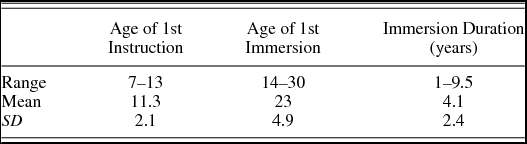
Forty native speakers of English recruited at the University of Illinois at Urbana–Champaign participated as a control group (age = 18–51, M = 22.2). The L2 learner group was also recruited at the same university and consisted of 32 native speakers of Korean who were learning English as L2s (age = 20–37, M = 27.7). The learners provided language background information on a questionnaire, which included questions about their age at the time of testing, the age at which they began to receive English instruction in Korea, the age at which they arrived in the United States, and the duration of their residence in the United States. All L2 learners were born in Korea and had resided there at least until they were 14 (mean years of residence in Korea = 23) before they moved to the United States. Because English use in Korea is mostly confined to classroom settings, it is reasonable to assume that immersion in English for the learners began when they moved to the United States. The learners’ language background is given in Table 1.
Second language learners’ background information

The participants took a cloze test, which we considered a measure of their general English proficiency. The cloze test (adapted from O’Neill, Cornelius, & Washburn, Reference O’Neill, Cornelius and Washburn1981) included blanks at every seventh word (for a total of 40 blanks). For each blank there were three choices from which the participants were asked to choose the most appropriate answer. The maximum score was 40, with 1 point for each correct answer. Native speakers’ cloze test scores ranged from 36–40 (M = 38.2, SD = 0.8). The L2 learners scored 27–39 (M = 32.2, SD = 3.1) on the test, suggesting that they had high intermediate to advanced proficiency in English as measured by the test.
Materials and procedures
The eye-tracking study was modeled on Runner et al. (Reference Runner, Sussman and Tanenhaus2006) and investigated the process of reference resolution of two types of anaphoric expressions (reflexives and pronouns) in two different contexts (coargument and picture NP contexts). Participants listened to auditory instructions of sentences containing reflexives or pronouns and performed appropriate actions on the display screen as instructed, using the mouse. The eye-tracking task monitored participants’ eye movements while they executed the instructions in order to examine what referents the participants considered as antecedents over time. It also examined participants’ final interpretations of anaphoric expressions by recording which referent the participants chose as the antecedent.
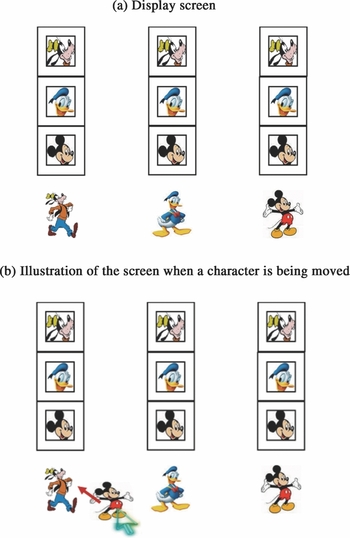
Participants saw a display with animation characters and pictures depicting them (see Figure 1a). At the bottom of the screen were three male characters (Goofy, Donald, and Mickey). Nine pictures depicting them (three for each) were placed above the characters. Participants were told that each character owned the three pictures above it.Footnote 12 The experiment was designed so that the three characters could be moved and dropped on any of the characters or on the pictures depicting them. With a single mouse click on a character, the character could be picked up and moved along the mouse trajectory, and with another click the moved character could be dropped on an appropriate location on the display screen. When a character was moving, a copy of the character remained in the position from which it was moved, as illustrated in Figure 1b. There were three versions of the display screen, each with different spatial arrays for the three characters and the nine pictures. Participants were randomly assigned to one of the three display versions. After the display screen was presented, participants were asked to perform the tasks specified by auditory instructions such as (13, 14).
-
(13) Example aural instructions: coargument trials
-
a. Reflexive
Look at Goofy. Have Mickey touch himself.
-
b. Pronoun
Look at Goofy. Have Mickey touch him.
-
c. (Unmentioned) Name
Look at Goofy. Have Mickey touch Donald.
-
-
(14) Example aural instructions: picture NP trials
-
a. Reflexive
Look at Goofy. Have Mickey touch a picture of himself.
-
b. Pronoun
Look at Goofy. Have Mickey touch a picture of him.
-
c. (Unmentioned) Name
Look at Goofy. Have Mickey touch a picture of Donald.
-
Example display screens.

The auditory instructions consisted of a lead-in sentence of the form “Look at X,” followed by an action sentence of the form “Have Y touch Z.” The lead-in sentence introduced one character (X), which we will refer to as the lead-in character. The action sentence introduced another character as the subject of the embedded clause (Y), which we will call the subject (or action) character. The critical final NP (Z) alternated between a reflexive, a pronoun, and a name. In the case of names, the NP referred to a character distinct from either the lead-in (X) or the subject/action (Y) character. When an anaphoric expression (reflexive, pronoun) instead of a name was used as the final NP, the expectation was that speakers would pick one of the two previously introduced characters (X or Y) as its referent.
Since the name condition introduced a character that had not been introduced in the previous part of the aural instruction, we expected that the participants would disregard the two previously mentioned characters (X, Y in the schematization above) and focus on the newly mentioned character (Z in the above schematization, where Z = / = X, Y). The name condition therefore served as a baseline to compute the extent to which participants considered the two previously mentioned NPs as antecedent of the reflexive or the pronoun. In the statistical analyses, we examined whether the reflexive instructions or the pronoun instructions induced significantly larger number of subject/lead-in character responses than the name conditions (our baseline).
In the sentences used in the coargument trials in (13) above, the embedded subject of the action sentence and the anaphoric expression that occurs as object are coarguments of the predicate touch. The embedded predicate is thus a reflexive predicate in the reflexive condition because one of its arguments is a reflexive. If the reflexive object is construed as coreferential with the subject, Condition A/B is satisfied. If the object is a pronoun, it cannot be construed as coreferential with the subject, because a pronoun is not a reflexivizer (hence failing Condition A/B), nor can the pronoun be construed as picking out the subject in the discourse module (due to Rule I). Thus, in the pronoun condition, the lead-in character is the only possible antecedent for the pronoun among the characters mentioned in the instruction.
In the sentences used in the picture NP trials in (14) above, the prepositional phrase complement (of NP) is the sole argument of the picture noun. When the prepositional phrase complement contains a reflexive, it is not subject to syntactic binding principles, since syntactic binding requires a dyadic argument structure minimally. Not being subject to syntactic licensing, the reflexive must be licensed as a logophor.Footnote 13 When the picture NP contains a pronoun, the pronoun can be coreferential either with the subject/action character of the sentence (Mickey), or with the lead-in character (Goofy), the choice between the two influenced by extrasyntactic factors. For example, in (14) speakers might use the pronoun to signal coreference with the lead-in character Goofy, while employing the logophoric reflexive when coreference with the subject/action character Mickey is intended.
Expected responses to each part of the instructions are as follows: upon hearing the lead-in sentence, participants were expected to look at the lead-in character (Goofy in 13 and 14). On hearing the action sentence, they were expected to pick up the subject/action character (Mickey) and drop it on one of the three characters (in the coargument trials) or on one of the pictures depicting the characters (in the picture NP trials). A trial ended if participants completed the action of dropping the subject/action character.
The auditory instructions consisted of three sets of items for the coargument instructions and for the picture NP instructions, varying the characters mentioned in the lead-in and action sentences. These 18 experimental items (9 items, respectively, for coargument and picture NP instructions) were presented to each participant in a randomized order, interspersed with 54 other instructions that served as fillers. Six of the fillers included names that were mentioned earlier in the sentence (e.g., Look at Goofy. Have Mickey touch Goofy.), and 48 of them included reflexives/pronouns/names in another type of picture NP (picture NP with a possessor, e.g., Have Goofy touch Donald's picture of himself/him/Mickey.). All instructions were read by a female native speaker of English. Subjects had one second of preview of the scene before the onset of the aural instructions. The lead-in sentence was separated by a pause of about 2170 ms on average from the onset of the action sentence. The average durations of the reflexive (himself), the pronoun (him) and the names (Goofy, Mickey, and Donald) were 612, 278, and 517 ms, respectively.
Participants sat in a quiet booth in front of a monitor, resting their chins on the chinrest. The participants were first familiarized with the characters and the display screen and took part in a practice session, which used only names in the instructions. Most participants were already familiar with the characters.Footnote 14 While participants were performing the task, their eye movements were recorded using the desktop mount EyeLink 1000 (SR research). Calibration was carefully monitored throughout the experiment. Viewing was binocular, but only the movements of the right eye were recorded. Information about eye fixations was collected at a sampling rate of 1000 Hz. The data was then reorganized in 20-ms window frames by averaging the information of 20 samples. There was a short break in the middle of the main session.
RESULTS
We first report the results of the coargument trials for each group, followed by those of the picture NP trials. For each trial (coargument and picture NP), we start by reporting the final antecedent choice and then the eye-fixation data. The former reveals the participants’ final interpretation of the anaphoric expressions, and the latter shows what referents they considered over time before settling on the final interpretation. These data were analyzed using a binomial logit mixed model in R (R development core team, 2012, v. 2.15.0). The data were statistically analyzed in each group separately for subject/action character responses and lead-in character responses. The fixed effect term was NP type, which was coded so that the name condition (baseline) was compared to the reflexive condition and to the pronoun condition, respectively. That is, we examined whether the reflexive condition and the pronoun condition induced significantly larger number of subject/lead-in character responses than the name condition. For all models, participants and items were included as random intercepts. Random slopes for NP type were also included following Barr, Levy, Scheepers, and Tily (Reference Barr, Levy, Scheepers and Tily2013), who suggest that generalizability of mixed effects models increases when they include the maximal random effects structure justified by the design. We examined the proficiency of the L2 learners by adding the main effect of the cloze test score and its interaction term to the model, after centering the cloze test score. When proficiency interacted significantly with other variables, we divided the learners into those with higher proficiency (n = 13) and those with lower proficiency (n = 19) using a median split (Mdn = 32), and analyzed the two proficiency groups separately.
The coargument trials
Final antecedent choice
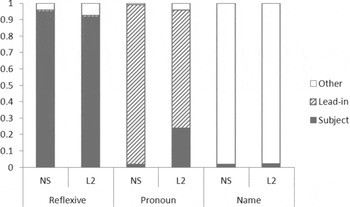
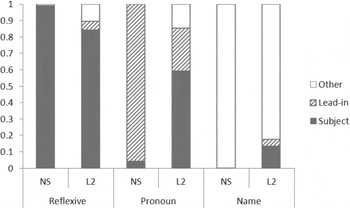
Figure 2 shows the proportions of choices of the subject/action character, of the lead-in character, and of the character that was neither the lead-in nor the action character, for each NP type and for each group. The target choice in the reflexive condition was the subject/action character, Mickey in (13), whereas the expected choice in the pronoun condition was the lead-in character, Goofy in (13).
Proportion of choosing each character as the referent in the coargument trials.

In the reflexive condition, both groups predominantly chose the subject/action characters as the antecedent. In the pronoun condition, however, the two groups’ final choices diverged. Native speakers almost exclusively chose the expected lead-in character as the antecedent of the pronoun. Although the L2 learners also chose the lead-in character as the antecedent predominantly (72%), they also chose the subject/action character 24% of the time. We cannot attribute the response of L2 learners to their failure to pay attention to the instructions or inability to carry them out, because in the name condition (our baseline) both groups successfully chose the character that the embedded object of the action sentence referred to (Donald in 13c), as directed by the instructions.
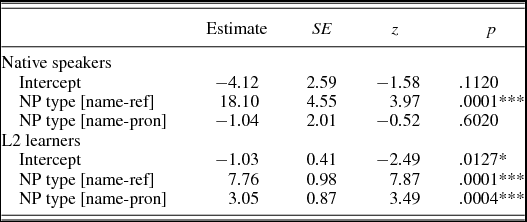
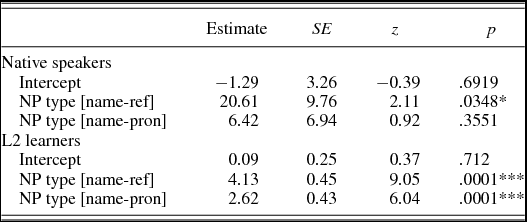
Table 2 presents the fixed effects of the model fitted to the number of subject/action character responses. Because the model including the cloze test score showed that proficiency did not interact either with NP type [name-reflexive] or with NP type [name-pronoun], the analysis was performed on the learner group as a whole. Table 2 shows that in the native speaker group the reflexive condition induced more subject character responses than the name condition, and the main effect NP type [name-reflexive] was significant (estimate = 18.10, z = 3.97, p < .0001), while the pronoun condition was not. That is, in the pronoun condition, native speakers did not interpret pronouns as referring to the subject character, just like in the name condition, where such a reading is clearly impossible. In the L2 learner group, however, there were main effects for both conditions (NP type [name-reflexive]: estimate = 7.76, z = 7.87, p < .0001; NP type [name-pronoun]: estimate = 3.05, z = 3.49, p = .001). Both the reflexive and the pronoun conditions induced significantly more subject character responses than the name condition, suggesting that, unlike the native speakers, the L2 learners sometimes allowed coreference between the pronoun object and its coargument subject.
Fixed effects of the model fitted to the number of subject response in the co-argument trials

Note: NPs, Noun phrases; L2, second language.
*p = .05. ***p = .001.
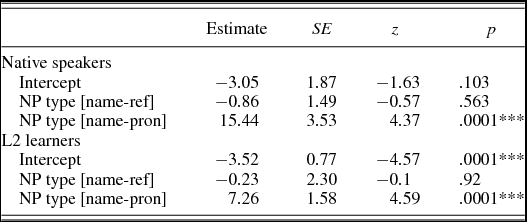
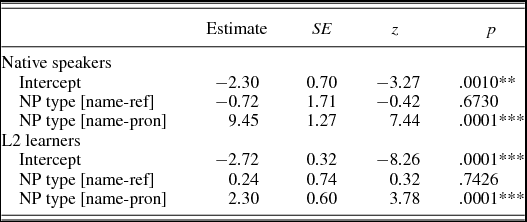
In addition to examining the subject/action character responses we also examined the lead-in character responses, which is a grammatically permitted option for pronouns but not for reflexives. We believe that a full range of results cannot be ascertained without looking at how participants consider the entire discourse context with the two anaphoric expressions. The fixed effects of the model fitted to the number of lead-in character responses are presented in Table 3. The results showed that in the native speaker group, the pronoun condition produced significantly more lead-in character responses than the name condition (estimate = 15.44, z = 4.37, p < .0001), as predicted, but the reflexive condition did not. The L2 learners’ responses showed the same pattern of significance as the native speakers with a main effect for NP type [name-pronoun] (estimate = 7.26, z = 4.59, p < .0001). The pronoun condition induced a significantly higher proportion of lead-in character responses than the name condition, but the reflexive condition did not. We next report the results of the time course of eye fixations.
Fixed effects of the model fitted to the number of lead-in response in the co-argument trials

Note: NPs, Noun phrases; L2, second language.
***p = .001.
Eye fixations
In order to see when the participants completed the required action, we examined the scatterplot of the time it took the participants to choose the antecedent as measured from the moment they heard the critical words (him/himself/name; averaged across all experimental trials). The average time to complete the action specified in the instructions for native speakers was 2501 ms (range = 1557–3684 ms), and there were no noticeable outliers. The L2 learners’ average was 3617 ms. Most L2 learners finished the action in about 5.5 s (range = 1580–5641 ms), but for three of the learners it took longer than 8 s. The statistical analyses conducted on the data after excluding these three participants produced the same results as the analyses including those participants. Therefore, the results we report below are from all the participants.
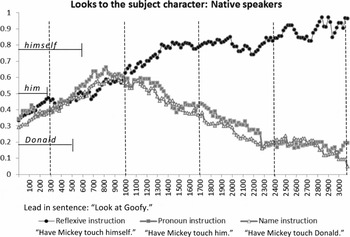
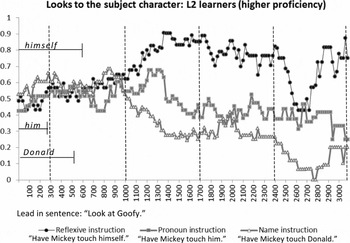
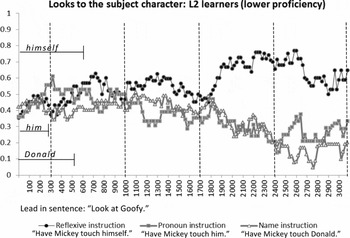
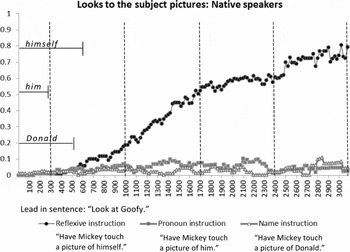
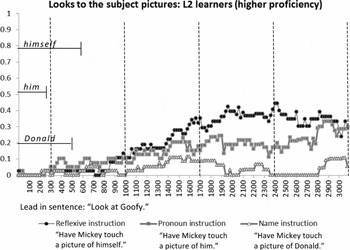
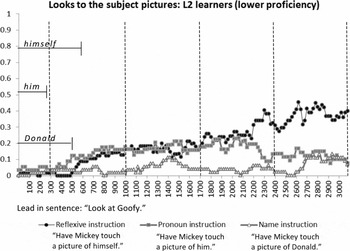
In the coargument trials the average time to complete the required action was 2426 ms for the native speakers (SD = 834) and 3358 ms for the L2 learners (SD = 2369). The trials in which the participants did not choose the correct antecedent were excluded, which resulted in the exclusion of 3.05% of the native speakers’ data and 14.9% of the L2 learners’ data. Thus, the analyses of fixation data were based only on the correct responses. Figures 3 to 5 show native speakers’ and L2 learners’ proportion of looks to the subject/action character for the three NP types (reflexive, pronoun, name), from the onset of the critical words to 3100 ms after that, on which we conducted the statistical analyses. The L2 learners’ fixation patterns are presented separately for two proficiency groups because, unlike in the final antecedent selection, the cloze test score interacted with the pattern of fixations (see test statistics). For the statistical analyses, we excluded the first 300 ms from the onset of each word, following the convention in visual world studies that takes into account the time to launch and execute eye movement (Runner et al., Reference Runner, Sussman and Tanenhaus2006). Eye movements were analyzed in four consecutive 700-ms analysis regions (windows), starting from 300 ms after the critical word onset (first, 300–1000 ms; second, 1000–1700 ms; third, 1700–2400 ms; and fourth, 2400–3100 ms; the regions are marked with dotted lines in each graph). The length of the time windows was based on the pattern shown in Figure 3, where 1000 ms is approximately the point at which the lines began to diverge. The three groups are compared in each window in order to establish the relative timing of the effects for each group. The same four time windows were applied to all the fixation data reported below, for the sake of consistency.Footnote 15
Proportion of looks to the subject of the action sentence in response to the reflexive, pronoun and name instruction in the coargument trials: native speakers.

Logistic mixed effects models were fitted to the number of fixations to the subject character in each group. NP type and time window were entered in the model as fixed effect terms. NP type was again coded in such a way that the name condition (baseline) was contrasted with the reflexive condition and with the pronoun condition. For the time window, the first 300–1000 ms window was coded as baseline. In case there was a significant interaction between NP type and time window, subsequent analyses were conducted in each time window, with NP type as a fixed-effect term. For the L2 learners, we also entered their proficiency score on the cloze test as a factor, and there were three-way interactions between NP type [name-reflexive], window, and cloze test score (estimate = 0.07, SE = 0.01, z = 6.62, p < .0001), and between NP type [name-pronoun], window, and cloze test score (estimate = 0.04, SE = 0.01, z = 4.33, p < .0001). Analyses were therefore conducted separately for higher and lower proficiency group of L2 learners.
Figure 3 shows that for the native speakers, the proportion of looks steadily rose for all three types of NPs until about 900–1000 ms (first window) after the onset of the critical word. We speculate that this result arose because the beginning of reference resolution of the critical NPs (him/himself/name) was not tightly time-locked to their word onset in the aural instructions and because the character that is picked up (Mickey in (13)) happens to be the embedded subject, which is one of the potential antecedents. The participants may have begun to pick up Mickey only after listening to the entire sentence Have Mickey touch himself/him/Donald, in which case, their gaze would be directed to Mickey initially. The increase in looks to the subject/action character for about 1 s after the onset of the critical word, therefore, may reflect the action of picking up the character. After 900–1000 ms, the three fixation lines began to diverge. In the second window (1000–1700 ms), looks to the subject character continued to increase in the reflexive condition, while they decreased sharply in the baseline name condition. Our main interest was the trajectory of the pronoun line in this window and later windows, as compared with that of the other two lines (reflexive and name). Looks to the subject decreased sharply in the pronoun condition as well at a rate similar to the name condition, suggesting that upon hearing pronoun objects (Look at Goofy. Have Mickey touch him), the native speakers look at the subject (Mickey) no more than when hearing a name that introduced a new referent (i.e., Donald in Have Mickey touch Donald).
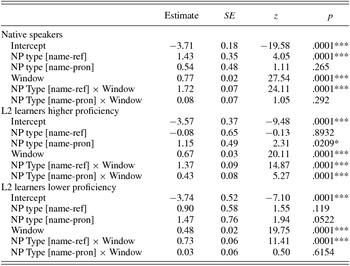
The fixation graph of L2 learners with higher proficiency in Figure 4 also shows a small increase of looks to the subject character (Mickey) in the second and third windows in all three conditions. At about 1000 ms (second window) looks to the subject character continued to increase in the reflexive condition while decreasing in the name condition (1000–1700 ms window). The fixation line in the pronoun condition also decreased in this window, although not as sharply as in the name condition, maintaining a noticeable difference from the name line. For L2 learners with lower proficiency shown in Figure 5, the point at which the reflexive line began to rise sharply occurs much later (about 1800 ms, in the third window) than in the results with native speakers (cf. Figure 3) and advanced L2 learners (cf. Figure 4). From about 2400–2500 ms, the pronoun line also began to diverge from the name line. Table 4 presents the fixed effects of the model fitted to the data from each group.
Proportion of looks to the subject of the action sentence in response to the reflexive, pronoun and name instruction in the coargument trials: second language (L2) learners with higher English proficiency.

Proportion of looks to the subject of the action sentence in response to the reflexive, pronoun and name instruction in the coargument trials: second language (L2) learners with lower English proficiency.

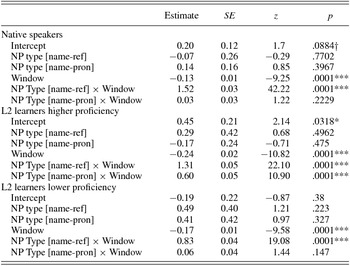
Fixed effects of the model fitted to looks to the subject in the co-argument trials

Note: NPs, Noun phrases; L2, second language.
†p = .1. *p = .05. ***p = .001.
For the native speakers, there was a main effect for time window (estimate = –0.131, z = −9.25, p < .0001). This is due to the decreasing number of fixations to the subject character (aggregated across the three NP type conditions) as the time window changes from the first window, which is the baseline, to the later ones. There were no main effects for NP type [name-reflexive] or NP type [name-pronoun]: the two anaphoric expressions do not have a larger number of fixations to the subject than the name in the baseline window. There was a significant interaction between NP type [name-reflexive] and time window, with a positive estimate (estimate = 1.52, z = 42.22, p < .0001), indicating that the number of fixations to the subject differed over time between the reflexive condition and the name condition. However, the interaction between NP type [name-pronoun] and time window was not significant. Separate analyses were conducted in each time window in order to examine the interaction. In the first window (300–1000 ms), the effects of NP type [name-reflexive] and NP type [name-pronoun] were not significant ([name-reflexive]: estimate = –0.03, SE = 0.28, z = –0.09, p = .924; [name-pronoun]: estimate = 0.18, SE = 0.25, z = 0.69, p = .484). In the second window (1000–1700 ms) and onward, there were significant main effects for NP type [name-reflexive] (second: estimate = 1.75, SE = 0.49, z = 3.60, p = .001; third: estimate = 3.16, SE = 0.30, z = 10.43, p < .0001; fourth: estimate = 5.61, SE = 0.68, z = 8.19, p < .0001), but the NP type [name-pronoun] effects were not (second: estimate = 0.06, SE = 0.52, z = 0.10, p = .914; third: estimate = 0.25, SE = 0.25, z = 0.98, p = .323; fourth: estimate = –0.59, SE = 0.74, z = –0.08, p = .4228).
The model fitted to the data from L2 learners with higher proficiency revealed a main effect for window (estimate = –0.24, z = −10.82, p < .0001), but no main effects of NP type [name-reflexive] and NP type [name-pronoun]. Similar to the native speakers’ data, there was a significant NP type [name-reflexive] and time window interaction (estimate = 1.31, z = 22.10, p < .0001), but there was also a significant NP type [name-pronoun] and time window interaction (estimate = 0.60, z = 10.90, p < .0001). Follow-up analyses conducted in each time window showed that neither NP type [name-reflexive] nor NP type [name-pronoun] main effects was significant in the first window ([name-reflexive]: estimate = –0.08, SE = 0.53, z = −0.15, p = .878; [name-pronoun]: estimate = –0.30, SE = 0.65, z = −0.45, p = .646). In the second window, the NP type [name-reflexive] main effect was significant (estimate = 2.85, SE = 0.81, z = 3.53, p = .001), and the NP type [name-pronoun] main effect was marginally significant (estimate = 1.22, SE = 0.65, z = 1.89, p = .058). Similar results were found in the third window as well ([name-reflexive]: estimate = 5.67, SE = 1.41, z = 4.01, p < .0001; [name-pronoun]: estimate = 1.60, SE = 0.84, z = 1.91, p = .0561). In the fourth window, both NP type [name-reflexive] and NP type [name-pronoun] main effects were significant ([name-reflexive]: estimate = 6.11, SE = 1.82, z = 3.36, p = .001; [name-pronoun]: estimate = 3.95, SE = 1.05, z = 3.74, p < .0001).
The L2 learners with lower proficiency also showed no main effects of NP type [name-reflexive] and NP type [name-pronoun], but showed a main effect for window (estimate = –0.17, z = –9.58, p < .0001) like the other two groups. NP type [name-reflexive] interacted with time window (estimate = 0.83, z = 19.08, p < .0001), but the interaction between NP type [name-pronoun] and time window was not significant. Although these overall statistical results are similar to the results of the native speakers, follow-up analyses conducted in each time window revealed a very different pattern of statistical effects from that of native speakers. In the first window, the main effects of NP type [name-reflexive] and NP type [name-pronoun] were not significant (although the NP type [name-reflexive] effect approached significance) ([name-reflexive]: estimate = 0.55, SE = 0.32, z = 1.69, p = .0896; [name-pronoun]: estimate = 0.34, SE = 0.50, z = 0.68, p = .4932). In the second window there was no significant NP type effect ([name-reflexive]: estimate = 1.18, SE = 0.77, z = 1.53, p = .125; [name-pronoun]: estimate = –0.29, SE = 0.84, z = –0.34, p = .732). A significant main effect for NP type was detected in the third window for [name-reflexive] (estimate = 2.40, SE = 0.82, z = 2.92, p = .01) but not for [name-pronoun] (estimate = 0.37, SE = 0.69, z = 0.54, p = .5895). In the fourth window, the NP type [name-pronoun] effect was marginally significant ([name-reflexive]: estimate = 6.18, SE = 1.21, z = 5.15, p < .0001; [name-pronoun]: estimate = 2.46, SE = 1.28, z = 1.92, p = .054).
The fixations on the subject thus reveal a difference between the native speakers and the L2 learners, and between the two learner groups in the pronoun condition (Look at Goofy. Have Mickey touch him). The native speakers looked at the subject (Mickey) in the pronoun condition no more than in the name condition (Look at Goofy. Have Mickey touch Donald). The L2 learners, however, looked at the subject (Mickey) more in the pronoun condition than they did in the name condition, suggesting that they considered the subject (Mickey), as well as the lead-in (Goofy), as possible antecedents for the pronoun him. The two learner groups were different in the timing of such effects: the learners with higher proficiency fixated on the potential antecedents as quickly as native speakers, whereas the lower proficiency L2 learners showed evidence for antecedent resolution later.
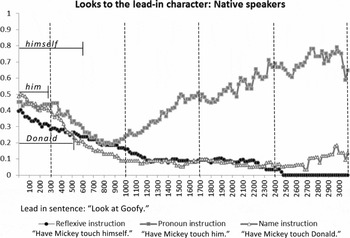
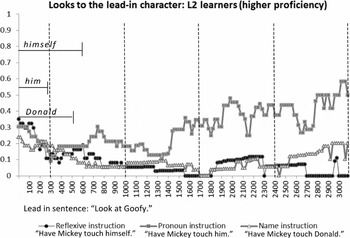
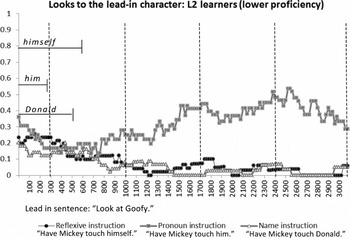
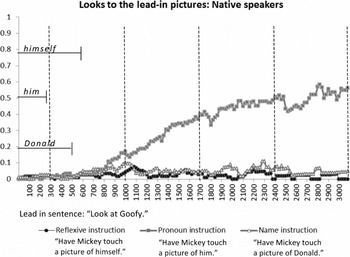
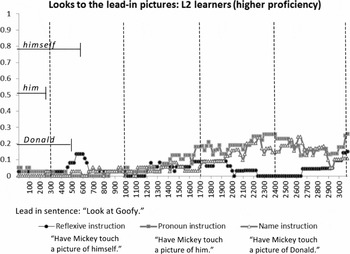
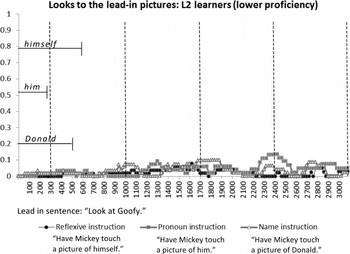
We now turn to fixations to the lead-in character, which is a grammatically permitted antecedent for pronouns but not for reflexives. Figures 6, 7, and 8 present the proportion of looks to the lead-in character (Goofy).
Proportion of looks to the lead-in in response to the reflexive, pronoun and name instruction in the coargument trials: native speakers.

Proportion of looks to the lead-in in response to the reflexive, pronoun and name instruction in the coargument trials: second language (L2) learners with higher proficiency.

Proportion of looks to the lead-in in response to the reflexive, pronoun and name instruction in the coargument trials: second language (L2) learners with lower proficiency.

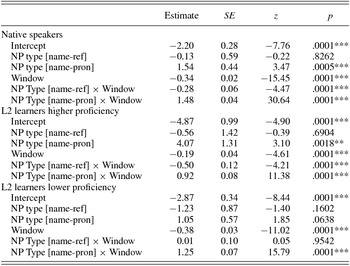
The model including the cloze test English proficiency score of the L2 learners revealed significant interactions between NP type [name-reflexive], time window and English proficiency (estimate = –0.12, SE = 0.03, z = −4.41, p < .0001) and between NP type [name-pronoun], time window and English proficiency (estimate = –0.07, SE = 0.02, z = −2.97, p = 0.01), and we thus split the L2 learner group into advanced and intermediate proficiency groups. Figure 6 shows that in all three types of instructions (reflexive: Have Mickey touch himself; pronoun: Have Mickey touch him; and name: Have Mickey touch Donald), native speakers’ looks to the lead-in character (Goofy) in the lead in sentence Look at Goofy decreased from the onset of the critical words (himself, him, Donald) until about 800–900 ms (first window). As in Figure 3, this appears to reflect the participants’ pick-up action. Picking up the action/subject character (Mickey) would direct the eyes toward it (accounting for the pattern in Figure 3), and away from the other characters. Consequently, looks to the lead-in are likely to have decreased at this stage (accounting for the pattern in Figure 6). After 800–900 ms, the pronoun line began to rise sharply. The reflexive line continued to decrease together with the name line. The graphs of the two L2 learner groups (Figures 7 and 8) show a similar pattern, but the point when the pronoun line begins to rise occurs earlier in the first window, and looks to the lead-in did not increase as sharply as in the native speaker's data. It looks like the learners are looking at the subject character instead of the lead-in character quite a bit (compare the pronoun instruction line in Figure 4 and Figure 7 for the high proficiency group and Figure 5 and Figure 8 for the lower proficiency group). Mixed effects logic models were fitted to the number of fixations to the lead-in character in each group and the fixed effects are presented in Table 5.
Fixed effects of the model fitted to looks to the lead-in in the co-argument trials

Note: NPs, Noun phrases; L2, second language.
**p = .01. ***p = .001.
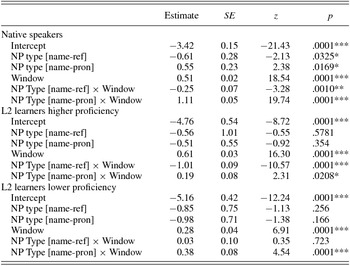
The native speakers’ data showed no significant main effect of NP type [name-reflexive], but a significant main effect for NP type [name-pronoun] (estimate = 1.54, z = 3.47, p = .001), indicating that the pronoun condition did induce a larger number of fixations on the lead-in character than the name condition already in the baseline window. There was a significant main effect for window (estimate = –0.34, z = −15.45, p < .0001), a significant NP type [name-reflexive] and time window interaction with a negative estimate (estimate = –0.28, z = −4.47, p < .0001), and a significant NP type [name-pronoun] and time window interaction with a positive estimate (estimate = 1.48, z = 30.64, p < .0001). Follow-up analyses conducted in each window showed that for all four windows, the NP type [name-reflexive] effect was not significant (first: estimate = –0.25, SE = 0.55, z = –0.45, p = .647; second: estimate = –0.09, SE = 2.04, z = −0.04, p = .966; third: estimate = 1.20, SE = 1.97, z = 0.61, p = .541; fourth: estimate = –4.33, SE = 7.37, z = –0.58, p = .556), while there was a significant main effect of NP type [name-pronoun] (first: estimate = 1.28, SE = 0.37, z = 3.42, p = .001; second: estimate = 7.95, SE = 1.30, z = 6.10, p < .0001; third: estimate = 13.20, SE = 2.65, z = 4.97, p < .0001; fourth: estimate = 10.34, SE = 2.01, z = 5.14, p < .0001), as expected.
The model fitted to the data from L2 learners with higher proficiency revealed a similar pattern of results as that of the native speakers. There was a significant main effect of NP type [name-pronoun] (estimate = 4.07, z = 3.10, p < .001), due to a larger number of fixations to the lead-in character (Goofy) in the pronoun condition (Have Mickey touch him) than in the name condition (Have Mickey touch Donald) in the baseline window. There was a significant interaction between NP type [name-reflexive] and time window, with a negative estimate (estimate = –0.50, z = –4.21, p < .0001), and a significant interaction between NP type [name-pronoun] and time window, with a positive estimate (estimate = 0.92, z = 11.38, p < .0001). There was no significant NP type [name-reflexive] main effect in any window, but the NP type [name-pronoun] main effect was significant in all windows (first: estimate = 4.29, SE = 1.86, z = 2.31, p = .05; second: estimate = 7.91, SE = 4.05, z = 1.95, p = .050; third: estimate = 20.77, SE = 7.33, z = 2.83, p = .01; fourth: estimate = 3.61, SE = 1.15, z = 3.12, p < .001).
In the data from L2 learners with lower proficiency, there was a significant main effect for window (estimate = –0.38, z = −11.02, p < .0001), no significant main effect for NP type [name-reflexive] and a marginally significant main effect of NP type [name-pronoun] (estimate = 1.05, z = 1.85, p = .063). There was a significant interaction between NP type [name-pronoun] and time window (estimate = 1.25, z = 15.79, p < .0001), but the interaction between NP type [name-reflexive] and time window was not significant. Analysis conducted in each window revealed that the NP type [name-reflexive] effect was not significant in any of the windows (first: estimate = –1.06, SE = 0.95, z = −1.11, p = .264; second: estimate = 2.94, SE = 5.96, z = 0.49, p = .622; third: estimate = 2.30, SE = 5.90, z = 0.50, p = .611; fourth: estimate = –3.68, SE = 7.43, z = −0.49, p = .620). Unlike in the learners with higher proficiency, for the lower proficiency learners the NP type [name-pronoun] effect did not reach significance in the first window (estimate = 0.44, SE = 1.17, z = 0.37, p = .711), but was significant in the second window and later (second: estimate = 12.35, SE = 4.92, z = 2.51, p = .05; third: estimate = 11.43, SE = 5.64, z = 2.02, p = .05; fourth: estimate = 10.52, SE = 4.80, z = 2.19, p = .05). Overall, looks to the lead-in character show that the grammatically illicit antecedent mentioned in the instruction did not interfere with the processing of reflexives in the native speakers or the L2 learners. However, there were differences between the groups in looks to the lead-in character in different analysis windows and in the timing of the NP type [name-pronoun] effect.
Summarizing the results of the coargument trials, native speakers made grammatically constrained interpretations when they heard instructions containing reflexives and pronouns in the coargument context. Their choice of final antecedents was in conformity with grammatical constraints, and they did not consider NPs not permitted as antecedents by the binding theory as potential antecedents throughout the online antecedent search process for both reflexives and pronouns. L2 learners’ final interpretation of reflexives also conformed to grammatical constraints. In online antecedent search, they considered the coargument but not a noncoargument as the antecedent. However, L2 learners with lower proficiency differed from higher proficiency L2 learners as well as from the native speakers in how long they took to clearly fixate on the grammatically licit antecedent for reflexives. As for the interpretation of pronouns, the L2 learners differed from the native speakers, since they allowed coarguments (subject/action character) as antecedent for pronouns, an option ruled out by grammar, in a significant number of trials. Moreover, they showed evidence of temporarily considering the coargument interpretation in the antecedent search process, even when they ultimately chose the correct antecedent (lead-in character) for the final interpretation. This tendency was observed for both proficiency groups, and the learners with higher proficiency seemed to be considering the action/subject character at earlier stages of processing to a greater degree than learners with lower proficiency. This suggests that even L2 learners with a fairly high proficiency may not have completely ruled out the action/subject character as the possible antecedent for pronouns. We now turn to the results of the picture NP trials, where we hypothesize that interpretation of reflexives and pronouns is determined extrasyntactically.
The picture NP trials
Final antecedent choice
Figure 9 shows the percentages of choice of the picture depicting the subject/action character (Mickey), the lead-in character (Goofy), and the character referred to by the name (Donald) in the three NP conditions in the picture NP trials displayed in (14).
Proportion of choosing each set of pictures as the referent in the picture noun phrase (NP) trials.

Upon hearing the instructions in the name condition (Have Mickey touch a picture of Donald), the native speakers chose the target pictures (picture depicting Donald), as expected. In the reflexive condition, the native speakers predominantly chose the pictures depicting the subject character (picture depicting Mickey). In the pronoun condition, although the choice of either a picture depicting the lead-in character (Goofy) or the subject (Mickey) is consistent with the binding principles, native speakers chose the lead-in pictures most of the time, selecting the subject pictures only on a small number of trials (4.2%).
The results of the L2 learners are quite different. L2 learners chose incorrect antecedents in quite a few trials, even in the name condition (17.7%), indicating that the picture NP trials were more difficult for them than the coargument trials.Footnote 16 The most frequently chosen picture in the reflexive condition was the subject picture (depicting Mickey), which was also the case for native speakers. However, in the pronoun condition, the L2 learners’ final choice of antecedents was noticeably different from the native speakers’ final choices in that they chose the subject pictures (Mickey) much more frequently than the lead-in pictures (Goofy). This pattern of response was found in both proficiency groups because the cloze test score did not significantly interact with the NP type contrasts in either the subject picture responses or the lead-in picture responses. The fixed effects of the model fitted to the number of subject picture responses are presented in Table 6.
Fixed effects of the model fitted to the number of subject picture response in the picture NP trials

Note: NPs, Noun phrases; L2, second language.
*p = .05. ***p = .001.
There was a significant main effect of NP type [name-reflexive] for the native speakers (estimate = 20.61, z = 2.11, p = .05). Upon hearing instructions with reflexives the native speakers chose the subject pictures (Mickey) significantly more often than when hearing instructions with names (Donald), whereas instructions with pronouns did not lead them to choose the subject pictures (Mickey). In contrast, both reflexive and pronoun instructions led the learners to choose the subject pictures (Mickey) significantly more often than pictures depicting the character picked out by names (Donald). The L2 learners’ results showed highly significant main effects for NP type [name-reflexive] (estimate = 4.13, z = 9.05, p < .0001) and for NP type [name-pronoun] (estimate = 2.62, z = 6.04, p < .0001).
The fixed effects of the model fitted to the number of lead-in picture responses in Table 7 revealed a similar pattern for both groups. For the native speakers, there were more lead-in picture responses in the pronoun condition than in the name condition, as revealed by a significant main effect for NP type [name-pronoun] (estimate = 9.45, z = 7.44, p < .0001), but the number of lead-in picture responses in the reflexive condition was not significantly different from that in the name condition. The pronoun condition induced reliably more lead-in picture responses than the name condition for the L2 learners as well (estimate = 2.30, z = 3.78, p < .0001). There was a small number of lead-in picture responses in the reflexive condition, but this was not different from that of the name condition. Therefore, the small number of lead-in picture responses in the reflexive trials in L2 learners’ results may be attributable to the overall processing difficulty that the learners experienced when executing instructions in the picture NP contexts.Footnote 17
Fixed effects of the model fitted to the number of lead-in picture response in the picture NP trials

Note: NPs, Noun phrases; L2, second language.
**p = .01. ***p = .001.
Overall, responses of the L2 learners to reflexives in the picture NP contexts were similar to those of the native speakers. However, the L2 learners differed from the native speakers in their final interpretation of pronouns in picture NPs. As we discussed, in terms of syntactic binding theory, the antecedent of a pronoun contained in a picture NP can be either the subject/action character or the lead-in character. Thus, if a preference for one antecedent emerges in the behavioral data, it may reflect extragrammatical factors; in particular, how participants construe the two sentences in discourse. It may also reflect the array of nonstructural factors that affect the interpretation of pronouns in native and nonnative speakers. In the discussion section, we will discuss the relevant pragmatic-discourse strategy that may account for the different pattern of results of native speakers and L2 learners in the choice of antecedents for pronouns in picture NPs. We turn to eye fixations next.
Eye fixations
In the picture NP trials, all trials were included for the analysis because syntactic binding theory does not constrain the possible antecedents of reflexives/pronouns, so that there is no syntactically correct or incorrect choice of the antecedent.Footnote 18 Native speakers took approximately the same amount of time as in the coargument trials to complete the action (mean time from the onset of the critical words = 2594 ms, SD = 402). However, it took the L2 learners considerably longer to finish the picture NP trials compared to the coargument trials (M = 5214 ms, SD = 2060). The fixation data beyond our analysis windows (3100 ms after the critical word onset) of the learners’ results did not show a particularly different pattern from the pattern found within the analysis windows. The preliminary analysis of the fixations to the subject pictures revealed significant interactions between NP type [name-reflexive], time window and cloze test score (estimate = 0.06, SE = 0.01, z = 4.34, p < .0001) and between NP type [name-pronoun], time window and cloze test score (estimate = 0.08, SE = 0.01, z = 5.69, p < .0001) in the L2 learner group. Analyses were therefore conducted for the two proficiency groups separately. Figures 10, 11, and 12 show the proportion of looks to the subject pictures from the onset of the critical words.
Proportion of looks to the subject pictures in response to the reflexive, pronoun and name instruction in the picture noun phrase (NP) trials: native speakers.

Proportion of looks to the subject pictures in response to the reflexive, pronoun and name instruction in the picture noun phrase (NP) trials: second language (L2) learners with higher proficiency.

Proportion of looks to the subject pictures in response to the reflexive, pronoun and name instruction in the picture noun phrase (NP) trials: second language (L2) learners with lower proficiency.

The native speakers’ fixation data (Figure 10) shows that looks to the subject pictures began to increase sharply in the reflexive condition 500–600 ms after the onset of the reflexive (first window). In the pronoun condition, the proportion of looks to the subject pictures rarely exceeded 10% throughout the analysis windows, and the proportion remained generally similar to that of the name condition, although there were time frames where the pronoun line was slightly higher than the name line. The two L2 learner groups’ graphs (Figures 11 and 12) show patterns noticeably different from the native speakers’ graph. The reflexive condition induced the biggest increase in looks to the subject pictures, but the pronoun condition also induced a higher proportion of looks to the subject pictures than the name condition in most of the analysis windows. Table 8 shows the fixed effects of the mixed effect logic models fitted to the data in each group.
Fixed effects of the model fitted to looks to the subject in the picture NP trials

Note: NPs, Noun phrases; L2, second language.
*p = .05. ***p = .001.
The native speakers’ results revealed a significant main effect of NP type [name-reflexive] (estimate = 1.43, z = 4.05, p < .0001), due to a higher number of fixations to the subject pictures upon hearing the reflexive instruction than the name instruction in the first window. There was also a significant main effect for window (estimate = 0.77, z = 27.54, p < .0001). The significant interaction between NP type [name-reflexive] and time window (estimate = 1.72, z = 24.11, p < .0001) indicates that the difference between the reflexive condition and the name condition increased in subsequent windows. In contrast, the main effect of NP type [name-pronoun] was not significant, nor did it interact with time window, because looks to the subject pictures remained generally low after hearing both the pronoun and the name instructions. In the analyses conducted separately in each time window, the NP type [name-reflexive] main effect was significant from the second window (first: estimate = 1.24, SE = 1.01, z = 1.22, p = .220; second: estimate = 5.29, SE = 0.66, z = 8.02, p < .0001; third: estimate = 14.09, SE = 2.88, z = 4.89, p < .0001; fourth: estimate = 23.08, SE = 6.59, z = 3.50, p = .001). Although the interaction between NP type [name-pronoun] and time window did not reach significance, the NP type [name-pronoun] contrast was significant in the second and third windows (first: estimate = 0.86, SE = 0.98, z = 0.87, p = .383; second: estimate = 1.88, SE = 0.74, z = 2.55, p < .01; third: estimate = 7.94, SE = 3.08, z = 2.57, p < .01; fourth: estimate = 11.76, SE = 7.21, z = 1.63, p = .102).
For L2 learners with higher proficiency, there was no significant main effect of NP type[name-reflexive] but the main effects of NP type [name-pronoun] (estimate = 1.15, z = 2.31, p = .05) and window (estimate = 0.67, z = 20.11, p < .0001) were significant. There were also significant interactions of window and NP type [name-reflexive] (estimate = 1.37, z = 14.87, p < .0001) and window and NP type [name-pronoun] (estimate = 0.43, z = 5.27, p < .0001), due to differences in the number of looks to the subject pictures over time between the reflexive and the name instructions and between the pronoun and the name instructions. Subsequent analyses conducted in each window showed that the NP type [name-reflexive] main effect and the NP type [name-pronoun] main effect were not significant in the first window ([name-reflexive]: estimate = –1.78, SE = 3.06, z = –0.58, p = .562; [name-pronoun]: estimate = –0.22, SE = 1.73, z = –0.12, p = .899), but they were significant or close to significant in the following windows ([name-reflexive]: second: estimate = 3.08, SE = 1.59, z = 1.94, p = .0524; third: estimate = 4.23, SE = 1.20, z = 3.52, p = .001; fourth: estimate = 29.26, SE = 7.72, z = 3.79, p < .0001; [name-pronoun]: second: estimate = 3.32, SE = 1.45, z = 2.29, p = .05; third: estimate = 3.39, SE = 1.26, z = 2.68, p = .01; fourth: estimate = 27.66, SE = 7.35, z = 3.76, p < .0001).
The model fitted to L2 learners with lower proficiency also showed a main effect for window (estimate = 0.48, z = 19.75, p < .0001) and a marginally significant main effect of NP type [name-pronoun] (estimate = 1.47, z = 1.94, p = .052). The interaction between NP type [name-reflexive] and time window was significant (estimate = 0.73, z = 11.41, p < .0001), but the interaction between NP type [name-pronoun] and time window was not. Analysis performed in each window revealed that the NP type [name-reflexive] effect was significant from the second window (first: estimate = 4.66, SE = 5.24, z = 0.88, p = .374; second: estimate = 3.94, SE = 1.50, z = 2.62, p = .001; third: estimate = 5.20, SE = 1.52, z = 3.43, p = .001; fourth: estimate = 4.80, SE = 0.87, z = 5.53, p < .0001). The NP type [name-pronoun] effect was significant in the second and the third window but was not significant in the fourth window (first: estimate = 7.95, SE = 4.94, z = 1.60, p = .108; second: estimate = 4.03, SE = 1.78, z = 2.26, p = .05; third: estimate = 4.66, SE = 1.49, z = 3.12, p = .01; fourth: estimate = –0.34, SE = 2.30, z = –0.14, p = .883).
Figures 13, 14, and 15 present the proportion of fixations on the lead-in pictures (Goofy). The L2 learners’ data are presented in two proficiency groups (Figures 14 and 15) because the proficiency test score interacted significantly with other factors (NP Type [name-reflexive] × Time Window × Cloze: estimate = –0.11, SE = 0.02, z = –5.24, p < .0001; NP Type [name-pronoun] × Time Window × Cloze: estimate = –0.05, SE = 0.02, z = –3.03, p = .01).
Proportion of looks to the lead-in pictures in response to the reflexive, pronoun and name instruction in the picture noun phrase (NP) trials: native speakers.

Proportion of looks to the lead-in pictures in response to the reflexive, pronoun and name instruction in the picture noun phrase (NP) trials: second language (L2) learners with higher proficiency.

Proportion of looks to the lead-in pictures in response to the reflexive, pronoun and name instruction in the picture noun phrase (NP) trials: second language (L2) learners with lower proficiency.

In the native speakers’ graph (Figure 13), pronoun instructions triggered increased looks to the lead-in pictures from about 700–800 ms after the onset of the critical word (him, himself, Donald). Reflexive and name instructions rarely prompted native speakers to look at the lead-in pictures throughout the analysis windows. The proportion of looks to the lead-in pictures was overall very low in all three conditions for both groups of L2 learners. Although for L2 learners with higher proficiency, looks to the lead-in pictures increased gradually with the pronoun instructions from about 1200 ms after the onset of the critical word (second window in Figure 14), the proportion of looks gradually rose in the name instruction as well. The lower proficiency L2 learners (Figure 15) show no visually discernible pattern of looks.
The results of the mixed effects model fitted to the data from the native speakers in Table 9 show that the main effect of NP type [name-reflexive] was significant (estimate = –0.61, z = −2.13, p = .05). The negative estimate indicates that the reflexive instructions induced a lower number of looks to the lead-in pictures compared to the name instructions in the baseline window. There were also significant main effects for NP type [name-pronoun] (estimate = 0.55, z = 2.38, p = .05) and for window (estimate = 0.51, z = 18.54, p < .0001). There was a significant interaction between NP type [name-reflexive] and time window (estimate = –0.25, z = −3.28, p = .001), with a negative estimate, but a significant interaction between NP type [name-pronoun] and the time window, with a positive estimate (estimate = 1.11, z = 19.74, p < .0001). In the within-window analyses, the NP type [name-reflexive] effect was significant in the first, second, and third window, due to a lower number of looks to the lead-in pictures in the reflexive instructions than in the name instructions (first: estimate = –2.06, SE = 0.63, z = –3.29, p < .001; second: estimate = –1.37, SE = 0.53, z = –2.60, p = .01; third: estimate = –4.21, SE = 1.83, z = –2.30, p = .05; fourth: estimate = 0.69, SE = 4.62, z = 0.14, p = .882). The NP type [name-pronoun] effect was significant in the second, third, and fourth windows, due to a higher number of looks to the lead-in pictures in the pronoun instruction than in the name instruction (first: estimate = –0.05, SE = 0.63, z = –0.07, p = .941; second: estimate = 2.23, SE = 0.40, z = 5.60, p < .0001; third: estimate = 5.48, SE = 0.83, z = 6.59, p < .0001; fourth: estimate = 12.07, SE = 3.07, z = 3.93, p < .0001).
Fixed effects of the model fitted to looks to the lead-in in the picture NP trials

Note: NPs, Noun phrases; L2, second language.
*p = .05. **p = .01. ***p = .001.
For L2 learners with higher proficiency, the main effects of NP type [name-reflexive] and NP type [name-pronoun] were not significant. The interaction between NP type [name-reflexive] and time window was significant with a negative estimate (estimate = –1.01, z = −10.57, p < .0001), and the interaction between NP type [name-pronoun] and time window was significant with a positive estimate (estimate = 0.19, z = 2.31, p = .05). In the follow-up analyses, the NP type [name-reflexive] effect was not significant in the first two windows, but the effect, with a negative estimate, was significant in the last two windows (first: estimate = –3.64, SE = 3.10, z = –1.17, p = .239; second: estimate = –1.94, SE = 2.11, z = –0.92, p = .357; third: estimate = –8.88, SE = 3.88, z = –2.29, p = .05; fourth: estimate = –6.94, SE = 2.19, z = –3.16, p = .01). There were no significant main effects of NP type [name-pronoun] in any window (first: estimate = –4.52, SE = 4.07, z = –1.10, p = .267; second: estimate = 2.16, SE = 1.44, z = 1.49, p = .134; third: estimate = 0.33, SE = 1.38, z = 0.24, p = .808; fourth: estimate = –1.06, SE = 1.34, z = –0.79, p = .4293).
For lower proficiency learners, there were no significant main effects of NP type [name-reflexive] and NP type[name-pronoun]. Although NP type [name-pronoun] interacted with time window (estimate = 0.38, z = 4.54, p < .0001), the within-window follow-up analyses did not show any significant NP type effect with a positive estimate ([name-reflexive]: first: estimate = –8.08, SE = 7.61, z = –1.06, p = .288; second: estimate = –3.22, SE = 1.49, z = –2.15, p = .05; third: estimate = –4.64, SE = 4.39, z = –1.05, p = .291; fourth: estimate = 0.02, SE = 1.76, z = 0.01, p = .992; [name-pronoun]: first: estimate = –7.56, SE = 6.33, z = –1.19, p = .232; second: estimate = –3.22, SE = 1.49, z = –2.54, p = .05; third: estimate = –2.39, SE = 2.75, z = –0.87, p = .384; fourth: estimate = –1.96, SE = 1.96, z = –1.00, p = .316).
To summarize, the picture NP fixation data is overall consistent with the final antecedent choice data. When native speakers heard instructions in picture NP contexts containing reflexives (Look at Goofy. Have Mickey touch a picture of himself), they settled quickly on the picture of the subject character Mickey rather than that of the lead-in character Goofy, and they maintained their choice throughout the time windows. When they heard instructions with pronouns (Look at Goofy. Have Mickey touch a picture of him), they mostly considered the lead-in character Goofy as the antecedent of the pronoun, although there was a hint of slight competition from the subject/action character Mickey. The L2 learners also considered the subject character Mickey and not the lead-in character Goofy as the antecedent of picture NPs in the reflexive condition. For the pronoun condition, however, the L2 learners showed clear evidence of considering the picture depicting the subject character Mickey as the antecedent. These results obtained for the L2 learners regardless of their proficiency in English.
DISCUSSION
The purpose of our study was to investigate the interpretation and processing of English reflexives and pronouns by Korean L2 learners of English in two different syntactic contexts. The first involved reflexives and pronouns with a coargument that can potentially serve as an antecedent. The second context was in picture NPs, where the reflexive/pronoun and the potential antecedents are not coarguments. We adopted an approach to the binding theory where the interpretation of anaphoric expressions involves a complex interplay of information at both grammatical and extragrammatical levels. Our study compared how L2 learners and native English speakers make use of diverse types of information to assign interpretations to reflexives and pronouns in two distinct types of contexts.
Our results showed that the L2 learners generally linked reflexives with coargument antecedents in a nativelike way but did not always assign a nativelike interpretation to pronouns in the same structural context, sometimes linking pronouns with coargument antecedents. This is a finding that is somewhat reminiscent of the well-documented difficulty with the acquisition and processing of pronoun interpretation in child L1 acquisition (DPBE).Footnote 19 As for the picture-NP contexts, the L2 learners experienced more difficulty in assigning interpretations to anaphoric expressions in this context compared with the coargument context, as shown by the significantly longer duration it took them to complete the tasks. However, the main difference from native speakers in the picture NP contexts was in the way they interpreted pronouns, since their responses on reflexives was largely similar to native speakers. Therefore, our main finding is that L2 learners were similar to native speakers with respect to the interpretation of reflexives but had significantly more difficulty with the interpretation of pronouns in both coargument and picture NP contexts. We turn now to a discussion of possible reasons for the difference between reflexives and pronouns, first in coargument contexts and then in picture NP contexts.
Difference between reflexives and pronouns in coargument trials
What could explain the divergence between reflexives and pronouns in coargument contexts? In the theoretical framework we are adopting, nontarget performance by L2 learners with pronouns in this context could mean that they have not fully internalized the syntactic binding principles; for example, they may be unaware that pronouns do not function as reflexivizers, or that reflexive predicates need to be licensed by reflexive-marking, or that reflexives are bound only by more prominent coarguments (generalized chain condition). Alternatively, they may be aware of the syntactic differences between pronouns and reflexives (the difference between reflexives and pronouns in their ability to encode reflexivity, and the requirement that reflexivity must be licensed syntactically) but nevertheless allow a discourse-mediated coreference between the pronoun and a coargument, an option that is usually ruled out for native speakers by the interface principle Rule I.
Of the two options, we are inclined to think that the second is more likely because, in the theoretical framework we adopted in this study, the syntactic component of binding theory involves knowledge of the distinction between reflexives and pronouns with respect to their differential ability to mark reflexive predicates, among others. If we suppose, on the basis of nontarget performance with pronouns, that L2 learners’ syntactic knowledge of binding theory is incomplete, we would have to conclude that incompleteness of knowledge is manifested only with pronouns, not reflexives, since L2 learners treat reflexives in conformity with syntactic binding theory. This does not seem to be a reasonable conclusion to draw. We therefore take the results of L2 learners to indicate that the learners may be experiencing certain difficulties at the pragmatic/discourse level, rather than possessing an incomplete grasp of the syntactic properties that distinguish reflexives and pronouns. Why then would there be an asymmetry between reflexives and pronouns at the pragmatic level? The answer can be found readily.
Recall that the only requirement on true reflexives is syntactic dependency formation between the reflexive and a more prominent coargument antecedent. However, for pronouns, both syntactic constraints and discourse-level information need to be considered before settling on a final interpretation (because Rule I needs to be computed as well). Therefore, the theory makes the prediction that computing binding relations for pronouns would tax more resources compared to reflexives. That some studies have found that antecedent search process is influenced by nonsyntactic information to a greater degree for pronouns than for reflexives even for native speakers in certain experimental settings (Phillips, Reference Phillips2012) is consistent with this prediction. We also know that developmentally, Principle B is acquired later than Principle A (DPBE). This developmental asymmetry also makes sense under the theoretical approach to binding we adopt in the study.
In a sense, what we found with L2 learners is similar to the challenges posed by anaphoric processing of pronouns in L1 acquisition and in certain types of tasks that tap into adult monolingual processing. It is hardly surprising that something that demands more processing resources and takes longer to acquire for monolinguals would also pose difficulties for L2 learners. What may exacerbate the difficulty of mastering pronominal binding for L2 learners has to do with the frequently observed difficulty faced even by advanced L2 learners in acquiring linguistic properties that involve the integration of discourse and grammar. This is the idea behind the interface hypothesis (Sorace, Reference Sorace2011; Sorace & Filiaci, Reference Sorace and Filiaci2006, among others). A number of studies have found support for the interface hypothesis from a range of different phenomena that involve the interaction of grammar and discourse. While the interface hypothesis has had its share of critics (see commentaries to Sorace's Reference Sorace2011 keynote article), a fundamental question is why the interface with grammar and discourse (sometimes called the external interface) should pose sustained difficulties for even advanced bilinguals when compared to grammar-internal (or internal interface) properties. An answer that is emerging in the relevant literature is that the difficulties involved in integrating discourse and grammar may arise because modulating two types of information is much more costly for processing than handling purely syntactic dependencies, even for monolingual speakers (Burkhardt, Reference Burkhardt2005; Piñango & Burkhardt, Reference Piñango, Burkhardt, Branco, McEnery and Mitkov2005). Understandably, the cost is even greater for bilinguals when compared to monolinguals (Chung, Reference Chung2013; Roberts, Gullberg, & Indefrey, Reference Roberts, Gullberg and Indefrey2008; Sorace & Serratrice, Reference Sorace and Serratrice2009, among others).
We acknowledge that the strength of the conclusion we just reached is compromised by an alternative explanation, provided by a reviewer. The reviewer notes that it may be possible to view the results as indicating that, compared to native speakers, L2 learners have an overall tendency to choose the subject/action character as antecedent in all trials. Obviously, this is a much less interesting explanation theoretically. The idea is the following. In the case of reflexives (in both coargument and picture NP trials) the choice of subject/action character leads to a result that is indistinguishable from a choice made in conformity with the binding theory. However, in the case of pronouns, the results will diverge from that predicted by the binding theory, as pronouns are not predicted to take coarguments as antecedents. The reviewer notes that the reason why a subject/action character choice may be the preferred antecedent for L2 learners is that between the lead-in character and the subject character, the latter may be more salient pragmatically, and L2 speakers have been known to consider pragmatically salient NPs as antecedents in anaphoric resolution. The reviewer points out further that in order for us to conclude that nativelike performance of L2 learners with reflexives (true and logophoric reflexives) is due to knowledge of the binding theory, a sentence-internal competitor that is not binding theory compatible (such as a noncommanding NP) needs to have been added to the action sentence, which is something we did not have in our study.
While agreeing that this is a possible perspective on the results, and conceding that we did not have internal competitors to independently verify correct application of Principle A by L2 learners, we believe that the suggested alternative does not materially affect the conclusion we reached about the asymmetry between pronouns and reflexives being rooted in knowledge of the binding theory. Suppose that, as the reviewer suggests, the subject/action character is the most salient character pragmatically and that choice of this character as antecedent of reflexives is not due to knowledge of syntactic binding theory, but to the overall tendency on the part of L2 learners to pick salient NPs as antecedents for anaphoric expressions, regardless of whether they are reflexives or pronouns. This alternative assumes that L2 learners behave this way because their knowledge of the syntactic distinction between reflexives and pronouns is not robust. This then predicts that we should find pronouns to be construed with the subject/action character in coargument contexts to a much greater degree than what we found (which was about 24% of trials, see Figure 2). Conversely, if the choice of the lead-in character for pronouns does not reflect knowledge (albeit, incomplete) of the binding theory, but the lack of solid knowledge of the difference between reflexives and pronouns, we expect L2 learners to pick the lead-in character as antecedent of reflexives more often, but they did not (again, see Figure 2). Furthermore, since we can reasonably assume that knowledge of binding theory should increase with proficiency, we expect lower proficiency learners to differ from higher proficiency learners in the rate of choices of antecedents that are not compatible with the binding theory. This is not what we found, however. Therefore, while not ruling out that the strategy of searching for a salient antecedent might have contributed in some way to the results with L2 learners, we believe that the performance of L2 learners is guided in large measure by knowledge of the binding theory and that the reason why they treat reflexives and pronouns differently may reflect the difficulty of computing the antecedent of pronouns due to the extra demand that such computation places on the processing resources.Footnote 20
Differences between pronouns and reflexives in picture NP trials
Turning now to the results of the picture NP trials, we predicted that L2 learners’ performance with logophoric reflexives and pronouns in picture NP contexts will be more variable than their behavior with true reflexives in coargument trials. The behavior of L2 learners with pronouns in picture NP trials did differ from that of native speakers, although the differences did not implicate knowledge of syntactic binding theory.
As you may recall, we used instructions like those in (14) repeated below as (15) as our experimental stimuli in picture NP trials. In our account, the reflexive is a logophoric reflexive, which is exempt from syntactic binding theory and whose antecedents are identified extra-syntactically. The action/subject character (Mickey) is a possible antecedent (see Note 9). The lead-in character (Goofy), which would be a discourse antecedent, cannot be ruled out a priori as a potential antecedent of the logophoric reflexive. The pronoun in turn is free to choose either the action/subject character or the lead-in character as antecedent, since the binding theory simply requires it to be free in the minimal NP (a picture of him) where it is contained.
-
(15) Look at Goofy. Have Mickey touch a picture of himself/him.
Even though both characters are in principle allowable as antecedents of both the reflexive and the pronoun, the vast majority of native speakers chose the action/subject character Mickey as the antecedent for the (logophoric) reflexive, while for the pronoun, a similarly large number chose the lead-in character Goofy.Footnote 21 Only a small number of native speakers chose the local subject Mickey as the antecedent when the pronoun was used and almost none chose Goofy as the antecedent for the reflexive.
L2 learners apparently found the picture NP trials more difficult, since they chose nontarget items (i.e., the character that was neither the lead-in or the subject/action character) on a fair number of trials, for both pronouns and reflexives (see Figure 9). Their online resolution pattern was also different from that of native speakers, and the picture NP trials took much longer than coargument trials for L2 learners. Differences between the two groups emerged with antecedent choice for reflexives, as seen in Figure 9. Unlike native speakers, L2 learners as a group sometimes chose the lead-in character (Goofy) as the antecedent of reflexives. However, given that they also chose nontarget items more often in the name condition, we cannot be confident that the choice of a discourse antecedent (lead-in character Goofy) is something that is based systematically on their overall knowledge of the binding theory. More likely than not (see Note 17), it is a reflection of the overall difficulty that L2 learners faced in executing the picture NP trials. If this explanation is on the right track, then it is possible that L2 learners do not in fact allow the lead-in character as discourse antecedent of the (logophoric) reflexive, any more than native speakers allow discourse antecedents, when task complexity is removed from consideration.
A more striking divergence between the two groups emerges in the antecedent choice for pronouns in picture NPs, as L2 learners chose the action/subject character (Mickey) as antecedent in the majority of trials more frequently than they chose the lead-in character (Goofy). This stands in stark contrast to native speakers who chose the lead-in character as antecedent of pronouns in the vast majority of trials. The choice is not random and cannot be easily attributed to task complexity when compared to the percentage of nontarget item responses. Therefore, L2 learners must have responded in this way based on something systematic.
Both the native speakers’ choices and L2 learners’ choices must involve something other than syntactic binding theory, as the antecedent choices of both reflexives and pronouns in picture NPs lie outside it. We think there are at least two possible, perhaps not mutually exclusive, accounts of the difference. The first one relies on pragmatics, while the second one relies on L1 transfer. We will discuss these two in turn, as well as a possible account under the previously mentioned alternative raised by a reviewer.
Pragmatic complexity and L1 influence
For the native speakers, we suggest that the pattern of responses whereby a reflexive is used to signal sentence-internal antecedents (action/subject character) and a pronoun to indicate discourse antecedents (lead-in character) is based on a pragmatic strategy on the part of subjects to disambiguate between potential referents by using different types of anaphoric expressions. We are led to this conclusion for the following reason: when the second sentence in our two-sentence experimental stimuli is presented in isolation with anaphoric expressions inside the picture NP as in (16) below, coreference between the pronoun (him) and the subject (Goofy) is easier to obtain.
-
(16) Goofyi touched a picture of himi/himselfi (hanging on the wall).
In our experimental tasks sentences such as this were presented as part of a two-sentence sequence (cf. 14/15). Furthermore, the participants heard the same type of sentence with both pronouns and reflexives. In this setting, participants may have adopted a strategy to disambiguate antecedents by the choice of anaphoric expressions. The disambiguation strategy works because in the minidiscourse in (14/15), when the reflexive (logophoric reflexive himself) is used, the sentence-internal antecedent (Mickey) is the likely antecedent because, even though logophoric reflexives can be discourse-bound, such instances are quite rare and are motivated by specific discourse considerations (see Note 9 for relevant discussion). A pronoun, by contrast, can go with either the sentence-internal antecedent (Mickey) or the discourse antecedent (Goofy). Thus, pronouns can be employed as a device to signal the speaker's intent to pick out the discourse antecedent.Footnote 22
This interpretation of the pattern of responses by native speakers assumes that they were construing the two sentences as constituting a minidiscourse. If for some reason participants do not (or cannot) view the two sentences in this way, we predict that pronouns within picture NPs would not be used consistently for the discourse antecedent but will be used with both sentence-internal and discourse antecedents. This is the pattern we found with L2 learners.
A plausible way to understand the responses of L2 learners is as follows: given the overall task complexity in the picture NP trials, it is possible that many L2 learners took each of the two sentences in isolation rather than assume that the two sentences constituted a minidiscourse. This means that these learners are taking the second sentence in isolation. It is not surprising then that many L2 learners chose the sentence-internal antecedent for the pronoun in the picture NP as often as they chose the discourse antecedent. Both options are permitted by the syntactic binding principles, and both options emerged about equally.
Again, this is just one of the possible interpretations of the pattern of responses by L2 learners that diverges from that of native speakers. The suggestion made by a reviewer discussed earlier, whereby the higher incidence of choice of the sentence-internal antecedent (action/subject character) as antecedent of pronouns is due to a preference to pick out the most salient contextual entity as antecedent of anaphoric expressions, would also work here. In fact, if anything, this line of explanation might fare better with the results of picture NP trials, because the rate of action/subject character choice does not differ as radically between reflexives and pronouns for L2 learners, compared to coargument trials (compare Figure 9 and Figure 2). Nevertheless, there is still an important difference between reflexives and pronouns in terms of how often they are construed with the action/subject character.Footnote 23 To explain this difference, this alternative might have to be augmented with the account based on differences between natives and L2 learners in terms of how they structured (or failed to structure) the two sentences as a coherent mini-discourse.
Another way to understand the differences between native speakers and L2 learners in the picture NP trials is to consider L1 transfer. We noted in the theoretical syntactic background section that at least some Korean reflexives (caki, as opposed to casin or caki-casin) allow discourse antecedents more freely than English reflexives when they occur in picture NPs. However, as previously mentioned, it may not be advisable to attribute the small number of choices that L2 learners made of the lead-in character as antecedent of reflexives in picture NPs to transfer from caki, since it is only one out of many reflexives in Korean and one that happens to be more lenient to discourse binding. We cannot be sure that it is this reflexive whose properties are being transferred.
Could L1 transfer be invoked to explain the high proportion of choices of the action/subject character as antecedent of pronouns in picture NPs? Possibly. Recall that unlike English pronouns, Korean pronouns in picture NPs do not have a preference for discourse antecedents over sentence-internal antecedents, as shown in (11b), repeated now as (17).
-
(17)

The interpretive preferences of pronouns in picture NPs in English differ depending on whether the pronoun occurs as a possessor (18a) or a complement (18b). While a pronoun possessor allows sentence-internal binding (i) and discourse binding (j) equally, a pronoun in complement position of a picture noun favors discourse binding strongly. When the sentence-internal binding interpretation is intended, speakers tend to use reflexives instead.
-
(18)
-
a. Mickeyi was holding hisi/j picture.
-
b. Mickeyi was holding a picture of him*?i/j.
-
As discussed earlier, the reason Korean differs from English in this regard is that a form like ku-uy sacin (he-gen picture) is ambiguous between a structure where the pronoun is a complement and one where it is a possessor. Possessors can be null in Korean and both possessors and complements are marked with the genitive particle –uy. There is always a parse where the gen-marked pronoun is a possessor, and pronouns in possessor position fail to display a preference for one of the two available interpretations.
It is possible therefore that if L2 learners are transferring their knowledge of Korean, they may not choose a high proportion of discourse bound readings for pronouns in picture NPs, and this is exactly the pattern we found with L2 learners. L1 transfer, coupled with incomplete knowledge of English, could also be a factor in explaining why L2 learners showed a nonnativelike behavior in picture NP trials, unlike in coargument trials. When the practice items were administered by one of the authors before the actual testing, L2 learners sometimes inquired about the meaning of a phrase like a picture of Mickey. Though in English this phrase means a picture depicting Mickey and not one that Mickey possesses, where the picture could depict someone other than Mickey (a reading that is available when Mickey occurs as possessor, as in Mickey's picture), if L2 learners of English are not aware that the Korean phrase ku-uy sacin (he-gen picture) corresponds to two distinct English structures with distinct interpretations, they might interpret the phrase a picture of Mickey as meaning a picture possessed by Mickey that does not necessarily depict Mickey. In that case, the choice of nontarget item (a picture above Mickey that is owned by Mickey but depicting some other character) would be a correct choice in response to the instructions (understood under L1 transfer). The same interpretive ambiguity exists for the Korean phrase caki/casin/cakicasin-uy sacin (self-gen picture), opening up another possible interpretation of the choice of nontarget items with reflexives as well.
We should note, however, that the L1 transfer account is not necessarily incompatible with the account based on task complexity (including the effect of complexity on L2 learners’ ability to create a coherent minidiscourse), if transfer results from failure to fully parse and comprehend the target structures in the L2. When the target structures are simple, as in coargument trials, there is little room for L1 transfer to come into play. However, when L2 learners are unsure of the subtleties of target structures, as in the picture NP trials, and as a result expend additional resources in an attempt to parse them, there may be room for L1 transfer to creep in.
In sum, we believe that the divergence between native speakers and L2 learners regarding pronouns can be understood in terms of the inherent asymmetry between the licensing of reflexives and pronouns, at least in the coargument trials. Given that L2 learners and the native speakers showed similar patterns in their interpretations of reflexives in coargument trials, we hypothesized that their knowledge of syntactic binding theory may be robust. Because reflexive licensing requires knowledge only of syntax, this allows us to realize that L2 learners perform adequately with reflexives in coargument contexts. In the same contexts, they differed significantly from native speakers with regard to pronoun licensing. We sought to understand this by capitalizing on the idea that nativelike command of pronoun licensing requires not only knowledge of syntax but also of an interface economy principle (Rule I) and the particular discourse contexts under which Rule I can be suspended. The computation involved straddles different levels of information, which we reasoned would pose a challenge to L2 learners. We also considered a simpler explanation that bypasses much of the binding theory but suggested that it may not be comprehensive enough to explain the observed patterns.
Reflexives in the picture NP contexts are logophors. And while logophors have been shown to incur additional processing costs compared to true reflexives (Koornneef, Reference Koornneef2008), the licensing of logophoric reflexives in picture NPs did not seem to incur additional problems for L2 learners over and above the burden imposed on them by the complexity of the task itself. This may be because identifying the logophoric antecedent of the reflexives in such cases was relatively straightforward. However, with regard to the interpretation of pronouns in picture NPs, L2 learners differed from native speakers in that they chose sentence-internal antecedents as often as sentence-external antecedents for pronouns contained within the picture NP, whereas native speakers chose sentence-external antecedents almost exclusively for pronouns, preferring to use reflexives when sentence-internal antecedents were intended. The divergence cannot be attributed to lack of knowledge of the binding theory, since pronouns within picture NPs can take a sentence-internal antecedent in English as well as in Korean. We therefore attributed the difference between native speakers to pragmatics. We reasoned that native speakers read the two sentences as constituting a minidiscourse and relied on a system of pragmatic inferences to disambiguate different referents by using different anaphoric expressions. By contrast, we reasoned that L2 learners seem to have read the two sentences in isolation, hence choosing a higher incidence of sentence-internal antecedents for pronouns. However, L1 transfer can also be invoked to explain the pattern of responses of L2 learners in picture NP trials, perhaps compounded by the difficulty of accurately parsing and comprehending the subtle interpretive differences between possessors and complements in picture NPs that get neutralized in Korean.
Implications for shallow parsing
The hypothesized difficulty to accurately parse and comprehend subtle aspects of coargument and picture NPs leads us to the question of whether or not the results of our study bear on the debate surrounding the shallow structure hypothesis. Felser et al. (Reference Felser, Sato and Bertenshaw2009) and Felser and Cunnings (Reference Felser and Cunnings2012) conclude that L2 processing cannot fully utilize syntactic resources on the basis of their finding that L2 processing of reflexives was initially influenced by a salient discourse antecedent that is not allowed by the binding principles. In the fixation patterns for coargument trials, native speakers showed a rapid and determinate pattern of fixations (see Figures 3 and 6) indicating the early deployment of binding theory, quickly fixating on binding theory compatible antecedents and disregarding binding theory incompatible antecedents. While the pattern of fixations for L2 learners is generally similar (see Figures 4 and 5 for subject/action character and Figures 7 and 8 for lead-in character), there are two discernible differences. Lower proficiency L2 learners took much longer than advanced L2 learners and native speakers to consider the subject as the antecedent for the three NPs (Figure 5). For the high-proficiency group there is an effect in the second analysis window, but the effect is delayed to the third window in lower proficiency L2 learners. Another intriguing difference is that higher proficiency L2 learners seem to be distracted by binding theory incompatible competitors much more than native speakers and lower proficiency learners. A possible interpretation of the delay in resolution of the anaphoric dependency is to question whether lower proficiency learners have in fact engaged in on-line processing at all, as pointed out by a reviewer. If they are not actively parsing moment-by-moment, they may not even be distracted by competitors. If this interpretation is on the right track, we have evidence in favor of the shallow structure hypothesis. By contrast, when the performance of advanced L2 learners is taken into account, it may be difficult to argue that there is a qualitative difference between learners and natives in the pattern of moment-by-moment parsing. L2 learners are less determinate and distracted by competitors more than native speakers, but they do seem to engage in incremental parsing in a way that is largely similar to native speakers.
The pattern of fixations in picture NP trials by native speakers (Figures 10 and 13) again shows an early, incremental, and determinate resolution of anaphoric dependencies, though here we suspect that it is not just grammar that is being invoked but also discourse strategies. The fixation patterns of L2 learners are largely similar to coargument trials. Advanced L2 learners begin to resolve anaphoric dependencies at about the same time as native speakers (second analysis window; see Figure 11); whereas, lower proficiency learners do not show evidence of resolving the dependencies until the end of the third analysis window (see Figure 12), a fact which might be indicative of the failure of incremental parsing. The higher proportion of fixations on the action/subject character by advanced L2 learners in the pronoun instruction in Figure 11 may result from the higher proportion of choosing this character as the final antecedent. However, at the third analysis window, the nontarget item also figures as a competitor, indicating a less determinate deployment of binding constraints. There is also an effect of competition from the nontarget item in the third analysis window for lower proficiency L2 learners, but these speakers show an almost equal amount of fixations on the action/subject character in both the reflexive and pronoun instructions, which does not seem to indicate moment-by-moment resolution.
The pattern of lead-in fixations by L2 learners (Figures 14 and 15) is harder to interpret, since L2 learners overall chose the action/subject character as antecedent of both reflexives and pronouns more often than they chose the lead-in character. The pattern shown by lower proficiency learners (Figure 15) is hard to view as the product of an engaged incremental processor. That shown by advanced learners show a discernible pattern of resolution later (in the fourth analysis window rather than the beginning of the third), and there is continued interference of nontarget items even as the pronoun instruction leads to more lead-in fixations than the reflexive instruction (Figure 14).
If added task complexity coupled with L1 transfer made the picture NP trials more challenging, we can understand why L2 learners diverged more radically from native speakers in this condition overall. The pattern of fixations of lower proficiency L2 learners is consistent with the lack of incremental parsing, but the magnitude of difference aside, the pattern for advanced learners shows a very slight trend in the direction of the native speakers though the effect of interference of nontarget item is found with this group of speakers, suggesting a less determinate deployment of the binding principles in real time.
In conclusion, the results of our investigation showed that L2 learners of English interpret reflexives on-line in a more nativelike fashion than pronouns. Adopting the binding theory as developed in the reflexivity/primitives of binding framework (Reinhart & Reuland, Reference Reinhart and Reuland1993; Reuland, Reference Reuland2001, Reference Reuland2011), we conclude that L2 learners have general knowledge of syntactic binding principles and are able to assign an interpretation to anaphoric expressions. However, we have seen that pronouns induce higher processing difficulties than reflexives, and we consider this finding to be related to difficulty in processing rather than in the actual grammatical representations. The higher processing cost of computing pronoun interpretation is also a well-documented pattern in child and adult monolingual processing as well (Conroy et al., Reference Conroy, Takahashi, Lidz and Phillips2009; Phillips, Reference Phillips2012). Studies using eye-tracking and self-paced reading measures have found evidence for temporary consideration of ungrammatical antecedents in Principle B contexts (Badecker & Straub, Reference Badecker and Straub2002; Kennison, Reference Kennison2003). What appears in adults as transient effects of ungrammatical antecedents might appear in children, as Conroy et al. (Reference Conroy, Takahashi, Lidz and Phillips2009) suggest, as persistent ungrammatical interpretations. Our on-line processing visual world data has been able to capture how this may happen in adult L2 learners as well.
Nonetheless, that advanced L2 learners are more nativelike overall than lower proficiency learners suggests that with higher proficiency, L2 learners may eventually develop nativelike processing of binding principles in a L2. Studies involving near-native speakers with the highest proficiency in the language could only determine with more certainty fundamental qualitative differences between L1 and L2 processing, as espoused by the shallow structure hypothesis.
ACKNOWLEDGMENTS
This work was supported by a Research Board grant for Project 08223 (to J.Y., Principal Investigator, and S.M., Co–Principal Investigator) from the University of Illinois, Urbana–Champaign. Several stages of this work were presented at CUNY 2011, GALANA 2010, BUCLD 2010, World Congress of Scholars of English Linguistics (Seoul, Korea, 2012), and GASLA 2013. We thank all of the audiences in these venues as well as Holger Hopp, Roumyana Slabakova, Kiel Christianson, Sion Yoon, Sarah Brown-Schmidt, Myeong Hyeon Kim, Eun Hee Kim, and the anonymous reviewer(s) from Applied Psycholinguistics for their constructive comments and suggestions. We are solely responsible for any remaining errors.