The purpose of this article is to map out the dimensions of party competition and explain coalition government formation following the general election of February 2013 in Italy. This task is undertaken by using data from an expert survey fielded by the authors which employs a methodology developed by Benoit and Laver (Reference Benoit and Laver2006). The analysis highlights the importance of two dimensions: socioeconomic left–right and pro-/anti-EU policy. In comparison to the 2008 elections, the EU dimension has become much more relevant to Italian parties’ relative positioning in the policy space. This change may be explained by the fact that the EU had played an increasingly important role in Italian domestic politics since the start of the 2008 economic crisis. This was most apparent in the appointment of the technocratic government that ruled Italy throughout 2012 in order to implement a number of emergency policy measures requested by the EU.
The argument presented in this article is structured as follows. The first section provides an overview of the context in which national elections took place. This is followed by a brief summary of the expert survey methodology and the data used in this article. Thereafter, the third section presents a two-dimensional account of the Italian party system, based on the socioeconomic left–right and the EU dimension, while the fourth section deals with government formation. Concluding remarks follow in the final section.
The Italian General Election Of February 2013
The Italian general elections held on 24 and 25 February 2013 took place after the resignation of Prime Minister Mario Monti, head of a technocratic government that had ruled Italy for about a year (16 November 2011 to 21 December 2012). The prime minister had been appointed by the president of the Italian Republic, Giorgio Napolitano, at the end of 2011 as head of an emergency cabinet after the fall of the Berlusconi government, which had been unable to guarantee the adoption of policy measures requested by the EU. The government was supported by a ‘strange majority’ that included the three largest party groups in the parliament: the centre-right People of Freedom (PDL), the centre-left Democratic Party (PD) and the Centrist Democratic Union (UDC).
Three main features marked Italian political life during this period (Di Virgilio and Radaelli Reference Di Virgilio and Radaelli2013). First, there was increasing public discontent with government austerity measures, high unemployment and lack of economic growth. Second, a stalemate occurred among political parties who proved unable to implement a long-awaited reform of political institutions in order to change the electoral rules, cut the ‘costs of politics’ and fight widespread corruption. Third, following the local elections held in May 2012, there was the rise of the Five Star Movement (M5S), led by the former comedian Beppe Grillo.
The ‘strange majority’ collapsed in December 2012 due to internal conflicts, after the People of Freedom withdrew its support for the government. Earlier elections were scheduled for February 2013. Parties and coalitions that contested this general election included the following: the left-wing coalition formed by the Democratic Party and Left, Ecology and Freedom (SEL), led by the Democratic Party secretary Pierluigi Bersani; the right-wing coalition including the People of Freedom, the Northern League (LN) and other minor groups such as the right-wing splinter of the People of Freedom, the Brothers of Italy (Fratelli d’Italia – FDI), led for the sixth time by Silvio Berlusconi; a coalition including the Centrist Democratic Union and other centrist forces called Civic Choice (Scelta Civica – SC), which endorsed the incumbent Prime Minister Monti as a prospective premier; the Five Star Movement led by Grillo, who, however, did not run as a candidate; finally, the extreme left joint list called Civil Revolution (RC).
According to many commentators, the centre left’s campaign was lacklustre and mostly targeted towards traditional left-wing voters. The incumbent Prime Minister Monti championed his reform agenda, strongly associated with a pro-Europe stance, but lost a great deal of his personal support after entering the political race. The growth in opposition to increased taxation and reduced spending during 2012 created an opportunity for party leaders to seek electoral gains by promoting populist policies such as repealing taxes introduced by the Monti government or renegotiating Italy’s position in the EU and eurozone. This populist and Eurosceptic style of campaigning was most strongly associated with Berlusconi and Grillo.
For the 2013 elections, Italy used the same electoral system as that employed in the 2006 and 2008 elections – a closed list proportional representation system with a seat bonus which generates a majority of 54 per cent for the party list or coalition that gains a plurality of the popular vote. There are important differences in the rules for electing the Chamber of Deputies and the Senate. The most important one concerns the allocation of the seat bonus: it is assigned on a national basis for electing the Chamber and on a regional basis for electing the Senate. The consequence of this provision is that there is no guarantee that a coalition or party list that obtains the largest number of votes at the national level will gain an absolute majority of the seats in the Senate.Footnote 1
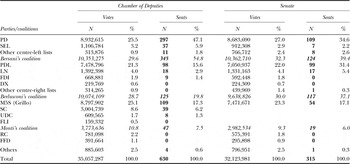
Table 1 presents the electoral results of the Chamber and the Senate. No party achieved more than 26 per cent of valid votes. Nine party lists obtained seats in the Chamber, 12 in the Senate. The centre-left coalition gained a plurality of votes in the Chamber (29.6 per cent of valid votes), and the seat bonus ensured it a majority of seats in the Chamber (340 seats out of 630). In the Senate, the centre-left coalition gained 124 seats: a number far short of the majority threshold required to govern (158). The centre-right coalition gained about 28.7 per cent of valid votes in the Chamber and 30.0 per cent in the Senate. The centre-right coalition lost the majority bonus in the Chamber by a tiny number of votes (279,167) and gained slightly fewer seats (117) than Bersani’s leftist coalition in the Senate. The coalition led by Monti barely passed the 10 per cent electoral threshold set for having representation in the Chamber. In the Senate, the Monti-led coalition won 19 seats, not enough to be pivotal for any potential centre-left or right-wing government.
Results of the Italian General Election of February 2013
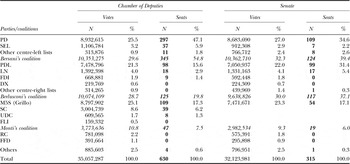
Note: PD: Democratic Party (Partito Democratico); SEL: Left, Ecology and Freedom (Sinistra, Ecologia e Libertà); PDL: People of Freedom (Popolo delle Libertà); LN: Northern League (Lega Nord); FDI: Brothers of Italy (Fratelli d’Italia); DX: The Right (La Destra); M5S: Five Star Movement (Movimento 5 Stelle); SC: Civic Choice (Scelta Civica); UDC: Centrist Democratic Union (Unione di Centro); FLI: Future and Freedom for Italy (Futuro e Libertà per l’Italia); RC: Civil Revolution (Rivoluzione Civile); FFD: Act to Stop the Decline (Fare per Fermare il Declino).
Source: http://elezionistorico.interno.it/index.php?tpel=C&dtel=24/02/2013.
To sum up, the 2013 elections resulted in a tie between the centre left, which had been predicted to win in the pre-election polls, and the centre right. The coalition led by Monti dropped to fourth place. The Five Star Movement was the indisputable winner of this election, gaining 25 per cent of the popular vote, which translated into 109 seats in the Chamber. In the Senate, the Five Star Movement won 23.3 per cent of the vote and gained 54 seats because of the disproportionate effects of the electoral system (Di Virgilio and Giannetti Reference Di Virgilio and Giannetti2014).
In all the Italian general elections between 1996 and 2008, a majority of votes and seats were won by one of the two main electoral blocs on the centre left and the centre right. As a result, the seat bonus went to coalitions that secured about 40 per cent of the popular vote. The fragmentation of party support in 2013 made it possible for the left-wing coalition to obtain the seat bonus in the Chamber with less than 30 per cent of the total vote. This process also had an important effect on the conversion of votes into seats in the Senate, making it impossible for any coalition to win a majority of seats in the Senate, and hence no one was able to form a government.
Voter turnout in 2013 at 75 per cent, although high in comparative terms, represented the lowest level of electoral participation in an Italian general election since 1946. Most commentators interpreted this record low turnout as reflecting popular disaffection with party politics in Italy. This alienation from contemporary Italian parties is also strongly evident in the changing levels of support for parties between the 2008 and 2013 general elections: one rough index of the level of vote switching between 2008 and 2013 is the fact that the total number of ‘lost votes’ (11.2 million) constituted a third of the total electorate in February 2013. This remarkably high level of volatility stems mainly from the emergence of Grillo’s political movement, which attracted more than 8.5 million votes in February 2013 to become the second largest party in the Italian Chamber.
Data And Methods
The spatial approach to party competition is grounded on the assumption that some kind of policy space can be used to describe the preferences and choices of relevant political actors. Policy dimensions can be thought of as ways of describing preferences on clusters of related issues. For instance, if preferences in economic issues such as taxation, workers’ rights and public spending are highly correlated, then we may think of these issues as being part of an underlying economic policy dimension. We use policy dimensions to describe different positions taken by political actors on them.
For example, a party that favours a strong interventionist role for the state in the economy would be regarded as holding a left-wing position on the economic policy dimension; a party which is in favour of the opposite would be regarded as a right-wing actor on the same dimension. The implementation of spatial models requires the measurement of relative distances between party positions and their movement in the policy space. In the Western political world, a widely understood ‘left–right’ dimension has been used to measure the positions and movements of political parties. In addition, two-dimensional maps of policy space have been constructed for most European countries (Benoit and Laver Reference Benoit and Laver2006).
The spatial approach is valuable because it allows us to represent party policy positions and citizens’ preferences in a common space, in order to test hypotheses about party competition and coalition government formation. In addition, it helps us to understand political change – for example, by looking at how the policy positions of political actors change over time and also how new dimensions structuring the policy space are strategically created by political actors (Riker Reference Riker1982).
A crucial requirement for testing spatial models is accurate estimates of the policy positions of political actors. Several techniques – such as mass surveys, expert surveys and content analysis of party manifestos – have been used to estimate party positions (Laver 2001). One of the most important sources of data is the Manifesto Research Group/Comparative Manifestos Project (MRG/CMP), which has been coding the electoral platforms of most parties in more than 50 countries since 1945 (Budge et al. Reference Budge, Klingemann, Volkens, Bara and Tanenbaum2001; Klingemann et al. Reference Klingemann, Volkens, Bara, Budge and McDonald2006; Volkens et al. Reference Volkens, Bara, Best and Budge2013). Here the focus will be on expert survey data. The expert survey methodology is characterized by the following features: dimensions or scales are predefined and parties are located on these scales by country experts. Estimates of party positions are the aggregated results of expert judgements. This has several advantages over other methods, as it provides more confidence in the accuracy of estimates; it is a relatively quick and costless way of gathering data and it allows us to estimate policy positions for single parties even when pre-electoral coalitions are competing (Benoit and Laver Reference Benoit and Laver2006).
This is especially important for the Italian case, because since the 1996 elections the Manifesto Research Group has coded pre-electoral coalition platforms and not single parties’ documents, which were unfortunately not available. For comparative purposes, expert survey data present some limitations. Some are related to comparison across countries, since the substantive content of dimensions can change from country to country.Footnote 2 Moreover, expert surveys are conducted at specific points in time and do not usually provide time series data (McDonald and Mendes Reference McDonald and Mendes2001). In the context of this research, these limitations are less relevant for two reasons. First, the analysis is limited to a single country. Second, previous expert survey data for Italian elections have been gathered since 2001, thereby allowing comparison across time.Footnote 3
Following the research methodology developed by Benoit and Laver (Reference Benoit and Laver2006), a survey among Italian experts was fielded in February 2013. We asked political experts to locate political parties on nine substantive policy issues, as well on the general left–right dimension using 20-point scales. The dimensions in the survey measure parties’ support for public spending vis-à-vis lower taxes (‘taxes vs. spending’), state regulation of the market (‘deregulation’), liberal policies on matters such as abortion, gay rights and euthanasia (‘social policy’), integration of immigrants (‘immigration’), environmental protection (‘environment’) and territorial decentralization of decision-making (‘decentralization’). The survey also includes three dimensions dealing with parties’ positions on specific aspects of European politics: the scope of EU intervention (‘EU authority’), its peacekeeping role (‘EU security’) and the relative powers of European institutions (‘EU accountability’).Footnote 4
Taking, for instance, the ‘taxes vs. spending’ dimension, a party that is strongly in favour of increasing public spending is located closer to point 1 on the scale, where the opposite holds for a party that is in favour of cutting taxes. Country experts were also asked to locate each party on a scale measuring the importance of the policy dimension to the party in question. This scale ranges from 1 (not important at all) to 20 (very important).
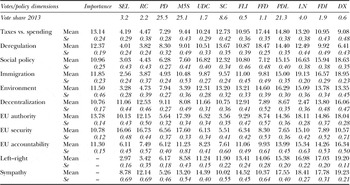
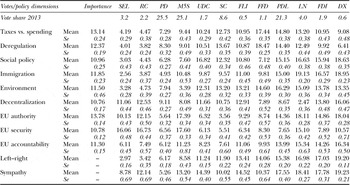
The survey was carried out in February 2013, during the parliamentary election campaign. Following Benoit and Laver (Reference Benoit and Laver2006: 125–6), we included only the politically relevant parties, selecting only the 12 parties which in February 2013 were expected to win at least 1 per cent of the vote. Our survey had more respondents than any other expert survey conducted in Italy: we sent an email invitation to 379 experts, 95 of whom completed the questionnaire, with a response rate of about 25 per cent.Footnote 5 Table 2 presents some summary data from the survey reporting the mean and the standard error of the expert placements for each party on each policy dimension.Footnote 6 In the next section, we will make use of these data to map out the relevant dimensions of party competition and the policy positions of Italian parties in the general election of February 2013.
Experts’ Placement of Italian Parties in the February 2013 General Election
A Two-Dimensional Account of The Italian Party System, 2013
In the previous section, we presented the data and methods used to measure the positions of Italian parties on a set of nine distinct policy dimensions, as well as on a general left–right scale. In this section, we will analyse this set of substantive issues in order to describe the spatial structure of party competition in Italy in the 2013 elections. We will undertake this task in two steps. First, we will use expert judgements to identify which policy dimensions are more important in Italy. Second, we will analyse the patterns of correlation between party positions on different policy dimensions revealed by the experts in order to identify the underlying axes of political competition in Italy.
The expert survey method is based on a priori decisions that identify the policy issues of potential importance in a given context. Parties attach different degrees of importance to each of these issues, and party salience scores enable us to understand which dimensions are the most relevant. We measured the overall importance score for each policy dimension in the 2013 general election by computing, for each issue, the mean of the party-specific salience scores and weighting it by the vote share received by each party. The first column of Table 2 reports the overall importance score of each dimension, as well as the associated standard error.
As Table 2 shows, the ‘EU authority’ dimension, which measures parties’ propensity to increase/reduce the set of areas subject to European intervention, was judged by our sample of experts to be the most important dimension in Italian politics during the 2013 general election. The fact that ‘EU authority’ is the top-rated policy issue indicates the importance attached by Italian parties to EU-related themes during the campaign. The policies adopted by the Monti government during 2012 created increasing tensions both between and within parties because of the austerity measures demanded by the EU. Moreover, the involvement of European institutions in Italian domestic affairs was one of the dominant themes of the 2013 election campaign. Some parties declared themselves ready, in the event of victory in the February elections, to renegotiate Italy’s position in the EU and eurozone and even to propose a referendum for abandoning the euro. Remarkably, the ‘EU authority’ dimension in 2013 received on average higher importance scores than the dimensions dealing with economic policy (‘taxes vs. spending’ and ‘deregulation’), which are the next most important policy dimensions. This indicates a strong change in the relative weight given by Italian parties to several themes in the election campaign. Indeed, past waves of expert surveys fielded in Western European countries revealed that economic issues were most often the top-rated dimensions (Benoit and Laver Reference Benoit and Laver2006).
The fourth most salient issue in the 2013 Italian elections was ‘immigration’, while ‘EU security’ and ‘decentralization’ are ranked last in overall importance.Footnote 7 The relatively low salience of the EU’s peacekeeping role, which ranks just ahead of decentralization, is surprising. Despite the recent political crises in a number of non-democratic regimes in North Africa and the Middle East, with the potential military involvement of European countries, the issue of peacekeeping operations remained one of the least salient electoral campaign themes in Italy. As far as ‘decentralization’ is concerned, the very low importance accorded by Italian experts to this issue probably reflects the marginal role played in the 2013 campaign by the Northern League: a territorial party that has traditionally been the main promoter of decentralization in decision-making.
A quick glance at the positions of the four largest Italian parties along some salient issue dimensions suggests that a single axis or policy dimension is not enough to characterize adequately the policy space in the 2013 general election. As Table 2 shows, along the ‘taxes/spending’ and the ‘deregulation’ issues Bersani’s Democratic Party and Grillo’s Five Star Movement are on the left and very close to each other. On the same dimensions, Civic Choice and the People of Freedom are both on the right and have similar positions. This picture changes if we consider the ‘EU authority’ issue. On this dimension, the Democratic Party is quite far from the Five Star Movement, and the People of Freedom is well away from Civic Choice. In both cases, the distance is as much as 11 points. In particular, the Democratic Party is on the pro-integration side and very close to Monti’s Civic Choice, the party that is most in favour of increasing European intervention in domestic Italian politics. In turn, the People of Freedom is placed just three points away from the Five Star Movement, which is among one of the most anti-EU parties. In other words, these three policy dimensions, which prove to be the most important for Italian parties in 2013, are not related to the same underlying axis of competition. Although two of them deal with economic policy and are clearly correlated, they do not seem to be linked to the ‘EU authority’ issue, and this implies a need for a multidimensional description of the Italian policy space.
We identify and measure the key axes of political competition in Italy by using principal components factor analysis, a statistical ‘data reduction’ technique that allows us to describe the variability among a large set of observed variables in terms of a few unobserved underlying or latent factors.Footnote 8 Each of the extracted factors can then be substantively interpreted by looking at those original variables that correlate (or ‘load’) onto each factor estimated. If some of our nine policy dimensions load highly on a single factor, we can say that the factor summarizes well parties’ placements on those dimensions, and hence we can ‘replace’ that set of policy dimensions with a more fundamental or latent axis of political competition.
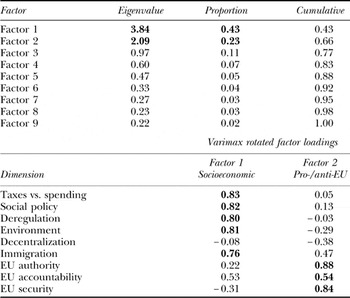
The results of the factor analysis applied to the experts’ placements of Italian parties indicate that the full set of the nine policy dimensions identified for Italy can be reduced to two primary axes of competition. As the top panel of Table 3 shows, for only two latent factors the eigenvalue is greater than 1, and this implies that the competition among Italian parties in the 2013 elections can be described in a two-dimensional political space.Footnote 9 From the last column of the top panel, we see that these two factors account for about 66 per cent of the total variance in Italian party positions on all the nine original policy dimensions.
Dimensional Analysis of the 2013 Italian Policy Space
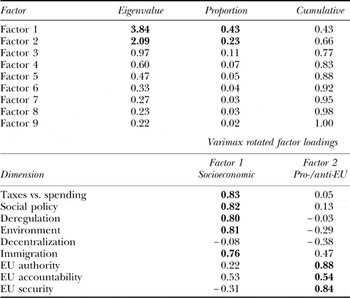
Note: Principal component factor analysis weighted by the vote share received by each party, N=684; parameters=17, Variable loadings higher than 0.5 are in bold, except when the variable has a higher loading on another factor.
The first and most important factor emerging from the analysis explains 43 per cent of the variance observed across the nine policy issues and can be interpreted as reflecting the socioeconomic left–right dimension. As reported in the bottom panel of Table 3, this factor is associated with a wide range of policy issues: two dimensions dealing with economic policy (‘taxes/spending’ and ‘deregulation’), two dimensions tapping social liberalism vs. conservatism (‘social policy’ and ‘immigration’), as well as environmental policy. All of these issues exhibit high loadings on factor 1.
Therefore, we may conclude that in Italy parties on the left prefer public spending rather than tax reduction, are in favour of state intervention in the economy, prioritize environmental protection, are liberal on moral issues and promote the integration of immigrants. In contrast, parties on the right tend to have anti-taxation positions, oppose state regulation, support economic growth even at the cost of damaging the environment, are conservative on moral issues and are against immigration.
The second factor identified in the factor analysis is associated with the three dimensions related to European politics, and accounts for approximately 23 per cent of the total variance observed. This factor can thus be easily interpreted as capturing the attitude of Italian parties towards the EU and can be labelled ‘pro-/anti-EU’ policy. Pro-EU parties are in favour of greater EU authority over domestic politics and greater involvement of Italy in European military security and would like to strengthen the European Parliament vis-à-vis national governments. On the other hand, anti-EU parties oppose further European integration and involvement in EU security, and would give more powers to national governments rather than to a supra-national institution like the European Parliament.
The emergence of a distinct pro-/anti-EU axis of political competition represents a major change from the past. None of the expert surveys estimates revealed a distinct pro-/anti-EU axis in the recent Italian general elections (2001, 2006 and 2008). In all previous elections, ‘EU authority’ and ‘EU accountability’ were highly correlated with other policy dimensions and were incorporated into the socioeconomic left–right axis, which constituted the first factor. In 2001 and 2006 the ‘EU security’ issue represented a third factor following left–right and decentralization/deregulation. Later, in 2008, ‘EU security’ was associated with decentralization/deregulation and formed part of the second most important factor.Footnote 10 In 2013, attitudes towards the EU became a primary political axis of competition on their own, orthogonal to socioeconomic policy.
Such a change is not so surprising if we consider the crisis in the eurozone (starting in 2008) and its dramatic consequences on Italian economy and politics. Previous research, in fact, has underlined the importance of economic motivations – together with national and local identities – in explaining most of the variation in public attitudes towards Europe (Gabel Reference Gabel1998; Hooghe and Marks Reference Hooghe and Marks2005). This instrumental relationship has proved to be particularly strong in Italy, where the idea of Europe seems to be mainly associated with material benefits (Bellucci et al. Reference Bellucci, Sanders and Serricchio2012). In this sense, the euro crisis has weakened popular enthusiasm for the EU in Italy.Footnote 11 Undoubtedly, this change in public opinion has had consequences on party competition. In 2013, we find strong anti-EU attitudes on both the centre left (Five Star Movement) and on the centre right (People of Freedom) of the Italian party system, subverting the well-known ‘inverted U-curve’: traditionally opposition to the EU was confined to the extreme left and right (Hooghe et al. Reference Hooghe, Marks and Wilson2002).
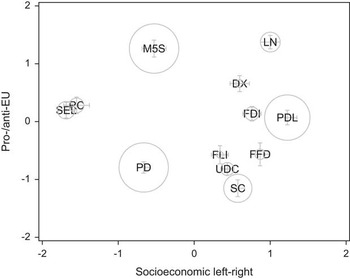
Having identified the underlying structure of the policy space in the 2013 Italian election, we estimated parties’ positions on the two main dimensions of competition. Figure 1 presents a two-dimensional map of this policy space. The horizontal axis corresponds to socioeconomic left–right policy (factor 1), while the vertical axis represents pro-/anti-EU policy (factor 2). We estimated each party’s position, as shown in Figure 1, using mean regression scores from factor analysis. Horizontal and vertical bars represent the 95 per cent confidence intervals for the mean estimates, while the size of each bubble reflects each party’s vote share.
A Two-Dimensional Map of the Italian Policy Space in February 2013 Note: The size of the markers varies according to party vote share. Horizontal and vertical lines represent 95 per cent confidence intervals.
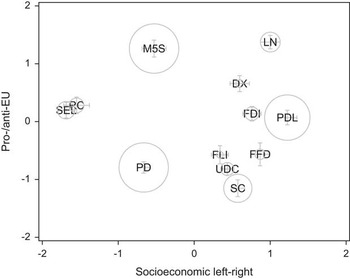
Figure 1 shows that the two largest parties, the Democratic Party and Five Star Movement, are very close on the socioeconomic left–right: the overlapping confidence intervals reveal they have an indistinguishable common left–right position. In contrast, both parties are far apart on the pro-/anti-EU axis. The third largest party, the People of Freedom, has an intermediate position on EU policy, but is far to the right on socioeconomic issues. Monti’s Civic Choice party is on the right on the socioeconomic axis and clearly pro-EU on the second dimension, whereas Left, Ecology and Freedom and the Civil Revolution are located on the extreme left and are somewhat opposed to European integration. The remaining small parties are on the right in socioeconomic terms, but are divided in their orientation towards the EU.
A Spatial Analysis of Potential Coalition Governments After The 2013 General Election
Estimating parties’ policy positions is an important methodological task, central to the spatial analysis of the process of coalition government formation. Earlier formal models of coalition formation assume that political parties and their leaders are rational actors that try to maximize their share of office rewards. Starting from these assumptions, office-seeking models elaborate a series of propositions about coalition formation in multiparty systems which are essentially based on the relative size (seats) of those parties involved in coalition bargaining (von Neumann and Morgenstern Reference von Neumann and Morgenstern1944; Riker Reference Riker1962; Leiserson Reference Leiserson1966).
A second generation of models assumes that government coalitions will be formed between actors with similar ideological backgrounds (de Swaan Reference de Swaan1973). When parties compete on a single ideological dimension, policy-based models predict that the party controlling the median legislator will have a bargaining advantage in government negotiations, since there are no other proposals in the policy space that can defeat the median legislator’s position through a majority vote. However, empirical analysis of multiparty systems suggests that coalition formation may be better analysed using a two-dimensional rather than a uni-dimensional account of the policy space (Laver and Schofield Reference Laver and Schofield1990).
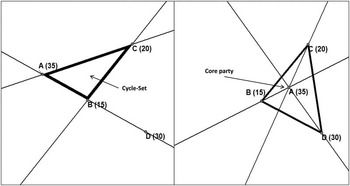
Within the two-dimensional approach, the political heart model developed by Schofield (Reference Schofield1993, Reference Schofield1995) takes into account both party size (seats) and policy position. The model gives specific predictions about coalition formation based on the notion of the ‘political heart’. The political heart is the union of the ‘core’ and the ‘cycle-set’. A ‘core party’ is one that occupies a strategic position in the policy space that cannot be defeated in a majority vote. In a two-dimensional space a core party will exist only when all the median lines intersect at one party’s ideal point. In general, only the largest party in a parliament can be a core party. When the median lines do not intersect at one point in the policy space the core is said to be empty. In this situation, the process of coalition formation will be characterized by instability. However, cycles do not span the entire political space, but are confined to the area enclosed by the intersection of the median lines which is known as the ‘cycle-set’. Assuming that no policy proposals will be made that make all members of a majority coalition worse off, the cycle-set contains all the points in the policy space that are Pareto optimal for every possible majority coalition.
For clarification, consider Figure 2, which describes parties’ size and policy positions in two hypothetical four-party systems. The lines represented in the figure are known as median lines. Each line has the property that ‘either on or to one side of it can be found parties that between them compose a legislative majority’ (Laver and Shepsle Reference Laver and Shepsle1996: 115). The line A–C in the left panel, for example, defines a majority holding 55 seats (A + C) on or above the line, while coalitions of parties holding 80 (A + B + D) or 65 (C + B + D) lie on or below the line. The same holds for all the other median lines.
The Political Heart Model: Cycle-set and Core Party Source: Curini and Pinto (Reference Curini and Pinto2013).
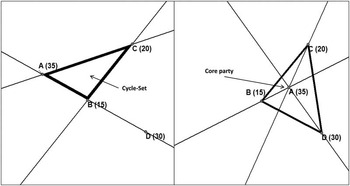
As noted earlier, when the core is empty – as shown in the left panel of Figure 2 – the political heart model predicts that instability will be confined to an area defined as the cycle-set, here delimited by parties A, B and C. The cycle-set can be interpreted as ‘the centre of gravity’ of a legislature: any point outside this area is pulled towards it by majority voting. For example, if a policy were proposed by D, the majority on or to the left of the C–B median line would prefer a point in the area delimited by A, B and C. It follows that a government should be formed by a combination of these parties, which can be considered dominant players, in contrast to those outside the cycle-set (Debus Reference Debus2008; Schofield Reference Schofield1995, 1996).
Conversely, in the right panel of Figure 2 we see that party A has moved to the right. Now all the median lines intersect at this party ideal point, which constitutes a core. B, C and D – the only majority that excludes A – cannot agree on any single policy without including A. In such a situation, negotiations among all parties will end either with a single-party cabinet formed by the core party, or with a coalition government that includes the core party where the latter’s ideal point is the coalition policy programme (Laver and Schofield Reference Laver and Schofield1990; Schofield Reference Schofield1995).
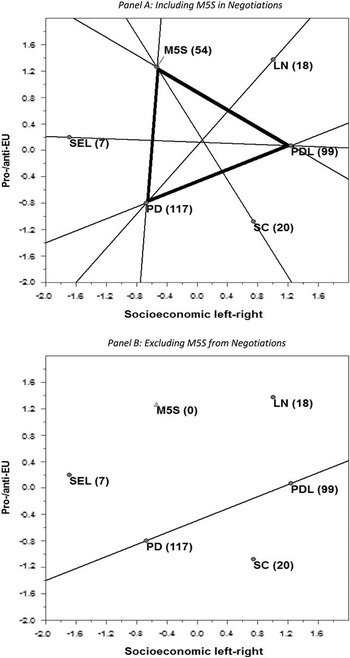
The political heart model is a powerful analytical tool in the study of coalition politics.Footnote 12 Here we use the political heart model in order to shed light on the government-formation process that followed the Italian general elections of February 2013. Panel A of Figure 3 presents the spatial map of parties’ policy positions. Party positions are represented as points in this space, while the seats each party holds in the Senate are reported in parentheses.Footnote 13 We focus on the Senate because no coalition had the majority of seats required to form a government (see above).
The Political Heart in the Italian Senate, February 2013
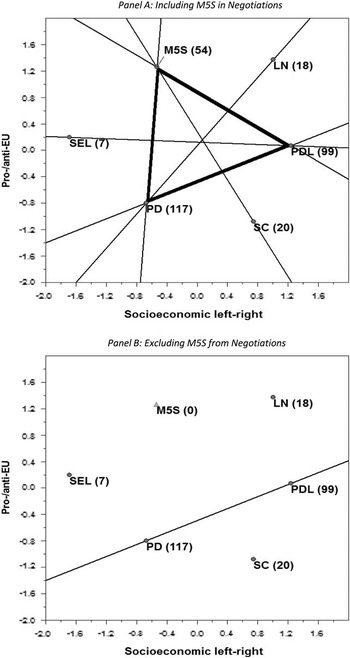
As we can see, the core is empty, since the median lines do not intersect at a single party ideal point. However, the model allows us to predict that the solution for the government-formation game will be found in one of the combinations of parties delimiting the cycle-set. The Democratic Party, the People of Freedom and the Five Star Movement can be considered dominant players in government negotiations, while parties outside the region delimited by the median lines (Civic Choice, the Northern League and Left, Ecology and Freedom) are peripheral to the coalition-formation game. Therefore, the Italian government after the general elections of February 2013 should be formed by one of the following party combinations: (1) the Democratic Party and the Five Star Movement, possibly with the support of Left, Ecology and Freedom; (2) the Democratic Party and People of Freedom, possibly with the inclusion of Civic Choice; or (3) People of Freedom and the Five Star Movement, with the support of the Northern League. Hence, this theoretical account depicts three scenarios.Footnote 14
The first one, which we can refer to as the ‘government of change’, was the path taken by the secretary of the Democratic Party, Bersani, appointed as a formateur by the president of the Republic, Napolitano, a few days after the elections. Bersani’s project to build a government majority based on eight programmatic points promoting big change in Italian social and public life failed because the Five Star Movement (with a different vision of change) refused to participate in any government. The second scenario, which commentators named ‘governissimo’, was the revival of the majority that supported Monti’s technocratic government. The third option was a coalition composed of People of Freedom and the Five Star Movement, with support from the Northern League. This unprecedented combination includes the parties that most contested the authority of the EU. Hence, we can refer to this scenario as the ‘government of the Eurosceptics’.
Predictions from the political heart model are based exclusively on parties’ size and policy positions. However, an analysis of coalition politics may also benefit from taking into account important behavioural and institutional constraints (Debus Reference Debus2008, Reference Debus2009). Among the behavioural constraints taken into account here are pre-electoral commitments to govern together and anti-pact rules such as ‘party combinations that are rejected a priori by at least one party that participates in the potential coalition’ (Debus Reference Debus2009: 47). Due to the importance given to credibility, these statements, which are usually public, constitute a powerful constraint on coalition bargaining (Golder Reference Golder2006; Martin and Stevenson Reference Martin and Stevenson2001; Strøm et al. Reference Strøm, Budge and Laver1994). These behavioural constraints to coalition formation allow us to rule out the first and third scenarios predicted by the political heart model.
Turning now to institutional constraints, Italy’s symmetric bicameralism requires an investiture vote in both chambers. In 2013 all coalitions had to necessarily include the Democratic Party, which was the largest party in the Chamber of Deputies, holding about 47 per cent of the seats. Hence, the ‘government of the Eurosceptics’ did not survive as a feasible option. The same fate befell the ‘government of change’. A coalition between the Democratic Party and the Five Star Movement was not viable because of Grillo’s refusal to take part in any coalition that included parties linked to ‘old politics’. This statement, made public before the elections, may be interpreted as an anti-pact directed against all parties in the parliament. Once the Five Star Movement was excluded from any potential coalition, the only feasible option suggested by the political heart model remains the ‘governissimo’ between the Democratic Party and the People of Freedom as Panel B of Figure 3 shows. Excluding the Five Star Movement from the set of potential negotiators results in only one median line connecting the ideal points of the other two largest parties in parliament. This is the coalition government that actually formed in Italy on 30 April 2013.
Party leaders reached an agreement over government formation after 61 days. The Democratic Party and the People of Freedom, which had represented the centre left and the centre right in Italy in the past two decades, relabelling themselves several times, were traditional enemies. This might explain why the Democratic Party leader Bersani, appointed as a formateur, spent several days exploring the possibility either of obtaining the support of the Five Star Movement or of forming a government without a majority of seats in the Senate.
It should be noted that the process of government formation was compounded by the election of the president of the Republic, scheduled for 15 March. The process of electing the head of state resulted for the first time in the reappointment for a seven-year second term of incumbent President Napolitano, after other candidates who had been proposed jointly or unilaterally by parties failed to receive enough votes in parliament. After re-election, Napolitano nominated Enrico Letta, vice secretary of the Democratic Party, as a formateur. Letta worked to build an alliance between the Democratic Party and the People of Freedom and was able to form a government including ministers from the Democratic Party, the People of Freedom, Civic Choice, plus several independents.
The government obtained the full support of Monti’s Civic Choice party and for this reason can be categorized as a surplus or oversized coalition. The inclusion of this party, not strictly predicted by the political heart model, might be understood in terms of two intraparty political considerations (Giannetti and Benoit Reference Giannetti and Benoit2009). First, the newborn Civic Choice formed by Monti just two months before the elections included, among others, former members of both the Democratic Party and the People of Freedom. Second, the Democratic Party was deeply divided over its coalitional strategies in the aftermath of the 2013 election.Footnote 15 This implies that full parliamentary support for government legislative provisions was not guaranteed from the start, suggesting that any prospective prime minister might have to rely on a wider parliamentary majority. The government passed the investiture vote with 453 for, 153 against and seven abstentions in the Chamber. In the Senate the government passed the investiture vote with 233 for, 59 against and 18 abstentions. The Democratic Party, the People of Freedom and Civic Choice voted in favour and the Five Star Movement and Left, Ecology and Freedom parties voted against. The Northern League abstained in both the Chamber and in the Senate.
To summarize, the theoretical and empirical arguments above allowed us to identify the potential coalition governments in the aftermath of the 2013 general election. According to the political heart model, three coalition governments were predicted. Institutional and behavioural constraints contributed towards explaining why the coalition government including the two largest parties on the left and on the right was the one that actually formed.
Conclusion
An analysis of party competition requires reliable estimates of the policy positions of key political actors. In this article we presented original data from an expert survey conducted by the authors immediately before the Italian 2013 election. Our survey provides updated information on Italian parties’ policy positions in a standard format which can be easily used for systematic intra- and cross-country comparison.
By using these data, we were able to describe the most important dimensions that structured party competition in 2013 and to locate political parties in a two-dimensional political space, where the main axes are the pro-/anti-Europe and the socioeconomic left–right dimensions. As our analysis shows, the dominance of a pro-/anti-EU dimension in 2013 represents a major change from the past.
Moreover, our work based on expert survey data provided a theoretically grounded account of the process of government formation in the aftermath of the 2013 elections. Most commentators portrayed the coalition between the centre left and the centre right as a ‘marriage of necessity’ imposed by the president of the Republic in order to deal with a deep institutional and economic crisis. In contrast, our analysis shows that the outcome of the government-formation process can be explained in terms of the structure of coalition bargaining and the impact of behavioural and institutional constraints.
ACKNOWLEDGEMENTS
We thank Kenneth Benoit and Michael Laver for their help in conducting the survey. In addition, we thank the Italian Political Science Association (SISP) and its members for their support. We also gratefully acknowledge the comments of three anonymous referees. Data are available from the authors upon request.
Supplementary Material
To view supplementary material for this article, please visit http://dx.doi.org/10.1017/gov.2014.15.