Introduction
Broomrapes form a large group of root holoparasites, that is obligate parasitic plants adapted to acquire resources from the vascular system of autotrophic host plants. Among these holoparasites, a few Orobanche and Phelipanche species have become major arable weeds, damaging crop production, thereby causing significant economic damage worldwide (Parker, Reference Parker2009). Some of these problematic broomrapes are generalist parasitic weeds characterized by a broad host range, particularly Phelipanche ramosa (L.) Pomel (syn. Orobanche ramosa L.; Joel, Reference Joel2009) known to parasitize many species from different plant families (Parker, Reference Parker2009; Gibot-Leclerc et al., Reference Gibot-Leclerc, Perronne, Dessaint, Reibel and Le Corre2016; Perronne et al., Reference Perronne, Gibot-Leclerc, Dessaint, Reibel and Le Corre2017).
However, suboptimal developments of P. ramosa are observed on numerous host species, suggesting host specificities. These host specificities seem to depend on the compatibility between P. ramosa and the host due to a specific recognition mechanism based on chemical signalling. Indeed, from the first phenological stage of seed germination, host recognition appears particularly critical because the haustorium, that is the organ invading the host and forming a physical bridge between plants, must be fixed within a few days after germination to allow the survival and growth of the parasitic plant (Yoshida et al., Reference Yoshida, Cui, Ichihashi and Shirasu2006; Kokla and Melnyk, Reference Kokla and Melnyk2018; Clarke et al., Reference Clarke, Timko, Yoder, Axtell and Westwood2019). This crucial stage of seed germination is a two-step process, first requiring a conditioning period initiated by seed imbibition under suitable environmental conditions during which seeds will not germinate in response to favourable stimuli, and then a period during which seeds become sensitive to germination stimulants, that is exogenous chemicals exuded by surrounding host roots (Auger et al., Reference Auger, Pouvreau, Pouponneau, Yoneyama, Montiel, Le Bizec, Yoneyama, Delavault, Delourme and Simier2012; Brun et al., Reference Brun, Braem, Thoiron, Gevaert, Goormachtig and Delavault2018). Concerning P. ramosa, two main classes of germination stimulants, strigolactones and isothiocyanates, can induce the seed germination (Fernández-Aparicio et al., Reference Fernández-Aparicio, Yoneyama and Rubiales2011; Auger et al., Reference Auger, Pouvreau, Pouponneau, Yoneyama, Montiel, Le Bizec, Yoneyama, Delavault, Delourme and Simier2012; Wang and Bouwmeester, Reference Wang and Bouwmeester2018; Brun et al., Reference Brun, Thoiron, Braem, Pouvreau, Montiel, Lechat, Simier, Gevaert, Goormachtig and Delavault2019). Moreover, the rate of induction of seed germination of P. ramosa is known to greatly differ between host species of different families, different genera, within different species in a same genus as well as between varieties within a crop (Zehhar et al., Reference Zehhar, Labrousse, Arnaud, Boulet, Bouya and Fer2003; Fernández-Aparicio et al., Reference Fernández-Aparicio, Flores and Rubiales2009; Gauthier et al., Reference Gauthier, Véronési, El-Halmouch, Leflon, Jestin, Labalette, Simier, Delourme and Delavault2012; Gibot-Leclerc et al., Reference Gibot-Leclerc, Perronne, Dessaint, Reibel and Le Corre2016; Perronne et al., Reference Perronne, Gibot-Leclerc, Dessaint, Reibel and Le Corre2017).
Moreover, these host specificities can also be related to genetic differences between P. ramosa populations, also named pathovars (Le Corre et al., Reference Le Corre, Reibel and Gibot-Leclerc2014; Stojanova et al., Reference Stojanova, Delourme, Duffé, Delavault and Simier2019). Thus, the biological life cycle of P. ramosa, the seasonal variation in the dormancy and mortality of the seeds, the aggressiveness of this parasitic plant as well as its germination success can greatly differ between populations of P. ramosa harvested on different host crops (Brault et al., Reference Brault, Betsou, Jeune, Tuquet and Sallé2007; Gibot-Leclerc et al., Reference Gibot-Leclerc, Dessaint, Reibel and Le Corre2013; Pointurier et al., Reference Pointurier, Gibot-Leclerc, Le Corre, Reibel, Strbik and Colbac2019; Stojanova et al., Reference Stojanova, Delourme, Duffé, Delavault and Simier2019).
However, to our knowledge, no study has investigated whether differences in germination rates of P. ramosa seeds may depend on seed origin (particularly the host species infested), that is that different pathovars of P. ramosa may appear more or less sensitive to different concentrations of the same germination stimulant.
To test this hypothesis, we used two P. ramosa populations harvested on two major host crops: tobacco, a long-known host of P. ramosa (Brault et al., Reference Brault, Betsou, Jeune, Tuquet and Sallé2007), and oilseed rape, a new preferred host with a massive expansion in France since the beginning of the 1990s (Gibot-Leclerc et al., Reference Gibot-Leclerc, Sallé, Reboud and Moreau2012). For each population, we stimulated seed germination with different concentrations of the synthetic germination stimulant GR24 (Mangnus et al., Reference Mangnus, Dommerholt, De Jong and Zwanenburg1992a). These in vitro experiments are widely considered as a standard in parasitic research to assess the optimal germination rate of several root holoparasite species, including P. ramosa (Mangnus et al., Reference Mangnus, Stommen and Zwanenburg1992b; Gibot-Leclerc et al., Reference Gibot-Leclerc, Corbineau, Sallé and Côme2004). Based on the rational above, we addressed a set of questions:
(1) What is the sensitivity of the two P. ramosa populations to the GR24 germination stimulant concentrations and does this sensitivity to the germination stimulant differ between these populations?
(2) How the germination speed differs between P. ramosa populations for the different GR24 concentrations tested?
(3) How the maximum germination rate varies between P. ramosa populations?
Material and methods
Seed material
Seeds of P. ramosa were collected from natural populations within highly infested arable fields of winter oilseed rape (population R) in 2012 (45°56′41.363″N, 0°31′3.947″W; Saint-Jean-d'Angély) and of tobacco (population T) in 2017 (45°53′38.908″N, 0°0′36.803″E; Aigre) located in the Nouvelle-Aquitaine region. These populations can be genetically differentiated, with seeds from one oilseed rape field belong to the genetic group named ‘Genetic group 1’ comprising populations able to infest winter oilseed rape (Stojanova et al., Reference Stojanova, Delourme, Duffé, Delavault and Simier2019), and seeds from one tobacco field belong to a distinct genetic group named ‘Genetic clust 05’ comprising populations able to infest tobacco. All seeds were kept in watertight glass containers at approximately 20°C until the beginning of the experiments.
Seed conditioning treatments and seed viability determination
Before any in vitro experiment, P. ramosa seeds were surface disinfected under a laminar flow hood by a 5-min immersion in 70% ethanol, followed by a 5-min immersion in a solution of Ca(OCl)2 at 3% (p/v) and Tween 20 (0.1%) to limit fungal spread (Gibot-Leclerc et al., Reference Gibot-Leclerc, Sallé, Reboud and Moreau2012). They were then rinsed five times with twice-distilled water. After disinfection, seeds of P. ramosa were placed on a Whatman® GF/A paper sheet (Ø 90 mm) at the bottom of a Petri dish (Ø 90 mm) and hydrated with 3 ml sterile distilled water. Petri dishes were sealed with Parafilm® (American Can Company), wrapped in aluminium foil and placed in a dark growth chamber, at 20°C during 14 d, to condition P. ramosa seeds and thus make them susceptible to germination stimulants (Gibot-Leclerc et al., Reference Gibot-Leclerc, Corbineau, Sallé and Côme2004).
Moreover, tests performed prior to the seed germination assay using 2,3,5-triphenyl tetrazolium chloride (TTC) were made to ensure the viability of seed lots of P. ramosa following the procedure described in Gibot-Leclerc et al. (Reference Gibot-Leclerc, Corbineau, Sallé and Côme2004). The viability of seed lots was high, ranging from 87 to 97%.
Seed germination assay
The germination experiment started on February 2018. After conditioning, P. ramosa seeds were moistened with 2 ml of the germination-triggering strigol analogue GR24 (provided by Dr. Binne Zwanenburg, Radboud University, Nijmegen, the Netherlands) at various concentrations. A preliminary analysis indicated that the sensitivity of the two P. ramosa populations to GR24 was different. To optimize the estimation of parameters of the cumulative germination curves based on equations defined below, we have, therefore, adjusted the concentration ranges of GR24. Eleven concentrations of GR24 to the population R (10−10, 10−9, 10−8, 10−7, 10−6, 10−5, 10−4, 10−3, 10−2, 10−1 and 1 mg l−1) and 12 concentrations of GR24 to the population T (10−6, 10−5, 10−4, 10−3, 2 × 10⁻³, 4 × 10⁻³, 6 × 10⁻³, 8 × 10⁻³, 10−2, 10−1, 1, 10 mg l−1) were tested, as well as a control without GR24 for both populations. For preparing these solutions, 1 mg of GR24 was dissolved in 1 ml of acetone and then diluted in distilled water to obtain the appropriate concentrations. The Petri dishes were placed at 20°C in darkness. One Petri dish was prepared for each GR24 concentration and each P. ramosa population. Each Petri dish contains on average 290 ± 85 (mean ± SD) seeds for population R and on average 192 ± 42 seeds for population T. The cumulative number of germinated seeds of P. ramosa was counted 3, 4, 5, 6, 7 and 10 d after application of the treatment condition using a stereoscopic microscope (1.95–250×). A seed was considered germinated when the radicle had pierced the seed coat.
Statistical analyses
Cumulative germination curves were analysed using a three-parameter log-logistic model and a time-to-event approach (Onofri et al., Reference Onofri, Gresta and Tei2010; Ritz et al., Reference Ritz, Pipper and Streibig2013). In this approach, characterizing the temporal pattern of germination of P. ramosa seeds, we have modelled the time taken by a seed to germinate.
The three-parameter log-logistic equation used is as follows, according to Ritz et al. (Reference Ritz, Pipper and Streibig2013):
 $$F( t ) = \displaystyle{{G_{{\rm max}}} \over {1 + {\rm exp}[ {b\log ( t ) -{\rm log( }t_{50}) } ] }}$$
with b, the slope around the inflexion point, G max the proportion of germinated seeds at the end of the experiment (higher asymptote, also named upper limit parameter d) and t 50, the median time (also named inflexion point), that is the time to have 50% of the maximum germination (G max/2). In this model, it was assumed that the lower asymptote was equal to 0. The time-to-event approach accounts for particular features characterizing the type of data, that is right-censored observations and monitoring intervals (Ritz et al., Reference Ritz, Pipper and Streibig2013). In our study, the concentrations of GR24 tested differing partially between the populations R and T, and the time-to-event approach was carried out separately for each population. The fitted models were furthermore used to derive the germination time for the 10th, 20th, 30th and 50th percentiles (thereafter named T10, T20, T30 and T50) of the total seed population. The choice of using different percentiles was based on the fact that in our study, the G max differed widely among GR24 concentrations and in several cases, G max was thus lower than 50%. All analyses were made with R version 4.0.2 (R Core Team, 2020) and the drc package version 3.0-1 (Ritz et al., Reference Ritz, Baty, Streibig and Gerhard2015).
Results
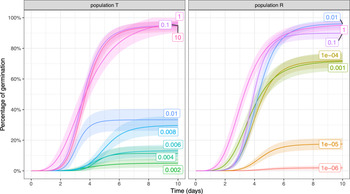
No seed germination of P. ramosa was observed for the control without GR24, as well as for concentrations of GR24 lower than or equal to 10−3 mg l−1 for population T (tobacco) and 10−7 mg l−1 for population R (oilseed rape). In the following, only the concentrations of GR24 that induced seed germinations are shown as cumulative germination curves (Fig. 1). Moreover, for both populations and the various concentrations retained, all parameters of the three-parameter log-logistic model were significantly different from 0 (p < 0.001).
Time-to-event approach of seed germination for P. ramosa population T (left) and population R (right). Cumulative fitted germination curves, and estimated 95% confidence interval based on the time-to-event model.

Concerning population T, the concentrations of GR24 ≥ 0.1 mg l−1 induced a maximum percentage of germinated seeds 10 d after application (G max) higher than 90%, while for lower concentrations, G max was consistently lower than 50% (Table 1, Fig. 1). Moreover, the time required to reach 50% of the maximum germination (t 50) ranged between 3.5 and 3.7 d for the concentrations of GR24 ≥ 0.1 mg l−1, while more than 4 d for the concentrations of GR24 < 0.01 mg l−1 (Table 1). The 0.01 mg l−1 GR24 concentration exhibited an intermediate result with a G max value close to that of lower concentrations and a t 50 close to that of higher concentrations (Table 1). For concentrations of GR24 < 0.1 mg l−1, the time required to reach the 10th, 20th and 30th percentiles (T10, T20 and T30) of the total seed population was longer than for higher concentrations tested (Table 1). Moreover, T50 could not be calculated for concentrations of GR24 < 0.1 mg l−1, but appeared quite similar to t 50 for concentrations of GR24 ≥ 0.1 mg l−1.
Germination time (d, with 95% IC in brackets) for different percentiles (T10, T20, T30 and T50 calculated on the total seed population) and t 50 (the median time, that is the time to have 50% of the maximum germination G max), and G max (the percentage of germinated seeds of P. ramosa at the end of the experiment, that is 10 d) for population T (top) and population R (bottom). More details about the parameters in the main text

Concerning population R, the concentrations of GR24 ≥ 0.01 mg l−1 induced a G max higher than 90%, and the concentrations ≥10−4 mg l−1 a G max higher than 70%, while only the lowest concentrations of GR24 tested induced less than 20% of germinated seeds 10 d after application (Table 1, Fig. 1). Moreover, the median time (t 50) showed a decreasing trend between 10−6 and 10−3 mg l−1, followed by an increase for 10−2 mg l−1, and then a further decrease (Table 1). The lowest median time was reached for the highest concentration of GR24 tested (Table 1). For concentrations of GR24 < 0.01 mg l−1, the time required to reach the 10th, 20th, 30th and 50th percentiles (T10, T20, T30 and T50) of the total seed population were often longer than for higher concentrations tested, with however several exceptions (Table 1). As for population T, T50 appeared quite similar to t 50 for concentrations of GR24 ≥ 0.01 mg l−1.
Discussion
No germination of P. ramosa seeds was observed either in the absence, or at too low concentrations of the germination stimulant, confirming that the induction of seed germination of this parasitic plant requires a minimum concentration of stimulant, in accordance with previous studies (Gibot-Leclerc et al., Reference Gibot-Leclerc, Corbineau, Sallé and Côme2004; Fernández-Aparicio et al., Reference Fernández-Aparicio, Yoneyama and Rubiales2011; Matusova et al., Reference Matusova, Kullacova and Tóth2014; Huet et al., Reference Huet, Pouvreau, Delage, Delgrange, Marais, Bahut, Delavault, Simier and Poulin2020). In our study, following a conditioning period, the germination of P. ramosa seeds was induced by concentrations of GR24 as low as 10−6 mg l−1, comparable to GR24 concentrations observed in other studies (Fernández-Aparicio et al., Reference Fernández-Aparicio, Yoneyama and Rubiales2011; Matusova et al., Reference Matusova, Kullacova and Tóth2014), although lower concentrations can also induce germination (Huet et al., Reference Huet, Pouvreau, Delage, Delgrange, Marais, Bahut, Delavault, Simier and Poulin2020). Moreover, we highlighted a marked difference in sensitivity to the germination stimulant between the two P. ramosa populations studied, the P. ramosa seeds of the R (oilseed rape) population appearing more sensitive to GR24 than the P. ramosa seeds of the T (tobacco) population by a factor 104. P. ramosa populations are well known to be characterized by highly variable germination rates between host species. Thus, Gibot-Leclerc et al. (Reference Gibot-Leclerc, Perronne, Dessaint, Reibel and Le Corre2016) showed that in the Brassicaceae family, the germination rate of P. ramosa depends on the origin of the seeds (oilseed rape or tobacco) and host species with germination rates higher than its crop hosts depending of the species, a similar pattern being observed in the Fabaceae family (Perronne et al., Reference Perronne, Gibot-Leclerc, Dessaint, Reibel and Le Corre2017). The marked difference in sensitivity to a germination stimulant could, therefore, be due to the ability of P. ramosa to produce seeds able to infest and develop on different hosts during the crop sequence. In poorly diversified crop consequences (i.e. tobacco monoculture or rapeseed-wheat rotation), this ability can result in the selection of populations that are highly adapted to the crop, as observed on other parasitic plants (Dor et al., Reference Dor, Plakhine, Joel, Larose, Westwood, Smirnov, Ziadna and Hershenhorn2020).
The median time (t 50) also differed both within and between P. ramosa populations under the different GR24 concentrations tested, a result confirmed by calculating the germination time for different percentiles of the total seed population (T10, T20, T30 and T50) when possible. For these two calculation methods, the germination speed appears high at the higher concentrations of GR24 tested and overall low at lower concentrations for both P. ramosa populations, although values do not change monotonically with the level of GR24 concentration. Moreover, the germination speed partly differed between the two P. ramosa populations for a similar GR24 concentration, for example from around 3.7 d for population T to around 3.3 d for population R at 1 mg l−1, even though at these high concentrations, values of t 50 and T50 were broadly similar. At concentrations higher than 0.1 mg l−1, for which the maximum germination rate was higher than 90% for both P. ramosa populations, the germination speed always seemed to be less than 4 d. A fast germination appears particularly crucial for P. ramosa because, in the absence of fixation on host roots, P. ramosa seeds degenerated and died within a few days (Gibot-Leclerc et al., Reference Gibot-Leclerc, Sallé, Reboud and Moreau2012), thus potentially explaining faster germination at high concentrations.
For both P. ramosa populations and all GR24 concentrations, the germination rate reached a maximum before the end of the experiment (10 d). For high GR24 concentrations, the germination percentage was around 90%. These results are in accordance with previous dose-response studies showing that P. ramosa seeds reach a higher asymptote, frequently higher than 90%, in response to GR24 (Gibot-Leclerc et al., Reference Gibot-Leclerc, Corbineau, Sallé and Côme2004; Matusova et al., Reference Matusova, Kullacova and Tóth2014; Huet et al., Reference Huet, Pouvreau, Delage, Delgrange, Marais, Bahut, Delavault, Simier and Poulin2020). For low GR24 concentrations, the maximum germination rate was lower, to be compared to a viability of seed lots ranging from 87 to 97% in our study, suggesting that the remaining viable seeds are no longer stimulated by GR24. Moreover, the maximum germination can greatly differ between the two P. ramosa populations for a similar GR24 concentration, for example from 33% for population T to 96% for population R at 0.01 mg l−1. These differences were also observed by Matusova et al. (Reference Matusova, Kullacova and Tóth2014) between two geographically distinct P. ramosa populations harvested from different host crops. Our observations of a higher asymptote (G max) differing between concentrations of the germination stimulant for the same P. ramosa population, or between P. ramosa populations for a same GR24 concentration, suggest a response to a limiting factor for which the minimum level to reach a high maximum germination rate is variable between populations. This suggestion might be consistent with the hypothesis that the strigolactone receptor of parasitic plants could use a mode of signal perception involving the hydrolysis of the bound hormone (Brun et al., Reference Brun, Braem, Thoiron, Gevaert, Goormachtig and Delavault2018; Bürger and Chory, Reference Bürger and Chory2020). Following this hypothesis, we could suppose both that the GR24 concentration in the environment allows the induction of germination of most seeds only from a given non-limiting threshold of this strigol analogue, and that the receptors of the P. ramosa population R require a lower concentration compared with the population T, thus achieving a high germination rate at a lower threshold. Moreover, this hypothesis would be consistent with the observations presented above related to the differences in sensitivity to the germination stimulant between P. ramosa populations.
To summarize, our study showed that the germination rate of P. ramosa seeds depended on the GR24 concentration and the duration of stimulation. In addition, this study highlighted that these two parameters could greatly vary according to the origin of the P. ramosa seeds. The synthetic germination stimulant GR24 being widely used as a standard in germination studies of parasitic plants to assess the germination rate, and it follows that its optimal use requires preliminary analyses to define the duration and the optimal concentration. Moreover, studies have also shown the influence of the GR24 used, that is stereoisomers or mix of racGR24, on the germination rate at different concentrations of the germination stimulant (e.g. Huet et al., Reference Huet, Pouvreau, Delage, Delgrange, Marais, Bahut, Delavault, Simier and Poulin2020). Finally, it is important to precise that tobacco and oilseed rape produce germination stimulants that differ between these crops, as well as compared with GR24 (Xie et al., Reference Xie, Kusumoto, Takeuchi, Yoneyama, Yamada and Yoneyama2007; Auger et al., Reference Auger, Pouvreau, Pouponneau, Yoneyama, Montiel, Le Bizec, Yoneyama, Delavault, Delourme and Simier2012), and that a cross-evaluation of the effect of these stimulants would also allow characterizing host specificities.
The presence of ecotypes in P. ramosa with different life cycles duration has already been observed. For example, the P. ramosa tobacco population was reported to be able to reproduce on both oilseed rape and tomato, whereas the tomato lifespan was too short for the P. ramosa oilseed rape population to produce seeds over its life cycle (Gibot-Leclerc et al., Reference Gibot-Leclerc, Dessaint, Reibel and Le Corre2013). The difference in germination speed between P. ramosa populations observed in our study shows further distinct responses at the intraspecific scale, in addition to distinct seasonal variation of seed dormancy (Pointurier et al., Reference Pointurier, Gibot-Leclerc, Le Corre, Reibel, Strbik and Colbac2019), aggressiveness (Gibot-Leclerc et al., Reference Gibot-Leclerc, Dessaint, Reibel and Le Corre2013) already reported among these populations. Our study thus suggests that the specialization of P. ramosa probably occurs at least from the first stage of the cycle, that is the underground contact between the seeds of the broomrape and host plant root exudates (Fernández-Aparicio et al., Reference Fernández-Aparicio, Yoneyama and Rubiales2011; Gibot-Leclerc et al., Reference Gibot-Leclerc, Perronne, Dessaint, Reibel and Le Corre2016; Perronne et al., Reference Perronne, Gibot-Leclerc, Dessaint, Reibel and Le Corre2017).
More recently, the populations studied have been identified as genetically differentiated (Stojanova et al., Reference Stojanova, Delourme, Duffé, Delavault and Simier2019). This type of differentiation has also been described in native populations of Orobanche minor where ISSR markers provided preliminary evidence of host-driven divergence of the coastal clade O. minor ssp. maritima growing on sea carrot (Daucus carota ssp. gummifer) from the host generalist lineage O. minor var. minor growing on clover (Trifolium pratense) (Thorogood et al., Reference Thorogood, Rumsey, Harris and Hiscock2008, Reference Thorogood, Rumsey, Harris and Hiscock2009).
From an evolutionary point of view, the acquisition of this response could reflect an optimization of the expansion strategy of P. ramosa by broadening its spectrum of potential hosts due to an intraspecific specialization.
Acknowledgements
We thank Philippe Simier and Jean-Bernard Pouvreau (LBPV, University of Nantes, France) for their safe contribution to the sampling of oilseed rape-infested areas and Sarah Huet (Agroécologie, Dijon, France) for our discussion on this work.
Financial support
This work was supported by CASDAR C201307 PHERAFAB and CASDAR FAM 201939 ELIOT.
Conflicts of interest
The authors declare that there are no conflicts of interest regarding the publication of this paper.