The welfare state is among the most salient topics in West European electoral politics.Footnote 1 Large segments of the public enjoy the benefits the welfare state brings, and governments can suffer serious electoral consquences from trimming citizens’ social rights.Footnote 2 While there is plenty of anecdotal evidence of such electoral punishment, the findings from more systematic research have been mixed. Indeed, previous studies have found that welfare state cutbacks sometimes – but not always, or only in specific contexts – lead to electoral punishment.Footnote 3
However, given how controversial this consensus is – that most politicians, most of the time, can get away with cutbacks of the otherwise very popular welfare state – it is warranted to point to two weaknesses of previous research. First, the extant measures of welfare state reform are either too aggregated, indirect or only applicable to a few cases. None of the existing measurements combines the qualities of recording concrete legislative changes with a large number of years and countries. Secondly, virtually no study has yet considered the effect of welfare state expansion. A significant amount of expansion has occurred even in the era of so-called permanent austerity since the 1970s, and such expansionist events can easily take place in the same election period as cutbacks. Moreover, we do not know if the effects of expansions and cutbacks are of the same magnitude, or if, as some research would suggest, cutbacks matter more to voters than expansions.Footnote 4 In short, to get an unbiased estimate of the effect of changes in the welfare state on governments’ support from voters, both expansions and cutbacks have to be analyzed.
This article addresses both shortcomings. We collect a new dataset on welfare state reforms in pensions and unemployment protection combined with polling data for government support in Britain (1946–2014) and Denmark (1957–2014). The two countries have different political systems and welfare state structures. The data allow us to get a firm understanding of both commonalities and national idiosyncrasies in the effect of welfare state reform on support for government.
Our analysis shows that welfare state reforms affect government support. More precisely, with the exception of unemployment benefits in Denmark, support for the government tends to decline in response to cutbacks, and increases in response to expansions. In years with no expansions, cutbacks have a clear-cut negative effect, but in years with both cutbacks and expansions the negative effect is either neutralized or reversed into a net positive effect. Providing a thorough test of Pierson’s ‘compensation’ strategy, our finding provides an answer to the question of why governments are not always punished for cutbacks and, more broadly, whether politicians can plausibly claim credit for pleasing voters.Footnote 5 Indeed, our results suggest that the literature has found such comparably mixed results because it has overlooked the fact that governments often successfully claim credit for expansions.
We also show that governments typically do not lose more support from cutbacks than they gain from expansions. This flies in the face of common wisdom, which assumes that voters care more about what is done against them than what is done for them. As we highlight in our discussion, this does not disprove the notion of negativity bias, but instead suggests that voters’ psychological biases are not translated as directly into vote intention as previously assumed.
In the following section, we start by outlining the state of the art in research on the link between welfare reform and electoral support, pointing out its achievements and shortcomings. In the subsequent section we deduce three hypotheses to be tested in the remainder of the article. We then present our original data on welfare reform and discuss our estimation strategy and the relevant issues. After presenting our findings, we end the article by discussing next steps for research in this field.
STATE OF THE ART
There is little doubt that the welfare state is hugely popular. Large segments of the public believe that it is the government’s responsibility to ensure adequate living conditions for the old, sick and jobless, and it has been repeatedly documented that there is broad-based demand for increasing amounts of money to be spent on these areas.Footnote 6 All else equal, such popularity makes cutbacks electorally risky. In the 1990s, this insight fueled the literature on the new politics of the welfare state, most eloquently advocated by Pierson.Footnote 7
According to Pierson, politicians are squeezed between the popular demand for welfare and the need for fiscal austerity. On the one hand, voters will punish governments for cutbacks. On the other hand, public budgets are overburdened, taxation is already too high and debt is gradually mounting to unsustainable levels. In such a situation, politicians will primarily do nothing, hoping simultaneously not to upset their voters and that the economy will keep afloat until they are out of office.
Yet the prediction that politicians will do nothing has not proven correct. New data on the development of citizens’ social rights since the 1970s have shown conclusively that the generosity of the welfare state has declined, especially in the area of unemployment protection.Footnote 8 Given the popularity of the welfare state, the expectation based on the new politics argument would be that governments should have experienced a severe electoral backlash. Surprisingly, this does not appear to have happened.
Armingeon and Giger’s pioneering study finds that welfare state cutbacks are not dangerous unless they are made into an issue in the preceding electoral campaign.Footnote 9 Giger and Nelson and Schumacher et al. study the role of party families for punishment, and both conclude that there is no universal cutbacks–punishment function at work.Footnote 10 Giger and Nelson find that religious (mostly Christian democratic) and liberal parties can gain votes from cutbacks, while there are no effects for other party families. Conversely, Schumacher et al. find that social democratic and Christian democratic parties lose votes. All three studies use data from the Comparative Welfare State Entitlements Database on citizens’ social rights.Footnote 11 With this data, it is possible to relate changes in social rights within an election period to changes in vote share from one election to the next. The main advantage of the dataset is its wide coverage both temporally and cross-nationally, covering multiple countries over roughly thirty years from the 1970s to the early 2000s.Footnote 12
The downside of this approach is the aggregated nature of changes and that the measure of social rights does not capture legislative decisions. All three studies rely on changes in the replacement rates for benefit recipients as their measure of cutbacks. Replacement rates are the percentage of the average production worker’s wage that the unemployed, sick or pensioners receive in income benefits. Replacement rates are meant to measure the real value of benefits paid out to recipients. Using these rates to measure welfare reform, however, is problematic in three ways. First, they may not capture all forms of salient cutbacks. Reductions in the duration of benefits, qualification period, contribution level, and so on are all ignored by design even though a majority of changes actually relate to these forms of cutbacks, as we will detail below.Footnote 13 This implies that the punishment opportunities are substantially underestimated.
Secondly, replacement rates are not just a function of the benefits paid out to recipients; they are also related to the wage of the average production worker. If the average production worker’s wage increases, the replacement rates will, by mathematical necessity, decrease unless benefits increase simultaneously (since the denominator in the calculation of the percentage grows while the numerator stays the same). In other words, if the economy is doing well and wages are increasing, replacement rates will decline even without any political decision to cut benefits. This is doubly problematic because governments are typically rewarded for a good economyFootnote 14 and there is no blameworthy government action to punish. For these reasons too, using replacement rates is likely to underestimate the effect of cutbacks on government support.
Finally, the implementation of political decisions to change replacement rates does not always happen in the same electoral cycle as the decision; delays in implementation are frequent. This is normally the case with regard to pensions, where changes are implemented several years, or even decades, down the road, and sometimes such delayed implementation also happens for changes in unemployment and sick pay benefits.Footnote 15 This means that the current government might not be to blame for reductions in benefits that may have been decided decades ago. That might not stop voters from blaming the government anyway, of course, but still points to a problem of identifying the causes of governments’ popularity. In addition, many voters do not fully understand their benefits and how they change over time. Therefore it is often the parliamentary decision to make cuts that attracts negative attention rather than the implementation.Footnote 16
Armingeon and Giger, Giger and Nelson, Schumacher and colleagues and several other articles examine the effect of cutbacks on the government’s vote share in the next election.Footnote 17 Exploring the punishment–reward mechanism through electoral vote choice is clearly a valid choice, as elections are the primary venue in which voters attribute political responsibility. There is, in other words, nothing wrong with such a strategy in itself, but again it risks overlooking punishment. Voters may react at the time of a decision, but later events in the electoral cycle such as an improving economy may crowd out the initial negative reaction to cutbacks. Put differently, an insignificant association between cutbacks and election outcomes may either be because (1) voters did not react or (2) they did react, but later events watered down the effect. Whether or not that reaction affects the election outcome is clearly also important, but remains secondary to the more fundamental question: do voters even respond? Of course, the answer to this question is less interesting if the reaction only lasts for, say, one week. Yet if punishments last for a year, this is likely to affect government actions (for example, not proposing new cutbacks, launching initiatives in other policy domains to distract voters or reshuffling cabinet members).
Another set of empirical studies focuses on a smaller number of cases using micro-level data.Footnote 18 This allows researchers to link concrete legislative action to the reactions of voters to create a fine-grained picture of the relationship between cutbacks and government popularity. These studies conclude that voters’ reactions depend on the context of the decision: sometimes governments are punished, but sometimes not. The downside of this small-N approach is that it is difficult to establish whether there are any general, or average, effects of cutbacks. More critically, with a small number of cases it is never possible to rule out potential confounders such as the state of the economy or how long the government has been in office (that is, the so-called cost of ruling effect).
Virtually all previous studies only examine cutbacks. This draws on what Pierson in his landmark work highlighted as the core issue of modern-day welfare state politics. Decades ago, in the Golden Age of the welfare state, expansion was the name of the game, but since the late 1970s, the need for fiscal austerity has made expansions impossible. Policy change, according to the literature, almost always equals cutbacks. Politicians can consequently never claim credit for popular actions (thereby winning new votes), and hope only to avoid blame for unpopular ones (hoping not to lose the votes they already have).
However, as we will show below, expansions continue to occur almost as often as cutbacks, at least outside the area of unemployment protection. This is vital for three main reasons. First, in substantive terms it means that many credit-claiming opportunities are unaccounted for. A few existing studies suggest that governments under certain conditions can gain votes from cutbacks.Footnote 19 Yet the much more obvious credit-claiming opportunity – expanding the generosity of social rights – has never been considered. Secondly, from a methodological perspective, by not including the (many) instances of expansion, the explanatory variable (Welfare Reform) is truncated to a subset of real-life observations.Footnote 20 Thirdly, in years with cutbacks there may or may not also be expansion, and vice versa. Even if we assume that expansion has a weaker positive effect on government support than the negative effect of cutbacks, as long as expansion has any effect on government support, the statistical models that do not account for expansions are misspecified.
Thus, despite substantial advances in the literature during the past decade, there are still some unanswered questions. To move the field forward, we need data that fulfill five criteria. The data should (1) contain legislative decisions (2) relate to all aspects of welfare state generosity – not just benefit levels, (3) include both cutbacks and expansions, (4) cover enough observations to control for possible confounders and (5) relate this to medium-term changes in government support. We present a dataset that meets these five criteria below.
HYPOTHESES
The previous section hinted at a set of theoretical questions that have been glossed over, or not satisfactorily answered, because of the lack of appropriate data. Most basically, we still need to ascertain whether voters punish cutbacks. Previous research has provided some insights, but given their methodological limitations, a test of Pierson’s core proposition remains warranted. This leads to our first hypothesis:
Hypothesis 1 (Punishment): Government support declines after cutbacks.
Apart from this baseline hypothesis, two issues that relate to the potential for blame avoidance are of particular relevance.Footnote 21 First, the fact that politicians not only cut citizens’ welfare, but also expand it, raises the prospect that politicians can engage in a ‘throw good money after bad’Footnote 22 or compensationFootnote 23 blame avoidance strategy. Under this strategy, voters remain supportive of the government because they are getting an expansion to compensate for their loss. Although clearly not a very cost-effective strategy, it can help politicians recalibrate the welfare state without risking their own re-election. The electoral effect of such compensation has never been tested, which inspires the second hypothesis:
Hypothesis 2 (Compensation): The loss in government support from cutbacks is reduced when cutbacks occur together with expansions.
Secondly, one reason voters may not be persuaded by such compensation attempts is due to people’s tendency to ascribe more importance to losses than to gains. Such negativity bias is well known in psychologyFootnote 24 and has been suggested by both Weaver and Pierson to be present in the context of welfare reforms too.Footnote 25 In this perspective, voters care more about what is done against them than what is done for them. If this is the case, an expansion should matter less than a cutback for government popularity. Although this expectation certainly appears plausible, and to a large extent is regarded as common wisdom in the literature, it has never been put to the test. Our third hypothesis therefore becomes:
Hypothesis 3 (Negativitiy bias): The losses in government support from cutbacks are bigger than the gains from expansions.
In the rest of the article we test these three hypotheses. We begin by describing our new dataset.
A NEW DATASET ON WELFARE STATE REFORM IN BRITAIN AND DENMARK
Our dataset contains information on legislative changes in the social rights of citizens with regard to old-age pensions and unemployment protection in Britain and Denmark. The two programs were selected for three reasons. First, they constitute a core part of what is conventionally understood as ‘the welfare state’ and, as a result, are prominently featured in a very long list of publications on the politics of the welfare state. They also form the backbone of the Comparative Welfare State Entitlement Database that Armingeon and Giger, Giger and Nelson, and Schumacher and colleagues, among others, rely on.Footnote 26 Secondly, despite our general expectation about cutbacks and expansions hypothesized above, the effect of pension reform might be different from that of unemployment benefits. It is well evidenced that social protection for the jobless is much less popular among the general public than social protection for the old and the sick.Footnote 27 This suggests that voters’ reactions to welfare reforms might be slightly different depending on the domain of reforms. Thirdly, both programs are transfer schemes, which means that we can code them using the same codebook, which is important if we want to compare the two programs. Britain and Denmark were chosen because they are characterized by very different political systems.Footnote 28 Britain is the prototypical Westminster system with typically two large parties in Parliament and single-party rule. Denmark, in contrast, is a multiparty system boasting minority governments.
For the dataset we code all legislative changes (what we call reform events) relating to any of the following thirteen aspects of citizens’ social rights:
1. Qualification period: How long does it take for a person to become eligible?
2. Contribution period: How long must a person contribute to a scheme before becoming eligible?
3. Contribution level: How much must a person contribute?
4. Waiting period: How long after a social risk occurs before a person is eligible?
5. Age brackets: How old must a person be to be eligible?
6. Means test: Is there a means test?
7. Duration period: How long can a recipient receive benefits?
8. Benefit level: Nominal value. What is the nominal value of the benefits?
9. Benefit level: Indexation rule. Are the nominal benefits automatically regulated, and with what factor?
10. Benefit level: Assessment base. Has the base for calculating benefits changed?
11. Employability: Is the recipient required to or offered the opportunity to voluntarily participate in activities meant to increase the likelihood of getting a job?
12. Health documentation: Is the recipient required to document that she is unable to work?
13. Residence: Does it matter where (and under what circumstances) the recipient lives?
For each of the thirteen dimensions we identified whether the reform event implied a cutback or an expansion in citizens’ social rights. For example, in 1995 the British Government reduced the maximum duration of unemployment insurance benefits from one year to six months. This is coded as a cutback in the duration period (Number 7 in the list above). The same year, the British Government increased the pension age for women from 60 to 65 years. This is coded as a cutback in social rights relating to age brackets (Number 5 in the list). We also coded whether a new scheme was created or abolished. Since there are few such events, the subsequent analyses are not affected by whether we include them alongside the regular reform events (that is, assuming that the creation of a scheme is equivalent to an expansion of social rights and that the abolishment is equivalent to a cutback) or if we simply leave them out. To gather information about reforms, we collected as many secondary sources as possible and supplemented these searches in legislative databases when necessary.Footnote 29
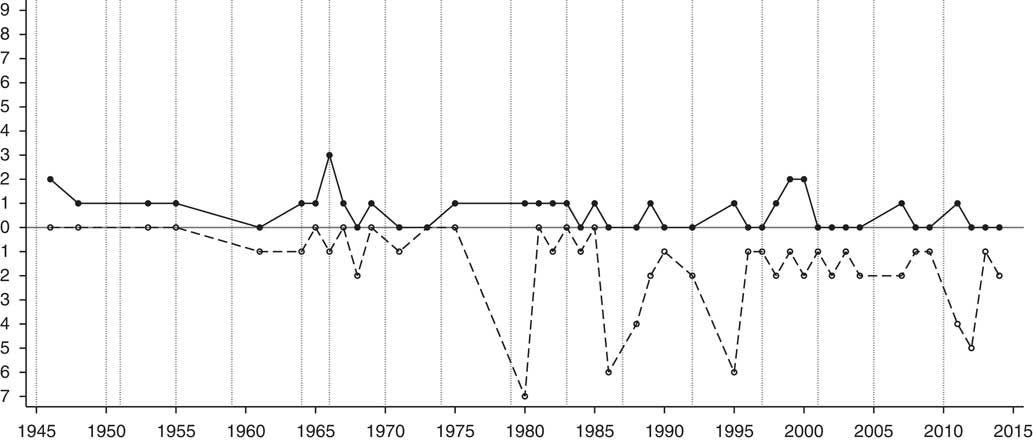
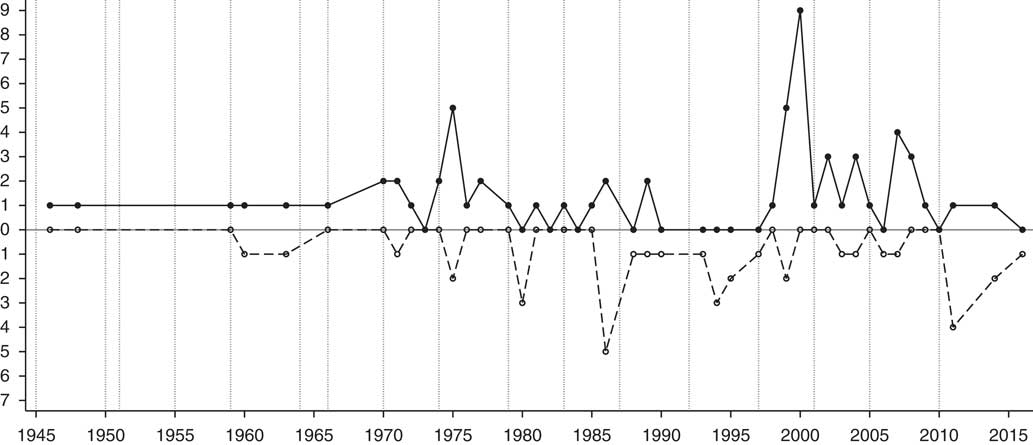
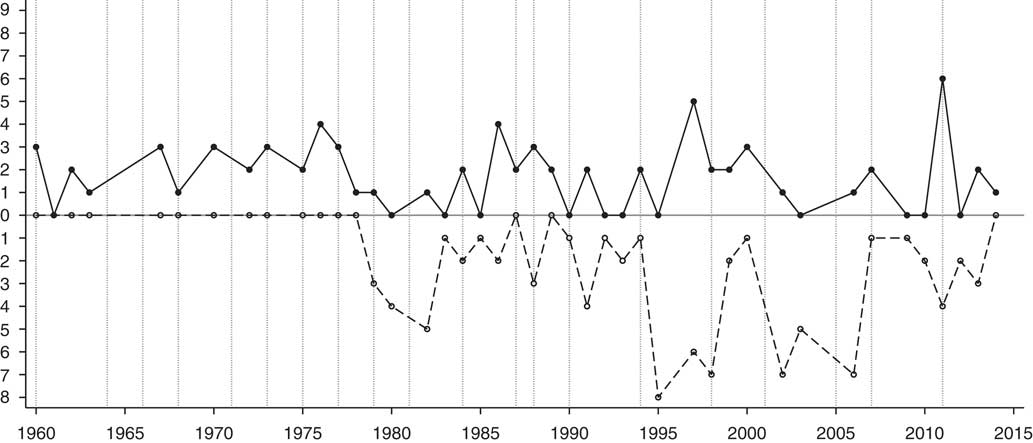
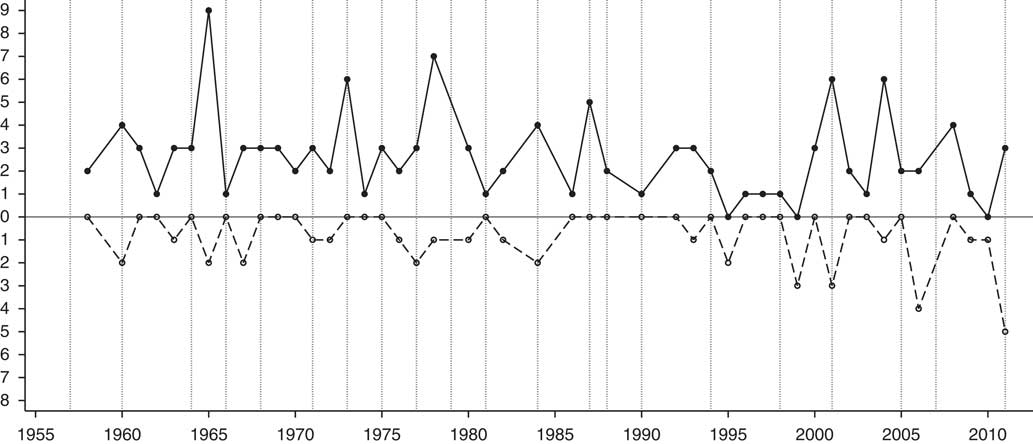
Figures 1–4 display the reform events of the two programs in Britain and Denmark. As we explain below, we were able to obtain data on government popularity from 1946 in Britain and from 1957 in Denmark, so these years also mark the beginning of our reform event data. Figure 1 shows British unemployment protection with the number of reform events listed on the vertical axis on the left-hand side. The values on the y-axis represent the number of reform events: the number of expansions above the zero and the number of cutbacks below the zero line. The solid line tracks the development of expansionist reform events over time, while the dashed line tracks the development in reductions.
Reform events in unemployment protection in Britain, 1946–2014 Note: the black circles with the solid line connecting them represent expansionist reform events. The hollow circles with the dashed line represent reductions. The number of reform events is reported on the vertical axis. The thin vertical dashed lines (i.e., in 1945, 1951, 1955 and so on) represent election years.

Reform events in old-age pensions in Britain, 1946–2014 Note: the black circles with the solid line connecting them represent expansionist reform events. The hollow circles with the dashed line represent reductions. The number of reform events is reported on the vertical axis. The thin vertical dashed lines represent election years.

Reform events in unemployment protection in Denmark, 1957–2014 Note: the black circles with the solid line connecting them represent expansionist reform events. The hollow circles with the dashed line represent reductions. The number of reform events is reported on the vertical axis. The thin vertical dashed lines represent election years.

Reform events in old-age pensions in Denmark, 1957–2014 Note: the black circles with the solid line connecting them represent expansionist reform events. The hollow circles with the dashed line represent reductions. The number of reform events is reported on the vertical axis. The thin vertical dashed lines represent election years.

There are several things worth noting in Figure 1. First, in the first roughly twenty years, only expansion takes place. For instance, in 1946 the National Insurance Act and the Industrial Injuries Act were both established (yielding the count of two expansion events in that year); in 1948 the National Assistance Act was passed (a count of one); in 1953 the maximum period one could receive unemployment benefits was extended from six to nineteen months (again a count of one); and so on. Secondly, the transformative nature of the Thatcher era is clearly visible. As many other researchers have pointed out before, since 1979 the generosity of British unemployment benefits has been systematically cut. Thirdly, the role of the incumbent’s ideology is also clearly visible. All the major cutbacks occurred under Conservative rule in 1980, 1986, 1988, 1995, 2011 and 2012.
Figure 2 reveals that for the first thirty years or so, the picture for old-age pensions is much the same as for unemployment protection: namely just a few, mostly expansionist, events. From the 1970s reform activities build up. While the tendency towards cutbacks was obvious for unemployment, it was much more mixed for pensions. Most notable are the expansions under the Labour governments from 1997 to 2010, but expansionist reforms have taken place from time to time under all governments since the 1970s. This picture of a balance between expansions and reductions fits well with what we know about the development of their generosity from other sources. According to the Comparative Welfare State Entitlements Database, for instance, the overall generosity of old-age pensions has not declined since the 1970s – in marked contrast to unemployment generosity.Footnote 30
Figures 3 and 4 display the data for Denmark. In Figure 3 the reform events in unemployment protection exhibit a pattern similar to the British. All reform events that occurred until the 1970s were expansions, at which point a shift towards a new regime of cutbacks began. In contrast to the British case, however, both left- and right-wing governments introduced cutbacks, although it is worth noting that many of the cutbacks under the right-wing governments of the 2000s were aimed at labor market outsiders and immigrants rather than native Danes.Footnote 31
In Figure 4 we once again see how old-age pensions have developed very differently. The last couple of decades have seen some cutbacks – in 1998, 2006 and 2011 in particular – but there have been many expansions as well. In 2004, for example, the means test for the pension supplement was relaxed, the ældrecheck (literally ‘elder check’ – an income supplement) made more generous, and a heat supplement was also increased, while mandatory contributions to a special pensions fund were suspended.
In summary, Figures 1–4 reveal that there have been plenty of credit-claiming opportunities in both Britain and Denmark, even in an era of fiscal austerity in which supposedly only cutbacks should have been on the table (although there have been many of those too). We use the number of cutback and expansion reform events as our main explanatory variable to examine how welfare reforms influence government support.Footnote 32
DATA, MEASUREMENTS AND ESTIMATION STRATEGY
To examine whether the reform events have had any impact on government popularity, we compiled opinion polls that asked voters who they would vote for if an election were held tomorrow. The annual mean of the polling results for parties in government is our main dependent variable, Support for the Government.Footnote 33 The annually structured dataset allows us to see if a reform event in any given year had an effect on support for the government in the following year. If the effect persists for that long, it should be regarded as substantial – especially, of course, if the size of the effect is large.
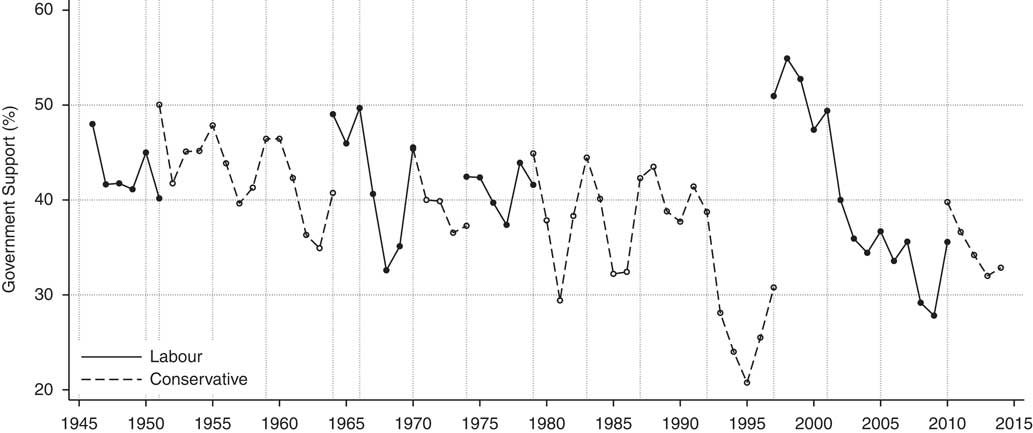
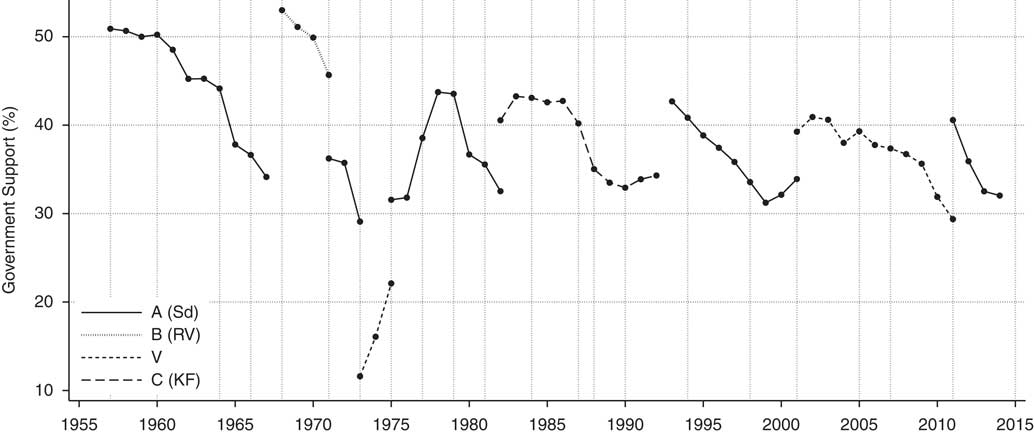
Figure 5 displays the support for British governments during the study period. The black circles with solid lines represent support for governments led by Labour, and the hollow circles with dashed lines represent support for Conservative governments. Apart from the well-known fact that British governments rarely have a majority of the voters behind them, it also transpires that the cost of ruling is at play. As a general rule, governments lose popularity over time, although they can bounce back, as Thatcher did from her low in 1982 (because of the Falklands War). Figure 6 shows the popularity of the Danish governments as the sum of the average support for the parties that comprised them. That Denmark tends to be run by minority governments is easy to detect, as is the cost of ruling, which, if anything, is even more evident here than in Britain.
Government support in Britain, 1946–2014 Note: the vertical axis reports the percentage of respondents saying that they would vote for the government if there were an election tomorrow. The thin, dashed vertical lines are election years. Black circles with solid lines represent Labour governments. Hollow circles with dashed lines represent Conservative governments.

Government support in Denmark, 1957–2014 Note: the vertical axis reports the percentage of respondents saying that they would vote for a party in the government if there were an election tomorrow. Legend indicates the party of the prime minister. A: Social Democratic Party, B: Social Liberal Party, V: Liberal Party, C: Conservative People’s Party.

As our main interest is in estimating the effect of reform events on government popularity, our specification draws on the standard economic voting models that predict government popularity and party support.Footnote 34 In so doing, we control for the variables that might affect both the reform events and government popularity. The economic situation is one such variable. A substantial body of research shows that a bad economy influences the likelihood that reforms will occur,Footnote 35 and that voters take the economic situation into account when deciding whether or not to vote for the incumbent.Footnote 36 This suggests that the relationship between reform events and government support could be affected by the state of the economy. To control for this possibility, we include measures of real GDP growth, the inflation rate and the unemployment rate.
As noted before, governments tend to lose votes as time goes by. This is the well-documented cost of ruling.Footnote 37 There is also research suggesting that governments tend to enact cutbacks early in the electoral cycle to avoid punishment from voters.Footnote 38 Taken together, we need to control for the number of years a government has been in office, since this affects both the likelihood of reform and its popularity. For Denmark we also control for the number of parties in the cabinet. Work by Bawn and Rosenbluth suggests that governments with many parties tend to spend more than those with fewer parties.Footnote 39 Governments with more parties will, all else equal, also be bigger, which means that we risk a biased estimate if we do not control for the number of cabinet members.
Given the data structure we build, it is necessary to consider the temporal dynamics in the data. Figures 1–4 demonstrate that the number of reform events in a given year is independent of the number of reform events the year before. There is also no theoretical reason to expect that having (or not having) a reform in one year should affect the likelihood of a reform in the following year. As for our dependent variable, there is a tendency for sliding popularity within each government. We handle this temporal trend in government support by including the cost of ruling as a control variable to de-trend the vote share within each government. Cost of Ruling is coded as the number of years a given government has been in office since the last election. In our analysis, this variable runs from 1 to 4 in Denmark and to 5 in the UK, the maximum legal length of an election term.Footnote 40 We do not include a lagged dependent variable in our regression models because the dependent variable does not share unit roots (that is, the trend over the entire period is stationary, as can also be seen from Figures 5 and 6).Footnote 41 The regressions are estimated using robust standard errors clustered around the different government parties.Footnote 42 All independent variables except Cost of Ruling are lagged by one year so we can see whether the effects of reforms persist into the medium term. With these methodological issues addressed, we now turn to the findings.
FINDINGS
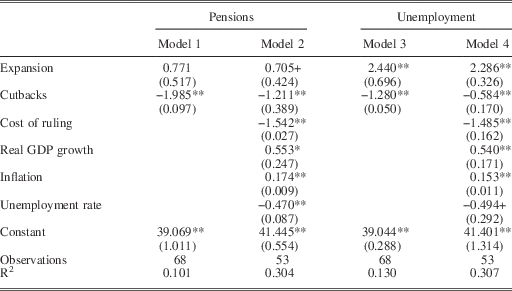
Table 1 reports the results for Britain. We estimate four models: Models 1 and 2 focus on pension reforms, while Models 3 and 4 focus on unemployment protection. Models 1 and 3 only contain the two main variables of interest – the number of expansion and cutback events. Models 2 and 4 include the controls. Since the consistent time-series variables for the economy indices are only available since 1960, the full models cover the years after 1960.
Welfare Reforms and Government Support in Britain, 1946–2014

Note: standard errors in parentheses. All variables lagged by one year except for cost of ruling. +p<0.10, *p<0.05, **p<0.01
Overall, the four models indicate relatively strong voter reactions to reforms. Although expansions of pensions are not significantly associated with the government’s popularity in Model 1, the association turns significant in Model 2 at the p<0.10 level after controlling for the cost of ruling, real GDP growth, inflation and unemployment rate. The estimated coefficient suggests that one expansion increases government support with 0.7 percentage points, which is a sizeable effect, given that in many years there was more than one expansion event. Moving to the domain of unemployment protection, the positive effect of an expansion is even larger, though it should be stressed that there are not many expansions overall in unemployment protection (c.f. Figure 1). The results indicate that a single positive reform event leads to a 2.5–2.8-percentage-point increase in government popularity, suggesting that there is ample opportunity for credit claiming in both policy domains.
The results indicate that the effect of cutbacks is, again, quite sizeable. Moreover, the effects are consistently significant and negative across both domains, as Hypothesis 1 predicts. For pensions, the effect in the full model (Model 2) is a 1.2-percentage-point loss per reform event, down from 1.9 percentage point in the stripped-down model (Model 1). For unemployment protection the estimated effects are more sensitive to the inclusion of controls, but a single reform still entails a 0.6-percentage-point loss in government popularity in the full model (Model 4). This remains a quite consequential effect exactly because cutbacks in unemployment protection have happened more frequently than any of the other outcomes (c.f. Figures 1 and 2). These findings lend support to Hypothesis 1: British voters do react to cutbacks.
The full models that include control variables account for around a third of the variation in government support (Models 2 and 4), and the stripped-down models (Models 1 and 3) explain between 10 and 13 per cent of the variation. Although many other factors might affect a government’s popularity, it is noteworthy that our measures of expansions and cutbacks can explain around 10 per cent of the variation in government support.
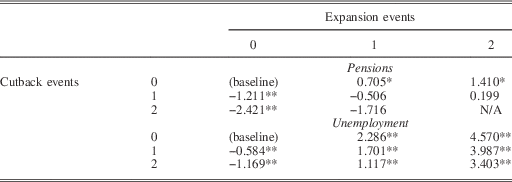
As mentioned previously, one of the shortcomings of the existing literature is that it does not empirically take both expansions and cutbacks into account, even though both WeaverFootnote 43 and PiersonFootnote 44 emphasize that a potential blame avoidance strategy may be to ‘throw good money after bad’ or ‘compensate’ by counterbalancing a cutback with an expansion (as summarized in Hypothesis 2). The empirical problem, in other words, is not just that both cutbacks and expansions matter. As we have shown so far, there is great variation across years whether the reform events are purely expansionary, only cutbacks or both at the same time. Focusing exclusively on cutbacks, as the empirical literature has done, risks producing a biased estimate. To illustrate this, we have calculated the net effects of one and two cutbacks in a year, respectively, when zero, one or two expansion events occurred in the same year. Some of these scenarios do not occur in the data, or only do so in a very few instances, in which case we refrain from calculating the marginal effects (and report an N/A instead). Thus we report the estimated effects of reform events in Table 2 only for the scenarios that may be considered realistic.
Net Effects of Expansions and Cutbacks in Britain

Note: calculated based on the full models in Table 1 (Models 2 and 4). Net effects marked with ** are statistically significant with p<0.05, and * with p<0.10. N/A=the coefficient is not reported because the scenario does not occur in our data.
In the left-most column the effect of cutbacks with no counterbalancing expansions is reported. Across the two policy areas (pensions and unemployment) and the number of cutbacks (one or two) cutbacks have a clear-cut negative effect on governments’ support. The negative effect varies in size across the policy areas, as we would expect from the results in Table 1, but in all cases the coefficient is non-negligible and statistically significant. Yet when there is just a single expansion event, the results alter dramatically. Looking first at pensions, a single expansion entirely neutralizes the effect of a cutback. The compensation effect is more pronounced for unemployment. A single expansion event even overpowers the effect of single cutback and neutralizes that of two cutbacks. The British data clearly support our expectation, summarized as Hypothesis 2, that expansion events compensate for losses caused by cutbacks.Footnote 45
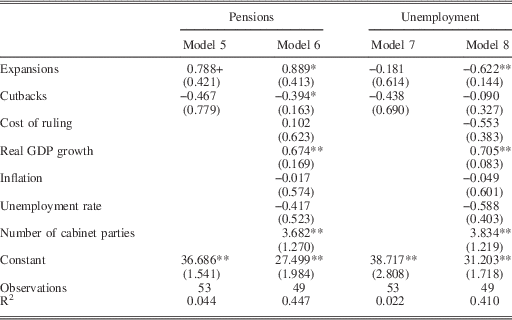
Table 3 shifts attention to Denmark. Looking first at pensions, roughly the same picture emerges as for Britain. An expansion is rewarded with an increase in support of almost one percentage point in Models 5 and 6. Cutbacks have a negative effect when controlling for confounders, but the size of the effect is a comparably low 0.4 percentage points, though still statistically significant and non-negligible in size. This finding suggests that blame diffusion is easier in the Danish political system since support for Danish governments (usually minority) typically slips less than support for British governments (always majority). Still, on balance the results from pension reforms in Denmark lend support to Hypothesis 1.
Welfare Reforms and Government Support in Denmark, 1957–2014

Note: standard errors in parentheses. All variables lagged one year except for cost of ruling. +p<0.10, *p<0.05, **p<0.01
Moving to unemployment protection, the results are rather interesting. In the stripped-down model (Model 7) we find no significant effect of expansions or cutbacks. Yet when controlling for the confounders, expansions have a negative effect (Model 8), which is something of a puzzle. As noted above, it is well known that unemployment protection is less popular with the public than old-age pensions, in Denmark as well as in Britain. However, the fact that Danish unemployment benefits and conditions are much more generous than the British might play a role. Unemployment benefits almost always go to a small and relatively marginal group, and if the Danish public believes that benefits are already high, a government’s attempt to expand them could be perceived as a waste of money. While this is not quite within the scope of the present study, whether the negative effect is driven by specific events is certainly a matter for future examination.
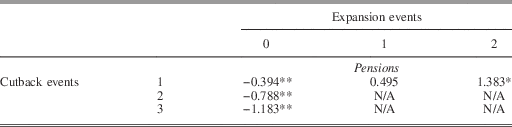
Table 4 reports the net effects of reform events on government popularity, as Table 2 did for Britain. Since apparently only expansions matter in the domain of unemployment protection, and therefore there can be no counterbalancing effect, we compute the net effects only in the domain of pensions, for the cases with one to three cutbacks across scenarios with various numbers of expansions in pensions. Similar to the results we found for Britain, cutbacks with no expansions have a negative effect on support for governments in Denmark. This negative effect is neutralized by just one expansion event; with more expansions, governments get even more support as long as there is only a single cutback.Footnote 46 All in all, governments appear to be able to compensate by combining cuts with expansions (Hypothesis 2) in both countries.
Net effects of Expansions and Cutbacks in Pensions in Denmark

Note: calculated based on the full models in Table 1 (Models 2 and 4). Net effects marked with **statistically significant with p<0.05, and * with p<0.10. N/A=the coefficient is not reported because the scenario does not occur in our data.
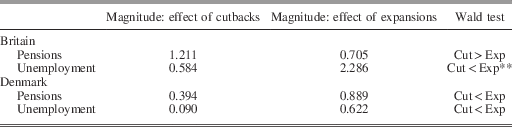
We now turn to a more systematic assessment of the negativity bias hypothesis (Hypothesis 3): Do cutbacks lead to stronger reactions than expansions? Table 5 compares the magnitude of the coefficients employing a set of Wald tests, which are reported in the last column. Note that to zero in on the magnitude, the analyses only compare the absolute values. In three out of four tests, the difference is insignificant, while expansions of British unemployment protection are rewarded more generously than cutbacks are punished. In the latter case, it should be kept in mind that there are few expansions of British unemployment protection to begin with. At any rate, our analysis suggests that voters are not particulary harsh in punishing cutbacks compared to rewarding for expansions. That is, the negativity bias hypothesis (Hypothesis 3) is not supported as the general response to welfare reforms in Britain and Denmark.
Wald Tests of Negativity Bias

Negativity bias is a well-established phenomenon in human psychologyFootnote 47 with documented ramifications in, for instance, media reporting.Footnote 48 Therefore our findings are surprising and at odds with the expectations of Weaver and Pierson.Footnote 49 So why do we not observe a negativity bias in voter reactions to reforms? One reason may be that voters do not evaluate reforms in the same way they evaluate other phenomena, although this appears implausible given the pervasiveness of negativity biases in human psychology. More likely, there is something about the way in which cutbacks and expansions are implemented that dilutes voters’ negativity bias. Both Weaver and Pierson point in this direction. Re-election motivated politicians may introduce cutbacks using technical or ‘invisible’ policy instruments, thereby hiding the extent of the cuts (or whether there were any at all). Conversely, expansion may be introduced using less technical, or ‘visible’, policy instruments. This would allow politicians to maximize credit claiming for expansions and minimize blame for cutbacks. If we assume that voters actually punish cutbacks harder than expansions and that reforms are implemented in this way, this could explain the observed pattern.Footnote 50
DISCUSSION
Given that the welfare state is hugely popular among voters, the findings in recent studies that governments can frequently get away with cutbacks have puzzled many researchers. There can be several reasonable explanations for this phenomenon. For example, voters may prioritize issues other than welfare policy reforms, they might not have a thorough understanding of what goes on in politics, or they might simply be unaware of reforms.Footnote 51 While this may be the case, our aggregate-level analysis suggests that these descriptions do not tell the whole story.
First, using a more appropriate measure of welfare reforms, which assuages concerns about the measurements previously employed in the literature, we have located substantially sizable effects of cutbacks on government support. Secondly, we have also shown that expansions can have fairly considerable positive effects. Binding together the two findings, the net effect of reform events on government popularity can vary greatly depending on whether in a given year there are only cutbacks, only expansions or both at the same time. This suggests that much of the previous literature suffers from a misspecification problem. More interestingly, though, it also suggests that modern-day politicians have more room for maneuver than is commonly assumed. Blame avoidance is not the only game in town. Instead, there is room for a government to please voters enough to make them support it. It seems that credit claiming never left the stage entirely.
There are many more cutbacks today than there were three decades ago, which is well illustrated in Figures 1–4 as well as documented in the literature. This reflects the fact that governments have been forced to restructure the welfare state to meet the demands of a globalizing economy. Yet there are fundamental differences across the two programs we studied in this article. Unemployment insurance has experienced many more cutbacks than pensions, which have seen just as many expansions as cutbacks. As mentioned above and elsewhere in the literature, this might be because pensions are much more popular than unemployment benefits. This difference in popularity is also plainly evident in our results. Controlling for potential confounders, electoral punishment for cutting back pensions in Britain is twice as large as the punishment for cutting back unemployment protection. In Denmark, on average, there is no punishment at all for cutbacks in unemployment protection, but a substantial one for cutting pensions.
We suggest exploring three important questions in future research. First, how do voters find out about welfare state reforms and subsequently decide to punish the government? Voters are presumably not keeping track of new legislation by themselves: they are likely to depend on mass media communication to stay informed about developments. Welfare reforms will, all else equal, be a salient issue to report on for most media, which is probably why we find the effects we do.Footnote 52 Voters are generally well enough informed to react, yet sometimes they may not be so informed. Understanding when welfare reforms become media news is therefore important.
Secondly, we found that most of the time, both expansions and cutbacks lead to reactions of the same magnitude. This flies in the face of previous claims that voters fail to react to expansions and only focus on cutbacks. That said, expansions and cutbacks may not be implemented the same way. Following the logic of Weaver and Pierson, it is possible to hypothesize that cuts will be introduced in more subtle ways than expansions to minimize blame from the former and maximize credit claiming for the latter.Footnote 53 An interesting avenue of future research would be to study the ways in which expansions and cutbacks are introduced, and whether that may help explain why there is no difference between the effects of cutbacks and expansions.
Thirdly, we observed some cross-country differences between Britain and Denmark. With only two countries, it is hard to ascribe much inferential value to such distinctions, but it is, of course, plausible that the institutional set-up of these and other countries affects voters’ reactions. With a larger sample of countries, it may be possible to more systematically gauge such cross-country differences. Lastly, we have explored the effects of cutbacks on voter reactions in two policy areas. An ambitious next step would be to obtain data on more areas – not simply to see if they experience similar effects, but to explore how reforms in one area may compensate for reforms on another.