Introduction
Flax (Linum usitatissimum L.) is an important oilseed crop, with nutritional, medicinal and industrial applications. The University of Saskatchewan at Canada has developed genetically modified (GM) flax event CDC-FLØØ1-2 (CDC Triffid flax) that expresses acetolactate synthase (ALS) gene derived from Arabidopsis thaliana conferring tolerance to sulphonylurea herbicide. The event was approved in Canada and the United States in 1990s, but was deregistered in 2001 (Ryan and Smyth, Reference Ryan and Smyth2012). However, in 2009, GM flax was unpredictably detected in the shipments from Canada to Europe, Japan and Brazil (Young et al., Reference Young, Hammerlindl, Babic, McLeod, Sharpe, Matsalla, Bekkaoui, Marquess and Booker2015), which has raised the necessity of GM testing in flax consignments imported from Canada.
In India, as GM flax has not been approved, so the imported consignments need to be checked for its unauthorized entry. The present study was aimed to check the unapproved GM flax event in flaxseed accessions imported from Canada for research purpose, as a precautionary approach.
Experimental
A set of 123 accessions imported from Plant Gene Resources of Canada (PGRC) by ICAR-National Bureau of Plant Genetic Resources (NBPGR) was used. As these accessions will be used for research purposes (as listed in online Supplementary Table S1) for multiplication, evaluation or characterization studies, so they need to be be GM-free.
Twenty seeds of each accession were randomly taken to represent the lot of respective seed material comprising 100–125 seeds per sample. This sample size was sufficient to be tested using test methods with limit of detection of 0.1–0.01%. Genomic DNA was extracted using the DNeasy® Plant Mini Kit protocol (Qiagen, Germany). The quantity and quality of DNA was assessed using a UV spectrophotometer (Eppendorf, Hamburg, Germany). Amplifiability of DNA extracts was ensured using polymerase chain reaction (PCR) assay targeting chloroplast tRNA (cp-tRNA) gene (Taberlet et al., Reference Taberlet, Gielly, Pautou and Bouvet1991).
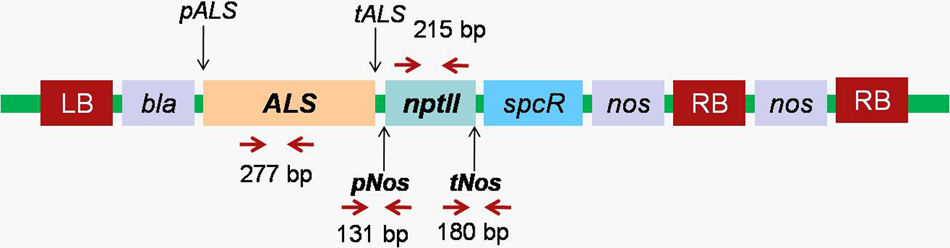
For analysing adventitious presence of GM flax, the targets were identified based on the transgenic construct of GM flax CDC Triffid (Fig. 1). The published primers were used for nos promoter (P-nos), nos terminator (T-nos) and nptII marker gene (Hardegger et al., Reference Hardegger, Brodmann and Herrmann1999; Singh et al., Reference Singh, Ojha, Bhatnagar and Kachru2008; Pansiot et al., Reference Pansiot, Chaouachi, Cavellini, Romaniuk, Ayadi, Bertheau and Laval2011). The published protocol for ALS transgene was used as specific test for checking the presence of modified flax CDC Triffid event (Nakamura et al., Reference Nakamura, Akiyama, Yamada, Satoh, Makiyama, Sakata, Kawakami, Mano, Kitta and Teshima2010). Additionally, PCR test for detection of commonly employed herbicide tolerant gene cp4-epsps in other GM crops was conducted (Hird et al., Reference Hird, Powell, Johnson and Oehlschlager2003). Details of primers used in the present study are given in online Supplementary Table S2.
Schematic representation of the construct integrated in GM flax event CDC Triffid (Source: McHughen, Reference McHughen1998). Arrows indicate the regions targeted for GM detection in 123 accessions of flaxseed.

The screening tests targeting P-nos, T-nos, nptII and construct-specific assay for ctp2-cp4epsps were performed in Veriti Thermal Cycler (Applied Biosystems, Foster City, CA, USA) in 20 μl reaction containing 100 ng template DNA, 1× PCR buffer, 1.5 mM MgCl2, 200 μM dNTP mix, 0.25 μM each of forward and reverse primers and 0.5 units of Taq DNA polymerase (ThermoFisher Scientific, MA, USA). For T-nos, 0.5 μM of primers were used. Thermal profile used was initial denaturation at 94°C for 5 min, 35 cycles of 94°C for 30 s (denaturation), 60°C for 50 s (annealing) and 72°C for 1 min (extension), followed by final extension at 72°C for 7 min. For ALS transgene, the published protocol of Nakamura et al. (Reference Nakamura, Akiyama, Yamada, Satoh, Makiyama, Sakata, Kawakami, Mano, Kitta and Teshima2010) was used. The PCR amplified products were separated on 2.0% (w/v) agarose gels (G Biosciences) and then visualized using UV Gel Documentation System (Alpha Innotech, USA).
A case study is being reported herein where the GM testing of 123 flaxseed accessions imported from Canada was conducted as an initiative in the country to check for unauthorized GM flax.
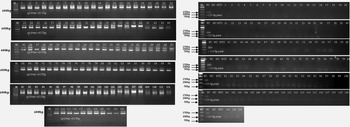
Amplifiability of DNA extracts was first ensured using cp-tRNA gene specific PCR (Fig. 2). On the PCR tests targeting P-nos, T-nos and nptII, amplification was not detected in the tested accessions (Fig. 2, online Supplementary Figs. S3 and S4).
PCR profiles for checking PCR inhibitors to ensure amplifiability of DNA samples using cp-tRNA (plant) gene specific assay (left) – 100 bp DNA ladder (b); 1–123: flaxseed accessions (sl. no. 1–123); and checking GM status targeting transgenic element, P-nos in 123 flaxseed accessions (right) – 50 bp DNA ladder (b); 1–123: flaxseed accessions (sl. no. 1–123). PC, positive control; NC, non-GM flaxseed; NTC, non-template control.

Checking unauthorized GM events is sometimes a challenge due to non-availability of certified reference material (CRM). CRM for a particular GM event is used as a positive control for respective GM event or targets present in it. CRM for GM flax event CDC Triffid is not available and also its seed material may not be accessible in India due to its regulatory status. In this case, the published protocol of Nakamura et al. (Reference Nakamura, Akiyama, Yamada, Satoh, Makiyama, Sakata, Kawakami, Mano, Kitta and Teshima2010) was used for detection of ALS gene. On the PCR test targeting ALS transgene, none of the tested accessions were found positive (online Supplementary Fig. S5). The representative gel profile as reported by Nakamura et al. (Reference Nakamura, Akiyama, Yamada, Satoh, Makiyama, Sakata, Kawakami, Mano, Kitta and Teshima2010) was used as reference for amplification product. The cp4-epsps being employed as common herbicide tolerant gene in other GM crops was also targeted and also no amplification was detected in tested samples (online Supplementary Fig. S6).
The tests were repeated three times along with appropriate positive/negative controls in order to minimize the chances of false positives or false negatives.
Discussion
The low level presence of GM flax in the shipments from Canada to Europe even after deregistration of the event CDC Triffid has necessitated the monitoring of imported consignments from Canada to trace GM contamination. In India, genetically modified organisms (GMOs) are regulated under the ‘Rules for the manufacture, use, import, export and storage of hazardous microorganisms, genetically engineered organisms or cells, 1989’ (Rules, 1989). In compliance with Food Safety and Standards Authority of India, every consignment of 24 food crops (including flaxseed) need to be accompanied by non-GMO certification and tolerance limit of adventitious presence of GMOs at 1% is permissible in these imported consignments (FSSAI, 2021). A case study on checking for unauthorized entry of GM flax in the imported consignment has been carried out. The absence of adventitious presence of transgenes in these accessions would facilitate to effectively undertake the evaluation and characterization studies by the concerned researchers. In case of research material where the seeds are not imported in bulk, withdrawing a large amount of samples is not necessarily feasible for GMO testing. In this study, approximately one-fifth portion of each sample was used as its representative, which would be sufficient for GMO testing using the test protocols with detection limit ranging from 0.1 to 0.01%. Also if the CRM is not available for a particular GM event such as GM flax CDC Triffid in the present study, screening elements present in this event may be targeted for GMO testing. The same strategy could be employed to test the imported consignments of flax and flax products, which would assist in restricting the GM contamination as a precautionary approach.
Supplementary material
The supplementary material for this article can be found at https://doi.org/10.1017/S1479262122000132.
Acknowledgements
The authors duly acknowledge the Indian Council of Agricultural Research (ICAR), New Delhi and Director, ICAR-National Bureau of Plant Genetic Resources, New Delhi for providing necessary facilities. The authors acknowledge Plant Gene Resources of Canada (PGRC) for providing material. Grant provided by Department of Biotechnology (Ref. No. BT/AG/Facility/2019) is duly acknowledged.
Conflict of interest
The authors declare that they have no known competing interests.