Introduction
It is important to understand how Alzheimer's disease (AD) patients are aware of their disease and how they reflect upon their own thinking. Lack of knowledge on these matters can contribute to situations where the AD patient is misunderstood, disrespected, and even neglected. Many studies overlook the possibility of gathering information from the individual with AD, probably due to assumed problems in acquiring valid data from a cognitively degraded individual (Hess-Wiktor and Opoczynska, Reference Hess-Wiktor and Opoczynska2012). Nevertheless, it is important to attach significance to the patient's firsthand experience of the disease (McKillop and Wilkinson, Reference McKillop and Wilkinson2004) and to bring light to the experiences affiliated with a disease leading to loss of self. Furthermore, the analysis of personal narratives conducted by Beard et al. (Reference Beard, Knauss and Moyer2009) emphasizes the importance of a reframing of dementia. They suggest everyone should consider the fact that a dementia diagnosis does not automatically make the individual a victim but rather someone who has a manageable disease and who wants to be seen as “more than dementia” (p. 234, Beard et al., Reference Beard, Knauss and Moyer2009). The present paper focuses on the AD patient and his or her own perception of the disease in terms of a few aspects of awareness, namely; disease awareness, metacognition, and reflections on the management of everyday life. Spouse calibration was also considered in relation to these aspects.
Awareness in Alzheimer's disease
Deficits in disease awareness could be an early symptom in the course of AD since similar changes have been found in individuals with age-related mild cognitive impairment (Ecklund-Johnson and Torres, Reference Ecklund-Johnson and Torres2005; Vogel et al., Reference Vogel, Stokholm, Gade, Andersen, Hejl and Waldemar2004; Hardy et al., Reference Hardy, Oyebode and Clare2006). Starkstein et al. (Reference Starkstein, Chemerinski, Sabe, Kuzis, Petracca, Teson and Leiguarda1997) concluded that anosognosia (first defined by Babinski, Reference Babinski1914) i.e. unawareness of problems, is common, although not mandatory in AD, while others consider anosognosia to be a general part of AD which increases with progression of the illness (Barrett et al., Reference Barrett, Eslinger, Ballentine and Heilman2005; Starkstein et al., Reference Starkstein, Jorge, Mizrahi and Robinson2006; Lorenzo and Conway, Reference Lorenzo and Conway2008; Tremont and Alosco, Reference Tremont and Alosco2011). Apart from unawareness of disease in AD, unawareness of cognitive problems (Correa et al., Reference Correa, Graves and Costa1996; Galeone et al., Reference Galeone, Pappalardo, Chieffi, Lavarone and Carlomagno2011) as well as poor awareness of deficit in daily functioning have been reported (Starkstein et al., Reference Starkstein, Jorge, Mizrahi and Robinson2006). On the other hand, there have also been reports on awareness of cognitive shortcomings and awareness of problems in social interaction in patients with mild to moderate AD (Maki et al., Reference Maki, Amari, Yamaguchi, Nakaaki and Yamaguchi2012). To some degree, these differences in results regarding awareness in AD might be explained by the differences in methodologies used to study awareness. The study of awareness in patients suffering from neurological illness often includes clinicians’ ratings of patients (Correa et al., Reference Correa, Graves and Costa1996); discrepancy between patients’ ratings and ratings conducted by relatives (Maki et al., Reference Maki, Amari, Yamaguchi, Nakaaki and Yamaguchi2012); discrepancies between patients’ self-ratings and performance on cognitive tasks (Dalla Barba et al., Reference Dalla Barba, Parlato, Iavarone and Boller1995); or combinations of these approaches (Clare, Reference Clare2004; Morris and Hannesdottir, Reference Morris, Hannesdottir, Morris and Becker2004). As Clare (Reference Clare2004), in line with several other investigators points out, the method of discrepancies between the patient's ratings and the spouse's ratings rests on the presumption that the spouse holds the truth about the patient's awareness, and hence discrepancies in ratings are interpreted as a lack of awareness in the patient. On the other hand, it has been established that there is great disagreement between patient and caregiver in ratings of memory capacity and self-care (Vasterling et al., Reference Vasterling, Seltzer, Foss and Vanderbrook1995). This is why the approach of the present study is to take as the starting point the patient's own description of his or her situation.
Metacognition can be described as the reflection upon and understanding of one's own thinking (Perfect, Reference Perfect2002). Metacognition requires conscious monitoring of one's own thinking and is involved in several cognitive functions, such as memory, problem solving, listening, and reading comprehension (Flavell, Reference Flavell1979). Several researchers report normal metacognitive performance in AD (Bäckman and Lipinska Reference Bäckman and Lipinska1993; Souchay et al., Reference Souchay, Isingrini, Pillon and Gil2003), while others claim impaired metacognitive abilities in AD (Correa et al., Reference Correa, Graves and Costa1996; see Moulin, Reference Moulin, Perfect and Schwartz2002, for a review on metacognition in dementia). A common way of assessing metacognition is to ask participants to learn a list of words and then predict how many words they think they will remember at a memory test (Hager and Hasselhorn, Reference Hager and Hasselhorn1992; Galeone et al., Reference Galeone, Pappalardo, Chieffi, Lavarone and Carlomagno2011). Such tasks, involving prediction of performance before or after learning, comprise metacognitive measures of accuracy. Oyebode et al. (Reference Oyebode, Telling, Hardy and Austin2007) concluded that patients with AD overestimated predictions of memory performance. According to Moulin (Reference Moulin, Perfect and Schwartz2002), demented patients displayed metamemory deficits to accuracy assessments made before learning. Postdictions (judgments of accuracy of performance conducted after learning) appeared relatively spared in AD suggesting that predictions and postdictions tap different aspects of metacognitive memory functioning. However, predictions have been used repeatedly to assess alterations as to metacognition in AD (Galeone et al., Reference Galeone, Pappalardo, Chieffi, Lavarone and Carlomagno2011).
Spouse calibration
Concerning the management of everyday life, it is important to understand the agreement between the patients’ and the spouses’ perceptions of awareness, metacognitive status, and handling of everyday life as in coping strategies. How well the thoughts and judgments of one spouse agree with the beliefs of the other spouse is referred to as spouse calibration (Andersson, Reference Andersson2001). Coping is referred to as cognitive and behavioral efforts to manage demands that are on the limit to, or strain, the capacity of the individual (Lazarus, Reference Lazarus1999). In the context of the present study, coping is referred to as strategies for handling situations that occur in everyday life.
Aim of the present study
The present study employed a mixed-method evaluation design (Onwuegbuzie and Leech, Reference Onwuegbuzie and Leech2005), involving semistructured interviews with patient and spouse as well as neuropsychological testing involving patients and control subjects. Through this approach some of the methodological concerns discussed earlier in relation to discrepancies in ratings between patient and spouse (Clare, Reference Clare2004) were met. The approach allowed for an illumination of the research questions from different perspectives; that is, the same issue could be explored both in the answers from interview questions (subjective measure) and in neuropsychological testing (objective measure). Due to the choice of a mixed-methods design, it was not feasible to have a full battery of tests in each domain but rather a selection of methods that would illustrate the research questions from different perspectives. Three main questions were approached, namely:
1. How do AD individuals express disease awareness?
2. How do AD individuals describe management of cognitive deficits in everyday life?
3. How well do the thoughts and judgments of one spouse (AD) agree with the beliefs of the other spouse, i.e. spouse calibration?
Method
Participants
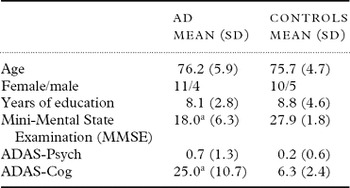
Fifteen AD patients were recruited at the Department of Geriatrics, Linköping University Hospital in Linköping, Sweden. Diagnosis of AD was made according to the NINCDS-ADRDA (McKhann et al., Reference McKhann, Drachman, Folstein, Katzman, Price and Stadlan1984) criteria. None of the patients included suffered from major depression or any other mood disorder. All patients who were asked agreed to participate in the study. Fifteen healthy control subjects, matched on age, gender, and education were recruited from a local senior-citizens organization. The control subjects were recruited as a comparison group for the neuropsychological examination performed. Apart from the AD group and the control group, the study design required the AD patient to have a spouse. Hence, the study design involved three groups; the patients (n = 15), a matched control group (n = 15), and the spouses of the patients (n = 15). Demographic characteristics of the participants are outlined in Table 1. The research protocol was approved by the ethical committee of Linköping University (Number 98413). All participants were given informed consent prior to the study.
Demographic characteristics of the participants

Note: AD: Alzheimer's disease; ADAS-Cog: Alzheimer's Disease Assessment Scale. Values enclosed in parentheses represent standard deviation (SD).
ap < 0.001.
Procedure and material
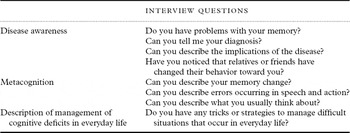
The investigation comprised a neuropsychological examination and an interview. The neuropsychological examination involved two different sessions. The sessions were performed by two different examiners who consequently administered the same session (S. Mårdh and T. Karlsson). The spouses were interviewed and the control subjects were exposed to the neuropsychological testing and saw both examiners the same day. The patients were invited to the department on two different occasions, once to meet both neuropsychological examiners and a second time to meet with the interviewer. The interview of the spouse was conducted on the same occasion, but not at the same time. The spouse was not present when the patient was interviewed and vice versa. The interviews were semistructured and conducted by an experienced clinician (J. Marcusson), following a predefined protocol (see Table 2). All activities took place at the Geriatric Department at the University Hospital.
The interview questions employed in the study

The interview
The interview comprised questions on disease awareness (four questions, for example, “Can you tell me your diagnosis?”; Table 2) metacognition (three questions, for example, “Can you describe your memory change?”; Table 2), and management of everyday cognitive deficits (“Do you have any tricks or strategies to manage difficult situations that occur in everyday life?”). The same sets of questions were given to the spouse, rephrased to capture the spouse's perspective (e.g. “Can you tell me your spouse's diagnosis?”; “Can you describe the memory change of your spouse?”).
The neuropsychological evaluation
The neuropsychological examination consisted of two sessions. The first session focused on mental status and metacognition, i.e. Mini Mental State Examination (MMSE) (Folstein et al., Reference Folstein, Folstein and McHugh1975), the cognitive subscale of Alzheimer's Disease Assessment Scale (ADAS-Cog) (Rosen et al., Reference Rosen, Mohs and Davis1984), and metacognitive predictions. The second session focused on executive functions, the psychiatric subscale of Alzheimer's Disease Assessment Scale (ADAS-Psych) (Rosen et al., Reference Rosen, Mohs and Davis1984), memory for emotions, and consciousness (unpublished data).
The first session involved a memory prediction task. In this task, the patients and the control group were given a memory test, word recall. Twelve concrete nouns were printed on index cards and presented one at a time. Each word was shown during two seconds. Before the test was given, the subjects were asked to predict their memory performance (“You will now see 12 words presented one at a time, how many words do you think you will recall after having seen the 12 words?”).
validity and reliability
All interviews were logged by note taking from the interviewer. The interviewer followed a detailed interview protocol to ensure proper and fast recording of the interview answers. In addition, for validation reasons, 8 of 15 patient interviews were recorded on tape. A professional transcriber transcribed all recorded interviews. Hence, the taped interviews were available both in the form of an interview protocol and in a tape-recorded version. This made it possible to assess the validity of the interview protocols. The interview questions were assigned a number according to the answers, 0 = no and 1 = yes (i.e. “can describe memory change”; 1 = yes). All interviews, both the recorded versions and the interview protocols, were assessed according to the same strategy. A comparison between the assessment of the two versions of the same interview shows that the measure of agreement, Cohen's (Reference Cohen1960) kappa coefficient, κ, was high, r = .87, p < 0.01. To consider inter-rater reliability, a second rater, blind to the results of the first rater, coded a random 5 of 8 taped patient interviews. The Cohen's kappa coefficient, κ, was high, r = .89, p < 0.01, which indicated almost perfect agreement between the two raters.
method for analysis of the interview questions
In the analysis of the answers from the interviews, the aim was to give descriptions of what the patients, on one hand, and the spouses, on the other hand, discussed in relation to a particular question. When analyzing the interviews, the order of analysis was altered. Hence, regarding the first question, the patients’ answers were analyzed first; regarding the second question, the spouses’ answers were analyzed first, and so on. This was done to ensure that the coder would not be influenced by the analysis of the first group analyzed in every question. After analyzing all the questions, a translation of the results from Swedish to English was made by the principal investigator (S. Mårdh).
The first main question, “How do AD individuals express disease awareness?,” was assessed in terms of whether the patient/spouse could give adequate answers to the interview questions involved. The second main question was analyzed in detail according to the initial stages of Grounded Theory (Strauss, Reference Strauss1987). Constant comparisons amongst the interviews of each group were made to find differences and similarities in the material. The interviews were coded by dividing them into separate comments. The comments were numbered and put together in dimensions according to similarity in content, for example, comments like “I forget more quickly than I used to” and “. . .if I don't answer immediately – then it disappears” were put together in a dimension called “forgetfulness.” All comments were assigned a dimension in a similar way. After assigning the comments to different dimensions, the dimensions were organized into categories. From these categories, core categories were created. For example, in the case of the interview question concerning “can describe memory change,” the core categories created were “cognitive aspects of memory change,” “action related aspects of memory change” and “social aspects of memory change,” all according to what context the patient related their memory change to.
statistical analysis
t tests were made between AD patients and control subjects concerning age, years of education, MMSE, ADAS-Psych, and ADAS-Cog. The differences in prediction and performance in the memory prediction test was assessed by means of a mixed 2 × 2 repeated measurements ANOVA, where Group (AD patients vs. controls) was a between groups factor and Memory Prediction (predicted performance vs. actual performance) varied within groups. Correlations were made between MMSE and the memory prediction test to assess the association between cognitive impairment and altered metacognition. Finally, Kendall's Tau was used to correlate patient and spouse reports for each couple.
Results
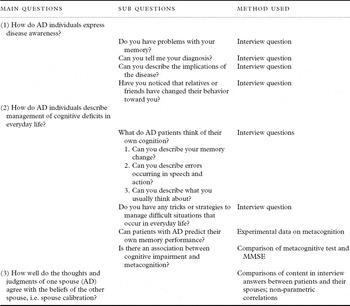
In the following section, the three main questions of this paper are explored in the order they were asked, namely; (1) how do AD individuals express disease awareness?; (2) how do AD individuals describe management of cognitive deficits in everyday life?; (3) how well do the thoughts and judgments of one spouse (AD) agree with the beliefs of the other spouse, i.e. spouse calibration? Table 3 describes the layout of the results section.
The lay-out of the results section

AD: Alzheimer's disease, MMSE: Mini-Mental State Examination.
(1) How do AD individuals express disease awareness?
The first main question was explored by asking four interview questions (see Table 3).
do you have problems with your memory?
All patients admitted to having memory problems. All spouses admitted that the patients had memory problems.
can you tell me your diagnosis?
Seven of 15 of the patients were aware of their diagnosis, and after being reminded, another 5/15 claimed they were aware of their diagnosis. Three patients, thus, denied any knowledge about diagnosis. All spouses (apart from one spouse whose data are missing on this question) were aware of the patients’ diagnosis.
can you describe the implications of the disease?
When asked to describe implications of the disease, 9/15 of the patients and 9/15 of the spouses were able to give an adequate description. The definition of an adequate description was set to involve comments on the disease as related to the brain and/or had something to do with memory disorders. An example of an answer from a spouse that was not considered adequate was “Yes, I don't know exactly but it gets worse and worse and some can come, how do you say. . .?” An inadequate answer from a patient was “Yes, I don't really know but I do know that it is a severe disease that I. . .can never get rid of.” Due to problems with the tape recorder, there was one dropout on this question in each group.
have you noteiced that relatives or friends have changed their behavior toward you?
Seven of 15 patients said they noticed a change in behavior. One woman claimed her husband got annoyed with her when she forgot things, another woman said her son had become more thoughtful toward her. Six of 15 patients said they noticed that friends had changed their behavior toward them since they received their diagnosis. One woman said she was afraid her friends would talk about her behind her back and that she did not trust them, she felt like less of a person nowadays. Another woman said she tried to withdraw from friends since she thought they might ask her things she could not answer. The last example was a woman who said: “When my husband and I are out walking they never talk to me – they just talk to him.”
(1) How do AD individuals describe management of cognitive deficits in everyday life?
The second main question was explored by interview questions as well as by an objective memory-prediction task. In addition a comparison was made concerning a possible association between cognitive impairment and metacognition.
what do ad patients think of their own cognition?
Can describe memory change – patients (34 comments). Thirteen of 15 patients could describe their memory change. The comments were subordinated into three core categories, namely, “cognitive aspects of memory change,” “action-related aspects of memory change,” and “social aspects of memory change.”
Cognitive aspects of memory change (19 comments). The patients described the cognitive aspects of memory change in terms of how the memory had changed, for example, that the change had come gradually or that they did not remember evident things anymore. These reflections were made in a general mode, without providing concrete examples of what they forgot and merely stating the fact that they did forget. The patients also made comments on thinking, for example: “. . .now it is harder to think and follow a dialogue.” There was also one example of a metacognitive reflection in that one man in describing his change said “. . .I notice it gets a little bit weird. . . .”
Action-related aspects of memory change (10 comments). This category comprised comments on problems in finding things “. . . .can't find things that I put away the last hour,” or not remembering what they were supposed to do “I started to forget what I was supposed to do.”
Social aspects of memory change (3 comments). Comments associated with this category concerned social issues, for example, finding it hard to interact with friends. There were also comments on family circumstances, such as; the patient's father was forgetful.
Can describe memory change – spouses (29 comments). The spouses’ descriptions of memory change were also subordinated into three main categories according to their perceptions of what the memory change was related to: “cognitive aspects of memory change,” “social aspects of memory change,” and “practical aspects of memory change.”
Cognitive aspects of memory change (19 comments). Most of the comments made by the spouses on cognitive aspects of memory change dealt with the nature of the memory change, for example, “It disappears in just a few minutes,” and “. . .it's much more mixed-up.” Other comments concerned understanding: “She doesn't understand either the remote control or the clock anymore,” and repetition “She can ask the exact same thing five times in five minutes.”
Social aspects of memory change (5 comments). The spouses were concerned about the interaction in social circumstances, for example, “He became more quiet,” “She didn't know who she was talking to on the phone,” or the fact that the patient didn't remember friends anymore.
Practical aspects of memory change (5 comments). The practical aspects of memory change were related to domestic chores like forgetting how to cook and, as one spouse said, “She doesn't even know what macaroni is anymore.”
Describes errors in speech and action – patients (14 comments). Two-thirds of the patients admitted to errors occurring in speech and action, but only one-third of the patients could describe these errors. Due to the fact that the comments were quite disparate, four main categories were created; “cognitively related disorders,” “nature of change,” “oblivious,” and “others notice.”
Cognitively related errors (6 comments). Comments in this category involved both statements on how the errors occurred and reflections on the fact that something didn't come out right. Examples of how the errors occurred are: “. . .then I just stuttered and stuttered. . .,” “Sometimes I am looking for words, I just can't get them out,” “Yes, there may be a few words that are wrong,” and “It takes a while before I can find the words.” One patient who reflected on words not coming out right verbalized it like this: “Yes, I notice that it wasn't the way it should be.”
Nature of change (3 comments). Errors in speech and action were described in terms of the nature of the change by a number of patients. Some comments concerned the fact that the change in their speech and action had come gradually, one man described it like this: “And it comes sneaking, you know.”
Oblivious (3 comments). A couple of patients reported that words or actions “come out wrong,” but they did not seem to be bothered about it. One woman seemed unreflective, which is evident in the following comment: “No (moaning) but others might notice, I don't know. I haven't thought about it.”
Others notice (2 comments). This category was created because there were two patients who did not seem to realize they had problems themselves but were concerned that others noticed there was something wrong with their speech and action. One man said: “But it is. . .it is the wife who is. . .but she knows about it, so. . . .”
Describes errors in speech and action – spouses (17 comments). Six spouses denied that their relative had any errors occurring in speech and action. Two of these still made comments on errors, for example: “No. But he asks frequently. One time he was supposed to wind up a clock but he went up to the wrong clock where the key didn't fit.” The core categories created were “cognitively related errors,” “action-related mistakes,” and “cover-up strategies.”
Cognitively related errors (10 comments). Most of the comments on errors in speech and action related to cognition. Some spouses exemplified language problems in that their spouse used the wrong words or expressions. One example is a man who said: “Yes, it can be different words like, for example, if we are about to put something down, she might say ‘stand’ instead of the right word. She mixes those things up.” Other cognitively related errors reported were problems with numbers (“But what is bad is numbers. He distorts them. I think he lost track of those.”), forgetfulness (“He completely forgets things”), and temporal disorientation, like wanting to pull down the curtains in the middle of the day, thinking it was evening.
Action-related mistakes (6 comments). The action-related mistakes that the spouses exemplified were mostly related to mistakes in performing household chores, for example, difficulties with cooking and cleaning; “She has a hard time cooking since she cannot assess the amount of water needed.” One husband said that the wife had more difficulties in handling her clothes now as compared to before disease onset, another husband said: “. . .it happens every once in a while that she forgets which faucet to turn on for the washing machine and then she might forget that she has, for example, laundry in the basement.”
Cover up strategies (1 comment). One husband said that he frequently discovered that his wife constructs things to try to cover up memory problems; “Yes, it often happens that she ‘constructs’ to cover up memory problems.”
Describes what s/he usually thinks about – patients (14 comments). Eight patients could describe what they usually think of. Four patients made no comments at all. Two patients said they did not think at all, for example, one woman said she had “. . .gotten away from thinking. . .” and did not do that anymore. Another woman could not come up with specific examples but she said: “All kinds of things. There is a lot; there are so many things in my head.” The core categories created were “disease related issues,” “daily events,” “the past,” “family,” and “God.”
Disease-related issues (4 comments). When thinking about the disease, thoughts on how it would turn out and if it would get worse were dominating. One patient compared her situation to her father's final days since she noted similarities in their behavior.
Daily events (4 comments). When thinking, one woman said she thinks about what she is supposed to do during the day, another woman said she mostly thinks about economy and things that she reads. One woman related her daily events to her husband, in that she said she was grateful he was around to keep track of everything they were supposed to do during the days.
The past (3 comments). The past was reflected upon in terms of old acquaintances and former work conditions as well as previous activities in community programs.
Family (2 comments). One comment concerned family in that one woman was very thankful to her husband for helping her when she forgot things; one woman said she mostly thought about her children.
God (1 comment). One woman just said: “I usually think about God.”
Describes what s/he usually thinks about – spouses (16 comments). Six spouses made no comments at all in relation to this question. Two spouses claimed their spouse did not think at all. One husband said: “Not that I know of,” and another husband said: “No, she hasn't done that.” The core categories created were “daily concerns,” “the past,” “worries,” “disease-related thoughts,” and “God.”
Daily concerns (7 comments). One man reported that his wife plans the week by looking up TV and radio shows. One woman said her husband “. . .thinks a lot about practical solutions to problems.” One husband said his partner kept coming back to their living circumstances, talking about the house they lived in and where they should be living.
The past (3 comments). The past was mentioned in terms of where the patients used to live: “She dreams, she says, about her home,” thoughts about the parents: “She thinks about her parents all the time,” and former workplaces: “She thinks a lot about her friends in X. She was there for 33 years.”
Worries (3 comments). Some spouses report on worries that the patients talk about, for instance (about a summer house): “Because there is a lot to do there. . .and he worries about that. Sometimes he says it would probably be best to sell it.” Another spouse said his wife kept worrying about what would happen if she became alone and how she would manage then. One spouse said her husband worried a lot about his son's divorce.
Disease-related thoughts (2 comments). The examples displayed in relation to this category were reports from spouses who thought that the patients were thinking of the disease most of the time; “I think that she primarily thinks about the disease.”
God (1 comment). One man said his wife was very religious and that she kept thinking about God.
do you have any tricks or strategies to manage difficult situations in everyday life?
Patients
Six of 15 patients claimed they had strategies to manage difficult situations that arose in their everyday life. The core categories created from the patients’ answers were “practical strategies” and “cognitive strategies.”
Practical strategies. Examples of practical strategies that the patients claimed to use were writing notes and deliberate strategies for organizing everyday matters. A comment on writing note was: “. . .I have been doing that for quite some time now.” One woman said: “We have tried to make things easier and create routines.” One more example was: “We have tried to make it practical in the kitchen.” Another example of a new routine was the woman who had started to bring her identification card when she was out walking so that people would be able to identify her and help her if she fell.
Cognitive strategies. One example of a cognitive strategy was the patient who said she tried to remember how she had managed the same procedure before: “I think, how did I do this the last time?” She also said she repeated things to make it easier. One man said that he did not let go of a problem until it was solved.
Spouses
When spouses were asked about the patients’ strategies, 9 of 15 denied they had strategies, and 1 spouse was unaware of whether his wife had strategies. One spouse reported trying to initiate strategies but said: “I try with him but it is. . .it is not very popular.” Apart from these answers, the rest of the answers from the spouses were related to practical strategies; hence, one core category was created, i.e. “practical strategies.”
Practical strategies. Three spouses reported that their partners wrote notes to remember things, for example, to remember who called on the phone “. . .if someone calls and asks for me then there might appear a note next to the phone stating that such and such has called.” A fourth spouse mentioned a strategy he had noticed: “She wants to prepare in time for activities.”
can patients with ad predict their own memory performance?
To further explore the metacognitive aspect of our study design, we analyzed the results from the neuropsychological examination concerning metacognition. In this test, the patients and the control group were given a memory test, word recall. Before the test was given, the subjects were asked to predict their memory performance (“You will now see 12 words in a row, how many words do you think you will recall after having seen the 12 words?”). On average, the patients predicted they would remember 4.5 words but they only remembered 2.2 words. The difference between prediction and performance for the patients was significant, F (1, 26) = 6.51, p < 0.05. In the control group, the average prediction was 5.5 words and performance was 5.3 words, n.s. Hence, the patients overrated their performance by an average of 2.3 words, whereas the control subjects were accurate in their predictions.
is there an association between cognitive impairment and altered metacognition?
This question was assessed by comparing MMSE with the metacognitive prediction test. In the prediction test, the difference between prediction and performance was assessed. A high score (i.e. a big difference between prediction and performance) meant poor ability to predict memory performance. There was a negative correlation (not significant) between MMSE and the prediction test for the patients (r = − 0.508, p < 0.08). Hence, there was a tendency for that the lower MMSE score, the poorer ability to predict memory performance.
(3) How well do the thoughts and judgments of one spouse (AD) agree with the beliefs of the other spouse, i.e. spouse calibration?
comparison of content in interview answers between patients and their spouses
Regarding spouse calibration concerning the metacognitive interview questions, it was evident that patients and spouses had different opinions concerning errors made in speech and action and content of thought. They did not report the same errors made even within a dyad. Regarding our questions related to speech and action, and content of thought, we also noted instances of anosodiaphora (i.e. indifference to cognitive problems; McGlynn and Schacter, Reference McGlynn and Schacter1989), in that some patients were indifferent to their errors in speech and action (Starkstein et al., Reference Starkstein, Chemerinski, Sabe, Kuzis, Petracca, Teson and Leiguarda1997).
Although both groups reported what the patients think about, they differed in nuances. The patients themselves talked about daily events in a general sense: “Yes, mostly about what I read,” while spouses assumed that patients think about daily concerns, such as, practical issues, planning activities, or current events.
In relation to the metacognitive question “Can describe memory change,” there was also a difference in nuances between the groups, which became evident in the difference between the core categories “action-related aspects” as compared to “practical aspects.” The patients’ comments on memory change were somewhat general and action related, such as, “can't remember what I was supposed to do.” The spouses typically commented on more specific, practical issues, like “she forgot how to cook.” When considering the content of answers we could conclude that patients and spouses were not fully calibrated
is there agreement between the patient's and spouse's perception of metacognitive status and coping strategies?
To understand if patients and their partners viewed cognitive changes and contents of awareness in similar terms, we correlated spouse and patient reports for each couple by means of Kendall's Tau. These calculations showed that one out of the three metacognitive questions in the interview correlated between spouses, namely, “describes memory change” (k = 0.68, p < 0.01). The other questions did not evidence statistically significant associations: “describes errors in speech and action” (k = 0.32 n.s.), and “describes what she/he usually thinks about” (k = −0.31, n.s.). As regards coping strategies, the answers between spouses did not correlate (k = 0.36, n.s.). Hence, besides worsening memory status, patients and their respective spouses may not be well calibrated when it comes to salient aspects of mental functioning.
Discussion
A major finding of this study was that although patients were aware of their disease, they were not able to realize the practical consequences of their deficit. We also found that patients’ experiences and experiences reported by spouses differed as to general consequences of the illness, whereas patients and spouses remained calibrated as to diagnosis and stereotypic facts of the disease (i.e. memory problems). More specifically, we tried to answer three questions. Our first question concerned disease awareness in general.
(1) How do AD individuals express disease awareness?
The results indicated that, yes, the AD patients in our sample were aware of their illness. Interestingly, patients also made reflections about the consequences of their disease in relation to their surroundings, as for instance, relatives and friends. Several of the patients who noticed that their relatives and/or their friends had changed their behavior toward them could also describe in what way the change was obvious. We thus obtain a glimpse of the inner world of a person with AD through their reports on how they reflect upon their interaction with their environment. In our study, we found no evidence for unawareness of deficit which is in line with the results of Maki et al. (Reference Maki, Amari, Yamaguchi, Nakaaki and Yamaguchi2012). This result is of clinical interest since it has also been found that caregivers’ perceived burden could be affected by the patients’ level of awareness (DeBettignies et al., Reference DeBettignies, Mahurin and Pirozzolo1990).
It should be kept in mind that our results relate to patients (and spouses) taking part in a research study. These individuals may be more aware of the illness and more motivated than other individuals. Also, when considering content of answers in an interview, it has to be taken into account that there might be an ordering effect of the questions asked. Hence, our findings of changes could represent the conservative end of an estimate of awareness alterations in AD.
(2) How do AD individuals describe management of cognitive deficits in everyday life?
It was concluded that all but two patients could describe memory change and also, the patients were aware of and could explicitly describe how their memory had changed since disease onset. Several patients admitted to errors occurring in speech and action but only five patients could describe actual errors occurring in speech and action. Eight patients could describe what they usually think about. Much in keeping with the results of others (Oyebode et al., Reference Oyebode, Telling, Hardy and Austin2007), the results of the metacognitive task of predicting memory performance suggested that metacognitive abilities of the AD individuals were impaired. The patients overestimated their memory performance, whereas healthy controls made accurate predictions. With this outcome and the results of the interview questions on metacognition as well as awareness in mind, we can conclude that it is possible to be aware of disease and memory problems without being able to monitor cognitive abilities on an online basis. Presumably, such more fine-grained problems may be associated with working memory and other attentional problems known to occur in AD (for an in-depth discussion on how these phenomena may relate to AD, see Morris and Hannesdottir, Reference Morris, Hannesdottir, Morris and Becker2004). This pattern has significant clinical implications in that the patient can understand the fact that she or he has AD, but at the same time he or she cannot understand the consequences of the disease when discussing, for example the ability to cook or shop for groceries.
In the case of coping strategies, we found that despite the patients’ awareness of the disease and its implications for memory, they actually use few, if any, coping strategies to handle situations occurring in everyday life. Possibly, this reluctance to use strategies could be due to the fact that the patients reported awareness but were not able to predict their practical shortcomings, that is, they were aware of their decline but were not able to transform this insight into practical consequences. When reporting strategies, the spouses seemed to be unaware of other than practical strategies, whereas some patients actually did report cognitive strategies. Other studies have found AD patients to use coping strategies, although the definitions of coping has been very broad, including coping strategies ranging from problem-solving to emotion-focused strategies. (Oyebode et al., Reference Oyebode, Motala, Hardy and Oliver2009). In the present study, coping was limited to strategies for handling situations that occur in everyday life.
(3) How well do the thoughts and judgments of one spouse (AD) agree with the beliefs of the other spouse, i.e. spouse calibration?
When analyzing spouse calibration in relation to awareness, our data suggest that disease awareness is not strongly calibrated with the disease awareness among spouses of individual patients. Although disease awareness was just as frequent among patients as among spouses, it was evident that there was no agreement within couples when it came to describing more detailed aspects of disease awareness. It can also be suggested that awareness is not dichotomous (being either fully aware or not aware at all), rather, it has different contents or levels, even to individuals living in close and life-long relations. Future research should involve dyads of healthy couples for comparison of calibration.
It is of interest to note that different conclusions would emerge from our study, depending on the perspective taken. The results on group level suggest similar proportion of answers in the two groups examined, i.e. patients and their healthy partners. However, when we compared responses in dyads, a different pattern emerges. Within a dyad, individuals talked about different problems. From a methodological point of view, data concerning awareness based upon aggregated group data may be highly misleading. Hence, it is recommended that patients’ individual reports be checked against answers provided by spouses to fully understand if there is consensus within a dyad.
Methodological issues
There are significant methodological problems related to testing cognitively impaired subjects on metacognitive issues. One could argue that the results we obtained were measures of the patients’ cognitive ability, rather than a true description of their cognitive status. As Wilson (Reference Wilson1994) indicated, many studies fail to include independent means of assessing what is orally reported by patients. For this reason we, apart from the patients’ verbal reports, also administered neuropsychological tests drawing on the same functions. This design enabled us to assess and compare what was orally reported at an empirical level (for example, “Do you have problems with your memory” was followed up by the memory prediction test). To further follow up on this issue in future studies it would be valuable (as a complement to interviews) to include objective questionnaires that measures subjective feelings (for example; Troyer and Rich, Reference Troyer and Rich2002).
Another methodological concern acknowledged is the small number of participants in the study. The major reason for this design is the comprehensive analysis of the interviews. According to Grounded Theory, the numbers of subjects interviewed can be relatively small (Strauss, Reference Strauss1987) since the analysis is very extensive and time demanding. Apart from this, we conclude that the number of patients in our study even exceeds that of many other studies of awareness (McGlynn and Kazniak, Reference McGlynn and Kaszniak1991; Clare et al., Reference Clare, Wilson, Carter, Roth and Hodges2004).
Finally, our findings apply to AD patients free from manifest mood disorder, in that we did not include patients who suffered from major depression or any other disorder of mood. This decision was taken since Nakaaki et al. (Reference Nakaaki, Yoshie, Junko, Yoshihiro, Jin and Hiroshi2008) found differences in estimation of memory ability, metacognition, in AD patients with depression as compared to AD patients without depression.
Theoretical and practical implications
There are a number of theoretical and practical implications of the results from the presents study. Awareness in AD has been studied extensively, yet there are still methodological concerns in relation to this concept. The present study was an attempt to meet some of these concerns. A mixed methods approach, involving both quantitative measures as well as qualitative measures was employed. Although such mixed methodology has received much attention in recent years, the psychological exploration of individuals suffering from dementia by means of mixed methods is still in its infancy (for methodologically related investigations in AD, see George, Reference George2011). Our current study clearly illustrates some of the advantages with the mixed approach. Questions related to awareness and subjective experiences of individuals with AD would be difficult to tackle with quantitative measures alone. At the same time, questions related to the veridicality of patients’ reports would be difficult to assess solely on the basis of qualitative data. The pragmatic use of both types of methodology clearly helped us to delineate boundary conditions for awareness in AD. This is very important, since awareness often tend to be gradual rather than appear in an all-or-none fashion (e.g. see the discussion on “remembering” and “knowing” in relation to episodic memory in Tulving, Reference Tulving2000).
As for practical implications, the AD patients of our sample, displaying mild to moderate dementia, had largely preserved disease awareness and could describe the cognitive problems that come with AD. However, they were not able to translate knowledge about these cognitive shortcomings into practical solutions, applicable in everyday life. For example, this was evident in that the patients reported on few, if any, compensatory strategies. These findings are important, not only as a contribution to theory but as a cue for reflection in the everyday care of AD individuals. The lack of insight of the practical consequences of the shortcomings may lead to repeated incidents of failure which in turn would lead to frustration and feelings of inadequacy.
Overall, AD patients and spouses were not well calibrated regarding thoughts about disease and problems in handling cognitive deterioration. That is, the spouse does not interpret the AD individual or their thoughts in the right way since they do not have the same perception of how the disease is manifested or how aware the AD individual is of this. The poor calibration between spouses implies that it is hard for the AD individual to get their message through even to their lifelong partner. This finding has clear relevance to well being and management of everyday life in patients with AD. Organization and structure of everyday life would probably benefit from an open dialogue between spouses, enhancing mutual understanding, of everyday life, routines, and feelings for each other. Healthcare professionals could find ways to be of assistance in promoting this dialogue.
Another important finding in the analysis of data in this study was that as many as half of the patients had noticed that either their relatives and/or their friends had changed their behavior toward them since diagnosis. They could also describe in what way the change was evident. This calls for consideration as to how to meet the AD individual, taking care in treating them as individuals that are still present. Traditionally Alzheimer patients statements are not assigned importance. In concordance with the results of the present study, it would be valuable to make patients, relatives, and caregivers aware of the fact that AD patients are able to report on some, but not all, aspects of their illness.
Conflict of interest
None.
Description of authors’ role
S. Mårdh, T. Karlsson, and J. Marcusson designed the study together. S. Mårdh performed session 1 of the neuropsychological examination on all AD patients and control subjects. S. Mårdh also made the analysis of the interviews as well as parts of the statistical analysis of the rest of the material. Furthermore, S. Mårdh translated the interviews and wrote the paper. T. Karlsson performed session 2 of the neuropsychological examination on all AD patients and control subjects. T. Karlsson also made parts of the statistical analysis, wrote parts of the paper and reviewed and commented the paper. J. Marcusson performed all the interviews with all AD patients and their spouses. J. Marcusson also reviewed and commented the paper.