Habitat fragmentation is gradually altering tropical forests all around the globe (Wright Reference WRIGHT2005), as human populations convert large blocks of pristine forest habitats into permanently fragmented or human-modified landscapes (Tabarelli et al. Reference TABARELLI, SILVA and GASCON2004). Fragmentation processes apparently create opportunities for small sets of species, which proliferate across modified landscapes, while others are driven to extinction or remain as minimal populations (Tabarelli et al. Reference TABARELLI, AGUIAR, RIBEIRO, METZGER and PERES2010). This ‘winners vs. losers paradigm’ (sensu McKinney & Lockwood Reference MCKINNEY and LOCKWOOD1999) probably describes one of the most conspicuous rearrangements of tropical biotas in response to human disturbances (in addition to biomass collapse), with unanticipated consequences for ecosystem functioning and long-term biodiversity persistence (Lôbo et al. Reference LÔBO, LEÃO, MELO, SANTOS and TABARELLI2011). Despite such appeal, the ecological identity of proliferating organisms and the mechanisms underlying their high abundance levels remains poorly appreciated.
The creation of forest edges due to habitat fragmentation exposes forest habitats to a plethora of environmental shifts recognized as edge effects, with some penetrating over 500 m into the remaining forest (Laurance et al. Reference LAURANCE, LOVEJOY, VASCONCELOS, BRUNA, DIDHAM, STOUFFER, GASCON, BIERREGAARD, LAURANCE and SAMPAIO2002). Therefore, edge-affected habitats drastically differ from core/interior forest, as edges are much more illuminated, exposed to microclimatic extremes and biotic stresses (Laurance et al. Reference LAURANCE, LOVEJOY, VASCONCELOS, BRUNA, DIDHAM, STOUFFER, GASCON, BIERREGAARD, LAURANCE and SAMPAIO2002). While many forest species avoid edge-affected habitats, others seem to proliferate due to relaxed levels of predation and/or increased resource availability (Tabarelli et al. Reference TABARELLI, AGUIAR, RIBEIRO, METZGER and PERES2010, Wirth et al. Reference WIRTH, MEYER, LEAL and TABARELLI2008). The latter case may be well exemplified by the leaf-cutting ants (LCAs) – generalist herbivores, which have been viewed as ecosystem engineers by providing resource heterogeneity and microsite diversity across pristine/old-growth neotropical forests, where they frequently occur in very low densities (Jaffe & Vilela Reference JAFFE and VILELA1989, Wirth et al. Reference WIRTH, BEYSCHLAG, RYEL, HERZ and HÖLLDOBLER2003). Yet, recent evidence from the Atlantic forest suggests that some LCA species are in fact experiencing proliferation across human-modified landscapes (Meyer et al. Reference MEYER, LEAL and WIRTH2009, Wirth et al. Reference WIRTH, MEYER, ALMEIDA, ARAUJO, BARBOSA and LEAL2007), thereby imposing far-reaching damage on the vegetation of edge-affected habitats (Corrêa et al. Reference CORRÊA, SILVA, WIRTH, TABARELLI and LEAL2010, Meyer et al. Reference MEYER, LEAL, TABARELLI and WIRTH2011, Urbas et al. Reference URBAS, ARAÚJO, LEAL and WIRTH2007). Objectively, a five-fold increment in the abundance of LCAs (Atta cephalotes and A. sexdens) was documented along forest edges as compared with old-growth interior of the Atlantic forest (Meyer et al. Reference MEYER, LEAL and WIRTH2009, Wirth et al. Reference WIRTH, MEYER, ALMEIDA, ARAUJO, BARBOSA and LEAL2007). Furthermore, this increase in colony density exerted an unprecedented herbivory pressure (36% of the available foliage compared with only 6% in the forest interior) along with substantial nest-driven alterations of forest structure and microclimate (Meyer et al. Reference MEYER, LEAL, TABARELLI and WIRTH2011, Urbas et al. Reference URBAS, ARAÚJO, LEAL and WIRTH2007). Although human-related shifts in the abundance of LCAs have been previously documented, particularly in secondary forests (Farji-Brener Reference FARJI-BRENER2001, Vasconcelos & Cherrett Reference VASCONCELOS and CHERRETT1995), the generality of this edge-related accumulation of Atta colonies has never been examined, despite the resulting cascade of severe impacts on the biological dynamic of human-modified landscapes (Corrêa et al. Reference CORRÊA, SILVA, WIRTH, TABARELLI and LEAL2010, Meyer et al. Reference MEYER, LEAL, TABARELLI and WIRTH2011).
Here we examined the abundance of LCAs across a fragmented landscape in the Amazon region in order to evaluate whether edge-related proliferation of LCAs (an edge effect) is a cross-forest pattern rather than an Atlantic forest phenomenon. We expected to find an increased abundance of LCA colonies (genus Atta) across 12 km of forest edges that were created c. 40 y ago along the principal (unpaved) road crossing the Biological Dynamics of Forest Fragments Project (the BDFFP landscape hereafter), 80 km north of Manaus, Brazil (2°30ʹS, 60°W). Road width was approximately 30 m with forest bordering both sides. We also expected lower levels of LCA abundance (relative to Atlantic forest) as the BDFFP landscape is still largely covered by unbroken old-growth forests with an almost intact fauna (Laurance et al. Reference LAURANCE, LOVEJOY, VASCONCELOS, BRUNA, DIDHAM, STOUFFER, GASCON, BIERREGAARD, LAURANCE and SAMPAIO2002, Stouffer & Borges Reference STOUFFER, BORGES, Bierregaard, Gascon, Lovejoy and Mesquita2001).
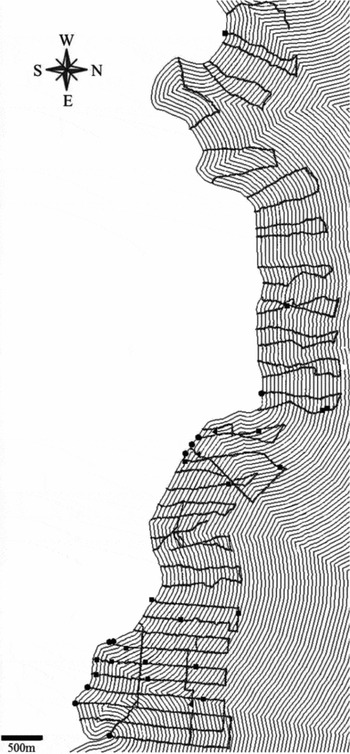
To estimate colony density and distribution across forest habitats 45 individual transects were walked one-sided perpendicular to the northern forest edge along the main road. Transect length was on average 2.36 (±0.71) km and a total of 130 km of transect was walked during a single survey period (March–April 2010). Transect entrances were set 200 m apart and, wherever possible, narrow understorey foot trails were used (Figure 1). Given a fixed belt width of 10 m to each side (as used by Jaffe & Vilela Reference JAFFE and VILELA1989, Wirth et al. Reference WIRTH, BEYSCHLAG, RYEL, HERZ and HÖLLDOBLER2003, Reference WIRTH, MEYER, ALMEIDA, ARAUJO, BARBOSA and LEAL2007), the transects amounted to a total area of 260 ha sampled, in which all LCA colonies of the genus Atta were recorded and assigned to species level. Colonies and forest habitats were mapped using a GPS-receiver (GPSmap 60CSx, Garmin Ltd., Olathe, KS, USA) set on averaging mode, resulting in an estimated resolution better than 5 m. Spatial data were compiled in a geographic information system (ArcView GIS 3.2, Environmental Systems Research Institute, Redlands, CA, USA). The forest habitat was divided into 50-m distance zones parallel to the forest border line. Transects were intersected with these distance zones, resulting in 842 sample areas (0.49 ± 0.29 ha), in which the density of adult colonies (as determined by the occurrence of a soldier caste) was estimated. Density scores were analysed using a Poisson GLM with colony density as the response variable and distance to the edge (50-m intervals) as a categorical explanatory variable as well as proximity to existing understorey foot trails as a binary explanatory covariate (i.e. a colony is either ≤10 m from a foot trail or ≥200 m away). For a measure of goodness of fit we used the pseudo-R2, which adopts the difference of null deviance and residual deviance divided by the null deviance. Following Zuur et al. (Reference ZUUR, IENO, WALKER, SAVELIEV and SMITH2009), we did not correct for underdispersion because model overfitting was not an issue (no outliers, few explanatory variables). Statistical analyses were conducted using the R software Package (R Development Core Team, http://www.R-project.org). Similar approaches have been adopted elsewhere (Zuur et al. Reference ZUUR, IENO, WALKER, SAVELIEV and SMITH2009).
Schematic overview of mapped Atta colonies along all transects (black lines) surveyed in this study. Triangles stand for A. cephalotes, squares for A. sexdens and circles for A. laevigata. Parallel lines indicate the 50-m distance zones from the forest border as used for density analysis.

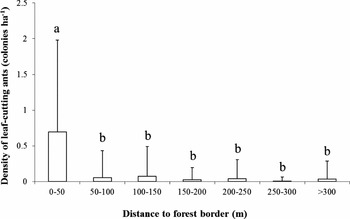
Overall we recorded 31 adult colonies of Atta spp. along transects, resulting in an average colony density of 0.12 colonies ha−1. The most abundant species was A. sexdens (L.), which accounted for 61.3% of all colonies. The other two species found in the area were A. laevigata (Smith) and A. cephalotes (L.), which accounted for 29% and 9.7% of the colonies, respectively. Altogether, the three species showed an almost 20-fold increase of colony density within the first 50 m of the forest as compared to edge distances >50 m into the forest (Figure 2). Colony density within the first 50 m was 0.69 ± 1.29 ha−1 and significantly higher than densities within other distance zones (Z = −3.87, P < 0.001). In the forest interior (>50 m distant to the border), colony density averaged 0.04 ± 0.26 ha−1 and was, thus, more than an order of magnitude lower than the respective values previously recorded in the Atlantic forest (1.01 ± 2.58 ha−1, Wirth et al. Reference WIRTH, MEYER, ALMEIDA, ARAUJO, BARBOSA and LEAL2007). Atta laevigata was only found in close proximity to the physical forest edge, while the other two species were found throughout the forest. Moreover, colonies were significantly (Z = 3.80, P < 0.001) more abundant in the close vicinity of understorey foot trails with an average density of 0.12 ± 0.54 ha−1 vs. 0.04 ± 0.33 ha−1 away from them. Our model, although based on only two spatially related variables, explained 39% of the variation in colony density.
Mean colony density (+ SD) of leaf-cutting ants (Atta spp.) in seven distance zones paralleling the forest border at the Biological Dynamics of Forest Fragments Project (BDFFP) in central Amazonia, Brazil. Different letters indicate significant differences (P < 0.05) among distance zones. The number of sample areas was 45 for each distance zone up to 300 into the forest; the distance zone > 300 m into the forest was sampled 612 times.

The distribution of Atta colonies across the BDFFP landscape was in accordance to our expectations and suggests that edge-related proliferation of Atta spp. may be a widespread phenomenon as LCAs benefit from forest fragmentation overcoming landscape singularities regarding matrix type, forest cover and historic human disturbances (i.e. aging vs. newly fragmented landscapes). Our results also indicate that small-scale disturbances, such as those by foot trails, are enough to trigger a positive response in colony numbers. In fact, while colony density in the Amazon showed a >17-fold increase within the first 50 m, it rose almost three-fold close to foot trails as well. Finally, the BDFFP findings suggest that some Atta species (e.g. A. laevigata), although able to inhabit undisturbed forests, are in fact poorly adapted to this habitat, while having a high potential to proliferate across edge-affected habitats.
Although we merely obtained a snapshot of the colony distribution in the BDFFP landscape, it is likely that such increased abundance along forest edge zones persists or even increases as already documented in the Atlantic forest (Meyer et al. Reference MEYER, LEAL and WIRTH2009), as well as across Amazonian secondary forest patches (Vasconcelos & Cherrett Reference VASCONCELOS and CHERRETT1995) and at roadsides (Vasconcelos et al. Reference VASCONCELOS, VIEIRA-NETO, MUNDIM and BRUNA2006). Apart from nesting site preferences of founder queens for open habitats (Vasconcelos Reference VASCONCELOS1990), LCA proliferation has been proposed to result from relaxation of food limitation, via increased abundance of palatable pioneer plants (i.e. bottom-up regulation; Farji-Brener Reference FARJI-BRENER2001, Urbas et al. Reference URBAS, ARAÚJO, LEAL and WIRTH2007), and population control through predators and parasites (i.e. top-down regulation; Almeida et al. Reference ALMEIDA, WIRTH and LEAL2008, Terborgh et al. Reference TERBORGH, LOPEZ, NUNEZ, RAO, SHAHABUDDIN, ORIHUELA, RIVEROS, ASCANIO, ADLER, LAMBERT and BALBAS2001). Accordingly, cross-forest differences in colony density or proliferation level (e.g. Atlantic vs. Amazonian forest) may be largely governed by differences in population controls. Much of the Atlantic forest landscape now consists of relictual and edge-dominated forest (<15% of forest cover), in which edge-affected habitats support pioneer-dominated plant assemblages; i.e. nearly 80% of tree species and stems (Santos et al. Reference SANTOS, PERES, OLIVEIRA, GRILLO, ALVES-COSTA and TABARELLI2008); these landscapes have also experienced complete extirpation of medium- and large-sized vertebrates as forest conversion into human-modified landscapes dates back to the 16th century (Silva & Tabarelli Reference SILVA and TABARELLI2000). In the opposite extreme of alteration, the BDFFP landscape is still largely dominated by pristine forests (>90% of forest cover) with their old-growth (less palatable) flora and the whole spectrum of baseline fauna (Laurance et al. Reference LAURANCE, LOVEJOY, VASCONCELOS, BRUNA, DIDHAM, STOUFFER, GASCON, BIERREGAARD, LAURANCE and SAMPAIO2002, Stouffer & Borges Reference STOUFFER, BORGES, Bierregaard, Gascon, Lovejoy and Mesquita2001). It is thus a plausible consequence that colony density is still lower in this Amazonian landscape than in the Atlantic forest interior (Wirth et al. Reference WIRTH, MEYER, ALMEIDA, ARAUJO, BARBOSA and LEAL2007), but this cross-forest difference is likely to diminish as edge-affected habitats encroach pristine forest, suitable nesting sites become more frequent, pioneer plants proliferate and defaunation proceeds (Laurance et al. Reference LAURANCE, LOVEJOY, VASCONCELOS, BRUNA, DIDHAM, STOUFFER, GASCON, BIERREGAARD, LAURANCE and SAMPAIO2002).
Leaf-cutting ants (species of Atta and Acromyrmex) are prevalent herbivores cutting up to 15% of the standing leaf crop in their foraging areas (Urbas et al. Reference URBAS, ARAÚJO, LEAL and WIRTH2007), which, in the case of tropical forests, alters light availability and promotes environmental heterogeneity (Farji-Brener & Illes Reference FARJI-BRENER and ILLES2000, Wirth et al. Reference WIRTH, BEYSCHLAG, RYEL, HERZ and HÖLLDOBLER2003). Additionally, LCA activities alter soil and microclimate properties with tangible effects on plant recruitment and the successional trajectory of forest patches (Bieber et al. Reference BIEBER, OLIVERIA, WIRTH, TABARELLI and LEAL2011, Corrêa et al. Reference CORRÊA, SILVA, WIRTH, TABARELLI and LEAL2010, Farji-Brener & Illes Reference FARJI-BRENER and ILLES2000, Meyer et al. Reference MEYER, LEAL, TABARELLI and WIRTH2011). With LCA proliferation such activities and their cascading impacts are likely to affect the functioning of human-modified landscapes through unprecedented rates and via new ecological roles. We therefore urge further studies to explore the forces driving ant proliferation and its consequences, the plurality of possible outcomes, and the shifting ecological role played by LCAs (i.e. traditional vs. novel roles) as landscape alterations by human populations proceed.
ACKNOWLEDGEMENTS
This study was supported by the DAAD (project D/06/33907 to RW) in a Brazil-Germany collaboration project (PROBRAL, CAPES/DAAD). We wish to thank José Luis Camargo and his staff at the BDFFP-INPA for providing infrastructure and logistic support during the field work. We are grateful to José Francisco Andes Junior, João de Deus Fragata Farias and Antonio Cardoso do Nascimento for their help in the field.