Infants and young children reared in institutions typically display marked deficiencies in development, and then substantial catch-up growth once placed in families. With a few notable exceptions, most of this research literature compares internationally adopted children's development with that of noninstitutionalized (NI) children in the adoptive country. The current study is one of the few in which postinstitutionalized (PI) children were placed in families within their birth country in accord with local practices and compared to domestic NI children reared by their parents from birth as a function of age at placement and type of family.
Institutions and Children's Development
An estimated 2–8 million children reside in institutions worldwide (Save the Children, 2009; USAID, 2009). The rearing environment in most institutions for infants and young children is not very supportive of their development. Although institutions vary in quality, many reports indicate that children tend to be housed in relatively large groups (Ns = 9–16 but up to 50+) of similarly aged children; children to caregiver ratios are high (6–8+ children per caregiver); there are many and changing caregivers who may work long shifts (24 hr) and then are off for 3 days; and children may be moved periodically to different wards with new caregivers and peers (Rosas & McCall, Reference Rosas and McCall2011; van IJzendoorn et al., Reference van IJzendoorn, Palacios, Sonuga-Barke, Gunnar, Vorria and McCall2011). In one study (St. Petersburg–USA Orphanage Research Team, 2008), children saw 50–100 different caregivers in the first 19+ months of residency.
On average, children develop poorly in these institutions. The mean height, weight, and head circumference as well as general behavior/mental development is 1 to 1.5 SD below US standards (van IJzendoorn, Bakermans-Kranenburg, & Juffer, Reference van IJzendoorn, Bakermans-Kranenburg and Juffer2007; van IJzendoorn, Luijk, & Juffer, Reference van IJzendoorn, Luijk and Juffer2008; van IJzendoorn et al., Reference van IJzendoorn, Palacios, Sonuga-Barke, Gunnar, Vorria and McCall2011). In some cases, children's developmental status is worse, and nearly half the children may fall below the lowest 10th percentile of US children on these measures (Groark, McCall, Fish, & the Whole Child International Team, Reference Groark, McCall and Fish2011; McCall, Reference McCall2013).
When children are transitioned out of such institutions, usually to be placed in adoptive homes in Western Europe and North America, they display immediate and substantial catch-up growth in most physical and behavioral/mental domains (van IJzendoorn & Juffer, Reference van IJzendoorn and Juffer2006). However, such catch-up may not be complete depending on the age at adoption (often a surrogate index of length of institutional residence), the severity of institutional deprivation, and the age at which the follow-up assessments are conducted (Julian, Reference Julian2013; McCall, Reference McCall2011, Reference McCall2013; Zeanah, Gunnar, McCall, Kreppner, & Fox, Reference Zeanah, Gunnar, McCall, Kreppner and Fox2011). Although the literature is full of exceptions, the general tendency is for developmental deficiencies or problems to occur at higher than expected rates for children placed at older rather than younger ages. However, the “older age” at adoption may be as young as 6 months for children leaving extremely depriving institutions such as the 1990s Romanian orphanages (Kreppner et al., Reference Kreppner, Rutter, Beckett, Castle, Colvert and Groothues2007), approximately 18 months for those departing less severe institutions such as those in Russia (Hawk & McCall, Reference Hawk and McCall2011; Merz & McCall, Reference Merz and McCall2010, Reference Merz and McCall2011; Merz, McCall, & Groza, Reference Merz, McCall and Groza2013), and perhaps 24–27 months or later for children from the relatively better institutions of China and South Korea (Merz, McCall, & Groza, Reference Merz, McCall and Groza2013).
Issues in Deinstitutionalization
Given these research results, virtually everyone subscribes to the goal of having every child live in a permanent, loving family, and many national and international organizations and advocacy groups are pushing for this reform (e.g., US Government, 2012). Although some countries have made substantial progress deinstitutionalizing in a relatively few years (Greenberg & Partskhaladze, Reference Greenberg and Partskhaladze2014), achieving this standard may take some other low-resource countries many years, even decades (Engle et al., Reference Engle, Groza, Groark, Greenberg, Bunkers and Muhamedrahimov2011; Groza, Bunkers, & Gamer, Reference Groza, Bunkers and Gamer2011; McCall, Reference McCall2011). Besides cultural, historical, religious, financial, and political challenges, some countries have a variety of policies and procedures that lengthen the time it takes for a child to be eligible to be placed into a family. The result is that children in many countries will be sent to an institution as a “half-way house” until placement in a family can be formalized. Given the above research, this can be potentially harmful to the child, depending on the quality of the institution and the length of time the child spends there before transferring to a family. Further, many countries lack a professional social work infrastructure to select, train, and support the parents who will take such children, and the quality of care in families will undoubtedly relate to the children's development. These are the practical issues that stimulated the current report.
Quality of the Institutions in the Current Study
As noted above, the quality of the institution can affect children's longer term outcomes, especially in interaction with the age at placement into a family. Institutions do not have to operate in the manner described above (Groark & McCall, Reference Groark and McCall2011a, Reference Groark and McCall2011b), and research coalesces on the proposition that the quality of caregiver–child interactions contributes to children's development over and above nutrition, sanitation, and medical care (McCall, Reference McCall2011; Rutter & Sroufe, Reference Rutter and Sroufe2000). The current study builds on one of the most comprehensive institutional interventions in the literature (St. Petersburg–USA Orphanage Research Team, 2008) using regular staff that improved the physical and behavioral/mental developmental status of resident infants and young children.
Specifically, three institutions for children birth to 4 years, called Baby Homes (BHs), in St. Petersburg, Russian Federation, participated in this quasi-experimental study. One received training and structural changes (T+SC). Training of staff consisted of 12–14 sessions for a total of approximately 60 hr that promoted warm, sensitive, contingently responsive caregiver–child interactions. Training was accompanied by supervision and coaching on the ward. Structural changes were designed to support caregiver–child interactions and relationships. They included reducing group sizes, reducing the number of caregivers per group and having them work more consistently throughout the week, integrating groups by ages and disability status of children, stopping periodic graduations to new groups, and initiating family hour twice daily in which visitors and specialists were barred from the wards and children were to be alone with their caregivers. No changes were made in nutrition, sanitation, safety, or medical care. A second BH received training only (TO) initially but some structural changes in some wards later, and a third BH conducted business as usual with no intervention (NoI).
Caregivers in T+SC improved their interactions with children on the wards, and T+SC children increased in physical growth (i.e., height, weight, and head circumference), social–emotional development and attachment to caregivers, and general behavioral/mental development relative to TO and NoI children. For example, T+SC children's average Battelle Developmental Inventory Developmental Quotients rose from 57 to 92, and improvements increased the longer children were in the T+SC intervention. Moreover, the intervention and its benefits for children have been maintained for at least 6 years (McCall et al., Reference McCall, Groark, Fish, Muhamedrahimov, Palmov and Nikiforova2013). Similar improvements have been associated with other social–emotional interventions (e.g., Groark et al., Reference Groark, McCall, McCarthy, Eichner, Warner and Salaway2013; McCall et al., Reference McCall, Groark, Fish, Harkins, Serrano and Gordon2010) and a randomized trial of a professional foster care intervention (Nelson et al., Reference Nelson, Zeanah, Fox, Marshall, Smyke and Guthrie2007).
The Current Study
The current study builds on a previous follow-up report (McCall, Muhamedrahimov, et al., Reference McCall, Muhamedrahimov, Groark, Palmov, Nikiforova and Salaway2014) that focused on possible differences between children from these three intervention BHs after they had transitioned to families in St. Petersburg. There were remarkably few significant differences between parental ratings of children from these three intervention BHs, consistent with the literature demonstrating that children from unimproved institutions display substantial catch-up growth in nearly every domain in the early years following family placement (van IJzendoorn & Juffer, Reference van IJzendoorn and Juffer2006).
Because there were so few statistically significant differences among children from these three institutions, children from the three BHs were combined into a single group (BHcomb) in the current study and compared with a sample of NI Russian children reared from birth by their parents (P-R). BHcomb children had left the BH at an average of 24.7 months of age, resided with families for an average of 43.2 months, and were visited when the children were between 1.5 and 10.7 years of age. The issue was whether BHcomb children caught up to P-R Russian children or whether some effects of the institutional experience remained. The BHcomb versus P-R comparison was examined as a function of the age at family placement, a surrogate for time in the BH, and whether children were transitioned to families of relatives or nonrelatives.
This study is one of the few to follow PI children into domestic families (see Tizard & Rees, Reference Tizard and Rees1974, Reference Tizard and Rees1975). The Bucharest Early Intervention Project (Nelson et al., Reference Nelson, Zeanah, Fox, Marshall, Smyke and Guthrie2007) also compared PI children with domestic parent-reared comparison children, but the PI children were placed into high-quality foster parent families, not untrained and unsupported families.
Age at placement
As noted above, rates of developmental deficiencies and problems are higher in Russian PI children adopted by US parents after 18 months of age (Hawk & McCall, Reference Hawk and McCall2011; Julian, Reference Julian2011; McCall, Reference McCall2013; Merz & McCall, Reference Merz and McCall2010). Consequently, the BHcomb children were divided into early and late placement groups (i.e., <18 months vs. ≥18 months) to determine if longer BH residencies were associated with larger differences between BHcomb versus P-R children.
Postinstitutional family types
The type of family to which PI children are transferred may make a difference in their subsequent development; certainly socioeconomic differences are related to many aspects of parent-reared US children's development (e.g., McLoyd, Reference McLoyd, Sigel and Renninger1998). A review of mainly nonexperimental studies suggests that children who were adopted develop best, children who were reunited with biological parents developed poorest, and fostered children were intermediate between these two groups (Julian & McCall, Reference Julian and McCall2011). These differences may not only reflect differences in resources, parenting, and the quality of caregiver–child interactions and relationships between these family types but also could be associated with developmental differences between children prior to placement (i.e., selective placement).
This is an important issue in international child welfare and the movement away from institutionalization toward family alternatives. There is sometimes a tendency to assume that any family is better than any institution (e. g., Moore & Moore, Reference Moore and Moore1977), and to ignore the proposition that the quality of care remains important within as well as between types of rearing environments (McCall & Groark, Reference McCall and Groark2015; Muhamedrahimov et al., Reference Muhamedrahimov, Agarkova, Vershinia, Palmov, Nikiforova and McCall2014; St. Petersburg–USA Orphanage Research Team, 2008; Tibu, Humphreys, Fox, Nelson, & Zeanah, Reference Tibu, Humphreys, Fox, Nelson and Zeanah2014). Consequently, children in the current study were placed into several types of families that were categorized into relatives (Rel.) versus nonrelatives (NonRel.; see below). These groups are known to differ on general indices of socioeconomic status and likely to differ on caregiver–child interactions (McCall, Groark, et al., Reference McCall, Groark, Fish, Muhamedrahimov, Palmov and Nikiforova2014), so children placed with relatives may develop less well than those in families of nonrelatives.
Russian P-R comparison group
Institutionalized children's development is often measured with instruments created in the United States and compared to US standardization samples. This strategy permits one to convert measurements to difference quotients, T scores, or z scores that are independent of age so children of different ages can be analyzed together. However, US standards are also used to determine the percentage of borderline/clinical cases or whether children are developing “typically,” at least relative to non-PI children in the United States. This is often justified because such standardization samples are usually not available for children in their birth country. However, such a comparison may be inappropriate if parent-reared children in that country deviate from the US standards. Therefore, a parent-reared comparison group obtained in the same country may be preferred, but there are few such reports in the literature, with the notable exception of the Bucharest study of children transferred to a professional foster care intervention (Nelson et al., Reference Nelson, Zeanah, Fox, Marshall, Smyke and Guthrie2007) and a pilot study of Russian BH and P-R children (Muhamedrahimov et al., Reference Muhamedrahimov, Agarkova, Vershinia, Palmov, Nikiforova and McCall2014). In the current study, the BHcomb children were compared with a sample of Russian P-R children, which controls for possible cultural influences.
Developmental domains of interest
Parental reports of the adjustment and development of children were obtained in four broad developmental domains that are commonly studied in the PI literature. Both mean scores and percent extreme scores (i.e., borderline/clinical; poorest 15%) were examined, because some studies have found larger PI versus non-PI differences for extreme scores (Hawk & McCall, Reference Hawk and McCall2011; Verhulst, Althaus, & Versluis-Den Bieman, Reference Verhulst, Althaus and Versluis-den Bieman1990).
Attachment and indiscriminate friendliness
Institutions typically lack the caregiver–child interactions thought to promote attachment (Bowlby, Reference Bowlby1951; Ainsworth, Reference Ainsworth1967), and institutionalized children have very high rates of disorganized attachments (Bakermans-Kranenburg et al., Reference Bakermans-Kranenburg, Steele, Zeanah, Muhamedrahimov, Vorria and Dobravo-Krol2011), including those children from the unimproved BH in the current study (St. Petersburg–USA Orphanage Research Team, 2008). PI children, especially those placed at older ages, become attached to their new parents more slowly and have less secure attachments than non-PI children (Chisholm, Reference Chisholm1998; Marcovitch et al., Reference Marcovitch, Goldberg, Gold, Washington, Wasson and Krekewich1997; O'Connor et al., Reference O'Connor, Marvin, Rutter, Olrick and Britner2003; Van den Dries, Juffer, van IJzendoorn, & Bakermans-Kranenburg, Reference Van den Dries, Juffer, van IJzendoorn and Bakermans-Kranenburg2009), although PI and non-PI differences can fade with time in the family (Cohen & Farnia, Reference Cohen and Farnia2011). Thus, we hypothesized that BHcomb children would be rated as having poorer attachment than P-R children.
Indiscriminate friendliness (i.e., disinhibited social behavior) is very commonly reported among PI children, and it seems to persist for several years after placement in a family (Bruce, Tarullo, & Gunnar, Reference Bruce, Tarullo and Gunnar2009; Chisholm, Reference Chisholm1998; O'Connor, Rutter, & the English and Romanian Adoptees Study Team, Reference O'Connor and Rutter2000). Although the origins of indiscriminate friendliness among PI children are not clear (Bakermans-Kranenburg et al., Reference Bakermans-Kranenburg, Steele, Zeanah, Muhamedrahimov, Vorria and Dobravo-Krol2011; Soares, Belsky, Mosquita, Osorio, & Sampaio, Reference Soares, Belsky, Mesquita, Osorio and Sampaio2013), one possibility is that it is learned and rewarded within the institution and in families (Chisholm, Reference Chisholm1998; Chisholm, Carter, Ames, & Morrison, Reference Chisholm, Carter, Ames and Morison1995; McCall, Reference McCall2011). If so, we hypothesized that BHcomb children would be rated as more indiscriminately friendly than P-R children.
Social–emotional development and behavior problems
PI children, especially those adopted at older ages from more severely depriving institutions, have higher rates than non-PI children of a variety of social–emotional and behavior problems (Gunnar, Reference Gunnar, Nelson and Luciana2001; Hawk & McCall, Reference Hawk and McCall2010, Reference Hawk and McCall2011; Juffer & van IJzendoorn, Reference Juffer and van IJzendoorn2005; Julian, Reference Julian2013; MacLean, Reference MacLean2003). Thus, we expected BHcomb children to have higher problem scores.
Executive functioning
US parents of PI children, including Russian children, report them to have more difficulty with executive functioning skills, especially those children adopted at later ages (Merz & McCall, Reference Merz and McCall2010; Merz, McCall, & Groza, Reference Merz, McCall and Groza2013; Merz, McCall, Wright, & Luna, Reference Merz, McCall, Wright and Luna2013). Therefore, we hypothesized BHcomb children to be rated more poorly on assessments of impulsivity, inhibitory control, and attention focusing.
Age at placement and family type
The above hypotheses are reasonable if catch-up development during family placement is not sufficient to reach the levels typical of P-R Russian children. However, given the literature reviewed above, it was possible that BHcomb children transferred at older ages and those transitioning to relatives including their biological parent(s) would be rated more poorly than P-R children on each of these measures.
Method
Participants
BH sample
Details of the recruitment and characteristics of the sample of parents and their BH children can be found in Muhamedrahimov et al. (Reference Muhamedrahimov, Agarkova, Vershinia, Palmov, Nikiforova and McCall2014) and McCall, Groark, et al. (Reference McCall, Groark, Fish, Muhamedrahimov, Palmov and Nikiforova2014). All families of children who had spent at least 3 months in one of the three intervention BHs (St. Petersburg–USA Orphanage Research Team, 2008) and who departed for families in the St. Petersburg area during the intervention study and for 6 years thereafter were potentially eligible. A study of the BH environments and the developmental status of children at the time of their departure to families indicated that the differences produced by the interventions were maintained throughout the 6 years following the intervention (McCall et al., Reference McCall, Groark, Fish, Muhamedrahimov, Palmov and Nikiforova2013).
Social workers at each BH contacted 205 different families, approximately the same number from each of the three BHs; 149 (73%) participated, 15% refused, and 12% could not be located or the child was unavailable. This distribution was not different for the three BHs (p > .20). The final sample included 71 children from T+SC, 32 from TO, and 46 from NoI. Note that over all ages, the social workers were more successful at obtaining the cooperation of families receiving children from the most improved BH (i.e., T+SC), which constituted 48% of the BHcomb sample (although comparisons to P-R children were made separately for each of the three BHs).
The NonRel. group (N = 81) consisted of adoptive (N = 43), foster (N = 20), and “nonrelative kin” (N = 18), the latter category consisting of nonrelatives who wished to take a child sooner than regulations permitted for nonrelatives but did allow for kin. The Rel. group (N = 54) consisted of biological parent(s) (N = 41) and other relatives (N = 13), usually a grandmother. Family type could not be determined for 14 participants. A previous study (McCall, Groark, et al., Reference McCall, Groark, Fish, Muhamedrahimov, Palmov and Nikiforova2014) demonstrated that children transitioning to these two broad family types did not differ in birth circumstances or developmental status at departure from the BHs, minimizing any potential selective placement based on child status. Children were also categorized into those departing their BH before (younger; BH<18; N = 56) or after 18 months (older; BH>18; N = 91; 2 with missing data). Children had to have lived with their family for at least 12 months prior to assessment, and they were between approximately 1.5 and 10.7 years of age at the time of the assessments.
P-R sample
Posters and flyers soliciting parents to participate in the study were placed in two St. Petersburg children's pediatric clinics located in the same neighborhoods as the BHs. These “well-baby” clinics provide vaccinations and routine medical care to a broad range of the population; they do not offer behavioral or mental health services. These characteristics minimize selective sampling for parental socioeconomic status (see Table 1) and children's behavioral problems. Parents (N = 83) volunteered by phone. Their children were in the same age range as the BHcomb sample.
Sample characteristics

Note: BHcomb, All Baby Home children combined across the three BHs; BH<18, children who transitioned from BHs to families before 18 months of age; BH>18, children who transitioned from BHs after 18 months of age; Rel., relative group; Non-Rel., nonrelative group; P-R, children raised from birth in their biological families.
Sample characteristics
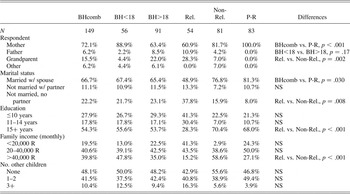
Because the total numbers would be too small if families were divided into all the possible cells in this study, the primary comparisons in this report were among BHcomb, BH<18, BH>18, relatives, and nonrelatives and P-R children. Characteristics of these groups are presented in Table 1, and significant differences are noted at the right. Notice that the total numbers are for the total maximum sample; the total numbers for any particular outcome variable are lower (see below) because each measure was appropriate for a specific age range and because of missing data.
The mother was the respondent for all the P-R children, which contributed to the significant difference on this characteristic between BHcomb and P-R. The mother was less likely the respondent for BH>18 and those placed with Rel.; in both cases, grandmothers were more prevalent. As expected, P-R respondents were more likely to be married and living with their spouses than in BHcomb, especially in Rel. families. Further, Rel. families had lower incomes and education than NonRel., but overall there were no significant differences in income or education between the BHcomb and the P-R group.
Assessments
All assessments originated in English, were translated by a professional translator who was also a psychologist, and checked by two bilingual psychologists (R.J.M. and O.I.P.). The ages of children were generally similar across subsample groups within an assessment, although children placed into families at older ages tended to be older at assessment. Age at assessment was covaried in all analyses of metric variables.
Attachment and indiscriminate friendliness
These assessments were given to parents of children who were 12–47 months of age (M = 29.1, SD = 8.2) at the time of the assessment, which included 42–48 BHcomb (28–33 BH<18 and 14–15 BH>18; 15–16 Rel. and 25–30 NonRel.) and 46–48 P-R children (the higher number in each case was for the attachment questionnaire).
Chisholm's Attachment Questionnaire (Chisholm, Reference Chisholm1998) consists of the 23 items from the Attachment Q-Sort (Waters & Deane, Reference Waters and Deane1985) that had the highest and lowest loadings on the security scale. Items were reworded slightly to improve clarity with the approval of Chisholm (personal communication, 2007). Parents responded to statements on a 5-point scale (1 = very unlike my child, 5 = very like my child).
Although the validity of the parent-reported Attachment Q-Sort has been questioned (van IJzendoorn, Vereijken, Bakermans-Kranenburg, & Riksen-Walraven, Reference van IJzendoorn, Vereijken, Bakermans-Kranenburg and Riksen-Walraven2004), the Chisholm short form discriminated between both Romanian PI (Chisholm, Reference Chisholm1998; Chisholm et al., Reference Chisholm, Carter, Ames and Morison1995), and Chinese PI children and Canadian non-PI children (Cohen & Farnia, Reference Cohen and Farnia2011), and PI and non-PI 54-month-old children rated as secure on a separation–reunion procedure had slightly higher Chisholm scores than those rated as insecurely attached (Chisholm, Reference Chisholm1998).
The internal consistency alpha in the current study was rather low across all respondents (0.32). Although this is lower than that reported in samples of PI children adopted into Canadian families (0.65–0.80; Chisholm, Reference Chisholm1998; Chisholm et al., Reference Chisholm, Carter, Ames and Morison1995), the low figure was similar for both BHcomb (0.39) and P-R (0.34) subsamples, suggesting the low figure was not random error. It should be noted that alpha reflects internal consistency, not necessarily test–retest reliability, so the low alpha suggests that the set of items represented more than one dimension of attachment that Russian parents judged to be rather uncorrelated.
Chisholm's Indiscriminately Friendly Behavior Questionnaire was given to the same parents (although some did not answer all the items and were omitted). It consists of five items relating to how friendly the child behaves with strange adults, whether the child is shy or wary around new adults, the child's behavior with new adults, whether the child tends to wander away from the parent, and whether the child is willing to go off with a stranger (α = 0.70). Raw scores were analyzed for both of the Chisholm scales, because no standardization sample exists and the age range of children was fairly narrow.
Social–emotional competences and behavior problems
Two questionnaires represented these behaviors, one for children under 5 years of age and another for older children.
Selected subscales of the Infant Toddler Social Emotional Assessment (ITSEA; Carter, Briggs-Gowan, Jones, & Little, Reference Carter, Briggs-Gowan, Jones and Little2003) were administered to parents of children 18–59 months of age. There were 55 BHcomb (32 BH<18 and 23 BH>18; 22 Rel. and 30 NonRel.) and 40 P-R. The aggression/defiant (12 items) and negative emotionality (13) subscales represented the externalizing and internalizing domains respectively, but all of the competencies subscales were included to complement the problem behaviors assessed at older ages by the Child Behavior Checklist (CBCL; see below). Competencies included compliance (8), imitation/play (6), mastery motivation (6), empathy (7), prosocial peer relations (5), and attention (5). Parents responded whether a statement was rarely/not true (0), sometimes true (1), or often/very true (2) of their children (or no opportunity to judge = 0). Alphas across all parents were 0.75 for aggressive/defiant, 0.83 for negative emotionality, and 0.83 for the competence broadband (subscales ranged from 0.57 to 0.77).
Scores were converted to standardized z scores (M = 0, SD = 1.00) based on the US standardization sample (Carter & Briggs-Gowan, Reference Carter and Briggs-Gowan2002). However, because some of the current children were older than 48 months (the oldest age of the standardization sample), the means and standard deviations for the 42- to 48-month standardization children were used to convert scores for older children because little change was observed in the standardization sample after 36 months of age.
Behavior problems were assessed for children 61–129 months with the complete CBCL 6–18 Years (Achenbach & Rescorla, Reference Achenbach and Rescorla2000). There were 81 BHcomb (21 BH<18 and 60 BH>18; 29 Rel. and 43 NonRel.), and 19 P-R families. Parents reported that statements were not true (0), sometimes true (1), or often true (2) of their children. The CBCL provides a total score, an internalizing broadband score (consisting of subscales anxious/depressed, withdrawn/depressed, and somatic complaints), an externalizing broadband score (consisting of aggressiveness and rule breaking), plus subscales for attention, thought, and social problems. Alphas for the total were 0.91, 0.78, and 0.83 for the two broadband scales, and 0.57–0.69 for the three problem subscales. Scores were translated into T scores (M = 50, SD = 10) based on the US standardization sample; T scores for 6-year-olds were used for younger children.
Effortful control and attention
Three subscales from the Children's Behavior Questionnaire (CBQ; Rothbart, Ahadi, Hersey, & Fisher, Reference Rothbart, Ahadi, Hershey and Fisher2001) assessed impulsivity and inhibitory control, which we will collectively refer to as “effortful control,” and attentional focusing. There were 64 BHcomb (32 BH<18 and 32 BH>18; 24 Rel. and 39 NonRel.), and 40 P-R families of children 30–82 months of age. Parents responded on a 7-point scale for each of the 35 items corresponding to the extent to which that item was extremely untrue (1) to extremely true (7) of their children. Alphas were 0.56, 0.79, and 0.74 for the three subscales respectively. Scores were converted to z scores (M = 0.00, SD = 1.00) using the US standardization sample (Rothbart et al., Reference Rothbart, Ahadi, Hershey and Fisher2001).
Demographic information
This information was obtained in various units of measurement from the BH records and from the parent during the assessment. BHcomb children averaged 10.7 months (SD = 11.9) at BH intake, spent 419.8 days (SD = 333.7) in residence (~13.8 months), were transferred to families at 24.7 months (SD = 15.2), spent 1,318 days (SD = 653.0; ~43.2 months) in those families, and were assessed at 67.9 months (SD = 24.2) of age. More than half the children arrived at the BH before 6 months of age, 83% spent more than 6 months in residence, 62% were transferred to families after 18 months of age, and 78% spent more than 2 years in their family. There were no significant differences in these characteristics between children from the three different BHs (McCall, Muhamedrahimov, et al., Reference Muhamedrahimov, Agarkova, Vershinia, Palmov, Nikiforova and McCall2014).
Children were assessed between 1.5 and 10.7 years of age for the total BHcomb sample, but 78% were older than 4 years at assessment. In addition, this broad range was handled in several ways. First, the age range was much shorter for any individual assessment as noted above. Second, the age at placement dichotomy was highly related to age at assessment and thus this dichotomy indirectly examined effects of gross differences in age at assessment. Third, age at assessment was covaried within each analysis.
Procedure
BH social workers made initial contact with BH families to determine their willingness to participate. Assessors scheduled home visits with parents of BH children and parents who responded to the notices at the clinics. Two assessors visited the home; one assessor primarily administered the questionnaires to the parent and the other engaged the child(ren) during the visit. After getting acquainted and adjusted, the procedure was explained, questions were answered, and written consent was obtained. Parents responded to the questionnaires in writing or orally if necessary. At the end of the visit, the child was given an age-appropriate small toy (approximate value = US $10) and the parent was paid the equivalent of US $30.
Results
Analysis plan
The previous follow-up study (McCall, Muhamedrahimov, et al., Reference Muhamedrahimov, Agarkova, Vershinia, Palmov, Nikiforova and McCall2014) compared the same children from the three intervention BHs (T+SC, TO, and NoI) with each other after transitioning to families. There were relatively few significant differences, presumably indicating that children from NoI, who left their BH at developmentally lower status, had caught up to children from T+SC and TO during their stay in families. The issue in the current study was whether these BH children had caught up to P-R Russian children, so the primary comparison was between BHcomb (all BH children ignoring BH intervention condition) and P-R children with age at assessment as a covariate. However, children from the three BHs also were separately compared to P-R children using pairwise simple effects tests within a one-factor (T+SC, TO, NoI, P-R) analysis of covariance (ANCOVA; covariate/age at assessment). This was done to look specifically at P-R children versus BH children from the NoI institution, which represents most typical BHs in St. Petersburg, and to provide some degree of replication within the BHcomb group, albeit with smaller total numbers.
Similarly, pairwise simple effects tests were conducted within a one-factor (BH<18, BH>18, or P-R) ANCOVA to determine if each of the two age at placement groups were different from P-R children and within a one-factor (Rel., NonRel., or P-R) ANCOVA to assess whether children from each of the family types were different from P-R children. These analyses were assessments of “main effects” for these predictors; interactions among these factors, while potentially important, could not be evaluated very reliably because of small total numbers.
As noted above, sometimes higher percentages of PI versus non-PI children display extremely poor scores, regardless of whether mean differences exist between these groups. All the outcome measures except the Chisholm scales had US standardization samples available, and the percentage of children whose scores fell in the worst 15% (z more extreme than 1.035) for the ITSEA and CBQ and the worst 14% (T > 61; borderline plus clinical ranges) of the CBCL were determined. These percentiles were compared with chi-square tests only between BHcomb versus P-R (percentages for the small Ns in subsamples would be somewhat unreliable).
Finally, it was possible that these samples of Russian parents and children, especially the P-R group, might be different from the US standardization sample. To test for such possible differences, the BHcomb and the P-R samples (their mean, standard error, and N) were statistically compared to the US population means of 0 for z scores and 50 for T scores.
BHcomb versus P-R
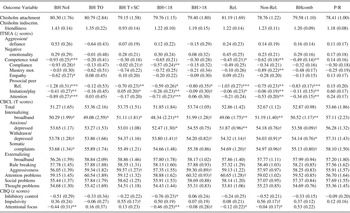
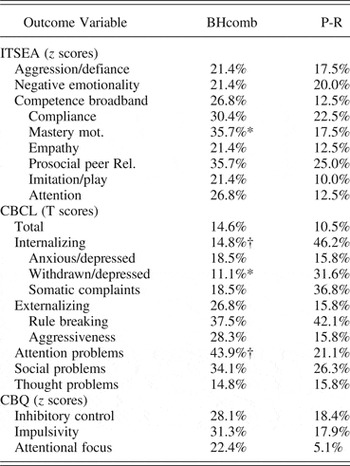
This study was primarily aimed at whether BH children, regardless of their intervention condition (i.e., BHcomb), caught up developmentally to P-R children or whether significant deficiencies remained after at least 1 year (average 43.2 months) in a domestic family. The means adjusted for age at assessment and standard errors for the BHcomb and P-R groups are presented in the right-most columns of Table 2. Significant differences between these two groups are indicated next to the BHcomb figures. Further, the three columns of data at the left are for the three individual BH intervention conditions, and statistical tests indicate whether each differed from the P-R group. It should be noted that higher mean scores reflect more of the named scale. That is, if the scale is an undesirable characteristic, higher scores are poorer; if the scale is a positive characteristic, higher scores are better. The percentages of extremely poor scores (regardless of whether the scale is a desirable characteristic or not) for BHcomb and P-R children are given in Table 3.
Adjusted means (standard errors) for BH groups and P-R children

Note: All means are adjusted for children's ages at assessment centered at its mean. Higher scores indicate more of the named variable. Thus, high scores for Attachment, all the ITSEA Competences, and the CBQ Inhibitory Control and Attentional Focus scales are “good.” BH, Baby Home; P-R, parent-reared children raised from birth in their biological families; BH NoI, no intervention BH; BH TO, training only BH; BH T+SC, training and structural changes BH; BH<18, children who transitioned from BHs to families before 18 months of age; BH>18, children who transitioned after 18 months of age; Rel., relative group; Non-Rel., nonrelative group; BHcomb, all BH children combined across the three BHs; ITSEA, Infant–Toddler Social Emotional Assessment; CBCL, Child Behavior Checklist; CBQ, Child Behavior Questionnaire.
†p < .10. *p < .05. **p < .01. ***p < .001. Statistical comparisons are with P-R children for each BH group.
Percentage of extremely poor scores

Note: BHcomb, All Baby Home children combined across the three BHs; P-R, children raised from birth in their biological families; ITSEA, Infant Toddler Social Emotion Assessment; Rel., relative group; CBCL, Child Behavior Checklist; CBQ, Child Behavior Questionnaire.
†p < .10. *p < .05. Between BHcomb and P-R.
Attachment and indiscriminate friendliness
There were no significant differences between BHcomb or any of the three individual BH groups on these two scales and P-R children. Although NoI had significantly more indiscriminate friendliness than T+SC (p = .009; one of the few differences between BHs), neither group was significantly different from the P-R group. The overall mean scores were very similar and not simply nonsignificant for lack of power. Apparently, a minimum of 1 year and an average of 43.2 months in a family postinstitutionally is sufficient for attachment to emerge and indiscriminate friendliness to be reduced, at least relative to P-R Russian children.
Social–emotional development (ITSEA)
Neither the aggressive/defiant (externalizing) nor negative emotionality (internalizing) subscales revealed differences between any BH group and P-R children. Again the means were fairly similar across all groups.
In contrast, on the ITSEA competencies total score, BHcomb children were rated as being significantly less competent overall, F (1, 91) = 9.20, p = .003, η2 = 0.09, than P-R children. This was especially clear for NoI children who were rated more poorly than the other two BHs (p < .05), which were also lower, but not significantly so, than P-R children. With respect to subscales within this domain, there were no significant differences with P-R children for BHcomb for compliance, mastery motivation, or empathy, although NoI was poorer on compliance and empathy. In contrast, BHcomb was rated as significantly poorer than P-R children on prosocial peer relations, F (1, 91) = 13.70, p < .001, η2 = 0.13, imitation/play, F (1, 91) = 9.28, p = .003, η2 = 0.09, and attention, F (1, 91) = 6.15, p = .015, η2 = 0.06, than P-R children, and this was especially true for NoI.
In terms of the percentage of extremely poor scores (Table 3), there were no significant differences, except that for mastery motivation BHcomb had more extremely poor scores (Table 3) but not mean scores (Table 2) than P-R children. Note, however, that although statistically significant differences were not observed, BHcomb had higher percentages of extreme scores than did P-R children on every ITSEA subscale, more than twice the P-R rates for four of the nine subscales, and more than twice the expected US rates on three subscales.
Thus, following a transition to families, young BH children, especially those from the unimproved NoI BH, were rated less competent than P-R children, especially on prosocial peer relations, imitation/play, and attention, which presumably represents a legacy of the institutional experience.
Problem behavior (CBCL)
For older children, BHcomb children's total problem score was not different from P-R children, but P-R children were rated as being more internalizing, F (1, 95) = 7.27, p = .008, η2 = 0.07, than each of the BH groups, and this was true (p < .10 to <.05) for BHcomb for each of the three internalizing subscales. One might have expected the PI children to display considerable internalizing behaviors, because of the insistence on compliance while residing in the BHs, but their scores were average relative to US standards (see below). In contrast, the internalizing scores for the P-R group were among the highest of any CBCL scale. Thus, this difference seems to be more associated with P-R Russian children being especially high rather than PI children being low on internalizing.
No general or specific differences were observed for externalizing behaviors or attention, social, and thought problems. In terms of the percent of children with extremely poor scores (Table 3), the trends were in the same direction as the mean scores, although significance levels were not as consistent.
Effortful control and attention (CBQ)
There were no BHcomb differences with P-R children for the effortful control subscales of inhibitory control or impulsivity, but BHcomb children had poorer attentional focusing skills than did P-R children, F (1, 102) = 4.40, p = .038, η2 = 0.04, and this was especially true for NoI children. Although there were no significant differences for the CBCL attention problems, BH children had their highest (worst) score on this CBCL subscale (but P-R children also had a high score), and a larger percentage of BHcomb children (43.9%) had extremely poor scores on CBCL attention problems, twice the percentage of P-R children.
Age at placement
The means and standard errors for younger (BH<18) and older (BH>18 months) transitioned BH children and the significance levels of those means tested separately against the P-R group are presented in Table 2.
Attachment and indiscriminate friendliness
There were no significant differences for either outcome variable between BH<18 and BH>18 compared with P-R children.
Social–emotional development (ITSEA)
There were no differences with P-R children for BH<18 and BH>18 for the aggression/defiance or the negative emotionality subscales. Generally, BHcomb children were rated significantly lower on the competencies broadband than were P-R children, but while both BH<18 and BH>18 had poorer means, neither was significantly lower, presumably partly because of reduced statistical power. Conversely, the generally poorer performance of BHcomb children on prosocial peer relations, imitation/play, and attention tended to be true for both BH<18 and BH>18 children, but attention was especially poor for the BH<18, contrary to expectations.
With respect to extreme scores, there were no significant differences between BH<18 and BH>18 or between BH>18 and P-R children on any subscale. However, contrary to expectations, BH<18 had a significantly higher percentage of extreme scores (43.8% vs. 17.5%) for mastery motivation, χ2 (1) = 5.93, p = .015, and for attention (31.25% vs. 12.5%), χ2 (1) = 3.79, p = .05. Both these results were consistent with large mean differences (significant in the case of attention).
Behavior problems (CBCL)
The tendency for BHcomb children to have lower (better) ratings than P-R children for internalizing was true (p < .10 to .05) for both BH<18 and BH>18 children, but significance levels were weaker because of reduced power. Notice that the means for BH>18 children are higher (worse) than those for younger placed children, although not statistically significantly so, on all but one of the CBCL scales.
With respect to extreme scores (worst 14% United States), there were no significant differences in these rates between BH<18 and BH>18, but there were a few significant comparisons with P-R children that were consistent with the mean differences reported above. Specifically, for the internalizing broadband, BH<18 children were less likely to be extreme (4.8%; not shown in Table 3) than were P-R (46.2%), χ2 (1) = 4.97, p = .026, but more BH>18 children had extremely poor attention problem scores (46.7%) than did P-R (21.1%) children, χ2 (1) = 3.93, p = .047.
Effortful control and attention
BHcomb children were rated lower on attentional focus (see above), and this was primarily associated with lower scores for BH<18. Further, BH<18 had a significantly larger percentage of extremely poor scores (29.4%) than did P-R (5.1%), χ2 (1) = 5.45, p = .020, although again the very small percentage for P-R children contributed to this result.
Family type
Means and standard errors for BH children transferred to families of Rel. versus NonRel. are presented in Table 2 plus the level of significance for tests comparing these means with those of P-R children. Generally, although significance levels varied somewhat, the results obtained for BHcomb are present in both Rel. and NonRel. groups. Percentages of extreme scores were similar; results were sometimes significant for Rel. and at other times for NonRel., with no consistent pattern for one or the other group. Therefore, generally, there were no systematic differences between family types versus P-R children.
Russian versus US standards
Mean CBCL scores (but not ITSEA scores) for the Russian P-R group (Table 2) were uniformly statistically higher (i.e., poorer) than for the US standardization samples (mean of 50). This is one of the few studies to make such a comparison for children under 10.7 years.
Discussion
The literature on PI children placed into families shows that they display immediate and substantial catch-up growth in most developmental domains (Bakermans-Kranenburg et al., Reference Bakermans-Kranenburg, Steele, Zeanah, Muhamedrahimov, Vorria and Dobravo-Krol2011; van IJzendoorn et al., Reference van IJzendoorn, Bakermans-Kranenburg and Juffer2007; van IJzendoorn & Juffer, Reference van IJzendoorn and Juffer2006). However, deficiencies and problems occur in some children, especially, but not exclusively, those from more severely depriving institutions, those placed at older ages, and those assessed during adolescence (e.g., Julian, Reference Julian2013; McCall, Reference McCall2013; Rutter et al., Reference Rutter, Sonuga-Barke, Beckett, Castle, Kreppner and Kumsta2010). This literature primarily pertains to children from a variety of institutions, some severely deficient, who were adopted out of their birth countries into advantaged families in Western Europe and North America.
The current study focused on children from institutions in the Russian Federation, which tend not to be globally deficient but are limited primarily in the social–emotional character of their environments, who are then transitioned to different kinds of families in the Russian Federation that were not given special training. The primary question was whether they would catch up developmentally or show some residual effects of institutionalization when compared to Russian P-R children. PI children resided in one of three BHs for at least 3 months but averaged 13.8 months and were studied as a combined group (BHcomb). They were placed with different types of families (Rel. vs. NonRel.) for at least 1 year, but 43.2 months on average. Parents of both BHcomb and P-R samples responded to questionnaires when these children were between 1.5 and 10.7 years of age.
Attachment and indiscriminate friendliness
PI children have been reported to take longer to form attachment relationships and are less likely to form secure attachments than are parent-reared children (Chisholm, Reference Chisholm1998; Marcovitch et al., Reference Marcovitch, Goldberg, Gold, Washington, Wasson and Krekewich1997; O'Connor et al., Reference O'Connor, Marvin, Rutter, Olrick and Britner2003), especially children placed after 12 months of age (Van Den Dries et al., Reference Van den Dries, Juffer, van IJzendoorn and Bakermans-Kranenburg2009). PI children also tend to display more indiscriminate friendliness (Bruce et al., Reference Bruce, Tarullo and Gunnar2009; Chisholm, Reference Chisholm1998; O'Connor et al., Reference O'Connor and Rutter2000). However, in the current study, there were no BHcomb versus P-R differences in attachment or indiscriminately friendly behavior. This may be because children had spent 43.2 months on average in their families, which some studies (e.g., Altenhofen, Clyman, Little, Baker, & Biringen, Reference Altenhofen, Clyman, Little, Baker and Biringen2013; Smyke, Zeanah, Fox, Nelson, & Guthrie, Reference Smyke, Zeanah, Fox, Nelson and Guthrie2010) indicate is sufficient time for typical attachment behavior to develop despite earlier BH experience.
Early social–emotional competence
In contrast, BHcomb children 18–59 months of age were rated to be generally less competent on the ITSEA, particularly with respect to prosocial peer relations, imitation and play, and attention, and this was especially clear for children from the more typical unimproved BH (i.e., NoI), who were also rated as being poorer on compliance and empathy. Although not significant, BHcomb had higher percentages of extremely poor scores than did P-R children on every ITSEA scale and more than twice the P-R rates on four of nine scales. Given the relative lack of caregiver–child social–emotional interactions in typical institutions, especially in the NoI BH, it is not surprising that PI children would have certain diminished early social–emotional competencies.
Problem behaviors
For older children, there were few differences between BHcomb and P-R children on CBCL assessed problem behaviors, except that P-R children were rated by their parents as being extremely high on internalizing behaviors of all kinds. It is not clear why P-R children should be rated so high on internalizing, although Pleshkova and Muhamedrahimov (Reference Pleshkova and Muhamedrahimov2010) found a different sample of parent-reared infants to have high rates of complex and insecure A-type attachment behaviors that might lead to later internalizing problems (Muhamedrahimov et al., Reference Muhamedrahimov, Agarkova, Vershinia, Palmov, Nikiforova and McCall2014).
The relative lack of higher levels of other problem behaviors among BHcomb children at both younger and older ages of assessment appears to conflict with the literature that reports PI children to have a variety of problem behaviors at higher rates than parent-reared children, especially during adolescence (Hawk & McCall, Reference Hawk and McCall2010; Juffer et al., Reference Juffer, Palacios, LeMare, Sonuga-Barke, Tieman and Verhulst2011; Juffer & van IJzendoorn, Reference Juffer and van IJzendoorn2005; Julian, Reference Julian2013), even in studies using domestic parent-reared comparison groups (e.g., Zeanah et al., Reference Zeanah, Egger, Smyke, Nelson, Fox and Marshall2009). However, not all studies find more behavioral problems in PI children (e.g., Rutter, Kreppner, & O'Connor, Reference Rutter, Kreppner and O'Connor2001), the comparability of the control condition may make a difference (Hodges & Tizard, Reference Hodges and Tizard1989), and even when more problems are found, the effect sizes may be small (Juffer & van IJzendoorn, Reference Juffer and van IJzendoorn2005). In addition, the current study compared PI children with a domestic P-R sample, whereas most of the literature has used some comparison with children in a Western adoptive country; had the current PI sample been compared with a US parent-reared group, there would have been more CBCL problem behaviors for BHcomb. Thus, the current study is actually relatively consistent with the literature in showing substantial adaptation to family life and a very modest tendency toward more behavioral problems of some kinds among young Russian PI children when compared with domestic parent-reared children and especially compared with US norms. Further, because all the children in the current study were 10.7 years of age or younger, it is possible that higher rates of problem behaviors may emerge in these children during adolescence.
Attention
One of the clearer persistent effects of institutionalization in this study is the higher rates of attention problems among BHcomb children. BHcomb had poorer attention scores than P-R children on the ITSEA and CBQ, with NoI children rated especially poorly. Further, BHcomb children had their worst mean score and a very high percentage of extremely poor scores (43.9%) on the attention problems subscale of the CBCL, even though they were not significantly worse than P-R children. Collectively, these findings appear consistent with the literature that shows attention and activity problems to be common among PI children, even during early childhood (Hawk & McCall, Reference Hawk and McCall2011) and especially for children from the most severely deficient institutions (Julian, Reference Julian2013; Rutter et al., Reference Rutter, Beckett, Castle, Colvert, Kreppner and Mehta2007, Reference Rutter, Sonuga-Barke, Beckett, Castle, Kreppner and Kumsta2010). That attention problems occur early and consistently in PI children may be related to atypical brain development, especially in the prefrontal cortex and hippocampus, which has been reported for some PI children and is related to deficits in executive function and perhaps attention control (Nelson, Bos, Gunnar, & Sonuga-Barke, Reference Nelson, Bos, Gunnar and Sonuga-Barke2011).
Age at placement
Differences for age at placement into families were generally infrequent, despite a literature that shows such effects are fairly common in general (Julian, Reference Julian2013) and for Russian children in particular (Hawk & McCall, Reference Hawk and McCall2011; Merz & McCall, Reference Merz and McCall2010, Reference Merz and McCall2011; Muhamedrahimov et al., Reference Muhamedrahimov, Agarkova, Vershinia, Palmov, Nikiforova and McCall2014). An exception was that older-placed children had higher mean scores on all but one subscale of the CBCL than did children placed at younger ages, and they had an especially high percentage of extremely poor scores (46.7% vs. 21.1%) on the CBCL attention problems scale. In contrast and inexplicably, younger-placed children had poorer scores on the attention scales of the ITSEA and CBQ than did P-R children.
Family type
There were essentially no profound or consistent effects for the type of family to which BHcomb children transitioned (Rel. vs. NonRel.). This appears to be inconsistent with the expectation that children placed with relatives, who had lower education and income, would score less well than those placed with nonrelatives (Julian & McCall, Reference Julian and McCall2011). Of course, the family groups in the current study were not homogeneously biological parents versus adoptive parents, which would have been the most extreme contrast.
Russian versus US parent reared
There is no ready explanation for why Russian P-R children were rated by their parents to be substantially higher in CBCL problem behaviors than were US children. Parents of older Russian children report more CBCL problems than do US parents (Hellinckx, Grietens, & DeMunter, Reference Hellinckx, Grietens, DeMunter, Singh, Leung and Singh2000), but the reasons for cultural differences are unclear. For example, parents can interpret the questions or their children's behaviors differently, parents may have different expectations for their children's behaviors, and parents in some cultures may be more or less reluctant to report problems. In any case, this result suggests caution in applying US standards for the CBCL to children in other cultures.
Limitations
Although this study represents one of the few attempts to follow institutionalized children who have been placed into domestic families of different types and compare them with domestic parent-reared children, it is limited in several ways. First, the sample size is modest. It is certainly possible that interactions may exist among specific BHs, age at placement, and family type that could not be explored with our limited sample size. The results for age at placement, the occasionally lower scores for NoI, and a pilot study (Muhamedrahimov et al., Reference Muhamedrahimov, Agarkova, Vershinia, Palmov, Nikiforova and McCall2014) with very small N suggest such interactions are possible. However, means were often similar across BHs, BHcomb, and P-R samples, suggesting that some no-difference results were not simply because of low statistical power.
Second, the children were preadolescent, and the literature indicates a variety of problems can arise in adolescence, especially among Russian children placed into adoptive families after 18 months.
Third, this study relied on parental report. Much of the literature on PI children, with certain notable exceptions, has used parental report, especially for social–emotional and behavior problems (e.g., Julian, Reference Julian2013). The literature on using parental informants indicates that they are less likely to be biased than to understandably rely on their particular experience with the child (De Los Reyes et al., Reference De Los Reyes, Youngstrom, Pabon, Youngstrom, Feeny and Findling2011). Further, parental reports have a certain ecological validity based upon more extensive and varied experience with the child than could be obtained in a practical manner by independent observers. In addition, results from parent-report studies of PI children are not obviously and systematically different than those using more independent assessments.
Fourth, children were required to have spent a minimum of 3 months in the institution, which might have been too short a time for that environment to have influenced children's longer term development. However, the average residency was approximately 13.8 months, and even 4-9 months has been shown to produce substantial contemporary developmental differences (St. Petersburg–USA Orphanage Research Team, 2008).
Fifth, the Russian institutions in this study are deficient primarily with respect to caregiver–child interactions, although the quality of those interactions varied between the BHs and are not as deficient as some institutions in some studies. Further, 48% of the BHcomb sample over all ages came from the most improved BH (i.e., that was made more “family-like”), although children from the unimproved BH (i.e., NoI) were not often clearly more different from P-R children. Thus, the results of this study may not readily generalize to children from institutions of poorer quality.
Sixth, it is not clear which parents might volunteer for this study. Some parents may have refused because they did not want to risk breaking the secrecy of adoption, which is a policy in Russia. More important, parents may have been more likely to refuse participation if their child was not developing well or appropriately, fearing reprisals from the BH. If this factor operated, it would reduce differences between the BHcomb and the P-R groups.
Seventh, comparisons between PI and parent-reared children rest partly on the appropriateness of the parent-reared sample. Generally, there were no major differences in income and education between the groups and these characteristics were similar to those for the general population of St. Petersburg (http://www.bus.gov.ru/public/analystics/rosstat/rosstatedusummary/html).
Conclusion
Russian children who were institutionalized early in life and who then transitioned to Russian families for at least 1 year were reported by their parents to be similar during childhood on most measures to parent-reared Russian children. There were few effects for age at placement into families or whether families were relatives or nonrelatives. The relative lack of BHcomb versus P-R differences is consistent with other literature demonstrating remarkable catch-up growth in PI children after placement in families. However, lingering effects of institutionalization consisted of reduced competencies in young children and difficulties with certain attention skills. However, other studies have revealed higher rates of behavioral problems in children adopted at older ages and assessed during adolescence (e.g., Juffer et al., Reference Juffer, Palacios, LeMare, Sonuga-Barke, Tieman and Verhulst2011). These studies suggest that adjustment issues might arise at older ages. The results also indicated that Russian P-R children may deviate substantially from US children, especially on CBCL parent ratings, suggesting national or cultural differences of some sort and indicating caution in the use of the standards of one country in another.
Clinical implications
Despite substantial catch-up development, lingering effects of institutionalization can be seen in children, and longer term problems are suggested by some studies. Thus, institutional rearing still has the potential to produce longer term deficiencies and problems in children, especially those exposed to the institutions for longer periods of time.