Twenty-five years ago, two seminal publications (Castillo Butters and Donnan Reference Castillo Butters, Donnan, Makowski, Donnan, Bullon, Castillo, Canseco, Revoredo and Mena1994a; Shimada Reference Shimada1994) changed Moche (a.k.a. Mochica) studies by partitioning the archaeological culture into the Northern Moche, from the Jequetepeque Valley northward, and the Southern Moche, from the Chicama Valley southward. Regional specialists had long recognized that Moche archaeology was quite different in the two areas, so this defining of the two regions was generally accepted by most scholars.
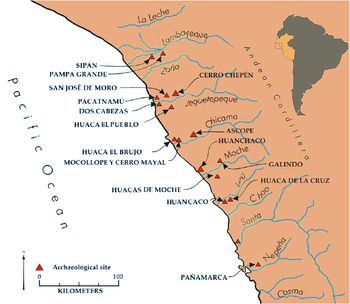
Before its separation into two regions, Moche was considered to be a single archaeological culture ranging from the Nepeña to the Chira Valleys (556 km), with the Moche and Chicama Valleys as its core region (Figure 1). It was not only considered a single archaeological culture but also viewed as a single state system based at the Huacas de Moche site in its eponymous valley; this view was promoted in the publications of Rafael Larco Hoyle (Reference Larco Hoyle2001), who founded modern Moche studies, and accepted as fact by subsequent scholars. Larco Hoyle's (Reference Larco Hoyle1948) uniform Moche concept was linked to his view of a standardized, five-phase ceramic chronology for Moche throughout the North Coast that was accepted until the early 1990s (see Castillo Butters and Quilter Reference Castillo Butters, Quilter, Quilter and B.2010). This chronology was considered so reliable that relatively few radiocarbon analyses were carried out for the Moche for many years.
Map of the North Coast of Peru with sites mentioned in the text. Adapted and modified from Castillo Butters and Quilter (Reference Castillo Butters, Quilter, Quilter and B.2010:2, Figure 1). (Color online)

After more than two decades, we now have new understandings of Moche (e.g., Castillo Butters and Uceda Reference Castillo Butters, Uceda, Silverman and Isbell2008; Quilter and Castillo Butters Reference Quilter and Castillo Butters2010) thanks to continued research, and consequently, a reexamination of the two-region theory is in order. This article contains such a reassessment, in which I suggest that available radiocarbon dates for temple centers, changes in mortuary pottery, and other data indicate that in an Early Moche period there was uniformity in ceremonial and other practices. This was succeeded in the late seventh into the eighth century AD by a Late Moche period during which differences between the Northern and Southern Moche regions are more sharply defined in the archaeological record. I suggest that some of these observed changes were related to the increasing influence of the Wari Empire, based in the southern highlands of Peru but extending its influence as far as the northern highlands and coast.
Moche Studies in the Early 1990s
The single most important event in Andean archaeology in the last 50 years arguably was Walter Alva's (Reference Alva1994, Reference Alva2015; Alva and Donnan Reference Alva and Donnan1994) discovery and excavation of the Sipán elite Moche tombs in the Lambayeque Valley. That occurred in 1987, with excavations of the main burials continuing until 1990. The Sipán discoveries came as a shock to many archaeologists who had not expected such political power manifested by elaborate tombs and their contents at a relatively small provincial site; they also challenged many archaeologists’ understandings of Moche as an expansive state based at the Huacas de Moche.
At about the same time as the Sipán finds, Luís Jaime Castillo Butters and Christopher Donnan (Reference Castillo Butters, Donnan, Makowski, Donnan, Bullon, Castillo, Canseco, Revoredo and Mena1994a, Reference Castillo Butters, Donnan, Uceda and Mujica1994b) were determining that the five-phase Larco ceramic sequence was not applicable to local ceramic styles at San José de Moro and at other Moche sites north of the Pampa de Paiján, the broad desert separating the Chicama and Jequetepeque Valleys. Consequently, they proposed a different ceramic chronology organized as Early, Middle, and Late Moche periods, with a Transitional period later added and with all periods except for Early Moche subdivided (Castillo Butters Reference Castillo Butters, Quilter and B.2010:93–95).
Castillo Butters and Donnan recognized that other northern valleys might have different ceramic sequences, but they avoided questioning the continued validity of the Larco sequence in the south. Their new view assumed that the different northern ceramic styles represented distinct polities, whereas Southern Moche was an expansive state based at the Huacas de Moche, as had been assumed and argued by scholars for decades (e.g., Moseley Reference Moseley1992; Uceda Reference Uceda, Quilter and Castillo2010). Similarly, focusing on the issue of political organization, Izumi Shimada (Reference Shimada1994:83, 85) suggested that the “Sipán enigma” undermined the single Moche state concept and that, instead, “the North Coast had two major polities of the same or related identity, concurrently evolving in the Lambayeque and the Chicama-Moche regions that shared the same stylistic tradition called Mochica.”
Thus, there was a shift from viewing a single Moche state spanning the North Coast to views of different Moche states, with various scholars seeing a single Moche style or two (or more) styles, focusing on pottery as representatives of state political systems. As a linchpin for understanding culture change, the ceramic chronology was held up against some of the few chronometric dates considered valid and, most importantly, a series of El Niño events and droughts in the seventh century based on interpretations of weather identified in the Quelccaya ice cap in southern Peru (Shimada Reference Shimada1994:249). This decades-long period of climatic instability was thought to have weakened the Moche state, leading to its collapse, possibly via conquest by the Wari state in Shimada's (Reference Shimada1994:254) view, a theory first proposed by Dorothy Menzel (Reference Menzel1964, Reference Menzel1977).
The concept of two Moche regions has remained in force since these pioneering studies and publications. But as is to be expected, our understandings of Moche have advanced in the quarter century since the two-region concept was first promoted. In particular, several additional elite Moche burials have been excavated or published more fully since that time. In general, there are more and varied datasets by which to consider what Moche was and how it changed; indeed, refinements of Moche ceramic styles in various valleys also have been made. We also have come to appreciate the complexities and difficulties of attempting to correlate ceramic styles with political systems, as well as with ethnic and other identities.
Reconsidering Moche Mortuary Ceramic Traditions
In many ways, the defining characteristic of the Moche archaeological culture has been its highly decorated pottery that seemed so standardized that it was thought to be the product of a “corporate” state system (see Quilter and Koons Reference Quilter and Koons2012). Furthermore, although much has been learned from detailed studies of the symbolism of painted surfaces and molded figures, virtually no attention has been given to a middle-range approach to fancier Moche pottery—here referred to as “fineware(s)”—that focuses on their forms. After all, there must have been some purpose in making, having, or giving a stirrup spout vessel instead of a bowl, or vice versa. Almost no studies (cf. Millaire Reference Millaire2002) have examined the patterning of the distribution of ceramic types or forms within cemeteries or regionally, a rather elementary and fundamental analytical procedure. We now have a sufficient number of scientifically excavated Moche burials to make it possible to conduct such a study.
Burials from the Huacas de Moche, with its large temples and urban complex, have been published by Christopher Donnan and Carol Mackey (Reference Donnan and Mackey1978), who directed research at the site during the Chan Chan-Moche Valley Project (CCMVP) from 1969 to 1980. They presented data on 19 Moche burials at Huacas de Moche; five burials from Pampa la Cruz, in the seaside town of Huanchaco; and one from Cerro Blanco, the hill overlooking the Huacas de Moche site. More recently, 31 Moche burials at Huacas de Moche were presented in reports issued by the long-term project directed by Ricardo Morales and the late Santiago Uceda, the Proyecto Arqueológico Huacas del Sol y de la Luna (PAHSL; Tello et al. Reference Tello, Armas, Chapdelaine, Uceda and Mujica2003).
Even a cursory glance at the published data on the burials in the Moche Valley reveals a distinctive pattern from the start. The burials illustrated in the Donnan and Mackey book display a very limited range of vessel forms in graves: stirrup spout bottles, floreros, cántaros, and cancheros, with a few less frequent types such as handled-single-spout bottles and bowls.
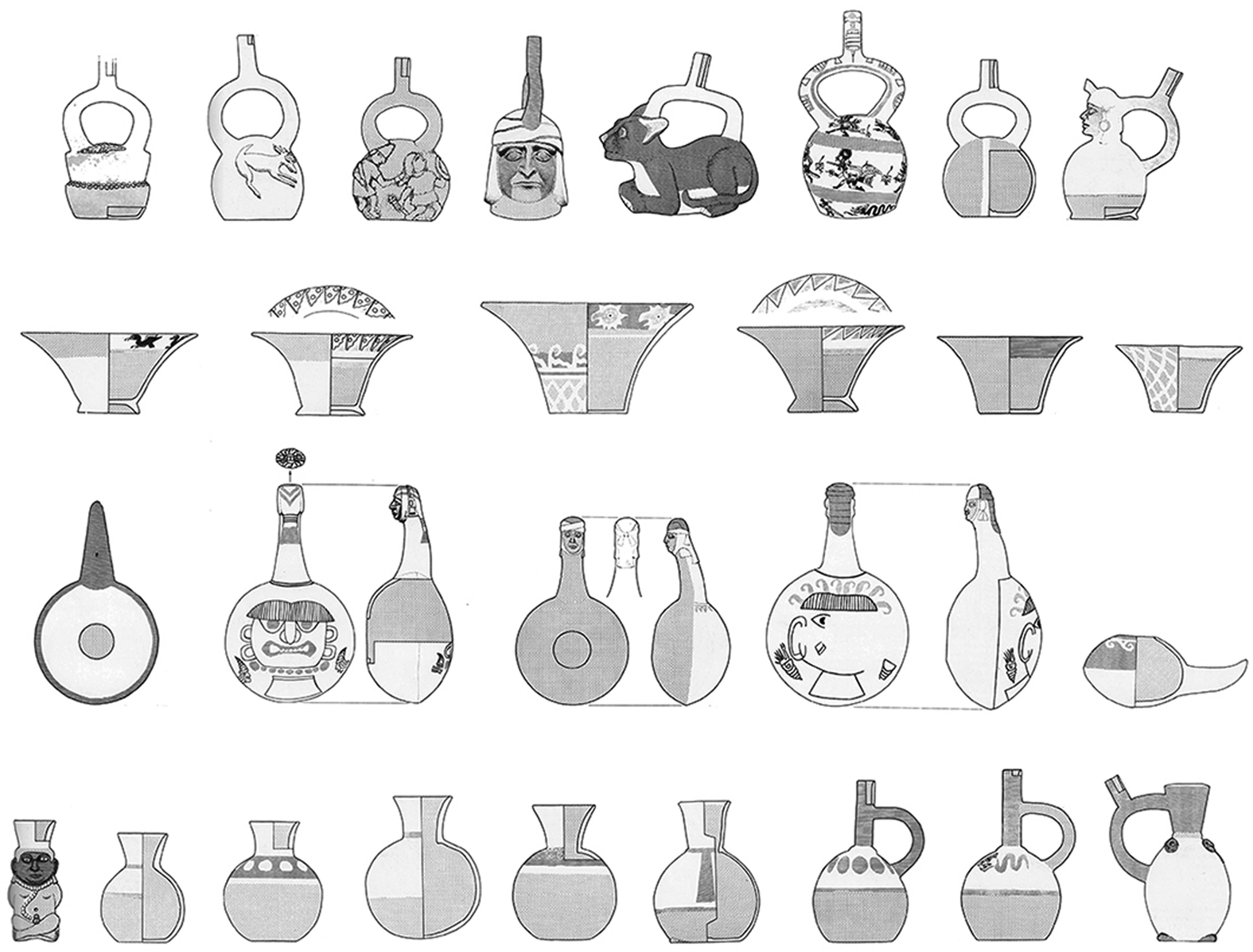
Surprisingly, the major types (Figure 2; see Donnan and McClelland Reference Donnan and McClelland1999) of funerary ceramic artifacts are of uncertain or unknown use other than as grave goods. Stirrup spout and single-spout bottles are difficult to fill with liquids or to pour from. Floreros (a.k.a. “flaring bowls”) seem to have been used to contain objects in rituals as depicted in some modeled and painted vessels. How cancheros were used is unknown, although the name is the Spanish term for “corn popper,” with the English term sometimes used, as well as “dippers.” Cántaros are jars with flared or tubular necks and wide mouths, presumably to contain liquids. Few other pottery forms are known to have been found in the Huacas de Moche burials, and there is a complete lack of cooking vessels (Quilter Reference Quilter2020).
Examples of Southern Moche Finewares from the Huacas de Moche (after Donnan and Mackey Reference Donnan and Mackey1978). Top row: stirrup spout bottles; second row: floreros; third row: cancheros; bottom row: cántaros and handled-single-spouts.

A recent review (Gayaso Rullier Reference Gayaso Rullier, Uceda, Morales and Rengifo2016) of all the ceramic types at Huacas de Moche recovered since 1978 concurs: bottles (both stirrup spouts and handled-single-spouts), cántaros, jars (cantarillos or jarras), bowls, cancheros, and floreros are cited. Additional types include tinajas, wide-mouthed, tall storage vessels; cuencos and escudillas, distinctive serving bowls; plates; and fuentes, large serving vessels. The various types of bowls would have been considered as a single category by Donnan and Mackey (Reference Donnan and Mackey1978), whereas plate fragments are only present in residential areas, not in burials, and fuentes are both rare and late in the occupation of the site (Gayaso Rullier Reference Gayaso Rullier, Uceda, Morales and Rengifo2016:301). The more recent work thus confirms the general categories established by the earlier research and the limited range of pottery recovered from funerary contexts.
Considering the representativeness of the Huacas de Moche mortuary ceramic artifacts, it is noteworthy that the pattern of a small set of funerary finewares as observed in the CCMVP-excavated burials holds for all published Moche burials from the Nepeña Valley northward (e.g., Donnan Reference Donnan1973). For this reason, I refer to them collectively as Southern Moche Finewares. Indeed, at least one reason why Moche was seen as an expansive state controlling much of the North Coast was due to the identification of what, at the time, appeared to be a highly standardized, “corporate” Moche ceramic style.
The same small set of these kinds of Moche funerary pottery was used both by urbanites, at the Huacas de Moche, and by the residents of a small seaside town, Pampa la Cruz. The excavated area of the latter consisted of a small dwelling containing the burials of two children of indeterminate sex, an aged man and woman, an adult woman, and an adult man. Most of these burials had either one or no finewares with them: the adult woman had a cántaro; the aged woman, a stirrup spout bottle; the aged man, no pottery; one child had a stirrup spout; and the other child had no pottery. The adult man (Burial M-IV 25) was interred with two stirrup spout bottles, seven cancheros, a florero, and other grave goods (Donnan and Mackey Reference Donnan and Mackey1978:200–201), and he was buried in a manner suggestive of a high or favored social status. Thus, even though the Pampa la Cruz residents appear to have been relatively poor in comparison to the Huacas de Moche population, they followed the same general mortuary practices with the same suite of mortuary ceramic artifacts.
Analysis and Discussion of the Southern Moche Assemblages
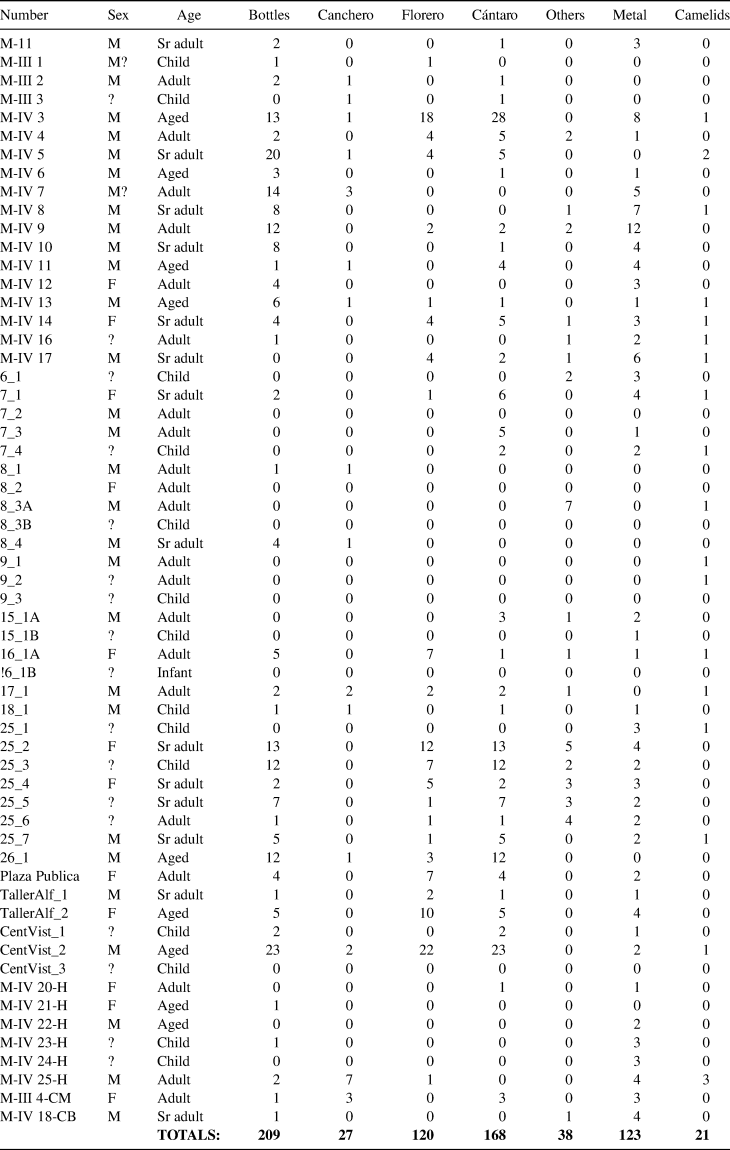
Burials from the Huacas de Moche and Pampa la Cruz sites are sufficiently numerous, with a total of 59 individuals (Table 1), including both the CCMVP and PAHSL excavations, to enable a simple analysis of the distribution of the four main vessel forms. Ages were standardized as children (infants–12 years), adults (13–30 years), senior adults (30–45 years), and aged (45+ years). Most children's sex could not be identified, and the number of females (N = 12) was significantly lower than the number of males (N = 30).
Moche Burials from Huacas de Moche and Huanchaco.

Notes: M- = Huacas de Moche; M-with “H” following the number = Huanchaco (Pampa la Cruz) from Donnan and Mackey (Reference Donnan and Mackey1978). All others are from Huacas de Moche PAHSL.
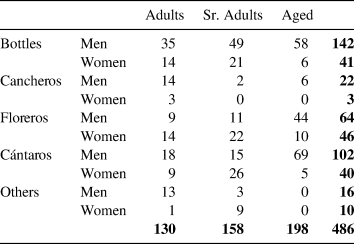
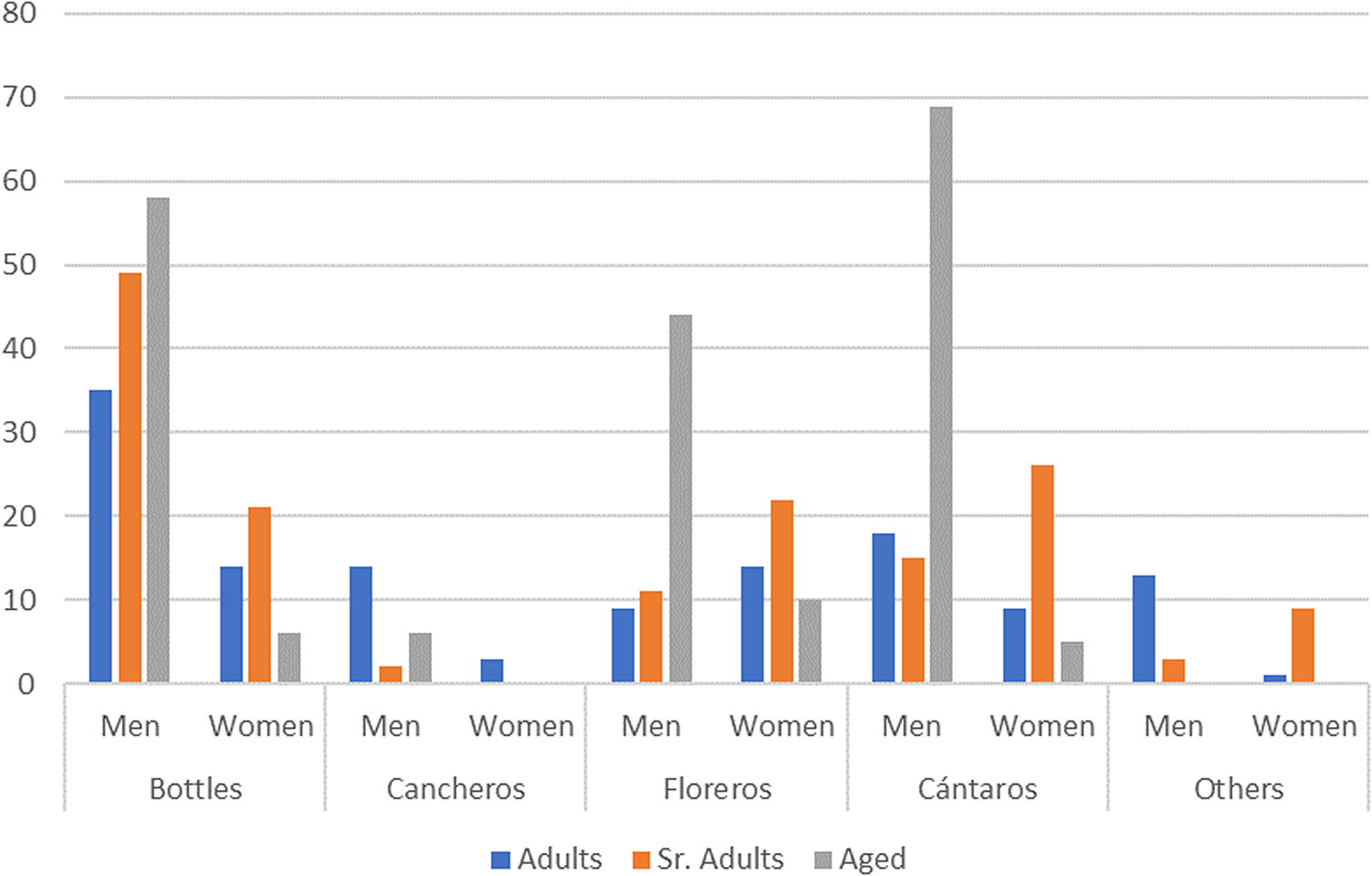
“Other” was used to designate all vessel forms other than the four types discussed earlier. The distribution of pottery according to age shows a general trend to greater numbers of vessels with increasing age at time of death. Table 2 and Figure 3 present the data from Huacas de Moche on the basis of age and sex, excluding the child burials that mostly cannot be sexed.
Distribution of Finewares in Moche Valley Burials by Age and Sex, Excluding Subadults.

Distribution of finewares in Moche Valley burials by age and sex, excluding subadults. (Color online)

The dominant fineware form in all of these burials is the stirrup spout bottle (183) followed by the cántaro (142) and florero (110). For all burials, there are few other vessel forms (26) and cancheros (25). The frequency of stirrup spout bottles as the favored ceramic burial offering in these Moche graves is significant, given the degree to which this vessel form has received so much attention in scholarly literature. Floreros and cántaros are found in the graves of all ages. Cancheros are found primarily with males, although not exclusively with adults; two are in the graves of children.
Children have few finewares of any kind interred with them. Adults have more ceramic grave goods and more grave goods in general than the aged. When both age and sex are considered (discounting nonsexed child burials), the same pattern holds. The lower representation of women may be why they appear to have fewer vessels, and future studies may clarify this issue.
The most striking aspect of the results of this analysis is what was evident from the start: the ceramic artifacts with which these people were buried consist almost exclusively of highly stylized and decorated finewares, with few quotidian vessels present. This may partly be explained by the absence of gourd bowls, everyday serving wares, in the CCMVP excavations. Those absences are largely due to preservation conditions of site soils (Christopher Donnan, personal communication 2018). Subsequent excavations by PAHSL did encounter gourds in locales such as room blocks in which burials were in less contact with local soils. Even so, finewares dominate burial assemblages.
Other examples confirming this pattern of the primacy of finewares are the burials excavated at Huaca de la Cruz in the Virú Valley. Although they were excavated in 1946, decades before CCMVP and PASHL, preservation conditions were excellent, with many organic items recovered such as textiles, feathers, and fibers (Strong and Evans Reference Strong and Evans1952). Ten non-elite burials and four individuals in a high-status group all followed the same pattern of finewares dominating the burial assemblages, with few other vessels other than gourd bowls present.
Not all of the finewares at these sites, however, were well crafted. Their importance seems not to have been in the quality of their manufacture or decoration but that they consisted of forms appropriate to accompany the dead and, perhaps, that they were decorated with appropriate religious imagery (see Donnan and McClelland Reference Donnan and McClelland1999).
Although no elite Moche burials have been scientifically excavated south of Huaca de la Cruz, Moche finewares there share the similar general features. Pottery at Huancaco (Bourget Reference Bourget, Uceda and Mujica2003) also in the Virú Valley, are distinctive in some of their decorative techniques but otherwise share the same vessel forms as the other sites discussed. Similarly, the Huaca Cao Viejo at the El Brujo Complex in the Chicama Valley yields classic Moche pottery in abundance. The high-status woman burial, the “Señora de Cao,” was interred with 11 ceramic artifacts consisting of four Gallinazo-style cántaros, three small collared bowls, a tall cántaro painted in a unique geometrical style, and three stirrup spout bottles, all of which were early Moche in style (Mujica Barreda Reference Mujica Barreda2007:225–229). Vessels found in the graves of three males in the same patio as the Señora also were early classic Moche forms.
Southern Moche Finewares depict and are associated with elite costumes and paraphernalia related to a specific set of rituals and beliefs—the sacrifice ceremony or presentation theme—in which deity impersonators sacrificed prisoners and possibly drank their blood. This bundle of artifactual traits and inferred practices and beliefs appears to have been present at all known major huaca centers, in both the north and south, beginning in relatively early Moche times.
Northern Moche Mortuary Traditions
Elite mortuary complexes excavated in the Northern Moche region are of two kinds. The first consists of tombs with ceramic assemblages generally similar to those in the Southern Moche region. Thus, at Sipán, Huaca el Pueblo, and Dos Cabezas, the dominant funerary pottery consists of stirrup spout bottles, floreros, and cancheros, although, interestingly, the cancheros are relatively few in number compared to the pottery assemblage at Huacas de Moche.
Because there are fairly good chronological controls for the Sipán elite burials, we can observe a number of patterns that may be significant for understanding prehistoric cultural dynamics. The Old Lord of Sipán, for example, dates several generations earlier than the Lord of Sipán and was not buried with Southern Moche Finewares but rather with 23 carefully made jars. The Lord of Sipán did have Southern Moche-style finewares but relatively few of them, with only eight stirrup spouts and three cancheros. The Priest had no finewares at all. In addition to these three high-status men, 11 other Sipán tombs contained single or multiple burials of high status, given that they were buried in a burial platform with precious metal artifacts and other rich grave goods in most cases (Alva Reference Alva2015). Although pottery was not abundant in these tombs, that which was present were in Southern Moche styles.
The Zaña Valley is immediately south of the Lambayeque Valley, with elite burials excavated and reported from Huaca el Pueblo in the town of Úcupe (Bourget Reference Bourget2014). The main burial was an adult man in a chamber with another individual. Pottery found with these burials consisted of five stirrup spout bottles.
The southernmost excavated Northern Moche temple site is Dos Cabezas in the southern Jequetepeque Valley (Donnan Reference Donnan2007). Two tombs (A and B) were at lower architectural levels than Tombs 1–3. Despite the relative time differences, finewares in these tombs were in Southern Moche mortuary styles.
A second, different funerary ceramic suite quite distinct from “Classic” Southern Fineware forms is found at later Northern Moche sites, with Pacatnamú and San José de Moro as the prime examples. Pacatnamú, on the northern side of the Jequetepeque River, was a large urban complex consisting of a square kilometer of huacas, compounds, and other architectural features. San José de Moro is 20 km inland, next to the Chamán River, and covers 10 ha in which there are 10 huacas and cemeteries.
Heinrich Ubbelohde-Doering excavated two pyramids at Pacatnamú in three field seasons (1937–1938, 1952–1953, and 1962–1963). His most extensive report was on 67 burials from a cemetery next to Huaca 31, near the middle of the site (Ubbelohde-Doering Reference Ubbelohde-Doering1983). Pacatnamú was investigated again by a combined U.S.-Peruvian research team between 1983 and 1987 (Donnan and Cock Reference Donnan and Cock1986, Reference Donnan and Cock1997). That project determined that there were two occupations: one was late Moche, and there was a later, larger Lambayeque occupation. The U.S.-Peruvian project recovered 84 Moche burials with equal numbers of men and women (N = 27, for each). The distributions in ages are noteworthy because of the great number of women reaching advanced years (Verano Reference Verano, Donnan and Cock1997:203).
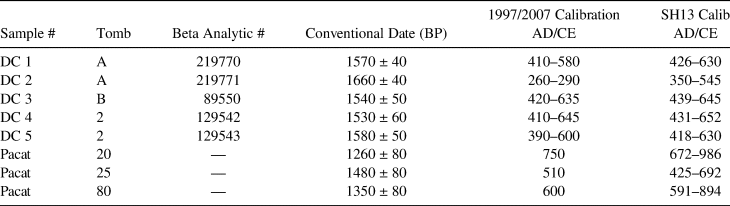
The U.S.-Peruvian archaeologists found it difficult to date the site using the Larco ceramic sequence because a few burials appeared to date to Phase III, but the majority of burials appeared to be later, with Phase IV–V pottery (Donnan and Cock Reference Donnan and Cock1997:36–37). Three radiocarbon dates also were relatively late (Table 3).
Radiocarbon Dates for Dos Cabezas (DC) and Pacatnamu (Pacat).

Notes: Radiocarbon dates for Dos Cabezas (DC) and Pacatnamu (Pacat) after Donnan (Reference Donnan2007:197–198) and Donnan and Cock (Reference Donnan and Cock1997:37), respectively. Two-sigma calibrations. Far-right column presents 2018 recalibrations. Additional intercepts listed are B 25 Pacatnamu 700–721 (1.8%) and 731–765 (4.7%) and B 80 Pacatnamu 938–961 (0.8%)
San José de Moro received its first serious investigations in 1991, followed by a long-term project continuing to the present (see Castillo Butters et al. Reference Castillo Butters, Julio Rucabado, Martín del Carpio, Bernuy Q., Ruiz R., Ch, Prieto B. and Fraresso2008; Murro Reference Murro2016). Excavations focused on numerous burials using period designations of Middle and Late Moche, Transitional, and Lambayeque. There are three burial formats at the site: simple graves, boot-shaped tombs, and chamber tombs. Middle Moche tombs are mostly shallow and boot-shaped, with a single interment with one or two ceramic artifacts (Castillo Butters et al. Reference Castillo Butters, Julio Rucabado, Martín del Carpio, Bernuy Q., Ruiz R., Ch, Prieto B. and Fraresso2008:36–37). Chamber tombs were reserved for elites, such as the well-known priestesses (Castillo Butters Reference Castillo Butters1996) and often housed multiple individuals. Simple graves were common for Transitional and Lambayeque burials.
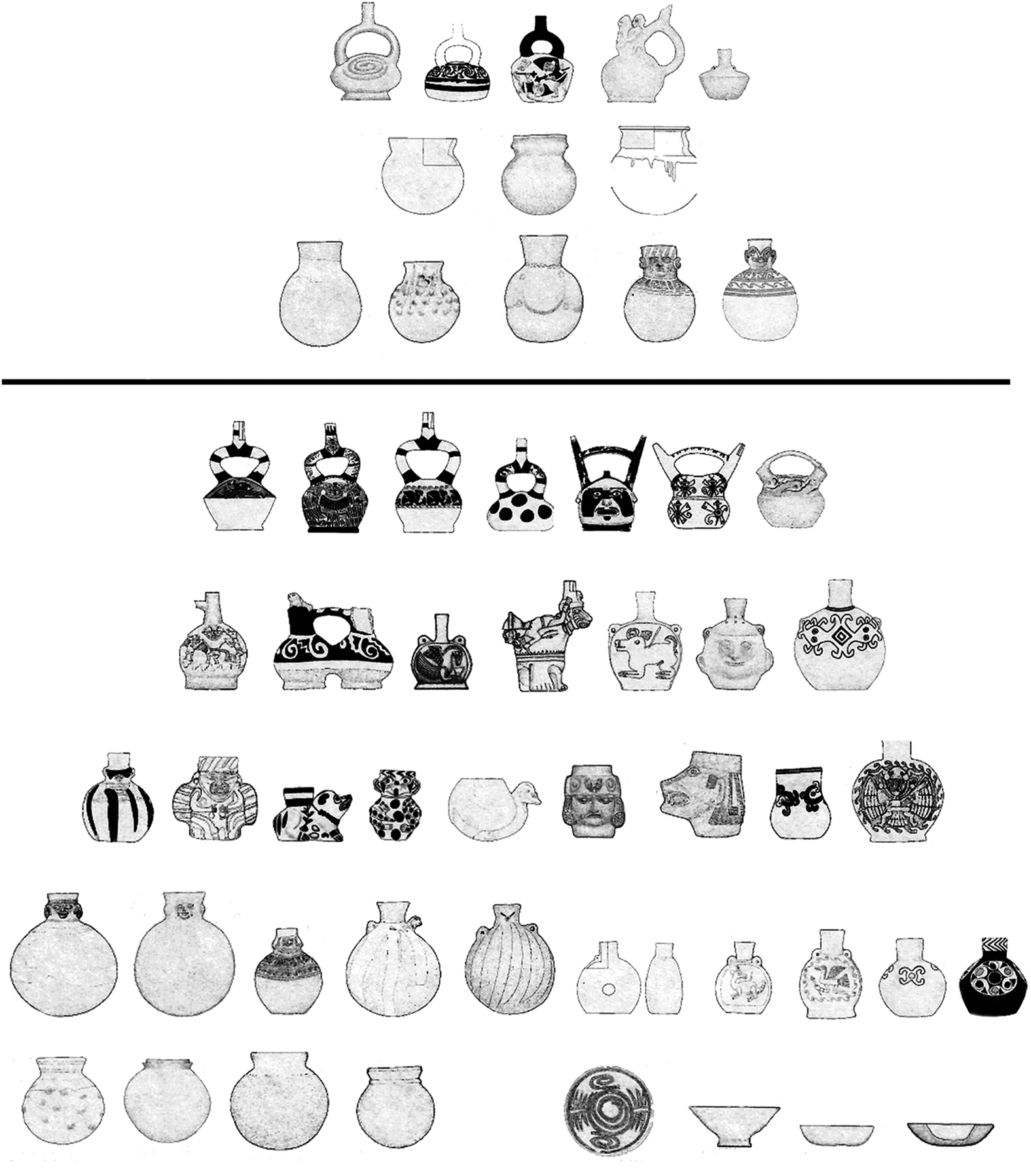
Both Pacatnamú and San José de Morro were occupied simultaneously for parts of their histories, and their funerary pottery are dramatically different from those in the Moche Valley and at the Northern temple complexes previously discussed (Figure 4). At Pacatnamú there are only 94 pottery vessels or fragments of them for the entire 84 burials. The majority of these are cántaros, most of which are not highly or carefully decorated. Only two stirrup spout bottles were recovered, one each in the graves of two adult men (Burials 20 and 64). Despite the lack of stirrup spout pottery, there were many gourds in the graves. Copper in the mouths or hands was common for most burials, and there were eight cases of llama bones in graves. The preservation was extraordinarily good at Pacatnamú, so many gourds and other fragile materials were preserved.
Northern Moche pottery from San José de Moro (after Mauricio Reference Mauricio and Butters2006). Black line separates Middle Moche (top) from Late Moche (bottom). Note both the stirrup spout bottles and double-spout-and-bridge bottles in the first row of Late Moche. Small vessels in the penultimate row on the bottom are similar to Gallinazo cántaros, and four vessels on the right in the last row are Cajamarca influenced.

The burials recovered by the U.S.-Peruvian team were near Huaca 45, more than 200 m from Huaca 31 where Ubbelohde-Doering excavated. Whereas the Donnan-Cock excavations found burials wrapped in textiles or in cane coffins, the German excavations encountered similar burials but also three group burials in boot-shaped tombs. The most elaborate of these group burials, E1, had nine stacked cane coffins, three human sacrifices, and a small child's skeleton on top of one of the coffins. More than four dozen ceramic vessels or large fragments of them, metal objects, and other items, including textiles, were in the burial. Similarities in pottery suggest that the burial groups were close in age.
Although the burials near Huaca 45 seem to be the remains of people of modest means, the Huaca 31 group burials apparently were of high status, considering the quantity of goods buried with them, including human sacrifices. Yet few, if any, of the dozens of ceramic artifacts buried with the elites would be exhibited in an art museum today. Most vessels are cántaros or face-neck jars and have minimum modeling; painted surfaces, when present, were simply made and quickly executed. The most elaborate vessels are stirrup spout bottles with press-mold designs, usually fired to a dark gray or black.
The San José de Moro burials are similar to the Pacatnamú interments in the common use of boot-shaped tombs for many burials, but they differ in also using large chamber tombs. The pottery of both the Middle and Late Moche burials share similarities with those found at Pacatnamú, especially for the earlier Middle Moche interments at the site, which frequently include cántaros and wide-mouthed jars. A few Southern Moche style ceramic sherds and vessels were found at both sites (e.g., McClelland Reference McClelland, Donnan and Cock1997). Some sherds at Pacatnamú with fineline decorations were similar to Late Moche sherds executed in styles known to be associated with the Chicama Valley, wheras others were close to identical to the fineline style common at San José de Moro (McClelland Reference McClelland, Donnan and Cock1997:267–268). The Late Moche ceramic collection from San José de Moro includes not only the distinctive fineline style associated with the site but also pottery that indicates contact with the Central Coast and a significant presence of Cajamarca-style and Wari pottery.
Ceramic Miniatures
Small, crudely made ceramic vessels called ofrendas (Donnan Reference Donnan2007) or crisoles (Castillo Butters and Donnan Reference Castillo Butters, Donnan, Uceda and Mujica1994b:125), and which I call copitas, are often encountered in Northern Moche burials where they first appear in the archaeological record; they continued in use into the Late Intermediate period in the region. They have received relatively little scholarly attention, although they were recognized as a distinct vessel form as early as 1991 and were interpreted to be drinking vessels likely made and used by participants at funerals (Costin Reference Costin and Chilton1999; Hayashida Reference Hayashida1995). Related ethnographic fieldwork by Alfredo Narváez (Reference Narváez, Heyerdahl, Sandweiss and Narváez1995, Reference Narváez2000, cited in Cervantes et al. Reference Cervantes, Wagner, Perry and Shimada2014:219; see also Cervantes et al. Reference Cervantes, Shimada, Häusler, Wagner and Wagner2011) suggests that these small cups may have been used to consume warmed chicha.
The most common cup shape is a cylinder with a mouth the same diameter as or slightly larger than that of the tube of the vessel body; the cylinder expands to a bulbous base, often with a round bottom, although some have pinched upper sections to form anthropomorphic faces and the like. They commonly are found grouped in clusters near burials. Although the piles themselves appear to have been arranged in restricted spaces, the vessels within them seem to be haphazardly placed. At some places and times, baskets may have held groups of these small cups. In some clusters there appear to be smaller groups within them, as if there had been separate deposits at slightly different times or by different people; in other burials, there are separate clusters. In some clusters there are other vessel forms, such as miniature shallow pedestal bowls with crenellated rims or miniature stirrup spout bottles.
The number of copitas in burials varies considerably from a few to dozens. At Dos Cabezas, Tomb A had 10 grouped in the northern end of the tomb and 20 in its northeast corner. Tomb 2 (Figure 5) had five copitas in the tomb's southeast corner, four in the southwest corner, and five in the northwest corner (Donnan Reference Donnan2007:19, 120–125). They also were found with other items on the floor below and in an offering above Tomb B, as well as in Tombs 1–3. In addition, they were found in compartments—small chambers next to the three later tombs—that appear to approximate the real tombs’ contents, with miniature metal figures substituting for the human burials.
Burials from Dos Cabezas (after Donnan Reference Donnan2007). Tombs, 1, 2, and 3, from top to bottom.

A chamber in the adobe floor next to the Lord of Sipán's tomb was filled with copitas mixed with other pottery and many llama bones, for a total of 1,137 vessels. Simply made ceramic human figurines were arranged so as to appear as if they were interacting, such as a group of musicians playing together (Goepfert and Alva Reference Goepfert and Alva2018:334). Analysis of camelid bones found in this depository indicates that they were the remains of funerary feasts. The copitas thus were also part of such mortuary feasts.
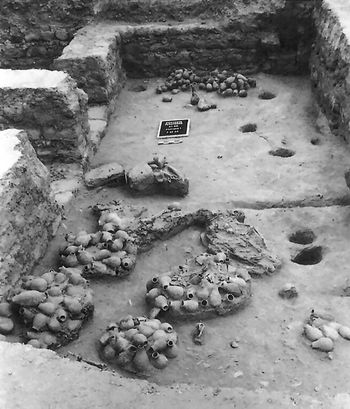
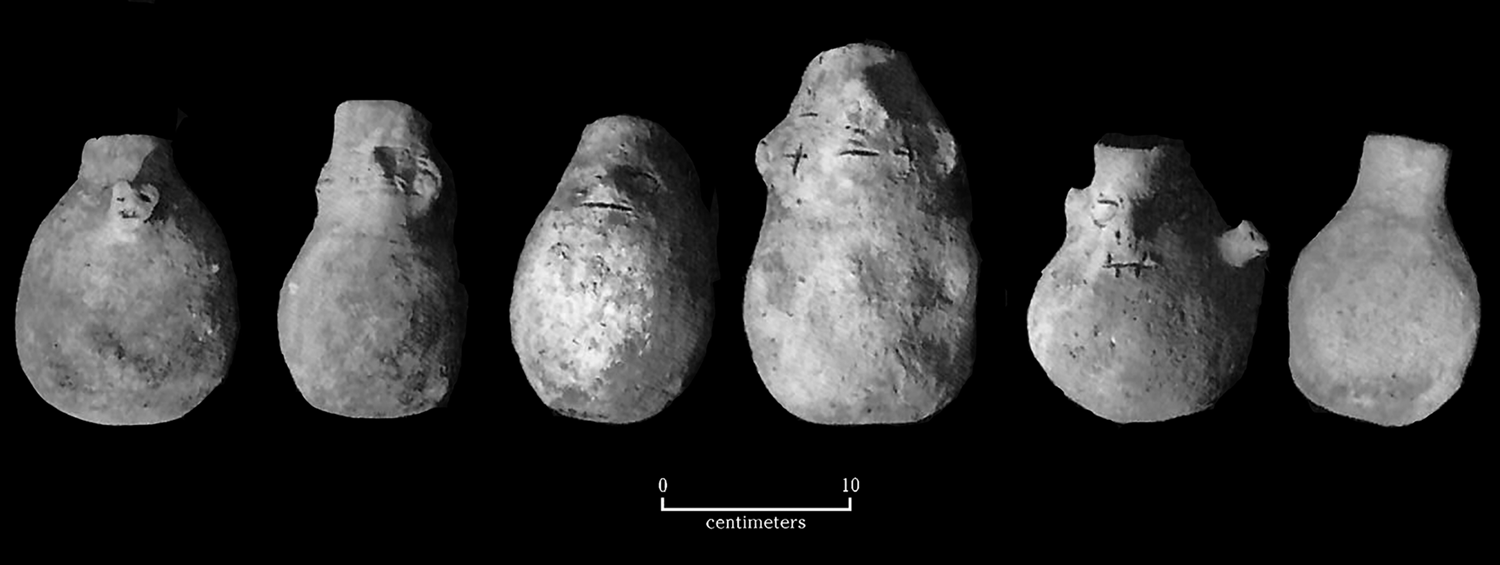
At Pacatnamú no copitas were found in the burials excavated by the German or the U.S.-Peruvian projects. But in the Moche occupation near Huaca 1, a room in a small structure was filled with artifacts that had been subjected to intense heat (Figures 6 and 7). Four hundred miniatures in six clusters, as well as other artifacts, were found in this offering room (Cordy-Collins Reference Cordy-Collins, Donnan and Cock1997). The vessels had been filled with liquid, plugged with cotton, and deposited in groups, possibly in gourd bowls or other perishable containers, as part of the final activities that took place before Room 3 was burned (Cordy-Collins Reference Cordy-Collins, Donnan and Cock1997:286, 289).
Photograph of the excavated offering group room (Cordy-Collins Reference Cordy-Collins, Donnan and Cock1997:284, Figure 2).

The five decorated copita types from the offering group room at Pacatnamú (Cordy-Collins Reference Cordy-Collins, Donnan and Cock1997:285, Figure 3).

Copitas were in abundance at San José de Moro (Castillo Reference Castillo Butters and Makowski2000:21) in three Late Moche (Phase C) priestess tombs (M-U41, M-U203, and M-U1045) and in two tombs of priestesses of the early Transitional period (M-U1242 and M-U1525). In other burials, these miniatures were placed in groups around and directly on top of bodies.
In sum, the use of copitas and other vessels in religious ceremonies, most notably funerals, was widespread in northern coastal Peru from Moche times onward. The styles of miniatures varied through time and space, and the specifics of their use surely also varied. That copitas were used to consume a beverage and that there was a relationship between their numbers and the number of people at the funeral seem quite likely. Groups of copitas made of different clays might suggest separate social groups, even if we cannot assume that each individual vessel represents a single individual who attended a ceremony. The small size of the cups does suggest a single serving and thus a single consumer, offering the possibility of estimating a “minimum number of mourners” for a given ritual when it can be determined that all vessels were deposited at the same time.
Discussion
The proposal made in 1994 that there were two spheres of different “Moches” has been supported by the present study of differences in funerary pottery and inferences of ritual and other cultural practices related to them. Based on current evidence, however, those differences are only archaeologically manifest in Late Moche times, during or shortly after the last half of the seventh century AD. That archaeological manifestation quite likely reflects real sociopolitical and cultural changes on the North Coast of Peru. Before AD 650, what I have been calling Southern Moche Finewares were present at major huaca complexes both north and south, as shown by evidence in the sites discussed in this article. After that time, however, ceramic styles changed drastically in both regions; significantly, large temple sites, both north and south, were either abandoned or radically remodeled, although new ones were built in new places.
The idea that the Moche experienced dramatic social changes has been considered by scholars for more than three decades. In the early 1990s, the end of the Moche altogether was thought to have occurred at some time between AD 500 and 600, caused by devastating floods on the coast and highland droughts brought on by a series of powerful El Niño events (Moseley Reference Moseley1992) that may have led to internal social unrest (Shimada Reference Shimada1994; Shimada et al. Reference Shimada, Schaaf, Thompson and Mosley-Thompson1991). Nevertheless, continued research at the Huacas de Moche site demonstrated that it was occupied later than the end of the sixth century, with major changes possibly occurring after the end of the eighth century, as suggested by Claude Chapdelaine (Reference Chapdelaine, Uceda and Mujica2003). Subsequent research determined that the “New Temple” was built adjacent to the Huaca de la Luna somewhat earlier, during the eighth century, after construction ceased at Huaca de la Luna, although it may have continued in use (Uceda Reference Uceda, Quilter and Castillo2010).
Available radiocarbon dates support the proposal that many major Early Moche temple centers in the Northern and Southern Moche regions closed down or dramatically reduced activities around AD 650 and in the following century. No end dates are known for Dos Cabezas, although three available dates are all before 650 (Table 3), with the early burials having a long temporal range at the 2-sigma scale from the mid-fourth to the late sixth century (Donnan Reference Donnan2007:197–198).
Huaca el Pueblo, in the Zaña Valley, has only one reported date for the sacrifice-ceremony-style burial found there, calibrated at AD 390–500 (Bourget Reference Bourget2014:238). Bourget considers that Huaca el Pueblo elites and those at Dos Cabezas were in contact for a good part of their occupations and suggests that there were relations between these sites and Sipán (Bourget Reference Bourget2014:240).Footnote 1
Few chronometric dates are available for the Sipán burials, but a looted tomb in the burial platform where most of the elite burials were discovered has been dated to AD 640–690 (Ami et al. Reference Ami, Walter Alva, Marco Martini, Sibilia, Makowski and Perassi2017). Given the fact that the Lord of Sipán and his retinue appear to have been the last elites interred in the burial platform, this date seems reasonable as close to terminal for the history of the huaca. In short, the Northern temples that resemble the Southern temples were all occupied relatively early in Moche times, but these temples likely no longer were used starting at about the second half of the seventh century into the eighth.
If this proposal is supported by future research, it has several implications for understanding Moche prehistory. Although not united under a single state, a distinctive ceremonial system with political and economic aspects bound leaders and centers together in early Moche times. We do not know the locus of the origin of this system and much work would be needed to find it, but the Huacas de Moche would be a likely candidate. More certainly, this system ended in the second half of the seventh century as the Early Moche period ended and the Late Moche began.
The Southern Moche Finewares comprise the “Classic” Moche pottery style that has been so popular for those interested in Moche symbolism and religion and that commonly appears in art museums. That style was a much more restricted and limited phenomenon than previously thought, and its achievements thus are all the more remarkable for the amount of energy expended to produce masterpieces of art and architecture over such a short period of two or three centuries.
Current evidence indicates that Southern Moche Finewares were present at huaca centers in the Northern Moche region in early times. So, although a uniform Moche state may not have stretched from the south to the north, it does appear that there was a common Moche culture, likely one in which the elites of different temple centers were interacting and probably intermarrying over that area before the last half of the seventh century.
There are, nevertheless, a number of issues revolving around this apparent phenomenon that still remain to be investigated. Chief among them is the need for more radiocarbon dates so that we can better chronicle culture change—particularly so we can know when huaca centers closed or were dramatically reorganized. One issue resulting from my analysis of ceramic styles, huaca centers, and chronology is that, broadly speaking, Moche chronology consists of only two periods: Early, before AD 650, and Late, from AD 650 to about 850.
There was a significant reorganization of Moche culture in the south—most notably, from the second half of the seventh century onward—when some temple complexes and urban centers were shut down while others expanded, underwent major renovations, reoriented ritual programs, and simplified the decoration of their finewares (Koons Reference Koons2015; Lockard Reference Lockard2009; Quilter et al. Reference Quilter, Franco, Galvez, Doonan, Gaither, Vásquez, Rosales, Jiménez, Starratt and Koons2011; Uceda Reference Uceda, Quilter and Castillo2010). Perhaps the starkest example of such changes is the large city of Galindo, farther up the Moche Valley than Huacas de Moche, close to the valley neck where the lower valley ends and the narrow midvalley begins. Its large wall separating elite residences from poor ones, its smaller ceremonial architecture compared to earlier sites, and its transformed “iconography of power” in its ceramic artifacts and other material culture (Bawden Reference Bawden1996:275; see Lockard Reference Lockard, Castillo, Bernier, Lockard and Yong2008, Reference Lockard2009) all resemble Pacatnamú and Pampa Grande (Shimada Reference Shimada1994) in the north.
These changes were particularly strong in the heartland valleys of Moche and Chicama, although we have scant data for other southern sites. Changes likely varied subregionally, given that current evidence suggests that the farthest south Southern Moche center, Pañamarca, prospered after 650 (Trever Reference Trever2017), perhaps as a transplant or holdout of old traditions as new ones disrupted the older centers to the north.
The implications of my analysis are that the majority of Moche fineware pottery dated as I–IV in the Larco chronology were made, used, and buried before around AD 650; the funeral rituals and other cultural practices, such as the sacrifice ceremony, which were related to the use of cancheros, floreros, and even stirrup spout bottles, occurred in that time and ceased after it. Although many of the Northern temple centers apparently were abandoned, others prospered and new ones arose, such as San José de Moro, which followed a very different set of rituals and iconography than the earlier huaca centers, retaining but reinterpreting some of the old deities such as “The Priestess” (Castillo Butters Reference Castillo Butters1996).
Of course, this interpretation is based on current evidence, and many questions remain. For example, although major Northern huaca centers may have participated in the rituals and material culture of the Southern huaca complexes, only additional research will inform us whether these centers were isolates in a Northern Moche world or whether the Southern-style practices were carried out even at smaller Northern ceremonial centers.
In other words, an important issue to resolve is the origins of the late Northern Moche ceramic style. Presently, the available literature (see Mauricio Reference Mauricio and Butters2006) suggests that it may have begun at the same time that some of the large huaca centers were in operation. But only more dates will help clarify this issue. If the crude, Northern Moche style was extant at the same time as the Southern-style huaca centers in the north, then how do we interpret this possibility? Does the existence of the two styles indicate two cultural modes in operation, with big huacas participating in a Southern Moche ritual system and a different, local, “little tradition” being extant at the same time in the same Northern region?
Similarly, many issues concerning Moche mortuary practices remain to be considered. If drinks were sipped from copitas by people attending a funeral, how might this observation help us reconsider the earlier Southern Moche Fineware vessels in graves? Is it possible that some of the finewares found in early Moche burials were not the property of the dead but instead were vessels contributed by those attending the funeral? Might residue analyses help identify what was contained in those vessels, or was it the pottery itself, and not its contents, that was valued?
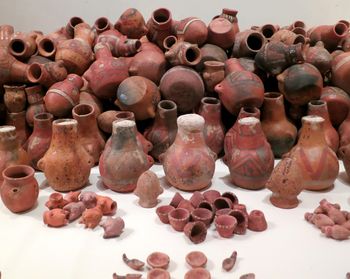
The role of copitas may be quite important in offering us new interpretations of cultural dynamics in northern Peru and perhaps beyond. The available evidence suggests that there were different styles at different times and places; tracing how they varied in time and space would help determine how the copita ritual originated, developed, and spread. Although miniatures are found in many ancient cultures in Peru and elsewhere, small cups, such as the copitas, are not that common in the ancient Central Andes. One of the few other places where such small vessels are known is at the site of Huari, the presumed capital of the Wari Empire in the southern highlands of Peru, 700 km south of the land of the Moche and over rugged terrain, and that began to grow in power in the sixth century. There, scores of miniature vessels were found as an offering in the subterranean Monqachayuq funeral complex (Figure 8). The shapes of these vessels are different from the Moche examples, and the Huari copitas were more carefully made, painted, and decorated. Analyses of residues in some of these vessels identified maize, suggesting that the copitas had contained chicha (González Carré and Soto Maguino Reference González Carré and Maguino2004; Pastor de Abram and Camargo León Reference Pastor de Abram, Camargo León, Carré and Maguino2004:10).
Display of some of the miniature vessels found in the Monqachayuq funeral complex at Huari at the Museo Histórico Regional “Hipólito Unanue,” Ayacucho (courtesy of José Ochatoma). (Color online)

Given that Wari was an expansive empire (Makowksi and Giersz Reference Makowski, Giersz, Giersz and Makowski2016) and that there are clear signs of its presence in northern Peru (Castillo Butters Reference Castillo Butters and Makowski2000, Reference Castillo Butters2001; Watanabe Reference Watanabe, Giersz and Makowski2016), it seems likely that the Wari introduced the copita ritual to the Moche; however, until studies are done to determine the origins of the practice, we must maintain the possibility that the use of copitas could have originated with the Moche or developed simultaneously in both regions.Footnote 2
One difference between all of the Northern centers and Southern Moche, whatever their ritual programs, is the presence of miniature cups in the north and their absence in the south. The fact that burials with many miniatures in them often have fewer of the classic funerary finewares may indicate that miniature cups served as a kind of substitute offering, replacing larger, older-style vessels—thus supporting the inference that the Southern Moche Finewares were contributions to the dead by attendees at funeral ceremonies, as discussed earlier.
Edward Swenson (Reference Swenson, Castillo, Bernier, Lockard and Yong2008) has argued that in late Moche times there was a “popularization” of religion at small sites by local leaders that undermined the authority of the lords at the large temple complexes. An interesting question follows as to what the cause of that change may have been. Was discontent with Moche potentates strictly a regional phenomenon? Did Wari directly conquer the Southern Moche while having more congenial relations with the late Moche lords of the north? Was Wari both a cultural influence, admired and imitated, and, at the same time, a feared political power? The eventual abandonment of tall temples for horizontal compounds and the rise of the cult of ancestors with the demise of deity impersonators suggest that Wari indeed had a strong impact on the Late and Transitional period Moche. The succeeding Lambayeque archaeological culture of the northern region is much more a continuation of Moche traditions than the later Chimu culture of the southern region, whose horizontal compounds are quite Wari-like. The distinctive, classic Southern Moche culture in the fourth through mid-seventh centuries AD and the apparent lack of Wari influence in that region during that time suggest that the early Southern Moche lords and ladies were uninterested or hostile to influences from the southern sierra. Yet, eventually, the Wari Empire had a profound effect on the entire region, as suggested more than four decades ago by Dorothy Menzel (Reference Menzel1964, Reference Menzel1977).
Acknowledgments
I am grateful to the Bard Graduate Center for a fellowship during the spring of 2017, which allowed me to explore the topics in this article, and to Claudine Gay, at the time the dean of the Social Sciences Division at Harvard University, for granting me the leave to take that fellowship. People who were critical in helping me work through the ideas in this article and a related one in Ñawpa Pacha include the editors, their able editorial assistants, and their peer reviewers, as well as Richard Burger, Ari Caramanica, Jonathan Choronzey, Tom Cummins, Ivan Gaskell, Krzysztof Makowsi, Peter Miller, Gabriel Prieto, Sarah Quilter, Lucy Salazar, Lisa Trever, and Gary Urton. Christopher Donnan and Luis Jaime Castillo Butters offered me useful insights, even when we disagreed, and I appreciate their allowing me to republish their artwork and photos. I am grateful to Anka Kraemer at the Museum Fünf Kontinente, Munich, for her interest in this work and her hosting of Sarah Quilter and me in July 2018. Thanks also to José Ochatoma, personnel at the Fowler Museum of UCLA; the Museo Rafael Larco Herrera, Lima; and the Peabody Museum of Archaeology and Ethnology, Harvard, for help with images and permissions.
Data Availability Statement
The data for this article are in the publications cited in the text.