Introduction
Fertilization of thawed oocytes has been poor, but has recently gained more attention since the development of intracytoplasmic sperm injection (ICSI) (Van der Elst, Reference Van Der Elst2003; Tucker et al., Reference Tucker, Morton and Liebermann2004; Chen et al., Reference Chen, Lien, Chen, Chang, Tsai and Yang2005; Li et al., Reference Li, Chen, Zhang, Tang, Kui, Wu, Wang and Guo2005). Vitrification is a rapid and simple method (Fabbri et al., Reference Fabbri, Porcu, Marsella, Rocchetta, Venturoli and Flamigni2001; Helmy et al., 2006; Masashige et al., 2007), however, not all reproduction centres have obtained satisfactory results. The vitrification process lends itself to issues such as membrane, mitochondria and spindles damage (Bernard et al., Reference Bernard and Fuller1996, Mavrides et al., Reference Mavrides and Morroll2005). Recent studies have suggested that chemical activation could improve fertilization and promote embryo development (Eldar et al., 2003, Murase et al., Reference Murase, Araki, Mizuno, Kawaguchi, Naito, Yoshizawa and Araki2004; Lu et al., Reference Lu, Zhao, Gao, Li, Ma, Mullen, Critser and Chen2006).
Oocyte activation is characterized by a two-step rise in intracellular calcium concentration. A first calcium trigger originates from the oocyte cortex after sperm–oocyte membrane interaction and is followed 30 min later by a series of short high amplitude calcium transients that continue for 3–4 h. The oscillatory function is dependent on the release of a sperm-associated oocyte activation factor that conditions the oocytes to sustain repetitive calcium release from intracellular stores. Research studies (Van Blerkom et al., Reference Van Blerkom, Davis, Mathwig and Alexander2002, Reference Van Blerkom and Davis2006; Jones et al., Reference Jones, Blerkom, Davis and Toledo2004) have suggested that cryopreservation has two negative consequences: loss of the ability of mitochondria to retain high polarity and form J-aggregates and a significant diminishment in the ability of the thawed oocytes to up-regulate calcium in response to calcium activation.
Sperm break oocyte arrest by inducing a series of calcium spikes that lasts for several hours. Calcium spikes generated by sperm are necessary and are necessary to induce egg activation. However, ICSI may not sufficiently activate freeze–thawed oocytes. During ICSI this natural trigger is replaced by a so-called pseudotrigger (a massive influx of calcium into the oocyte is provoked by the injection procedure itself). The first calcium rise starts 20–30 min after ICSI and originates from the oocyte cortex rather than from the vicinity of the injected sperm head. This calcium rise alone is insufficient to fully activate the oocyte. Some researchers (Tesarik et al., Reference Tesarik and Sousa1995, Chi et al., Reference Chi, Koo, Song and Chang2004) have shown that not only a sperm factor but also an oocyte factor is the oscillatory activation mechanism.
The activators applied in experiments are usually calcium ionophore, strontium chloride and ethanol. Calcium ionomycin or ethanol causes a single calcium transient, while strontium chloride evokes repetitive calcium oscillations. Strontium chloride binds to and activates the calcium-binding site on the InsP3R. Moreover, strontium chloride-mediated calcium oscillations are generated via the InsP3R. Repetitive oscillations are continued as long as strontium chloride is present in the culture medium (Gordo et al., 2000; Jellerette et al., Reference Jellerette, He, Wu, Parys and Fissore2000; Tomashov et al., Reference Tomashov, Tchetchik, Eldar, Kaplan, Oron and Shalqi2005).
So far, there have been few reports on the effect of activation with regard to thawed oocyte development potential. This study used rabbit oocytes as an animal model for oocyte vitrification by cryoleafs (Huang et al., Reference Huang, Tulandi, Holzer, Lau, Macdonald, Tan and Chian2008). The effect of different activation methods on thawed oocytes was determined.
Materials and Methods
Animals
Netherlands white rabbits were housed in air-conditioned light-controlled room, with food and water available ad libitum. Six- to 8-month-old female rabbits were superovulated by six successive subcutaneous injections of 10 IU FSH (Organon) each at 12 h intervals followed by 100 IU of HCG (Sigma) 12 h after the final dose of FSH.
Oocyte and sperm collection
The oviducts were flushed with HTF 1023 (SAGE, USA) containing 10% serum protein substitute (SAGE, USA) 14–15 h after HCG injection. The cumulus cells were removed from the oocytes by mechanically pipetting after exposure to 80 IU/ml hyaluronidase (SAGE, USA). Corona radiata cells were not removed (Cai et al., Reference Cai, Chen, Lian, Zheng and Peng2004). After washing four to five times in HTF 1023 containing 10% SPS, oocytes were then transferred into HTF 1023, containing 10% SPS for freezing.
Sperm was collected from male rabbits by percutaneous epididymal sperm aspiration. Rabbit epididymis were pricked and aspirated and the sperm was added to 10% polyvinyl pyrrolidone (PVP, SAGE) to slow down the sperms vigorous movements before microinjection (Deng et al., Reference Deng and Yang2001).
Vitrification of rabbit oocytes
Rabbit oocytes were cryopreserved by ethylene glycol (EG, Sigma) and propanediol (PROH, Sigma) using cryoleafs (MEDICOM, Canada, 254 × 70 mm).
Vitrification process: Initially, oocytes were cultured in HTF containing 7.5% EG, 7.5% PROH and 30% SPS for 3 min. Next, those oocytes were transferred into HTF 1023 containing 15% EG, 15% PROH and 30% SPS and cultured for 3 min. Finally, they were transferred into HTF 1023 containing 15% EG, 15% PROH, 30% SPS and 0.65 mol/l sucrose (Sigma) and cultured for 1 min. The process was conducted at room temperature. The cryoleafs were plunged into liquid N2. The vitrification process was performed in 1 min.
Thawing oocytes
To thaw the vitrified oocytes, the cryoleafs were removed from the liquid N2 and quickly placed directly into a warming solution composed of 1 mol/l sucrose in base medium (HTF 1023 containing 30% SPS). After 1 min, the oocytes were transferred sequentially into 0.5, 0.25, 0.125 and 0 mol/l sucrose in base medium in 3 min intervals. Thawing was conducted at room temperature. After thawing, the oocytes were washed four to six times in culture medium M-199 containing 10% fetal calf serum (FCS, Sigma) and then incubated in 37 °C with 5% CO2. ICSI was carried out 2.5 h later, within 1 h of thawing.
ICSI and oocyte cultures
The injection needle used for rabbit sperm had an inner diameter of 6.0–7.0 μm and an outer diameter of 7.5–8.0 μm (Cai et al., Reference Cai, Chen, Lian, Zheng and Peng2004). The micromanipulation method was as described by Ebner et al. (Reference Ebner, Moser, Sommergruber, Jesacher and Tews2004). Briefly, the polar body was oriented at 6 or 12 o'clock and the point of injection was at 3 o'clock. The oocyte was penetrated by the injection micropipette and a small amount of cytoplasm together with the sperm was expelled into the oocyte. Aspiration close to the opposite membrane, the opposite membrane responds with a slight invagination. The injecting micropipette was withdrawn quickly immediately after plasmic injection and the oocytes were released from the holding pipette to reduce the intracytoplasmic pressure exerted on the oocytes. All the micromanipulations were conducted at 37 °C on a warm stage. After injection, the oocytes were transferred into M-199 medium containing 15% FCS and cultured in 38.5 °C with 5% CO2. Pronuclear formation was examined using an inverted microscope (Olympus) 4–7 h after sperm injection. The oocytes with two distinct pronuclei and a second polar body were considered fertilized. Embryo development was scored daily and the same skilled embryologist counted the cells each day.
Visual inspection of oocytes following vitrification
A total of 226 rabbits oocytes derived from superovulated rabbits were vitrified and thawed after 1 month. The recover rate was 85.0% (192/226) and 69.0% (156/226) of survived ICSI. Oocytes were divided into different groups at random for subsequent activation.
Activation
After thawing, a total of 117 oocytes with normal appearance were derived. A skilled manipulator spent half an hour injecting four to six oocytes. Following ICSI, surviving oocytes (n = 95) were cultured in base medium M-199 containing 10% FCS for 1 h and were divided into three groups at random. Group 1: Oocytes (n = 30) cultured in base medium containing 5 μmol/l calcium ionomycin (I0634, Sigma) for 5 min in an incubator set to 38.5 °C and 5% CO2. Group 2: Oocytes (n = 26) cultured in base medium containing 10 mmol/l strontium chloride (Sigma) for 20 min at 37 °C with 5% CO2 (Heller Cell). Oocytes were washed five to six times in base medium and were transferred into M-199 containing 15% FCS and cultured at 38.5 °C with 5% CO2. Control Group (n = 39): directly cultured in base medium with no activation.
Double activation
After thawing, 75 normal appearing oocytes were derived. Surviving oocytes (n = 61) after ICSI were cultured in base medium M-199 containing 10% FCS for 1 h and then divided into two groups at random. Group 3: Oocytes (n = 33) activated in 5 μmol/l calcium ionomycin for 5 min in 37 °C, 5% CO2 incubator and then activated again half an hour later in 5 μmol/l calcium ionomycin using the same method. Group 4: Oocytes (n = 28) activated in 10 mmol/l strontium chloride for 20 min in 37 °C, 5% CO2 incubator twice as was performed in Group 3. All oocytes were washed five to six times in base medium after activation and transferred to M-199 containing 15% FCS and cultured at 38.5 °C, 5% CO2 incubator.
Rabbit embryo vitrification and transplantation
Rabbit blastocysts were vitrified and thawed after recipient rabbits were prepared with HCG. Blastocysts derived from different groups were separately transplanted into different rabbit uteri 96 h after HCG injection. Recipient rabbits were anesthetized with amobarbita and the uterus and fallopian tube were isolated. After transplantation, these rabbits were monitored for infection.
Statistical analysis
The fertilization rate and the proportion of embryos (developed to more than 2-cell) were analyzed using chi-squared test. p-values < 0.05 were considered to be statistically significant.
Results
Effects of activation on frozen–thawed rabbit oocytes
In Group 1, the fertilization rate was 33.3%, the cleavage rate was 16.7% and the blastocysts formation rate was 3.3%. In Group 2, the fertilization rate was 53.8%, the cleavage rate was 26.9% and the blastocysts formation rate was 7.7%. In the Control Group, the fertilization rate was 33.3%, the cleavage rate was 17.9% and the blastocysts formation rate of was 2.6%. There was no significant difference among the three groups(p > 0.05) (Table 1).
Effects of different activation methods on oocyte fertilization and embryo development.

ap <0.01; bp < 0.05.
In Group 3, the fertilization rate was 81.8%, the cleavage rate was 54.5% and the blastocysts formation rate was 15.2%. There was a significant difference between Group 1 and Group 3 (33.3% vs 81.8%, 16.7% vs 54.5%, respectively, p < 0.0). In Group 4, the fertilization rate was 60.7%, the cleavage rate was 21.4% and the blastocysts formation rate was 7.1%. There was no significant difference between Group 2 and Group 4 (53.8% vs 60.7%, 26.9% vs 21.4%, 7.7% vs 7.1%, respectively, p > 0.05). Fertilization rate, cleavage rate and blastocysts formation rate of double activation by I0634 were higher than those of double activation by SrCl2 and the difference in cleavage rate was significant (54.5% vs 21.4%, p < 0.05; 81.8% vs 60.7%, 15.2% vs 7.1%, p > 0.05).
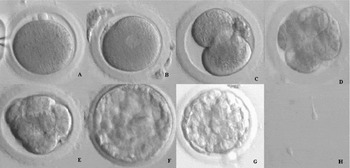
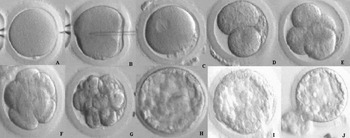
Embryo development was observed by inverted microscope by the same embryologist (Figure 1). Figure 2 (A–H) shows the embryo development process (double activation by calcium ionomycin I0634). We found that in the Control Group, two pronuclei (2PN) formed 5–6 h after ICSI, but in experimental group, 2PN formed about 4 h after ICSI. Therefore, development velocity of those embryos may be faster than that seen in the Control Group. Blastocysts derived from different groups were vitrified and then thawed (Fig. 2 (I, J)) after recipient rabbits were prepared with HCG injection. The survival was 100% after thawing.
Activation by calcium ionomycin (I0634). (A) A thawed rabbit oocyte; (B) a thawed oocyte formed 2PN (two pronuclei) after ICSI; (C) the fertilized oocyte developed into a 2-cell embryo; (D) the 2-cell embryo continued to cleavage and formed a 4-cell embryo; (E) a rabbit morula; (F) an expanded blastula; (G) thawed blastocyst was drilled by laser; (H) the head of rabbit sperm is bigger than that of human sperm. Total magnification is ×200.

Double activation by calcium ionomycin (I0634). (A) A thawed rabbit oocyte; (B) a thawed rabbit oocyte was subjected to ICSI; (C) the oocyte formed 2PN; (D) the fertilized oocyte developed into a 2-cell embryo; (E) the 2-cell embryo continued to cleavage and formed a 4-cell embryo; (F) an 8-cell rabbit embryo; (G) a rabbit morula; (H) an expanded blastula; (I) thawed blastocyst was drilled by laser; (J) an hatching embryo. Total magnification was ×200.

Rabbit embryo transplantation
All the blastocysts derived from the different groups were transplanted into different recipient rabbits (embryos from each group were transplanted to one rabbit). The rabbit transplanted with embryos from Group 3 became pregnant, but aborted spontaneously after 29 days.
Discussion
Developmental ability of thawed oocytes is lower than that of fresh oocytes in some reproduction centres. Jones et al. (Reference Jones, Blerkom, Davis and Toledo2004) reported that cryopreservation had two negative consequences. In a recent study, calcium ionophore combined with 6-dimethylaminopyridine (6-DMAP) was an effective activator that increased fertilization. (Nakasaka et al., Reference Nakasaka, Yamano, Hinokio, Nakagawa, Yoshizawa and Aono2000, Wang et al., Reference Wang, Wang, Yu and Xu2008). There have been few research studies on thawed oocyte activation. According to the conclusions reported by some researchers (Yanaqida et al., Reference Yanagida, Morozumi, Katayose, Hayashi and Sato2006; Kyono et al., Reference Kyono, Kumaqai and Nishinaka2008), the present study examines the effect of calcium ionophore and strontium chloride on thawed rabbit oocyte developmental potential.
Egg development is initiated by a rise in calcium and the suppression of the rise prevents egg development. Fertilization-like calcium oscillation frequency dramatically increases development stimulus, whereas an abnormally high frequency of oscillation results in cell death. Ionophore or ethanol results in a different calcium transient. Repetitive oscillation is continued as long as strontium chloride is present in the culture medium (Gordo et al., 2000; Jellerette et al., Reference Jellerette, He, Wu, Parys and Fissore2000, Tomashov et al., Reference Tomashov, Tchetchik, Eldar, Kaplan, Oron and Shalqi2005).
The optimum calcium oscillation time is not known. It has been reported that oscillation occurred (14 ± 6) min after ICSI at the earliest and (43 ± 20) min at the latest (Hanna et al., 2004). Therefore, researchers prefer to activate oocytes as soon as possible after ICSI, which may mimic the physiological mechanism of oocyte fertilization.
Human oocyte fertilization after ICSI produces a calcium response similar to that seen in normal fertilization, but the beginning of the sperm-induced calcium response is considerably delayed after ICSI (Heindryckx et al., Reference Heindryckx, Van Der Elst, Sutter and Dhont2005).
This experiment showed that oocyte activated by strontium chloride one time 1 h after ICSI, had higher fertilization potential, cleavage and blastocyst formation. One reason may be that the activation period of strontium chloride (20 min) was longer than that of calcium ionomycin (5 min), which may capture intracytoplasmic calcium oscillation time more accurately. Another reason may be that strontium chloride is more suitable to mammalian oocyte activation. However, the sample size was small in this study and thus there was no significant difference. Oocytes activated by strontium chloride twice displayed a different result. The ability of fertilization, cleavage and blastocyst formation was lower. The reason may be the culture period in activation medium was longer, which may increase embryonic toxicity and induce negative effects.
In mammalian eggs, the first prominent physiological change observed after fertilization takes the form of repetitive intracellular calcium increases (Keith et al., 2005). These increases continue at various frequencies for 3–4 h and cease around the time of pronucleus formation. Different patterns of calcium increase during oocyte activation have been shown to drive activation and have an effect on the preimplantation development of the embryos. Double activation had significant effects in this study. One reason may be that double activation enhanced the strength of activation. Another reason may be that the timing of double activation was closer to calcium oscillation. However, whether this method has negative effects on chromatosome and spindles needs to be determined. In this study, we found embryo cleavage velocity was faster than normal and double pronuclear formation occurred 4 h after ICSI, which was earlier than that seen in the Control Group, which occurred 5–6 h. Therefore, the mechanism of thawed oocytes activation and the effects on off-springs needs further investigation. Activation is a novel method that might be applied to thawed oocytes in the clinic.
Acknowledgements
The authors are grateful to Dr Wang for her help in data analysis and Dr Tao for his help revising this manuscript. We would also like to thank the Anhui Agricultural University for support in this work.