Blood stream infections (BSIs) are a major complication of antineoplastic chemotherapy in children. For decades, clinicians have appreciated the association of bacteremia with dose-intensive chemotherapy, mucositis, and profound neutropenia, attributing many of these episodes to bacterial translocation. The relative importance of bacterial translocation versus central venous catheter (CVC) maintenance on the development of BSIs in pediatric oncology patients is not known.
To account for gastrointestinal (GI) translocation as a source for bacteremia in oncology patients, the National Healthcare Safety Network (NHSN) has proposed a “mucosal barrier injury” (MBI) qualification for CVC-associated BSI (CLABSIs) due to specific enteric pathogens that occur in the setting of severe neutropenia or graft-versus-host disease. 1 In this study, a related classification was used to examine the multifactorial nature of bacteremia in children with cancer in relation to pathogen type: GI mucosa-associated or skin flora-associated.
METHODS
The records of patients with neoplastic and histiocytic disorders diagnosed at our institution from 2006 through 2012 were reviewed. Patients ≤22 years of age with bacteremia were included, for whom central or peripheral blood cultures had been performed. Cultures positive for common contaminants were included if they were identified in >1 sample, per NHSN guidelines. 1 Fungal bloodstream infections and allogeneic stem-cell transplant recipients were excluded due to potentially disparate etiologies. Local internal review board approval was obtained.
Baseline demographic information, performance status (Lanksy or Karnfosky scale), and diagnosis were collected. For each episode, all documented pathogens were recorded. GI mucosa-associated infection was defined as bacteremia that included the Gram-negative Enterobacteriaceae, Pseudomonas aeruginosa, Acinetobacter baumannii, Enterococci, or the viridans streptococci. Additional recorded data included disease course; changes in height and weight; change in performance status, blood counts, and chemistries; CVC placement information; mucositis; surgeries; exposure to radiotherapy; parenteral and enteral tube nutrition; and medication use including corticosteroids, gastric acid suppression, and recent (4 weeks) antibiotic exposures. Infection therapy, CVC removal, and outcomes were noted.
Descriptive statistics were calculated at the infection level and grouped into Gram-positive, Gram-negative, and mixed infections. Infection episodes with GI mucosa-associated bacteria were compared to all other organisms using clinical and laboratory data, and odds ratios (OR) with 95% confidence intervals (95% CI) were estimated using logistic regression with generalized estimating equations (GEE) to address the correlation between multiple infections in the same patient. Similar analyses were performed for infections with oral flora (eg, viridans streptococci) or Gram-negative bacilli. All tests were 2-tailed, were performed at a significance level of .05, and were analyzed on a complete case basis. Statistical calculations were performed using JMP® version 10 and SAS 9.3 (SAS Institute, Inc., Cary, NC).
RESULTS
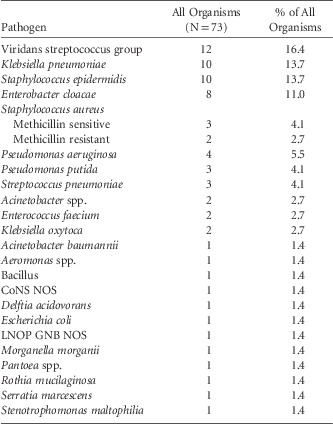
A total of 62 infection episodes were observed in 41 patients; 15 patients had >1 episode, with a maximum of 4 episodes. A total of 73 pathogens were identified; 10 episodes were polymicrobial (Table 1). The median age of infection was 6 years (range, 0.2–22 years). Acute lymphoblastic leukemia (ALL) was the most common diagnosis (N=16, 26%), followed by neuroblastoma (N=13, 21%), other solid tumors (N=12, 19%), and acute myelogenous leukemia (AML) (N=7, 11%). Symptoms of infection began in the outpatient setting in 58% of infection episodes (36 of 62). Nearly all infection episodes (N=61, 98%) occurred in patients with a CVC.
Bacterial Pathogens Identified

NOTE. Of 10 polymicrobial episodes, both organisms were Gram-negative in 5 episodes, 2 mixed Gram-negative plus an oral mucosa-associated Streptococcus viridans, 2 where all organisms were likely oral mucosa associated (Streptococcus viridans or Rothia mucilaginosa), and 1 mixed infection comprised of both a Gram-negative and a skin-flora associated organism (Staphylococcus aureus).
CoNS, coagulase-negative staphylococcus; GNB, Gram-negative bacillus; LNOP, lactose-negative oxidase-positive; NOS, not otherwise specified.
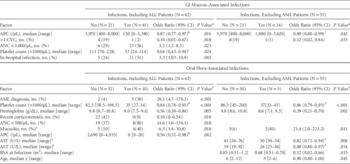
Univariate analyses of clinical characteristics for GI mucosa–associated infections are shown in Table 2. In-hospital symptom onset was associated with GI mucosa–associated versus other pathogens (OR, 3.3; 95% CI, 1.03–10.9; P=.045). More than 1 CVC present at the time of infection was negatively associated with organisms typical of the GI mucosa (OR, 0.10; 95% CI, 0.01–0.67; P=.018). GI mucosa–associated pathogens were associated with lower platelet counts (median 57,000 vs 111,000/µL, P=.024) and lower absolute neutrophil counts (ANC) (median 90 vs 3,710/µL), specifically ANC<1,000/µL (OR, 3.2; 95% CI, 1.2–8.5; P=.023).
Odds Ratios for Factors Associated with BSI Stratified by Pathogen Classification, Including or Excluding AML Patients

NOTE. The table includes only significant associations. No clinical characteristics were associated with Gram-negative bacilli infection at the 0.05 level.
ANC, absolute neutrophil count; AML, acute myeloid leukemia; AST, aspartate aminotransferase; ALT, alanine aminotransferase; APC, absolute phagocyte count; BSA, body surface area; CVC, central venous catheter.
a P values calculated using logistic regression with GEE.
b Odds ratio calculated per 1,000 units of measure.
c Odds ratio calculated per 100 units of measure.
d Odds ratio calculated per 10 units of measure.
e Data not available for all subjects.
Analyzed specifically, infections with oral flora were significantly associated with the diagnosis of AML (OR, 29.1; 95% CI, 4.7–178.2; P<.001) and mucositis (OR, 6.5; 95% CI, 1.4–30.8; P=.018). Recent corticosteroid exposure was negatively associated with oral pathogens (OR, 0.10; 95% CI, 0–0.54; P=.016). Oral pathogens remained associated with overall lower platelet counts (median 35,000 vs 82,500/µL, P<.001), ANC (median 0 vs 2,505/µL), and hemoglobin. ANC<500/µL was significantly associated with oral flora verses other organisms (OR, 14.6; 95% CI, 1.6–134.1; P=.018).
Strong associations were seen with a diagnosis of AML but not for other disease categories. In a subgroup analysis with AML patients excluded, GI mucosa–associated bacteremia was negatively associated with multiple CVCs (OR, 0.13; P=.04; OR, 0.12; 95% CI, 0.02–0.84; P=.033). Oral flora infections in patients with diagnoses other than AML were strongly associated with mucositis (OR, 21.4; 95% CI, 2.0–223.2; P=.011), lower platelet count, lower hemoglobin, lower AST, and lower ALT (P≥.05–0.1). When evaluating only infections with the Gram-negative bacilli, no associations were observed, with AML patients both included and excluded.
DISCUSSION
It is a commonly held belief that dose-intensive chemotherapy, mucositis, and neutropenia contribute to bacterial translocation across an injured GI mucosa.Reference Tancrede and Andremont 2 , Reference Taur and Pamer 3 A classic association exists between AML patients with mucositis and bacteremia with oral flora, namely the viridans streptococci.Reference Rossetti, Cesaro, Putti and Zanesco 4 , Reference Burden, Oppenheim and Crowther 5 In our study, we found that GI mucosa-associated infections do differ from infections with other flora and were associated with lower ANC (especially <1,000/µL) and lower platelet count, but the difference is largely attributable to bacteremia from oral flora in patients with AML or mucositis. Mucositis was only associated with oral flora bacteremia and not with bacteremia with Gram-negatives as a whole, despite the presumption that ulcerations occur throughout the GI tract. In fact, no specific risks were found for Gram-negative bacilli when analyzed by themselves.
This finding brings into question the appropriateness of using the NHSN’s MBI CLABSI qualification in pediatric populations. The MBI CLABSI qualification was instituted to address the issue of GI mucosal disruption as a source for BSI in the oncology population.Reference Fraser and Gordon 6 , Reference See, Iwamoto, Allen-Bridson, Horan, Magill and Thompson 7 In this definition, enteric pathogen bacteremias are deemed potentially unrelated to the central catheter in the setting of severe neutropenia or GI graft-versus-host disease. 1 In the nontransplant setting, a more restrictive modification of the NHSN MBI qualification limited to bacteremia from oral flora could be used, perhaps including only those patients with AML or documented mucositis.
Bacteremia in the pediatric oncology population is clearly multifactorial. Central venous access likely does play an important role in BSI in these patients, as is often suspected. The shift in pathogens away from GI mucosa-associated flora when patients have >1 CVC (Table 2) lends credence to the theory that “catheter density” is relevant.Reference Fong, Banks and Benish 8
In our study, we examined the associated characteristics of bacteremia in pediatric oncology patients based upon specific pathogen classification schemes. Clinical and laboratory data assessed here suggest that GI mucosa-associated infections do differ from infections with other flora but that the difference is largely attributable to bacteremia from oral flora in patients with AML or mucositis. This underscores the need to consider prevention strategies outside of CVC insertion and maintenance practices for patients with AML or oral mucositis.Reference Rinke, Bundy and Chen 9 However, even in patients with mucosal injury, our data do not support the conclusion that isolation of an enteric pathogen is unrelated to the central catheter. In this regard, implementation of CVC maintenance care bundles in pediatric oncology patients has been demonstrated to reduce the number of BSIs attributed to both Gram-positive and Gram-negative organisms.Reference Rinke, Bundy and Chen 9 , Reference Rinke, Chen and Bundy 10
Acknowledgments
Financial support. None reported.
Conflict of interest. All authors report no conflicts of interest relevant to this article.