Introduction
Post-traumatic stress disorder (PSTD), classified as an anxiety disorder, develops after exposure to actual or threatened death, serious injury, or threats to the physical integrity of self or others.Reference Vieweg, Julius and Fernandez1 In North America and European countries, the estimated lifetime prevalence of PTSD in the general population is 7%–8%,Reference Vieweg, Julius and Fernandez1,Reference de Vries and Olff2 but is 17%–22% among firefighters.Reference Vieweg, Julius and Fernandez1,Reference Wagner, Heinrichs and Ehlert3
The work of firefighters includes not only firefighting, but also ambulance, and rescue duties, which often involve tragic events that contribute to the risk of developing PTSD. In Japan, the estimated prevalence of PTSD is approximately 20% for ambulance and rescue workers,Reference Alexander and Klein4 and 9%–22% for firefighters.5–Reference Mitani9
Job stress (evaluated using the Japanese Brief Job Stress Questionnaire) may influence the risk for developing PTSD among Japanese firefighters.Reference Mitani, Fujita, Nakata and Shirakawa10 Furthermore, social support has been implicated as a possible influence on the development of PTSD among American rescue workers, paramedics, and Japanese firefighters.Reference Mitani, Fujita, Nakata and Shirakawa10–Reference Regehr, Goldberg and Glancy12 Frequently, PTSD exists as a comorbid condition with depressive disorders.Reference Oquendo, Brent and Birmaher13
The purpose of this study was to clarify the relationship of PTSD scores to job stress, social support, and depressive stress among Japanese firefighters.
Methods
Participants in this study were firefighters (18 through 60 years of age) working for the local government and holding a rank of Section Chief or lower. The study was conducted during September and October 2005 using self-administered questionnaires.
The Japanese version of the Center for Epidemiologic Studies Depression Scale (CES-D) questionnaire was used to evaluate depressive symptoms, as well as to gather information related to age, gender, job type and class, marital status, smoking, and drinking habits. The standard CES-D uses a cutoff score of 16 points for depressive symptoms.Reference Shima, Shikano and Kitamura14,Reference Radloff15 The U.S. National Institute for Occupational Safety and Health (NIOSH) Generic Job Stress Questionnaire was used to evaluate job stresses and social support.Reference Hurrell and McLaney16 The Japanese version of the NIOSH Generic Job Stress Questionnaire has demonstrated consistently high levels of internal reliability (Cronbach's alpha = .68–.95) and test-retest reliability over a one-year period (r = .44–.71).Reference Haratani, Kawakami and Araki17,Reference Haratani, Kawakami and Araki18 The following measures were chosen from the NIOSH Generic Job Stress Questionnaire for further evaluation: quantitative workload, variance in workload, cognitive demand, job control, intra-group conflict, inter-group conflict, role ambiguity, role conflict, social support from a supervisor, coworker, and/or family or friends, non-work activity, self-esteem, and job satisfaction. Post-traumatic stress disorder was assessed using the Japanese version of the IES-R comprised of 22 items, in which a score of 25 points or more indicates a PTSD-positive status.Reference Asukai, Kato and Kawamura19
Age was categorized as <30 years, 30–39 years, 40–49 years, or ≥50 years. Subjects were classified as “nonsmokers” (never- and ex-smokers) or “current smokers.” Drinkers were defined as those who consumed alcohol more than once per week once per week. Marital status was classified as unmarried or married. Job classes included Firefighter, Assistant Fire Sergeant, Fire Sergeant, Fire Lieutenant, Fire Captain, and Battalion Chief. Job types encompassed firefighting, ambulance work, rescue work, other shift work (fire inspection and command work), and daytime work (general affairs and fire prevention). Subjects involved in firefighting, ambulance work, rescue work, and other shift work worked >24 hour shifts (from 8:45 AM to 8:55 AM the next day), and rested four days every two weeks.
This study was approved by the Institutional Ethical Board for Epidemiological Studies of Asahikawa Medical University.
Statistical Processing
The PTSD-positive and PTSD-negative groups were compared with regard to socio-demographic factors, the mean values for each measure of the NIOSH Generic Job Stress Questionnaire, and the CES-D scores using chi-square or t-tests. Logistic regression was used to estimate age- and sex-adjusted odds ratios (ORs) of marital status, smoking and drinking habits, job class, job type, and depression (CES-D ≥16). Analysis of covariance was used to compare age- and sex-adjusted scores of each measure of the NIOSH generic job stress questionnaire, and CES-D scores between PTSD-positive and PTSD-negative groups. P values <.05 were considered statistically significant. All calculations were conducted using IBM SPSS Statistics 18.0 for Windows (SPSS Inc., Chicago, IL, USA).
Results
Responses were received from 1,731 of the 1,767 firefighters (response rate = 98%). A total of 64 respondents were excluded because they were employees on loan from a city office (n = 8) or had provided responses with missing information (n = 56). The final study group consisted of 1,667 subjects (effective response rate (ERR) = 94.3%).
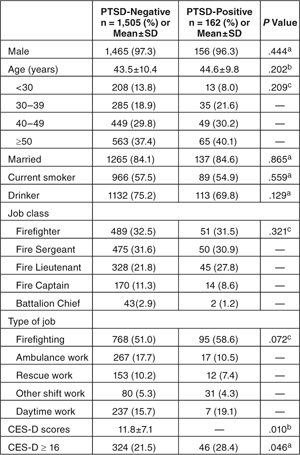
The number of subjects identified as PTSD-positive was 162 (9.7%). Differences between PTSD-positive and PTSD-negative group characteristics with respect to the CES-D questionnaire results are detailed in Table 1. The two groups were roughly comparable in terms of gender, marital status, the percentage of smokers and drinkers, and job classes. CES-D scores were higher for the PTSD-positive group (13.6±8.4) than for the PTSD-negative group (11.8±7.1). In addition, the percentage of firefighters with CES-D ≥16 was higher in the PTSD-positive group (28.4%) than in the PTSD-negative group (21.5%).
Subject characteristics and CES-D scores
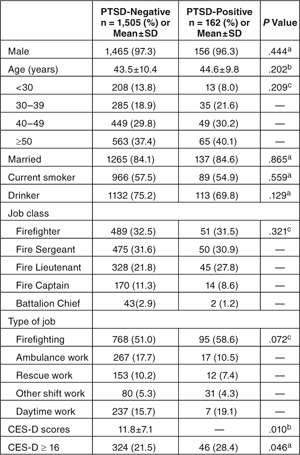
Abbreviations: CES-D, Center for Epidemiologic Studies Depression Scale; PTSD, post-traumatic stress disorder.
a Chi-square test of 2 by 2 table
b t-tests
c Chi-square test of 2 by n table
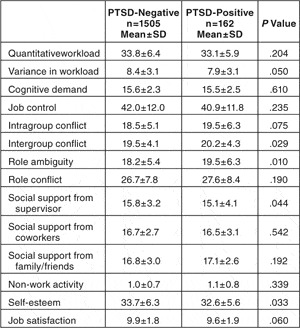
Mean scores on components of the NIOSH generic job stress questionnaire are shown in Table 2. There were statistically significant differences for intergroup conflict and role ambiguity (higher in the PTSD-positive group), as well as self-esteem and social support from supervisors (lower in the PTSD-positive group).
NIOSH Generic Job Stress Questionnaire scores

Abbreviations: NIOSH, National Institute for Occupational Safety and Health; PTSD, post-traumatic stress disorder.
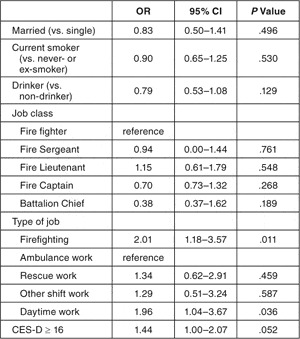
The age- and sex-adjusted odds ratios (ORs) of the participants' marital status, smoking and drinking habits, job class, job type, and depression (CES-D ≥16) for those respondents that were identified as PTSD-positive are shown in Table 3. Compared to rescue work, the ORs for PTSD were significantly higher statistically for firefighting (2.01; 95% CI = 1.18-2.91, P = .011), and daytime work (1.96; 95% CI = 1.04-3.67, P = .036). The OR for depression (CES-D ≥16) was 1.44 (95% CI = 1.00-2.07, P = .052).
Age- and sex-adjusted odds ratios (OR) for PTSD-positive respondents

Abbreviations: CI, confidence interval; CES-D, Center for Epidemiologic Studies Depression Scale; OR, odds ratio; PTSD, post-traumatic stress disorder.
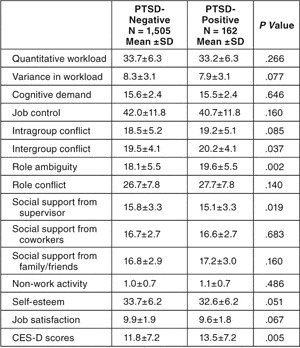
Comparison of age- and sex-adjusted scores for each measure of the NIOSH generic job stress questionnaire, along with the CES-D scores of PTSD-positive and PTSD-negative groups is shown in Table 4. Compared to the PTSD-negative group, participants in the PTSD-positive group had statistically significant higher scores for inter-group conflict (P = .037), role ambiguity (P = .002), and CES-D (P = .005). This group also had significantly lower scores for social support from supervisors compared to the PTSD-negative participants.
Age- and sex-adjusted job stress variables and CES-D score comparison

Abbreviations: CES-D, Center for Epidemiologic Studies Depression Scale; PTSD, post-traumatic stress disorder.
Discussion
This study identifies statistically significant relationships between inter-group conflict, role ambiguity, social support from supervisors, and CES-D scores and PTSD development among Japanese firefighters. To the authors' knowledge, the relationship between the development of PTSD among firefighters and the stress factors assessed by the NIOSH generic job stress questionnaire have not been previously reported.
Recent studies investigating Japanese firefighters have estimated the prevalence of PTSD to be 9.4%–21.9% using the IES-R.Reference Hatanaka, Matsui and Maruyama5–Reference Mitani, Fujita, Nakata and Shirakawa10 The prevalence of PTSD reported in the current study (9.7%) is in the low end of this range. The number and the effective response rate of subjects who participated in this study were greater than that of the other studies. The estimated prevalence of PTSD among North American and European firefighters/ambulance workers is reported to be approximately 20%.Reference Alexander and Klein4 The lower prevalence reported in this study may be due to Japan's low rate of violent crime rate.Reference Kuhne20 Additionally, the subjects of this study work in a well-maintained city that experiences disasters from a natural event to a lesser extent than other Japanese regions, which frequently encounter earthquakes and volcanic eruptions. The aging population of Japan is reflected in the present study by the fact more than one third of the respondents were >50 years of age. This may have influenced the results, since older individuals are known to be less vulnerable to PTSD compared to their younger counterparts.Reference Asukai, Kato and Kawamura19
A recent study using the Japan Brief Job Stress Questionnaire reported that high job stress is related to PTSD development; however, the particular job stresses assessed in that study were not reported.Reference Mitani, Fujita, Nakata and Shirakawa10 In the current study, inter-group conflict was found to be related to a positive PTSD status. A significant relationship between inter-group conflict and depressive symptoms has been reported; lower inter-group conflict probably has a beneficial effect on the mental health of workers and may have a protective effect against the development of PTSD.Reference Tsuno, Kawakami and Inoue21,Reference Inoue and Kawakami22
Role ambiguity also was found to have a significant relationship with the development of PTSD in the current study. Relationships between role ambiguity, depressive symptoms, and burnout have been reported previously;Reference Tunc and Kutanis23 less role ambiguity may provide a protective effect against the development of PTSD.
Other studies have investigated factors that may have protective effects against the development of PTSD among firefighters,Reference Mitani, Fujita, Nakata and Shirakawa10–Reference Regehr, Goldberg and Glancy12 and many have reported that lower levels of social support are associated with increased PTSD symptoms.Reference Yuan, Wang and Inslicht24–Reference Guay, Billette and Marchand26 No statistically significant relationship was found between social support of co-workers and family with PTSD in the current study; however, support from supervisors was determined to be related significantly to PTSD development. In other studies, social support from supervisors has been linked to perceptions of healthier work environments,Reference Lowe, Schellenberg and Shannon27 less work-related stress,Reference Thompson, Kirk and Brown28,Reference De Lange, Taris and Kompier29 and fewer depressive symptoms.Reference Tak, Driscoll and Bernard30,Reference Dolbier, Smith and Steinhardt31 In addition, because firefighting requires strict, military-like discipline, supervisors may have pronounced effects on their subordinate officers.
The PTSD-positive group had higher CES-D scores compared to the PTSD-negative group, and depression (CES-D ≥16) had a nearly statistically significant higher OR for the presence of PTSD. Post-traumatic stress disorder is known to be frequently comorbid with depressive disorders.Reference Oquendo, Brent and Birmaher13 It has been reported that pre-existing major depression may render individuals more vulnerable to developing PTSD in the aftermath of trauma.Reference Breslau, Davis and Peterson32,Reference Bromet, Sonnega and Kessler33 Likewise, when PTSD and depression co-occur, they may represent a single traumatic stress construct with shared vulnerability and similar predictor variables.Reference O'Donnell, Creamer and Pattison34 Post-traumatic stress disorder and major depressive episodes share a number of symptoms, including sleep disturbance, poor concentration, guilt, restricted affect, and suicidal ideation.Reference Oquendo, Brent and Birmaher13
Among the various types of jobs performed by Japanese firefighters, firefighting had a significantly higher odds ratio for PTSD. It has been speculated that injuries or the deaths of co-workers were related to PTSD, and that there is a high probability of encountering these situations when firefighting.Reference Yamashita, Sato and Ishizawa7 Daytime workers also had significantly higher odds ratios for the presence of PTSD. In another Japanese publication, it has been speculated that the reason for this trend may be due to daytime workers having lower levels of support.Reference Koga, Maeda and Shinto6 Moreover, people with mental health disorders tend to change to daytime work to lessen the chance of encountering situations that can cause PTSD. However, the work of firefighters varies among countries, and there have been few reports detailing the relationship between PTSD and the various jobs performed by firefighters.Reference Koga, Maeda and Araki35
Limitations
This study had several limitations. The cross-sectional design precludes determination of the causal order of the associations between stress measures, depressive symptoms, and PTSD with any degree of certainty. Furthermore, the small number of females in the sample size restricted gender-specific analysis. Also, if non-responding subjects had higher stress levels, depressive symptoms, and PTSD, the relationship between investigated factors and PTSD could have been underestimated. However, selection bias can be ruled out in this study due to the high response rate. Japanese and United States firefighters perform tasks such as emergency services and rescue work in addition to firefighting; therefore, the results cannot be compared directly to firefighters from other countries who engage only in firefighting. Finally, because there were many variables involved, the significance could be the result of chance alone; however, the results were similar to findings reported by other researchers.
Conclusions
High inter-group conflict and role ambiguity, low social support from supervisors, and depressive symptoms are related to the presence of PTSD among Japanese firefighters. Further prospective studies are required to clarify whether these factors precede the development of PTSD, and whether alleviation of these factors can prevent the development of PTSD among firefighters.
Abbreviations:
CES-D = Center for Epidemiologic Studies Depression Scale
ERR = effective response rate
IES-R = Impact of Event Scale-Revised
NIOSH = U.S. National Institute for Occupational Safety and Health
PTSD = post-traumatic stress disorder