INTRODUCTION
For people who have progressive and eventually fatal diseases, the months before death can be very stressful. The decline in health, treatment side effects, worries about death and dying, and changes in relationships with family or professional caregivers may all add to a heightened level of strain (Silberfarb et al., 1980; Weisman & Worden, 1985–1986; Houts et al., 1988; Hinton, 1994; Classen et al., 1996). Indeed, there is a small but consistent body of literature, both empirical and conceptual, that supports a multidimensional view of the sources of stress in people with terminal illness. These dimensions include physical symptoms, social concerns, and spiritual/existential issues (Noyes et al., 1990; Corr, 1991–1992; Cohen et al., 1996, 1997; Trail et al., 2004). An important research question, therefore, pertains to how people cope with the multidimensional stressors of advanced disease.
Coping has been defined as cognitive and behavioral efforts to manage demands that are appraised as taxing an individual's resources (Lazarus & Folkman, 1984; Folkman, 1992). Coping has two major functions; management or alteration of the situation causing the problem (problem-focused coping) and the regulation of one's emotional response to the situation (emotion-focused coping). It has also been suggested that coping strategies can be further classified on a dimension of approach–avoidance (Suls & Fletcher, 1985) or engagement–disengagement (Tobin et al., 1989; Epping-Jordan et al., 1999). The approach dimension refers to the tendency to focus on or deal directly with the stressful event, whereas the avoidance dimension refers to ignoring, letting go, or minimizing the significance of the threat.
Several studies have found that patterns of coping are related to psychological distress in people with cancer (Stanton & Snider, 1993; Heim et al., 1997; Epping-Jordan et al., 1999). For example, there is some indication that depressive symptoms are related to the use of avoidant emotion-focused strategies such as resignation–fatalism, passive–avoidant behavior, or blaming oneself and the environment (Dunkel-Schetter et al., 1992; Heim et al., 1997; Hack & Degner, 2004). On the other hand, emotional approach strategies, such as positive reappraisal and actively processing emotions, have been associated with better adaptation (Taylor et al., 1984; Dunkel-Schetter et al., 1992; Manne et al., 1994; Stanton et al., 2000, 2002).
Despite these findings, however, much remains to be learned about how people cope with advanced illness. One particular issue concerns the fact that people with advanced cancer must cope concurrently with multiple problems across different dimensions of stress. It may be overly general to ask about “coping with a life-threatening illness,” rather than inquiring more concretely into specific individual problems. As noted by Lazarus (1993, p. 236), and reiterated by Brennan (2001) and Somerfield et al. (1999), “it is necessary to specify the particular threats of immediate concern and to treat them separately rather than broadening the focus of attention to the overall illness.” However, this approach to coping has seldom been adopted within the psycho-oncology literature. In this study, therefore, we have conducted in-depth interviews with people who were receiving palliative care for advanced cancer to (1) identify sources of stress across physical, social, and existential dimensions; (2) determine how people cope differentially with different types of stressors; and (3) examine the associations between stress, coping, and psychological distress.
METHODS
Participants
Participants were recruited from an acute care hospital, an inpatient palliative care unit, or a day hospice. They were identified by palliative care clinicians who reviewed consecutive patients admitted or referred to their services. The criteria for inclusion were that (1) in the opinion of the referring clinician, the patient was not impaired cognitively; (2) the patient's physical condition permitted participation; (3) the patient's primary diagnosis was cancer; and (4) the patient was aware that treatment was not directed toward cure. Only patients who were willing to take part in a study related to “how people cope with stress” had their names passed along to the research team. Of 88 patients who were approached, 52 (59.1%; 19 men and 33 women) agreed to take part.
Participant Characteristics
The average age of participants was 65.7 years (SD = 14.5, range = 37 to 87 years). As a group, they were highly educated, with 28 (53.8%) having attended college or university. Primary tumors were located in the female breast (N = 10; 19.2%), lung (N = 8, 15.4%), bowel (N = 8; 15.4%), gastrointestinal system (N = 6; 11.5%); head and neck (N = 5; 9.6%), genitourinary system (N = 7; 13.5%), or other sites (N = 3; 5.8%). The site of the primary tumor was unknown for the remaining participants (N = 4; 7.7%). The majority of participants (N = 38; 73.1%) were receiving opioid medications.
Procedures
The study was approved by the Research Ethics Boards of three institutions that were involved in recruitment. Before beginning the study, each participant signed an acknowledgement of informed consent.
Each participant completed a semistructured interview that inquired about a range of problems within the physical, social, and existential dimensions of stress, as well as the participant's ways of coping with those problems. The interviews were administered by doctoral students in clinical psychology who were experienced in research interviewing. The interviews were tape-recorded to permit the preparation of verbatim written transcripts and also to permit independent reliability checks of interviewer ratings.
For the assessment of symptoms and concerns, the interview adapted a protocol that has been used previously in palliative care settings (Wilson et al., 2000, 2004, 2005). Each item followed the same pattern: a lead question that asked about the presence of a specific symptom or concern, followed by probing to assist in rating the severity of the problem on a 7-point scale (0 = no problem, 1 = minimal, 2 = mild, 3 = moderate, 4 = strong, 5 = severe, 6 = extreme). The probing included an inquiry into the intensity, frequency, and degree of distress associated with each problem. The specific symptoms and concerns were assigned on an a priori basis into the dimensions of physical symptoms, social concerns, and existential issues. These categorizations were informed by prevalence studies of various symptoms and concerns (Coyle et al., 1990; Ventafridda et al., 1990; Curtis et al., 1991) and the item content of other quality-of-life and symptom checklists (Portenoy et al., 1994; Cohen et al., 1996) as well as by the identification of particular themes that have been considered relevant in other research related to stress and coping with cancer (Dunkel-Schetter et al., 1992).
Physical Symptoms
The physical symptom assessment reviewed pain, weakness, drowsiness, nausea, and dyspnea. Although this is not a comprehensive list of symptoms that can occur in advanced cancer, these specific items were selected based on their high prevalence in palliative care (Coyle et al., 1990; Curtis et al., 1991). All of these items were taken from the structured interview of symptoms and concerns developed by Wilson et al. (2004), who found that the interrater reliability was excellent, (rs ≥ .92). They also found that the items correlated highly with visual analogue scales of the same constructs (ranging from r = .71 to .90).
Social Concerns
Six items were included to address major social concerns that arise frequently with advanced illness. Conceptually, social issues were defined as problems that involved relationships with people as individuals or relations with people as members of groups or society (Corr, 1991–1992), including interactions with health professionals. The specific items in the social dimension were the sense of isolation from others, concern about a lack of information from health professionals, concern about a lack of consultation regarding care, a sense of loss around important social roles, financial strain, and a feeling of being a burden to others.
Existential Issues
Another section of the interview comprised six items that have been described as existential sources of distress associated with terminal illness. They included problems in maintaining a sense of control, loss of dignity, diminished life satisfaction, concern for the future, hopelessness, and loss of meaning (Dunkel-Schetter et al., 1992; Cohen et al., 1996, 1997; Chochinov et al., 1998, 2002; Street & Kissane, 2001).
Coping Strategies
The assessment of coping strategies was done with an interview methodology similar to that described by Wertlieb et al. (1987), Compas et al. (1988), Wilson et al. (1995), and Osowiecki and Compas (1998). An interview approach was used because of concerns that very ill participants would not be able to complete three administrations of a lengthy coping questionnaire. Moreover, as noted by Aldwin (1994, p. 67), “interviews may be especially useful when exploring a new area about which relatively little is known, when studying potentially very sensitive areas … or when dealing with a population that might have very different views of what constitutes stressors, either owing to culture or age.”
The assessment of coping was directed toward identifying individual cognitive and behavioral strategies that the participant used when attempting to manage the single most significant problem in each of the three dimensions of stress. Specifically, the participant was asked to describe every strategy in detail, in order to clarify the intent of the action as representing an effort to alter/solve the problem (i.e., problem-focused coping) or to manage the feelings associated with the problem (i.e., emotion-focused coping).
The transcribed narratives were reviewed independently by two coders, who initially parsed each transcript into distinct conceptual statements that reflected individual examples of coping behavior. At this stage of analysis, the coders agreed on 88.3% of statements (κ = .77). Disagreements were resolved by a third coder, resulting in a final pool of 1,347 distinct statements to be categorized into specific ways of coping.
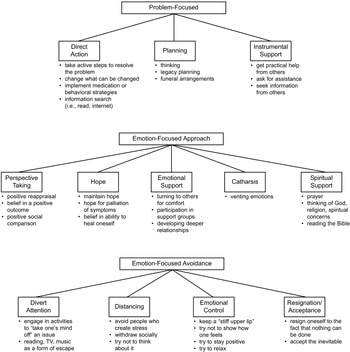
The starting point for the categorization of coping strategies was the Cheng et al. (2000) adaptation of Stone and Neale's (1984) description of coping behaviors. This framework was adopted because, like the present study, it used semistructured interviews to examine the coping behaviors of medical patients. The adequacy of the model was reviewed periodically during the course of coding, and some modifications were introduced to account for the fact that, among our participants, some behaviors occurred too infrequently to merit separate codes and others emerged that had not been identified by Cheng et al. As shown in Figure 1, the final rating system comprised 12 different categories of coping behavior, which could be further classified into three dimensions of problem-focused approach, emotion-focused approach, and emotion-focused avoidance strategies. Problem-focused avoidance strategies were mentioned too infrequently to include as a separate category.

Categorization of coping strategies.
Psychological Distress
The seven-item Beck Depression Inventory for Primary Care (BDI-PC) was used as an index of general distress. The BDI-PC was developed as a short form of the widely used 21-item BDI, by retaining only those items that are most appropriate for use with medical patients. Beck et al. (1997) reported that the internal consistency of the BDI-PC is high, and in the present study it was α = .77.
RESULTS
Sources of Stress
To determine the interrater reliability of the ratings of stress, the tape recordings of all interviews were scored by an independent rater. In general, the reliability was excellent, with intraclass r ≥ .97 for every variable that required an ordinal rating.
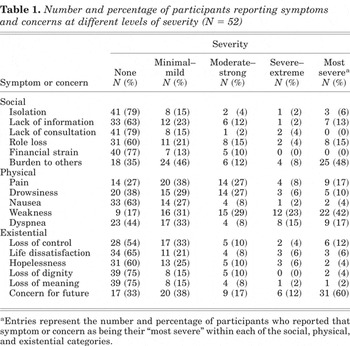
Table 1 shows the prevalence and severity of the different sources of social, physical, and existential stress. As is evident in this table, the most prevalent social concern was the feeling of being a burden to others. This was cited by 65.4% of participants as a problem that occurred with at least a minimal level of severity, and it was identified as the most significant social concern by 48.1%. Other common social stressors (reported by at least a third of participants) were role loss (an issue for 40.4% of participants) and lack of information about their illness or treatments (36.5%). Nine (17.3%) participants were not distressed by any of the social issues included in the interview.
Number and percentage of participants reporting symptoms and concerns at different levels of severity (N = 52)

All of the physical symptoms occurred commonly and were reported by over 35% of participants. Weakness was the most prevalent physical symptom (82.7%), followed by pain (73.1%). Weakness was also identified by the greatest number of participants (42.3%) as the single most distressing physical symptom. There were 5 (9.6%) participants who reported that they experienced no distress around any physical symptoms.
The most prevalent existential issue was worry and concern about the future, which was cited as a source of stress by 67.3% of participants. It was acknowledged as the greatest existential concern by 59.6%. It is important to note, however, that “concerns about the future” meant different things for different people. For 21 (40.4%) participants, worry about the future was directed toward concerns about death and dying (e.g., not being ready to die, uncertainty about the time they had left, fear of a painful or prolonged death, being alone, concerns about an afterlife). Concern for the future welfare of family members was reported as the primary issue for 9 (17.3%) others, suggesting that for some participants there was also a social component to this existential concern. Seven (13.5%) participants reported that they experienced no distress at all as a result of any existential issues.
Intercorrelations and Differences between Measures of Stress
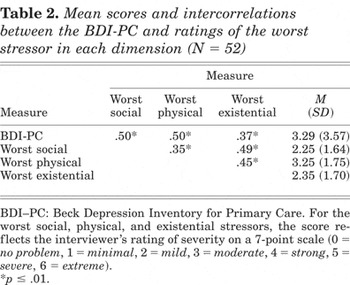
Table 2 shows the intercorrelations between different measures of the worst stress ratings across the social, physical, and existential dimensions. As is evident, all of the measures of stress severity were correlated significantly with one another (all ps < .01). In general, therefore, the stress experience seems to have some communality across dimensions, in the sense that participants who reported high levels of distress in one dimension also tended to report high levels of distress in the others. Moreover, all of the worst stress ratings were also correlated significantly with scores on the BDI-PC.
Mean scores and intercorrelations between the BDI-PC and ratings of the worst stressor in each dimension (N = 52)

Despite this communality, there were also important differences across the dimensions of stress. Specifically, a repeated-measures analysis of variance (ANOVA) revealed a significant difference in the average ratings, F(2,102) = 9.63, p < .001, such that the worst physical stressor was rated as more severely distressing than either the worst social or existential stressors.
Specific Coping Strategies
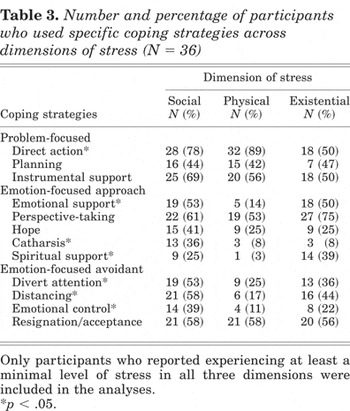
The percentages of participants who reported using the different categories of coping behaviors within each of the physical, social, and existential dimensions are shown in Table 3. Only the 36 participants who reported experiencing some degree of stress in all three dimensions are included in the table. It should be noted that this summary does not incorporate the overall number of coping strategies; rather, for this purpose, a participant is counted as having used a particular strategy as long as a relevant coping behavior was used at least once. For example, with physical stressors, direct action strategies were reported most commonly, with at least one such strategy being reported by 88.9% of the participants.
Number and percentage of participants who used specific coping strategies across dimensions of stress (N = 36)

Overall, the coping strategies that were used most widely across the dimensions of stress were direct action, seeking instrumental support, perspective-taking, and resignation/acceptance. These strategies were reported by at least half of the participants for all three dimensions.
To determine whether different ways of coping were used for different problems, these frequency data were analyzed in a series of Cochrane's Q analyses. Significant Q values were followed up with McNemar's χ2 for pairwise contrasts. These analyses revealed that distancing, emotional support, and spiritual support were all used by fewer participants in response to physical stressors than to either social or existential concerns (all ps < .008). In addition, fewer participants reported the use of diverting attention and emotional control strategies in response to physical, as opposed to social, stressors (ps < .03). Catharsis was used by more participants in the context of social stressors than with either physical or existential issues (ps < .007). Finally, direct action strategies were used by fewer participants to cope with an existential concern than with social or physical concerns (ps < .03).
Problem-Focused and Emotion-Focused Coping
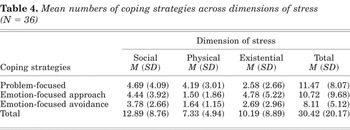
An alternative analytic approach was used to examine the overall numbers of coping strategies. For this purpose, the data were first collapsed into the problem-focused, emotion-focused approach, and emotion-focused avoidance categories. The mean numbers of coping behaviors within each category are shown in Table 4.
Mean numbers of coping strategies across dimensions of stress (N = 36)

A 3 × 3 (dimensions of stress × ways of coping) ANOVA conducted on the numbers of coping strategies revealed significant main effects for dimensions of stress, F(2,70) = 12.50, p < .001, and ways of coping, F(2,70) = 4.67, p = .013. These effects indicated, first of all, that participants reported the greatest number of coping strategies for social concerns, followed by existential and then physical stressors (all pairwise ps < .03). In addition, across all categories of stress, they reported using fewer emotion-focused avoidance strategies than problem-focused or emotion-focused approach strategies (ps < .04). However, these main effects were embedded in a significant stress × coping interaction, F(4,140) = 11.23, p < .001.
The interaction effect was probed in a series of individual ANOVAs conducted within each of the three dimensions of stress. Within the social dimension, there were no significant differences in the numbers of problem-focused, emotion-focused approach, and emotion-focused avoidance strategies, F(2,70) = 1.18, p > .10. On the other hand, different patterns of coping behavior were observed for both the physical, F(2,70) = 28.96, p < .001, and existential dimensions, F(2,70) = 6.90, p = .007. For the physical stressor, more problem-focused strategies were reported than strategies from either of the emotion-focused categories. For the existential stressor, emotion-focused approach strategies were reported most frequently.
Coping and Distress
The association between coping and distress was also examined using two analytic strategies. In the first, the dichotomous classifications of individual coping behaviors (i.e., whether a specific strategy was either used or not used) in each of the three dimensions of stress were correlated with the BDI-PC scores. Given the categorical nature of these classifications, they were assigned dummy weightings and analyzed with point-biserial correlations. In this series of 36 correlations (12 coping behaviors × 3 dimensions of stress), only 2 were statistically significant. People with higher levels of distress were less likely to report turning to spiritual support for their most significant social concern, rpb = −.34, p = .045, and less likely to use perspective-taking in response to their worst physical stressor, rpb = −.37, p = .027. It should be noted, however, that two significant correlations would be expected to occur by chance alone with p < .05; even a minor adjustment for multiple comparisons would render those correlations nonsignificant.
In the second set of analyses, nine correlations were computed between the BDI-PC scores and the total numbers of problem-focused, emotion-focused approach, and emotion-focused avoidance strategies that were reported across the three dimensions of stress. None of these correlations approached statistical significance (all ps > .10).
DISCUSSION
Given that the experience of cancer, especially in advanced stages, can be a very stressful one, studies of coping are important for psycho-oncology. One limitation of the available research, however, is that “cancer” has typically been viewed as a unitary life stress, without considering that the illness actually imposes multiple stressors across various dimensions of function. As noted by some recent critics, the study of coping can perhaps be advanced by adopting a more narrow perspective on specific or immediate threats, rather than on the broader construct of illness in general (Lazarus, 1993; Somerfield et al., 1999; Brennan, 2001).
For the present study, we used a multidimensional conceptualization of stress in advanced disease as arising from social concerns, physical symptoms, and existential issues. Our findings confirmed, first of all, that the stressors facing people who have a terminal illness are indeed complex and varied (Silberfarb et al., 1980; Weisman & Worden, 1985–1986; Houts et al., 1988; Hinton, 1994; Classen et al., 1996). However, they are not necessarily universal. For each of the three individual dimensions of stress, between 9.6% and 17.3% of participants denied experiencing any difficulties, and 3 participants (5.8%) reported a complete absence of distress in all three dimensions. With disease progression, it is perhaps inevitable that all patients with advanced cancer will experience some problems eventually, at least with respect to physical symptoms, but some are able to carry on with great equanimity in the face of a terminal diagnosis. Evidently, the experience of advanced cancer is not invariably stressful in all domains, and there may even be potential for self-discovery, deepening relationships, and personal growth (Cunningham, 1992).
For those participants who were experiencing significant distress, this study helps to elaborate the nature and severity of their difficulties. Concern about being a burden to others was the most disturbing social issue, and was acknowledged as such by 48.1% of the participants. In the physical dimension, pain is reportedly a problem that engenders a high level of fear among people with cancer (Wilson et al., 2000), and indeed most participants did report some degree of pain. On the other hand, pain was generally well controlled, and it was not identified most consistently as the worst physical symptom. Rather, weakness was considered the most troubling problem by 42.3% of respondents. Finally, earlier research has shown that a major source of existential distress for people with cancer is the prospect of disease progression, with its implicit threat to survival (Gotay, 1984; Noyes et al., 1990). This was also evident in the present study, with 59.6% of participants citing concern about the future as their most significant source of existential distress.
Among the three dimensions, physical symptoms received the highest severity ratings, but it was also observed that the dimensions were significantly intercorrelated. Similar findings have also been reported in other research. Cohen et al. (1996), for example, reported that several of the subscales on the McGill Quality of Life Questionnaire are at least moderately correlated. Thus, the experience of stress appears to show some consistency across the social, physical, and existential domains, which suggests that there may be a general factor of global distress that cuts across more specific dimensions. This finding is analogous, perhaps, to the concept of “total pain” that has been described by Twycross (1994) and Saunders (2000). This suggestion is reinforced by the additional finding that scores on the BDI-PC were correlated significantly with stressor severity ratings for all three dimensions.
The cognitive and behavioral strategies that people use to manage these stressors are thought to play a role in how well they adapt. We used structured interviews and content analysis to assess coping in a way that permitted the identification of specific types of coping behaviors as well as broader categories of problem-focused or emotion-focused approach and avoidance strategies. Although it has sometimes been concluded that patients cope with cancer using mainly emotion-focused avoidance (Maes et al., 1996), the present findings suggest a more complex view of the coping process, which is dependent on the specific stressors that are being coped with. Some strategies, such as direct action, perspective-taking, seeking instrumental support, and resignation/acceptance, were used commonly across all dimensions, in the sense that they were used by a majority of participants in each of the three dimensions of stress. On the other hand, some strategies were used infrequently. For example, when coping with physical symptoms, emotional support, catharsis, spiritual support, distancing, and emotional control were used by fewer than 20% of participants. For the most significant existential concern, only 8% acknowledged the venting of emotion in a cathartic way.
In general, participants used combinations of coping strategies to deal with their stressors. However, there were broad differences across dimensions in the relative use of problem-focused and emotion-focused alternatives. Problem-focused coping was uncommon for existential issues, whereas emotion-focused approach and avoidance strategies were used less frequently for physical symptoms. Clearly, and perhaps obviously, people cope with different problems in different ways (Lazarus & Folkman, 1984). Nevertheless, this finding has important implications for research in cancer care, which has generated a considerable body of literature into how people cope. In reality, are people actually “coping with cancer” in such an abstract and general sense? We found, rather, that different ways of coping were determined by the nature of the particular individual stressors. Yet, for stressors within each dimension, the participants were in fact, “coping with cancer,” if it is recognized that cancer is a multidimensional experience.
A number of studies have shown that some coping strategies are related to elevated levels of distress wherea others are associated with good psychological adaptation (Feifel et al., 1987; Dunkel-Schetter et al., 1992; Manne et al., 1994; Epping-Jordan et al., 1999; Ben-Zur et al., 2001; Hack & Degner, 2004). In contrast, the present study found that there was no association between the level of psychological distress and the use of problem-focused, emotion-focused approach, or emotion-focused avoidance strategies. There are several reasons that could explain this failure to replicate the broader literature. First, by splitting cancer-related stress into three component dimensions, we may have diluted the associations that have been observed by others. That is, patients may adopt a global approach when asked to describe coping with cancer in general, but a more specific approach when asked to reflect on discrete individual stressors. In that case, it is possible that the correlations between coping and distress depend on the more global perspective.
Second, we interviewed only people who were receiving palliative care for advanced disease. There appear to be both similarities and differences with respect to how people cope with different stages of cancer progression (Gotay, 1984; Heim et al., 1997), and it is possible that stronger associations might have been observed at earlier points in the illness trajectory.
Third, we used content analysis of interview narratives to identify specific examples of coping behavior, whereas most studies have used questionnaires. Unfortunately, the two approaches do not necessarily provide comparable results (Aldwin et al., 1996). Notably, Osowiecki and Compas (1998), using a assessment method similar to that of the present study, found that cancer patients' ratings of coping, but not those of external evaluators, showed modest associations with symptoms of anxiety and depression. Therefore, stronger associations between coping and distress may be more evident with alternative ways of assessing coping. It should be noted, however, that questionnaire assessment may be of limited applicability with those palliative care patients who have difficulty reading. Furthermore, questionnaires have been criticized for inflating the associations between coping and distress because of common method variance or confounding with item overlap (e.g., when behaviors such as crying or social withdrawal are used on coping scales that are then correlated with depression measures; Coyne & Racioppo, 2000).
Our approach to the assessment of coping also involved several assumptions, including (1) the reliance on participants' awareness of specific coping strategies, (2) the individual's capacity to conceptualize and articulate responses adequately, and (3) the question of whether the raw number of strategies is the most relevant variable. With this approach, simple strategies, such as resting to relieve weakness, are weighted comparably to strategies that are psychologically more complex, such as seeking spiritual support around fears of dying. In future research, there may be other options for coding coping behavior that merit investigation, such as the frequency of use of individual strategies (as is done commonly with questionnaires) or asking participants to rate the importance of different behaviors. Again, each of these methods might yield different patterns of results. As a broad conclusion based on the present findings, however, the lack of association between coping and distress suggests that for specific social, physical, and existential problems facing people with advanced cancer, there is not necessarily any particular pattern of coping that is best for relieving distress.
ACKNOWLEDGMENTS
At the time this research was conducted, Barbara de Faye was supported by a doctoral award from the Canadian Hospice Palliative Care Association—Canadian Institutes of Health Research joint fellowship program. The study was funded by the National Cancer Institute of Canada Sociobehavioural Cancer Research Network with funds donated to the Canadian Cancer Society. We acknowledge the contributions of Janet Belzile, Dorothyann Curran, Suzanne Pelletier, Amanda Pontefract, and Elyse Sevigny for assistance with transcription, coding, interviewing, and report preparation. We thank the palliative care staff at the Civic and General campuses of The Ottawa Hospital, the SCO Health Service, and the Hospice at May Court for their help with recruitment. We are also indebted to John Seely, who helped to plan and implement the study and commented on an earlier draft of the manuscript.