


Introduction
The concept of metacognition was raised to refer to the construct commonly viewed as thinking about thinking. It is currently thought of as describing the processes involved in the monitoring, appraisal and control of thinking itself. Over the last thirty years, metacognition has emerged as a new approach for treating psychiatric diseases. According to recent theories, metacognition is an important factor in the development and maintenance of psychological disorders. Papageorgiou and Wells proposed a metacognitive model of depression (Papageorgiou and Wells, Reference Papageorgiou and Wells2003), according to which a pattern of thinking and its control are crucial in the development of emotional distress. Since then, several studies have provided empirical support for this model.
The Metacognitions Questionnaire-30 item (MCQ-30) is the short version of the 65-item questionnaire developed by Wells and Cartwright-Hatton (Reference Wells and Cartwright-Hatton2004) to explore the metacognitive dimensions that are central in this metacognitive model, while having the advantage of being more economical to use compared with the original MCQ. Accordingly in its initial form, the short version of the questionnaire (MCQ-30) consisted of five subscales which corresponded to five factors: (1) positive beliefs about worry (POS), which assesses the extent to which a person believes that worrying is helpful to them (e.g. ‘worrying helps me cope’), (2) negative beliefs about uncontrollability of thoughts and danger (NEG), which measures the extent to which a person believes that worrying is uncontrollable and dangerous (e.g. ‘when I start worrying I cannot stop’), (3) lack of cognitive confidence (CC), which measures confidence in memory (e.g. ‘my memory can mislead me at times’), (4) beliefs concerning the need to control (NC), and the consequences of not controlling, one’s own thoughts (need to control thoughts) (e.g. ‘not being able to control my thought is a sign of weakness’), and (5) cognitive self-consciousness (CSC), which assesses the tendency to monitor one’s own thoughts and focus on one’s thinking processes (e.g. ‘I pay close attention to the way my mind works’).
Several studies have demonstrated a convergent validity with appropriate measures of depression. Current research literature indicates that the MCQ-30 and its subscales are increasingly used as indicators of metacognitive beliefs involved in depression. This approach has been encouraged by the results of a recent study showing that metacognitive beliefs measured by the MCQ-30 were the strongest predictor of depression (Solem et al., Reference Solem, Hagen, Wang, Hjemdal, Waterloo, Eisemann and Halvorsen2017).
Since its conception, studies of the MCQ-30’s psychometric properties (in English, Spanish, Korean, Greek, Turkish and Italian versions of the questionnaire), have replicated the five-factor structure. A validation of a French-Belgium version of the MCQ (65-item version) was conducted by Larøi et al. (Reference Larøi, Van der Linden and d’Acremont2009). Dethier et al. (Reference Dethier, Heeren, Bouvard, Baeyens and Philippot2017) conduced a validation of a short version (30 items) of this scale. To our knowledge, the psychometric properties of a version of the MCQ-30 in a clinical sample of depressed in-patients have never been studied.
The purpose of this research, authorized by Adrian Wells, was to create and validate a French version of the MCQ-30, evaluating the psychometric properties of the questionnaire in a non-clinical sample and a psychiatric sample of depressed and hospitalized patients. Measures of rumination, worry and depression were used to assess the convergent validity of the MCQ-30. The details of the study are presented in the full report that is available online (see Supplementary Material).
Method
Participants
The psychiatric group consisted of 73 in-patients (29 men and 44 women) diagnosed with, and treated for, major depressive disorder based on the criteria established in the Diagnostic and Statistical Manual of Mental Disorders (4th edition), in a French public hospital located in an urban area. The mean age was 49.67 years (SD = 14.64; range 18–81 years). Patients were interviewed in person.
The non-clinical group consisted of 467 people (125 men and 342 women) from the general population. The mean age was 35.04 years (SD = 14.91; range 18–79 years). They were invited to self-administer a confidential web survey by clicking on a URL link.
Measures
Adaptation of the MCQ-30 for French speakers was performed using a back-forward process, which ensured conceptual equivalency. The version was then administered to a first clinical sample, a non-clinical sample, and to clinical experts. After evaluating the results of this intelligibility test, small modifications were made, resulting in the final version of our French version of the MCQ-30. Participants were asked to complete a form that included the French version of the MCQ-30, the short form of the Beck Depression Inventory (BDI) used as a measure of depression, the Penn State Worry Questionnaire (PSWQ) used as a measure of worry, and the Ruminative Response Scale (RRS) used as a measure of rumination.
Statistical analysis
Reliability of the MCQ-30 and its subscales was assessed using Cronbach’s alpha coefficient, which evaluates internal consistency. To examine the factorial structure of the MCQ-30, a confirmatory factor analysis (CFA) was performed on the non-clinical group and a multi-trait–multi-method analysis was performed on the psychiatric group. We estimated that a sample of 73 patients was insufficient to obtain a correct estimate for the factorial analysis using CFA.
The criterion validity was explored by comparing the scores on each scale and their subscales across the two groups using Welch’s two-sample t-test. As we found some differences between the groups on age, gender and educational level, we matched each patient with two specific participants in the non-clinical sample on these covariates.
The convergent validity of the MCQ-30 and its subscales in both groups was explored with Pearson correlation coefficients between the MCQ-30 total score, MCQ-30 subscales, worry, rumination and depression measures.
Results
The psychiatric and non-clinical groups differed by age, sex and educational level. The non-clinical group included more women. Participants in this group were younger.
Factor structure
In the non-clinical sample, the CFA provided adequate fit of the five-factor model from Wells and Cartwright-Hatton (Reference Wells and Cartwright-Hatton2004) to the data, with the following indices: CFI = 0.97, TLI = 0.96, RMSEA = 0.06, IC-90% = (0.056; 0.065). Items loaded above the criteria of 0.40 on their expected factors, with only one exception. This result supports the stability of the factor structure of this questionnaire in this sample.
In the clinical sample, each item of the POS and CC factors were more correlated with their expected factors than with the others. This was not the case for other factors, whose items did not have their highest correlation coefficient with their related construct (most of them from the NEG and NC subscales).
Internal consistency
The Cronbach’s alpha coefficients, used to assess reliability, were computed in each group for the whole scale and its subscales. In the non-clinical group, coefficients returned values above the criterion of 0.8 for POS, CC and the whole scale, and above 0.7 for NEG, NC and CSC. In the psychiatric group, we observed coefficient values above the criterion of 0.8 for the CC subscale and the global scale, above 0.7 for POS and CSC, and equal to 0.69 and 0.65 for NEG and NC, respectively. Except for CC, the reliability of each MCQ-30 subscale in the psychiatric group was lower than in the non-clinical group.
Criterion validity
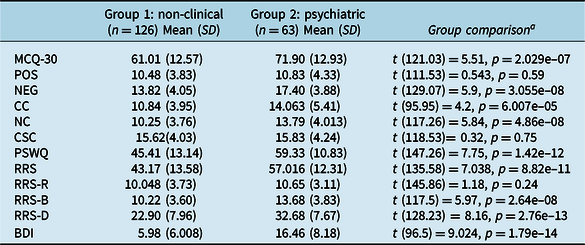
The means and standard deviations of the five MCQ-30 subscales in each matched group are presented in Table 1. The psychiatric group scored significantly higher than the non-clinical group on the PSWQ, BDI, RRS-D, RRS-B and on the NEG, CC and NC subscales, but not on the POS and CSC subscales. The mean scores on the MCQ-30 and its subscales in both groups were similar to those of previous studies.
Comparisons across matched groups for the MCQ-30, the RRS and their subscales, the PSWQ and the BDI

PSWQ, Penn State Worry Questionnaire; BDI, Beck Depression Inventory; RRS, Ruminative Response Scale; RRS-B, Ruminative Response Scale, ‘brooding’ subscale; RRS-R, Ruminative Response Scale, ‘reflection’ subscale; MCQ-30, Metacognitions Questionnaire-30; CC, lack of cognitive confidence; POS, positive beliefs; CSC, cognitive self-consciousness; NEG, uncontrollability and danger; NC, need to control thoughts.aWelch’s two-sample t-test.
Convergent validity
In the non-clinical group, each subscale correlated with depression. In the psychiatric group, the convergence of the five MCQ-30 factors with other measures was more contrasted. Specifically, the NEG, CC and NC subscales but not the POS and CSC subscales correlated with depression in that group.
Discussion
Our work aimed to adapt and validate the MCQ-30, a well-known instrument for the assessment of metacognitive beliefs.
The final version of the MCQ-30 showed an adequate face validity. The result of the CFA supported the five-factor structure of the questionnaire in the non-clinical sample, in line with previous studies. In the clinical sample, the multi-trait–multi-method analysis revealed discrepancies with the original factor structure: the items of the NEG and NC subscales did not have their highest correlation coefficient with their related construct. In this group, we also observed that NEG and NC displayed poor consistency (0.69 and 0.65, respectively). In the non-clinical sample the internal consistency of the MCQ-30 and its subscales was adequate to good. As in previous studies, the lowest alpha coefficient was for NC in this group (ranging from 0.68 to 0.8).
Thus, the reliability of the MCQ-30 and its subscales, as well as the factor structure in the two groups, was not homogeneous. The psychiatric group showed lower reliability values related to a factor structure that may not be similar to the one of the original MCQ-30. This misfit in the measurement model and the related decline in internal consistency in the clinical sample may in part be explained by cognitive impairment (i.e. altered executive function, memory and attention), known to be a core feature of depression. It may have reduced the accuracy of patients’ report of their metacognitive thoughts.
With regard to the criterion and convergent validities, our results reveal a consistent pattern of metacognitive beliefs associated with depression, given: (i) the correlation of the NEG, CC and NC subscales with depression in the psychiatric group, and the strong correlation of the NEG and NC subscales with depression in both current samples as well as in previous studies, and (ii) the ability of these subscales to discriminate between psychiatric and non-clinical samples in agreement with previous results. Notwithstanding the low reliability of the NC and NEG subscales in the psychiatric sample, this consistent pattern supports the interest of using these subscales in this population.
Despite several limitations detailed in the full report, our results show that the French version of the MCQ-30 maintains adequate psychometric properties, in the general French population, indicating that it is a valid instrument for measuring metacognitive beliefs in this population. Further research is needed to support its use as an indicator of metacognitive beliefs among depressed in-patients. However, in line with previous studies, our results provide evidence that metacognitive beliefs are an important component of depression. As shown in recent studies, addressing these metacognitive beliefs in therapy could be beneficial (Hagen et al., Reference Hagen, Hjemdal, Solem, Kennair, Nordahl, Fisher and Wells2017).
Supplementary material
To view supplementary material for this article, please visit https://doi.org/10.1017/S1352465820000065
Acknowledgements
The authors are grateful to the many clinicians, patients and volunteers who have contributed to this study. We are also grateful to Dr Wells and Guilford Press for giving us permission to translate the Metacognitions Questionnaire (MCQ-30) into French and to validate its use in both populations.
Conflicts of interest
All four authors declare no conflicts of interest.
Ethical statement
This study was conducted in accordance with the Declaration of Helsinki and French Good Clinical Practices: participants were informed that by accepting to send back their anonymous questionnaires, they gave their informed consent to participate.
Financial support
This research received no specific grant from any funding agency, commercial or not-for-profit sectors




Comments
No Comments have been published for this article.