Introduction
Adjuvant radiotherapy plays a significant role in preventing local failure in women treated for early-stage breast cancer. The rules of adjuvant breast irradiation are now clearly established.1 In addition, some studies analyzing long-term cosmetic outcome after breast-conserving surgery followed by radiotherapy have reported excellent or good results in most patients.Reference Toledano, Garaud, Serin, Fourquet, Bosset, Breteau, Body, Azria, Le Floch and Calais2,Reference Vrieling, Collette, Fourquet and Hoogenraad3
Numerous articles discussing radiotherapy and its toxicity in patients with collagen vascular diseases (CVDs) have been published.Reference Darras-Joly, Wechsler, Bletry and Piette4–Reference Cooper and Denham17 Some describe only one or two cases. Others report larger series that suffered from heterogeneity in terms of the types of CVD and of cancers.Reference Chen, Obedian and Hafty5–Reference Morris and Powel15 These articles are contradictory and report from good tolerance to very significant toxicity.Reference Darras-Joly, Wechsler, Bletry and Piette4–Reference Cooper and Denham17
In addition, the mechanism that led to an increase in late complications in these patients is unclear.Reference Morris and Powel15 One possible hypothesis, which still needs confirmation, was that CVD was responsible for additional microvascular damage to that caused by irradiation.
The largest series of scleroderma and radiotherapy included 16 cases and concluded that the choice of therapeutic modality should be made on a case-by-case basis.Reference Morris and Powel15
The aim of this study was to add to the literature six new cases of scleroderma treated by radiotherapy for breast cancer and discuss the clinical problems of these patients.
Patients and methods
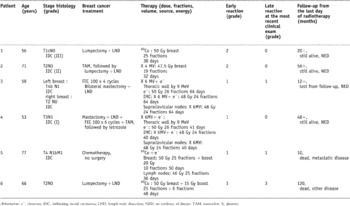
Of the nine patients with pre-existing scleroderma treated from 1995 to 2005 for their breast cancer at the Institute Curie, five underwent breast surgery and radiotherapy and one chemotherapy and radiotherapy. In the remaining three cases, radiotherapy was declined after multidisciplinary discussion because in two cases the risk of toxicity was deemed too high (mastectomy was thus proposed) and in one case of ductal carcinoma in situ, the risk of local recurrence was deemed too low. We reviewed all six patients’ files retrospectively. Radiotherapy using high-energy photons from a cobalt unit and/or linear accelerator was given either exclusively or in combination with breast-conserving surgery. All patients underwent simulation with at least three computed tomography slices of the breast for the dosimetry planning. The treatment modalities and doses of radiotherapy are shown in Table 1. The recommendations of reports 29 and 50 of the International Commission on Radiation Units (ICRU) were respected.18 We used either a standard tangential field technique or a technique with the patient in the lateral decubitus position.Reference Fourquet, Campana and Rosenwald19,Reference Campana, Kirova and Rosenwald20 The technique chosen for each patient depended on her anatomy. Our criteria and dosimetric findings have been reported elsewhere.Reference Campana, Kirova and Rosenwald20 The early and late skin reactions were evaluated using the Acute Radiation Morbidity Scoring Criteria (RTOG) and Late Radiation Morbidity Scoring Scheme (RTOG, EORTC).Reference Perez and Brady21
Treatment modalities and doses of radiotherapy

Abbreviations: e−, electrons; IDC, infiltrating ductal carcinoma; LND, lymph node dissection; NED, no evidence of disease; TAM, tamoxifen; X, photons
Results
Median follow-up of the six irradiated patients was 34 months (range from 10 to 120 months), and the mean follow-up was 44.3 months. Early reactions were as follows: grade 1 in two cases (33.3%), grade 2 in two cases (33.3%), and grade 3 in two cases (33.3%). Late toxicity was as follows: grade 0 in three patients (50%), currently at 56, 48, and 12 months of follow-up; grade 1 in two patients (33.3%) with slight atrophy; and grade 3 reaction with marked atrophy in one patient (16.7%) followed up for 120 months now. There was no toxicity worse than grade 3 in these series. The characteristics of the patients and tumors are shown in Table 1.
Discussion
This study shows that scleroderma should be taken into consideration when discussing breast cancer therapeutic options for patients in multidisciplinary meetings, with the participation of surgeons, radiation oncologists, medical oncologists, and rheumatologists. Radiation therapy may still be proposed, whenever required, with a choice of technique that preserves as much as possible of the normal surrounding tissues from radiation.Reference Campana, Kirova and Rosenwald20 Careful follow-up during the radiation therapy is needed because of the higher risk of developing early and late reactions in these patients.
It has previously been shown that patients with CVD present an increased sensitivity to radiation.Reference Wenzel14,Reference Ransom and Cameron16,Reference Cooper and Denham17 Some authors have suggested a decrease in the doses of radiotherapy to improve the tolerance.Reference Delanian, Maulard-Durdux, Lefaix and Housset13 However, these studies suffered from a lack of homogeneity in terms of cancers and types of CVDReference Morris and Powel15–Reference Cooper and Denham17 that makes it difficult to draw any definitive conclusion in a specific setting. Little information is available, for instance, on the use of radiotherapy in the treatment of breast cancer in patients with scleroderma. In the largest series, reported by Morris and Powel,Reference Morris and Powel15 of the 209 patients with CVD studied, 16 presented with scleroderma. The authors concluded that radiation therapy was feasible, bearing in mind a higher risk of early and late reactions. They emphasized the importance of adapting the treatment protocol to each patient. The drawback of their results is that they were reported for the whole population, which makes it difficult to know the treatment tolerance in scleroderma patients.Reference Morris and Powel15 A study by Ross et al.Reference Ross, Hussey, Mayr and Davis10 reported a series of 61 patients with CVD (3 with scleroderma) treated for different types of tumors, with a follow-up of 18 months. Of the patients, 60% received doses higher than 40 Gy. The authors concluded that there were more early and late reactions.
Another interesting study on breast-conserving surgery and radiotherapy was published by Chen et al.Reference Morris and Powel15 They reported a series of 36 patients (4 with scleroderma), with a median follow-up of 12.5 years. The results compared with a control group were as follows: early reactions, 14% (5/36) vs. 8% (6/72) (p = 0.4, NS); a significantly higher rate of late reactions, 17% (6/36) vs. 3% (2/72) (p = 0.0095). When only the four patients with scleroderma were analyzed, statistical significance was reached for the occurrence of both early (2/4 vs. 0/8; p = 0.029) and late (3/4 vs. 0/8; p = 0.0005) complications.
However, in our small series, we lack statistical power to draw any further conclusions. It would be very interesting to study the occurrence of early and late complications in the population of patients with scleroderma compared with a matched population of patients without CVD. This study would require a multicenter setting.
Until further evidence is available, in light of the fact that no serious complications have been observed in our series, a patient with scleroderma can be offered radiotherapy for breast cancer provided her individual therapeutic ratio suggests that the expected benefits exceed the risk of complication.
Conclusion
This small study suggests that scleroderma increases the risk of developing both early and late toxicity, but more patients are needed for definitive conclusions. It shows that patients with scleroderma must be discussed in multidisciplinary meetings to adapt their treatment to their rheumatologic history. When radiotherapy is considered, particular attention must be paid to the protection of normal tissues. Needless to say, careful follow-up during and after the radiation therapy remains of paramount importance in this specific population of patients.