Introduction
The most studied area of terrestrial continental Antarctica is Victoria Land adjacent to the west side of the Ross Sea. This area encompasses various habitats ranging from moist coastal areas and penguin rookeries to the McMurdo Dry Valleys. The biota consists of bacteria, fungi, protozoa, lichens, mosses, cyanobacteria, algae, rotifers, tardigrades, nematodes, mites and springtails (Adams et al. Reference Adams, Bardgett, Ayres, Wall, Aislabie, Bamforth, Bargagli, Cary, Cavacini, Connell, Convey, Fell, Frati, Hogg, Newsham, O'Donnell, Russell, Seppelt and Stevens2006). Studies have focused on the Dry Valleys, the site of the McMurdo Dry Valleys Long-Term Ecological Research programme, which are thought to have the lowest species diversity of any ecosystem on Earth (Adams et al. Reference Adams, Bardgett, Ayres, Wall, Aislabie, Bamforth, Bargagli, Cary, Cavacini, Connell, Convey, Fell, Frati, Hogg, Newsham, O'Donnell, Russell, Seppelt and Stevens2006, Wall Reference Wall2006). These are one of the planet's most extreme environments and are considered extreme even by Antarctic standards (Poage et al. Reference Poage, Barrettt, Virginia and Wall2008). Nematodes are the dominant soil fauna, with springtails and mites limited to moss and algae-covered areas near glacial meltwater streams, and tardigrades and rotifers rarer than nematodes (Freckman & Virginia Reference Freckman and Virginia1997, Courtright et al. Reference Courtright, Wall and Virginia2001).
Some studies have gone beyond investigating the distribution of terrestrial species in localized populations, and have investigated distribution patterns across numerous sites along the Victoria Land coast (the Latitudinal Gradient Project: Howard-Williams et al. Reference Howard-Williams, Hawes and Gordon2010). Diversity varies from high to low from northern to southern Victoria Land, although no latitudinal effect has been observed in penguin rookery soils (Adams et al. Reference Adams, Bardgett, Ayres, Wall, Aislabie, Bamforth, Bargagli, Cary, Cavacini, Connell, Convey, Fell, Frati, Hogg, Newsham, O'Donnell, Russell, Seppelt and Stevens2006, Barrett et al. Reference Barrett, Virginia, Wall, Cary, Adams, Hacker and Aislabie2006). Many of the ice-free areas of Victoria Land remain un-sampled for either fauna or flora, hindering the identification of broad trends or species-level habitat preferences (Adams et al. Reference Adams, Bardgett, Ayres, Wall, Aislabie, Bamforth, Bargagli, Cary, Cavacini, Connell, Convey, Fell, Frati, Hogg, Newsham, O'Donnell, Russell, Seppelt and Stevens2006). This also hinders the development of conservation strategies and the identification of protected areas. A knowledge of the Victoria Land biota will also be required to anticipate climate change impacts, which may be particularly severe as low diversity ecosystems are expected to be the most vulnerable (Wall Reference Wall2006).
A better understanding of where nematodes are found in the terrestrial Antarctic and what represents ‘available habitat’ for them will be important in addressing many topical questions. To what extent does their current distribution reflect isolation of populations in glacial refugia followed by more recent dispersal into available habitat? How will these species be affected by a changing climate and changes in habitat availability, and what impact will this have on ecosystem functioning? How should we select protected areas in order to ensure the conservation of these species (Chown & Convey Reference Chown and Convey2007)? Nematodes are good candidates for such studies, with their suspected high endemism and broad distribution: in some areas they may be the only invertebrate found.
This study investigates the distribution of Antarctic nematodes in two Victoria Land coastal sites: the areas around Cape Hallett and Gondwana station (unofficial name) in Terra Nova Bay. Their ice-free areas range from sandy beaches, to exposed hilltops, Adélie penguin rookeries, moss beds and moraines, enabling a broad range of habitats to be sampled and their populations compared. We aim to describe the habitat characteristics for the different species found. By comparing distributions with models for the Dry Valleys, the prediction that Antarctic nematodes exhibit species-specific distribution patterns can be tested. We also investigate whether soil geochemical properties that explain nematode distributions in Dry Valley soils are also able to predict distributions in other Antarctic terrestrial habitats, where water and nutrient availability are less limited. Finally, using logistic regression models, we attempt to identify any evidence for biotic interactions between species, going beyond simple trends of co-occurrence.
Methods
Study sites
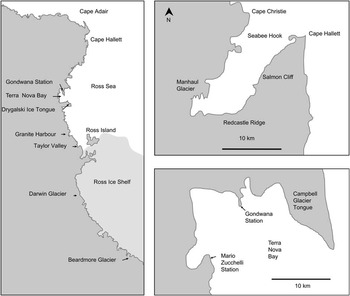
This study over three summers, from 2005–07, was part of the Latitudinal Gradient Project (LGP: Howard-Williams et al. Reference Howard-Williams, Peterson, Lyons, Cattaneo-Vietti and Gordon2006, Reference Howard-Williams, Hawes and Gordon2010). In 2005, the LGP field camp was at Cape Hallett and for the following two seasons it was at Gondwana station (Fig. 1). Data from Granite Harbour and Darwin Glacier will be presented in a later publication.
Left: map of the Victoria Land coast showing the location of Cape Hallett and Gondwana station, and the other locations of Latitudinal Gradient Project field camps (by permission of Antarctica New Zealand). Upper right: map of the Cape Hallett area showing sampling sites. Luther lakes are alongside the Manhaul Glacier. Lower right: map of the Gondwana station area. Enigma Lake and Adélie Cove are south of this area.

Cape Hallett (72.31°S, 170.27°E, Antarctic Specially Protected Area No. 106) is located on the northern tip of the Hallett Peninsula and has an ice-free area of about 74 hectares (Fig. 1). This includes steep scree slopes that descend to a low-lying beach area and Seabee Hook, a low curved spit of coarse volcanic material, which is home to an Adélie penguin rookery.
In their study of collembolans at Cape Hallett, Sinclair et al. (Reference Sinclair, Scott, Klok, Terblanche, Marshall, Reyers and Chown2006) divided the main ice-free area into three broad habitats: moss and algal flats, scree slopes, and the penguin colony, and found distinct faunal assemblages in each. The moss and algal flats are low-lying undulating moraines and disused penguin mounds with abundant water supply from snowmelt, and plant communities of moss and algae. The scree slopes are steep, unstable slopes with lichens and some moss and algal communities at lower levels. The penguin rookery consists of ornithogenic soils of guano, pebbles and penguin debris (Sinclair et al. Reference Sinclair, Scott, Klok, Terblanche, Marshall, Reyers and Chown2006). All three habitat types are used by a south polar skua colony. Sinclair et al. have also sampled this area for nematodes (B.J. Sinclair, personal communication 2012).
Four other sites in the vicinity of Cape Hallett were included in this study. The ice-free area at the base of Redcastle Ridge (72.43°S, 169.94°E) consists of fans and raised beaches, with no bird communities and few algae or lichens. The low-lying beach area at the base of Salmon Cliffs (72.37°S, 170.09°E) is occasionally used by skuas, receives water from snowmelt in summer and is covered in thick algal mats. The large ice-free area around Luther lakes (unofficial name; 72.34°S, 169.92°E) is used by snow petrels and skuas, and has large amounts of algae, mosses and lichens. The ridge at Cape Christie (72.29°S, 169.94°E) is an exposed and relatively dry site, with limited water available from snowmelt in summer and consists of unstable scree slopes, with several lichens and some mosses present on the top of the ridge.
Gondwana station (74.63°S, 164.22°E), on the coast of Terra Nova Bay across the Gerlache Inlet from the Italian Mario Zucchelli Station (Fig. 1), is on a large ice-free area close to several ponds and a south polar skua colony. The Terra Nova Bay area is relatively ice-free in summer and is estimated to contain more than 100 small lakes and ponds, as well as meltwater and periglacial lakes.
The Gondwana station area has not previously been sampled for nematodes. Examples of habitats identified in the Gondwana station area include recently-disturbed lateral moraines of the Campbell Glacier Tongue, lakebeds, exposed ridge sites, moss beds, and skua colony nesting areas. Other areas in the vicinity that were studied are Enigma Lake, the Adélie Cove penguin rookery (74.76°S, 164.05°E), and more exposed sites near Mario Zucchelli Station (74.7°S, 164.1°E) receiving large amounts of sea spray in summer.
Transect sampling
At Cape Hallett, sampling of the ice-free area was carried out in the three broad habitat areas described above. Additional sampling trips were made to other neighbouring ice-free areas. Distinct habitat types were identified and sampling carried out in each. The same strategy was employed in the Gondwana station area.
Once an area had been selected, transect lines were run through it, avoiding disruption to vegetation or nesting birds. Transect lines attempted to cover as much variation in the habitat as possible (e.g. by crossing meltwater streams) and random sampling carried out. Every 10 m a die was rolled twice to determine the direction and number of paces away for sampling. Two 100 g soil samples were taken from the centre of a 1 m2 quadrat, collecting from the surface to a depth of c. 10 cm. Stones larger than 5 cm in diameter were excluded. The GPS co-ordinates were noted, along with a range of descriptive habitat characteristics, similar to those recorded by Sinclair & Sjursen (Reference Sinclair and Sjursen2001). A total of 435 samples were collected for this study.
Nematode extraction and identification
One sample was processed in the field and the other kept frozen for return to New Zealand. Nematodes were extracted using a modified Baermann technique (Hooper Reference Hooper1986) from 100 g samples (wet weight) for 24 h, concentrated using a hand-cranked centrifuge, identified using published species descriptions (Timm Reference Timm1971, Andrassy Reference Andrassy1998) and the numbers in four subsamples counted. Plectus sp. was only identified to genus level.
Soil geochemical analysis
Soil geochemical analysis was performed on the second soil samples on return to New Zealand using previously described methods (Barrett et al. Reference Barrett, Virginia and Wall2002, Reference Barrett, Virginia, Wall, Parsons, Powers and Burkins2004, Poage et al. Reference Poage, Barrettt, Virginia and Wall2008). Soil moisture was determined gravimetrically from a 10 g subsample dried in an oven for 24 h at 100°C. The same soil sample was then combusted at 500°C for eight hours and reweighed to estimate the organic carbon content. Soil pH and conductivity were measured in a slurry of 1:2 (w/v) < 2 mm soil to milli Q water.
Distribution modelling
Logistic regression models were generated from presence and absence data from Cape Hallett and Gondwana station over all three field seasons using SPSS. Models predicted the presence of nematode species from the soil geochemical parameters and the habitat descriptive data. Soil conductivity was log10 transformed. The variables were entered manually and the resulting changes in model parameters were recorded. Only variables that were significant (P ≤ 0.05) were included in the final models.
Results
Nematode distribution in the Cape Hallett area
The nematodes identified from the Cape Hallett area were: Panagrolaimus davidi Timm, Scottnema lindsayae Timm, Eudorylaimus antarcticus (Steiner) Yeates and Plectus sp. In general, P. davidi was the most abundant. It also tended to be the dominant species if present.
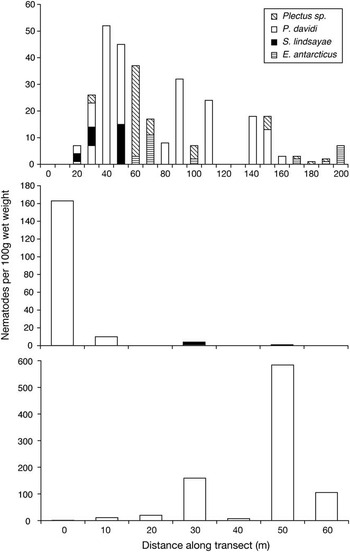
Soil sampling from the three habitat types revealed a very patchy distribution, with both species composition and abundance varying over small distances, although nematodes were found in all three of the habitat types (Table S1, which will be found at http://dx.doi.org/10.1017/S0954102012001162). The moss beds were the most productive habitat sampled and the most diverse (Fig. 2). However, distribution remained patchy along the transect with nematodes completely absent from some samples. On the scree slopes, abundance was greater in sites at the base (where the habitat included moss beds receiving runoff) than those further up (Fig. 2). However, S. lindsayae was found in samples collected from some of the higher sites, where surface stability was low and neither moss nor algae were present.
Total nematode abundance and species composition along transects at Cape Hallett. Top: across the moss and algal flats. Middle: running up the scree slopes. Bottom: across a runoff site in the Adélie penguin rookery.

The Adélie penguin rookery contained only P. davidi at very high numbers (maximum of 222 individuals per 100 g wet weight, Fig. 2). The transect started at the penguin nesting mounds and crossed an area where meltwater from snow banks flowed through the penguin colony. Nematodes were also found at Salmon Cliffs, Luther lakes and Redcastle. The only site where none of the samples contained nematodes was the beach site at Redcastle (Table S1, which will be found at http://dx.doi.org/10.1017/S0954102012001162). Here the samples taken were sand rather than soil.
Nematode distribution at Gondwana station
The same species that were found around Cape Hallett were found in the Gondwana station area. There was a similar patchy distribution, with both species composition and abundance varying over small distances and over the greater area (Tables S2 & S3, which will be found at http://dx.doi.org/10.1017/S0954102012001162). The longer duration of the trips enabled a greater variety of habitats to be sampled than at Cape Hallett. This revealed more sites from which nematodes were absent and provided adequate data points to enable nematode distribution modelling.
Factors affecting nematode distribution: habitat characteristics
Habitat characteristics were related to the presence of each species individually using logistic regression models (Table I). These models give an indication of which field-identifiable characteristics are correlated with the presence of each species and show some of the differences between the habitats of the four species identified from both Cape Hallett and Gondwana station.
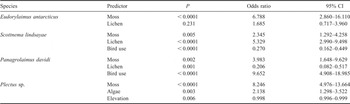
Logistic regression models predicting the presence/absence of Antarctic nematodes from field measurable predictors (presence/absence of moss, lichen, algae; area used by penguins/skuas/snow petrels, elevation (m)). Only significant (P ≤ 0.05) predictors were included in the models presented here. CI = confidence interval.

All species were strongly positively correlated with the presence of moss (P < 0.001 to P = 0.005), with the effect being strongest for E. antarcticus, which was over six times as likely to be found when moss was present. Eudorylaimus antarcticus was also weakly positively correlated with the presence of lichen. A stronger positive correlation was found between the presence of lichen and S. lindsayae, with the presence of lichen increasing the chance of S. lindsayae being present by more than fivefold. A strong negative correlation was seen between the presence of lichen and P. davidi, which was about five times less likely to be found where lichen was present. Scottnema lindsayae was about five times less likely to be found in areas which were regularly used by birds, while bird use increased the likelihood of P. davidi being present by almost tenfold. The elevation of the sites where soils were sampled had a significant effect only on the presence of Plectus sp., the correlation being weakly negative.
Factors affecting nematode distribution: soil geochemistry
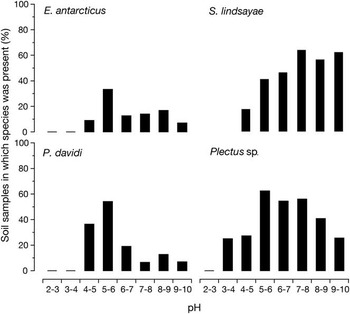
Soil geochemical analysis enabled the presence or absence of nematodes to be related to the pH, conductivity, water content and organic content of samples. No nematodes were present in the soil samples with a very low pH (Fig. 3). Eudorylaimus antarcticus, P. davidi and Plectus sp. were found in soils with a large pH range, although their distribution did not show a linear correlation to soil pH. The presence of S. lindsayae showed a weak linear correlation to pH, being present in more soils with a high pH than those with a low pH, although this was not a significant predictor in logistic regression models (Table II).
Presence of nematodes in soil samples of varying pH. Data are the percentage of soil samples of a given pH in which nematodes of each species were present.

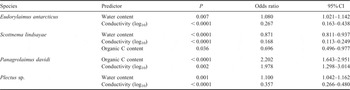
Logistic regression models predicting the presence/absence of Antarctic nematodes from soil geochemistry variables (water content (%), pH, conductivity (log10), combustible organic C content (%)). Only significant (P ≤ 0.05) predictors were included in the models presented here. CI = confidence interval.

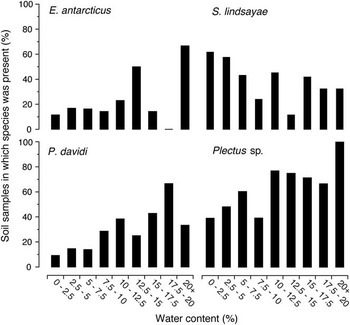
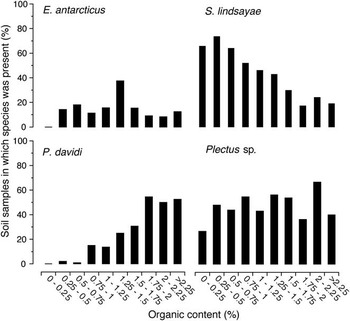
The presence of nematodes varied with soil water content (Fig. 4). In general, E. antarcticus, P. davidi and Plectus sp. were found in wetter soils and S. lindsayae at drier sites. The soil combustible carbon content is related to the presence of the four species (Fig. 5). The organic content was very low in most samples from both Cape Hallett and Gondwana station. Nematodes were found in soils with very low organic content and the presence of E. antarcticus and that of Plectus sp. were not correlated to the organic content of the soil. The presence of S. lindsayae was negatively correlated to soil organic content, while that of P. davidi showed a positive correlation.
Presence of nematodes in soil samples of varying water content. Data are the percentage of soil samples with a given water content in which nematodes of each species were present.

Presence of nematodes in soil samples of varying organic content. Data are the percentage of soil samples with a given organic content in which nematodes of each species were present.

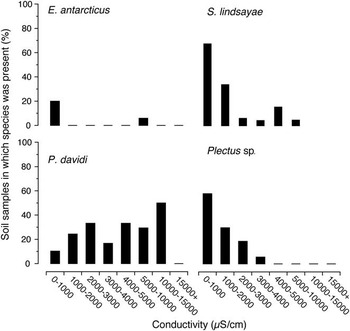
The conductivity of the soil was measured to give an indication of salt content. Eudorylaimus antarcticus, S. lindsayae and Plectus sp. were associated with soils of lower conductivity, while P. davidi was associated with higher conductivity (Fig. 6).
Presence of nematodes in soil samples of varying conductivity. Data are the percentage of soil samples with a given conductivity in which nematodes of each species were present.

Relationships between the presence of nematodes and soil geochemical properties were tested using multiple logistic regression models to adjust for interdependencies between the variables (Table II). The presence of E. antarcticus was positively correlated to water content and negatively correlated to conductivity. The presence of S. lindsayae was negatively correlated to water content, conductivity and organic carbon content. The presence of P. davidi was positively correlated to conductivity and organic content. Finally, the presence of Plectus sp. was weakly positively correlated to soil water content, and strongly negatively correlated to conductivity.
Factors affecting nematode distribution: species interactions
To look for possible interactions between species, the presence of each was related to the others using logistic regression models. The presence of P. davidi was negatively correlated to that of S. lindsayae and the presence of E. antarcticus was positively correlated to that of Plectus sp.
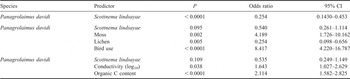
There are two potential causes of the correlations observed between species. It could be due to two species having similar or opposite habitat requirements, or there could be a biotic interaction, such as predation or competition. To distinguish between these causes further logistic regression models were run. The first model shows the presence of P. davidi to be significantly negatively correlated to that of S. lindsayae, with P. davidi about four times less likely to be found if S. lindsayae was present (Table III). However, the presence of S. lindsayae is no longer a significant predictor once the habitat characteristics are controlled for in model two. The same effect is seen in model three, when controlling for soil geochemistry.
Logistic regression models predicting the presence of Panagrolaimus davidi from the presence of Scottnema lindsayae and habitat characteristics (presence/absence of moss, lichen; area used by penguins/skuas/snow petrels) and from soil geochemistry variables (water content (%), pH, conductivity (log10), combustible organic C content (%)). CI = confidence interval.

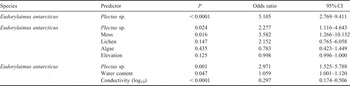
For E. antarcticus, the first model shows a significant positive correlation between E. antarcticus and Plectus sp., with E. antarcticus over five times more likely to be present in samples in which Plectus sp. was present (Table IV). In the second model the habitat characteristics are controlled for, this decreases the explanatory power of the presence of Plectus sp., but it remains a significant predictor with E. antarcticus about twice as likely to be found in samples in which Plectus sp. was present. The third model controls for the soil geochemistry, which also reduces the explanatory power of the presence of Plectus sp., but again it remains a significant predictor of the presence of E. antarcticus.
Logistic regression models predicting the presence of Eudorylaimus antarcticus from the presence of Plectus sp. and habitat characteristics (presence/absence of moss, lichen; area used by penguins/skuas/snow petrels) and from soil geochemistry variables (water content (%), pH, conductivity (log10), combustible organic C content (%)). CI = confidence interval.

Discussion
Nematode distributions at Cape Hallett and Gondwana station
Nematodes were found in all habitats sampled in the Cape Hallett area, although species assemblages and total nematode abundance varied dramatically over a range of scales. In general, Plectus sp. and E. antarcticus were found in wetter sites, S. lindsayae in drier and higher sites, while P. davidi was found in sites used by birds and was the only nematode found in Adélie penguin rookeries. Of these four species, P. davidi was found in the greatest and E. antarcticus the lowest abundance.
These trends are in line with recent observations that found P. davidi in penguin rookery soils at Cape Hallett and Plectus murrayi Yeates in moss beds adjacent to the rookery (Yeates et al. Reference Yeates, Scott, Chown and Sinclair2009). It is probable that the Plectus sp. found in our study is also P. murrayi. Barrett et al. (Reference Barrett, Virginia, Wall, Cary, Adams, Hacker and Aislabie2006) also reported P. davidi in the Cape Hallett penguin rookery, as well as Plectus antarcticus De Man (P. murrayi) and a Eudorylaimus sp. at Willett Cove (near the moss beds sampled in our study), and S. lindsayae, Eudorylaimus sp., and P. murrayi at Luther vale (unofficial name). The same species as those found at Cape Hallett were found in the Gondwana station area, with a similar distribution. This is the first time this area had been sampled for nematodes.
More intense sampling at Gondwana station enabled a broader range of potential nematode habitats to be sampled. Similar trends were observed to those in the Cape Hallett area: S. lindsayae was more often found in drier and higher sites, Plectus sp. and E. antarcticus were found in wetter sites, often in moss or algal beds, while P. davidi was found in areas of bird activity. Scottnema lindsayae was found in exposed sites up to 650 m elevation and generally in greater numbers than in Cape Hallett soils. Eudorylaimus antarcticus was rarest and was never found in isolation from other species.
The only sites where nematodes were absent were the disturbed areas around Mario Zucchelli Station that appeared to have received some pollution from the road used to transport fuel. While pollution of the marine environment around the station has been studied previously (Bargagli et al. Reference Bargagli, Corsolini, Focardi, Fossi, Martella and Sanchez-Hernandez1997, Bruni et al. Reference Bruni, Maugeri and Monticelli1997), impacts on terrestrial biota have not been reported. The studies of marine pollution have concluded that impacts are confined to a minimal zone (Bargagli et al. Reference Bargagli, Corsolini, Focardi, Fossi, Martella and Sanchez-Hernandez1997, Bruni et al. Reference Bruni, Maugeri and Monticelli1997), and the presence of nematode populations within about 200 m of the station would imply that the terrestrial impact was also minimal and confined to the main transport routes.
The observation of the same nematode species at Cape Hallett and Terra Nova Bay is not surprising given that both sites are within their reported ranges (Timm Reference Timm1971, Andrassy Reference Andrassy1998), and that their cold and desiccation tolerance should enable significant wind dispersal. All species have been reported further south: for example, P. davidi from penguin rookeries on Ross Island, S. lindsayae, P. murrayi and E. antarcticus from the McMurdo Dry Valleys (Wharton & Brown Reference Wharton and Brown1989, Freckman & Virginia Reference Freckman and Virginia1991, Porazinska et al. Reference Porazinska, Wall and Virginia2002). Aeolian transport of live nematodes across the McMurdo Dry Valleys has been demonstrated using Bundt pans and open-top chamber traps (Nkem et al. Reference Nkem, Wall, Virginia, Barrett, Broos, Porazinska and Adams2006b), and confirmed by their presence in cryoconite holes on glaciers and frozen lakes (Christner et al. Reference Christner, Kvitko and Reeve2003, Porazinska et al. Reference Porazinska, Fountain, Nylen, Tranter, Virginia and Wall2004, Nkem et al. Reference Nkem, Wall, Virginia, Barrett, Broos, Porazinska and Adams2006b). Survival rates of wind-transported nematodes are low but the recovery of live nematodes from traps indicates that anhydrobiosis is an important survival strategy, allowing wind dispersal (Nkem et al. Reference Nkem, Wall, Virginia, Barrett, Broos, Porazinska and Adams2006b).
Significant population-level differences have been observed in Gomphiocephalus hodgsoni Carpenter springtail populations north and south of the Campbell Glacier (just to the north of Gondwana station). These are thought to be a result of genetic isolation and divergence during the extensive Pleistocene glaciations (Stevens & Hogg Reference Stevens and Hogg2003). In our study similar nematode species assemblages were found north and south of the Campbell Glacier, suggesting that it might not have been a significant barrier to dispersal between nematode populations in the same way as it had been for springtails (although genetic analysis is needed to test this hypothesis). The low desiccation tolerance of Antarctic springtails is thought to reduce their wind dispersal capabilities, resulting in greater population level differentiation than in flora and fauna capable of aeolian transport (Chown & Convey Reference Chown and Convey2007).
Species-level habitat differences observed with field-measurable indicators
The use of multiple logistic regression models enabled the quantification of trends in the distribution patterns of the nematodes found at Cape Hallett and Gondwana station. This analysis was chosen due to the high incidence of co-linearity in the habitat characters that were used as predictors of nematode presence or absence.
An overall positive association between the presence of moss and nematodes was found for all species and was most pronounced for Plectus sp. and E. antarcticus. While the presence of nematodes in moss beds has been reported previously (Wharton & Brown Reference Wharton and Brown1989, Sohlenius et al. Reference Sohlenius, Boström and Jonssön2004), a positive association had not yet been quantified. It is possible that this association represents similar habitat requirements for moss and nematodes. However, Sohlenius & Boström (Reference Sohlenius and Boström2006), in their study of moss patches and invertebrates on East Antarctic nunataks, hypothesized that moss cushions provide suitable microhabitats for invertebrates by having an insulating effect on temperature and reducing desiccation rates (Hogg et al. Reference Hogg, Cary, Convey, Newsham, O'Donnell, Adams, Aislabie, Frati, Stevens and Wall2006, Sohlenius & Boström Reference Sohlenius and Boström2006).
The presence of lichen was associated with the presence of S. lindsayae and negatively associated with that of P. davidi. This is probably due to the presence of lichen being an indicator of drier habitats, rather than any biotic interaction between lichens and nematodes. The negative association between S. lindsayae and soil moisture has been well documented in the McMurdo Dry Valleys (Courtright et al. Reference Courtright, Wall and Virginia2001, Poage et al. Reference Poage, Barrettt, Virginia and Wall2008) and in samples from Cape Hallett (Barrett et al. Reference Barrett, Virginia, Wall, Cary, Adams, Hacker and Aislabie2006).
The negative association between lichen and P. davidi remained highly significant when controlling for the effect of bird use. This suggests that this association cannot be explained by the absence of lichen from penguin rookeries, where P. davidi was found in greatest abundance. The mediating factor is probably soil moisture, with which P. davidi had a positive association while lichens were found mainly in drier sites. This hypothesis is supported by a strongly negative association between bird use and S. lindsayae, which remained significant when controlling for the positive association between lichen and S. lindsayae.
In ornithogenic soils further south (on Ross Island), P. murrayi and E. antarcticus live on the margins of penguin rookeries but P. davidi is the only species within rookeries (Wharton & Brown Reference Wharton and Brown1989, Sinclair & Sjursen Reference Sinclair and Sjursen2001, Porazinska et al. Reference Porazinska, Wall and Virginia2002). Higher nutrient, organic and moisture levels in ornithogenic compared to McMurdo Dry Valley soils have not resulted in greater nematode diversity, suggesting that high soil salinity created by the accumulation of nutrients might be limiting nematode presence within rookeries (Porazinska et al. Reference Porazinska, Wall and Virginia2002). High ammonium concentrations in soils from rookeries can be toxic to many organisms, suggesting that P. davidi must have special survival adaptations (Wharton & To Reference Wharton and To1996, Porazinska et al. Reference Porazinska, Wall and Virginia2002). The presence of P. davidi was weakly correlated to soil conductivity, but much more strongly correlated to organic content. This may reflect the strong dependence of P. davidi on ornithogenic input from penguins or skuas, mediated by a need for a bacterial food source.
The presence of algae was weakly correlated with Plectus sp. Plectus murrayi and algae both occur in wetter sites around glacial meltwater in the McMurdo Dry Valleys (Treonis et al. Reference Treonis, Wall and Virginia1999, Courtright et al. Reference Courtright, Wall and Virginia2001). This is probably mediated through positive associations between water content, and both algae and Plectus sp. A correlation between P. murrayi and soil moisture has been reported from Dry Valleys soils (Treonis et al. Reference Treonis, Wall and Virginia1999) and Cape Hallett (Barrett et al. Reference Barrett, Virginia, Wall, Cary, Adams, Hacker and Aislabie2006).
There was a negative correlation between elevation and Plectus sp. Elevation was not a significant predictor of any other species. The range of elevations in this study was small in an Antarctic context, from sea level to 650 m above sea level. Higher sites were often drier and more exposed, with less surface stability. Lower soil moisture content and absence of algae and moss were probably mediating factors, and the inclusion of samples from more stable habitats at higher elevations (e.g. meltwater communities at the heads of the Dry Valleys) may negate this correlation (Barrett et al. Reference Barrett, Virginia, Wall, Cary, Adams, Hacker and Aislabie2006).
The field-measurable predictors used in our models of nematode presence could provide a useful tool for selecting sampling sites. However, correlations between the presence of nematodes and these predictors do not necessarily imply causation or provide ways to explain their patchy distributions. They could also be useful as broad-scale indicators of terrestrial diversity for conservation priorities. For example, the positive correlation between the presence of moss and all nematode species suggests that Victoria Land moss beds should be included in protected areas.
Most terrestrial ecosystems host a large diversity of organisms and the degree of functional redundancy is thought to be great enough for the effects of the loss of individual species to be low. However, the role of nematodes in ecosystem functioning is particularly important in Antarctica (Barrett et al. Reference Barrett, Virginia, Wall and Adams2008). In such low-diversity ecosystems, a decline in abundance of S. lindsayae, as a result of the decrease in average summer temperatures from 1993–2005, had direct impacts on soil carbon cycling and thus ecosystem functioning (Barrett et al. Reference Barrett, Virginia, Wall and Adams2008). Soil biodiversity, including nematodes, should be taken into account when selecting protected areas for conservation.
Habitat specialization and soil geochemistry at the species level
Multiple logistic regression models enabled correlations between soil geochemistry and each nematode species to be investigated. Soil geochemical variables were based on a conceptual model (Freckman & Virginia Reference Freckman and Virginia1998) and measured using the same methods as studies in the McMurdo Dry Valleys (Barrett et al. Reference Barrett, Virginia, Wall, Parsons, Powers and Burkins2004) to enable comparison.
Soil pH varied considerably, but was not a significant predictor of the occurrence of any species. This is probably due to a non-linear relationship between pH and nematode presence. All nematodes were absent in the most acidic samples (pH 2–3), but were found in samples of pH 3–10 showing tolerance of both acidic and alkaline soils. The pH of Dry Valleys soils, was around 7.8–9.7 in one study (Poage et al. Reference Poage, Barrettt, Virginia and Wall2008) and 8.0–9.9 in another (Courtright et al. Reference Courtright, Wall and Virginia2001). While pH was related to S. lindsayae in Dry Valleys soils, this was attributed to the systematic variation in pH associated with conductivity (Poage et al. Reference Poage, Barrettt, Virginia and Wall2008), which is probably the case in our study also. While pH and conductivity are highly correlated in these soils, conductivity appears to affect nematode presence more than pH, although low conductivity alone does not indicate abundant or species-rich nematode populations in either this study or those in the Dry Valleys (Courtright et al. Reference Courtright, Wall and Virginia2001).
Soil conductivity (as a measure of salinity) varied greatly and was a significant predictor for all nematode species. The strongest correlation was found for S. lindsayae, which was negatively correlated to conductivity. Both Plectus sp. and E. antarcticus were also negatively correlated, while P. davidi was positively correlated to conductivity. Similar trends have been reported in Dry Valleys soils, with S. lindsayae, E. antarcticus and P. murrayi negatively correlated to conductivity (Treonis et al. Reference Treonis, Wall and Virginia1999), accounting for 60% of the total variation in the distribution of S. lindsayae (Poage et al. Reference Poage, Barrettt, Virginia and Wall2008). The actual range of soil salinities in which nematodes were found varied considerably between species in our study, with Plectus sp. only found below 40 μS cm-1 conductivity, while other species were found at over 50 μS cm-1 and P. davidi at over 100 μS cm-1. In the Dry Valleys, S. lindsayae occurs at conductivities up to 8130 μS cm-1, although predominantly below 700 μS cm-1 (Courtright et al. Reference Courtright, Wall and Virginia2001), or below 250 μS cm-1 (Poage et al. Reference Poage, Barrettt, Virginia and Wall2008). The threshold soil salinities for E. antarcticus and P. murrayi are always lower than those for S. lindsayae (Treonis et al. Reference Treonis, Wall and Virginia1999, Courtright et al. Reference Courtright, Wall and Virginia2001, Poage et al. Reference Poage, Barrettt, Virginia and Wall2008), with P. murrayi also associated with low conductivity in a study including Cape Hallett (Barrett et al. Reference Barrett, Virginia, Wall, Cary, Adams, Hacker and Aislabie2006). The high salt tolerance of P. davidi has been previously noted (Porazinska et al. Reference Porazinska, Wall and Virginia2002). Some species are better adapted across a larger range of salinities than others, which may explain distribution patterns (Nkem et al. Reference Nkem, Virginia, Barrett, Wall and Li2006a).
Soil water content was a significant predictor for E. antarcticus, S. lindsayae, and Plectus sp. Soil moisture is only a general indicator of summer water availability. Samples were not taken at the same time of day, month or year, introducing variation. Soil moisture content was measured but not water potential. Soil water potential would be a stronger and more accurate predictor of distribution, giving an indication of the water available to diffuse into biological tissues (Forge & MacGuidwin Reference Forge and MacGuidwin1992). The models do, however, show the general trend that E. antarcticus and Plectus sp. were found in wetter sites, and S. lindsayae in drier sites, as in the Dry Valleys (Courtright et al. Reference Courtright, Wall and Virginia2001, Poage et al. Reference Poage, Barrettt, Virginia and Wall2008) and models including Cape Hallett samples (Barrett et al. Reference Barrett, Virginia, Wall, Cary, Adams, Hacker and Aislabie2006).
Soil organic content was a significant predictor of P. davidi (positive) and S. lindsayae (negative), as for Dry Valleys and Cape Hallett data (Barrett et al. Reference Barrett, Virginia, Wall, Cary, Adams, Hacker and Aislabie2006). While the maximum organic content in our study (0.78 g kg-1) was considerably higher than in Dry Valleys soils (Poage et al. Reference Poage, Barrettt, Virginia and Wall2008), the averages are not particularly different.
The general conclusion from studies investigating the impacts of soil geochemistry on nematode distribution in Victoria Land is that soil salinity is the primary determining factor (Poage et al. Reference Poage, Barrettt, Virginia and Wall2008). In our study, conductivity was the strongest predictor of the distribution of S. lindsayae, Plectus sp. and E. antarcticus and the only factor that was a significant predictor for all species. Despite the average conductivity of soil samples being lower than that reported in the Dry Valleys (Nkem et al. Reference Nkem, Virginia, Barrett, Wall and Li2006a, Poage et al. Reference Poage, Barrettt, Virginia and Wall2008), the range of salinities appeared to be greater, with exceptionally saline soils in the Gondwana station area (probably from coastal storms). Soil salinity is not only a primary determining factor of habitat suitability for nematodes in the Dry Valleys context, but also for the entire Victoria Land coast.
Biotic interactions or co-occurrence?
The four nematode species had distinct distribution patterns, strongly influenced by abiotic characteristics. The ‘extreme’ conditions in terrestrial Antarctic habitats and highly simplified ecosystems with limited trophic levels, have led to the conclusion that distributions are almost entirely a function of abiotic factors (Chown & Convey Reference Chown and Convey2007). For example, the co-occurrence of nematodes with moss and algae has generally been interpreted as a by-product of requirements for habitats with sufficient water content, as opposed to species interaction (Hogg et al. Reference Hogg, Cary, Convey, Newsham, O'Donnell, Adams, Aislabie, Frati, Stevens and Wall2006).
Examples of predation in terrestrial Antarctic communities are rare, and studies of mites from the Maritime Antarctic have failed to identify a functional response, indicating that natural predator densities are not high enough to have an impact on even the lowest recorded prey densities (Lister et al. Reference Lister, Block and Usher1988). There was no correlation between the diversity or abundance of bacteria and invertebrates (Barrett et al. Reference Barrett, Virginia, Wall, Cary, Adams, Hacker and Aislabie2006), suggesting that bacterial diversity is not mediated by higher trophic levels in Victoria Land soils.
Nematode distribution patterns may reflect feeding preferences (Barrett et al. Reference Barrett, Virginia, Wall, Cary, Adams, Hacker and Aislabie2006), with the bacterial feeder P. davidi favouring ornithogenic soils, whilst S. lindsayae might be at an advantage in McMurdo Dry Valleys soils as a yeast and bacterial feeder, since fungi are more abundant (Adams et al. Reference Adams, Bardgett, Ayres, Wall, Aislabie, Bamforth, Bargagli, Cary, Cavacini, Connell, Convey, Fell, Frati, Hogg, Newsham, O'Donnell, Russell, Seppelt and Stevens2006, Barrett et al. Reference Barrett, Virginia, Wall, Cary, Adams, Hacker and Aislabie2006). Our study confirms the dependence of P. davidi on ornithogenic input, with its distribution being restricted to penguin rookeries and areas used by skuas.
In an attempt to identify any biotic interactions between nematode species, logistic regression models were used to distinguish between variation in distribution caused by habitat requirements and those that could be a result of a biotic interaction. Interactions were found between two pairs of species. The significant negative correlation between the presence of P. davidi and S. lindsayae became non-significant when controlling for habitat characteristics. This implies that the correlation was mediated through opposing habitat preferences, rather than a biotic interaction. However, the strong positive correlation between the occurrence of E. antarcticus and Plectus sp. could not be fully explained by abiotic characteristics. Furthermore, E. antarcticus was never the only nematode in a soil sample. It is the largest species and has been reported to feed on algae, although as a eudorylaimid it is probably omnivorous (Barrett et al. Reference Barrett, Virginia, Wall and Adams2008) and may be predacious (Yeates et al. Reference Yeates, Bongers, De Goede, Freckman and Georgieva1993). A prominent odontostyle is present in E. antarcticus (Andrassy Reference Andrassy2008). This may be used to pierce the prey, the contents of which are then sucked into the mouth (Munn & Munn Reference Munn and Munn2002).
Our study indicates that E. antarcticus may be dependent on availability of a prey species, most probably P. murrayi, thereby indicating that its distribution pattern is restricted by this interaction. This is an example of a biotic interaction structuring even these simplest ecosystems.
Acknowledgements
This work was generously supported by a Fanny Evans Postgraduate Scholarship for Women and a scholarship from Antarctica New Zealand and Kelly Tarlton's, awarded to MRR. We are grateful for the logistical support of Antarctica New Zealand (event KO66), technical support from Karen Judge, and field assistance from Justine Marshall, Francesca Cunninghame and Konstanze Gebauer. The constructive comments of the reviewers are also gratefully acknowledged.
Supplemental material
Three supplemental tables will be found at http://dx.doi.org/10.1017/S0954102012001162.