1 Introduction
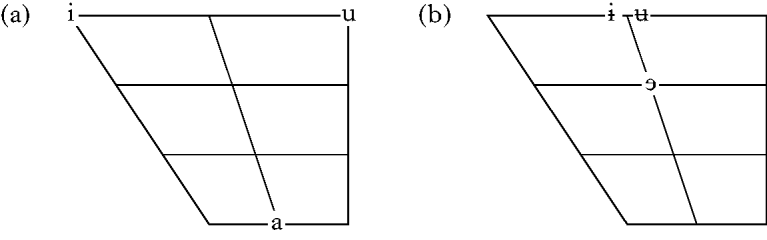
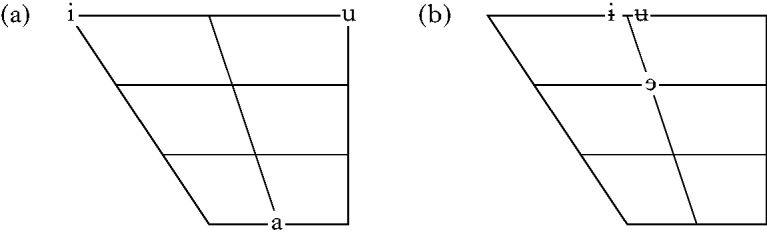
It has long been observed that phonological inventories exhibit a tendency toward maximising auditory distinctness. For example, the very common three-vowel inventory /i a u/ (Fig. 1a) contains robust contrasts in height and in backness and rounding, audible primarily as differences in the frequencies of the first and second formants, while the much less distinct set of vowels /ɨ ɘ ʉ/ (Fig. 1b) is unattested as an independent vowel inventory.Footnote 1
Two triangular three-vowel inventories: (a) a widely attested triangular inventory; (b) an unattested triangular inventory.
Because this tendency produces an obvious functional benefit for the listener, it is intuitively appealing to attribute it to some mechanism that compares segments and evaluates the auditory robustness of the contrasts between them. This is the approach taken by Dispersion Theory, both in the dynamic model of Liljencrants & Lindblom (Reference Liljencrants and Lindblom1972) and in more recent constraint-based versions (e.g. Flemming Reference Flemming2002, Padgett Reference Padgett and Eric Holt2003b, Sanders Reference Sanders2003).
There are, however, drawbacks to the Dispersion approach. Liljencrants & Lindblom's (Reference Liljencrants and Lindblom1972) model, in which vowels repel one another so as to achieve maximal dispersion through the available space, is highly sensitive to the vowels' initial positions – different starting conditions can produce plausible or implausible inventories, as demonstrated by Hall (Reference Hall1999, Reference Hall2007). Constraint-based approaches to dispersion, which make use of the basic formal mechanisms of Optimality Theory, do so in a way that requires the grammar to evaluate candidates consisting not of single forms, but rather of sets of potentially contrasting forms; in effect, the constraint hierarchy ceases to be a device by which languages select optimal surface forms, and becomes a device for selecting optimal languages. This drastic reconception of the constraint grammar's ambit brings with it both conceptual and practical problems. Padgett (Reference Padgett2003a: 51) suggests that ‘the objects of analysis are indeed languages, but this daunting prospect is made manageable by means of extreme idealization’. Dresher (Reference Dresher2009: §8.3.4.2) argues that this idealisation is very different from the familiar and (mostly) harmless practice of expository simplification to which Padgett compares it: in Padgett's analysis, the grammar itself operates on abstract sets of idealised forms, rather than on actual words.
The purpose of this paper is to show that there is an alternative explanation for the tendency exemplified in Fig. 1, one that does not rely on explicit comparisons between segments or words. This alternative approach involves a division of labour between phonology and phonetics. In phonological representations, the differences between segments are encoded minimally, in accordance with the theory of Modified Contrastive Specification (Avery & Rice Reference Avery and Rice1989, Dresher et al. Reference Dresher, Piggott and Rice1994, Dresher Reference Dresher2009). In phonetic implementation, redundant characteristics are employed in ways that enhance the specified contrastive features, along the lines of proposals by Stevens et al. (Reference Stevens, Keyser, Kawasaki, Perkell and Klatt1986), Stevens & Keyser (Reference Stevens1989) and Keyser & Stevens (Reference Keyser, Stevens and Kenstowicz2001, Reference Keyser and Stevens2006). The idea at the core of this approach is a simple one: if all phonologically encoded features are contrastive, then enhancing these features enhances contrast.
The structure of the paper is as follows. §2 presents a more detailed discussion of previous approaches to the phenomenon, with particular emphasis on Dispersion Theory, and describes some of the problems associated with them. §§3 and 4 outline the two components of the approach proposed here: Modified Contrastive Specification and phonetic enhancement. §5 illustrates how these two elements combine to make accurate generalisations about typological patterns in vowel and consonant inventories. §6 concludes the paper with a discussion of some questions raised by the contrast and enhancement approach.
2 Previous approaches
2.1 The dynamic model of Liljencrants & Lindblom (Reference Liljencrants and Lindblom1972)
Liljencrants & Lindblom (Reference Liljencrants and Lindblom1972) propose a dynamic approach to modelling dispersion in vowel inventories. In their model, vowels repel one another in a manner analogous to the behaviour of particles with the same electrical charge, and thereby move toward the edges of the available acoustic space.
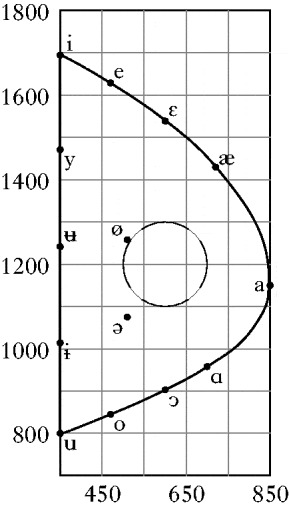
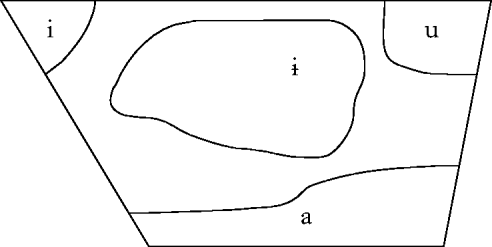
Vowel space in Liljencrants & Lindblom's model is represented in two dimensions, with a shape based on earlier work by Lindblom & Sundberg (Reference Lindblom and Sundberg1969). The horizontal dimension of the space corresponds to the first formant, and the vertical dimension represents a combination of the second and third formants.
In general, lower x values correspond to higher vowels and higher x values to lower vowels; higher y values correspond to vowels that are further front or less rounded, and lower y values to vowels that are further back or more rounded. Figure 2 shows approximate positions for fourteen vowels. Initially, three to twelve vowel points ‘are evenly placed on a circle of radius 100 mel’ in the middle of the space (Liljencrants & Lindblom Reference Liljencrants and Lindblom1972: 842); this circle is shown in Fig. 2. Under the vowels-as-particles metaphor, each vowel acts on each other vowel with a force equal to the inverse of the square of the distance between them. The total ‘energy’ (E) of the system is the sum of the forces generated by each pair of vowels, given by the equation in (1). This sum is a measure of the tension generated by the acoustic similarities between vowels.
(1)


From the starting points on the circumference of the circle, a computer program determines, for each vowel, the direction that will lead to the greatest decrease in E, and continues to move the vowel in that direction until E no longer decreases or the edge of the vowel space is reached, whereupon it chooses a new direction. The whole procedure is repeated until no further reductions in energy are obtained.
The vowel space, with starting circle and approximate positions of 14 vowels (based on Liljencrants & Lindblom Reference Liljencrants and Lindblom1972: 844). Units on each axis are mels.

The dispersed inventories produced by this simulation, particularly the smaller ones, are in many respects similar to vowel inventories common in natural languages, but there are a few notable discrepancies. The larger simulated inventories tend to be much less symmetrical than attested vowel inventories, with disproportionately many high vowels. The predicted inventories with nine or more vowels each had five distinct high vowels, in contrast with Rice's (Reference Rice1995, Reference Rice, Amberber and Collins2002) generalisation that no language has more than four distinctive combinations of place and rounding at any height.
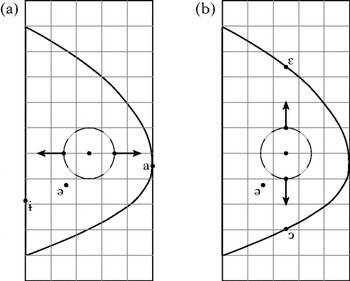
The simulation also fails to predict the occurrence of schwa in any inventory of fewer than ten vowels, and does not generate any non-high front rounded vowels at all. These omissions are somewhat surprising when considered from a typological point of view, or even from the premise that vowel inventories make optimal use of the available space, but they are natural consequences of the method employed in the simulation. The vowels start out on the circumference of a circle and repel one another, and so, rather than distributing themselves evenly through the available space, they all – or nearly all, in the larger inventories – migrate to the periphery. Hall (Reference Hall1999, Reference Hall2007), re-implementing Liljencrants & Lindblom's (Reference Liljencrants and Lindblom1972) model, demonstrates that selecting different starting positions can lead the same procedure to produce quite different results; for example, a schwa can be generated in an inventory with as few as three vowels if one vowel is permitted to start at the centre of the circle rather than on the circumference, as in Fig. 3.Footnote 2
Generating three-vowel inventories that include /ə/: (a) starting positions leading to /ɨ ə a/ (Hall Reference Hall2007: 145); (b) starting positions leading to /ɛ ə ɔ/ (Hall Reference Hall2007: 146).

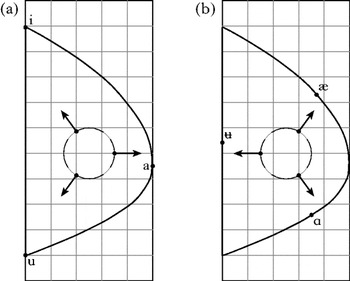
The starting positions shown in Fig. 3a yield the attested, though uncommon, inventory /ɨ ə a/. Other initial states, however, can lead to less plausible inventories. For example, rotating the starting positions in Fig. 3a by 90 degrees leads to the unattested horizontal inventory /ɛ ə ɔ/, as in Fig. 3b. Similarly, if three vowels start out evenly spaced around the circumference of the circle, as in Liljencrants & Lindblom's simulation, the resulting inventory will be the very common /i a u/ if the initial positions are as in Fig. 4a, but rotating these starting positions by 180 degrees, as in Fig. 4b, leads to the unattested /ʉ æ æ/.
Three vowels starting on the circumference of the circle: (a) starting positions leading to /i a u/ (Hall Reference Hall2007: 145); (b) starting positions leading to /ʉ æ æ/ (Hall Reference Hall2007: 149).

While the central insight behind Liljencrants & Lindblom's approach remains compelling, the details of the implementation of their vowels-as-particles metaphor introduce irrelevant complications into the model. Both the starting positions of the vowels and the way in which their movement is calculated have significant effects on the results of the simulation, but these elements of the model have no obvious analogues in the linguistic phenomenon the model is intended to represent.Footnote 3 It is not surprising, then, that more recent approaches to dispersion have dispensed with this dynamic model, turning instead to the surface-oriented constraints of Optimality Theory (Prince & Smolensky Reference Prince and Smolensky1993), which offer a means of achieving robust phonetic contrasts declaratively rather than procedurally.
2.2 Dispersion Theory in OT
In optimality-theoretic versions of Dispersion Theory, the shapes of inventories are derived from the interaction of three types of constraints. The role of repulsion in Liljencrants & Lindblom's model is taken over by constraints that mandate the auditory robustness of contrasts at the surface; these include the Mindist constraints of Flemming (Reference Flemming2002, Reference Flemming, Hayes, Kirchner and Steriade2004), the Contrast constraints of Ní Chiosáin & Padgett (Reference Ní Chiosáin and Padgett1997), the Disp constraints of Kirchner (Reference Kirchner1998), the Space constraints of Ní Chiosáin & Padgett (Reference Ní Chiosáin, Padgett and Lombardi2001) and Padgett (Reference Padgett2003a) and the  -constraints of Sanders (Reference Sanders2003).
These constraints mandating dispersion would be satisfied (trivially, in most cases) by an inventory consisting of a single segment. The presence of multiple segments in an inventory is attributed to the countervailing effect of constraints that either mandate the existence of particular numbers of contrasts (Flemming's Reference Flemming2002 Maximise.ontrasts) or of forms (Ní Chiosáin & Padgett's Reference Ní Chiosáin and Padgett1997, Reference Ní Chiosáin, Padgett and Lombardi2001n.ords), or require faithfulness to underlying contrasts (Padgett's Reference Padgett2003a *Merge) or to underlying forms (Sanders' Reference Sanders2003 -constraints).
A third factor, potentially conflicting with each of the two general types of constraints outlined above, is markedness. In keeping with the functionalist character of Dispersion Theory, the relevant markedness constraints are often formulated as constraints against articulatory effort, as in Flemming's (Reference Flemming2002) Minimise.ffort or Kirchner's (Reference Kirchner1997, Reference Kirchner1998) Lazy.
The tableau in (2), adapted from Flemming (Reference Flemming, Hayes, Kirchner and Steriade2004: 246), shows how these three types of constraints interact in an analysis of vowel reduction in Central Italian dialects.Footnote 4 (2) shows the inventory of unrounded vowels found in unstressed syllables, where there are three contrasting heights, represented here as [i  ɐ]; stressed syllables have four distinct heights, [i ɛ a].
(2)
Candidate (2a), in which the unstressed vowels are identical in quality to the stressed ones, is ruled out by *UnstressedLowV. This high-ranking markedness constraint will not permit any inventory containing unstressed [a]. However, simply raising the lowest vowel to [ɐ], as in candidate (2b), is also not optimal, because the closeness of [ɐ] to [ɛ] violates Mindist=F1:2. It is therefore better to eliminate one vowel from the inventory, even though this degrades performance on Maximise.ontrasts. Simply deleting [a] from the inventory, though, as in candidate (2c), is not quite optimal; if there are to be only three vowels, then it is better for the lowest one to be [ɐ], as in the winning (2d), because [ɐ] is a little more distinct from [] than [ɛ] is.Footnote 5 The fully dispersed three-vowel inventory in (2e), on the other hand, is ruled out by *UnstressedLowV. A system with fewer than three contrasting vowels, as in candidate (2f), can satisfy both the markedness constraint and all the Mindist constraints, but will be ruled out by Maximise.ontrasts.
Maximise.ontrasts, which represents the functional need for contrasting forms in this version of Dispersion Theory, is formalised as a positive scalar constraint. In order to reformulate this constraint in negative terms, it would be necessary to determine a maximum ideal number of forms m; the negative constraint could then assign n violation marks to any candidate comprising m−n contrasting forms. There being no obvious value for m, it makes sense to formulate Maximise.ontrasts as a positive constraint instead. This means, however, that the relative ranking of Maximise.ontrasts cannot be entirely free; if this constraint were to outrank all of the Mindist constraints, then the optimal output would be one containing infinitely many contrasting forms. (Note that the effects of this ranking would not be mitigated by the presence of markedness constraints above Maximise.ontrasts in the hierarchy; unhampered by Mindist, the winning candidate would simply divide the licit acoustic space – however narrowly bounded it might be – into an infinite number of categories.) Flemming (Reference Flemming, Hayes, Kirchner and Steriade2004: 241–242) acknowledges this, but counters that
the need to place limits on possible constraint rankings is not novel to the Dispersion Theory. The same issue arises with respect to standard faithfulness constraints: If all faithfulness constraints are at the top of the ranking then all inputs will surface as well-formed outputs, that is, this ranking would yield an unattested language with no restrictions on the form of words. Conversely, if all faithfulness constraints were at the bottom of the ranking, then all inputs would be mapped to a single, maximally well-formed output (presumably the null output, i.e. silence).
A ranking in which all markedness constraints dominate all faithfulness constraints has, however, been proposed to be the initial state of the grammar in acquisition (see e.g. Smolensky Reference Smolensky1996, Gnanadesikan Reference Gnanadesikan and Kager2004, Hayes Reference Hayes2004). While neither this ranking nor its converse is attested in any adult language, that fact can plausibly be attributed to functional pressures outside the grammar. In Flemming's approach, though, the grammar is itself explicitly intended to encode functional pressures; representing some of these pressures as ranked violable constraints and others as stipulated restrictions on constraint rankings makes for a somewhat inelegant model.
A further objection to the analogy between these two restrictions on constraint rankings is that Flemming's model may not have room for faithfulness constraints. As Flemming (Reference Flemming, Hayes, Kirchner and Steriade2004: 249) points out, ‘the inclusion of faithfulness constraints subverts the intended effect of the Mindist and Maximise Contrasts constraints, because it makes the selected inventory of vowel height contrasts dependent on the input under consideration’. If the relevant faithfulness constraints are ranked sufficiently high, then the grammar can generate inventories that are not functionally optimal, in that they may contain contrasting segments that are auditorily closer to one another than either markedness constraints or the number of segments would justify. Even supposing that the grammar can be made to work without faithfulness constraints, their elimination would undermine Flemming's argument that extrinsic restrictions on constraint rankings are independently necessary, to the extent that this argument hinges on the position of faithfulness constraints.Footnote 6
The absence of input–output faithfulness, of course, has other and more fundamental consequences as well. In tableaux like the one in (2), not only are there no faithfulness constraints, there are no inputs. The obvious functional motivation for Mindist constraints is that they make it easier for the listener to hear the difference between one morpheme and another, but the candidates under evaluation are only sets of surface forms, with no lexical affiliations. In one sense, it does not matter what meaning any particular form may happen to be associated with, but the connection between output forms and morphemes cannot be ignored entirely. For example, if a speaker of English produces the forms [bʊkʰ] and [bʊk⌝], the relatively small auditory difference between [kʰ] and [k⌝] in word-final position is of no functional consequence, provided that these are both tokens of the word book; there is no need for a contrast in sound to be robust if it does not correspond to any contrast in meaning. Nor will it quite do to say that Mindist constraints apply to all and only those forms that represent different morphemes, without being any more specific about which morphemes those might be: the existence of [liːk⌝] as one possible pronunciation of leak cannot be allowed to prevent [liːkʰ] from being a licit pronunciation of leek. In a phonological computation that includes input forms and faithfulness, homophones are straightforwardly describable as words that happen to have identical phonological underlying representations; in a system that both eliminates inputs and crucially relies on a functionalist view of contrast, they become strangely problematic.
Other approaches to dispersion avoid some of these difficulties by casting input–output faithfulness constraints in the functional role that Maximise.ontrasts plays in Flemming's theory. Under this view, the presence of multiple contrasting segments in the surface inventory is driven by faithfulness to either segments or contrasts in the input. For Padgett (Reference Padgett, Hume and Johnson2001, Reference Padgett2003a, Reference Padgett and Eric Holtb), the relevant constraint is *Merge, a word-level analogue of McCarthy & Prince's (Reference McCarthy, Prince, Beckman, Dickey and Urbanczyk1995) Uniformity. *Merge penalises any word in the output that has multiple correspondents in the input – i.e. one in which an underlying contrast has been neutralised. This constraint potentially conflicts with Space constraints mandating particular degrees of phonetic distance between members of minimal pairs on the surface.
As in Flemming's analysis of Central Italian vowels, the candidates in Padgett's (Reference Padgett2003a) account of historical post-velar fronting in Russian are sets of surface forms – in effect, they are abstract and idealised representations of entire languages (Padgett Reference Padgett2003a: 51). The input is also a set of surface forms; more specifically, it is the set of surface forms in the previous diachronic stage of the language. As Dresher (Reference Dresher2009: 224–228) points out, the assumption that the output of one stage is the input to the next is both questionable in itself and difficult to reconcile with the optimality-theoretic principle of the Richness of the Base.
Padgett's (Reference Padgett2003a: 74) sets of forms, in both input and output, involve a degree of idealisation that is also problematic. In principle, the sets represent languages, and the individual forms are words. In order to make the computation tractable, though, the ‘language’ is reduced to just a few forms, each of which consists of just a single CV sequence that may or may not be an actual word of Russian. Rather than sets of words, then, these languages are sets of phonotactically possible forms.
The constraint grammar must evaluate something more than just an inventory of individual segments: crucially, Padgett analyses post-velar fronting as a dispersion effect in which [kɨ] fronted to [kʲi], occupying a space that had been vacated when earlier [kʲi] became [ʧʲi]. While there was thus room for [kɨ] to become more distinct from [ku], [ɨ] in other contexts contrasted with [i] and remained unchanged. However, restricting the candidates to the fronted vowel and its immediate syntagmatic and paradigmatic context dilutes the functional motivation behind the Space and *Merge constraints. There is an obvious functional benefit to constraints that penalise merger or excessive similarity between actual words; applying the same constraints to strings that are merely potential words is functionally useful in a rather more abstract sense.Footnote 7
A further objection to the idealisation involved in Padgett's approach is that it effectively prejudges what contrasts are relevant, thereby doing some of the work that properly belongs to the constraint grammar. Space constraints are limited in their scope, in that they consider only minimal pairs of forms; this ensures, for example, that the presence of [pʲi] will not inhibit the fronting of [kɨ]. What constitutes a minimal pair, though, is not entirely well defined. At the time of post-velar fronting, consonants were predictably palatalised before [i]; the fronting of [kɨ] thus produces [kʲi] rather than *[ki]. The palatalisation of the consonant apparently does not prevent Space constraints from considering [kʲi] and [ku] as a minimal pair. If it did, then changing [kɨ] to *[kʲɨ] would eliminate the Space violation while incurring fewer faithfulness violations than the mapping from [kɨ] to [kʲi]. For that matter, Padgett's model implies that if the relevant faithfulness constraints are ranked low enough, it should be possible for a language to repair Space violations by making arbitrary changes to one of the words in a minimal pair. For example, changing [kɨ] to [ɨ] or [kɨŋ] would satisfy the Space constraints, and changes of this sort are predicted to be typologically possible unless there is some external factor preventing Max and Dep from being ranked low enough to permit them.
2.3 Emergent dispersion
Boersma & Hamann (Reference Boersma and Hamann2008: 225) object to approaches like those of Flemming and Padgett on two grounds: first, that these approaches are unnecessarily teleological, in that they stipulate dispersion as an explicit desideratum, and second, that having the grammar evaluate entire inventories or languages is difficult to reconcile with the notion that the phonological computation is a mechanism for mapping individual input forms onto individual output forms. They propose that dispersion is better understood as an emergent property arising from the interaction of production and perception, formalised in terms of articulatory constraints and auditory cue constraints.
The typological insights in Boersma & Hamann's model come not from the constraints themselves (which if freely rankable would predict any number of unlikely systems), but rather from the learning procedure. Boersma & Hamann present the results of several simulations using Lexicon-Driven Perceptual Learning (Boersma Reference Boersma1997, Escudero & Boersma Reference Escudero and Boersma2004), based on the Gradual Learning Algorithm of Boersma (Reference Boersma1997) and Boersma & Hayes (Reference Boersma and Hayes2001); they show that while the contrast between the English sibilants /s/ and /ʃ/ is learnable and thus diachronically stable, systems with two-way contrasts between sibilants that are either insufficiently or excessively distinct will be transmitted imperfectly from one generation to another, in such a way as to converge on something very much like the English system. They also replicate a sound change from the history of Polish in which the unevenly spaced sibilant inventory /ʃ sʲ s/ developed into the more evenly dispersed /ṣ ɕ  /.
Boersma & Hamann's (Reference Boersma and Hamann2008) approach thus offers a picture of dispersion that is grounded in the diachronic effects of phonetic factors involved in acquisition. Unlike the theories presented by Flemming and Padgett, theirs does not require explicit calculation of distances between segments, nor does it stipulate dispersion as an explicit goal. This evolutionary view of emergent dispersedness is shared by exemplar-based approaches such as those of Blevins (Reference Blevins2004) and Wedel (Reference Wedel2004, Reference Wedel2006). Boersma & Hamann (Reference Boersma and Hamann2008) argue that their model compares favourably with Exemplar Theory, in that it does not require the learner to store detailed phonetic images of past tokens as prototypes. In their approach, however, the grammar must also store considerable phonetic detail, although in this case the information is aggregated and stored in the constraint ranking.
The approach that I will take in the following sections of this paper presents a rather different view of the same basic cross-linguistic pattern, one that is based primarily on underspecified phonological representations that are then elaborated in phonetic implementation. This approach has in common with Exemplar Theory and with Boersma & Hamann's approach the idea that dispersion is not teleologically driven. Unlike these other approaches, however, the theory advanced here is based on the interaction of two different modules of the synchronic grammar, rather than on the diachronic effects of production, perception and acquisition. In this view, the phonological representations of segments are minimal, consisting only of contrastive feature specifications; the effect of dispersedness emerges from the enhancement of contrastive properties of individual phonemes in phonetic implementation. Inventory shapes that are disfavoured by this theory are predicted not merely to be diachronically unstable, but to be unlikely to be generated by any synchronic grammar. Because its predictions do not depend either on functionally motivated constraints (as in Dispersion Theory) or on the operation of actual functional effects over time (as in the evolutionary models), this approach does not always favour the same kinds of compromise between auditory distinctness and articulatory ease that are predicted by the other theories mentioned in this section. This difference sheds a new light on some otherwise mysterious typological facts, such as the absence of diagonal vowel inventories (discussed below in §§5.2.2–5.2.3).
3 Modified Contrastive Specification
The specific theory of phonological representations I adopt here is the one developed by Avery & Rice (Reference Avery and Rice1989), Dresher & Rice (Reference Dresher and Rice1993), Dresher et al. (Reference Dresher, Piggott and Rice1994), Rice (Reference Rice1996) and Dresher & van der Hulst (Reference Dresher and van der Hulst1998), and summarised most recently in Dresher (Reference Dresher2009: ch. 7). This approach was given the name Modified Contrastive Specification (MCS) by Paradis & Prunet (Reference Paradis, Prunet, Paradis and Prunet1991), to distinguish it from earlier theories of contrastive specification (e.g. Clements Reference Clements1987, Steriade Reference Steriade1987). The central ideas of MCS are, first, that phonemes are specified only for contrastive features – i.e. features that serve to distinguish them from one another – and second, that the contrastive or redundant status of a feature is determined by a hierarchical ordering of features. This definition of contrastiveness is expressed procedurally by the Successive Division Algorithm (SDA), which is given in the form shown in (3) by Dresher (Reference Dresher2009: 16).
(3)
The SDA itself does not specify the order in which features are to be used, and thus allows for cross-linguistic variation in the relative scopes of different contrasts. For example, suppose the features [low] and [back] are used to make divisions in the three-vowel inventory /i a u/. The two possible orders of divisions result in different feature specifications, as illustrated in (4).
(4)
Whichever of the two features takes wider scope is necessarily contrastive for the entire inventory, and so all three segments have specifications for [low] in (4a), and for [back] in (4b). This initial feature assignment separates one segment from the other two, and this segment receives no further feature values, being already fully distinguished: /a/ in (4a) is uniquely identified by [+low], and /i/ in (4b) is uniquely identified by [−back]. The second feature to be assigned therefore has limited scope: in (4a) the feature [back] is contrastive only for the [−low] vowels, and in (4b) [low] is contrastive only for the [+back] vowels.
One might argue that both [+back] on /a/ and [−low] on /i/ should be omitted from a purely contrastive set of feature specifications, since both values are predictable. This line of reasoning, however, leads to an untenable definition of contrastiveness. If one considers the full specifications of /i a u/ for the features [high], [low], [back] and [round], as shown in (5), then all the feature values are redundant. The values for [high] are predictable from the values for [low], and vice versa. The backness and unroundedness of /a/ are predictable from its height. For /i/ and /u/, values of [back] and [round] are mutually predictable once it is known that the vowel is [+high] (or [−low]).
(5)
If all apparently predictable feature values are eliminated from (5), then we are left with no specifications at all, and thus with no ability to distinguish any segment from any other.Footnote 8 The crucial insight of the SDA is that any ‘predictable’ feature value is predictable only in light of other feature values; the hierarchical ordering of features provides a framework for determining which values to specify and which to omit in cases of mutual predictability.
The primary motivation for MCS comes from the observation that phonological processes are very often demonstrably insensitive to redundant feature values, even when they are sensitive to contrastive specifications for the same features. To take one example, the vowels /i/ and /e/ in Finnish are transparent to place harmony, even though they are phonetically non-back (Jakobson et al. Reference Jakobson, Fant and Halle1952: 41, Anderson Reference Anderson1975).Footnote 9 In each of the examples in (6), it is the initial vowel of the root that determines the frontness or backness of the vowel in the suffix; the presence of an intervening /e/ or /i/ (or both, in the case of the first form in (6c)) has no effect.
(6)
If we consider the Finnish vowel inventory, shown in (7), purely in terms of the features that characterise the vowels' phonetic realisations, then there is no obvious basis for separating the front vowels into harmonising /y ø æ/ and neutral /i e/.
(7)
If we consider the inventory as a system of phonological contrasts, though, the pattern becomes clear: /i/ and /e/ do not have back counterparts, while /y ø æ/ are paired with /u o a/. As Jakobson et al. (Reference Jakobson, Fant and Halle1952: 41) put it:
those acute vowels which ceteris paribus are paired with grave vowels cannot belong to the same simple word-unit as the grave vowels …, while the plain acute vowels /e i/, which have no plain grave counterparts, are combinable with any Finnish vowel.
This insight can be captured with a contrastive hierarchy in which [back] crucially takes narrower scope than [low] and [round], as in (8).Footnote 10 (The scope of [low] and [round] relative to each other is not crucial here, nor is the position of [high], which is omitted from the tree in (8), for simplicity.) If /i/ and /e/ are distinguished from /u o a/ by being [−low] and [−round], then there is no need for them to be further specified as [−back], and so their transparency to [back] harmony is entirely expected.
(8)
The theory of Modified Contrastive Specification thus uses feature hierarchies like the one in (8) as a means of formalising the hypothesis that systems of phonemic contrast determine what information about any given segment is phonologically relevant. Similar contrastive hierarchies, however, have also been used in frameworks that, unlike MCS, do not assume that redundant features are absent from the phonological computation. For example, Cherry et al. (Reference Cherry, Halle and Jakobson1953) used a contrastive hierarchy to calculate the information content of Russian phonemes, and Halle (Reference Halle1959) and Postal (Reference Postal1968) posited minimal underlying representations based on contrastive hierarchies, while allowing for the possibility that predictable features filled in later by redundancy rules could nonetheless be phonologically active. For the purposes of this paper, the strongest claims of MCS about the exclusion of redundant features are not crucial; the most important points are the following: (i) that the procedure in (3) provides a reliable method for assigning contrastive feature specifications while allowing for cross-linguistic variation in the order in which features are assigned; (ii) that there is evidence that the phonological significance of phonemic contrastiveness extends beyond the inventory itself and into the computation – i.e. there are reasons for positing contrastive specification that are independent of the typological patterns analysed below in §5.
4 Enhancement and redundancy
If phonological representations include only contrastive features, as per the theory of Modified Contrastive Specification, then predictable properties of sounds must be filled in somewhere in the translation from phonology to phonetics. MCS itself makes no claims about how this mapping is performed, or about the principles that constrain it, but the degree of underspecification posited by MCS leads almost inescapably to the view that phonetic implementation must be capable of varying from one language to another (contra the position of Hale et al. Reference Hale, Kissock and Reiss2007, for example, but in accord with Kingston & Diehl Reference Kingston and Diehl1994 and Hyman Reference Hyman2008a, among many others). This variation, however, does not appear to be wholly arbitrary.
The theory of phonetic enhancement (Stevens et al. Reference Stevens, Keyser, Kawasaki, Perkell and Klatt1986, Stevens & Keyser Reference Stevens and Keyser1989, Reference Stevens and Keyser2010, Keyser & Stevens Reference Keyser, Stevens and Kenstowicz2001, Reference Keyser and Stevens2006) offers insight into cross-linguistic patterns and tendencies in phonetic realisation. Stevens & Keyser (Reference Stevens and Keyser1989) identify a set of highly salient ‘primary’ distinctive features, and claim that other, ‘secondary’ features are typically marshalled in ways that enhance the acoustic effects of the primary features. For example, Keyser & Stevens (Reference Keyser and Stevens2006: 44–45), citing Iverson & Salmons (Reference Iverson and Salmons1996), note that in Mixtec, prenasalisation is used to amplify the salience of the feature [+voice] on word-initial stops. Similarly, Keyser & Stevens (2001: 271–272) describe the presence of lip-rounding on English /ʃ/ as an enhancement of the feature [−anterior]: extending the front cavity of the vocal tract by rounding the lips lowers its resonant frequency and thus strengthens the spectrum prominence of the fricative in the F3 range (in contrast to [+anterior] fricatives, whose lowest spectral prominence is typically in the F4 to F5 range).
The notions of contrast and redundancy are clearly important to the theory of enhancement: rounding on /ʃ/ is a redundant characteristic that enhances the degree to which this [−anterior] segment contrasts phonetically with [+anterior] /s/. Indeed, Stevens et al. (Reference Stevens, Keyser, Kawasaki, Perkell and Klatt1986: 426) characterise their goal as ‘a phonetic and phonological theory of redundant features’. They do not, however, explicitly adopt any fully articulated theory of phonological contrast. Stevens & Keyser (Reference Stevens1989: 86) consider [continuant], [sonorant] and [coronal] to be primary features for consonants, in part because their acoustic correlates are very readily perceptible by the human auditory system. This criterion for dividing features into primary and secondary sets is similar to the robustness hierarchy proposed by Clements (Reference Clements, Raimy and Cairns2009: §2.7). Other criteria mentioned by Stevens & Keyser in favour of the primacy of these features are that they can be implemented independently of one another and of other feature values (1989: 86), and that ‘these three features are used distinctively in a large majority of languages’ (1989: 88).
However, it is not so simple to identify whether a given feature is distinctive or redundant, or whether it is independent of or dependent on some other feature value. For example, Stevens et al. (Reference Stevens, Keyser, Kawasaki, Perkell and Klatt1986: 428) write that ‘the feature [strident] can only operate to signal a distinction in segments that are [−sonorant]’; they thus take [sonorant] to be independent and primary, and [strident] to be contingent and secondary. But the argument could be turned around: it is just as true that [sonorant] is distinctive only among segments that are [−strident]. In effect, Stevens & Keyser (Reference Stevens1989) are assuming that features are organised into a contrastive hierarchy, and proposing that the features they identify as primary take scope over those they label secondary. In other words, they posit that (9a) is a possible hierarchy, and that (9b) is not.
(9)
The relative scope of other pairs of features seems to be variable. Keyser & Stevens (Reference Keyser and Stevens2006: 39) write that ‘even though English /ʃ/ and, say, English /u/ are both rounded, the source of rounding in the former is not featural whereas that of the latter is’. In other words, [+round] is a distinctive feature on /u/, but rounding is a redundant enhancement on /ʃ/. Elsewhere, though, the same authors describe rounding as an enhancement of [+back] on non-low vowels, though with no specific reference to English. Keyser & Stevens (Reference Keyser and Stevens2006: 38) briefly allude to rounding enhancing [+back] specifically in Spanish; Stevens & Keyser (2010: 16) mention this pattern as typical of five-vowel systems more generally; and Stevens et al. (Reference Stevens, Keyser, Kawasaki, Perkell and Klatt1986: 429–431) discuss the phenomenon in greater phonetic detail without restricting their attention to any particular set of languages. This implies that [round] takes scope over [back] in English, but that the opposite ordering applies in Spanish and other similar systems.
If the relative scope of [back] and [round] can vary from one vowel system to another, how can we tell, in any particular case, which is the distinctive feature and which the enhancement? One possible answer is phonetic. Keyser & Stevens (Reference Keyser and Stevens2006: 40) claim that the implementation of distinctive features is categorical, whereas enhancement is gradient. Positing [+round] as the distinctive feature in English is thus consistent with the observation that /u/ (or the goose vowel, to give it the phonetically neutral label of Wells Reference Wells1982) is subject to various degrees of fronting – but generally not to unrounding – in many contemporary varieties of English.Footnote 11 If the backness of English /u/ is merely an enhancement of its distinctive roundness, then this variability is expected.
Phonological behaviour can also offer insight into such questions, particularly if one adopts from MCS the idea that only contrastive features are accessible to the phonological computation. Phonetic realisations are of little use in deciding between the hierarchies in (9), for example: sonorants in general are not particularly variable in the degree to which they are phonetically strident (although one might consider realisations of devoiced word-final /r/ in languages such as Turkish (Dmitrijev Reference Dmitrijev1927: 526) or Spanish (Penny Reference Penny2000: 157–158)), any more than stridents are variable in their sonority. The choice of (9a) over (9b) does, however, make a well-supported phonological prediction, namely that obstruents should pattern as a natural class, while the category of non-stridents – encompassing both sonorants and non-strident obstruents – should not. Strident and non-strident obstruents often pattern together to the exclusion of sonorants in processes such as voicing assimilation, and many languages have alternations involving spirantisation or occlusivisation that change the stridency of a consonant without affecting its value for [sonorant]. (See Hall & Żygis 2010 for an overview of phenomena involving obstruents and various subclasses thereof.) To the extent that non-strident obstruents and sonorants pattern together, they do so as the ‘elsewhere’ case in processes targeting [+strident] segments, as in English road[z], loan[z] vs. ros[əz], roach[əz]. The partial feature hierarchy in (9a), then, if it is taken to determine which feature values are phonologically relevant, accurately captures the relative scope of [sonorant] and [strident].
Phonetic enhancement and Modified Contrastive Specification thus perform complementary roles. The theory of enhancement needs something like MCS to identify which properties in a given system are contrastive (and therefore featurally encoded) and which are redundant (and thus available to enhance the contrastive features). MCS, on the other hand, needs something like enhancement to account for cross-linguistic tendencies in how phonologically underspecified segments are realised phonetically. The following section explores the typological predictions that emerge from a view of the phonology–phonetics interface that combines aspects of MCS and enhancement as in (10).
(10)
As we shall see, adopting (10a) significantly restricts the range of ways in which the segments of any given inventory can be phonologically specified. Feature assignments may be even further constrained if there are universal restrictions on the order in which the SDA may make divisions – for example, if [sonorant] universally takes precedence over [strident], as Stevens et al. (Reference Stevens, Keyser, Kawasaki, Perkell and Klatt1986) imply. (This question is taken up in §6.2.) The hypothesis in (10b), although it is central to the ability of MCS to make predictions about segments' phonological behaviour, is peripheral to the typological patterns under consideration here; Hall (Reference Hall2007) provides a detailed discussion of the consequences of this aspect of the theory. The generalisation in (10c) is essentially the position of Stevens et al., but in linking enhancement to an explicit theory of contrast, it explains how the amplification of properties of individual segments taken in isolation serves to increase the overall phonetic distinctness of an entire system. Finally, (10d) allows for the existence of language-specific phonetics, and for the fact that phonetic inventories display even more variation than phonological ones.
There are several sorts of ways in which (10c) can play out in the enhancement of any particular feature. These are given a rough categorisation in (11), beginning with the most obvious, and proceeding to cases in which the connection between the contrastive feature and its phonetic enhancement is less direct.
(11)
All of these methods of enhancement are, of course, constrained by the system of contrastive feature specifications. For example, a vowel that is contrastively [−back] cannot be enhanced to [i] if it is also contrastively [−high]. Contrastive features are primary, and non-contrastive properties serve to enhance them.
5 Application
With this theoretical background established, we are now in a position to return to questions like the one posed by Fig. 1: why are inventories such as /i a u/ reported so frequently and less dispersed inventories so infrequently, or, in extreme cases such as /ɨ ɘ ʉ/, not at all?
5.1 Metalinguistic confounds: sorting out phonology and phonetics
It is worth bearing in mind that this generalisation is not a purely descriptive one. To some extent, it is an artefact of the norms of phonological transcription. A transcription of a phonemic inventory is, by definition, a phonemic transcription, and therefore abstracts away from allophonic variation. Furthermore, such transcriptions tend to use simpler, more familiar symbols, even in cases where a less familiar or typographically more obscure symbol might be phonetically more precise. Finally, because they are phonemic and because they aim at simplicity, such transcriptions sometimes omit predictable non-alternating phonetic detail – implying, in effect, a particular set of contrastive feature specifications. As the IPA Handbook (1999: 30) notes:
In English, for example, the contrast between the words bead and bid has phonetic correlates in both vowel quality and vowel duration. A phonemic representation which explicitly notes this might use the symbols /iː/ and /i/ … But it is equally possible unambiguously to represent these phonemes as /iː/ and /i/ (where the phonemic symbol only explicitly shows the length difference), or as /i/ and /i/ (where only quality is shown explicitly). All three pairs of symbols are in accord with the principles of the IPA (as long as the principle chosen for this pair of vowels is applied consistently throughout the vowels of the language).
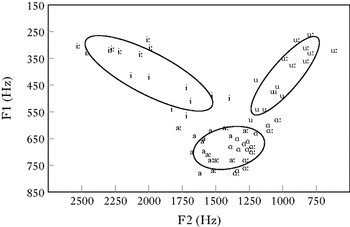
All three of these metalinguistic confounds can be observed in the case of Standard Arabic. Standard Arabic has three contrastive vowel qualities that are normally represented as /i/, /a/ and /u/, as in Fig. 1a; length is also distinctive (Thelwall & Sa'adeddin Reference Thelwall and Akram Sa'adeddin1999). Figure 5 shows the mean first and second formant frequencies for these vowels as produced by eight adult male speakers from different parts of the Arabic-speaking world; the data are from Abou Haidar (Reference Abou Haidar1994).Footnote 12Abou Haidar (Reference Abou Haidar1994) provides separate means for two allophones each of /a/ and /aː/; the backed variants [æ] and [æː] occur adjacent to uvular and emphatic consonants, the non-backed [a] and [aː] elsewhere. The figure thus presents a rough sketch of geographical variation, while abstracting away from intraspeaker variation and omitting certain kinds of sociolinguistic variation entirely (in particular, variation by gender is wholly unrepresented here). Standard deviational ellipses are drawn for each of the three contrastive vowel qualities, with no regard for the length contrast or for the allophonic difference between [a(ː)] and [æ(ː)].
Variation in Standard Arabic vowels (data from Abou Haidar Reference Abou Haidar1994).

As Fig. 5 reveals, there is considerable acoustic variation in the realisation of the Standard Arabic vowels. Such variation is common in phonological vowel inventories of all sorts, although there is a tendency for sparser inventories, like that of Arabic, to display greater variability than more densely packed ones; on this point see e.g. Manuel (Reference Manuel1990), Dyck (Reference Dyck1995) and Rice (Reference Rice1995). The standard transcriptions /i/, /a/ and /u/ obscure this variability, and do so in a way that takes the more peripheral realisations as canonical; on the basis of the centres of the ellipses, the vowels could plausibly be represented as /e/, /a/ and /o/.
At the same time, the standard transcriptions also obscure the apparent differences in quality between /i/ and /iː/ and between /u/ and /uː/. These pairs of vowels, like the English /i/ and /iː/ mentioned in the passage from the IPA Handbook quoted above, contrast in both length and timbre, but only one of these contrasts is explicitly reflected in their usual transcriptions. There are, of course, sound phonological reasons for giving precedence to the length contrast: distinctions of length in Arabic clearly belong to the templatic morphology of the language (McCarthy Reference McCarthy1981), and representing them as either subordinate to or inseparable from distinctions of vowel quality would make it harder to capture prosodic generalisations about word structure. The choice of symbols here is well motivated, but it should not be mistaken for an analytically neutral phonetic description. It encodes a particular phonological analysis, and in doing so it omits elements of the phonetics that are irrelevant to that analysis.
These observations about Arabic vowels illustrate some of the difficulties inherent in any attempt to talk about the phonetic dispersedness of phonological inventories. As Ladd (forthcoming) puts it, ‘it is fairly obvious what ‘the sounds of parole’ might refer to, but less obvious what ‘the sounds of langue’ might be'. Any measurable degree of dispersedness is a property of the sounds of parole, which are subject to variation, but a phonological inventory is composed of the sounds of langue, which are abstract cognitive entities and therefore not directly analysable in terms of phonetic distance.
The contrast and enhancement approach, because it assigns distinct roles to phonology and phonetics, contends with this dichotomy in a principled and transparent way. In this theory, featural representations are contrastive, and are posited on the basis of phonological evidence – thus Standard Arabic, from a phonological perspective, has three contrasting vowel qualities and a templatic length contrast. One plausible set of phonological feature specifications for the three vowel qualities is the one in (4a), repeated below in (12).
(12)
The exact realisations of the vowels vary, but /a/ is consistently lower than /i/ and /u/, and /u/ is consistently more back than /i/. The degree to which the contrastive features are enhanced depends in part on the opportunity afforded by the segmental and prosodic context. When /i/ and /u/ are associated with two timing slots, allowing more time for the articulators to reach their targets, they are not merely non-low but high, and they are also more widely separated from each other along the horizontal dimension. The vowel /a/, on the other hand, is consistently low, but, having no contrastive specification for place, it varies along the front–back dimension according to its immediate consonantal context.
The contrast and enhancement approach thus has somewhat more to say about the vowel inventory of Standard Arabic than the Dispersion model of Liljencrants & Lindblom (Reference Liljencrants and Lindblom1972), which says only that /i a u/ is a favoured configuration for an inventory of three vowels. Even this seemingly accurate prediction is not trivial to evaluate, though, because the output of Liljencrants & Lindblom's (Reference Liljencrants and Lindblom1972) program is a set of points (as in Fig. 4a), while the vowels of Arabic are not points, but regions (as in Fig. 5). Liljencrants & Lindblom evaluate their model's predictions by comparing them to phonemic transcriptions of inventories, but there is no theoretically neutral way of saying whether the correct phonemic transcription of the Arabic vowel system is /i a u/, /e a o/ or something else. For the contrast and enhancement approach, these phonemic symbols are nothing more than convenient abbreviations (as argued by Halle Reference Halle1962); the phonological representations of segments consist of features, while their phonetic realisations vary within the bounds set out by those features.
Flemming's (Reference Flemming, Hayes, Kirchner and Steriade2004) OT version of Dispersion Theory does allow for at least some allophonic variation – e.g. the unstressed Central Italian vowels derived in (2) differ from their stressed counterparts. This theory, though, as discussed in §2.2, has no place for phonological contrasts: the computation proceeds without any input from the lexicon, and there is no fully developed mechanism for saying whether a particular stressed vowel is phonologically the same as a particular unstressed vowel, although Flemming suggests that output–output correspondence constraints could perform this function. This approach also has surprisingly little scope for more fine-grained phonetic variation. The outputs are sets of discrete sounds represented by IPA symbols, separated from one another by specific (though somewhat abstract) degrees of phonetic distance. The contrast and enhancement theory, on the other hand, places abstraction squarely in the phonology, in underspecified featural representations, and continuous variation squarely in the phonetics, where the implementation of enhancement may be influenced by any number of factors.
5.2 Vowel inventories
5.2.1 Deriving dispersedness
The example of Arabic illustrates the fact that it is something of an oversimplification to say that /i a u/ is a common inventory and /ɨ ɘ ʉ/ an unattested one. This oversimplification is, however, only an oversimplification, and not a fundamental misconception. In a typical three-vowel inventory like the one in Fig. 5, the vowels occupy large regions of the available space, and while some tokens of contrasting vowels are very close together, the centres of the regions are fairly widely separated. We do not find inventories consisting of a small number of vowels whose realisations are all crowded together in a small area.
In the contrast and enhancement approach, the explanation for this pattern rests on the fact that MCS ensures that the featural representations of segments can only encode how they differ. Every feature that is assigned to any phoneme serves to differentiate it from at least one other phoneme in the language. Any property that some set of phonemes has in common will be featurally encoded only if it serves to distinguish the set from some other set. While shared properties are phonologically important in defining natural classes, their formal featural representation is primarily a representation of contrast, not of similarity. In a very literal sense, ‘il n'y a que des différences’, as Saussure (Reference Saussure1916: 166) famously said.
The consequences of this can be seen if, for example, we consider what feature specifications the SDA could assign to /ɨ ɘ ʉ/ if these three segments did actually constitute the vowel inventory of some language. /ɨ/ differs from /ʉ/ only in rounding, and from /ɘ/ only in height; /ʉ/ and /ɘ/ differ from each other in both height and rounding. Consequently, the only features that can be assigned to these vowels are [high] and [round] (or their functional equivalents), and the only room for variation is in the order of divisions. The two possibilities are shown in (13).
(13)
What is noteworthy about the feature specifications in (13) is that each of them could just as well be a representation of /i a u/, as shown in (14).
(14)
Because /i/, /a/ and /u/ are more distinct than /ɨ/, /ɘ/ and /ʉ/, there are possible sets of specifications for /i a u/ that could not represent /ɨ ɘ ʉ/ (the ones in (4), for example), but there are no possible specifications for /ɨ ɘ ʉ/ that could not represent /i a u/.
Contrastive specification thus makes it impossible to distinguish the inventory /ɨ ɘ ʉ/ from the inventory /i a u/ (though not vice versa); phonetic enhancement is what makes a potentially ambiguous set of feature values much more likely to be realised as [i a u] or some similarly dispersed set of phones, at least in favourable environments (e.g. under stress, when long, when the coarticulatory effects of adjacent consonants do not interfere to the contrary, etc.). All other things being equal, a vowel that is specified as [−high] can be enhanced by being realised as low, a vowel that is specified as [+round] can be enhanced by being made back, and one that is [−round] can be enhanced by being made front.
The specifications in (13a) lead quite naturally to surface [i a u]: the vowel labelled /ɘ/ is contrastively non-high, and unspecified as to place or rounding, while /ɨ/ and /ʉ/ are specified as to both height and rounding. This system of representations might be expected to surface in much the same way as the vowels of Standard Arabic, with the non-high vowel being realised as a low vowel whose place depends on context, and the two high vowels being realised as front and back.
If [round] takes scope over [high], as in (13b), then [i a u] is still a plausible set of surface forms, although not one that would necessarily follow from a phonetic implementation procedure that simply maximises the phonetic effects of each feature value. Here, the vowel labelled /ʉ/ is not specified for height, and so it might surface as mid by default, although the top of the vowel space offers more scope for enhancing roundness through backing. Also, /ɘ/ is contrastively [−round] in this inventory, and so might be expected to be realised as front rather than as central or with variable place. Although I am not aware of any language whose vowel inventory has been represented specifically as /i æ o/, the similar set of transcriptions /i a o/ has been given for the vowel-quality inventories of Axininca Campa (Payne Reference Payne1981: 59), Mikasuki (Sedlak Reference Sedlak1969, cited in Liljencrants & Lindblom Reference Liljencrants and Lindblom1972: 845) and Blackfoot (Frantz Reference Frantz1991: 1–2, though cf. Elfner Reference Elfner2005: 37, who analyses Frantz's /ai/ and /ao/ as synchronic monophthongs /ɛ/ and /ɔ/, and thus posits five underlying vowel qualities rather than three). In any case, as discussed in §4, phonetic implementation is language-specific, not universal, and enhancement is a tendency of implementation rather than an absolute. There is, in effect, nothing in the contrast and enhancement theory that would predict that the set of representations in (13b) and (14b) should not be realised as [i a u] as opposed to [i æ o]; what the theory does predict is that inventories along the lines of [i a u], [i æ o] and [i a o] are all vastly more likely than [ɨ ɘ ʉ].
Because every specified feature value marks a phonological contrast, enhancement of specified features has the effect of dispersing the realisations of segments through the available phonetic space. Unlike Dispersion Theory, however, enhancement accomplishes this without recourse to constraints that explicitly compare surface segments or measure the phonetic distances between them; rather, the paradigmatic relations between segments are encoded in phonological features, and dispersion emerges from the amplification of individual features' phonetic correlates.
5.2.2 Linear vowel inventories
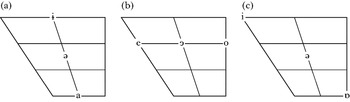
While /i a u/ is the most common three-vowel inventory, other configurations of three vowels are also attested. If we consider the case of linear three-vowel inventories, a pattern emerges that is somewhat mysterious if viewed from the perspective of Dispersion Theory. Vertical inventories like the one in Fig. 6a, though rare, are attested; for example, Trubetzkoy (Reference Trubetzkoy1969: 97) attributes such an inventory to Adyghe. The Adyghe vowels, which Trubetzkoy transcribes as /ə e a/, contrast only in height: /ə/ is ‘maximally close’, /e/ ‘mid open’ and /a/ ‘maximally open’. Their phonetic backness and rounding vary according to the consonantal context in which they appear.Footnote 13
Linear three-vowel inventories: (a) vertical inventory (e.g. Adyghe); (b) horizontal inventory (unattested); (c) diagonal inventory (unattested).

Other logically possible linear inventories are unattested. There are no apparently horizontal inventories like the one in Fig. 6b; this observation leads Hyman (Reference Hyman2008b) to formulate the generalisation in (15).Footnote 14
(15)
Diagonal inventories such as the one in Fig. 6c are also unattested. Furthermore, no vertical inventories are attested whose vowels are invariably front, invariably back or invariably central; rather, the place and rounding of vowels in such systems vary contextually, as in Adyghe. Hyman (Reference Hyman2008b: 99) takes this to mean that the vowels in these systems are underlyingly central, and they are often represented with central vowel symbols like the ones in Fig. 6a, but it seems more appropriate to say that they are simply unspecified as to place.Footnote 15
If there is functional pressure on languages to maximise dispersion in inventories, it is not surprising that /i a u/ is more common than any of the inventories in Fig. 6. What is surprising, though, is the apparent preference for vertical inventories over horizontal or diagonal ones. Of the three possibilities in Fig. 6, the diagonal /i ə ɒ/ would seem to have the best dispersion, because its vowels, though arranged in a collinear formation, differ along two dimensions of phonetic space rather than just one. For that matter, a horizontal inventory consisting only of high vowels (e.g. /i ɨ u/) might be expected to be at least as good as the attested vertical inventories; in Liljencrants & Lindblom's (Reference Liljencrants and Lindblom1972: 844) model of the vowel space (shown in Fig. 2), the distance from [i] to [u] is 900 mels, while the distance from the top of the vowel space to [a] is only about 500 mels.
The contrast and enhancement approach, on the other hand, is able to shed some light on this pattern. As in the case of the unattested /ɨ ɘ ʉ/, it is instructive to consider the possible feature specifications that could be assigned to each of the three inventories in Fig. 6. For the vertical inventory in Fig. 6a, the vowels contrast only in height, and so only height features can be assigned. Assuming that these features are [high] and [low] (or their functional equivalents), the only two possible sets of specifications are those shown in (16).
(16)
These specifications, unlike the ones in (13), are distinct from any that could be assigned to the widely attested /i a u/. In both (16a) and (16b), /ɨ/ is contrastively high, /a/ contrastively low and /ə/ contrastively neither; in fact, the two sets of specifications are virtually identical, since the unspecified values are predictable not just in this specific vowel system, but universally: [+high] /ɨ/ is necessarily non-low, and [+low] /a/ is necessarily non-high. There is relatively little work for phonetic enhancement to do here. Producing the vowels with consistent differences in place or rounding would spread them out more through the phonetic space, as in the diagonal system in Fig. 6c, but would not specifically reinforce any of their contrastive properties in the way that lip rounding enhances the posteriority of a [+back] vowel or a [−anterior] sibilant. In the contrast and enhancement theory, then, there is no particular reason to expect the vowels' place and rounding to be determined by anything other than the environments in which they occur.
The case of the unattested horizontal inventory in Fig. 6b is superficially similar. Here, because the horizontal dimension of the vowel space encompasses both place and rounding, there are more potentially relevant features to consider. Rice (Reference Rice1995, Reference Rice, Amberber and Collins2002), observing that there are no languages that have more than four vowels contrasting in place and rounding at any given height, proposes that there are only two phonological features distinguishing vowels in the horizontal dimension: Coronal, which indicates frontness, and Peripheral, which subsumes labiality and dorsality. In the maximal four-place system, a front unrounded vowel such as /i/ is Coronal; a back rounded vowel such as /u/ is Peripheral; a front rounded vowel such as /y/ is both Coronal and Peripheral; and the fourth vowel, such as /ɨ/, /ʉ/ or /ɯ/, is neither Coronal nor Peripheral. (Coronal is thus similar to Jakobson et al.'s feature acute, and Peripheral to their flat; 1952: 29–31.) Adapting Rice's originally monovalent features to the binary system we have been assuming here so far, the possible specifications for /e ɘ o/, shown in (17), are essentially a rotated version of the possibilities for /ɨ ə a/.Footnote 16
(17)
Despite the apparent similarity between the feature specifications in (16) and (17), there are some differences that are key to understanding why an inventory specified as in (16) would be realised as a genuinely vertical inventory, while an inventory specified as in (17) might not be realised as purely horizontal. First, the divisions applied to /e ɘ o/ in (17) could also be applied to /i a u/, while the ones that divide the vertical inventory could not; the vowels /i a u/ have at most a two-way height contrast, but they could be divided into three place categories instead. This is illustrated in (18).
(18)
Granted that the inventory in (17) could be realised as [i a u] (or, to look at it from the opposite perspective, that the inventory /i a u/ could be represented as in (17)), is there any reason to expect that it would be realised thus? If the ‘vertical’ and ‘horizontal’ dimensions of the vowel space are genuinely orthogonal to each other, then why would the representations in (17) be any more likely to be enhanced in a way that introduces vertical differences than those in (16) are to be enhanced in a way that introduces horizontal differences?
The answer lies in the asymmetrical shape of the vowel space. As mentioned in (11c), the space is wider at the top than at the bottom: [i] and [u] are farther apart than [æ] and [ɒ]. Consequently, a vowel that is specified for place but not for height can enhance its contrastive place specification more effectively by being realised as higher rather than lower. In the system in (17), then, we might reasonably expect the [+coronal] and [+peripheral] vowels to be realised as relatively high, while the [−coronal, −peripheral] vowel represented as /ɘ/ would have no reason to depart from a neutral height, and would thus end up being realised as lower than the other two. A system with only horizontal contrasts in the phonology is thus predicted by the contrast and enhancement theory to surface as phonetically triangular, while a system with only vertical contrasts is not.Footnote 17
Much the same results obtain if, instead of [coronal] and [peripheral], we use Chomsky & Halle's (Reference Chomsky and Halle1968) features [back] and [round] to divide the hypothetical horizontal inventory. The possible specifications are shown in (19).
(19)
In (19), /e/ is contrastively specified as [−back] and possibly also as [−round]; /o/ is contrastively [+round] and possibly also [+back]. For the purposes of phonetic enhancement, the phonological presence or absence of the second feature in each case is not particularly important, as it will reinforce the acoustic effects of the first. Each of these vowels, then, is likely to be pushed by enhancement toward one of the upper corners of the vowel space, the better to realise its contrastive place and/or rounding in the absence of any countervailing specification for height. The remaining vowel /ɘ/ is specified as [+back, −round], and thereby confined to the central region of the vowel space, with no inherent reason to be realised as high. As with (17), the specifications in (19) are fully consistent with /i a u/ and would be likely to be realised as something approaching [i a u], or at least [i ə u].Footnote 18
In effect, then, the contrast and enhancement theory does not rule out the existence of a horizontal inventory at the phonological level, but rather predicts that an inventory underlyingly specified as though it were /e ɘ o/ would appear triangular at the surface level in a way that vertical inventories do not.Footnote 19 The inventory of vowel qualities in Jaqaru offers a possible example of the predicted pattern. Hardman (Reference Hardman2000: 3) transcribes the vowels of Jaqaru as /i a u/, but also says that the ‘vowel contrast is front/center/back’, and indicates considerable variation in height: /i/ ranges from [i] to [ɛ], /u/ from [u] to [ɔ] and /a/ from [a] to [e].Footnote 20 These surface realisations are consistent with an inventory of vowels specified only as front, central and back, with the front and back vowels frequently being raised, in order to enhance their contrastive place specifications.
Turning finally to the unattested diagonal inventory in Fig. 6c, the range of possible specifications here is even wider, because the vowels contrast in two dimensions rather than one. Some of the possible feature specifications, however, have already been dealt with. The vowels of the diagonal inventory could be fully distinguished using only height features, in which case it would behave exactly like a vertical inventory; alternatively, the segments could be distinguished using only place and rounding features, just like the horizontal inventory in Fig. 6b. Assuming that there are no phonological features that would make explicitly diagonal divisions, the only ways of treating this inventory as a phonologically ‘linear’ inventory are ones that we have already considered.
The only novel possibilities to contend with, then, are those that use one height feature and one place or rounding feature. These are limited by the logic of contrast: the first feature assigned will cut off either /i/ or /ɒ/ from the other two vowels, and the second feature must then be capable of distinguishing the remaining segments from each other. This means that [high] must be paired with [peripheral] or [round], and [low] with [coronal] or [back]. (20) shows the possible divisions using [low] and [back], and (21) those using [round] and [high]. For the present purposes, [αperipheral] is equivalent to [αround], and [αcoronal] to […αback]; accordingly, no separate trees are shown for these features.
(20)
(21)
Both sets of feature specifications in (20) lend themselves readily to enhanced realisations as [i a u]. The vowel transcribed as /ə/ is contrastively back and non-low; the most thoroughly amplified realisation of these features would be [u]. The vowel transcribed as /ɒ/ is contrastively low, and perhaps also contrastively back; it might be realised as [a], [æ] or [ɒ]. Finally, the vowel represented as /i/ is contrastively non-back. If it is also contrastively non-low, as in (20a), then [i] is the obvious phonetic form; if it is not, as in (20b), then it might vary in height, but could still be realised as high in order to increase its frontness.
The representation in (21a) also maps naturally onto [i a u], although not in quite the same way. Here, the vowel likely to emerge as [u] is the one transcribed as /ɒ/, which is contrastively rounded and unspecified for height, while /ə/, being specified as unrounded and non-high, is a good candidate for being realised as [a] or [æ]. The vowel labelled /i/, which is contrastively high and unrounded, should again surface as [i].
The representations in (21b) are the only ones in this quartet that could not have been assigned to the inventory /i a u/, because they include a vowel specified as [−high, +round], namely /ɒ/. These representations are, however, compatible with another attested inventory, /i a o/, which was also a possible realisation of the specifications in (13b). Here, though, the [+high] vowel is unspecified as to place and rounding, and might thus be expected to vary along the horizontal dimension rather than being realised as [i] consistently or even canonically.
5.2.3 Conclusions
What we have seen in this section is that, for all the types of unattested inventories considered here, any set of feature values assignable by the SDA is equally compatible with the vowels of some attested inventory. Furthermore, a tendency toward enhancement of specified properties in phonetic implementation has the effect of making the attested surface patterns more likely than the unattested ones to occur as the realisations of the potentially ambiguous underspecified phonological representations. Like Dispersion Theory, the contrast and enhancement theory predicts the absence of gratuitously compact inventories such as /ɨ ɘ ʉ/: the SDA cannot specify all the properties that the vowels have in common, and enhancement will tend to amplify their differences. Unlike Dispersion Theory, however, the contrast and enhancement theory also predicts the absence of diagonal inventories such as /i ə ɒ/. Here, the SDA cannot specify that every pair of vowels differs along two separate dimensions. Just as the algorithm cannot encode excessive similarity, it also cannot encode excessive difference.
Evolutionary models, such as those of Blevins (Reference Blevins2004), Wedel (Reference Wedel2004, Reference Wedel2006) and Boersma & Hamann (Reference Boersma and Hamann2008), may also have difficulty accounting for the absence of diagonal inventories. Such an inventory may be unlikely to develop over time from a vertical or horizontal inventory – vertical inventories would most likely be relatively stable, while horizontal inventories might be expected to become triangular, with the front and back vowels drifting upward to become more distinct from the central one. However, it is not obvious that a diagonal inventory, if one did arise, would be any less stable than the canonical triangular inventory /i a u/.
The inventories explicitly dealt with here have been small ones, consisting of only three vowels each. This limitation in scope is motivated partly by concision; as the size of the inventory grows, so does the number of possible contrastive hierarchies.Footnote 21 Working through the full range of possibilities for larger inventories would consume more space without necessarily being more informative. The range of attested three-vowel inventories is remarkably small compared to the number of hypothetically possible configurations of three vowels in the available space. In larger inventories, while the same basic pattern holds – the SDA can assign only contrastive features, and enhancement, by amplifying contrastive feature specifications, produces relatively dispersed phonetic realisations – the range of predicted, and attested, inventories is wider; because more features are required to differentiate the vowels, the position of each vowel is more precisely indicated by its specified features, and so larger inventories can and do differ in finer detail. The three-vowel inventories examined here offer the most dramatic difference between what is attested and what is hypothetically possible, and therefore the best opportunity for the contrast and enhancement theory to make interesting predictions.
5.3 Consonant inventories
In consonant inventories as well as vowel inventories, the tendency toward dispersedness has long been noted. For example, Trubetzkoy (Reference Trubetzkoy1969) and Jakobson (Reference Jakobson1941) both remark on the fact that nearly all languages have consonantal contrasts between labial, coronal and dorsal places of articulation, while other place contrasts are less ubiquitous. Trubetzkoy (Reference Trubetzkoy1969: 123) explicitly relates this pattern to auditory distinctness as follows:
The three types of consonants mentioned are ‘natural’ only in the sense that they solve most easily and naturally, with the aid of the movable parts of the oral cavity, the task of producing different sounds that have their own individual character and that are clearly discriminated from each other. This may also explain their universal (or near universal) presence in the world.
The idea that certain configurations of the vocal tract naturally lend themselves to the production of robustly distinct sounds has since been taken up and substantiated in considerable detail in the Quantal Theory of Stevens (Reference Stevens, David and Denes1972, Reference Stevens1989) and Stevens & Keyser (Reference Stevens and Keyser2010).
Again, the combination of MCS and enhancement offers some insight into this pattern. Suppose that a language had an obstruent inventory consisting entirely of coronal plosives, as in (22). While some languages do have similarly rich inventories of coronals as subsets of larger consonantal systems (e.g. the Australian languages surveyed in Hamilton Reference Hamilton1996: App. B), an inventory like the one in (22) has never been reported as the complete set of obstruents in any language.
(22)
As in the case of the minimally dispersed vowel inventory in Fig. 1b, the SDA can assign to the consonants in (22) only feature values that differentiate them; it cannot encode properties that they all have in common. (22) shows how the inventory might be divided and specified using the features [voice], [anterior], [strident] and [distributed]. In this example, because the inventory is fairly symmetrical, there is relatively little room for different feature hierarchies to produce different specifications, although some minor differences would result from giving either [strident] or [distributed] wider scope than [anterior].
How might the acoustic correlates of these contrastive feature specifications be enhanced in phonetic implementation? Because all the segments are unspecified for traditional major place and manner features, these very salient properties are available to reinforce the minor differences in place encoded by the specified features. Although this is the reverse of the normal situation envisioned by Stevens et al. (Reference Stevens, Keyser, Kawasaki, Perkell and Klatt1986), in which minor properties enhance major ones, the result is very similar. Stevens et al. (Reference Stevens, Keyser, Kawasaki, Perkell and Klatt1986: 439–440) describe the enhancement of [+continuant] by stridency; in this inventory, [+strident] can conversely be enhanced by the addition of continuancy (and [−strident] segments can be enhanced by being realised as stops). Similarly, the place contrasts can be enhanced by realising the [+anterior, −strident] segments as labial, and the [−anterior, +distributed] segments as dorsal. This yields the surface representations shown in (23). The familiar pattern of contrasting labial, coronal and dorsal consonants emerges from the enhancement of such few features as are capable of dividing the inventory in (22).
(23)
The inventory in (23) looks much more typical of small obstruent inventories than the unenhanced version in (22) – in fact, it is very nearly the obstruent inventory of Mer as described by Holmer (Reference Holmer1988: 1–2).Footnote 22 Of course, it is unlikely that any phonologist would represent the inventory in (23) using (only) the feature values shown; instead, it would be more likely to be assumed to have feature specifications along the lines shown in (24).Footnote 23
(24)
While the SDA itself makes no predictions as to which of these sets of features will actually be used, it does ensure that whatever features are employed will be ones that differentiate the segments, rather than ones that express what they have in common. Combined with phonetic enhancement, it predicts that the inventory in (23) and (24) is more likely than the one in (22) to be attested as the obstruent inventory of any natural language.
5.4 Too much contrast?
Despite the absence of inventories like the one in (22), it has sometimes been suggested that consonant inventories in general do not show precisely the same tendency toward dispersedness that is observed in vowel inventories. For example, Ohala (Reference Ohala1980: 185) speculates that if we applied to consonants a model similar to Liljencrants & Lindblom's (Reference Liljencrants and Lindblom1972) model of vowel dispersion, ‘we should undoubtedly reach the patently false prediction that a 7 consonant system should include something like’ the set of segments shown in (25).
(25)
Ohala (Reference Ohala1980: 185) goes on to suggest that consonant inventories are governed by a principle of ‘maximum utilization of the available distinctive features’, an idea that has subsequently been taken up under the name of Feature Economy by Clements (Reference Clements2003, Reference Clements, Raimy and Cairns2009).Footnote 24 ‘Does this mean’, Ohala (Reference Ohala1980: 18) asks, ‘that consonant inventories are structured according to different principles from those which apply to vowel inventories?’.
There appears to be a consensus in favour of a negative answer to this question, but less agreement as to precisely what the relevant principles are. Clements (Reference Clements2003: 327) predicts that Feature Economy applies to vowel systems as well as to consonant systems. Lindblom & Maddieson (Reference Lindblom, Maddieson, Hyman and Li1988), taking a more narrowly phonetic approach, posit that both vowel and consonant inventories are governed by the competing desiderata of maximising perceptual distinctness and minimising articulatory effort. This conflict between functional preferences is also at the core of the optimality-theoretic versions of Dispersion Theory discussed in §2.2.
The contrast and enhancement approach, too, suggests a unified explanation for the shapes of consonantal and vocalic inventories, but it does so without attributing to the phonological component of the grammar either a metalinguistic consideration such as Feature Economy or an ability to supervise negotiations between rival phonetic principles. It does so in part through the imposition of representational economy, which Clements (Reference Clements2003: 292) is careful to distinguish from Feature Economy in his sense. The representational economy of the contrast and enhancement theory resides in the fact that the SDA can assign to any inventory only the features that are required to differentiate its segments. This means that it cannot assign to the inventory in (22) any of the features that the segments have in common, but also that it cannot assign to the inventory in (25) all of the features in which the segments differ. The segment /ɬ/, for example, cannot in this context be represented as being both a fricative and a lateral, because either of those properties by itself is sufficient to distinguish it from its fellows. Similarly, because /k'/ is both the only dorsal consonant in (25) and the only ejective, the SDA cannot represent it as both ejective and dorsal.
Unlike the redundant properties that typically enhance segments in vowel inventories – e.g. rounding enhancing backness or vice versa – the different properties of the consonants in (25) do not obviously reinforce one another. If /ɬ/ is specified as a fricative, then the most obvious way to enhance it is by making it strident, so we would expect it to surface as something more like [s]. On the other hand, if it is specified as lateral, then it could be enhanced by being realised as sonorant, in which case we would expect [l] instead. Thus it is not surprising that, of the 60 consonant inventories in Mielke's (Reference Mielke2008) P-base database that include a segment transcribed as /ɬ/, all but five also have an /l/, all but two have an /s/, and the two that lack an /s/ each have both an /l/ and an /ʃ/. Similarly, the velar place of articulation and the glottalic egressive airstream mechanism do not specifically reinforce each other's auditory correlates, and so there is no particular reason to expect a segment to surface as [k'] if it is contrastively specified with only one or the other of these properties. 67 inventories in P-base contain a segment transcribed as /k'/; unsurprisingly, all of these also contain both a pulmonic /k/ or /kʰ/ and at least one non-velar ejective. Realising a velar stop as an ejective when it is not contrastively so, or a voiceless fricative as lateral, could enhance the dispersion of an inventory as a whole, but it would not enhance the features of the particular segments involved.
Although the absence of such gratuitous dispersion is most evident in consonant inventories, the same fundamental pattern holds of vowel inventories as well. As Lindblom & Maddieson (Reference Lindblom, Maddieson, Hyman and Li1988: 74) point out, ‘the most frequent vowel inventory is /i e a o u/ – not /i ẽ  uˤ/’: contrasts in height, place and rounding are not typically supplemented by redundant differences in nasalisation, pharyngealisation or phonation type.
It is instructive to compare Lindblom & Maddieson's hypothetical example with the vowel inventory of Cherokee, shown in (26).
(26)
The Cherokee vowel system could be described as consisting of the common five-vowel inventory /i e a o u/, with the addition of contrasts in length and nasality. Length fully cross-classifies with the other oppositions in the inventory, as expected under Feature Economy (or under the view that length is encoded in prosodic structure and is thus independent of feature specifications). Nasality, on the other hand, distinguishes only a single short–long pair from the other five, and this pair does not correspond directly to any one of its non-nasal counterparts in height, place or rounding. This appears to be a startlingly uneconomical use of the feature [nasal], perhaps even a redundant one. Notably, though, the unique nasal vowel is mid, unrounded and central; this is consistent with a contrastive hierarchy in which the feature [nasal] takes relatively wide scope, separating the nasal vowel from the rest of the inventory before any other features have been assigned. Being fully distinguished by its nasality alone, this vowel has no contrastive features for place, height or rounding, and is realised with the tongue and lips in a neutral position, while its oral counterparts have features that differentiate them along these other dimensions.
If we find a nasal vowel that also appears to have specific height, place or rounding properties, then the contrast and enhancement theory predicts that it will contrast with oral vowels that have similar specifications for these other features, or with nasal vowels that have different specifications, or both. In Maba, for example, the only nasal vowel is /ũ/, but it stands in contrast with an oral vowel /u/ (Lukas Reference Lukas1933: 28). This suggests a contrastive hierarchy in which [nasal] has much narrower scope than in Cherokee. Mohawk and Oneida, on the other hand, have /ũ/ and lack /u/, but in these languages /ũ/ is not the only nasal vowel; it contrasts with / / (Mithun Reference Mithun1982: 54). In Assiniboine, which has a more typical assortment of nasal and oral vowels, /ũ/ contrasts both with /u/ and with /ĩ/ and /ã/ (Cumberland Reference Cumberland2005: 17). What we do not expect to find under the contrast and enhancement theory is an inventory in which vowels have positions that are specified in more phonetic dimensions than are required to distinguish them from one another. The absence of inventories such as /i ẽ uˤ/ follows naturally from this approach, whereas in Dispersion Theory it appears to require further explanation – for example, restrictions on the ranking of markedness constraints relative to constraints mandating auditory distinctness.
In noting the absence of excessively dispersed inventories, it is worth recalling from §5.1 that transcriptions of phoneme inventories often omit predictable details, and may therefore obscure the presence of additional dimensions of phonetic contrast. The contrast and enhancement theory does not predict that such redundant properties will not exist at all, but rather that they are much more likely to be present if they reinforce a contrastive feature. One relevant example is the phenomenon of intrinsic F0 on vowels, in which slight differences in pitch correlate with differences in vowel height; lower vowels tend to have lower pitch, and higher vowels higher pitch (see e.g. Peterson & Barney Reference Peterson and Barney1952: 183, Kingston Reference Kingston1992, Whalen & Levitt Reference Whalen and Levitt1995, Connell Reference Connell2002). Although speakers are clearly capable of using pitch and vowel height independently to make orthogonal contrasts (most obviously so in the case of tone languages, but also in languages like English that manipulate pitch at higher levels of prosodic structure), the correlation is not entirely arbitrary. It has a possible articulatory source in the fact that raising the tongue body can increase the tension of the vocal folds (Honda Reference Honda, Bless and Abbs1987). From an auditory point of view, the correlation makes vowel height easier to perceive by increasing the distance between F0 and F1 in low vowels and decreasing it in high vowels (Kingston Reference Kingston1992).
As outlined in (11), a gesture that is apparently orthogonal to a contrastive property of a segment can legitimately be viewed as an enhancement of that property if it amplifies a mechanically natural by-product of it (11d), or if it makes it more salient by altering the acoustic background against which the contrastive property is perceived (11e). Thus, while the canonical five-vowel inventory is normally transcribed as /i e a o u/, the contrast and enhancement theory will countenance what might be represented in greater detail as [i e
 a
 o u]. What it does not predict is the introduction of wholly unrelated phonetic differences that increase dispersion without enhancing any specific phonologically contrastive features.
6 Questions, consequences and conclusions
The examples presented in the preceding section illustrate the ability of the contrast and enhancement theory to account for typological patterns attested in segmental inventories. This section addresses some of the questions raised by this approach.
6.1 The valency of features
In the examples discussed so far, I have assumed that phonological features are binary. The most relevant consequence of this assumption for the contrast and enhancement theory is that it accords equal status to the members of any given opposition: when a vowel inventory is divided according to place, for example, both [+back] and [−back] are explicitly marked, and both values are presumably eligible for phonetic enhancement. The features are equipollent, in the sense of Trubetzkoy (Reference Trubetzkoy1969). However, much work in phonology posits that some or all features are monovalent, and thus privative in Trubetzkoy's terms; under this view, a back vowel might have the unary feature [Back], while its non-back counterpart is distinguished from it solely by the absence of this feature, and not by the presence of an opposite value.Footnote 25 Would the contrast and enhancement theory make different predictions if features are monovalent rather than binary?
In principle, it would be possible for the grammar to treat monovalent features as equivalent to binary ones for the purposes of phonetic enhancement. Suppose that at the point of phonetic implementation, each segment is evaluated according to the contrastive hierarchy established for the language, with each branch in the hierarchical structure being interpreted as a question (as suggested by Cherry et al. Reference Cherry, Halle and Jakobson1953: 37, but with privative features instead of their binary ones). At each branch, the absence of the feature at issue is interpreted as contrastive, and thus subject to enhancement, but absences of features that are not specifically inquired about are non-contrastive. As a concrete example, (27) shows a monovalent version of the contrastive hierarchy in (12), in which the vowel inventory of Standard Arabic is divided by the features [Low] and [Back], in that order.
(27)
The contrastive hierarchy in (27) can be translated into the questionnaire in (28).
(28)
Although neither /i/ nor /a/ is specified with the feature [Back], the questionnaire in (28) identifies the absence of this feature as contrastive on /i/ but not on /a/. Accordingly, we would expect /i/ to be enhanced by being made front (and unrounded), while the place and rounding of /a/ would be unaffected by enhancement. In this way, monovalent features could be made to behave exactly like binary ones for the purposes of phonetic implementation.
An interesting alternative to this approach would be to say that in a monovalent feature system, the asymmetry that exists between marked and unmarked values in the phonology also extends into phonetic implementation. Under this view, the contrastive absence of [Back] on /i/ in (27) would not be subject to enhancement; rather, /i/, like /a/, would be taken to be indifferent as to place, being at most constrained not to encroach on the markedly back territory of /u/.
Some of the vowel systems discussed by Rice (Reference Rice1995) appear to support this interpretation. For example, Djapu and Gooniyandi each have the inventory /i a u/, specified as in (29) according to Rice's system. Rice (Reference Rice1995: 104) reports that in these languages, /i/ may be realised as front or central, and also that it varies in height. The contrastive absence of the features [Peripheral] and [Low] does not consistently cause the vowel to be realised as front and high.
(29)
In the four-vowel system of Yimas, /i/ contrasts with a central vowel /ɨ/, and is thus specified as [Coronal] according to Rice's feature system. Rice's features for the Yimas vowels are shown in (30).
(30)
The /i/ of Yimas is more restricted in its phonetic realisation than the /i/ of Djapu or Gooniyandi. The two Yimas vowels that are unspecified as to place, however, both vary considerably along the front–back dimension, even though one of them (/ɨ/) contrasts with specified vowels on either side and the other (/a/) does not. The approximate phonetic ranges of the Yimas vowels are shown in Fig. 7.
The vowel inventory of Yimas (Foley Reference Foley1991: 44, cited in Rice 95: 107).
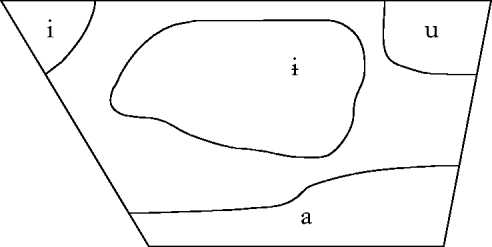
Another case in which the absence of a marked feature has been posited to correlate with greater phonetic variability can be found in the approach to laryngeal feature specification taken by Petrova et al. (Reference Petrova, Plapp, Ringen and Szentgyörgyi2006). They claim that in German there is a two-way contrast between stops specified with [spread glottis] and stops with no laryngeal feature, while in Swedish the contrast is between stops with [spread glottis] and stops with [voice].Footnote 26 While the primary motivation for their claim is phonological, they also find support for it in the different phonetic realisations of the non-[spread glottis] stops in the two languages. The unspecified German stops are unaspirated and usually voiceless, but undergo passive phonetic voicing in intersonorant position. The voiced stops in Swedish, on the other hand, are consistently voiced not only intersonorantly but also word-initially and word-finally, where there would be no obvious articulatory reason to introduce phonetic voicing if it is not specifically indicated by the phonological features.
Even in Petrova et al.'s system, however, there appears to be some basis for speculating that the phonetic implementation of an unmarked segment may depend in part on what it contrasts with. In Russian, Hungarian and Yiddish, laryngeally unmarked stops contrast with stops specified for [voice]. Unlike the unspecified stops of German, the unmarked stops in these languages do not undergo passive voicing between sonorants. This suggests that phonetic implementation recognises a difference between the contrastive absence of [spread] and the contrastive absence of [voice], although a more extensive typological investigation would be needed to determine whether this difference is cross-linguistically significant, rather than simply being a phonetic quirk of these few languages.
The hypothesis that the contrastive absence of a privative feature is not subject to enhancement may be helpful in accounting for the absence of horizontal vowel inventories. In §5.2.2, we saw that enhancement could cause surface differences in height to emerge in an inventory such as /e ɘ o/, in which one vowel is specified as front, another as back or round, and the third as neither. While a horizontal inventory of this type might be expected to surface as something more like [i a u], an inventory such as /e ø o/, in which the middle vowel is both front and rounded, would have no particular reason to surface as anything other than horizontal if it is specified using binary features. (31) shows how such an inventory could be specified using the binary versions of the features [coronal] and [peripheral].
(31)
Under either ordering of features, the vowel /ø/ ends up specified as [+coronal, +peripheral]. An enhanced realisation of these feature values would be as far forward as possible, and also maximally rounded. Unlike the [−coronal, −peripheral] vowel /ɘ/, then, /ø/ would have just as much reason to adhere to the top of the vowel space, where more forward articulations are possible, as the two other vowels with which it contrasts. An inventory specified as in (31) might thus be expected to be realised as [i y u].
With monovalent features, on the other hand, there will always be one segment in every inventory that is assigned no marked feature values at all. (32) shows how the inventory in (31) could be specified using the privative versions of [Coronal] and [Peripheral].
(32)
If the absence of [Coronal] on /o/ in (32a) and of [Peripheral] on /e/ in (32b) is not subject to enhancement, then there will be no reason for the unspecified vowel in either inventory to tend toward the top of the vowel space. Instead, we might find the inventory in (32a) approximating [i ə y], and the one in (32b) approaching [y ə u]. These triangular inventories are also unattested; in general, vowel inventories do not contain a front rounded vowel at any given height unless they also have both a front unrounded vowel and a rounded non-front vowel at the same height (see e.g. Rice Reference Rice, Amberber and Collins2002: 245). However, restrictions on the order of divisions made by the SDA may push such inventories further in the direction of the canonical /i a u/, as discussed below in §6.2.
Ultimately, the choice between binary and monovalent features must be made on phonological grounds. The possibility of privative features raises some interesting questions about the phonetic implementation of unmarked values, definitive answers to which depend on the difficult process of separating out what is idiosyncratic about phonetic implementation in individual languages from what can be attributed to a systematic cross-linguistic pattern. Under either a binary or a monovalent feature system (or under a system that combines the two types of features), the contrast and enhancement approach is nonetheless able to offer insight into the kinds of typological patterns discussed in §5.
6.2 The order of divisions
While the SDA itself as stated in (3) is wholly neutral as to the order in which features are used to make divisions, restrictions on the feature hierarchy would further limit the ways in which inventories can be specified. There are various potential motivations for positing such restrictions. To the extent that the SDA corresponds to the procedure by which children acquire the phonological contrasts of their native languages (as opposed to its more abstract role as a theoretical tool for enforcing contrastive specification), one might wish it to conform to such regularities as can be observed in acquisition. For example, Jakobson & Halle (Reference Jakobson and Halle1956: 41) posit a partial ordering of contrasts in acquisition, which could be taken to constrain not only the sequence in which the features are learned, but also their relative scope in the resulting contrastive hierarchy.
Another natural basis for imposing restrictions on the order of divisions is the geometrical organisation of features within segments. While the contrastive hierarchy employed by the SDA is not the same thing as the hierarchical constituent structure posited in theories of phonological feature geometry, there is significant reason to expect at least some isomorphism between the two. Feature geometry groups phonological features into natural classes; at the same time, it establishes relations of scope between features. For example, Clements & Hume (Reference Clements and Hume1995: 252–253) argue that [anterior] and [distributed] should be dependents of [coronal], on the grounds that it is only within the class of coronal segments that these two features make useful distinctions. (See Dresher Reference Dresher2009: §5.4.1 for further discussion.)
Cross-linguistic uniformity in the phonological behaviour of features could provide another source of evidence suggesting that the order of divisions is not entirely free. For example, Walker (Reference Walker1993: 181), on the basis of typological patterns in vowel-harmony processes, proposes that vowel features conform to the hierarchy in (33).
(33)
Taken in combination with the hypothesis that the contrastive absence of privative features is not subject to enhancement, Walker's hypothesis that height features take precedence over place features may help to account for the absence of horizontal vowel inventories. Walker's feature hierarchy is not simply a restatement of the observation that such inventories do not exist (Hyman's Reference Hyman2008b Vocalic universal #1, quoted above in (15)), because it does not by itself guarantee that height features will actually be able to divide any given vowel inventory; it merely says that the SDA will try to use height features to divide the inventory before trying place features. Walker's (Reference Walker1993) hierarchy would prevent the inventory /i a u/ from being specified as though it were a purely horizontal inventory, but it cannot impose height features on an inventory whose segments do not differ in phonetic height in the first place.
Consider, however, the consequences of this ordering restriction for the specification of the unattested horizontal inventory /e ø o/. As discussed in §6.1, if features are privative, and contrastive absence is not subject to enhancement, this inventory is likely to end up being realised phonetically as something along the lines of either [i ə y] or [y ə u]. If such a set of surface vowels is then taken as input to the SDA, then the hierarchy in (33) would require that the first division separate /ə/ from the other two vowels by means of some height feature. Once this has been done (either by assigning [Low] to /ə/ or by assigning [High] to the other two vowels), only one place feature can be used to distinguish /y/ from /i/ or /u/. If /y/ needs to be distinguished from /i/, then /y/ will be assigned [Labial] according to Walker's (Reference Walker1993) hierarchy, or equivalently [Peripheral] or [Round]. If /y/ needs to be distinguished from /u/, then it will be assigned [Coronal] (or /u/ could be assigned [Back]). Under any of these scenarios, the language will now have only a two-way place contrast, and none of the vowels will have any reason to be realised as both front and rounded. The resulting set of feature specifications will now be wholly compatible with the surface inventory [i a u]. Thus Walker's hierarchy, which was motivated by phonological patterns of formal complexity as manifested in vowel-harmony systems, can also contribute to our understanding of the phonetic shapes of phonemic vowel inventories.
6.3 The source and content of features
Another current question in phonological theory that has potentially significant consequences for the contrast and enhancement approach is the question of where phonological features come from. Generative phonology and its immediate precursors have generally posited that the features used in any language are drawn from a finite universal set, and that they have well-defined phonetic correlates (see e.g. Jakobson et al. Reference Jakobson, Fant and Halle1952, Halle Reference Halle1959, Chomsky & Halle Reference Chomsky and Halle1968). More recent work, in particular that of Mielke (Reference Mielke2008), has explored the possibility that features are emergent and language-specific rather than innate and universal – that they can be inferred by the learner from a combination of phonetic and phonological data, and therefore do not need to be provided by Universal Grammar. Moreover, Mielke argues that innate features are inadequate for the task of accounting for phonological patterns in natural languages, because there are many phonologically active classes of segments that cannot be represented by conjunctions of standardly posited features.
Many phonological patterns arise diachronically through the phonologisation of natural phonetic processes. This fact, in Mielke's view, accounts for the degree to which theories of universal features have succeeded, because the features they posit define phonetically natural classes of segments. Emergent Feature Theory has no difficulty accommodating such classes, but it also allows for the possibility of much more abstract features, as Mielke (Reference Mielke2008: §5.3) notes. If the learner constructs features to identify phonetically unnatural classes of segments that pattern together phonologically, then such features may lack phonetic content altogether, as they simply identify the relevant class as ‘the segments that do X’ (Mielke Reference Mielke2008: 99).
While the contrast and enhancement theory does not depend on the universality or innateness of phonological features, it does require that features have identifiable phonetic content. The SDA is capable of making divisions on the basis of any sort of features, but phonetic enhancement cannot operate unless features can be associated with phonetic properties. Whatever emergent feature might distinguish / g s j/ (consonants to which /m/ assimilates) from /b d k Φ n ŋ r l/ (to which it does not) in River West Tarangan (Mielke Reference Mielke2008: 121–122, citing Nivens Reference Nivens, Burquest and Laidig1992), it is not immediately obvious how we might determine whether a given articulatory gesture ought to count as an enhancement of that feature. Such a feature would be like Fudge's (Reference Fudge1967) purely phonological features, whose names are arbitrary numeric or alphabetic labels, and which are realised phonetically according to arbitrary rules that sometimes involve extensive disjunction.
While some well-established phonological features may have phonetic correlates that are quite broad, these do not pose the same difficulty for enhancement that purely ad hoc features such as Fudge's would. The features that are phonetically vaguest are normally ones that are used to mark the largest divisions in phonological inventories (e.g. [consonantal], [sonorant]), and their implementation is determined to a large extent by the more specific features that make subsequent divisions within the broad categories they define. The input requirements of phonetic enhancement are not exceptionally stringent: to be enhanceable, a feature may be associated with a particular articulatory action whose auditory effect(s) can be amplified, or it may be associated with a particular acoustic property that can be produced by one or more gestures. For example, the feature [+voice] on consonants can be enhanced in part through the exaggeration of the natural phonetic by-products of vocal fold vibration, such as a lowering of the F0 of adjacent vowels (Hombert Reference Hombert and Fromkin1978), and the acoustic correlate of [+rhotic], a relatively low F3, can be achieved by a variety of different vocal tract shapes (Guenther et al. Reference Guenther, Espy-Wilson, Boyce, Matthies, Zandipour and Perkell1999).
Some of the results presented in the previous section rest on the further assumption that each feature corresponds to a single dimension of phonetic contrast, rather than encoding two or more wholly independent differences at a time. For example, the vowels /i/ and /o/ can be distinguished from each other by a feature such as [high], which indicates a difference in tongue height whose primary acoustic consequence is a difference in the position of F1, but which may also involve a slight difference in F0. Alternatively, the two vowels can be distinguished by a feature such as [peripheral], which indicates a difference in the position of F2 that can be achieved through differences in place or lip rounding or both. I have assumed, however, that there is no feature that would conflate the correlates of height and place features so as to make a diagonal division in the vowel space (see §5.2.2). The predictive power of the contrast and enhancement theory would be significantly compromised – though by no means wholly destroyed – if phonetically unrelated properties can be arbitrarily combined into single features.
What enhancement requires, then, is that a feature be associated with a particular phonetic dimension. This requirement leaves considerable scope for cross-linguistic variation in the specific content of features. In particular, the exact position of the boundary between positive and negative values in any dimension need not be cross-linguistically consistent. Mielke (Reference Mielke2005, Reference Mielke2008) points out that laterals and nasals, which involve both a continuous flow of air and a complete closure in the mid-sagittal region of the oral cavity, pattern phonologically sometimes with [−continuant] segments and sometimes with [+continuant] ones. Mielke uses this observation to argue against the existence of an innate feature [continuant] and in favour of emergent groupings of phonetically similar segments. An alternative, though, would be to say that there is such a feature, but that different languages draw the line between [+continuant] and [−continuant] in different places. There is a continuum of continuancy, just as Vaux (Reference Vaux1998: 509) argues that there is a continuum of glottal width; Universal Grammar can provide the features that divide these continua without stipulating precisely where the boundaries between + and − should be. Such a view is arguably already the norm in the case of vowel features, which generally refer to more obviously continuous phonetic dimensions; for example, it is not terribly controversial to say that the vowels /ɛ/ and /ɔ/ may be analysed as [−low] in some languages (e.g. Italian; Calabrese Reference Calabrese1998: 9) and as [+low] in others (e.g. Portuguese; Mateus & d'Andrade Reference Mateus and d'Andrade2000: 30).Footnote 27
Adopting the contrast and enhancement approach thus does not commit one to any specific theory of phonological features, nor even to the proposition that features are innate and universal, but it does preclude the use of features that fail to correspond to any coherent phonetic correlate. Under this view, then, the unnatural classes cited by Mielke (Reference Mielke2008) must either be viewed as sets of unrelated segments that happen to behave alike, or else be reanalysed as being natural according to some phonetically intelligible set of features.Footnote 28 Of course, positing any particular finite set of universally available features limits the feature specifications assignable by the SDA, and thus has potentially interesting predictions to make about the typology of inventories.
6.4 Concluding remarks
As we have seen in this section, many details of the predictions made by the contrast and enhancement approach depend on separate theoretical considerations, and in particular on the theory of phonological features. Although this increases the number of variables involved in testing the theory, it is also illustrative of one of the theory's strengths: its components are independently motivated postulates of phonology and phonetics, rather than apparatus constructed specifically to deal with the dispersedness of inventories. Modified Contrastive Specification is motivated primarily by the existence of phonological patterns that are apparently oblivious to redundant features. Phonetic enhancement is a theory of the realisation of individual segments and features, and by itself has nothing explicit to say about contrast. The conjunction of these two modules, however, makes accurate predictions about typological patterns of phonetic contrast in phonemic inventories, and does so without requiring the grammar to make any explicit phonetic comparisons between sounds.


 /.
 ŋ: a system-driven account. In