In July 2015, a British court ruled that a Moroccan citizen who had been convicted of sexual assault and was living in the United Kingdom without legal status could not be deported. Because he was married to a British citizen and had two citizen children, his deportation was barred by the 1998 Human Rights Act (HRA), which protects the right to family life (R(AB) v SSHD [2015] UKUT 352 [IAC]). The Daily Mail, one of the United Kingdom’s most widely read tabloid newspapers, published an editorial arguing that the ruling represented the latest example of a worrisome change in the arrangement of British political power. The article blamed judges and human rights lawyers, “an insidious Fifth Column who are giving succor to Britain’s enemies and undermining at every step all attempts to make our streets safer. … [While] the Human Rights Act remains in place, the Fifth Columnists will continue to jeopardize the well-being of this country” (“A Nation Imperiled by the Human Rights Act,” July 31, 2015).
Outrage about the treacherous behavior of courts has become fairly commonplace in the British tabloid media of late. The HRA, which brought the European Convention on Human Rights (ECHR) under the purview of British courts, has become the subject of great controversy, increasingly accused by the media and politicians across the political spectrum of enabling judicial activism. Tabloids vilify the act for protecting so-called “foreign criminals,” thwarting attempts by Parliament and the Home Office to control Britain’s borders, elevating the authority of judges in Strasbourg, and accelerating the Europeanization of Britain. The volatile nexus between the issues of criminality, immigration, international law, and judicial power has created a widespread opposition to the domestic entrenchment of universal human rights. In a recent poll, 23% of the British public supported the idea of keeping the 18-year-old act, including only 5% of Conservatives, the party that currently controls Parliament.Footnote 1 When David Cameron became prime minister after the May 2015 elections, he vowed to repeal the HRA and replace it with a “British Bill of Rights.”
Political backlash to the judicial protection of unpopular minorities often homes in on the rights of the criminally accused. In the United States, the most obvious example of this phenomenon occurred during the Warren Court era, when the Supreme Court’s high-profile decisions expanding rights in the area of criminal procedure lacked the support of the dominant national coalition (Powe Reference Powe2000). Nixon famously harnessed popular outrage over these newfound rights and won the presidency in 1968 by running on a law and order platform that included a pledge to curb judicial activism (Hickman Reference Hickman2011). The theme of judicial overindulgence of the rights of the accused has been regularly invoked in racialized campaign strategies ever since (Mendelberg Reference Mendelberg2001).
While a criminal frame is also central to British public hostility to constitutionalization, backlash became particularly virulent when combined with the issues of immigration and internationalism. Immigration has become one of the most contentious issues across Europe, triggering widespread fear of invasion and insecurity (Guild and Van Selm Reference Guild and Van Selm2005; Huysmans Reference Huysmans2006; Van Munster Reference Van Munster2009). Given the prevalence of immigration and the inevitable accompanying rise in court decisions about immigrants, public law scholars do not know enough about what happens when mass migration and empowered courts collide. Many of the same countries currently hosting large numbers of noncitizens are also experiencing a well-documented trend toward an expansion of judicial power (see, e.g., Holland Reference Holland1991; Tate and Vallinder Reference Tate and Vallinder1995; Ferejohn Reference Ferejohn2002; Erdos Reference Erdos2010). Scholars have focused on the impact of judicial empowerment on vulnerable groups presumed to be citizens, such as racial and religious minorities, LGBT people, women, or the criminally accused (Epp Reference Epp1998; Feely and Rubin Reference Feely and Rubin2000; Hirschl Reference Hirschl2004). Meanwhile, rights claims by noncitizens pose uniquely complex democratic dilemmas for courts yet are understudied.
When courts are perceived as activist in the service of disadvantaged citizens, they can make a claim to democratic legitimacy. In many ways, that form of rights protection exemplifies constitutional democracy. In contrast, noncitizens’ rights claims come from political outsiders and uniquely reinvigorate concerns about the countermajoritarian difficulty and national sovereignty. Joppke’s (Reference Jopkke2001) comparison of judicial enforcement of noncitizens’ rights in several liberal democracies found that courts tend to be extremely reluctant to assert new rights for noncitizens. Instead, courts ground protection in the careful language of “bounded proto-citizen rights that reflect the involvement of individuals in the rights-granting community” (363). Thus, noncitizens’ rights protection is rarely the vehicle through which courts self-empower. Rather, judicial decision making on immigration matters, especially by lower courts, often takes the form of fact-based statutory interpretation aimed at rapid processing of heavy caseloads (Law Reference Law2010; Hamlin Reference Hamlin2014).
Yet, the UK case demonstrates that when large-scale immigration and general judicial empowerment collide, even judicial conservatism related to noncitizens may not prevent a political backlash. Noncitizens rarely succeed in using the HRA to prevent deportation, and when they do, decisions are confined to the individual facts of the case and lack larger jurisprudential ramifications. However, when the media and disgruntled politicians use such cases as high-profile public examples of the HRA’s impact, they take on broader political significance. The amplification of tales about noncitizen beneficiaries, especially foreign criminals, has helped foster deep anxieties about the HRA and contributed to a major popular backlash against empowered courts more generally.
Criminality and immigration have also combined with internationalism to spur this popular constitutionalism. An extensive literature focused on the United States details the role that the public plays in giving meaning to constitutions, and even driving constitutional change (Kraemer Reference Kraemer2004; Friedman Reference Friedman2009; Collins and Ringhand Reference Collins and Ringhand2013; Ackerman Reference Ackerman2014). Few scholars have examined popular responses to the constitutionalization of international law, but in the United Kingdom, the dynamics of popular constitutionalism are situated within a supranational federalism created by international courts. The Labour Party slogan for the HRA was “Bringing Rights Home” because it enabled individuals to raise ECHR issues in domestic courts instead of the European Court of Human Rights in Strasbourg. However, rather than being viewed as a redomestication of rights, popular response to the HRA has emphasized the invasion of foreign rights and an imposition of foreign standards on domestic institutions. Populist resistance to constitutionalization has been highlighted since 2010 by the precipitous rise of the UK Independence Party, whose two main party platforms are Euro-skepticism and increased border control (http://www.ukip.org/issues). Many UKIP supporters, the right-wing media, and even some members of the Conservative Party leadership have taken to speaking about the HRA as a violation of sovereignty that empowers nonelected judges to use foreign law to aid foreigners. This perception has major ramifications for the future of British constitutional politics. Current proposals to replace the HRA with a British Bill of Rights that would include fewer protections for noncitizens raise questions about the durability of universal human rights versus domestically grounded ones.
Methodology
This article uncovers the dynamics of the Human Rights Act controversy with three strands of data. First, I use a process-tracing approach to explain the development of British immigration law alongside the relative erosion of parliamentary sovereignty during the period prior to the HRA’s passage. These two areas of British law have rarely been analyzed together, and I illustrate how the groundwork was laid for a collision between them, as international human rights law began to be used by immigrants even before the passage of the act. Even though the HRA was passed for reasons that had nothing to do with immigration, I demonstrate how the current backlash against the HRA’s protection of noncitizens became an unintentional by-product of the act.
Second, I flesh out the contours of contemporary constitutional politics via 12 in-depth interviews with representatives of the leading human rights advocacy organizations, several top legal scholars, officials at the Parliamentary Joint Committee on Human Rights, and a former member of the Commission on a Bill of Rights appointed by Parliament in 2012–13. I began by contacting staff at the relevant advocacy organizations, government departments, and human rights law firms and used a snowball sample to gain referrals to new interview subjects. Most of my interviewees had been proponents of the HRA at the time of its passage, and most expressed genuine surprise about the direction of current debate about the act. All of them believed that it would be difficult, if not impossible, to fully repeal the HRA.
Third, I conducted a content analysis of 747 newspaper articles covering judicial interpretation of the HRA. I collected the universe of articles from two key time periods for two major papers, searching LexisNexis for the terms “Human Rights Act” and “court.” The 2000–2003 period encompasses the lead-up to and early implementation of the act, which went into force on October 2, 2000. The 2010–13 period includes the national parliamentary elections on May 6, 2010, during which David Cameron’s Conservative Party pledged to repeal the HRA. By taking an in-depth look at two time periods a decade apart, I am able to demonstrate that a marked shift has occurred in British media portrayal of the HRA. Coverage in the later time period differs in several significant ways from the early period, before the act had become such a source of outrage and controversy.
I focused my analysis on two of the United Kingdom’s most widely read newspapers, one from each side of the political spectrum. The Daily Mail is a right-of-center tabloid-style paper, the United Kingdom’s second-most widely read paper with a circulation of over 2 million; the Daily Mirror is a left-of-center tabloid-style paper, the United Kingdom’s third-most widely read paper with a circulation of 1.3 million.Footnote 2 I selected these two papers rather than the Times, Independent, or Guardian, which have better international reputations, because those papers have significantly lower circulations, and my aim was to get a sense of the rhetoric about the HRA in popular culture, in contrast to the elite opinions expressed in my interviews. Further, my interview subjects repeatedly mentioned the tabloid press as a major driver of public hostility toward the HRA. While the British tabloid press can be sensational and while political scientists rarely examine low culture, the study of tabloid media is common in sociology (see, e.g., Gamson Reference Gamson1998; Grindstaff Reference Grindstaff2002).
An analysis of media coverage is obviously not a proxy for public opinion. However, it can provide a window into understanding how certain topics become controversial, and how issues get framed in the public arena. The media can also serve an agenda-setting function, by highlighting certain issues, and even giving them disproportionate weight (McCombs Reference McCombs2004; Baumgartner and Jones Reference Baumgartner and Jones2009). Several recent studies have shown that the media can have a particularly powerful impact on public opinion about minorities and migrants (Chavez Reference Chavez2001; Boomgaarden and Vliegenthart Reference Boomgaarden and Vliegenthart2009; Bleich et al. Reference Bleich, Stonebraker, Nisar and Abdelhamid2015; Bloemraad, de Graauw, and Hamlin Reference Bloemraad, de Graauw and Hamlin2015; Lawlor Reference Lawlor2015). Ethnic minorities and migrant communities often lack “civic visibility” among ordinary residents because they rarely hold positions of public authority and may be linguistically or residentially isolated (Ramakrishnan and Bloemraad Reference Ramakrishnan, Bloemraad, Ramakrishnan and Bloemraad2008). Thus, by shaping and framing public discourse about groups with few other avenues of exposure to the public eye, media portrayal that emphasizes a particular angle of noncitizen behavior can have a powerful impact on how they are perceived by the general public.
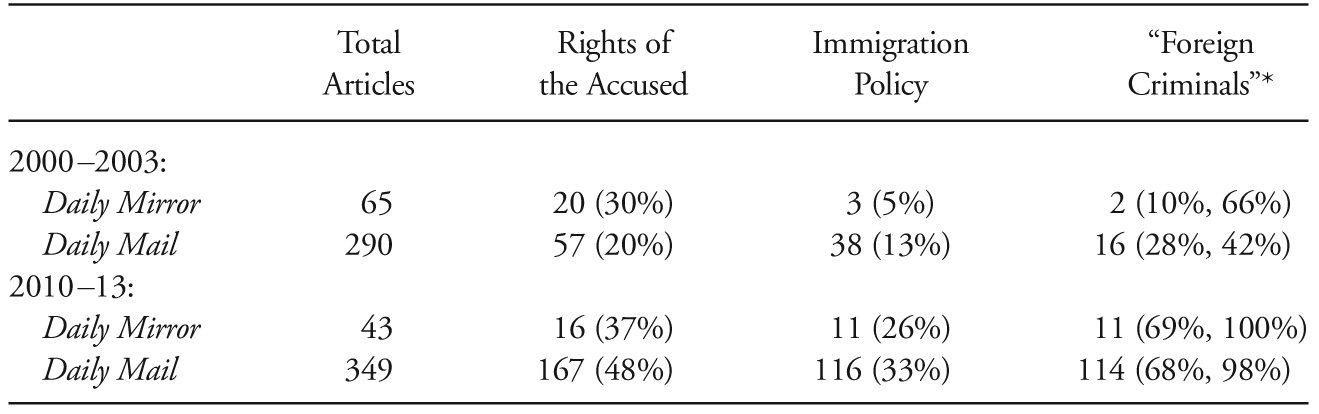
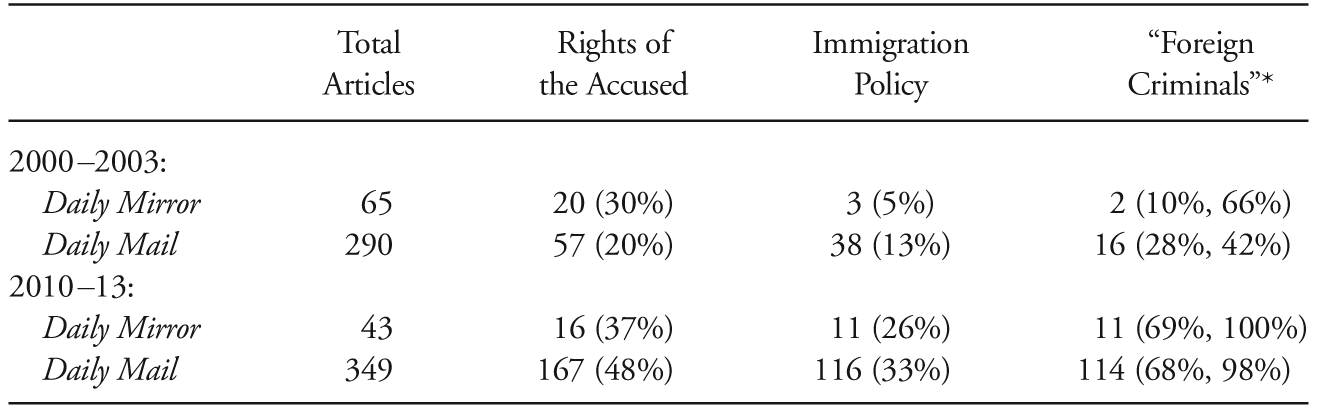
In the first stage of coding, I identified the dominant topical focus of each article.Footnote 3 The HRA is invoked in relation to dozens of different policy areas, and so if there are patterns in the way the media link the HRA to some issues more than others, those patterns reveal important framing of the act. A number of articles took the form of a general discussion of the ways in which the HRA was affecting the balance of power in Britain and, in the later period, the question of whether or not the act should be repealed. However, the overwhelming majority of articles in the data set discussed a particular case in which an individual had used the act to make a claim. Among these articles, by far the most common topical categories were the rights of the criminally accused and the rights of noncitizens (see tables 1 and 2). The remaining articles fell into a wide range of topical categories, with a only a few articles each devoted to the rights of same-sex couples, freedom of the press, the right to die, the privacy rights of celebrities, military protocol, public school administration, the rights of adoptive parents, the quality of public housing, and the actions of child protective services.
Topical Coverage of the Human Rights Act
Source.—Keyword search in LexisNexis using “Human Rights Act” AND “court.”
*. The first number in the parentheses is the percentage of accused and the second the percentage of immigration.
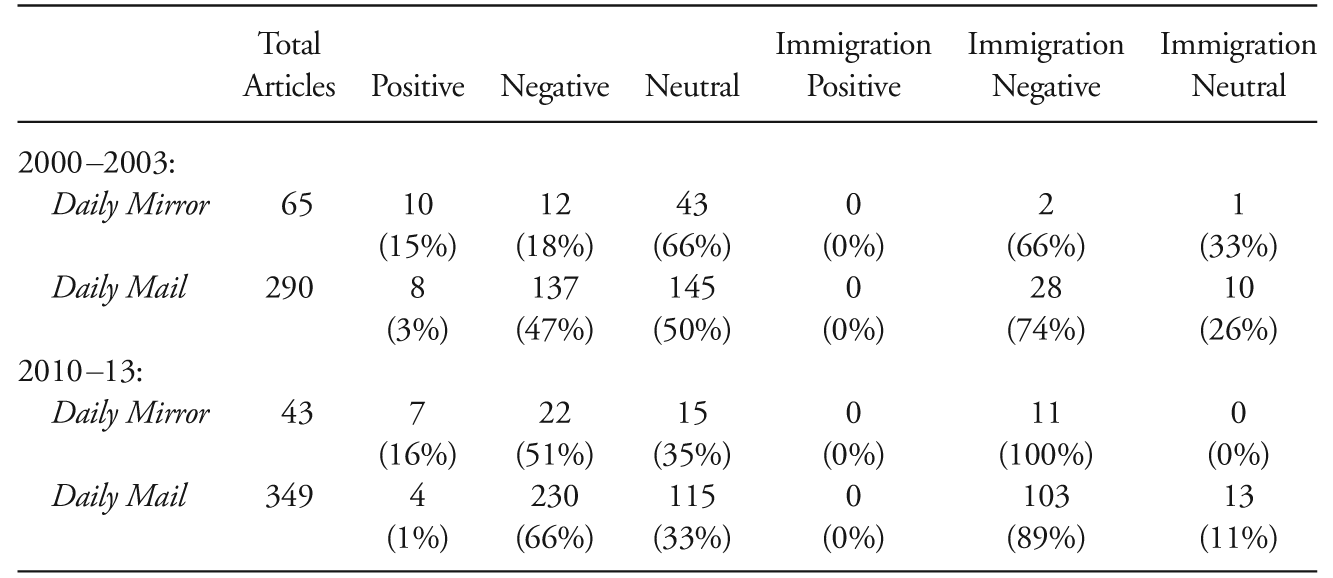
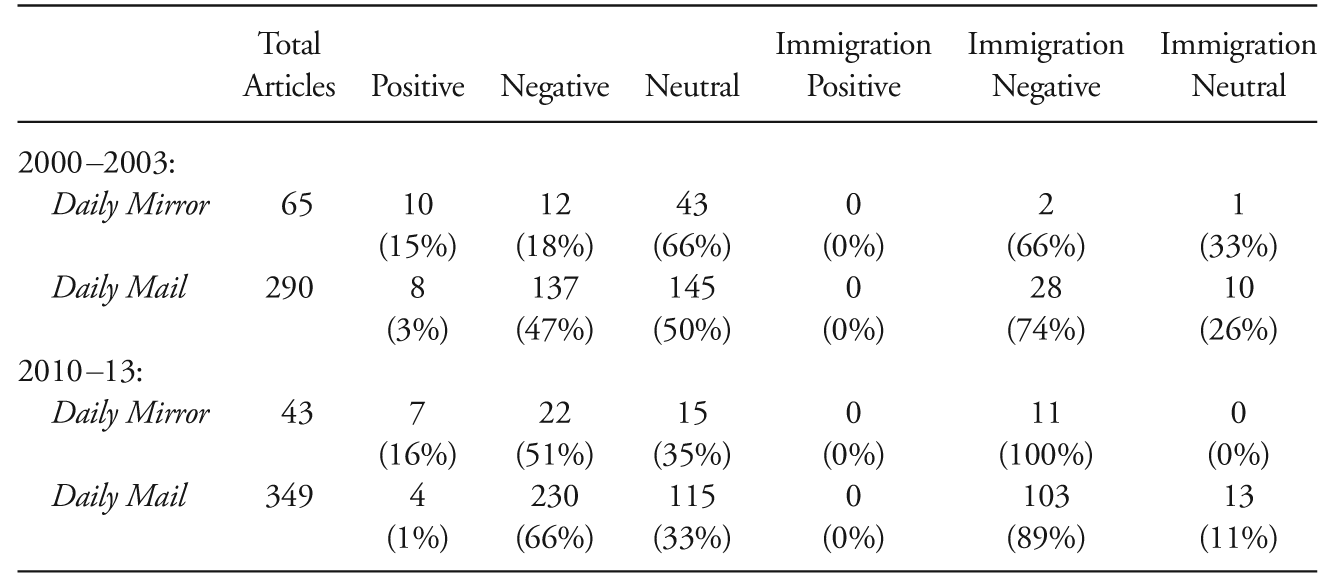
Media Coverage of the Human Rights Act
Source.—Keyword search in LexisNexis using “Human Rights Act” AND “court.”
The second stage of coding involved a qualitative assessment of the tone of each article’s portrayal of the HRA. Articles were coded as positive if they defended the act or suggested that it had benefited the country. These articles usually took the form of an op-ed by an advocate. Articles were coded as negative if they explicitly criticized the act or discussed the high financial cost of the act. Many of these articles were editorials. Articles were coded as neutral if they described the act with no editorial comment, even if they reported on a public figure criticizing the act. For example, an article that described the Home Secretary’s outrage about a case in which a noncitizen with a criminal record was “allowed to stay in the UK under the Human Rights Act” was coded as neutral because it did not independently decry the outcome as appalling, scandalous, and so forth. Some scholars take a more narrow view of neutral reporting and would code reporting of criticism as negative in tone, even if it does not include explicit editorializing (see, e.g., Baumgartner, DeBoef, and Boydstun Reference Baumgartner, DeBoef and Boydstun2008). In this study, because I am analyzing tabloid media, which use an editorial slant in the vast majority of articles, I take a broader view of neutral reporting. My approach may therefore lead to an undercount of articles that readers could perceive as emitting negativity about the HRA.
I did not distinguish in my coding between the various legal statuses that noncitizens can possess, for both practical and conceptual reasons. News coverage rarely provides that kind of information, instead using seemingly general terms such as “migrant” or “foreigner” that do not indicate legal status or using terms such as “illegal immigrant” to refer to a wide range of people, including asylum seekers, whose statuses are in flux. I treat all noncitizens as a common category in this analysis because news coverage, whether deliberately or inadvertently, often conflates noncitizens of various statuses, thus erasing the official legal distinctions between them in the public eye.
Tracing the Development of Judicial Power and Immigration Law
Under the HRA, immigration politics and constitutional development have collided, inspiring a popular backlash against the act. I trace this collision here by outlining two significant shifts that occurred simultaneously in the post–World War II era, one regarding the fundamental structure of British parliamentary democracy and one regarding the basic makeup of the British population. The foundations of constitutional change were not connected to migration policy when they were conceived. In fact, these changes occurred quite separately from one another, and courts did not play a role in immigration politics for many decades. But as judicial empowerment gained momentum, it collided with the increasing reality of mass migration to the United Kingdom. Today, judicial enforcement of noncitizens’ rights is at the center of a very public debate about the future of British constitutionalism.
Although the United Kingdom has not traditionally considered itself to be a nation of immigrants, it has experienced a remarkable demographic shift due to massive, generally unwanted, migration. In 1945, Britain had a mere 30,000 nonwhite residents in a country of 49 million people. After the war, migrants began to arrive from the Commonwealth, and though they had Commonwealth citizenship, many were still subjected to immigration controls (Karatani Reference Karatani2003). Despite political resistance to continuing migration, by 2011 13% of residents were born outside of the United Kingdom.Footnote 4 Further, the nonwhite population had grown 100-fold in 60 years, to more than 5% of the British population. While being nonwhite is not synonymous with noncitizenship—some immigrants in the United Kingdom are white and many nonwhite residents are British citizens born in the United Kingdom or the Commonwealth—dramatic racial shifts have been driven by, and are associated with, migration.
Immigration politics in the United Kingdom is highly restrictionist and centralized, based on legislation passed by Parliament rather than Home Office regulations, and with little involvement from civil society groups or migrant advocacy organizations (Hansen Reference Hansen2000; Schain Reference Schain2012). In 2010, 59% of British people said that Britain let in too many immigrants, and during the 20th century, public resistance to immigration was held consistently across the political spectrum so that, as Schain has put it, “conflict between parties over immigration is not conflict about basic policy, but enforcement of policies about which they generally agree” (180). This policy uniformity relied heavily on a system of parliamentary sovereignty in which there was almost no judicial involvement in immigration matters.
The United Kingdom does not have a written constitution, and its constitutional law prioritizes the preservation of parliamentary sovereignty. According to this core principle, Parliament can do “everything that is not naturally impossible” (Leyland Reference Leyland2007, 37; quoting Sir William Blackstone), and the British constitution is “no more and no less than what happens” (Griffith Reference Griffith1979, 19). As flippant as these characterizations may sound, foundational British constitutional scholar A. V. Dicey consistently asserted that rights will be protected in the United Kingdom because the people control Parliament and will not accede to a Parliament that acts to take away their liberties. Under this common law system, courts can interpret statutes and, in doing so, place some limits on government actors, but their decisions can be overridden by later legislation, and they lack the power to overturn acts of Parliament.
Because British courts have traditionally been highly limited in their power, in 1915 Dicey claimed that there was no such thing as English administrative law (Hickman Reference Hickman2010, 12). The few immigration decisions in the early to mid-20th century supported that claim by exhibiting a strong deference to administrative decisions regarding deportation. For example, in R. v. Inspector of Leman Street Police Station, ex p. Venicoff (1920), the Divisional Court concluded that the Home Secretary had broad discretion to order deportations without a hearing and that this practice did not violate the common law principle of natural justice (Legomsky Reference Legomsky1987, 38).
While parliamentary sovereignty is still the foundation of British constitutional law, the growth of an administrative state and transnational legal institutions have unequivocally undermined parliamentary sovereignty since the mid-20th century. British administrative law developed very slowly at first, maintaining a strong presumption of deference known as the Wednesbury unreasonableness standard after the foundational case Associated Provincial Picture Houses Ltd. v. Wednesbury Corporation (1948). In that case, the House of Lords concluded that a decision by a government agent could be struck down only if a court found it to be so illogical or outrageous that no reasonable person would make it. The Wednesbury unreasonableness standard remains the touchstone of British administrative law, but by the mid-1960s, it had already loosened somewhat from its original form. Disenchantment with Parliament’s limited oversight of administrative behavior led courts to begin using rights frames for criticizing governance practices (Waltman Reference Waltman and Holland1991; Sterret Reference Sterret1997, 45). For example, in Ridge v. Baldwin (1964), the Lords found that by not providing an officer with a hearing before he was fired, the Brighton police commission had violated natural justice. This ruling reversed a long-standing doctrine that courts would not apply the natural justice principle to administrative decisions. Thus, judicial review of administrative decisions expanded from a purely procedural notion to a means through which courts examined “the substantive correctness of government decisions” (Epp Reference Epp1998, 119).
By contrast, the subset of administrative law dealing with immigration policy lagged behind, as rights frames that were applied to citizens were not extended to the immigration context. For example, in R. v. Governor of Brixton Prison, ex parte Soblen (1963), the Court of Appeal found that while one should generally have a hearing before being deprived of liberty or property, immigration cases were an exception to this rule because of national security considerations (Legomsky Reference Legomsky1987, 39). Even into the 1970s, as judicial oversight of other administrative behavior grew, immigration law remained a bastion of judicial deference.
The late 1970s ushered in a period of rapid legal change, where the realities of mass migration and the development of administrative law began to interact. The Labour government had established a commission of legal experts in 1965, who called for a full review of Britain’s extremely complex and arcane system of administrative law. This move eventually prompted the Lord Chancellor—Britain’s highest legal officer—to implement Administrative Order 53 in 1977, making it easier to apply for judicial review of an administrative decision (Sterret Reference Sterret1991, 753). Because Order 53 coincided with an increase in the number of immigrants applying for residency in the United Kingdom and new legislative efforts to restrict entry, it led to a “dramatic increase” in the number of cases that received judicial review (Sterret Reference Sterret1991; Epp Reference Epp1998, 119). By the mid-1980s, applications for review of immigration decisions had reached 30% of the caseload at the High Court, the first level of the appeals court system (Sterret Reference Sterret1997, 159).
This spike in judicial attention to immigration matters did not trigger much jurisprudential change, however. Immigration decisions in the 1970s and 1980s exhibited a “strong judicial conservatism” and a “marked preference for literal interpretation” (Legomsky Reference Legomsky1987, 80). Sterret’s study of immigration decisions in the 1980s concluded that “victories are small. They do not overturn the immigration rule but allow one client to stay in the country, sometimes only for a limited time” (Reference Sterret1997, 13). Indeed, the fact that the House of Lords made only eight decisions regarding noncitizens between 1970 and 1989 illustrates just how narrow these lower court cases were; they did not contain the larger ramifications that led to review by the highest judicial body.Footnote 5
Despite the judiciary’s reluctance to get involved in immigration policy, by the 1970s, the influence of international human rights law served as another vehicle for increased judicial attention to the rights of noncitizens. Britain ratified the 1950 European Convention on Human Rights in 1953, which it had been deeply involved in drafting. In 1966, Parliament granted individuals the right to bring cases to the ECHR in Strasbourg (Bogdanor Reference Bogdanor2005, 87). However, the meaning of favorable decisions was unclear, since a British court had not found the right, and legal scholars were divided about how international law was to be incorporated into the common law (Hunt Reference Hunt1997, 11). Hunt’s exhaustive study of British judicial consideration of international law found that by the mid-1990s, UK courts had “modified the premise of parliamentary sovereignty in significant respects” (44). While he makes no mention of the striking trend, his database of 473 cases that mention unincorporated international law treaties includes 112 with the topic of immigration, by far the largest policy topic in his data set (app. 1, 325–76). The ECHR contains several textual hooks that immigrants could use to make claims, including the article 8 right to family life and the article 3 prohibition of torture and inhumane or degrading treatment. This integration was further facilitated in 1993 when Parliament incorporated the 1951 United Nations Convention on the Status of Refugees into domestic law via the Asylum and Immigration Appeals Act, which includes specific rights protections for immigrants who request refugee protection.
Also in 1993, the House of Lords issued “a highly significant” decision in the case of M v. Home Office (Leyland Reference Leyland2007, 58). M was deported before he could appeal the denial of his asylum claim, even though a court had ordered the Home Secretary not to do so. The Lords ruled that government ministers must follow court orders and held the secretary in contempt. This case has become canonical in the general study of British separation of powers and is significant in establishing that, unlike earlier rulings, immigration decision making was not to be carved out as a separate area with lower procedural justice standards. Thus, by the time the HRA was passed in 1998, British immigration law had begun to shift toward a more rights-oriented framework, and immigration cases had become a major driver of the integration of international law. The groundwork had been laid for a major collision between the areas of judicial power and mass migration. Immigration cases had increased to the point of almost dominating lower review courts, and lawyers were invoking international human rights law in service of their noncitizen clients, albeit with little success.
Meanwhile, a domestic rights consciousness had developed. Epp (Reference Epp1998) concluded that despite Britain’s lack of a bill of rights, its long-standing doctrine of parliamentary sovereignty, and the general conservatism of the Judicial Committee of the House of Lords, the United Kingdom had experienced a “modest rights revolution” in some areas during the 1970s and 1980s (132). During the Thatcher era, academics’ and lawyers’ discontent about accountability in British politics began to raise questions about the need for a bill of rights for the first time (Sterret Reference Sterret1997, 91; Erdos Reference Erdos2010). A left-wing organization called Charter 88 was formed that called for a bill of rights, and the concept gained support from the United Kingdom’s major civil rights groups, such as JUSTICE and the National Council for Civil Liberties (now called Liberty), as well as the new Liberal Democrat Party. Then, after a 17-year period in opposition, the Labour Party came back into power.
Labour’s rise to power in 1997 was a pivotal moment for British constitutional law, one in which the Diceyan focus on parliamentary supremacy experienced a series of significant blows (Bogdanor Reference Bogdanor2005; Norton Reference Norton2011). Labour was trying to reinvent itself as a party of change and progress, and the negative experience of being in opposition for so long motivated the party to embrace judicial empowerment, even though historically the British judiciary had been hostile to Labour interests (Erdos Reference Erdos2010). The HRA was a pillar of the “New Labour” agenda, which also included devolution of authority to Scotland and Wales, a shift of the House of Lords away from a hereditary model, and changes to the electoral system (Norton Reference Norton2011, 13). A Labour-controlled Parliament also passed the Constitutional Reform Act in 2005, creating a separate Supreme Court to replace the judicial committee of the House of Lords as the highest judicial body in the country. Taken together, these measures can be characterized as a “quiet revolution” through which the British constitution became dramatically more codified (Bogdanor Reference Bogdanor2005).
The HRA was “presented as a constitutional measure” that would modernize British politics and law by strengthening the culture of human rights (Klug Reference Klug1999, 247). It requires domestic legislation to be read consistently with the ECHR and public authorities to act compatibly with it. Home Office Minister Lord Williams promised that once the act was passed, “every public authority will know that its behavior, its structure, its conclusions, and its executive actions will be subject to this culture” (247). The power of British courts to review administrative decisions had already been expanding gradually since the 1960s. However, the HRA empowers judges to weigh multiple factors in bold new ways, asking whether the violation of Convention rights was proportionate to the ends, which is a much higher standard of review than Wednesbury unreasonableness.
Despite providing for some degree of judicial empowerment, the HRA attempts to preserve the notion of parliamentary sovereignty. It is statutory, rather than an entrenched constitutional bill of rights, and can theoretically be repealed by Parliament at any time. Further, while it grants courts the power to review acts of Parliament for compatibility with the ECHR, it does not extend that power to judicial review. If judges cannot read a statute in a way that conforms to the requirements of the Convention, they can only declare legislation to be incompatible with Convention rights, not strike the law down. These features have led some scholars to complain that the HRA is an “enfeebled version” of other nations’ human rights reforms (Marshall Reference Marshall, Jackson and Tushnet2002, 108).
A statutory bill of rights without judicial review was the result of calculated political compromise. Proponents of the HRA emphasized the ways in which it would encourage participatory democracy and create “a dialogue between the courts, parliament, and the executive about the meaning and effect of Convention rights” (Hickman Reference Hickman2010, 59). According to a representative from JUSTICE, the interest group knew it was “not going to get agreement on an entrenched model. It doesn’t sit with parliamentary sovereignty. That’s why the HRA was seen as a good model. It created a triumvirate model between the legislative, the executive, and the judiciary.”Footnote 6 Similarly, Francesca Klug, a high-profile defender of the HRA, argued that a bill of rights “often involves philosophical or quasi-political judgments that are better determined by elected representatives, with the courts acting as a check on the executive, rather than as a primary decision-taker or law-maker” (Reference Klug2007, 710; emphasis in original).
While the HRA was somewhat controversial at the time of its passage, its potential impact on immigration policy was not part of the controversy. None of the debates about the act touched on that topic. Instead, the focus was on the partial empowerment of domestic courts as an alternative to the Strasbourg Court. In the White Paper outlining its support for the HRA, the Blair government made this point explicitly: “Bringing these rights home will mean that the British people will be able to argue for their rights in the British courts. … Rights will be brought much more fully into the jurisprudence of the courts throughout the United Kingdom, and their interpretation will thus be far more subtly and powerfully woven into our law.”Footnote 7 The White Paper does not discuss noncitizens at all. It was only in the implementation of the act that the impact on noncitizens arose as a central source of opposition to it.
Tabloid Coverage of the Human Rights Act
Tabloid coverage of the Human Rights Act reveals some striking trends (see tables 1 and 2). First, the right-leaning Daily Mail covered the HRA much more frequently than the left-of-center Daily Mirror in both the 2000–2003 and 2010–13 periods. Second, the Mail increased its coverage over time, while the Mirror reduced coverage, revealing a growing interest in the HRA on the conservative side of the political spectrum and a lack of counternarrative in the leftist tabloid press. Third, the tone of coverage was consistently much more negative in the Daily Mail, but coverage became much more negative for both papers in the later time period. Fourth, the two most common topical codes across both papers in both time periods were the rights of the criminally accused and immigration policy. No other topical category comes close to having the same number of articles devoted to it.
Most significantly, these two topical areas overlapped heavily, especially as time went on. By the later time period, more than two-thirds of the coverage in the “rights of the accused” category focused on noncitizens who had been accused of crimes. This does not include people who were discovered to be living in the United Kingdom without proper documentation but who had committed no other crime. Rather, the articles in this category focused on noncitizens who had been charged with serious criminal offenses either abroad or after arrival in the United Kingdom. In fact, by the 2010–13 time period, 100% of the articles about immigration in the Daily Mirror and 98% of the immigration articles in the Daily Mail were focused on how these “foreign criminals” used the HRA to prevent deportation, access legal aid, and generally improve their circumstances. Further, none of the articles about immigration, across both papers and time periods, discussed the HRA in a positive light. From these general trends, I conclude that the HRA has become more controversial over time, and specifically, that controversy has been linked to the issue of Britain’s vulnerability to foreign criminals in the minds of the tabloid-reading public. There is no evidence that the left-wing media introduced a different narrative about the HRA to compete with the focus on foreign criminals in the right-wing paper. Indeed, albeit to a lesser extent, the Mirror also adopted the foreign criminal trope. I elaborate and explain these trends in more detail below.
From the beginning, the British media on both sides of the political spectrum interpreted the act as a negative development, focusing on the cultural shift it was sure to bring. Before the HRA went into effect, the Daily Mirror called it a “radical new rights law” that would be “a lawyers’ lottery bonanza.” The Daily Mail used more inflammatory rhetoric, warning that the act would usher in a “self-indulgent” “compensation culture” benefiting only “money-grubbing lawyers and their querulous clients.” On the day the act went into effect, the Daily Mail’s editorial page announced the arrival of “a new tyranny of human rights,” suggesting that “politically-correct lunacy could become almost routine.” The editorial went on to conclude, “One thing is certain. This country is on the verge of an unwanted revolution that will reach into every corner of society.”Footnote 8
As the 2000–2003 period progressed, however, the left- and right-leaning papers began to diverge in their coverage of the act. The Daily Mirror published shorter articles describing cases brought under the HRA. While these articles were presented without editorializing, frequently the people using the act were unsympathetic, such as prisoners. For example, the Mirror covered use of the HRA to protest life sentences, to challenge the ban on prisoner voting, and to claim violations of parolees’ privacy (Don Mackay, “Pervert Bids for ‘Right’ to Be Freed,” Daily Mirror, December 17, 2001). During this time period, only three Daily Mirror articles mentioned anyone’s citizenship status or discussed immigration policy.
By contrast, the Daily Mail did not temper its hostility to the HRA over time and frequently characterized the act as foreign. For example, the Mail often referred to it as the “European Human Rights Act” (not its proper title) and several times referred to it as “a European law.” During this period, 13% of Daily Mail articles were about how the act benefited noncitizens, and 74% of those were explicitly negative, while the rest were classified as neutral. Like the Mirror, the Mail often focused on how the HRA was benefiting prisoners, but the Mail also frequently referred to the ways in which the HRA was helping “gays” or foreigners (Steve Doughty, “Be Biased in Favour of Gays Judges Are Told,” Daily Mail, December 15, 2000). Sometimes, the themes of homosexuality, immigration, and criminality were woven together, as in this headline: “He Has AIDS and Convictions for Drugs and Violence. But the Asylum Seeker Has a Human Right to Be in Britain, Says a Judge” (October 25, 2000).
Sometimes, the Mail explicitly connected the erosion of parliamentary sovereignty to the HRA’s impact on border control. In an editorial entitled “Who Cares about the Majority?” (August 1, 2000), the Mail wrote,
So democracy in Britain has sunk to this. Two dangerous Sikh terrorists must be allowed to stay in this country, even though their presence threatens the public interest and our elected Government is desperate to be rid of them. … But public opinion no longer matters one jot. Under the European Convention of Human Rights, these thugs can’t be sent back to India, Britain is obliged to offer hospitality to such undesirables and there isn’t a thing the Government, Parliament or the rest of us can do. And this is just a foretaste of the appalling consequences flowing from New Labour’s crass decision to incorporate the Human Rights Convention into British law.
Despite this editorial fervor, several high-profile cases during the early implementation period suggested that the HRA’s jurisprudential impact might be quite limited. First, in Brown v Stott (2003), the law Lords concluded that the HRA merely provided domestic remedies under international law equivalent to those previously provided by Strasbourg. In other words, they found that the HRA had not created new domestic constitutional rights. Further, the HRA did not affect the stalemate between the ECHR and the United Kingdom over its ban on prisoner voting. In R (Ullah) v Special Adjudicator (2004), the House of Lords interpreted section 2 of the HRA, which says that British courts should take Strasbourg jurisprudence into account, to mean that courts should try to follow it. Then in 2005, though the Strasbourg Court found that the ban violated the ECHR and must be revised, Parliament refused to implement a change (Hirst v. United Kingdom (2) [2005] ECHR 681).
Despite this evidence of continuing parliamentary authority, in the area of noncitizens’ rights, even modest assertions of judicial power had major political ripple effects. In 2002, Lord Chief Justice Woolf stated in a public speech that it was the duty of the judiciary to protect human rights for unpopular minorities such as asylum-seekers because “the temporary unpopularity of the judiciary is a price well worth paying if it ensures that this country remains a democracy committed to the rule of law” (Arifa Akbar, “Judges Will Protect Minorities,” Independent, October 16, 2002). Woolf’s suspicion that judicial promotion of noncitizens’ rights would cause a political backlash was prescient. After an administrative court found that section 55 of the 2002 Nationality, Immigration, and Asylum Act, which required that applications be made in a timely fashion, was being interpreted in a way that violated the ECHR, Home Secretary Blunkett attacked the decision publicly (R (Application Q) v. Secretary of State for the Home Department [2003]). His statement that “frankly, I’m personally fed up with having to deal with a situation where parliament debates issues and the judges then overturn them” broke a long-standing norm that ministers should not publicly criticize judicial decisions made against them (Elizabeth Pane, “Blunkett to Appeal Asylum Decision,” Daily Mail, February 20, 2003). The most notable aspect of this confrontation is that Blunkett was a cabinet member of the government that had passed the HRA, yet only 2 years after its implementation was openly decrying the way in which British judges were interpreting it.
Labour’s commitment to the HRA had clearly been strained. As one interviewee put it, “Blair almost acted as if it hadn’t been an initiative of his own government. 9/11 was a part of that. Things changed, and the media attacked the Act.” Another interview subject made a connection between Labour’s stance on the act and its use in favor of certain groups: “Labour quickly played into a populist critique of the Act when courts issued declarations of incompatibility for terrorists, prisoners, and asylum seekers. Opposition within the Labour party didn’t like the outcomes of decisions for unfavorable groups.” Nevertheless, the Labour-controlled Parliament revised section 23 of the 2001 Anti-Terrorism, Crime, and Security Act when the House of Lords held that the indefinite detention of foreign prisoners without trial was incompatible with the ECHR (A and others v Secretary of State for the Home Department [2004]; Leyland Reference Leyland2007, 177).
Public concern about the imposition of European rights onto the United Kingdom made the HRA a major issue in the parliamentary elections of 2010. Conservative Party leader David Cameron vowed to replace the legislation with a British Bill of Rights that would limit the power of international courts and develop a homegrown rights jurisprudence, calling the HRA “a glaring example of what is going wrong in our country” (James Kirkup, “Increasing Use of Human Rights Act to Escape Deportation,” Telegraph, May 20, 2010). This framing of the issue is ironic in light of the fact that a decade earlier, the Labour Party had sold the HRA as a redomestication of rights protection. However, Labour did not defend its act during the campaign, leaving that task to the Liberal Democrats. Ultimately, when the Conservatives were forced to form a coalition government with the Liberal Democrats, the Tory pledge had to be put on hold. Thus, the HRA continued to be a source of much controversy and debate for the entire 2010–13 period.
Media coverage of the HRA was markedly more negative in both newspapers during this later period. The percentage of Daily Mirror articles that were openly critical of the HRA shifted from 18% in the earlier period to 51%, though total coverage declined; so the number of negative articles per year increased only slightly. Daily Mail coverage in the later time period increased and became more negative, so that the raw number of negative articles went up from about 45 per year to about 75, and the proportion of articles with openly negative coverage grew from 47% during the 2000–2003 period to 66% in 2010–13. In both papers, the focus shifted noticeably away from criticism of Parliament for passing the act to criticism of judicial interpretation. Once the coalition government took over, the Parliament that passed the HRA no longer existed. Additionally, by 2010 a substantial body of case law interpreting the act had developed, creating fodder for media criticism. For example, to mark the 10-year anniversary of the HRA, the Daily Mail published a long analytical piece entitled “The Judges Are Stealing Our Freedom” (July 25, 2010), which concluded, “A revolution is under way in Britain. Power is shifting from elected politicians to unelected judges. Britain is losing its parliamentary democracy and replacing it with a new form of aristocracy: let’s call it ‘juristocracy.’” The piece argued that the HRA and the establishment of a Supreme Court in 2009 had shifted the United Kingdom toward an American style of law, an observation that was not meant as a compliment. Meanwhile, in another unflattering comparison to the United States, an interview subject described right-wing opposition to the HRA as “Tea Party madness!”
While earlier coverage of the HRA had frequently discussed immigrants and criminals, by 2010, it had linked these two topical streams into one, focused on how the HRA made deportation of criminal immigrants more challenging. In the 2010–13 period, 26% of Daily Mirror articles were about the HRA’s aid to foreign criminals, and 100% of those were negative in tone. For example, a typical headline for the period was “Untouchable: 102 Foreign Offenders UK Can’t Deport Because of the Right to a Family” (by Victoria Murphy, June 13, 2011). The article’s opening sentence was “Violent foreign criminals and illegal immigrants are avoiding the boot from Britain because of frustrating human rights laws.” In the Daily Mail, 33% of articles were about foreign criminals, and 89% of those were negative. The remaining 11% reported on immigrants winning the right to stay in the United Kingdom thanks to the HRA but were coded as neutral because they did not editorialize alongside the reporting.
The right-wing Mail built an ongoing negative narrative focused on foreign criminals, to which there was no real counternarrative in the Mirror. Both papers engaged in some degree of conflation between criminals and immigrants, though the Daily Mail was more inflammatory. As one article put it, “In many cases, dangerous offenders were granted the right to stay despite the courts accepting that they pose a risk to the public. Among those to have taken advantage of the Human Rights Act to stay here are killers, rapists, serial burglars and drug dealers” (Jack Doyle, “One Foreign Criminal a Day Wins Right to Stay in Britain,” Daily Mail, August 16, 2010). Articles never failed to blame the HRA. In fact, in Murphy’s article, the Mirror reported (not totally accurately) that because the HRA “takes precedence over other British laws,” it is used to prevent the deportation of criminals. A typical Daily Mail article bemoaned the power the HRA gave to judges: “Incredibly (or perhaps all too predictably), the judge yesterday granted their appeal against deportation, giving them permission to remain in the Britain they want to destroy. There are no prizes for guessing which statute we have to thank for this perversity.”Footnote 9 Another article lamented, “Underpinning the whole, rotten edifice is the pernicious yuman rites Act [sic], which releases violent criminals to walk the streets and prevents Britain from deporting foreign terrorists, murderers and drug smugglers” (Richard Littlejohn, “Justice Stabbed in the Heart,” Daily Mail, November 26, 2010).
A case that captured particular media attention in both papers was that of Abu Qatada, a so-called “hate preacher” with alleged ties to Al-Qaeda (James Lyons, “Mayday: After Two New Border Bungles, Home Secretary’s Get Tough Fiasco,” Daily Mirror, April 9, 2012). The United Kingdom tried to deport him to Jordan, but he claimed that he would be tortured if returned, which is barred by article 6 of the ECHR. While this claim was successful at the Court of Appeal, in 2009 the House of Lords found him to be deportable. The saga continued as the Strasbourg court ruled that his deportation would violate the ECHR. Finally, in 2013, the British and Jordanian governments signed a treaty arranging for Abu Qatada’s deportation and stipulating conditions of his subsequent treatment. Throughout this decade-long controversy, the British media expressed constant frustration at the fact that the ECHR was being used to prevent deportation of a national security threat. While the unpopular Strasbourg ruling was not connected to the HRA, the tabloids regularly and inaccurately blamed the act for Abu Qatada’s continuing presence in the United Kingdom.
Aside from the Abu Qatada drama, coverage of the HRA began to home in on article 8, the right to family life, after it was used to prevent the deportation of an undocumented immigrant who hit and killed a 12-year-old girl with his car. Mohammed Ibrahim was a failed asylum seeker from Iraq who had never been deported. After the hit-and-run, he asked for relief from deportation because he was married to a British woman and had two British children. The immigration tribunal found that deportation would deprive him of his article 8 right to family life, and he was allowed to stay. The girl’s father called the decision an “abomination to civilized society,” and David Cameron wrote to him, “promising reforms that would ensure ‘that rights are better balanced against responsibilities.’” By 2011, the Mail reported that “the Home Office has confirmed that the ‘right to a family life’ has become the number one excuse used by convicts successfully blocking removal from the UK. It has overtaken the usual claim submitted by illegal immigrants and overseas criminals that they face ill-treatment at home.”Footnote 10 While the hit-and-run driver’s case had no larger legal ramifications, it was symbolically significant and was used by the press and by Cameron as a touchstone for outrage about the HRA.
During the entire 2010–13 period, there were only two articles reporting on cases of immigrants who were not criminals. For example, in October 2011, the Supreme Court decided that an immigration rule restricting spousal visas for people under 21 years old violated article 8 (Quila & Anor v. Secretary of State for the Home Department [UKSC 45] October 12, 2011). This decision was more jurisprudentially significant than the hit-and-run case, and media coverage was highly critical. The Daily Mail reported that the ruling was “the final proof that, at present, it is the judges and not MPs who are running Britain and deciding who should and should not be let into the country. That is hardly good for democracy” (James Slack, “It’s MPs We Elect to Run Britain,” Daily Mail, October 13, 2011).
Perhaps in response to relentless critiques from both the press and the government, in mid-2011, the Judges’ Council of England and Wales chimed in to emphasize their helplessness in the face of requirements that they review immigration decisions. They wrote a public letter to Justice Secretary Kenneth Clarke, reporting that “out of 12,500 judicial review claim forms issued in the Administrative Court in 2010, about 7,500 concerned asylum or immigration. The claims have been considered—and dismissed—by the Secretary of State and at least one immigration tribunal, making the judicial review a ‘second or sometimes the third or fourth bite of the cherry.’” The judges went on to say that “most claims fail, most of the claims which fail are without merit, and many are wholly abusive of the court’s process.” Reporting on this letter, the Mail added that “in the overwhelming majority of cases, they are using the controversial Article 8” (James Slack, “Judges in Scathing Attach on the Abuse of Migrant Appeals,” Daily Mail, June 20, 2011). This incident is a perfect example of media amplification; the judges’ letter had been emphasizing the baselessness of most immigration claims, and the fact that most noncitizens are unsuccessful. Ignoring that fact, tabloid news coverage of the letter portrayed it as evidence that the HRA was being used to expand the rights of noncitizens.
While the Mail had been consistently calling the HRA “Labour’s Human Rights Act” for years, in mid-2011, media coverage began to turn critical of Prime Minister Cameron. For example, the Mail reported with frustration that “in opposition, David Cameron was one of the most articulate voices about how the egregious Human Rights Act and the European Court of Human Rights had driven a coach and horses through our ability to police our own borders. Yet, in order to keep his Liberal Democrat coalition partners happy, he has cravenly disregarded plans to replace the Act with a British Bill of Rights. At the same time, the European Court in Strasbourg has been scandalously allowed to assume more power over British life” (James Slack, “Cameron Vowed to Fix This: So Why Has He Gone Quiet?” Daily Mail, June 30, 2011).
Conservative Home Secretary May went on the offensive, attacking judges’ interpretations of article 8. She gained a lot of traction criticizing a particular case involving a Bolivian immigrant, which the media dubbed Cat-gate. A judge had suspended the man’s deportation, because (among other reasons) he and his partner had jointly adopted a cat, which the judge concluded was proof that he had established a family life in the United Kingdom (James Slack and Jason Groves, “Theresa and Ken’s Catfight: Clarke Outburst Wrecks May’s Big Speech on Human Rights,” Daily Mail, October 5, 2011). At the urging of Secretary May, in 2012, Parliament passed a resolution issuing guidelines to judges faced with article 8 cases. The guidelines suggested that noncitizens convicted of a crime with a sentence of more than 4 years should be deported regardless of their family ties to the United Kingdom. Home Secretary May made the following statement: “For too long the rights of foreign criminals have been placed above the rights of the British public. … The British public’s right to protection from crime trumps a foreign criminal’s weak claim to family life. … We trust the courts will give due weight to a statement from this House” (James Slack, “Stop Giving Foreign Criminals a Right to Stay in the UK, Says MP,” Daily Mail, June 20, 2012). While this resolution was nonbinding, Conservatives in Parliament could point to it as a clear message to the judiciary to be more conservative in its interpretation of the ECHR.
Around this time, Cameron began to renew talk about replacing the HRA with a British Bill of Rights. In response, Deputy Prime Minister Nick Clegg of the Liberal Democrats defended the HRA as good law. The Daily Mail editorialized, “Has Mr. Clegg ever tried asking voters if they want these Strasbourg-imposed laws, which guarantee the rights of foreign murderers and terrorist suspects to remain in Britain? Is he unaware of the legions of law firms, queuing up to exploit the foreign judges’ rulings on everything from voting rights for British prisoners (resoundingly rejected by our own Parliament) to Somalian killers’ entitlement to asylum and a ‘family life’ in the UK?” (August 27, 2011). This rhetoric clearly links the foreignness of the ECHR and the Strasbourg Court to the foreignness of its beneficiaries.
In February 2011, Cameron moved forward on his pledge to do something about the HRA. He formed a commission of leading experts in British and international law tasked with investigating the creation of a British Bill of Rights saying, “it’s about time we started making sure decisions are made in this Parliament rather than the courts” (House of Commons Debate, vol. 525 col. 955, February 16, 2011). Cameron’s assumption seemed to be that a domestic bill of rights would include fewer judicially enforceable rights protections. However, because the Conservative and Liberal Democrat leadership each appointed their own commission members, the body suffered from deep internal divides over whether it should be considering the possibility of nonadherence to the ECHR. Commissioners also differed over whether the Strasbourg Court had overreached itself. As a result, the final report was “a bizarre collection” of papers representing a “cornucopia of perspectives” (Elliott Reference Elliott2013, 139, 144). Two members of the commission opposed adoption of a domestic Bill of Rights, which they viewed as a “a path towards withdrawal from the European Convention” (32). However, the majority concluded that there should be a British Bill of Rights because the public would be less “alienated” by a domestic version, even if it protected the same rights as the ECHR (UK Commission on a Bill of Rights 2012, 29).
Some members of the commission believed that a domestic Bill of Rights could legitimately limit noncitizens’ access to judicial protection. For example, the final report included a draft “UK Bill of Rights” authored by Martin Howe, QC, which included a provision in article 26 stating that “it may be desirable carefully to consider whether some of the rights which are more civic in nature ought to extend to non-citizens. In this regard it might be appropriate to make a distinction between non-citizens who are lawfully present in the United Kingdom and those who are not.” As the commission was so divided, no action was taken at the time. Meanwhile, the Mail continued to remind its readers of the HRA’s connection to Europe, such as in a commentary entitled “Dozens of EU Human Rights Are Smuggled into the UK” (November 13, 2013). This headline simultaneously conveyed the two major themes of anxiety about the HRA that emerged in the tabloid press: foreign criminals smuggled into the United Kingdom as a result of lax border control and the illegitimacy of foreign laws influencing domestic policy.
Discussion
The HRA has affected British government on multiple levels. According to some observers, it has enhanced “both the ability and willingness of the courts to intervene to uphold fundamental constitutional principles” and has “given parliament and the Government added incentives to take Convention rights seriously” (Kavanagh Reference Kavanagh2009, 420). Parliament has been quite responsive to judicial declarations of incompatibility; with the exception of prisoner voting, it has amended the offending legislation each time courts have found incompatibility with the HRA (Human Rights Joint Committee 2015). Constitutionalization of the HRA seems also to have affected the civil service. According to a 2006 study, court decisions referencing Convention rights had fostered an expanded rights consciousness among civil service decision makers (Feldman Reference Feldman and Norton2011, 79, 80).
Meanwhile, as the HRA has grown more embedded into British law, public hostility to the act seems only to have increased and has taken a xenophobic and populist tone. The government has done little over the years to educate the public about what it can do for them. This silence has opened the doors for the right-wing tabloid press to invent “a subtitle to the Act in the public’s mind which reads ‘Human Rights for FTPs: foreigners, terrorists, and pedophiles, law abiding citizens need not apply’” (Klug Reference Klug2007, 714). While many Conservative members of Parliament were initially concerned about the HRA’s impact on parliamentary sovereignty rather than border control, the UKIP party has introduced new forms of resistance to the HRA. In the 2013 local elections, UKIP came third in the nationwide vote share and won many local races (Simon Walters, “A Great Day for British Justice,” Daily Mail, March 3, 2013). The UKIP victories led Cameron to tack to the right, playing up the issues of border control and Euro-skepticism in an attempt to prevent Conservative voters from defecting to the UKIP. Nevertheless, the UKIP garnered 12.6% of the national vote in the 2015 elections, a rate that was 9.5% higher than in 2010 (http://www.bbc.com/news/election/2015/results). Owing to the restrictions of the British electoral system, UKIP has only one seat in the House of Commons and three members of the House of Lords who are defected ex-Conservatives. Nevertheless, the Conservative Party is under threat from the far right (Ford and Goodwin Reference Ford and Goodwin2014).
Once the Conservative Party won a majority in Parliament in the May 2015 elections, replacing the HRA with a British Bill of Rights was again placed high on the party’s legislative agenda. However, the proposal immediately ran into some practical difficulties. First, repeal would not eliminate the authority of the Strasbourg Court and might even enhance it. Rather, the United Kingdom would also have to make the drastic move of leaving the Council of Europe. The Daily Mail reported that Cameron was considering this: “The Prime Minister said he would do ‘whatever it takes’ to ensure Britain can throw out people who pose a threat to the country and have no right to be here. Asked if the party is considering complete withdrawal, the Prime Minister said: ‘It may be that that is where we end up’” (James Slack and James Chapman, “May: I’ll Kick Out Illegal Migrants Before They Get a Chance to Appeal,” Daily Mail, September 30, 2013). Despite this rhetoric, the experts I interviewed were highly skeptical. One scholar explained, “The Foreign Office would go crazy. The AG would oppose it, and it’s not clear how it would even work. There is no precedent for membership in the EU without being a signatory to the ECHR.” Even those who support withdrawal have concerns about whether it is possible. A former member of the Bill of Rights Commission told me that he likes the idea in theory, “but a thousand ways have been knitted in to make it very difficult to undo. There is a growing dissatisfaction—what we have done? Is it too late? It depends how radical you want to be.” A June 2016 vote in favor of leaving the European Union does ease withdrawal from the ECHR, but there are other complications.
The second practical concern is whether a statutory Bill of Rights can be repealed after 16 years. Through repeated enforcement, the HRA has been entrenched into British law such that even repeal will not remove its mark. As one interviewee put it, “the thing is, if it is repealed, the Courts will just carry on. We can’t go back to the way it was before because of the common law.” Another said, “the HRA is referenced in so many statutes, what would happen to those? I don’t want to say it’s impossible just because it would be very difficult, but … .” As a leading expert on the British constitution predicted a decade ago, “to the extent that ministers and Parliament do uphold human rights, the Human Rights Act will, like the devolution legislation, take on the character of a higher law, something hitherto unknown in the British Constitution” (Bogdanor Reference Bogdanor2005, 89). Because political resistance to the HRA did not build up enough momentum for repeal until now, it may, for all practical purposes, be too late. Cameron has not admitted as much publicly, but talk of repealing the HRA faded from his agenda in 2016.
The impracticality of repeal and withdrawal from the Council of Europe will not deter most opponents of the HRA. Instead, the tabloid press will continue to criticize the judiciary, highlighting decisions that benefit unpopular groups. The Conservative Party leadership will continue to issue symbolic statements providing guidance to courts on how to apply the HRA to noncitizens. Since judges do not operate in a vacuum, this method of soft constitutional amendment through popular outrage may lead judges to interpret the HRA less generously.
Conclusions
The increased role of British courts in enforcing rights predates passage of the HRA, but there is no doubt that it has led to more rights claiming, especially by groups at the margins of democratic politics. When it comes to noncitizens, the largest significance of this shift is not jurisprudential. Most of the rights claims made by noncitizens under the HRA are ultimately unsuccessful attempts to prevent deportation and are not cases with larger legal ramifications. British immigration law is still characterized by administrative deference, policy is still made by Parliament, and appeals rarely go to the Supreme Court.
Nevertheless, judicial involvement in these types of cases has become increasingly controversial over the years. Today, it is a central fault line of British politics, driven by three major currents of opposition. First are concerns about the overreach of the Strasbourg Court and the belief that foreign, unaccountable bodies should not be making important decisions affecting Britain. Second are fears about the decline of parliamentary sovereignty, the hallmark of British politics. Third is reluctance to offer universal human rights protection to noncitizens, prisoners, and other politically unpopular groups. These three objections to the current state of British constitutionalization are conceptually separate but have become deeply interwoven in popular media and party politics. A uniquely British popular constitutionalism has emerged from this combination of mass migration and international human rights law. The movement is being pushed by the far right, and the Conservative Party must respond.
While the rights of the accused are often the cause of popular backlash against courts, the British case suggests that judicial enforcement of noncitizens’ rights is particularly anxiety provoking in the eyes of the public. Tabloid coverage of immigration eventually completely subsumed coverage of prisoners. When the press or a politician amplifies the impact of judicial decisions regarding noncitizens, even a few cases can stir up major outrage and resistance to constitutionalization. This resistance may lead to the repeal of the HRA and passage of a British Bill of Rights in the near future. If a British Bill of Rights is proposed, it will be compared to the ECHR, provoking a heated discussion of priorities. Inevitably, there will be a national conversation over which rights should be protected and for whom. A British Bill of Rights may not be dramatically different in its substance, but it may include rights restrictions for noncitizens. It could also lead to a major destabilization of British law, driven in large part by popular hostility to judicial enforcement of noncitizens’ rights, but with ramifications for all areas of law.
The UK case also reveals the volatile nature of interactions between popular constitutionalism and international law. The fact that the HRA is based on European law is a key component of public opposition to it. In this regard, backlash to judicial assertion of rights for unpopular minorities differs from the Warren Court story in the United States. There, the perceived judicial activism of the Warren Court was based on a belief that the words of the Constitution were being interpreted overly broadly. There was no disagreement about the legitimacy of the words themselves. In contrast, some opponents of the HRA view it as importing rights that are themselves foreign and do not represent the core values of the United Kingdom.
Immigration is a hugely contentious political issue, and courts around the world are making migration decisions with increasing frequency, sometimes relying on international legal instruments. Scholars of other migration destination states should explore the ways in which immigration politics, a politics that is often populist in nature, influences discussions of the legitimacy of judicial power and the reach of international human rights norms. Future research should also examine the degree to which judges are influenced by media amplification of their own power. In other words, studies should explore whether a popular constitutionalism that pushes judges to read international human rights law more parochially actually works. If so, that type of domestic resistance raises doubts about the durability of universal human rights.