Introduction
Marriage creates a world of shared meaning and experience from which it is difficult to disengage – a satisfactory marriage in our society provides a number of benefits, such as material support and care-giving and stable companionship. The permanent presence of a spouse, which might evoke negative as much as positive affect, is nonetheless vital in creating a secure and predictable environment (Jerrome Reference Jerrome, Bond, Coleman and Peace1993: 246).
The complex nature of late-life husband and wife relationships is increasingly recognised as an important factor contributing to healthy ageing. The long-term marriage relationship is highly relevant in terms of the health and the social, emotional, financial and practical needs of older people, yet the dynamics of this relationship remain poorly understood (Ray Reference Ray, Bernard, Phillips, Machin and Harding2000). The socio-environmental context of ageing, such as the role of neighbourhoods or physical environment, has been explored as an important determinant of health among older people (e.g. Phillipson et al. Reference Phillipson, Bernard, Phillips and Ogg1999). An equally important social context is that of marriage, which provides spouses with their primary source of social support and economic stability, and which in turn have been shown to be associated with physical health (Stimpson and Peek Reference Stimpson and Peek2005). Marital relationships have the potential to influence health, and the onset of ill-health in one spouse can in turn influence the relationship. There is strong evidence that the ways in which elderly couples mutually relate can have a direct influence on health and wellbeing, irrespective of co-existing factors such as education, income and age (Tower and Kasl Reference Tower and Kasl1996a).
Research on late-life marriage has to date tended to examine the influence of marital status per se as opposed to the nature of the marital relationship over time (e.g. Kiecolt-Glaser and Newton Reference Kiecolt-Glaser and Newton2001; Manzoli et al. Reference Manzoli, Villari, Pirone and Boccia2007), or to examine the burden of being a care-giving spouse (e.g. Seltzer and Li Reference Seltzer and Li2000), especially for a partner with cognitive impairment (e.g. Eloniemi-Sulkava et al. Reference Eloniemi-Sulkava, Notkola, Hamalainen, Rahkonen, Viramo, Hentinen, Kivela and Sulkava2002; Adams Reference Adams2006). Research on changes in health, as they impact on the couple, has typically focused on one spouse predominantly, not the dynamics within the relationship, and the impact on both spouses. Empirical studies of the dynamic interchanges involved in marital relationships require a dyadic approach, with data from both members of a couple (Goodman and Shippy Reference Goodman and Shippy2002). There is also the need to account for the interdependence of spouses' experiences in terms of data collection and analysis (Barnett et al. Reference Barnett, Marshall, Raudenush and Brennan1993), as by examining both individual-level and couple-level variables.
This systematic review is of published research into the dynamics of the relationship as perceived by both spouses, and therefore extends the established gerontological focus on marriage as predominantly a care-giving relationship. Although we accept that instrumental care is a very important aspect of late-life couple relationships, the topic has been well documented in several reviews (e.g. Walker, Pratt and Eddy Reference Walker, Pratt and Eddy1995; Dunkin and Anderson-Hanley Reference Dunkin and Anderson-Hanley1998; Torti et al. Reference Torti, Gwyther, Reed, Friedman and Schulman2004). To date, however, there has not been a synthesis of the literature on the broader dynamics of late-life couple relationships, or the factors which impact on spouses' health or on their relationships, using data from both members of the couple. This systematic review has identified and evaluated studies from many disciplines, including sociology, nursing, psychology, gerontology, public health and social work, and thereby makes a contribution to a better understanding of the dynamics of late-life couple relationships and their implications for health.
Methods
Searches were conducted using the online databases PubMed, Sociological Abstracts, PsychInfo, and CINAHL, using combinations of the key words: ‘spouse’, ‘marriage’, ‘husbands’, ‘wives’, ‘couples’, ‘aged’, ‘older people’, ‘elderly’, ‘satisfaction’, ‘marital satisfaction’, ‘interpersonal relations’, ‘marital relations’, ‘marriage/psychology’, ‘social support’, ‘health’, ‘depression’, ‘institutionalisation’, ‘nursing homes’ and ‘transitions’. To be included in the review, articles had to be peer-reviewed, available in English, to have studied populations aged 65 or more years, and have been published between 1990 and April 2007. Reference lists of key papers were also scanned for relevant studies that were missed by the electronic searches. An article was included if:
• the focus was primarily or extensively on exploring the complexity of older couple relationships in their own right (e.g. in terms of relationship dynamics and/or changes/transitions and/or health/health behaviours);
• the study examined data from both members of the marital dyad;
• the focus was on couples aged 65 or more years (demonstrated by the mean age of participants).
An article was excluded if:
• elderly spousal relations/behaviours were mentioned incidentally to a wider focus (e.g. on younger, middle-aged or all-age couples or wider family);
• the focus was primarily on one spouse, especially where this related to studies of care-giver burden, the experiences of wife/husband care-givers, or bereavement;
• it was an intervention study.
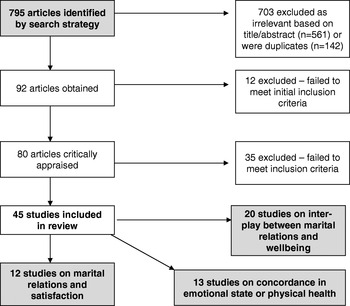
As can be seen in Figure 1, the initial searches in the online databases identified 795 citations. Most of the articles excluded were those which did not focus extensively on elderly couples or focused on one spouse predominantly (i.e. with a focus on care-giving burden). A total of 45 articles met the review criteria and were subsequently grouped into three broad thematic areas. These thematic areas derived from the main aims and terminology used in the papers. There were 12 papers on marital relations and satisfaction, 13 on concordance in emotional state or physical health, and 20 on the interplay between marital quality and wellbeing.
The identification of eligible studies for systematic review

Marital satisfaction and marital relations
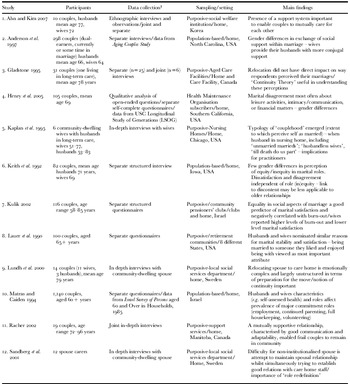
As people age, they purposefully narrow their social environments and place increasing importance on significant relationships (Carstensen Reference Carstensen1992; Acitelli and Antonucci Reference Acitelli and Antonucci1994). Although divorce rates are low and reports of satisfaction are high among couples in later life, challenges within the relationship are apparent. It is important to understand these challenges because marital problems have been linked to decreased physical activity and increased depression (Henry, Miller and Giarrusso Reference Henry, Miller and Giarrusso2005). The characteristics of the small number of studies focusing on relationship dynamics are summarised in Table 1. These studies have highlighted the factors contributing to marital satisfaction, including notions of ‘successful’ marriages (Lauer, Lauer and Kerr Reference Lauer, Lauer and Kerr1990; Henry, Miller and Giarrusso Reference Henry, Miller and Giarrusso2005), the division of roles and marital equality (Keith, Schafer and Wacker Reference Keith, Schafer and Wacker1992; Matras and Caiden Reference Matras and Caiden1994; Kulik Reference Kulik2002), and the provision of social support (Anderson, Earl and Longino Reference Anderson, Earle and Longino1997), all of which might change over time as couples negotiate shifting roles and expectations in line with transitions or illness.
Studies of marital relations and satisfaction

Notes: 1. All studies were cross-sectional (conducted at a single point in time), unless otherwise stated. ‘Home’ refers to people living in the community (not in institutions).
A United States survey of 100 couples resident in retirement communities in eight states found that the most important attribute contributing to marital happiness, reported by both husbands and wives, was being married to someone they liked and enjoyed being with (Lauer, Lauer and Kerr Reference Lauer, Lauer and Kerr1990). In addition, a sense of commitment to their partner and the marriage, a shared sense of humour and agreement on a wide variety of issues were also seen as important. Several studies, however, have highlighted areas that might prove a catalyst for disagreements or dissatisfaction in late-life marriages (e.g. Keith, Schafer and Wacker Reference Keith, Schafer and Wacker1992; Kulik Reference Kulik2002). Henry, Miller and Giarrusso (Reference Henry, Miller and Giarrusso2005) found that issues relating to leisure activities, intimacy or communication were the main difficulties reported by elderly couples surveyed by the US Longitudinal Study of Generations (LSOG). When looked at in terms of gender, there was no difference in the number of reported challenges, but some in the types of challenges. Wives were more likely to complain about husbands' personal habits and health matters in general, whereas husbands were more likely to have concerns about financial issues. In addition, the researchers found that in relation to measures of marital quality, those in happier marriages reported fewer challenges, whereas there were no differences by duration of the marriage.
Marital roles and equity also appear to play a part, albeit a complex one, in relation to satisfaction in elderly marriages. Keith, Schafer and Wacker (Reference Keith, Schafer and Wacker1992) found very little difference between husbands' and wives' perceptions when they asked older couples to report levels of equity or inequity in roles such as housekeeping, food preparation, the provider (or earner) role and companionship. Although rare, reports of disagreements or dissatisfaction usually related to the provider and companion roles, rather than housekeeping or food preparation. While they caution that their findings were based on an exploratory study, Keith and colleagues suggested that over time the benchmarks for calculating ‘fairness’ in a marriage might reduce or be buffered by a sense of commitment to the spouse. Furthermore, they suggested that any perceived inequity might be downplayed or accepted and seen as a natural consequence of long-term marriage. On the other hand, a study of Israeli retiree couples found negative correlations between equality in family roles (such as chores, financial and social roles) and marital burn out (feeling trapped and depressed) among husbands (Kulik Reference Kulik2002). Overall, wives reported lower levels of satisfaction with the marriage and higher levels of burn-out than husbands. The author suggested that this could either be because Israeli wives experience the significant burden of maintaining the home, and/or women are more likely actually to report burn-out, i.e. it might be deemed socially acceptable for women, but not men, to speak up about emotional distress.
It is well documented that older people prefer to remain living in the community as they age, and that spousal relationships play a major role in the capacity for such independent living, particularly in the provision of informal support. Two studies have provided insight into the mechanisms involved in such relationships by exploring how older couples assist each other to remain independent. Among a sample of 19 frail rural elderly couples in the United States, a relationship characterised by synergism and adaptability saw couples develop a supportive relationship involving role reciprocity and interdependence (e.g. one member of the couple preparing the meals, one doing the household chores, and both sharing some tasks such as cleaning dishes and gardening) (Racher Reference Racher2002). Where friction or the breakdown of relationships was apparent, this was often due to imbalance in the roles or contributions to the relationship, or where cognitive impairment meant that they could no longer communicate as effectively, causing strain and frustration. An ethnographic study of 10 Korean couples found that mutual caring was seen as fraught with difficulties, involving the desire to care for each other in the presence of diminished capacities. This was coupled with a perceived lack of family support, and hence the need for outside or formal support, but the older couples were restrained by the cultural norm of not wishing to disclose the need for such support (Ahn and Kim Reference Ahn and Kim2007).
Relatively few studies have described the impacts on a relationship when one spouse moves to a nursing home (Gladstone Reference Gladstone1995; Kaplan et al. Reference Kaplan, Ade-Ridder, Hennon, Brubaker and Brubaker1995; Lundh, Sandberg and Nolan Reference Lundh, Sandberg and Nolan2000; Sandberg, Lundh and Nolan Reference Sandberg, Lundh and Nolan2001). With one exception (Gladstone Reference Gladstone1995), these studies did not strictly meet the eligibility criteria for the systematic review as they involved data collection from only one spouse, but they have been included because they discussed the impact of the move on the relationship, rather than on care-giving roles exclusively. Two studies in North America (Gladstone Reference Gladstone1995; Kaplan et al. Reference Kaplan, Ade-Ridder, Hennon, Brubaker and Brubaker1995) and two in Sweden (Lundh, Sandberg and Nolan Reference Lundh, Sandberg and Nolan2000; Sandberg, Lundh and Nolan Reference Sandberg, Lundh and Nolan2001) explored the experience of marriage when one spouse moved into long-term care, either regarding the transition itself or the impact on the relationship once the move had occurred. Such research has provided an insight into how the non-institutionalised spouse perceives their continued marriage or ‘couplehood’.
Gladstone (Reference Gladstone1995) found that, overall, relocation did not appear to have a direct impact on the way respondents perceived their marriages, in that having a spouse living in a nursing home did not necessarily affect the marriage, especially if they felt able to retain an active role in the marriage or, on a personal level, the image of themselves as being ‘married’ was not disrupted. The researchers argued that ‘continuity theory’ helps explain such reactions; this theory posits that in day-to-day life and when faced with a challenge, older people seek practical and symbolic ways of preserving a sense of predictability and of retaining some sense of normality in the face of change (Atchley Reference Atchley1989). So, regardless of the physical change of living apart, preservation of the marriage relationship (as by maintaining involvement in various shared activities) can help sustain the relationship and the wellbeing of both spouses. They found that deteriorating health, rather than re-location, most negatively affected relationships. Kaplan et al. (Reference Kaplan, Ade-Ridder, Hennon, Brubaker and Brubaker1995) also found that, as a way of coping, wives re-frame the notion of ‘couplehood’ when their husband has been institutionalised into one of three categories: ‘no’, ‘low’ or ‘high’ couplehood, dependent on the effect of institutionalisation on the relationship, and their need to re-assess their new role.
The Swedish research looked more closely at the spouse's emotional reactions to the impact of placement in a nursing home and his or her subsequent efforts to maintain the relationship (Lundh, Sandberg and Nolan Reference Lundh, Sandberg and Nolan2000; Sandberg, Lundh and Nolan Reference Sandberg, Lundh and Nolan2001). They too found a theme of ‘continuity’. Specifically, whilst relocating a spouse to a care home was emotionally complex (with both grief and relief), and preparation for the move was usually precipitate and unstructured, many couples saw it as important to continue the relationship whilst at the same time creating new roles and relationships with staff at the care home.
Summary
According to the studies examined, there is a clear potential for dissatisfaction and distress in late-life marriages, and these states need to be understood as factors contributing to poor functioning and possibly ill health. The importance of having a supportive spouse has been emphasised, as also has the importance of recognising that husbands and wives may differ in their emotional and practical needs. Particularly in the context of relocation, viewing older people's marital relationship as continuous is an equally important challenge to late-life marriage, and to the wellbeing of both spouses. The reviewed studies predominantly took a qualitative approach, enabling the subjective experiences of older couples to be heard. It should be pointed out that the scope and coverage of these studies was fairly limited, not least because the majority were carried out in North America with white, heterosexual couples (Lauer, Lauer and Kerr Reference Lauer, Lauer and Kerr1990; Keith, Schafer and Wacker Reference Keith, Schafer and Wacker1992; Kaplan et al. Reference Kaplan, Ade-Ridder, Hennon, Brubaker and Brubaker1995; Gladstone Reference Gladstone1995; Anderson, Earle and Longino Reference Anderson, Earle and Longino1997; Racher Reference Racher2002; Henry, Miller and Giarrusso Reference Henry, Miller and Giarrusso2005). This systematic review did not identify any studies of the dynamics of non-traditional, late-life, couple relationships (such as non-heterosexual, de-facto or re-marriage relationships). Whilst these sub-sections of the older-people population have traditionally been small, it is envisaged that such minority groups of elderly couples will become more prevalent in the coming decades (Cooney and Dunne Reference Cooney and Dunne2001; Heaphy, Yip and Thompson Reference Heaphy, Yip and Thompson2004).
Concordance in emotional state or physical health
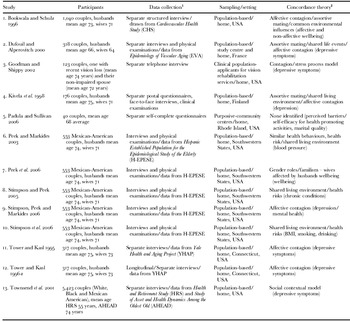
The second theme in the published research examines the concordance between the spouse's emotional states or physical health. Concordance here relates to the notion that married couples often share health and wellbeing characteristics, such as degree of life satisfaction or depressive symptoms. As Stimpson and Peek (Reference Stimpson and Peek2005: 2) distilled the idea, ‘sharing a living environment, resources, life events and habits, individuals ultimately share health risks that may translate into having a disease they might otherwise not have in an alternative social context’. A recent systematic review of studies of couples of all ages found overwhelming evidence for couple concordance in terms of mental and physical health (Meyler, Stimpson and Peek Reference Meyler, Stimpson and Peek2007). It is argued that concordance may be especially applicable among older couples in consequence of the many years that they have lived together. The current systematic review found 13 studies that focused specifically on health or wellbeing concordance among elderly couples, as summarised in Table 2.
Studies of concordance in emotional state or physical health

Notes: 1. All studies were cross-sectional (conducted at a single point in time), unless otherwise stated. 2. Concordance theories are illustrated, where these were identified by the study authors. The domain of interest in relation to concordance is included in brackets.
The majority of these studies found concordance between spouses in terms of depressive symptoms (Tower and Kasl Reference Tower and Kasl1995, Reference Tower and Kasl1996a; Bookwala and Schulz Reference Bookwala and Schulz1996; Kivela et al. Reference Kivela, Luukinen, Viramo and Koski1998; Dufouil and Alperovitch Reference Dufouil and Alperovitch2000; Townsend, Miller and Guo Reference Townsend, Miller and Guo2001; Goodman and Shippy Reference Goodman and Shippy2002; Stimpson, Peek and Markides Reference Stimpson, Peek and Markides2006; Peek et al. Reference Peek, Stimpson, Townsend and Markides2006). Most were cross-sectional studies of community-dwelling couples aged 65 or more years, and most found that depressive symptoms in one spouse influenced those of the partner, even after controlling for socio-demographic and health status variables. Some of these studies have also shown differences between husbands and wives in the effect of spousal characteristics on the other spouse's affect (Tower and Kasl Reference Tower and Kasl1995; Stimpson, Peek and Markides Reference Stimpson, Peek and Markides2006; Peek et al. Reference Peek, Stimpson, Townsend and Markides2006).
Peek and colleagues (Reference Peek, Stimpson, Townsend and Markides2006) found evidence that, overall, there was an association between husbands' and wives' wellbeing, but this did not appear equal for men and women across different domains of wellbeing. Focusing on three aspects of wellbeing (self-rated health, depressive symptoms and life-satisfaction) among Mexican-American older people, they found that life satisfaction and depressive symptoms in husbands had significant effects on wives' wellbeing, but not vice versa. A Finnish study found that wives' characteristics affected husbands' depression, but not the reverse, under specific conditions where the wife's father had died when she was under 20 years of age and she currently perceived family relations as poor (Kivela et al. Reference Kivela, Luukinen, Viramo and Koski1998). Another study found that the convergence of depression might be higher among couples who are emotionally close (Tower and Kasl Reference Tower and Kasl1996a), as measured by nominating your spouse as confidant or a source of emotional support. For men in particular, being close to their spouse was seen to increase vulnerability to depressive concordance (Tower and Kasl Reference Tower and Kasl1995). In terms of an explanation for the concordance of depression among elderly spouses, seven studies posited the theory of ‘emotional or affective contagion’. Such contagion may arise when people interact in a close relationship, such as marriage, are interdependent and, to a certain extent, control each other's outcomes, thus leading at times to a convergence in emotional patterns such as negative mood (Tower and Kasl Reference Tower and Kasl1995, Reference Tower and Kasl1996a; Bookwala and Schulz Reference Bookwala and Schulz1996; Kivela et al. Reference Kivela, Luukinen, Viramo and Koski1998; Dufouil and Alperovitch Reference Dufouil and Alperovitch2000; Goodman and Shippy Reference Goodman and Shippy2002; Stimpson, Peek and Markides Reference Stimpson, Peek and Markides2006).
Fewer studies found couple concordance in physical health and health behaviours, particularly in terms of heart-disease risk factors, including blood pressure, as was shown among 553 Mexican-American couples by Peek and Markides (Reference Peek and Markides2003). Follow-up studies in the same Mexican-American population have demonstrated that other chronic conditions in one spouse, such as hypertension, cancer and arthritis, significantly increase the likelihood of the other spouse developing the same conditions (Stimpson and Peek Reference Stimpson and Peek2005). This led the authors to suggest that couples share similar health-risk behaviours. Indeed, ‘body mass index’ was found to be similar and risk of smoking or drinking alcohol was related to spousal smoking and consumption of alcohol (Stimpson et al. Reference Stimpson, Masel, Rudkin and Peek2006). Interestingly, a study conducted with 40 Caucasian couples in the United States found low correlations between spouses in terms of health promoting behaviours such as health management, injury prevention, stress reduction, rest and relaxation, exercise and nutrition (Padula and Sullivan Reference Padula and Sullivan2006). Disparities in ethnic background of the participants, sample size and outcomes measured may have contributed to these equivocal findings.
Summary
The published research suggests that, along with individual risk factors, the marital partner is an important influence on health among elderly couples. The reviewed studies present clear evidence for concordance of depressive symptoms within elderly couples, but the quality of the relationship might moderate this ‘affective contagion’. Further research is needed to determine whether elderly couples share other health issues or risk factors, better to determine the extent to which the context of marriage is related to other chronic conditions in older people. The issue of a differential impact of spousal depression or characteristics on husbands' and wives' wellbeing also warrants further exploration.
The interplay between marital quality and wellbeing
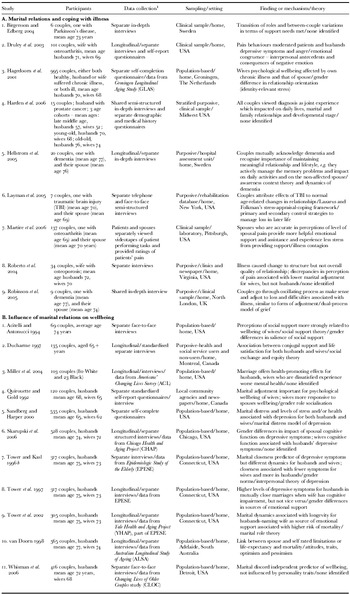
Couples in late-life marriages tend to rely on each other to meet the daily challenges they experience that are associated with a gradual decline in physical abilities and increased susceptibility to illness. It is therefore not surprising that the largest number of studies in the systematic review were based on the notion of the dynamic interplay between marital relationships and ill-health, and the way one impacts on the other. The literature suggests that members of a couple mutually experience stressful life events such as illness, and that marital relations might mediate the association between stressors and wellbeing. The 20 studies in this area were grouped under two distinct themes that will be discussed in turn (Table 3).
Studies of the interplay between marital quality and wellbeing

Notes: 1. All studies were cross-sectional (conducted at a single point in time), unless otherwise stated.
Marital relations and coping with illness
Studies of this topic can be further differentiated into those which focused on how the marital relationship is influenced by illness, i.e. looking only at post-morbid relationships, and those which examined how pre-existing marital relationships affect the experience of spousal illness. The first block of Table 3 lists the (mainly qualitative) studies that examined how the marital relationship was influenced by the onset of illness in one or both spouses, and that have demonstrated that this is not always a wholly negative experience (Birgersson and Edberg Reference Birgersson and Edberg2004; Roberto, Gold and Yorgason Reference Roberto, Gold and Yorgason2004; Hellstrom, Nolan and Lundh Reference Hellstrom, Nolan and Lundh2005; Layman, Dijkers and Ashman Reference Layman, Dijkers and Ashman2005; Robinson, Clare and Evans Reference Robinson, Clare and Evans2005; Harden, Northouse and Mood Reference Harden, Northouse and Mood2006). In general, this research has focused on the effects on the couple of specific chronic conditions such as Parkinson's disease (Birgersson and Edberg Reference Birgersson and Edberg2004) and osteoporosis (Roberto, Gold and Yorgason Reference Roberto, Gold and Yorgason2004), and suggests that couples demonstrate considerable resilience which can counteract the inherent negative impacts of illness. For example, a study focusing on the impact of dementia on the couple has suggested that whilst diagnosis can have major detrimental effects on the relationship of elderly couples, those who understood and accepted the diagnosis and developed a joint process for dealing with everyday issues found it easier to adjust (Robinson, Clare and Evans Reference Robinson, Clare and Evans2005).
Two quantitative studies have suggested, however, that illness in one spouse can lead to distress in the other (Hagedoorn et al. Reference Hagedoorn, Sanderson, Ranchor, Brilman, Kempen and Ormel2001; Druley et al. Reference Druley, Stephens, Martire, Ennis and Wojno2003), and that this is experienced differently by husbands and wives. A quantitative study carried out in The Netherlands focused on the effect of chronic disease on 995 elderly couples, and found evidence that psychological distress was particularly elevated in wives in relation to their own chronic disease, and also to the husbands'. Conversely, husbands' psychological distress was associated only with their own health condition, not their wives' (Hagedoorn et al. Reference Hagedoorn, Sanderson, Ranchor, Brilman, Kempen and Ormel2001). This finding parallels that discussed above for gender-asymmetric dynamics of the impact of one spouse's depression on that of the other spouse.
A longitudinal study carried out by Druley and colleagues (Reference Druley, Stephens, Martire, Ennis and Wojno2003) found that, among couples with the wife suffering from osteoarthritis, depressive symptoms and anger, there was an associated increase in the same negative emotions in husbands. Wives' pain behaviour (such as rubbing joints and limping) was also associated with the husbands' negative emotions. One study specifically focused on how marital relations affect the experience of spousal chronic illness (Martire et al. Reference Martire, Keefe, Schulz, Ready, Beach, Rudy and Starz2006). It found among people with osteoarthritis, that spousal ratings of patient health or pain levels had implications for the ways in which the partners interacted and provided emotional support, ultimately affecting the patient's wellbeing.
The influence of marital quality on wellbeing
The several studies that have examined the link between marital relationships and mental health outcomes among older people are listed in the second block of Table 3 (Quirouette and Gold Reference Quirouette and Gold1992; Acitelli and Antonucci Reference Acitelli and Antonucci1994; Tower and Kasl Reference Tower and Kasl1996b; Tower, Kasl and Moritz Reference Tower, Kasl and Moritz1997; Ducharme Reference Ducharme1997; Sandberg and Harper Reference Sandberg and Harper2000; Miller, Townsend and Ishler Reference Miller, Townsend and Ishler2004; Whisman et al. Reference Whisman, Uebelacker, Tolejko, Chatav and McKelvie2006; Skarupski et al. Reference Skarupski, de Leon, McCann, Bienias, Wilson and Evans2006). The majority of these cross-sectional and longitudinal studies have found evidence that positive marital relations (characterised by support and closeness) may be protective of psychological wellbeing, whereas negative marital relations (characterised by disagreement, dissatisfaction and distress) are associated with poor mental health outcomes for one or both members of the couple, irrespective of health status and other socio-demographic variables.
Importantly, several of these studies have found gender differences in the effects of marital quality on wellbeing, suggesting that there may be different dynamics for husbands and wives. Relationships characterised by closeness, whereby the spouse is seen as confidant and a source of emotional support, or where levels of satisfaction and agreement are high (e.g. Quirouette and Gold Reference Quirouette and Gold1992; Acitelli and Antonucci Reference Acitelli and Antonucci1994; Tower and Kasl Reference Tower and Kasl1996b; Sandberg and Harper Reference Sandberg and Harper2000), have been found to be protective for wives in terms of psychological wellbeing. There is evidence, however, that for husbands, emotional closeness might indeed be a risk factor for depression (Tower and Kasl Reference Tower and Kasl1996b), particularly if the wife becomes cognitively impaired (Tower, Kasl and Moritz Reference Tower, Kasl and Moritz1997). Some authors have suggested that the mechanism underpinning these gender differences may reflect a greater focus on autonomy for men and on interpersonal relationships for women (Quirouette and Gold Reference Quirouette and Gold1992); that is, wives may be particularly vulnerable to the harmful effects of marital disharmony or husbands' poor mental health status, unlike husbands for whom independence from wives (or self-sufficiency) may be protective. When the husband does draw on his wife for emotional support, however, there is evidence that he may be particularly susceptible to poor mental health (see Tower and Kasl Reference Tower and Kasl1996b).
These gender differences in the effect of the spouse on wellbeing might reflect the traditional gender-roles of men and women, whereby women have been socialised to derive their wellbeing in terms of close interpersonal relationships (i.e. their traditional role being centred within the family), whereas men derive their sense of self through more autonomous pathways (i.e. in the paid workforce) (Scanzoni and Litton Fox Reference Scanzoni and Litton Fox1980; Tower, Kasl and Darefsky Reference Tower, Kasl and Darefsky2002). This distinction has been labelled by some researchers as men tending toward an ‘agentic’ as opposed to a ‘communal’ orientation, i.e. independent rather than interpersonally sensitive orientations (Eagly and Johannesen-Schmidt Reference Eagly and Johannesen-Schmidt2001), which in this instance might be seen as protective in terms of the relationship between marital dynamics and mental health.
In terms of whether marital quality is associated with mortality, Tower and colleagues (Reference Tower, Kasl and Darefsky2002) found that whether the spouse was perceived as a confidant or source of emotional support related to mortality risk. For wives who had had children, naming their husband as a confidant and source of emotional support, but not being named by him, was protective in terms of mortality risk. Husbands in this study were most likely to live longer if they were perceived by their wife as being a source of emotional support, but did not view their wife in the same way (i.e. they were more self-sufficient). An Australian study has looked at the degree to which spouse-rated limitations and life-expectancy predicted three-year mortality among elderly couples (van Doorn Reference van Doorn1998). They found that wives' perceptions (ratings) were not only significant predictors of husbands' mortality but wives' perceptions were in fact better predictors than the husbands' for their own mortality. While spouse-ratings are not overt measures of marital quality, this study suggested that the ability of a wife accurately to judge her husband's short-term mortality risk (which might indicate a measure of closeness) may in fact directly influence his health.
Another indirect indicator of marital quality found to be related to mental health outcomes is cognitive impairment in one spouse. Skarupski and colleagues (Reference Skarupski, de Leon, McCann, Bienias, Wilson and Evans2006) found a cross-sectional association between cognitive impairment in the wife and depressive symptoms in the husband, but not the reverse. They recognised that the relationship may result from myriad factors, and suggested that as men tend to have fewer emotional confidants, their wife becoming cognitively impaired signals the end of their main source of emotional intimacy and support, hence the negative impact on their mental health. This notion also fits with ‘socio-emotional selectivity theory’ which argues that as people age they increasingly narrow their social relationships so that, assuming the marital dyad is close, one's spouse is likely to be a prominent source of emotional closeness (Carstensen Reference Carstensen1992).
Summary
Taken together, these studies demonstrate that the ways are complex in which marital relations affect, and are affected by, illness, wellbeing and even longevity. Eight of the nine studies focusing on martial relations and coping with illness – the exception being Hagedoorn et al. (Reference Hagedoorn, Sanderson, Ranchor, Brilman, Kempen and Ormel2001) – focused on one particular chronic condition. This limits the extent to which we can distinguish whether the findings are particular to the specific illness, the specific sample or apply to the ways in which couples deal with illness more broadly. On the other hand, to the extent that the samples were diverse and the studies tapped into a range of illnesses, the consistency of the results implies a generalisable pattern. It has emerged that husbands and wives might be differentially affected by their spouse's wellbeing, which warrants further investigation. Nonetheless, for both husbands and wives, spousal relationships have been found to have the potential either to protect or enhance the risk of poor mental health outcomes. The presence of ill-health in one spouse, specifically cognitive decline or functional disability, may be detrimental to the health of both spouses, but this appears to be moderated by marital closeness. The gender differences that are apparent in some studies may reflect inherent divergence in terms of where men and women tend to seek their emotional support and reassurance, and the ramifications of this for the degree to which one spouse is influenced by the ‘mood’ of the other. Unlike the majority of the articles in this review, those that focused on the interplay between marital quality and wellbeing included seven longitudinal studies that collected repeat measures of spousal health and wellbeing. These studies emphasise the need for greater awareness of the role of the spouse in moderating ill-health, not only among professionals working with older people but also among elderly couples themselves. The knowledge that spouses can have a significant impact on each other's wellbeing needs to be recognised as a legitimate element of an individual's social context, and hence represents an important contributor to health.
Conclusions
Although a wealth of research has focused on the care-giving dimensions of elderly couple relationships, no previous systematic review has focused on couple dynamics as they relate to both spouses, outside a care-giving relationship. According to the 45 studies examined, there is strong evidence that the dynamics of late-life marital relationships are associated with the health and wellbeing of both husbands and wives, although not in all cases with equal effects. Importantly, there is strong evidence for spousal concordance in terms of depression. Most of the reviewed research concentrated on the interplay between marital relations and physical ill-health, and relatively little has investigated the dynamics of the relationship in the absence of ill-health. Research is needed that focuses on several gaps in the literature: the strengths of elderly marriages (e.g. the factors associated with strong, ‘successful’ partnerships); the burdens of late-life marriages (such as the increasing demands of grandparenting and associated family pressures); and the impact of relocation or housing transitions on the couple. Equally, nearly all of the studies have been exclusively at the marital dyad level (and the dynamics within the dyad) without adequate attention to the broader life conditions that affect a couple, such as their perceptions of housing, neighbourhoods, social support and access to services.
A number of methodological features of the reviewed research deserve special comment. Whilst nine longitudinal studies were identified (Tower and Kasl Reference Tower and Kasl1996a; Tower, Kasl and Moritz Reference Tower, Kasl and Moritz1997; Ducharme Reference Ducharme1997; van Doorn Reference van Doorn1998; Tower Kasl and Darefsky Reference Tower, Kasl and Darefsky2002; Druley et al. Reference Druley, Stephens, Martire, Ennis and Wojno2003; Miller, Townsend and Ishler Reference Miller, Townsend and Ishler2004; Hellstrom, Nolan and Lundh Reference Hellstrom, Nolan and Lundh2005; Skarupski et al. Reference Skarupski, de Leon, McCann, Bienias, Wilson and Evans2006), most studies were cross-sectional. This limits the overall contribution to our understanding of causation, particularly in relation to the spouses' concordance in emotional states and the impact of changes in spousal wellbeing. The recent use of dynamic dual change score models to reveal the dynamics for both the partners and the couple (McArdle and Hamagami Reference Matras and Caiden2001), and within or across domains of health will eventually clarify causal links (e.g. Hoppmann, Gerstorf and Luszcz Reference Hoppmann, Gerstorf and Luszcz2008).
Another factor that may compromise the published findings is the inconsistency in collecting data separately from husbands and wives. In fact, the studies used various methods, from separate interviews to shared accounts, which might influence the gathered information (Meyler, Stimpson and Peek Reference Meyler, Stimpson and Peek2007). Some studies pointed out that although separate interviews were planned, in the event this was not always possible, with spouses sometimes ‘interfering’ with the interview process or insisting on being interviewed together (e.g. Townsend, Miller and Guo Reference Townsend, Miller and Guo2001; Gladstone Reference Gladstone1995). Other things being equal, we advise that two fieldworkers are deployed to interview individually each spouse concurrently, either in their own homes or in a research setting.
In terms of the length and types of relationships studied, most focused on ‘traditional marriages’ of around 40 years duration. Some did not detail the length of marriage (Matras and Caiden Reference Matras and Caiden1994; van Doorn Reference van Doorn1998; Kivela et al. Reference Kivela, Luukinen, Viramo and Koski1998; Lundh, Sandberg and Nolan Reference Lundh, Sandberg and Nolan2000; Hagedoorn et al. Reference Hagedoorn, Sanderson, Ranchor, Brilman, Kempen and Ormel2001; Peek and Markides Reference Peek and Markides2003; Dufouil and Alperovitch Reference Dufouil and Alperovitch2000; Skarupski et al. Reference Skarupski, de Leon, McCann, Bienias, Wilson and Evans2006; Ahn and Kim Reference Ahn and Kim2007). One study mentioned that they did not include duration of marriage in the data analysis (Stimpson and Peek Reference Stimpson and Peek2005), and another explicitly stated that the variable was not available (Bookwala and Schulz Reference Bookwala and Schulz1996). Only two papers mentioned length of time living together, as opposed to length of marriage, in either selecting (Layman, Dijkers and Ashman Reference Layman, Dijkers and Ashman2005) or describing (Hellstrom, Nolan and Lundh Reference Hellstrom, Nolan and Lundh2005) the sample. Consensus over what constitutes a marriage relationship, and whether the key factors relating to older couples highlighted in this review relate equally to people in non-traditional but long-lasting relationships (i.e. de-facto or consensual unions) or in relationships of less than 40 years duration are important considerations for future research.
Similarly, the ways in which the quality of the marriage was measured differed in the studies, and can be seen as indicative of how the measures were conceived. The studies that focused on the interplay between marital quality and wellbeing or on marital relations and satisfaction per se used many different measures of ‘satisfaction’ or ‘quality’ of the marriage. We argue that more research is needed on how precisely to delineate the myriad perceptions that make up a person's assessment of their marriage. Innovative research to understand contemporary meanings of ‘marital satisfaction’ will ensure a more robust theoretical examination of this important domain of older people's lives (Askham Reference Askham, Arber and Ginn1995). As previously mentioned, the great majority of the studies were conducted in single geographical areas, mainly in North America, with predominantly white populations in traditional couple relationships. More work on late-life marriage among older minority groups is clearly needed, particularly as some of these groups are at greater risk of decreased wellbeing through relatively high rates of disease and disability (Peek et al. Reference Peek, Stimpson, Townsend and Markides2006). The extent to which interactions between spouses in a marriage might contribute to overall wellbeing in these groups should be central to the future research agenda.
In summary, given the importance of marital dynamics for wellbeing among older people, it is somewhat surprising that only 45 studies were identified. Of these, it could be argued that the research parameters were fairly narrow in that they could readily be grouped under three themes. Furthermore, much of the research, apart from the concordance literature, was not integrated with relevant theory, nor did it contribute new theoretical perspectives. The question must therefore be asked, why has there been relatively limited interest in long-term marriage? Perhaps a tendency to concentrate on the biomedical processes of ageing has overshadowed the seemingly ‘uninteresting or unproblematic’ behavioural interactions that comprise late-life marital relationships (Askham Reference Askham, Arber and Ginn1995: 87). On the other hand, perhaps investigation of the marital relationship, particularly in late life, carries a taboo associated with delving into a private sphere of functioning. Whatever the reason, we hope that this review has made clear that marital relationships, and spouse-specific changes or changes shared by a couple, are of great importance for older people's health. We encourage studies of elderly couples that investigate the rich socio-cultural diversity of this cohort and that take into account the many research gaps that we have identified.
Acknowledgements
This research was made possible by funding from the Australian Research Council (LP0669272), Office for the Ageing (SA), ECH, and kindly supported by Alzheimer's Australia (SA) and Relationships Australia (SA).