INTRODUCTION
The legions based along the Rhine were stamping tiles from the mid-fi rst century onwards,Footnote 1 whilst in Dalmatia legio XI, which left the province in a.d. 69, may have been stamping its tiles since a.d. 41 and it is possible that legio VII Claudia was also.Footnote 2 However, no stamped tiles are known for legio XIV, which left Britain c. a.d. 70, nor for legio II Adiutrix, which left c. a.d. 86, and none have been found at the Agricolan fortress of Inchtuthil. In fact Britannia seems to have been insulated from this continental fashion and the earliest datable stamped tiles from a British-based legion are those of legio II Augusta which have come from contexts at Caerleon that date to c. a.d. 90–100.Footnote 3 This is consistent with the likely date that the other British legions started stamping their tiles. Cohors IIII Breucorum based at Slack was also stamping tiles from close to this time.Footnote 4
Roman Inscriptions of Britain II, Fascicule 4 (RIB)Footnote 5 lists 72 different dies for legio II Augusta, 94 for legio VI, 16 for legio IX, and 64 for legio XX. Most of the stamped tiles have been found in and around the legionary fortresses or, in the case of legio XX, at its kiln site of Holt. Stamps are found on tegulae, imbrices, brick and flue-tile, but the great preponderance is on roof tile and the majority of this on tegulae.
COHORTS AND THE MULTIPLICITY OF DIES
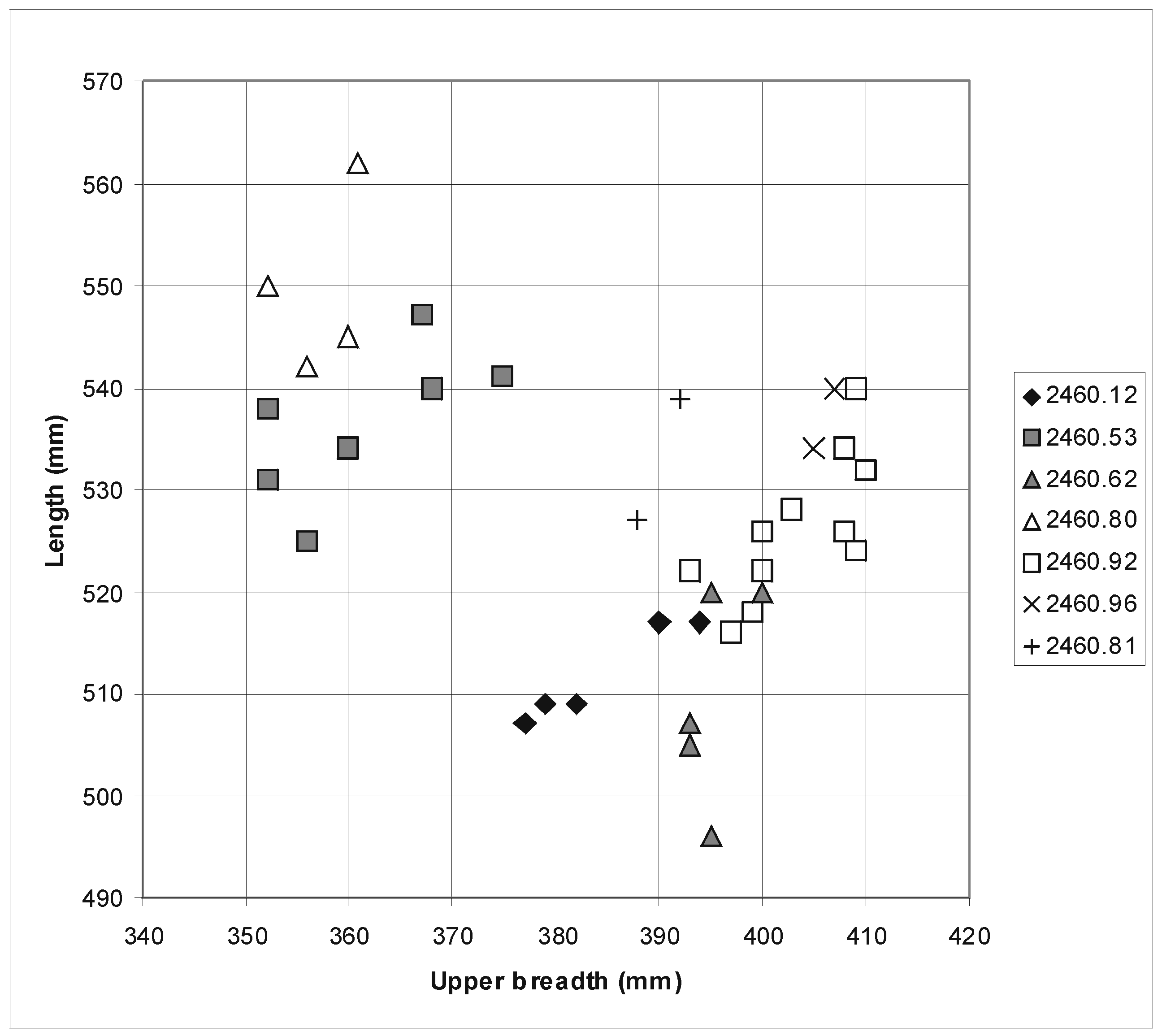
Legio VI has the largest number of complete stamped tegulae, the bulk of which have come from tile tombs, although, because the dies are mixed, this was probably a secondary usage for tiles that were originally placed on roofs. Superficially there is considerable variation in the size of the legio VI tegulae, but rather less so when viewed by die types as shown in fig. 1, which plots the length versus upper breadth for the seven die-types where there are multiple examples of complete tegulae.Footnote 6
Tegula sizes of legio VI dies.

All tiles will shrink in the processes of drying and firing. In principle, tiles formed in the same mould with the same clay that undergo identical drying and firing processes should shrink by the same amount. However, the nature of the clay, and in particular its moisture content, inevitably varies and hence the ultimate size, even of tiles made in the same mould, will vary. Normally it would be difficult to know whether the difference in size of two fired tegulae was caused by a difference in the size of the mould or by a difference in the clay that was used, but stamped tegulae can provide a way around this problem. Two tiles struck by the same die will originally have had the same-sized stamp impression; any variation in the impression sizes after firing will therefore be ‘differential shrinkage’, the result of differences in the moisture content of the clay and other elements of the process. In a study by the author,Footnote 7 differential shrinkage has been measured across 10 different dies totalling 100 stamp impressions, which showed that the degree of differential shrinkage took the shape of a normal distribution with a standard deviation of 1.9 per cent. If this distribution can be applied to all tiles, then statistically 95 per cent of tiles made from the same mould should be within two standard deviations of the same size, that is ±3.8 per cent from the mean or 7.6 per cent from the smallest to the largest size.
For the size of tiles shown in fig. 1 the 95 per cent confidence limit on measurements of tiles made from a single mould as a result of differential shrinkage would represent an overall spread of c. 30 mm. This is far less than the aggregate distribution of all the stamped tegulae, but fits very comfortably with the spreads of the individual dies. Moreover, the distribution of measurements for each of the dies lies broadly along a diagonal, which is entirely consistent with both the length and breadth of individual tiles shrinking uniformly, but with the amount of shrinkage varying across the sample of tiles. We may, therefore, reasonably assert that all of the tegulae stamped with the same die were made in the same sized mould or moulds and that the small variations in size are owing to differential shrinkage.Footnote 8 That the distribution of each of the dies differs from the distributions of the other dies can also be tested statistically using the ANOVA test. This shows that the probability that the size differences between the distributions of these dies is simply a statistical accident is minuscule.Footnote 9 It also clearly shows that the differences between any two of the dies’ distributions being simply chance is small, albeit rising to 10 per cent in the two dies with the closest distributions.
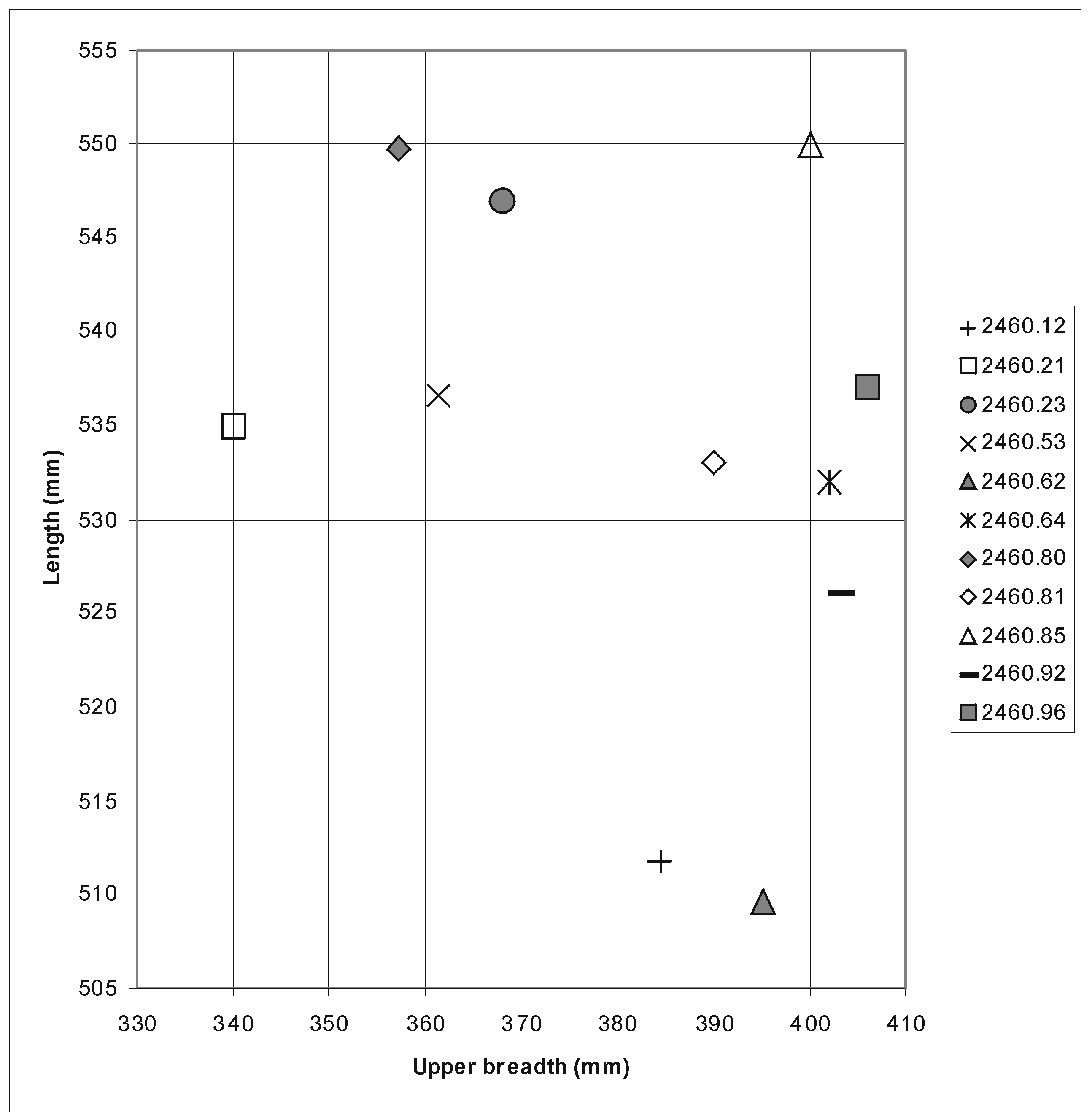
Each die appears to have its own distinct tegula mould size and each of these mould sizes is different. The average mould size of the samples from each die in fig. 1 has been calculated and these are plotted in fig. 2, along with the dimensions of those dies not included in fig. 1 for the reason that only one complete example has been recorded.
Average tegula sizes of legio VI dies.

To investigate this relationship further we need some idea of the probable life of these dies and this can be derived from an examination of the tegulae themselves. Tegulae have notches (cutaways) carved out of the underside of their lower ends to enable the tiles to overlap effectively when laid on a roof. These cutaways divide into four basic morphological groups which appear in chronological sequence on all tegulae: the groups being dated to the first century, second century, second/third century, and third/fourth century. There is some overlap in the dating, especially with the third form which occasionally occurs in non-military contexts as early as the first century.Footnote 10 By examining the cutaway form of every stamped tegula (military and civil) in the province, it is apparent that some dies only appear with a single cutaway form, whilst others are seen with two chronologically adjacent cutaway forms. There are no dies that appear with three cutaway forms. Clearly if dies had very long lives then we would expect the majority to appear with at least two cutaway forms; conversely, if dies had very short lives then most would exhibit only a single cutaway form. Modelling demonstrates that an average die life of 20 years best fits the observed data, although a life as short as 10 or as long as 40 years cannot be excluded.Footnote 11 Dies were typically made of wood as is evidenced by some dies being re-cut and wood grain occasionally being visible in stamp impressions. As a result they would have needed to be carefully treated if they were to survive for 20 years. To date 95 different legio VI dies have been identified,Footnote 12 which implies that unless the actual life of those dies was nearer 2 years rather than the 20 that the modelling suggests, then many of the dies — each with their own unique mould size — must have been in concurrent use.
To explore this further we need to consider how these tiles were produced. A work list dated 25 April probably for the Ninth Cohort of Batavians at Vindolanda details their various assignments, including a number of men sent to the kilns and a further group despatched for clay.Footnote 13 So whilst we might anticipate that the Batavians had an individual expert tile-maker (magister figlinarum), the inference is that the men allocated to assist him rotated. Extrapolating from this auxiliary unit, we could expect that a legion would have a dedicated tile-master and that each cohort would allocate labour to fulfil its own requirements, perhaps using its own equipment, which might have included its own die.
Tegulae were manufactured by throwing wet clay into a four-sided mould and then (literally) punching the clay into the corners and against the sides to ensure the mould was tightly filled. This was a robust process and it seems likely that moulds used in this way would have survived months rather than years. It is likely that all of the legion’s moulds were originally of the same size, but the requirement for regular replacements offers an explanation for the variation in mould size shown in fig. 2. If each successive mould was accurately modelled, say to within 2 mm of the mould it replaced, then over the life of the die there would be some 40 replacement moulds some of which may have been bigger than their predecessors by 2 mm and others smaller by 2 mm. After 20 years of this replacement process the ups and downs should, within limits, more or less average themselves out. In fact, if each cohort had started with a mould of the same size, then by the end of the die’s life they might differ in size by ±10 mm.Footnote 14 This degree of variation is less than the natural variation caused by differential shrinkage in the processes of drying and firing (see above) so, unless the moulds were physically compared against each other, the difference in sizes would have been undetectable.
The dies shown in fig. 2 have a maximum size variation of 65 mm and are all found on tegulae with the second cutaway form, which suggests that they may cover a period of 60 to 80 years from the arrival of the legion in Britain. If the process of regular mould replacement continued unchecked for 60 years then, on the assumptions above, the size differences would grow to around 60 mm, very much in line with the spread shown in fig. 2. Whilst this level of difference is now double that which we have attributed to differential shrinkage, it would not necessarily have led to a problem. If each cohort was responsible for its own buildings, the randomizing effect of differential shrinkage would have meant that the difference between two cohorts’ tiles would not have been noticeable once the tegulae were laid on a roof. Moreover, since differential shrinkage meant that careful selection was required even when fitting tegulae from the same mould on a roof, mixing tegulae from two different cohorts would not have materially increased the difficulty. Indeed, it is only by plotting the sizes graphically, as in fig. 1, that it becomes obvious that the reasons for the size distribution are more than just the random effects of differential shrinkage. It, therefore, seems plausible that the explanation for several dies, each with their own unique mould size, being in concurrent use is that each cohort had its own equipment and that the size of the moulds drifted apart, almost undetectably, over decades through a process of regular replacement.
There is significant variation in the nomenclature used on legio VI dies, the most common variants of which are listed in Table 1. The obvious explanation that these represent changing nomenclatures through time is dispelled by the observation that many of the variants are also found on tiles at Novaesium Footnote 15 where legio VI was based in the first century. It, therefore, seems likely, since many dies appear to have been in concurrent use, that several different nomenclatures were also in contemporaneous use and the best explanation for this could be that individual cohorts favoured particular nomenclatures. This is supported by excavations at the legio VI kiln site of Peasholme GreenFootnote 16 where the 15 legio VI stamped tiles that were recovered contained representatives of four of the six lettering forms listed in Table 1, possibly implying that all of the lettering forms may have been in use at the same time.
DIFFERENT LETTERING FORMS FOUND ON LEGIO VI DIES

A possible alternative explanation for the number of different dies and mould sizes should also be considered; this is that the different dies were a code used to indicate the different sizes of the tegulae in order to facilitate their placement on roofs. The most obvious difference in the dies is in their nomenclatures. However, as shown in fig. 2, inter alia, there are four dies that read LEGVIVPFFootnote 17 and they span almost the complete size distribution. Moreover two of these dies, RIB2460.80 and 81, whose breadths differ by some 30 mm, are very similar and would only be distinguishable by careful visual inspection. It is, therefore, very unlikely that the die was used to signify any variation in tegula size and the association with cohorts seems the stronger argument. It is also worth observing that whilst stamp impressions from most dies are consistently placed at the lower end of the tegula and orientated to read across the tile, impressions from two dies (RIB2460.53 and 80) have all been placed diagonally across the tile and impressions of two other dies (RIB2460.52 and 81) have all been placed towards the top edge of the tile. This may show that stamping practices changed through time or, alternatively, that they varied between cohorts.
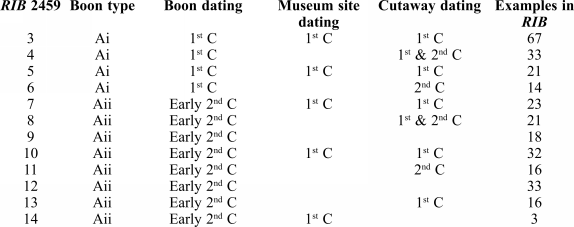
Legio II also provides evidence to support the hypothesis that each cohort had its own die. BoonFootnote 18 classified the legio II dies on stylistic and contextual grounds; he dated his earliest group of dies (Ai) to a.d. 90–100 and the next group (Aii) to the early second century (fig. 3). Subsequently several of these dies from both groups have been recovered from contexts at the Legionary Museum siteFootnote 19 in Caerleon that date prior to a.d. 100. Where they have survived, all of the tegula cutaways from these dies come from either the first- or second-century forms, with a number of the dies exhibiting examples of both cutaway forms. The data are summarised in Table 2, from which it can be seen that, although Boon thought that his Aii group was early second-century, these dies must actually have started production in the first century. The presence of second-century cutaway forms on some of the examples, particularly on dies where the first-century cutaway form has also been observed, indicates that these dies were in use for a number of years. Arguably the data in Table 2 could suggest that dies 3 and 5 were exclusively first-century and dies 9, 11 and 12 were exclusively second-century, with the remaining seven dies lying in between, but, recognising the limitations of the data, it seems more likely that all these dies were in use contemporaneously at the end of the first and beginning of the second centuries.
Boon’s legio II Ai and Aii die styles.

DATING EVIDENCE FOR EARLY LEGIO II DIES

The number of examples listed in RIB for each of these twelve dies is shown in Table 2. There are only three examples of RIB 2459.14 compared with a minimum of fourteen of every other die. So, whilst it is possible that this simply reflects the areas that have been available for excavation, it seems more likely that this die was lost or broken shortly after being made and that one of the other dies was made as a replacement. This leaves eleven different dies each represented by a significant number of examples. Since these dies all appear to have been in contemporaneous use, the best explanation is that each of the legion’s ten cohorts had its own die and that either the additional die belongs to the first double-strength cohort or is perhaps another replacement for a die which was also lost.
In comparison legio XX has produced less than half the number of stamped tegulae that legio II has and even fewer of these have had the cutaway still attached. Despite this there are eight legio XX dies that have been found with the first-century cutaway form and half of these have also been found with the second-century form. Again, these dies are likely to have been in contemporaneous use; indeed two of them have been found stamped on the same tile,Footnote 20 which might be suggestive of some confusion at the tile-works in the handover from one cohort to the next. However, in sharp contrast to legio II where there were just two designs for the first twelve dies, each one of the early legio XX dies has a markedly different style. This may serve as better evidence for each cohort creating its own die rather than the commonality of style in legio II.
In total there are fifteen legio IX dies, four of which read LEGVIIII(H) and the remainder LEGIXHISP. Additionally there is one disputed die found in Victorian times at Leicester that reads (retrograde) LVIII, or possibly LVIIII if part of the die is missing.Footnote 21 Ignoring the Leicester die, all of the LEGVIIII dies have been found in the Carlisle area (including two from the kiln-site at Scalesceugh) and nowhere else, whilst all of the LEGIXHISP dies have been found at York or at surrounding forts. The LEGVIIII dies could simply represent the output of a vexillation of the legion that was working the Scalesceugh kiln. An alternative interpretation is that they relate to a separate period of tile stamping by the legion. Since this cannot date to before the legion moved to York when tiles were not being stamped, it must relate to a period after it had left York, but unfortunately no LEGVIIII dies have been found with a tegula cutaway that might support this.Footnote 22 Birley has suggested that legio IX may have been based at Carlisle c. a.d. 122–125 and engaged in the construction of the turf section of the Wall which would fit well.Footnote 23 A single legio IX die found at Nijmegen in Holland also reads LEGVIIII,Footnote 24 and the continuity of use of this nomenclature reinforces the proposal that Carlisle was the legion’s last posting before it was moved to the Continent. It also makes it difficult to suggest that the Nijmegen die was produced earlier by a vexillation of legio IX on detachment, because this would require the unit to anticipate the later use of this nomenclature, unless it was indeed a vexillation that produced the original Scalesceugh LEGVIIII dies before moving to Nijmegen.
Of the eleven LEGIXHISP dies, nine have been found at York and the remaining two at Malton, which is some 20 miles to the north. Since these dies span at most 30 years and some have been found with both first- and second-century cutaway forms, it is possible that they were all in contemporaneous use. If so, then again this might support the notion that each cohort had its own die with the first double-strength cohort having two.
CONTRACTORS AND UNSTAMPED TEGULAE
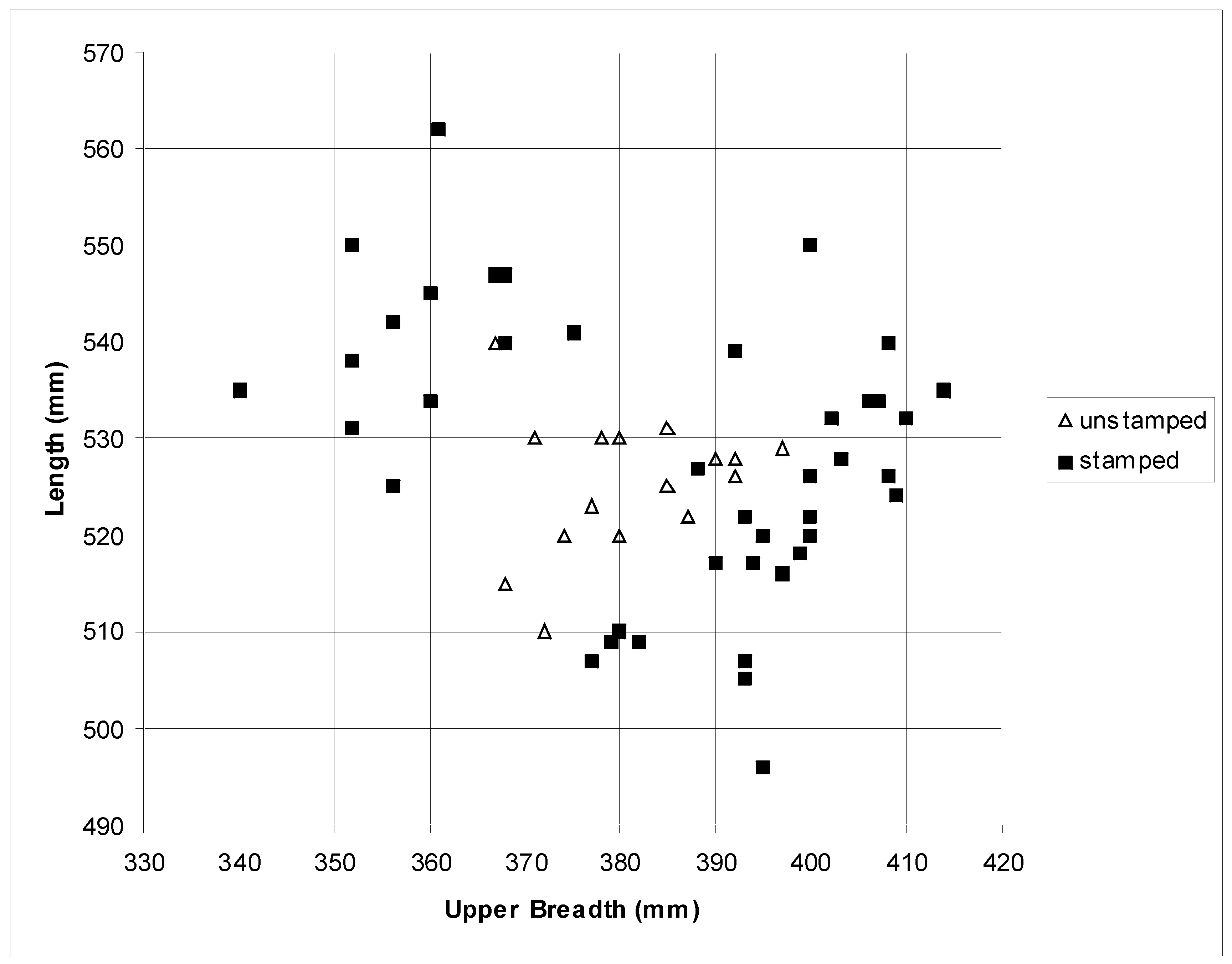
So far this analysis has only considered the stamped tegulae. There are, however, many complete unstamped tegulae from York of second-century date based on the cutaway form; these are plotted in fig. 4 against the complete population of legio VI stamped tegulae.Footnote 25 The unstamped tegulae lie in the gap between the narrower stamped tegulae and the broader ones and they display the diagonal distribution caused by differential shrinkage. The cluster of unstamped tegulae varies only 30 mm across in both directions, so in principle all of these tiles could have come from the same mould. In practice more moulds may well have been in use, but, unlike the moulds for the stamped tiles shown in fig. 2, there appears to have been no drift in mould sizes.
Comparative sizes of legio VI stamped and unstamped tegulae.

Statistically the unstamped tegulae represent an unambiguously different population from the stamped ones; that is they cannot have been made from the same moulds as the stamped tegulae but must have been produced in their own, slightly different sized moulds.Footnote 26 This is important for it means that, contrary to received wisdom, legio VI seems to have stamped all the tegulae that were made in certain moulds and to have stamped none of the tegulae produced in others. This may be compared with the finding from Beauport Park, a Classis Britannica bath-house in Sussex, where 29 of the 32 complete tegulae recovered were stamped and the remaining three may have been, but their surfaces were too damaged to show a stamp. This strongly indicates that the Classis Britannica had a policy of stamping all tegulae. Similarly, a good continental parallel comes from a legio II Italica tile kiln at Vransko in Noricum where the bulk of the tiles used in its construction were stamped. There was also another kiln at Vransko, which might not have been contemporary, where none of the tiles were stamped.Footnote 27
The actual findspots of most of the unstamped legio VI tegulae are unknown and it is, of course, possible that they were not military, but civilian production for use in the vicus. However, even if there were sufficient high-status houses in the vicus to account for so many unstamped tegulae, those used in civil construction tend to be smaller than tegulae used in military works, whereas the ones in fig. 4 are the same overall size. On balance, therefore, it is probable that these unstamped tegulae have come from military buildings. But, if so, why were they not stamped? Since the absence of stamps was not accidental, we have to look for another explanation. It is possible that some cohorts chose not to stamp their production, or the whole legion chose not to stamp its production during parts of the second century, or that the legion was supplementing its own production with that of contractors, perhaps when part of the legion was on detachment on Hadrian’s Wall. This last possibility is reinforced by Swan and McBride’s suggestion that legio VI may have had two or more tileries operating in the vicinity of York, which could be interpreted as one operated by the legion itself and the other by contractors.Footnote 28 Of course, the contractors could have been asked to stamp their products in the same manner that Viducius did for legio XX, but it would seem that legio VI did not adopt this practice.
Unfortunately there are too few complete tegulae from Caerleon to be able to draw any similar conclusions for legio II. However, the relative absence of unstamped tegulae — only three of which two have the second/third-century cutaway form — suggests that they may not have used contractors, at least until the third century. Legio XX has only two dies where there are multiple examples of tegulae with complete dimensions and these are similar in size, conforming to the legio VI picture. However, there are many more complete unstamped tegulae and a number of them come from the legionary tile-works at Holt; these will be discussed further after considering some of the other evidence from legio XX.
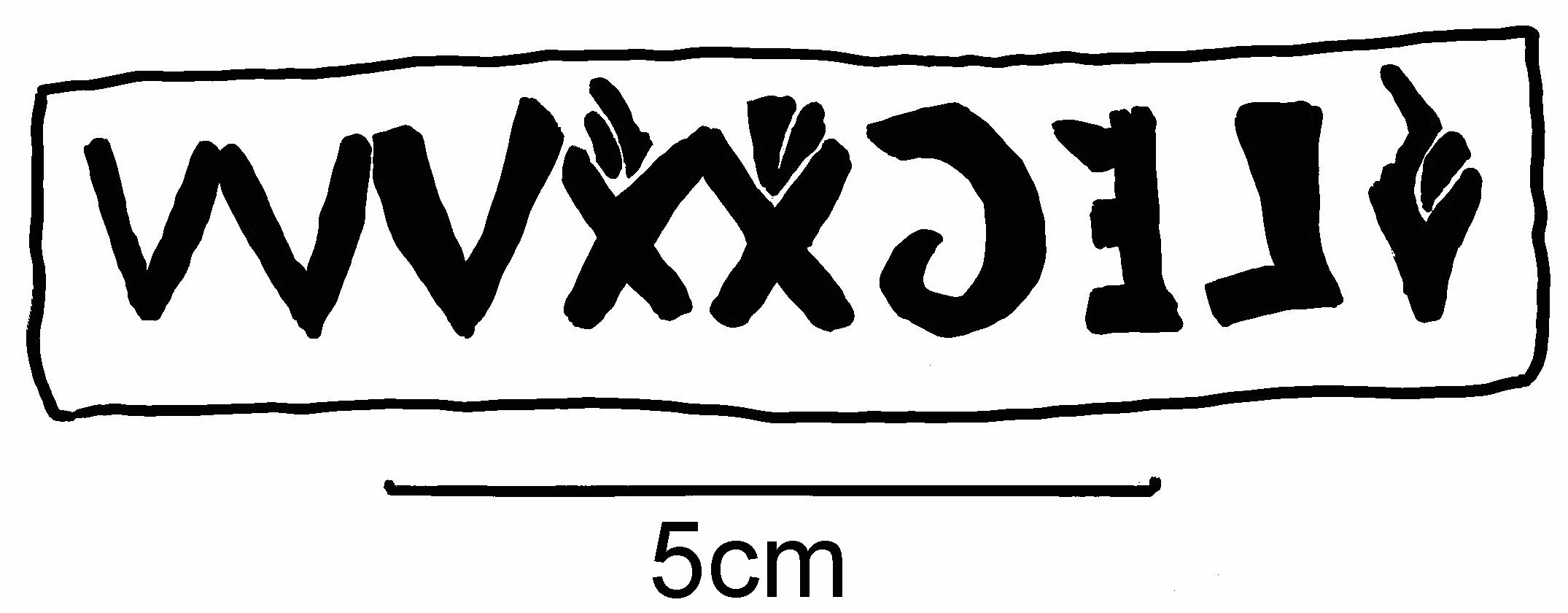
Legio XX has produced a die that appears to refer directly to a contractor (fig. 5), which reads TEGVLA A VIDV | VERO III COS LEG XX.Footnote 29 Five examples of this die have been excavated at TarbockFootnote 30 in Merseyside and a further two were found at the North Gate brewery site in Chester. When RIBII.4 was published a complete die had not been found and so the entry suggested an additional F(ecit) at the end of the first line to match an additional VV at the end of the second line and so translating the text as ‘Aulus Viducius(?) made this roofing-tile for Legion XX Valeria Victrix in the third consulship of Verus’. Even without the actual F(ecit), this still seems to be the correct interpretation, although Swan and Philpott suggest that TEGVLA could be a contraction of tegularia (tilery).Footnote 31
The VEROIIICOS die found at Tarbock.

Although there is only one other complete British legionary die that incorporates a person’s name, there were spates amongst the legions based on the Continent when the inclusion of names was common, for example legio V Alaudae dies from Vetera incorporate 36 separate names.Footnote 32 The legio V Alaudae names were mainly of Italian origin and have been interpreted as those of soldiers or officers. In contrast, Viducius is an uncommon Gallic nameFootnote 33 and Tarbock lay in a rural location on the north side of the Mersey estuary some 20 km due north of Chester without any military characteristics. As a consequence the interpretation of Viducius as a contractor rather than a soldier seems much more probable.
The other complete British legionary stamp which mentions a person is also from legio XX; it reads LEGXXVV | SVBLOGOPR.Footnote 34 This is interpreted in RIB as ‘The Twentieth Legion, Valeria Victrix | under Logus, princeps’, although some doubt is expressed about the translation of PR as princeps. Like the VEROIIICOS stamp it extends over two lines (the only British legionary dies that do so) and both these dies share the use of an inverted letter S.Footnote 35 Coupling these points with the fact that Logus is a name common amongst slaves and freedmen, it is possible to suggest an alternative reading for the die ‘The Twentieth Legion, Valeria Victrix | (made) under Logus, princeps’, where the fecit is implied but not part of the actual text in a similar way to the VEROIIICOS die. If this were correct, then Logus would be the manager (chief) of the tile-works and a contractor — like Viducius — to legio XX.
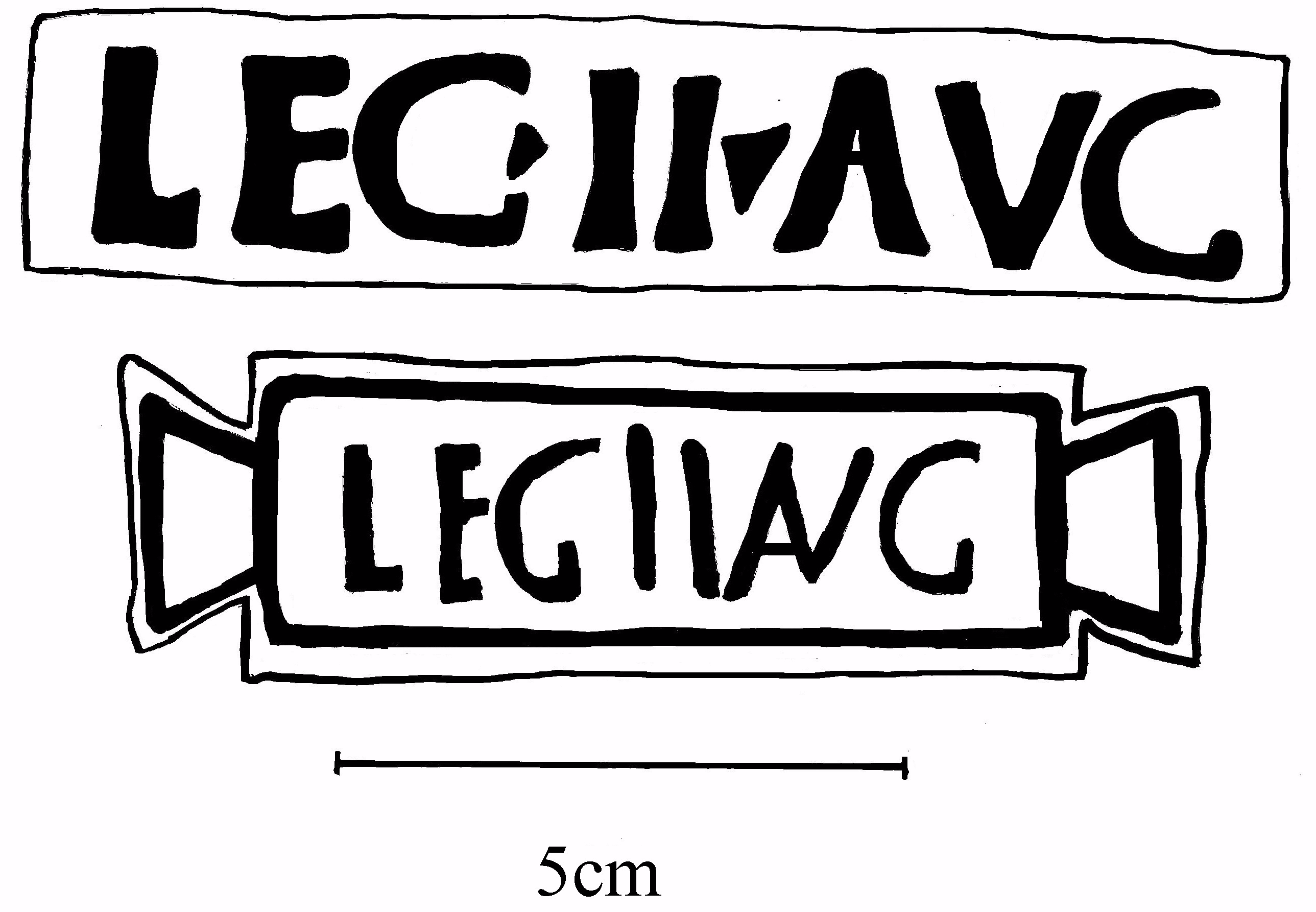
Although no kiln has been discovered at Tarbock, wasters and other debris suggest that the kiln was near by and that Viducius’ tilery was only in operation for a short period in the second century. Only one other die which read either LXXVVV or LXXVVVI was present at Tarbock. This is one of three diesFootnote 36 of legio XX carrying a third V (fig. 6), that has tentatively been interpreted as the cognomen Victoriniana which, if correct, would have been awarded to the legion in a.d. 268–70. Manifestly neither the second-century site nor the association with the second-century VEROIIICOS die make the Victoriniana attribution plausible and the V more likely refers to Viducius. We might also note that two unstamped tegulae from Tarbock had a V incised onto their upper surfaces.Footnote 37 There are two further legio XX dies reading LEGXXVVDE and LEGXXVDE which require consideration. It is suggested in RIBthat the DE could stand for either Deciana or Devana. The cognomen Deciana would relate to a.d. 249–251 which is inconsistent with the second-century cutaway form found on these tiles and also with their discovery in late second- or early third-century contexts at Deanery Field, Chester.Footnote 38 Devana for Deva (Chester) is possible, and there are rare continental parallels.Footnote 39 However, it is also possible that DE refers to a person’s name and if so, by analogy with the LEGXXVVV dies for Viducius, this could once again be a contractor. In addition, the LEGXXVDE die has an additional V inserted in the right-hand ansa, which may simply be the restitution of the V missing from the main text or could possibly refer to Viducius.
Unlisted LEGXXVVV die from Chester.

All of these possible contractor dies have been found with the second-century cutaway form, where the tegulae have been sufficiently complete. No cutaways remained on the stamped tegulae from Tarbock where the VEROIIICOS tiles originated, but most of the unstamped tegulae from the site had the first-century form of cutaway with only four having the second-century version, which suggests that the site was in operation around the transition point between the first- and second-century forms, c. a.d. 120.Footnote 40 An analysis of the lengths of all of the tegula cutaways found in Chester produces a bi-modal distribution, one mode of which coincides with equivalent measurement of tegulae found at Holt and the other with the tegulae from Tarbock,Footnote 41 which implies that these were the two principal sources of supply to the fortress. However, as second-century building work at Chester had effectively ceased by a.d. 130,Footnote 42 the expectation must be that the Tarbock tegulae were supplied prior to that date, in which case the VEROIIICOS die may be better attributed to M. Annius Verus who celebrated his third consulship in a.d. 126, rather than that of L(ucius) Verus in a.d. 167 as proposed in RIB.
With the exception of the four dies attributable to Viducius and the two dies with the Antoniniana cognomen,Footnote 43 all of the dies where more than two examples have been recovered from Chester have also been found at Holt.Footnote 44 Since 16 examples of the Antoniniana dies have been found in Chester it is unlikely that these were made at Holt and, as there are now no legio XX dies that appear to be later than the early third-century Antoniniana ones, it seems probable that tile production at Holt ended in the second century. Indeed, it has been argued that the absence of ceramic and coin evidence implies that there was no military activity at Holt beyond a.d. 150.Footnote 45 Moreover, if most of the tegulae found at Chester can be attributed to production at either Holt or Tarbock, as suggested by the analysis of cutaway lengths, then it would seem that other than an early third-century burst of Antoniniana production from an unknown source, no further ceramic tiles were supplied to the fortress.
This raises the question as to why legio XX allowed a seemingly good tile kiln at Holt to fall into disuse and be replaced with logistically less well placed contractor facilities. Part of the answer probably relates to the legion’s absence on Hadrian’s Wall (and possibly elsewhere), as well as its apparent preference for contractors, but a significant reason could also have been the availability of fuel. Tile kilns use prodigious quantities of wood, and indeed collecting the timber would have represented over half the cost of production.Footnote 46 It is possible, therefore, that over the thirty plus years of Holt’s existence it had exhausted all of the locally available timber supplies, thereby making sourcing from Tarbock economically attractive.
This does not explain, however, why several of the supposed contractor dies originate from the legionary tile-works at Holt rather than from a private contractor’s site such as Tarbock. To answer this question we need to consider how a legionary tile-works might have operated. We know from stamp finds at outlying forts that these tile-works also supplied some of their tile. It is difficult to imagine that the legions would have happily operated as manual labourers in the production of tiles which the auxiliaries simply collected once they had been produced. It seems much more likely that either contractors were used or that the auxiliary units sent men to the tile-works who would have produced their own tiles, probably under the supervision of the legionary or cohort tile-master. There is evidence for just this on a tegula of second-century cutaway form stamped LEGXXVV,Footnote 47 which was found at Holt with a graffito that reads IVLIVS AVENTINVS MILIS | CORTIS P(R)IMA SVNICOR. Presumably, this was a soldier in charge of a detachment from the First Cohort of Sunici which was producing tiles for their fort at Caernarfon (Segontium).
Fragmentary dies which read …IVLIVS… have also been found at Holt. Iulius is a very common Roman name, but conceivably this could perhaps be the same Iulius mentioned in the graffito. If so, it might suggest that originally his unit was producing tiles under the supervision of the legionary tile-master, which was acknowledged by the tiles bearing the legionary stamp, but that at a later stage the unit was allowed to manufacture tiles unsupervised and this was recognised with the use of their own stamp incorporating Iulius’ name.Footnote 48 Thus, if the legion were no longer exclusively operating the site, then contractors as well as auxiliaries could have been involved in production. This is probably what was also happening at the legio II Italica kiln-site at Vransko, where stamps of two private tile-makers appear on tegulae and imbrices respectively.Footnote 49 These arrangements could have involved a lease, with the military providing access to the raw materials and equipment and being paid by taking a share of the production; civilian parallels for this exist on the Continent and possibly in Britain at Minety.Footnote 50
Returning to the unstamped tegulae, seven complete unstamped tegulae were recovered from Holt and five from Chester. Eight of these had first-century cutaways, but the dimensions were such that they could not easily be differentiated from the stamped tegulae with the same cutaway form. In contrast, the four remaining tegulae with the second-century cutaway form are likely to have come from a single mould which differed from the mould that produced the two complete stamped tegulae with this cutaway form. Given that both auxiliaries and contractors appear to have been using the tile-works at Holt, it is possible that the unstamped tegulae were produced by either auxiliaries or contractors using their own (different sized) moulds rather than a legionary cohort that chose not to stamp its product. However, it should be noted that the Holt works produced a full range of ceramic products including floor, wall and hypocaust tiles, box-flue tiles and imbrices, almost all of which were unstamped.Footnote 51 This material may well have been produced by contractors, but could equally have been produced by legionaries who chose not to stamp the less accessible types of tile.
So far we have concentrated on tegulae, but almost as many imbrices would have been required on roofs as tegulae. For legio VI this is neatly demonstrated both in terms of the number of different dies — 54 found on tegulae, 48 on imbrices (of which 22 were common to both) — and the number of examples listed in RIB – 132 stamped tegulae, 135 stamped imbrices. We can, therefore, safely conclude that legio VI adopted the same process for the manufacture and stamping of both tegulae and imbrices. In contrast there are just three legio XX stamped imbrices and the clear implication is that either legio XX chose not to stamp its imbrices or that, from an early date, they were made by subcontractors who did not stamp their imbrices.
Legio II and legio IX fall between these two extremes: legio II has 756 examples of stamped tegulae compared with just 104 stamped imbrices, whilst legio IX has 59 examples of stamped tegulae and 10 of stamped imbrices. In terms of dies for legio II, 61 were found on tegulae and 20 on imbrices, of which 19 were common to both; whilst for legio IX, 13 dies were found on tegulae and 5 on imbrices, all of which were common to the tegulae. Unlike legio VI and legio XX, there is no evidence for the use of contractors by legio II and legio IX and so, perhaps, the best interpretation of this data is that only a minority of the cohorts stamped their imbrices even though all of them appear to have stamped their tegulae.
There are only three stamped box-flue tiles identified in RIB from all the legions combined, although this number will be understated because ‘brick’ is used as a generic term in the RIB listings and, therefore, includes some box-flue tile. Nevertheless, flue tile is significantly under-represented, a finding which is matched at Beauport Park where effectively all the Classis Britannica tegulae were stamped, but only three flue tiles were.Footnote 52 As the manufacture of box-flue tiles would have required considerably more skill than other products, one might expect more of them to be stamped. It is sometimes argued that stamping was to denote army property and prevent theft which would not have been so necessary on a flue tile that was to be incorporated into the fabric of a building, but, if this were the case, then all imbrices should be stamped, for they were even more accessible to theft than tegulae. It is evident from the extensive distribution of individual relief-patterned dies, with ranges in excess of 100 km,Footnote 53 that specialist firms were manufacturing box-flue tiles from the later first century. It is possible that the military also took advantage of such contractors from about that time resulting in a paucity of stamped box-flue tile.
DISTRIBUTION AND THE OUTLYING FORTS
In addition to this diversity of application to products there are also distinct differences in the overall distribution of legionary tiles: 22 per cent of legio IX stamped tiles have been found outside York and 20 per cent of legio XX stamped tiles have been found outside of Chester and Holt, whereas only 4 per cent of legio II stamped tiles are found outside Caerleon. However, half of the legio VI stamped tiles lie beyond York, mainly at Carpow and around Hadrian’s Wall.
Carpow, a fortress on the south side of the Tay estuary in Scotland, has produced four legio VI dies bearing the cognomen Britannica on a total of 216 stamped tile fragments. On the basis, at least in part, of an inscription on the gates of the fortress,Footnote 54 Carpow was believed to have been built by Septimius Severus for his campaign in Scotland. The cognomen on the dies has, therefore, been attributed to Severus’ son Caracalla who took the title Britannicus in a.d. 210, rather than to Commodus who took the same title in a.d. 184 and who was also responsible for campaigns in Scotland. In fact, the inscription on the gates could equally be reconstructed to fit Commodus. The position of the fortress on the south bank of the Tay better fits a defensive posture, rather than a launch pad for Severus’ later campaigns further north, where a base on the far bank would have been preferable (equally it could be argued that if Severus was establishing a permanent base then he may have preferred a defensible position). Evidence is accumulating to suggest that the fort at Cramond was occupied throughout the later second century,Footnote 55 so it is possible to imagine a defensive line running up Dere Street through Newstead and Cramond, and terminating at Carpow, thus protecting all the land to the east.Footnote 56 This proposal is reinforced by the observation that tegula cutaways from Carpow are all of second-century form.
There are four legio VI dies reading LEGVIV that only occur at forts on the route to Hadrian’s Wall, the Wall forts and associated bases beyond the Wall. No other legio VI dies appear on these sites and the fact that they occur at two of the castra exploratum may indicate that these forts were built or refurbished at much the same time as the construction of the Wall itself. These dies could be interpreted as the output of a vexillation of four cohorts who were charged with legio VI’s production for this enterprise. The fabric of these tiles is indistinguishable from those at York,Footnote 57 so it is possible that the tiles were produced there and then transported to Hadrian’s Wall, an idea that is supported by their appearance at forts along Dere Street from York to the Wall. Transporting heavy tiles from York would not be strictly economic, but neither was shipping Black Burnished ware pottery to the Wall from Dorset when more local sources were available. If the tiles were, indeed, made in York, then we can suggest that four cohorts were stamping tiles produced in York, which were then transported to the Wall for general use by the six cohorts working on the construction there. On this hypothesis, since none of these dies are found at York, it can be implied that no work was being undertaken on the fortress buildings at this time.
Apart from the Carpow and Wall groups, all but eight examples of the legio VI stamped tiles have been recovered from York. These eight stamped tiles, all of which come from the outlying forts that would have been under the supervision of the legion, represent just 1 per cent of the total of legio VI stamped tiles or 2 per cent of the quantity found in York. This matches much more closely the 4 per cent of legio II stamped tile that has been found beyond Caerleon. With two exceptions (discussed later) all of the outlying legio II dies are restricted to forts in South Wales and Gloucestershire and the great majority of these are from the first batch of dies listed in Table 2. These tiles were no doubt used in the original construction phase of these forts. It is interesting to note that six different dies are represented at Brecon, five at Cowbridge and three at Usk, which suggests that most of the legion’s cohorts were involved either in the tile-works or perhaps with the actual building.
There is a single legio II die that has been found at Seaton in Devon.Footnote 58 Boon postulated a date of c. a.d. 200 for this style of die, which is consistent with the cutaway dating of another die of this same Boon-style.Footnote 59 The fabric of the stamped Seaton tile corresponds with other unstamped tiles from the site, but differs from the Caerleon fabrics,Footnote 60 which perhaps points to this being a legionary detachment of sufficient size and permanence to justify its own kiln. This is the only kiln known to have been established away from the main legionary base, other than those at Scalesceugh and Carpow which were connected with military operations in the North.
Two dies of legio II and three dies of legio XX have been found at Carlisle, one of which was also found at Scalesceugh, the old legio IX kiln site. Both the legio II dies and one of the legio XX dies are incuse; the only such dies produced by the British legions. The tegulae with these incuse dies are identical in size and form and come from the same tiled tomb, which may indicate that they were made in the same mould, perhaps as part of a joint operation between the two legions using the tile-works. In addition to the legionary dies, Carlisle has also produced many examples of an incuse, presumed imperial, die that reads IMP,Footnote 61 and an example of this die has now also been found at Scalesceugh.Footnote 62 The imperial die appears with the second-century cutaway form and has been found in a stratified context dating to a.d. 170–183,Footnote 63 whereas the incuse legionary dies appear with the subsequent, second/third-century cutaway form. From inscriptions, legio II and XX are known to have undertaken combined operations in the North-West and the inscription from Netherby can arguably be dated to a.d. 219.Footnote 64 By this time both legions would have been using the Antoniniana cognomen, so the dies probably date closer to a.d. 200, which would sit more comfortably with the incuse imperial dies that were produced at Scalesceugh a few years earlier.Footnote 65
The presence of the two legions using the Scalesceugh kiln c. a.d. 200 provides a contrast with the absence of any of their stamped tile in the Wall forts some 75 years earlier. All of the legionary stamped tile associated with the original construction of Hadrian’s Wall comes from legio VI and was possibly made at York. Why then could Scalesceugh not have been used to make tile for the other legions, especially since legio IX could actually have been based at Carlisle for part of the construction period? It seems very unlikely that legio VI was given responsibility for all tile production because their stamped tile is only found at five of the Wall forts. So was Scalesceugh, indeed, used by the other legions to make tiles which they did not stamp or was the rest of the tile used on the Wall being produced by contractors and auxiliaries?
The remaining legio XX dies found outside of Chester/Holt/Tarbock follow a very similar pattern to those of legio II, with several different dies appearing in many of the outlying forts in North Wales and the North-West. There is, however, one unexpected occurrence of a legio XX stamped brick from an unstratified context at Silchester, Hants.;Footnote 66 it is the only example of this die. The die reads LEGXXVV and, if the find is genuine and not the result of some distant antiquarian relocation, then it cannot have been produced before a.d. 60 when legio XX was awarded the title Valeria Victrix for its part in putting down the Boudiccan rebellion. Fulford has proposed that, in the wake of the rebellion, a palace was built at Silchester for a client king with official support which would surely have included military assistance.Footnote 67 Stylistically this Silchester die looks little different from the rest of legio XX’s output, but there is no evidence for any of the British legions producing stamped tiles before c. a.d. 90. The most likely explanation is that it may be connected to the construction of the Hadrianic forum-basilica. The original design of the complex had foundered, inter alia, because of the faulty alignment of the walls,Footnote 68 so it is possible that professional assistance had to be provided by legionary soldiers in its replanning and reconstruction. Legionary tiles signalling assistance with the construction of public buildings has been postulated at Asseria in Dalmatia,Footnote 69 and military assistance with the Caerwent Hadrianic forum-basilica has also been suggested.Footnote 70 Another small piece of evidence for this at Silchester is provided by bricks with tally marks which are more normally found on military and official production albeit these came from the Flavian basilica contexts.Footnote 71
The rarity of multiple examples of the same die occurring at outlying forts — between them these forts have produced 76 different dies (excluding the legio VI dies from Carpow and the Wall) — is curiously common to all the legions. Only in twelve instances has more than one example of the same die been found at any individual fort. In small part this may be owing, in older excavations reports, to only publishing a single representative example, when in fact many more were found, but this does not detract from the overall conclusion. To explore this further we need to examine the process of tile fragmentation and survival. A typical military tile measures about 50 by 38 cm, which gives a surface area of 1900 cm2, whilst a typical tile stamp measures 10 by 2 cm with a surface area of 20 cm2. Thus the stamp represents about 1 per cent of the surface area of the tile. If a tile is broken in two the chance of picking up the piece with the stamp on is slightly higher than 50 per cent, which takes account of the stamp possibly lying across the break. If the tile is broken in four then it is slightly better than 25 per cent and if broken into eight pieces then the chance is a bit over 12.5 per cent, and so on until it is broken into an infinite number of pieces and the chance will converge on the 1 per cent that represents the ratio of the two surface areas.
The degree of fragmentation varies from site to site, but if we generously assume an average fragment size of 10 by 10 cm (i.e. tiles are broken into roughly twenty pieces), then if all the tiles were stamped, the chance of picking up a single piece showing all or part of a stamp would be of the order of 5 per cent. Of course, if we were confident that all the original tiles remained on site, then by collecting enough fragments we could be sure of recovering all of the stamps. However, this is unlikely to be the case and on most sites the great majority of the material will have been removed; it would be extremely rare to find an assemblage that amounts to 10 per cent of the original assemblage and a typical site may only have 1 or 2 per cent surviving. So, in theory if we started with 5,000 stamped tiles (which is roughly the number of tegulae and imbrices required for a typical fort praetorium and principia) and broke each of them into 20 pieces, a potential total of 100,000 fragments, and then removed 99 per cent of the fragments, we would be left with 1,000 fragments. For simplicity’s sake we will ignore the possibility that the stamps might lie across the breaks in the tile and therefore assume that the probability of any individual fragment in this assemblage bearing a stamp is 5 per cent. Applying probability theory, if we pick up just ten of these fragments then the chance that none of these will contain a stamp is 60 per cent, the chance that one of them has a stamp is 32 per cent, the chance that there are two stamps is 7 per cent, the chance of three stamps 1 per cent, and the chance of finding more than three stamps amongst these ten fragments fades away into insignificance.Footnote 72
This exercise shows us that, on the assumptions above, we should find four times as many sites where a single example of a die has emerged (32 per cent chance) as sites where two or more examples have appeared (7 per cent + 1 per cent chance). This is fairly close to the observed occurrence of 64 instances of a single die in an outlying fort and 12 instances of multiple examples of the same die being found — especially when allowance is made for the under-reporting of multiple finds in earlier excavation reports. Of course, most excavations recover far more than ten tile fragments and so, if our assumptions above were correct, this should lead to far more finds of stamped tiles than is actually the case. If the degree of fragmentation was higher than the 1 into 20 assumed and the rate of survival was lower than the 1 per cent, then the probability of finding stamped tiles would reduce, but probably not by enough to match the evidence of actual stamp finds. The most likely explanation is that not all of the tiles supplied to auxiliary units were stamped. We can test this by using the same fragmentation and survival rates, but assuming that none of the imbrices and only 1 in 50 of the tegulae were stamped and that we then recover all 1,000 fragments. This reduces the number of stamped tiles by a factor of 100, but also increases the fragments recovered by a factor of 100. As a result the probability of recovering stamped tiles will be broadly unchanged, with approximately a 40 per cent chance of finding a stamp, or stamps, and a 60 per cent chance of finding none. This equates much better with data from excavation reports where, for example, at Segontium just two stamped tiles were found in 667 tegula and imbrex fragments.Footnote 73 It is also reasonably consonant with the data from Prestatyn, where 10 stamped tegulae were found within 2,531 identifiable fragments of roof tile.Footnote 74 Manifestly this is not an exact science, but the best explanation for the evidence is that, since the tiles were probably made by the auxiliary soldiers under the supervision of legionary officers, only 1 in every 50 was stamped to attest to the source of production.
An interesting by-product of this statistical analysis is that we can also estimate the number of stamped tiles that originally existed but which have not been found at the outlying forts. Statistically there should be one and half times the number of sites that have yielded stamps (60 per cent chance of no stamps being revealed versus 40 per cent chance of 1, 2 or 3 being found). In other words, in addition to the 76 instances of legionary dies already found at outlying forts, there could be in excess of a further 100 instances where the evidence no longer exists. This might imply that legionary tiles were supplied to all outlying forts, but it should be emphasised that this analysis is extremely simplistic and based on assumptions about fragmentation and survival rates.
For those auxiliary units that stamped their own tiles, we can also contrast the frequency of occurrence of auxiliary stamps with the legionary stamps on the same sites. At Caersws thirteen examples of tiles stamped by an unidentified unit cohors I C(…) have been found compared with two (on different dies) stamped by legio XX; this could either be interpreted as the unit supplying considerably more tile to the fort than the legion or, more likely, the unit stamping all of its own production, whereas only a small proportion of the output produced at the legionary tile-works was stamped. At Slack in Yorkshire there are around one hundred stamped roof tiles of cohors IIII Breucorum, which was garrisoned there at the start of the second century and produced its tile at Grimescar some 5 km distant. One legio IX die and two legio VI dies are also believed to have been found at Slack, but the attribution is uncertain and it is difficult to understand why a fort with its own thriving tilery until its abandonment c. a.d. 125Footnote 75 would have been in receipt of legionary products, unless of course it was brick or flue tiles that were not made by the unit locally.
Cohors IIII Breucorum also supplied tile to other forts and stamped examples have been found at Manchester, Castleshaw and Castleford. Manchester has also produced three tiles stamps of cohors III Bracaraugustanorum and two (on different dies) of legio XX. It is possible that cohors III Bracaraugustanorum may have been based at Manchester, but the presence of an example of the same die at Melandra Castle, Derbyshire, casts doubt on this. At Castleford, where the military phase ended by a.d. 100,Footnote 76 two cohors IIII Gallorum and six legio IX tiles have been found,Footnote 77 in addition to the cohors IIII Breucorum tile. It seems unlikely that cohors IIII Gallorum was the first-century garrison at Castleford since, inter alia, the unstamped first-century tegulae on the site are dimensionally different and, based on the evidence from tombstones, it was very likely garrisoned at Templeborough. It seems, therefore, as in the case of the forts policing the Brigantes at least, that there was a tile production economy — whereby forts drew their requirements from multiple sources including those of the legions, either on an organised or entrepreneurial basis.
CONCLUSION
Despite the general adoption of tile stamping by the continental-based legions in the mid-first century, the British legions did not start stamping tiles until c. a.d. 90, perhaps spurred by the practice of auxiliary units that had arrived from the Continent. There is no evidence for British legionary tile production beyond the mid-third century. It seems that legio VI supplemented its own production with that of contractors and that legio XX did likewise, perhaps from the end of the first century. Indeed it is possible that legio XX subcontracted all of its production from c. a.d. 130 onwards. In contrast, there is no evidence for legio II subcontracting the production of roof tiles; but it seems likely that all the legions subcontracted specialist flue tile manufacture from the second century onwards. Why some legions contracted their output and others did not is not clear, but it may simply have been out of necessity when the legion was posted away from its permanent base, although the evidence from legio XX seems to go further than this. Apart from limited operations at Carpow, Scalesceugh and Seaton, legionary tile production was restricted to the fortress tile-works. A second kiln site, however, is suspected at York, perhaps for use by contractors. Viducius based at Tarbock was supplying tiles in the first half of the second century to legio XX and there must be a further source for the third-century LEGXXANTO tiles, which do not occur at Holt.
The average life of the dies used has been estimated at c. 20 years which, if correct, means that many of the dies we have examples of must have been in use together. This could be explained, as suggested here, by each cohort having its own tile-making equipment, thus using its own die on tegulae made in its own moulds. Over time, through a process of regular replacement, the size of each cohort’s moulds drifted apart and this has enabled the author to show that different sizes of tegulae are associated with specific dies. Compared with some of their continental counterparts, British legionary dies are plainer and simpler. Only legio XX’s dies extend beyond the legionary name, although legio VI also continued its past practice of proliferating the nomenclatures used on its dies. Some, perhaps all, of the legions appear to have stamped all of the tegulae that they produced; legio VI seems to have stamped all its imbrices as well, whereas legio XX stamped virtually none and the other legions only a minority. It is clear that there was no single set of rules in the production of tiles that all the legions adhered to, either in Britain or on the Continent, but rather that each legion determined its own way of working.
Stamped tiles provide a window into the movements of the legions, as well as supporting the suspected absence of legio XX from Chester for most of the second century. They also show how legio VI contributed to the construction of Hadrian’s Wall, which contrasts with the absence of tiles stamped by the other legions. Stamped tiles have shed new light on the post-Antonine arrangements in Scotland, suggesting that a line of forts running up Dere Street continued to protect the lands to the east. Finally, the distribution of stamped tile in the auxiliary forts — where it is clear that not every tile was stamped — shows that the supply was separate from each legion’s own production. The evidence points to, at least for the forts in Brigantia, an overall tile supply system for auxiliary units.
ACKNOWLEDGEMENT
I am grateful to Professor Michael Fulford for commenting on a draft of this paper.