Introduction
The emergence of mental disorders in childhood is strongly associated with adverse events occurring in the prenatal period and early life (Bale et al., Reference Bale, Baram, Brown, Goldstein, Insel, McCarthy and Nestler2010), childhood maltreatment and trauma (Carr, Duff, & Craddock, Reference Carr, Duff and Craddock2018; Green et al., Reference Green, Hindmarsh, Kariuki, Laurens, Neil, Katz and Carr2020), and adverse neighbourhood circumstances during development (Curtis et al., Reference Curtis, Pain, Fuller, Khatib, Rothon, Stansfeld and Daya2013). While most research in this area has focused on relationships between single environmental factors and single mental disorders (Guloksuz, van Os, & Rutten, Reference Guloksuz, van Os and Rutten2018; Uher & Zwicker, Reference Uher and Zwicker2017), no one risk factor is a necessary or sufficient cause of the mental disorder, and risk factors commonly co-occur (Evans, Li, & Whipple, Reference Evans, Li and Whipple2013). Further, as with genetic risk factors, environmental risk factors appear to be pleiotropic, such that the same environmental factors are associated with many different types of mental disorders (Guloksuz et al., Reference Guloksuz, van Os and Rutten2018). Multifactorial and transdiagnostic approaches are therefore needed to understand the impact of the environment on the development of mental disorders (Uher & Zwicker, Reference Uher and Zwicker2017).
One approach for understanding the impact of multiple environmental risks is the use of cumulative risk models, which posit that developmental outcomes are better predicted by an accumulation of different risk factors, rather than a single risk factor (Evans et al., Reference Evans, Li and Whipple2013). That is, the type or severity of risk experienced is less important than the absolute number of risks (Sameroff, Reference Sameroff, Clarke-Stewart and Dunn2006). This can be operationalised by summing binary measures of environmental exposures into a cumulative environmental risk score (ERS). This approach is similar to research on adverse childhood experiences (ACEs), where the number of childhood experiences of trauma or neglect an individual has experienced are often summed into a singular score (Hughes et al., Reference Hughes, Bellis, Hardcastle, Sethi, Butchart, Mikton and Dunne2017). However, proximal exposures of trauma and neglect are not the only environmental exposures to act cumulatively. There is also evidence that prenatal exposures act cumulatively to predict childhood psychopathology (Roffman et al., Reference Roffman, Sipahi, Dowling, Hughes, Hopkinson, Lee and Dunn2021), as do neighbourhood risk factors (Theall, Drury, & Shirtcliff, Reference Theall, Drury and Shirtcliff2012). It is therefore important to understand the cumulative impacts of a range of both proximal (direct) and distal (indirect) risk factors that commonly co-occur, and which may be causally linked or reflect shared background factors (e.g. both maternal complications and childhood victimisation are more common in individuals from socioeconomically deprived areas; Fisher et al., Reference Fisher, Caspi, Moffitt, Wertz, Gray, Newbury and Arseneault2015; Kim et al., Reference Kim, Lee, Bae, Kim, Lim, Yoon and Jo2018). Further, the impact of both proximal and distal risk factors may be mediated through the same or similar biological pathways (e.g. dysregulation of the hypothalamic–pituitary–adrenal (HPA) axis; Bunea, Szentágotai-Tătar, and Miu, Reference Bunea, Szentágotai-Tătar and Miu2017).
Recently, there has been a surge of interest in using ERSs to examine their association with psychotic disorders, both to enhance risk prediction (e.g. Cannon et al., Reference Cannon, Yu, Addington, Bearden, Cadenhead, Cornblatt and Kattan2016; Carrión et al., Reference Carrión, Cornblatt, Burton, Tso, Auther, Adelsheim and McFarlane2016; Moore et al., Reference Moore, Calkins, Rosen, Butler, Ruparel, Fusar-Poli and Gur2021; Padmanabhan, Shah, Tandon, & Keshavan, Reference Padmanabhan, Shah, Tandon and Keshavan2017) and to help understand the impact of the environment on the development of psychotic disorders (e.g. Guloksuz et al., Reference Guloksuz, Pries, Delespaul, Kenis, Luykx, Lin and van Os2019; Mas et al., Reference Mas, Boloc, Rodríguez, Mezquida, Amoretti and Cuesta2020; Pries et al., Reference Pries, Guloksuz, ten Have, de Graaf, van Dorsselaer, Gunther and van Os2018). However, there has been less research on other types of mental disorders. Older developmental theories assumed specific risks lead to specific outcomes, but recent evidence suggests that environmental factors are largely non-specific (Uher & Zwicker, Reference Uher and Zwicker2017). Indeed, transdiagnostic models of psychopathology have become increasingly favoured, as they focus on processes underlying multiple disorders, which can help explain comorbidity between disorders and heterotypic continuity of mental disorders across the life course (Nolen-Hoeksema & Watkins, Reference Nolen-Hoeksema and Watkins2011).
Development during early childhood may be particularly susceptible to the impact of environmental factors (Appleyard, Egeland, van Dulmen, & Sroufe, Reference Appleyard, Egeland, van Dulmen and Sroufe2005), given their capacity to influence vulnerability to the effects of further environmental exposures later in life (i.e. environment-environment interactions; Cicchetti, Reference Cicchetti2010; Rutten et al., Reference Rutten, Hammels, Geschwind, Menne-Lothmann, Pishva, Schruers and Wichers2013). For example, exposure to maltreatment in childhood appears to sensitise individuals to the effects of stressful life events in adulthood (McLaughlin, Conron, Koenen, & Gilman, Reference McLaughlin, Conron, Koenen and Gilman2010; Starr, Hammen, Conway, Raposa, & Brennan, Reference Starr, Hammen, Conway, Raposa and Brennan2014). With the majority of adult mental disorders preceded by childhood mental disorders (Kim-Cohen et al., Reference Kim-Cohen, Caspi, Moffitt, Harrington, Milne and Poulton2003), early and middle childhood represent key developmental periods in which efforts to prevent adverse environmental exposures may have a greater impact by preventing a cascade of effects with potentially lifelong consequences.
The aim of the current study was to examine the relationship between environmental risk factors in early life (before 6 years of age) and health service contact for mental disorders emerging in childhood (from age 6–13 years). In a sample of 71 932 Australian children, we used record linkage data to test associations between both individual and, via calculation of an ERS, cumulative environmental risk factors and the full range of childhood mental disorder diagnoses. We hypothesised that the ERS would be associated with an increased likelihood of all categories of mental disorders measured; phobias and anxiety, depressive disorders and emotional disorders of childhood, stress reactions, hyperkinetic disorders, conduct disorders, developmental disorders (including autism spectrum disorders), and self-harm.
Method
Study setting and record linkage
Data were drawn from Wave 2 of the New South Wales Child Developmental Study (NSW-CDS; https://nsw-cds.com.au), a longitudinal, multi-agency, population-based record linkage study (Carr et al., Reference Carr, Harris, Raudino, Luo, Kariuki, Liu and Green2016; Green et al., Reference Green, Harris, Laurens, Kariuki, Tzoumakis, Dean and Carr2018). The NSW-CDS Wave 2 linkage was conducted in 2016 for 91 635 children and their parents, encompassing 99.7% of children entering full-time schooling in NSW (Australia) in 2009 (at around age 5 years). Parental records were available for 72 245 children who had births registered in NSW. Record linkage was conducted by the Centre for Health Record Linkage (CHeReL; http://www.cherel.org.au/) using probabilistic record linkage methods, with an estimated false-positive linkage rate of <0.5% (Green et al., Reference Green, Harris, Laurens, Kariuki, Tzoumakis, Dean and Carr2018). Ethical approval was obtained from the NSW Population and Health Research Ethics Committee (HREC/15/CIPHS/21).
Participants
Participants were 71 932 children (78.4% of the total cohort) who had complete data available on relevant indices drawn from administrative databases, including linked maternal records for children with births registered in NSW.
Measures
Childhood mental disorders (from age 6–13 years)
Childhood mental disorders diagnosed between 6 and 13 years were defined by the International Classification of Disease, revision 10 (ICD-10), Australian modification codes. ICD-10 codes were recorded when children accessed services within the state of NSW between 2010 and 2016 in either the NSW Ministry of Health's Mental Health Ambulatory (community-based or outpatient mental health services), the Admitted Patient Data Collection (both public and private hospital admissions), or the Emergency Department Data Collection. Indices were created for any mental disorder diagnosis and for the specific categories of phobias and anxiety (e.g. social phobia, generalised anxiety disorder), depressive disorders and emotional disorders of childhood (e.g. major depressive disorders, separation anxiety, school refusal), stress reactions (e.g. PTSD, adjustment disorders), hyperkinetic disorders (e.g. ADHD), conduct disorders, developmental disorders (e.g. autism spectrum and unspecified developmental disorders), and self-harm (see online Supplementary Materials for specific ICD-10 codes included in each category). Each disorder category was dichotomised as a binary variable, but categories were not mutually exclusive (i.e. multiple diagnoses across specific mental disorder categories were possible).
Environmental exposures (before 6 years of age)
Environmental factors were largely selected based on a review of factors included in previous ERSs, which have primarily been constructed for examination in association with psychosis, to date. Factors unavailable in the NSW-CDS, that were not relevant in the Australian context – such as season of birth, which is not consistently associated with mental disorders in Southern Hemisphere countries (McGrath & Welham, Reference McGrath and Welham1999) – or factors that were not relevant to the age group (e.g. substance use) were not included. Additional variables that were uniquely relevant to the Australian context (Aboriginal and/or Torres Strait Islander status) or that had not been included in previous ERSs despite links to mental disorders (e.g. parental criminal offending; Lee, Fang, and Luo, Reference Lee, Fang and Luo2013) were also included in the ERS. All environmental factors selected had previous evidence of association with at least one type of mental disorder.
Child protection contact
Child protection contact was determined from data in the NSW Department of Communities and Justice Case Management System – Key Information Directory System. The case management system includes records of both substantiated and non-substantiated reports (i.e. reports that were judged to meet an internal threshold for risk-of-significant harm; ROSH), as well as reports that were determined not to meet this ROSH threshold, and reports that resulted in the child entering out-of-home care. In the present study, child protection contact was defined as any type of report of child protection contact recorded from 2003 to 2009.
Parental criminal offending
An indicator for any parental criminal offending between 2003 and 2009 was derived using data from the NSW Bureau of Crime Statistics and Research (BOCSAR) Reoffending dataset. The BOCSAR database includes data on all matters where there has been a determination of guilty or not guilty handled by the NSW Criminal Justice System for individuals with at least one conviction. Offending was defined as a criminal offence of any type (including violent, non-violent, and minor offences), as per the Australian and New Zealand Standard Offence Classification (Australian Bureau of Statistics, 2018) that was determined to be proven by the NSW courts.
Childhood crime victimisation
Crime victimisation was derived from data from the NSW Police Force Computerised Operational Policing System (COPS). These data include records of all criminal and non-criminal incidents and events that are reported to or detected by the NSW police. The type of contact is classified by NSW police staff as either victim, person of interest, or witness. An indicator was created for any child who experienced police contact as a victim of any type of criminal incident between 2003 and 2009.
Head injury
An indicator for any head injury that occurred between 2003 and 2009 was created using data from the NSW Ministry of Health's Admitted Patients and Emergency Department Data Collections. Head injuries were identified using ICD-10 codes S00-S09.
Socioeconomic deprivation
Deprivation was measured using the Socio-economic Indexes for Areas, Index for Relative Socio-economic Disadvantage (SEIFA-IRSD) developed by the Australian Bureau of Statistics (Pink, Reference Pink2013), and based on the child's home postcode at birth, as recorded in the NSW Ministry of Health's Perinatal Data Collection. A binary indicatory of disadvantage was defined as membership in the bottom quintile of the SEIFA-IRSD.
Regionality
Regionality was determined using the Accessibility and Remoteness Index for Australia [ARIA; Department of Health and Aged Care (Australian Government), 2001], a continuous variable which can be designated into 5 quintiles. Regionality was defined by membership in quintiles 2–5 (inner regional-very remote) v. quintile 1 (major city), based on the child's home postcode at birth.
Neighbourhood crime
Crime rates were derived from open data from the NSW BOSCAR (NSW Bureau of Crime Statistics & Research, 2020) database. Using each child's postcode at birth, we calculated the annual number of crimes, inclusive of all offence categories, for each postcode for the year 2004 (being the modal birth year for the cohort). Neighbourhood crime rates were then calculated as the number of criminal incidents per 1000 people, relative to the population in that postcode according to the 2006 census (Australian Bureau of Statistics, 2006). A binary indicator of high neighbourhood crime was derived from membership in the top quintile of crime rate.
Aboriginal and/or Torres Strait Islander status
An indicator for Aboriginal and/or Torres Strait Islander status was determined on the basis of either the child or their parent(s) being designated as of Aboriginal and/or Torres Strait Islander descent in any record in the NSW-CDS collection. We note that Aboriginal and/or Torres Strait status is not inherently a risk factor but, rather, was included here as a covariate to provide a proxy measure of exposure to adversities caused by systemic racism and disadvantage (Paradies, Reference Paradies2018).
Perinatal factors
Indicators for six perinatal factors were determined from data recorded in the NSW Ministry of Health's Perinatal Data Collection. The factors were: obstetric and pregnancy complications (any history of maternal diabetes, gestational diabetes, hypertension, or pre-eclampsia); any maternal smoking during pregnancy; 3 or more previous pregnancies; pre-term birth (<37 weeks gestation), low birth weight for gestational age (defined as <10th percentile; Dobbins, Sullivan, Roberts, and Simpson, Reference Dobbins, Sullivan, Roberts and Simpson2012) and no (or late; >16 weeks) antenatal visits.
Paternal and maternal Age
Data from the NSW Registry of Births, Deaths and Marriages were used to determine paternal and maternal age at the time of their child's birth. Two indicators were calculated of (1) Advanced paternal age (⩾40 years at the day of their child's birth), and (2) Young maternal age (⩽21 years at the day of their child's birth).
Data analysis and ERS calculation
Unadjusted associations between each risk exposure and each childhood mental disorder (relative to children without any mental disorder) were calculated using binary logistic regression. The majority of environmental factors were not associated with child sex (online Supplementary Table S2) so sex was not included as a covariate in analyses. Environmental risk factors were selected to be included in the ERS based on significant, positive associations with at least one mental disorder (or ‘any mental disorder’), excluding variables that had both positive and negative associations with different mental disorders. An ERS was calculated for each child, representing the total number of environmental risk exposures the child experienced. The association between the ERS and each mental disorder was then calculated via binary logistic regression. Figures were generated using the ggplot2 package (Wickham, Reference Wickham2016).
Statistical analyses were performed in RStudio version 1.3.1093 using R version 4.0.3.
Results
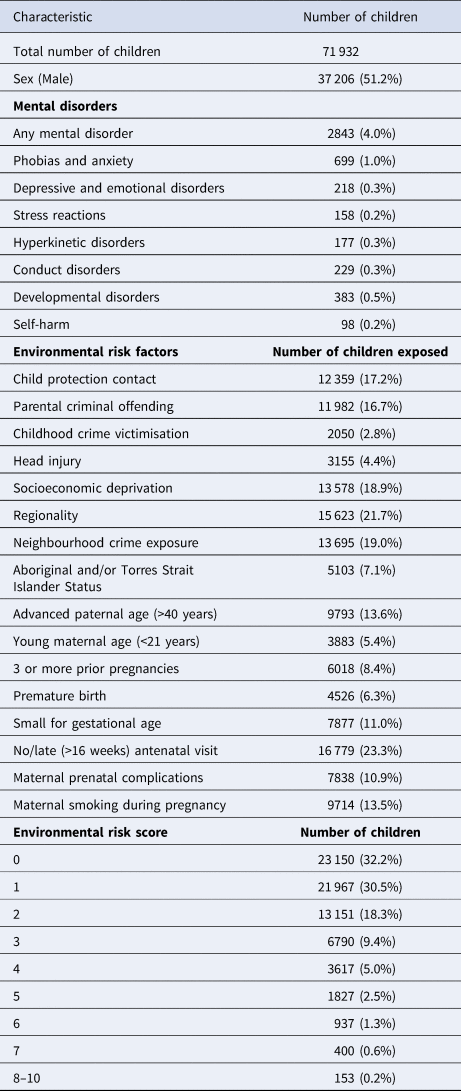
Descriptive data for the cohort are summarised in Table 1. The mean age of the child cohort was 13.2 years (s.d. = 0.4 years), and the mean age of children (who had a diagnosis of any mental disorder) at their first mental health system contact was 6.7 years (s.d. = 3.7 years).
Prevalence of mental disorders, environmental risk factors, and environmental risk score

Associations between environmental exposures and childhood mental disorders
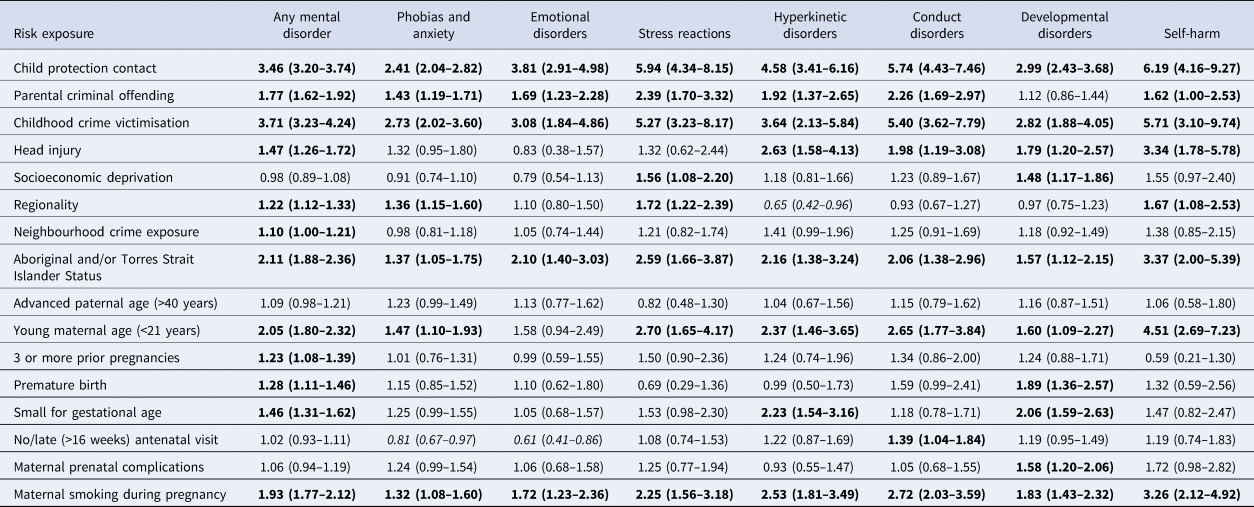
All environmental factors showed significant positive associations with at least one mental disorder, except for advanced paternal age which was not associated with any type of mental disorder (Table 2). Two factors – regionality and no/late antenatal visits – had both positive and negative associations with different mental disorders and were therefore not included in the ERS calculation. Regionality was positively associated with any mental disorder, phobias and anxiety, stress reactions, and self-harm but negatively associated with hyperkinetic disorders (i.e. children living in urban environments were at greater likelihood of health service contact for hyperkinetic disorders compared to children living in rural/remote environments). No/late antenatal visits were positively associated with conduct disorders but negatively associated with phobias and anxiety and emotional disorders (i.e. children whose mothers had had no [or late] antenatal visits were less likely to be diagnosed with a phobia/anxiety or emotional disorder).
Unadjusted ORs (95% CIs) for the association between childhood mental disorders and each environmental risk exposure

Note: ORs, Odds ratio; 95% CIs, 95% confidence interval. Bold indicates significant values (i.e. 95% CI not inclusive of 1). Italics indicates significant effect in the protective direction.
Associations between ERS and childhood mental disorders
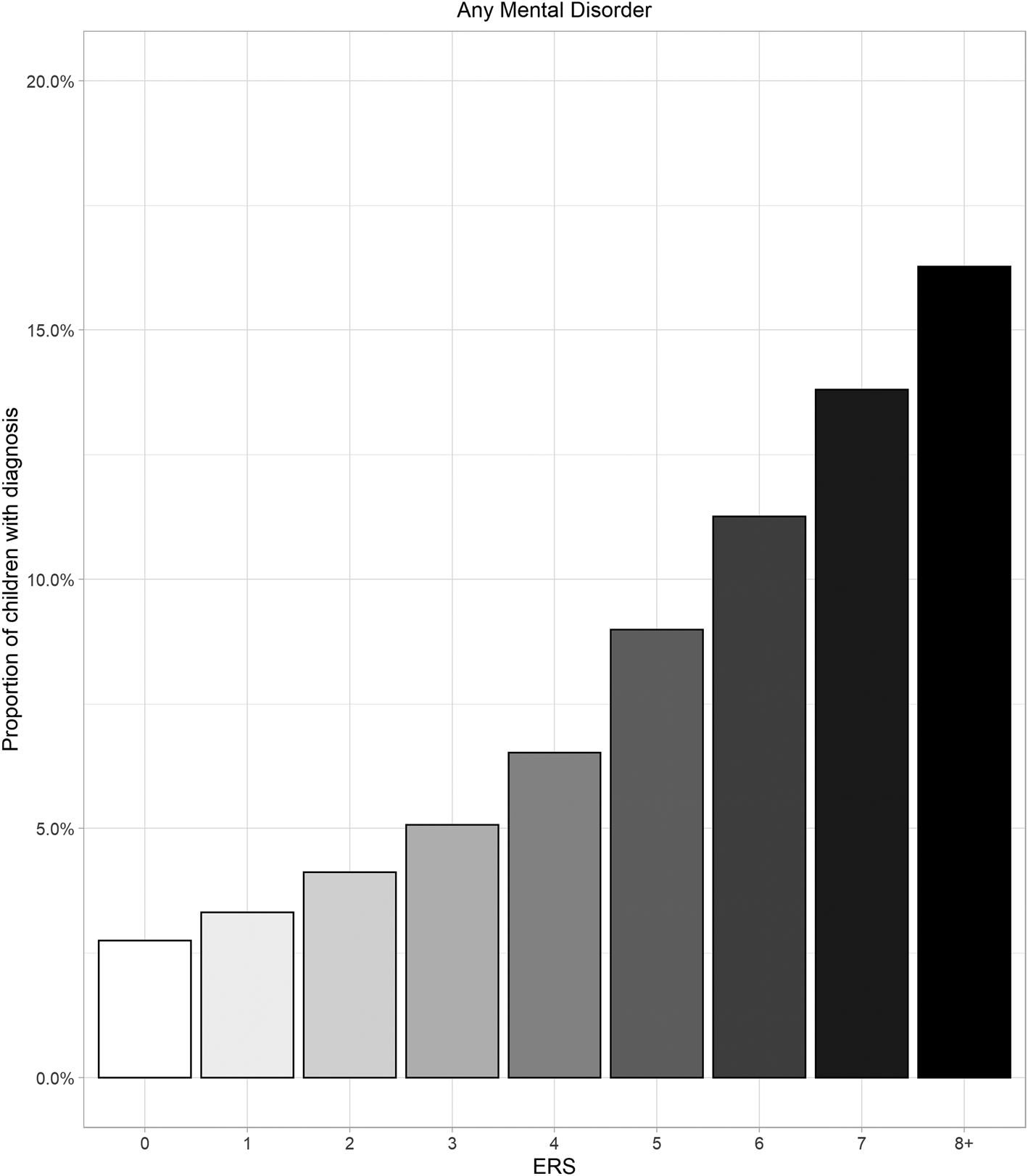
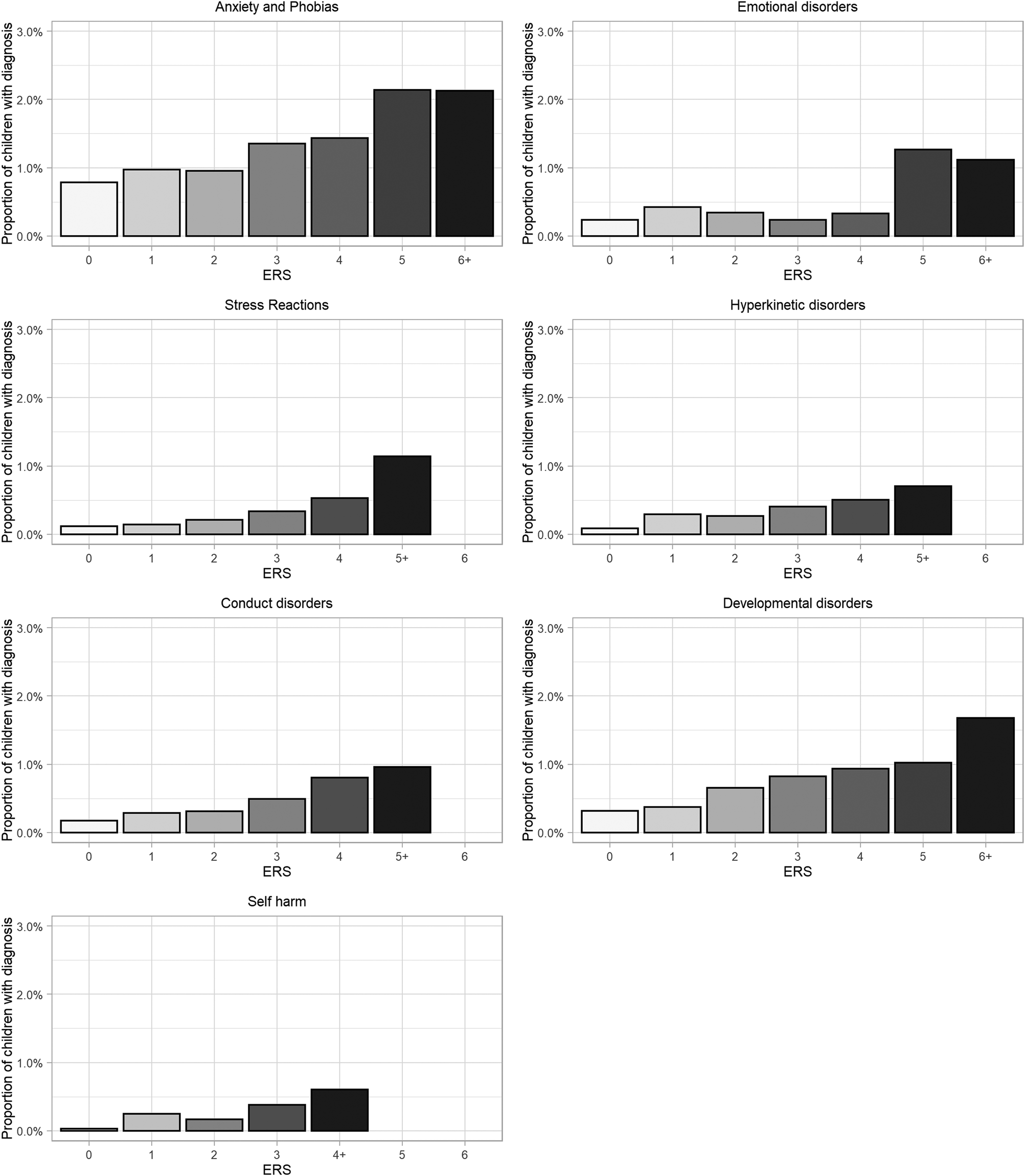
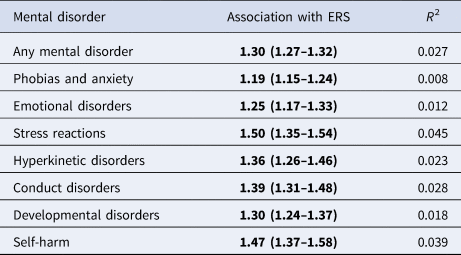
Of the 16 environmental risk factors examined, 13 were summed into an ERS (excluding advanced paternal age, regionality, and no/late antenatal visits). The median ERS score was 1 (IQR = 2; range 0–10). The ERS was associated with all types of mental disorders (see Table 3), and the pattern of associations reflected a dose–response relationship between the number of environmental exposures (higher ERS) and a greater likelihood of mental disorder diagnoses (Fig. 1). Among children with an ERS of zero, only 2.8% had a diagnosis of a mental disorder, while 18.3% of children with an ERS of eight or more had a mental disorder diagnosis. Of the specific mental disorders, the ERS had the strongest association with stress reactions (OR 1.50, 95% CI 1.35–1.54) and self-harm (OR 1.47, 95% CI 1.37–1.58), and the weakest association with phobias and anxiety (OR 1.19, 95% CI 1.15–1.24). The patterns of association between the ERS and specific mental disorder diagnoses were also dose–response in form (Fig. 2), though the proportion of children with phobias and anxiety, and emotional disorders, was slightly lower for children with an ERS of 6+ than children with an ERS of 5.
Proportion of children with any diagnosis of mental disorder by environmental risk score (ERS).

Proportion of children with specific diagnoses by environmental risk score (ERS). ERSs are categorised as to avoid display of small cell sizes (i.e. <15).

Unadjusted ORs (95% CIs) for the association of environmental risk score with childhood mental disorders

Note: ORs, Odds ratio; 95% CIs, 95% confidence interval. R 2, Nagelkerke Pseudo R 2; Bold indicates significant values (i.e. 95% CI not inclusive of 1).
Discussion
In this study of 71 932 Australian children, a cumulative ERS comprised of traumatic life events, prenatal adversities, and adverse neighbourhood features experienced before age 6 years, was associated with all types of childhood mental disorder diagnoses between the ages of 6 to 13 years. Effect sizes for the associations with the ERS were similar in magnitude across all of the 7 mental disorder categories measured, ranging from children having a 1.19 increase in odds of phobias and anxiety disorders per 1 point increase in ERS, to a 1.50 increase in odds of stress reactions per 1 point increase in ERS. Risk of the mental disorder increased in a dose–response fashion with increases in ERS, such that 18.3% of children with an ERS of ⩾8 had a diagnosed mental disorder compared to 2.8% of children with an ERS of zero.
All environmental risk factors tested were associated with at least one type of mental disorder, excepting advanced paternal age. The latter was unexpected given that past research has found a link between advanced paternal age and psychiatric disorders in offspring (de Kluiver, Buizer-Voskamp, Dolan, & Boomsma, Reference de Kluiver, Buizer-Voskamp, Dolan and Boomsma2017). The mechanism for this relationship is not well understood and may reflect genetic (e.g. de novo mutations, epigenetic changes) and/or environmental or social factors that are associated with delayed parenthood (de Kluiver et al., Reference de Kluiver, Buizer-Voskamp, Dolan and Boomsma2017). There may be factors specific to the current study, including the early offspring developmental period being considered or other factors unable to be measured (e.g. parenting style differences), that mitigate or mask the effects of advanced paternal age. Of the 16 environmental risk factors examined, four were associated with all types of mental disorders: child protection contact, childhood crime victimisation, Aboriginal and/or Torres Strait Islander status, and maternal smoking. Two risk factors [no (or late) antenatal visits, and regionality] had both negative and positive relationships with specific disorders. Interestingly, regionality had a protective association with hyperkinetic disorders (i.e. children born in urban environments were more likely to have been diagnosed with a hyperkinetic disorder), consistent with previous evidence of children in urban environments having increased rates of diagnoses of ADHD (Madsen, Ersbøll, Olsen, Parner, & Obel, Reference Madsen, Ersbøll, Olsen, Parner and Obel2015); however, this may reflect easier access to services to receive a diagnosis rather than the increased prevalence of the disorder among urban children. Further, children whose mothers attended no (or late) antenatal visits were less likely to be diagnosed with a phobia or anxiety disorder, or an emotional disorder. This could reflect levels of parental engagement with the health system, with those parents who were less likely to attend antenatal visits also being less engaged with child health services. This effect was more pronounced for internalising disorders which typically have less overt symptoms and may be more likely to remain underdiagnosed.
When early life environmental factors were summed into an ERS, significant associations were evident with both a global index of ‘any type’ of mental disorder diagnosis, as well as all specific types of diagnoses examined. Effect sizes were largely consistent across the different types of disorders – the smallest association between the ERS and a specific type of mental disorder was with phobias and anxiety disorders (OR 1.19, 95% CI 1.15–1.24), and the largest with stress reactions (OR 1.50, 95% CI 1.35–1.54). These findings extend previous evidence of an ERS associated with psychotic disorders (e.g. Pries et al., Reference Pries, Lage-Castellanos, Delespaul, Kenis, Luykx, Lin and Guloksuz2019; Stilo et al., Reference Stilo, Gayer-Anderson, Beards, Hubbard, Onyejiaka, Keraite and Morgan2017), showing that cumulative exposure to environmental risk also predicts other mental disorders that emerge in childhood. While the strength of the association varied slightly between disorder types, these findings support the idea that cumulative environmental risk represents a transdiagnostic indicator of risk for the full spectrum of mental disorders. The proportion of children with a mental disorder diagnosis increased in a dose–response fashion with the ERS (Fig. 1), where only 2.8% of children with an ERS of zero had a mental disorder, increasing incrementally through to 18.3% of children with an ERS of ⩾8 being diagnosed with a mental disorder by age 13 years. The same dose–response pattern was observed for most of the disorder subcategories, though there was little difference in the proportion of children with an ERS of 5 or 6+ who were diagnosed with anxiety and phobias, and emotional disorders (Fig. 2).
The current findings extend previous research showing that children who have been exposed to prenatal risk factors (Roffman et al., Reference Roffman, Sipahi, Dowling, Hughes, Hopkinson, Lee and Dunn2021), trauma or neglect (Hughes et al., Reference Hughes, Bellis, Hardcastle, Sethi, Butchart, Mikton and Dunne2017) and neighbourhood adversity (Curtis et al., Reference Curtis, Pain, Fuller, Khatib, Rothon, Stansfeld and Daya2013) are more likely to develop mental disorders; here, we demonstrate that an accumulation of these risk factors across the early life-course increases the likelihood of developing later mental disorders in a dose-dependent fashion. Furthermore, we extend previous findings which have shown that cumulative social risk factors (Saunders et al., Reference Saunders, Janus, Porter, Lu, Gaskin, Kalappa and Guttmann2021) and cumulative perinatal risk factors (Chittleborough, Searle, Smithers, Brinkman, & Lynch, Reference Chittleborough, Searle, Smithers, Brinkman and Lynch2016) predict early childhood (age 5 years) developmental vulnerability, by demonstrating that these associations extend to diagnoses of mental disorders in middle childhood (age 6–11 years).
The finding that early childhood environmental exposures (before age 6 years) are associated with childhood mental disorders calls for policies that prioritise reducing exposure to adverse environmental risks in early life. In NSW, there is a ‘first 2000 days’ framework which recognises the importance of the first 5 years of a child's life, and prioritises working with families during these years, including targeted specialist support for children most at risk of adverse outcomes (Mendoza Diaz et al., Reference Mendoza Diaz, Burman, Finlay Jones, Short, Woolfenden, Downs and Eapen2020). The current findings suggest that the number of different risk factors a child experiences is an important consideration when determining which children are most in need of targeted support. Further, the findings support inter-agency interaction to identify children most at risk, since children may encounter environmental adversities in a range of contexts.
The current study findings should be interpreted with consideration of several limitations. First, mental disorder diagnoses were derived from a routinely collected emergency department, inpatient hospital, and outpatient mental health service records, such that children with mental disorders diagnosed by general practitioners and private specialists would not be captured by these records; other children who did not have access to these services, or who did not receive care despite being mentally unwell, would have been missed. The prevalence of mental disorders in our sample was therefore likely underestimated; this misclassification of children's mental disorder status would have only weakened (rather than exaggerated) the strength of any associations. Second, neighbourhood risk factors were defined on the basis of geographical boundaries determined by the Australian Bureau of Statistics and may not necessarily reflect the day-to-day neighbourhood/s with which the child engages. Third, in some cases, creating binary indicators to reflect exposure to environmental risk factors may have led to the loss of valuable information as to the type, timing, and severity of risk, important for understanding associations. Fourth, the additive model of environmental risk used cannot account for interactions between environmental factors, which may be important in the aetiology of mental disorders (Uher & Zwicker, Reference Uher and Zwicker2017). However, there is no conclusive evidence favouring an interactive model over an additive model (Stepniak et al., Reference Stepniak, Papiol, Hammer, Ramin, Everts, Hennig and Ehrenreich2014; Vassos et al., Reference Vassos, Sham, Kempton, Trotta, Stilo, Gayer-Anderson and Morgan2020) and correlations between environmental factors were small in our cohort (online Supplementary Table S3). Last, the choice of environmental risk factors to be included in the ERS was limited by what data had been collected by each agency and do not represent all possible environmental adversities. Strengths of the study include the longitudinal nature, the large sample size, and the representativeness of the sample to the source population (Carr et al., Reference Carr, Harris, Raudino, Luo, Kariuki, Liu and Green2016; Green et al., Reference Green, Harris, Laurens, Kariuki, Tzoumakis, Dean and Carr2018). Further, the use of multiagency record linkage data avoids recall or interviewer biases, minimises attrition, and allowed examination of a range of different types of risk factors.
In conclusion, we show here that cumulative exposure to risk in early childhood, as determined from routinely collected administrative data, is associated with the full range of mental disorders in middle childhood. This extends previous research showing that prenatal factors (Roffman et al., Reference Roffman, Sipahi, Dowling, Hughes, Hopkinson, Lee and Dunn2021), neighbourhood factors (Theall et al., Reference Theall, Drury and Shirtcliff2012), and experiences of trauma or neglect (Hughes et al., Reference Hughes, Bellis, Hardcastle, Sethi, Butchart, Mikton and Dunne2017) are associated with mental disorders by demonstrating their cumulative effects on risk for mental disorders. Further, the relationship between cumulative environmental risk and mental disorder appears to be a transdiagnostic risk factor associated with all categories of childhood mental disorders. In general, the cumulative ERS used in this study had the same pattern of association across different types of disorders, but self-harm and stress reactions had the strongest association with the ERS, and phobias and anxiety disorders the weakest. Taken together, these findings support the need for public policies that focus on preventing the accumulation of environmental adversities or mitigating their effects in the first five years of life, and demonstrate that, while proximal experiences of trauma and neglect are important risk factors for childhood mental disorders, the child's wider context, including neighbourhood and prenatal risk exposures, is an important consideration.
Supplementary material
The supplementary material for this article can be found at https://doi.org/10.1017/S0033291722001702.
Acknowledgements
This research used population data owned by the NSW Department of Communities and Justice; NSW Ministry of Health; NSW Registry of Births, Deaths and Marriages; the Australian Coordinating Registry (on behalf of Australian Registries of Births, Deaths and Marriages, Australian Coroners and the National Coronial Information System); the Australian Bureau of Statistics; the NSW Bureau of Crime Statistics and Research, and the NSW Police Force. This paper uses data from the Australian Early Development Census (AEDC). The AEDC is funded by the Australian Government Department of Education, Skills and Employment. The findings and views reported are those of the author and should not be attributed to these Departments or the NSW and Australian Government. The record linkage was conducted by the Centre for Health and Record Linkage.
Financial support
This research was conducted by the University of New South Wales with financial support from the Australian Research Council (ARC) Linkage Project (LP110100150, with the NSW Ministry of Health, NSW Department of Education, and the NSW Department of Communities and Justice representing the Linkage Project Partners), Discovery Project (DP170101403) and ARC Future Fellowship (FT170100294 awarded to KRL), as well as the National Health and Medical Research Council (NHMRC) Project Grants (APP1058652 and APP1148055), NHMRC Partnership Project (APP1133833), and NHMRC Investigator Grant (APP1175408 awarded to KD).
Conflict of interest
None.