INTRODUCTION
Lough Hyne Marine Nature Reserve in West Cork, south-west Ireland is a highly sheltered inland marine lough, connected to the Atlantic Ocean by a narrow shallow channel, known as the ‘Rapids’. Lough Hyne has been described as a biodiversity hotspot as it supports a high faunal diversity within a small geographical area (0.5 km2) (Bell, Reference Bell2007). This high biodiversity was the principal factor in its designation as Europe's first marine nature reserve in 1981 and it remains the Republic of Ireland's only marine nature reserve. A broad range of biodiversity studies has taken place in the variety of subtidal habitats within the Lough for over 100 years. However, the last study of the soft sediment fauna was performed by Thrush & Townsend (Reference Thrush and Townsend1986). Prior to that, Kitching et al. (Reference Kitching, Ebling, Gamble, Hoare, McLeod and Norton1976) studied the soft sediment benthos of the Western Trough, the deepest part of the Lough. The present study commenced in May 2009 to reassess the soft sediment ecology and biodiversity within the Lough.
MATERIALS AND METHODS
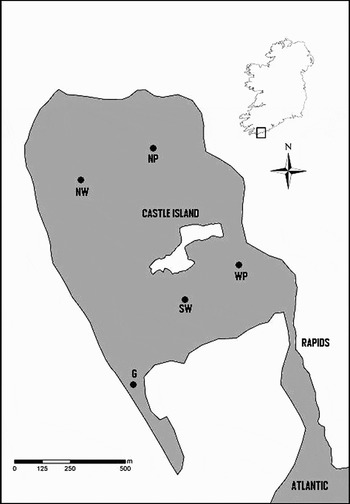
Sediment samples were taken on 12 May 2009 by van Veen grab (0.05 m2) inside Lough Hyne (see Figure 1). Sample depth except in the Western Trough was between 15 and 23 m. Four samples were taken at six sites (see Figure 1). Samples were fixed in 5% formalin for two days before being transferred to 70% ethanol for storage and later identification. Grain size was analysed following chiefly Buchanan & Kain (Buchanan & Kain, Reference Buchanan, Kain, Holme and McIntyre1971). Organic matter was analysed by taking one gram of oven dried sediment sample (dried at 80°C for 48 hours) and burning it for six hours at 450°C before reweighing. This was repeated for a subsample of each sediment sample.
Map of Lough Hyne. Five sampling stations where Rhabdomolgus ruber has been found in Lough Hyne. G, Goleen; NW, North-west; NP, North Pier; SW, South-west; WP, Whirlpool Cliff.

RESULTS
Ten of the 24 samples at five out of six locations contained 14 specimens of Rhabdomolgus ruber Keferstein. The species was absent from the Western Trough (sample depth 45 m). Table 1 lists locations, number of individuals found, median grain size and organic matter content. The specimens were between 4 and 18 mm long.
Sampling sites, frequencies of occurrence of Rhabdomolgus ruber and corresponding environmental conditions at six sampling locations.

DIAGNOSIS
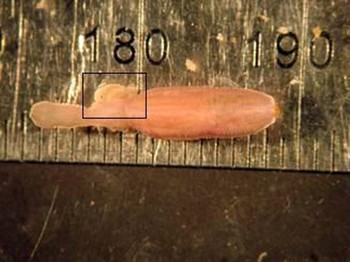
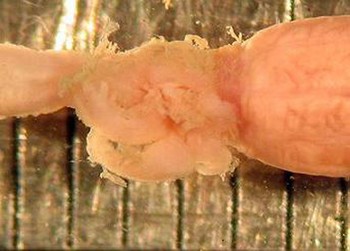
The collected specimens were identified using the echinoderm key of Southward & Campbell (Reference Southward, Campbell, Crothers and Hayward2006). Rhabdomolgus ruber (Figure 2) is a cylindrical animal without tube feet or spicules. Ten finger-like tentacles were withdrawn into the body or partly protruded in the dead specimens (Figure 3). The alimentary canal is straight.
Rhabdomolgus ruber. Sample specimen where some tentacles can be seen (box).

Close-up of protruded tentacles of Rhabdomolgus ruber.

SYSTEMATICS
DISCUSSION
The specimens collected in Lough Hyne are morphologically consistent with the existing descriptions of Keferstein (Reference Keferstein1863) and Southward & Campbell (Reference Southward, Campbell, Crothers and Hayward2006). The specimens found in Lough Hyne are bigger than described by those sources (up to 18 mm, rather than 10 mm maximum length as described by Keferstein). However, Keferstein (Reference Keferstein1863) based his description on a single specimen found near Cherbourg, France. Numerous specimens found at Helgoland (Menker, Reference Menker1970) were much smaller (4–5 mm long), but at that site sediment grain size was larger, and the amount of organic matter lesser than at Lough Hyne (Table 1). These differences may help to explain the larger body size of the specimens found in our study.
Rhabdomolgus ruber was found at a depth of 19 – 21 m around Helgoland (Menker, Reference Menker1970), while in Lough Hyne it presented itself at similar depths from 15 to 23 m. There are two reasons why it may not have been found in the Western Trough where samples were taken at a depth of 45 m. Firstly it may simply be restricted to the shallow subtidal. Secondly the Western Trough of Lough Hyne is known to develop a strong thermocline during the summer months, beneath which the water becomes anoxic and essentially lifeless (McAllen et al., Reference McAllen, Davenport, Bredendieck and Dunne2009). The grab samples taken in May 2009 were black and smelt of hydrogen sulphide. This indicates hypoxic/anoxic conditions on the sampling day, which are probably incompatible with survival in R. ruber.
The lack of previous records of this species may have two reasons: either it is slow at spreading its geographical distribution, or (more probably), it may have been previously overlooked (Southward, personal communication). Greenwood et al. (Reference Greenwood, Barnes and O'Riordan2000) found synaptid larvae in vertical plankton tows at the entrance to Lough Hyne and in the water column over the Western Trough. Their samples were taken from a depth of 20 m. These may well have been larvae of Rhabdomolgus ruber, but further plankton sampling would be needed to confirm this.
ACKNOWLEDGEMENTS
Many thanks to E. Southward for help with identification of Rhabdomolgus ruber. Luke Harman and Catherine Russell helped with the collection of sediment samples. The Aquatic Services Unit, Environmental Research Institute Cork lent sampling equipment and gave advice. One of us (S.B.) acknowledges the support of the Crawford Hayes PhD studentship of University College Cork. We thank two anonymous referees for their valuable comments.