Introduction
In recent years, there has been an increasing recognition of the impacts of industrialized food and fiber production on soils, waters and the atmosphere. The extensive tillage commonplace in industrial agriculture alters soil food websReference Hendrix, Parmelee, Crossley, Coleman, Odum and Groffman1, increases nitrogen lossesReference House, Stinner and Crossley2 and erosionReference West, Miller, Bruce, Langdale, Laflen and Thomas3, depletes soil carbonReference Jarecki and Lal4–Reference Lal6 and has been the source of surface and groundwater nitrateReference Burkart and Stoner7 and other nutrient contaminationReference Burkhart and James8, Reference Donner, Kucharik and Foley9. In the southeastern US, centuries of row cropped monocultures have eroded vast tracts of surface soil horizons. The exposed, heavily weathered subsoil often lacks any appreciable organic matter or available nutrientsReference Rhoades, Nissen and Kettler10. In addition to this land use legacy, the subtropical climate in the region provides a myriad of management challenges. The climate is hot and humid with abundant rainfall, thus organic amendments and soil organic matter (SOM) decompose rapidly, and pest, pathogen and weed pressures are high. Dealing with this combination of historical, edaphic and climatic factors is a challenge for sustainable agriculture.
SOM has been identified as a ‘keystone’ property driving above- and below-ground productivityReference Swift, Izac and van Noordwijk11, and is a holistic indicator of soil quality in subtropical climatesReference Nguyen and Klinnert12, Reference Jordan13. A number of management techniques have been proposed to protect and restore SOM, or its chief constituent, soil organic carbon (SOC). These include the use of cover crops, perennial legumes, conservation tillage and composts. The benefits and disadvantages of these techniques in the southeastern US are reviewed below.
Winter cover crops have proven effective in increasing SOCReference Sainju, Singh and Whitehead14, Reference Sainju, Whitehead and Singh15. However, incorporating cover crop residues via tillage may negate potential SOM gains, due to the rapid decomposition of incorporated residueReference Jarecki and Lal4, Reference Sainju, Singh and Whitehead14, Reference Sainju, Whitehead and Singh15. Incorporation of leguminous residues may cause early season N losses due to rapid decomposition of nitrogenous residuesReference Cherr, Scholberg and McSorley16.
Alley cropping (AC) is a technique where hedgerows of trees or shrubs are planted between rows, or alleys, of crop plantsReference Kang, Ghuman, Moldenhauer, Hudson, Sheng and Lee17. This technique is often practiced in the tropics where leguminous hedgerow species are used as perennial source of crop fertility, animal fodder and erosion controlReference Rao, Ong, Pathak and Sharma18–Reference Long and Nair20. In these systems, shoots of hedgerow plants are coppiced, and the pruned branches applied as a mulch and green manure for adjacent crop plants. This application may have utility in the southeastern US, where hedgerows have the potential to produce large quantities of biomass due to the subtropical climate. JordanReference Jordan13 hypothesized that AC systems in the Southeast could reduce off-farm inputs, aid in weed suppression, control erosion and tighten nutrient cycles. However, AC systems can be land and labor intensive. Hedgerows may occupy 25% or more of available croplandReference Matta-Machado and Jordan21 and require labor to establish and manage. As such, previous works have concluded AC may be best suited for labor-intensive operations, such as organic and high-value horticultural cropsReference Rhoades, Nissen and Kettler10, Reference Rhoades, Nissen and Kettler13, Reference Rhoades, Nissen and Kettler21–Reference Seiter, William and Hibbs23.
Conservation tillage has been shown to increase yields and SOM, reduce nutrient pollutionReference Tyler, Wagger, McCracken, Hargrove and Carter24, and to decrease erosionReference West, Miller, Bruce, Langdale, Laflen and Thomas3, Reference Langdale, West, Bruce, Miller and Thomas25. However, conservation tillage is often dependent on herbicides for weed management and termination of cover crops. These chemicals have been shown to move beyond the ‘farm gate’, even in conservation tillage systemsReference Sims, Buhler, Turco and Unger26.
Organic agriculture is not widely adopted in Georgia27, but research in the northeastern US has demonstrated organic practices can increase soil C and produce yields comparable to those of conventional agricultureReference Pimentel, Hepperly, Hanson, Douds and Seidel28, Reference Drinkwater, Letourneau, Workneh, Vanbruggen and Shennan29. In organic agriculture, crop fertility needs are often met through application of composts, cover crops, animal manures, or mineral deposits in sand or gravel dustsReference Altieri30. These techniques can require less fossil fuel inputs than conventional agricultureReference Pimentel, Hepperly, Hanson, Douds and Seidel28, but may still experience high nutrient lossesReference Pimentel, Hepperly, Hanson, Douds and Seidel28, Reference Vadas, Kleinman and Sharpley31 due to extensive tillage and application of nitrogenous organic amendments. While organic agriculture may be considered ‘low external input’ in comparison to conventional agricultureReference Liebman, Gibson, Sundberg, Heggenstaller, Westerman, Chase, Hartzler, Menalled, Davis and Dixon32, nutrient and pest management inputs may come from far off-farm, and have higher labor costsReference Pimentel, Hepperly, Hanson, Douds and Seidel28, Reference Altieri30.
As reviewed, alley cropping, conservation tillage, winter cover cropping and organic farming practices have been shown to increase SOM and address other aspects of soil quality in the southeastern US. However, they are most often studied individually and not in combination. The objective of this study was to design cropping systems that incorporate a suite of these techniques and to study their effects in combination on SOM, agronomic soil quality and plant production. To our knowledge, this is the only organic, conservation tillage, agroforestry experiment in the southeastern US.
Materials and Methods
Site description
The study site is located in the Georgia Piedmont, near Athens, Georgia, USA (33°57′N 83°19′W). Soils on the research farm have been in cultivation since 1864. The soil at the experimental site is a Pacolet sandy clay loam (kaolinitic, thermic typic hapludults). The A horizon was entirely eroded away as a result of nearly a century of cotton farming. The surface soil was a remnant B-horizon of heavily compacted red clay. Intense cultivation and grazing on the site ceased in 1993, when management shifted to a mowed fallow. This degraded site was chosen to test the methods on an extremely poor soil in the Georgia Piedmont. In 2001, leguminous hedgerows of Albizia julibrissin (mimosa) were planted 5 m apart along an east-facing slope on the site. Between 2001 and 2004, the alley ways were planted with a variety of vegetables and cotton. This work commenced in 2004.
Experimental design
The four experimental cropping systems were:
1. AC with organic vegetables using strip tillage (AC),
2. organic vegetables using strip tillage [no alley cropping and organic strip tillage (OST)],
3. conventionally fertilized, conventionally tilled (CT) vegetables, and
4. a mowed fallow (fallow).
The AC and CT cropping systems and the fallow were established in 2004 and studied for 3 years, and the OST system was established in 2005, and studied for 2 years. At the start of this experiment in summer 2004, the alleys were surface tilled with a roto-tiller to a depth of 5 cm. A summer cover crop of sunn hemp (Crotalaria juncea) was broadcast sown and killed with a mechanical grass roller (a ‘roller crimper’) in September.
In early October of each following year, summer vegetation was killed using the roller crimper. A blend of legume and grass cover crops consisting of crimson clover [Trifolium incarnatum (20.17 kg ha−1)], Austrian winter pea [Pisum sativum (22.61 kg ha−1)] and winter rye [Secale cereale (53.80 kg ha−1)] was broadcast sown over the summer vegetation. In the spring when crimson clover was in full flower and winter rye was at ‘soft dough’ stage (early mid April), winter cover crops in the AC and OST treatments were mechanically killed with the roller crimper. Cover crop residues were allowed to decompose for approximately 2 weeks, and then plots were strip-tilled to create a planting furrow 15 cm wide by 15 cm deep. The conventionally tilled treatment was disked and roto-tilled approximately 1 week prior to vegetable planting.
Vegetable crops were direct seeded (years 1 and 3) or transplanted (year 2) into the furrow by hand. All vegetable crops were irrigated using drip irrigation, which was installed prior to planting each spring and removed each fall. The sequence of summer vegetables began with okra (Abelmoschus esculentus, ‘Clemson spineless’) in year 1, and was followed in year 2 by hot peppers (Capsicum annum, ‘Long cayenne’) and corn and winter squash intercrop (Zea mays, ‘Reid's yellow dent’ and Cucurbita moschata, ‘Waltham butternut’) in year 3. All plots were hand weeded throughout the growing season.
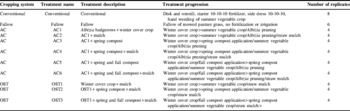
The AC system consisted of six treatments with varying rates of compost application, and with and without straw mulch (Table 1). Hedgerows were pruned one to three times each summer to a height of 1 m when they began to shade crop plants. Prunings were evenly applied to the cultivated plots in adjacent alleys. AC plots were 5 m wide (the spacing between the hedgerows) by approximately 6 m in length. The OST system consisted of three treatments with varying rates of compost application to correspond with the AC cropping system, with all treatments receiving straw mulch. OST plots were 5 m by 5 m. Compost consisted of poultry litter and wood chips. Straw mulch consisted of wheat straw in year 1 and pasture hay in years 2 and 3. Compost and straw mulch were applied by hand in all treatments. Conventional treatments were broadcast fertilized with inorganic fertilizers (10-10-10 percent N, P and K, respectively) in bands adjacent to crop rows within 10 cm of crop plants. Rates of application were according to University of Georgia (UGA) Cooperative Extension fertilizer recommendations for each cropReference Colditz, Granberry and Vavrina33–Reference Kelley and Langston36. All treatments were randomly distributed within their respective cropping system. Complete treatment descriptions are listed in Table 1.
Description of experimental treatments.

>Indicates the treatment progression. / Indicates concurrent treatments.
Soils were sampled in the fall of each year prior to fall compost application and sowing of the winter cover crop. Soils were sampled from 0 to 5 cm and 5 to 15 cm for C, N and pH, with three soil cores collected randomly from the middle portion of each plot and bulked for a single analysis. C, N and pH samples were oven dried at 50°C to a constant mass, passed through a 2 mm sieve, and ground on a Spex mill to a particle size <250 μm. Samples were analyzed for total C and N by micro-Dumas combustion assay. pH was assayed from a solution of equal volumes of soil and water using an Fischer Scientific Accument 25 pH meter. Bulk density was sampled from 0 to 5 cm in the fall of each year, with one sample collected from the middle portion of each plot, outside of the planting furrow. Aggregate stability was sampled in the spring of 2004 in the AC treatments, and in the fall of 2005, 2006 and 2007 in all treatments. Three 0–5 cm cores were collected randomly from each plot, air dried and bulked for a single analysis per plot. Water stable aggregates (WSAs) >250 μm were determined by wet sieving by hand, according to USDA Soil Quality Test Kit protocol37.
Soils were sampled for microbial biomass six times over 3 years, in the winter (February) and spring (late April) of each year to obtain low and high microbial activity, respectively. Three soil cores from 0 to 5 cm were collected per plot, placed on ice at collection and refrigerated prior to processing, which occurred within 24 h of collection. Samples were hand sorted to remove roots and rocks greater than 2 mm. Hand sorting was preferred to the passing samples through a 2 mm sieve, as samples from the initial sampling date soils were too wet and clayey to pass through the sieve, thus succeeding processing was handled identically. Soil microbial biomass was determined by the chloroform fumigation extraction methodReference Vance, Brookes and Jenkinson38. Samples were fumigated for five days to maximize extraction of microbial biomass C in wet, clayey soilsReference Motavalli, Parton, Elliott and Frey39. Extracted samples were stored frozen prior to analysis on a Shimadzu 500 Total Organic Carbon analyzer. Microbial biomass C was calculated as the difference between fumigated and non-fumigated samples using a k c value of 0.45Reference Joergensen40.
Vegetation was sampled in the spring and fall, corresponding to the end of the winter and summer cropping seasons. One 0.25 m2 sample was collected randomly from the middle portion of each plot. Above- and below-ground biomass was collected, with above-ground biomass reported in this work. Vegetation samples were dried at 50°C to a constant mass and sorted into weed and crop categories to determine if the vegetation community had changed between years. Biomass was recorded for each category, and then bulked into a single sample per plot for nutrient analysis.
Crop yields were recorded throughout the summers of 2005 and 2006 from four marked plants per plot. Fruits from one of the marked plants in each plot were collected and dried throughout the season, and combined by plot at the end of the season for a single nutrient analysis. In 2007, all winter squash fruits in each plot were weighed for yield determinations, due to the difficulty in isolating individual squash plants. One fruit per plot was collected for nutrient analysis. Corn yields were estimated from kernel counts on 10 ears of corn per plot and total number of corn plants per plot. Yield calculations assumed an average of 90,000 kernels bushel−1 and average mass of 24.36 kg bushel−1, which was determined by dry weights of a known quantity of oven dry kernels. Corn grain nutrient content was obtained from ears collected in 0.25 m2 vegetation samples.
Hedgerow prunings and straw mulch additions were sampled at the time of application, with one, 1 m2 sample collected from the middle portion of each plot. Except for winter squash fruits, all amendment and crop yield samples were dried in a 50°C drying oven to a constant mass. Winter squash fruits were dried in an American Harvest Food Dehydrator to a constant mass, due to samples molding in the drying oven. Vegetation samples were homogenized on a Wiley mill with a 2 mm screen. Subsamples were ball-milled to less than 250 μm particle size on a Spex mill, and analyzed for C and N by micro-Dumas combustion assay. All analyses were conducted at the UGA School of Ecology Analytical Chemistry Laboratory.
Statistical analysis
Data were analyzed using the MIXED procedure with restricted maximum likelihood (REML) in SAS Version 9.1 for PC41 as a randomized block with sampling date as the repeated measure, plot as a random variable. Treatment effects were nested within cropping system (AC, OST, CT and Fallow). A nested experimental design was necessary to keep hedgerow roots isolated within the AC system. Differences between treatments with significant interactions were determined by pairwise differences.
Results
Soil characteristics
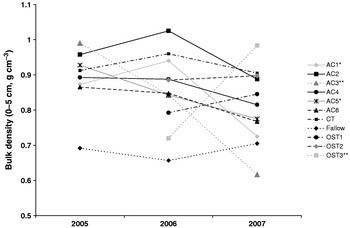
Bulk density (g cm−3) from 0 to 5 cm differed significantly by treatment over time (P=0.0332). AC treatments not receiving mulch (AC2, AC4 and AC6) decreased significantly over 3 years. Bulk density in other AC treatments also decreased over time, but trends were not significant. OST treatments receiving mulch and 0 or 22.4 Mg ha−1 of compost, Fallow and CT treatments did not change significantly. Bulk density in OST3 increased significantly over 3 years (Fig. 1). Mean values for all treatments were uncharacteristically low for the region.
Soil bulk density (g cm−3) from 2005 to 2007. *Indicates significance at P⩽0.10. **Indicates significance at both P⩽0.10 and P⩽0.05.

WSAs >250 μm in the 0–5 cm soil depth changed significantly over time (P<0.001) but not by treatment. Mean WSAs from all treatments increased from year 1 (65.97±7.12%) to year 3 (80.17±1.66%), then decreased from year 3 to year 4 (58.45±6.17%).
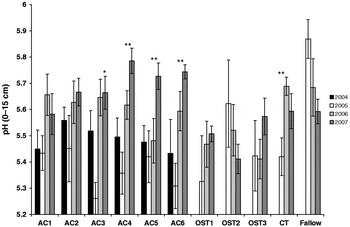
pH was higher in the 0–5 cm depth than in 5–15 cm depth (P<0.0001), with significant treatment by time interactions (P<0.0001). Irrespective of depth, AC treatments receiving compost (AC3–AC6) and the CT increased in pH (Fig. 2). OST and Fallow treatments did not change significantly.
Soil pH (0–5 cm) by treatment from 2004 to 2007. *Indicates significance at P⩽0.10. **Indicates significance at both P⩽0.10 and P⩽0.05.

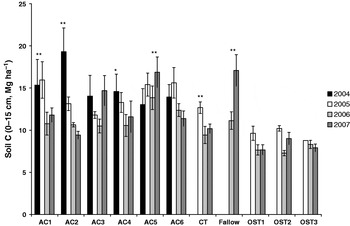
Gravimetric soil C and N content (%C and %N) were converted to volumetric content using bulk density values from 0 to 20 cm samples that were taken after the study had concluded (data not shown). Four samples were taken from each cropping system (AC, OST, CT and Fallow) and the mean value used for both 0–5 cm and 5–15 cm calculations. This estimation was necessary, as bulk density was sampled only from 0 to 5 cm during the course of the field study. Soil C was greater from 0 to 5 cm than from 5 to 15 cm in all treatments (P<0.0001) and significantly different by time (P<0.0001) and treatment by time (P=0.0009). Depth by time interactions were significant (P<0.0001), with soil C increasing from 0 to 5 cm and decreasing from 5 to 15 cm. Irrespective of depth, CT and AC treatments without compost additions (AC1 and AC2) decreased significantly over 3 years (Fig. 3). The OST treatments also decreased, but the trend was not significant. The only significant increases in soil C were in the Fallow and AC5, which received 44.8 Mg ha−1 of compost annually and not mulch. Treatments receiving mulch, irrespective of the quantity of compost and/or alley cropping, did not increase significantly in soil C. Soil microbial biomass carbon (μg C g−1 dry soil) fluctuated seasonally, with higher biomass C in spring than in winter (P=<0.0001), but did not differ significantly by treatment or by treatment over time (data not shown).
Soil %C (0–15 cm) by treatment from 2004 to 2007. Values reported are mean treatment values±S.E. *Indicates significance at P⩽0.10. **Indicates significance at both P⩽0.10 and P⩽0.05.

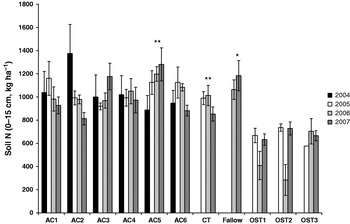
Changes in soil nitrogen (N) were significant by treatment (P<0.0001) and were higher from 0 to 5 cm than 5 to 15 cm in all treatments (P<0.0001). Depth by time interactions were significant (P<0.0001), increasing from 0 to 5 cm while decreasing from 5 to 15 cm over the course of the study. Soil N differed significantly by treatment over time (P=0.0016), with trends following the same pattern as soil C. However, the only significant increases in soil N were in AC treatments receiving 44.8 Mg ha−1 of compost but not mulch (AC5) and the Fallow. The only significant decreases were in the AC treatment without compost (AC2) and in the CT treatment (Fig. 4).
Soil %N (0–15 cm) by treatment. Values reported are mean treatment values±S.E. *Indicates significance at P⩽0.10. **Indicates significance at both P⩽0.10 and P⩽0.05.

Vegetation characteristics
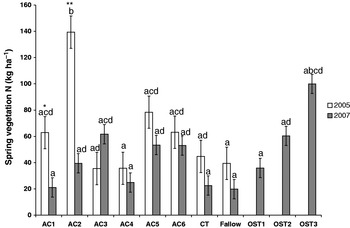
Spring vegetation results include data from 2005 and 2007, as 2006 samples rotted in storage prior to analysis. Across all years, cover crop biomass was greater than fallow vegetation in the CT and fallow treatments (P<0.0001). Cover crop biomass declined in all treatments from 2005 to 2007 (P=0.0056), but treatment by date interactions were not significant (data not shown). Cover crop N (kg ha−1) results had significant treatment by date interactions (P=0.0374), with declining N production in virtually all AC treatments (Fig. 5). Declines in AC treatments receiving compost (AC3–AC6) were less precipitous than those without compost. Spring weed biomass increased significantly from 2005 to 2007 across all treatments (P=0.0135), from 64.87 kg ha−1 (0.99% of spring biomass) to 858.91 kg ha−1 (16.00% of spring biomass) in the AC treatments. Although treatment effects were not significant, mulched treatments had considerably less spring weed biomass.
Spring vegetation above-ground biomass N (kg ha−1) by treatment. Values reported are mean treatment values±S.E.

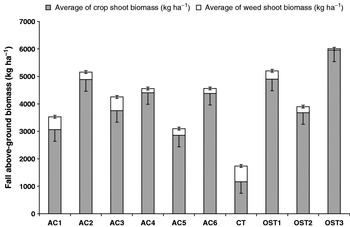
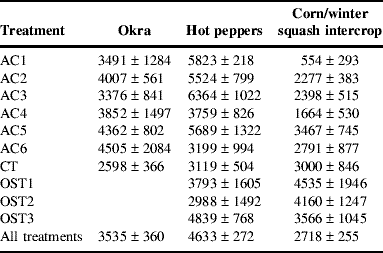
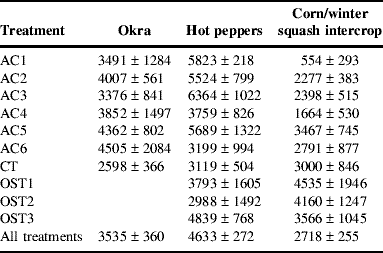
Fall vegetation biomass (kg ha−1) consisted of crop plants and weeds harvested at the end of the summer growing season. Crop biomass (kg ha−1) differed significantly by date (P<0.0001) and treatment (P=0.0368), generally with greater biomass in mulched than non-mulched treatments. All AC and OST treatments had greater crop biomass than the CT treatment. Fall weed biomass decreased significantly over time (P=0.0549) and by treatment (P=0.0054). Across all years, mulched treatments had lower weed biomass, and by the final sampling date weeds in mulched treatments were nearly non-existent (Fig. 6). Crop yields (fruit biomass) differed significantly by year (P=0.0002), due to morphological differences in the crops in the rotation. Yield differences were not significant by treatment due to high variation in the data. Mean crop yields are presented in Table 2.
Fall crop and weed above-ground biomass (kg ha−1) from 2005 to 2007. Values reported are mean treatment values±S.E.

Annual crop yields by treatment. Values reported are treatment mean yields (kg ha−1)±standard error (S.E.).
Biomass of hedgerow prunings differed significantly by date (P<0.0001), with greater biomass from the first annual pruning than succeeding prunings. Corresponding C and N inputs (kg ha−1) from the pruned biomass varied significantly over time (P<0.0001 and P<0.0001, respectively), as did the C/N ratio (P<0.0001). During the 2005 season, biomass and C/N ratios declined over the course of three pruning dates. In 2006, biomass and C/N ratios increased from the first to the second pruning. Only one pruning was necessary in 2007, as a late spring frost killed developing mimosa shoots and a severe summer drought led to very slow shoot growth. Mean values for each pruning date are presented in Table 3.
Albizia hedgerow pruning biomass. Values reported are means±S.E.

Discussion
The only significant decreases in surface soil bulk density were in AC treatments without mulch. However, our sampling is not representative of bulk density throughout the study system, as samples were only taken from between crop rows and not in cultivated furrows. This sampling technique was used to reduce variation due to differences within and between rows and minimize soil removal on relatively small plots, but as a result does accurately reflect change within the strip tilled planting rows, approximately 18% of the plot area. In the sampled between-row space, bulk density decreased in all AC treatments and increased in all OST treatments, suggesting AC-based systems may reduce soil compaction to a greater extent than analogous systems without perennial legumes. Long-term, deeper sampling with increased sample size would better illustrate the significance of these trends. Similarly, soils were sampled for C, N and pH randomly within the middle portion of each plot without consideration of whether the sample was collected within or between tilled rows. Thus, our results reflect the error associated across the entire plot, and are not weighted with values within and between rows.
Soil aggregate stability (WSAs>250 μm) results are probably a function of interactions between microbial response to organic inputs and climate. As observed in the first 2 years of the study, we would expect aggregate stability to increase with the addition of organic amendments and a resulting increase in soil microbial activity. However, in 2007 the region experienced a historic summer drought, which deteriorated to the ‘exceptional’ level, a condition expected only once every 100 yearsReference Stooksbury42. At the final sampling date, aggregate stability decreased in all treatments, as soils were exceedingly dry and friable at the surface with presumably little microbial activity.
While pH increases in AC treatments were incremental, they demonstrate that this technique in combination with conservation tillage can increase soil pH beyond analogous treatments without perennial legumes. pH increases on the CT treatment are probably due to greater crop and weed vegetation inputs relative to the sparse fallow vegetation that covered the site when this study began.
We initially hypothesized that the compost and mulch additions would have additive effects in increasing soil C. However, our results indicate interactions (non-additive effects) when these techniques are used in combination; interactions that are of ecological and economic relevance. In both the AC and OST systems all treatments receiving mulch either declined significantly or did not change, even with the addition of large quantities of compost. However, in non-mulched treatment receiving identical compost applications, soil C increased to a much greater extent, increasing significantly at the 44.8 Mg ha−1 annual application rate. We hypothesize that the increased moisture retained under the straw mulch increased decomposition rates relative to non-mulched treatments, to the extent that there were not significant changes in soil C after 3 years of the highest level of compost addition when mulch was present. This interaction may be particularly pronounced in the southeastern US, where hot, humid summers create high evapotranspiration rates that rapidly dry surface soils, decreasing microbial activity and consequently decomposition rates. Additionally, compost was required to maintain soil C in AC treatments, as treatments not receiving compost (AC1 and AC2) declined significantly.
These results are of economic significance to growers in the region. It is a common organic farming practice to apply straw mulch for weed suppression, particularly if tillage is minimized. However, mulching may negate increases in SOM from any economically practical level of compost application, and without a corresponding consistent increase in crop yields. As many small, diversified organic farmers in the region describe themselves as labor-limitedReference Estes, Kleese and Lauffer43, the benefits of mulching to reduce weeding labor may outweigh the potential to more efficiently sequester soil C and N, but will also increase compost costs for years to come. The production economics of this study are presented in Jacobsen and EscalanteReference Jacobsen and Escalante44.
Throughout the course of the study soil C and N were generally higher in the AC system than the OST. Differences in initial conditions may be explained by the establishment period of the mimosa hedgerows, which were planted 3 years prior to initiation of this work. During this time, inputs from occasional hedgerow prunings, root sloughing, and crop and weed residues may have contributed soil C and N. Differences in initial conditions aside, soil C in AC treatments increased to a greater extent than in analogous OST treatments. That is, changes in soil C within treatment over time were greater in AC than OST treatments that differed only by the inclusion of perennial legumes (AC2 versus OST1, AC4 versus OST2 and AC6 versus OST3). These results indicate that on degraded soils, AC can sequester soil C more rapidly than organic, conservation tillage systems alone.
It is well established that conservation tillage conserves soil CReference West, Miller, Bruce, Langdale, Laflen and Thomas3, Reference Jarecki and Lal4, Reference Hendrix, Franzluebbers and McCracken45. However, increases in soil C have also been observed in organic farming systems that are tillage-dependentReference Pimentel, Hepperly, Hanson, Douds and Seidel28, Reference Teasdale, Coffman and Mangum46. This is probably due to incorporation of high levels of organic amendments and long crop rotations, resulting in a rate of sequestration that outpaces decomposition. While our work utilizes conservation tillage, it is unclear whether some minimal incorporation of organic amendments would have increased soil C at deeper soil depths. A mechanistic analysis of the fate of amendment-derived nutrients under conservation and traditional tillage regimes would aid in making such conclusions.
The rationale for using mimosa in this study, although it has been considered invasive47, was because the hedgerows were 3 years old at the initiation of this work and would be indicative of the production potential of a maturing system. Current research and extension work related to this study utilizes a native shrub Amorpha fruticosa (http://www.springvalleyecofarms.org). It appears from the declining number of pruning events over the course of this study that the hedgerows were declining in productivity. However, the quality (C and N content) and quantity (biomass) of mimosa prunings were probably a function of plant response to pruning and precipitation. Biomass from the first pruning in 2005 consisted of many large branches as the plants had not been pruned regularly since establishment. The resulting growth was prolific, as new aboveground growth was supported by a well-established root system and summer precipitation was abundant, near the regional average. In 2006, hedgerows produced less biomass than in the preceding year, probably due to below average rainfall and heavy pruning in the previous year. In both years, prunings from the second coppicing were more lush and nitrogenous than the first. Prunings in 2007 severely underestimate the production potential due to frost and drought damage the plants, as previously discussed.
Average annual N inputs from mimosa prunings varied from 42 to 111 kg N ha−1, but are probably underestimates of total C and N inputs from the hedgerows. Root-derived inputs have been hypothesized to contribute significant quantities of additional C and N in AC systems, including root exudates and large pulses of dying fine roots that may senesce after pruning (‘root sloughing’)Reference Seiter and Horwath48. Additional above- and below-ground inputs may also come from seasonal leaf senescence in the fallReference Kass, Sylvester-Bradley and Nygren49.
It was initially theorized that the mimosa prunings would produce sufficient biomass to create a mulch layer that would aid in weed suppressionReference Jordan13; organic farmers have identified weed management as their biggest management challengeReference Stockdale, Lampkin, Hovi, Keatinge, Lennarsson, Macdonald, Padel, Tattersall, Wolfe and Watson50. However, the fine leaflets fell from the rachis of the compound leaf with 48 h of pruning, and the sparse woody material left behind was unable to suppress weeds. It is possible that with less space between hedgerows, and thus greater biomass production, the prunings would have been able to suppress weeds more effectively. The hedgerows in this experiment were planted 5 m apart, corresponding to the 4–6 m spacing most common in the tropical alley cropping systemsReference Lawson and Kang51. Closer hedgerow configurations would need to be evaluated in light of the corresponding reduction in available cropland, additional labor to prune more plants, and the effects on residue quality produced by the increased pruning frequency required to prevent closer hedgerows from shading crop plants.
Spring weed biomass increased in the AC system due to a buildup of pernicious early season weeds, such as Carolina horse nettle (Solanum carolinense), crab grass (genus Digitaria) and annual ryegrass (Lolium multiflorum). More diligent, timely weed management in the early season and the use of larger transplants that would close the plant canopy faster could have minimized this problem. However, tillage is considered the most effective method of weed suppression in organic farmingReference Pekrun, El Titi, Claupein and El Titi52. Successful weed management in organic, conservation tillage systems requires continuous effort throughout the year, beginning with dense spring cover crop production to create thick, weed suppressing mulch, followed by timely transplant and quick establishment of cropsReference Infante and Morse53, Reference Carrera, Morse, Hima, Abdul-Baki, Haynes and Teasdale54. The cover crop provided an effective weed barrier for 4–6 weeks after roller crimping, but the time required for crop canopy closure was longer than the period of weed suppression, which resulted in a window for weed establishment. Weeds declined in the fall, as mature crop plants out competed weeds, and as the late summer weed community shifted from spring grasses toward easier to manage forbs.
Declines in spring vegetation (cover crop) biomass production are probably due to decreased available nutrients at the end of the summer cropping season. Declines in biomass production were less in treatments receiving fall compost than those without. Cover crop biomass was greater in mulched treatments, indicating that the residue layer did not have deleterious effects on succeeding cover crop growth.
Yield results did indicate significant differences in treatments over time, but trends observed in the field have important management implications. In 2005, okra yields in mulched treatments were higher than their non-mulched counterparts. Okra is susceptible to few soil-borne pathogens, and thus increased moisture content under mulch benefited the crop. Yield results in 2007, a drought year, showed similar trends. However, in 2006, yields in the mulched treatments were lower than their non-mulched counterparts. The pepper plants in mulched treatments had a higher incidence of Fusarium wilt, with high plant mortality in the late season. It is possible the wetter, organic matter-rich soil under the mulch led to a proliferation of this fungal disease. These results indicate that the use of mulch in addition to no-till residues may increase soil-borne pathogen pressure in wetter years with disease-susceptible crops. No disease pressure was observed in the no-till residue without additional mulch.
Conclusions
Organic farmers in the southeastern US face a variety of management challenges in restoring soils to sustained productivity. The results from this study suggest that a suite of techniques, when used in concert, have the potential to restore soil C and other aspects of agronomic soil quality. This work also demonstrates how systems-level studies can elucidate interactions between management practices (e.g., mulch and compost application) that could not have been predicted by studying techniques individually. This unexpected interaction between residue quantity and compost application has agronomic implications, as non-mulched treatments required additional weeding labor. These results of this study indicate that organic, conservation tillage systems may provide farmers on degraded southeastern US soils low-input, organic alternatives that can restore soil C and keep lands in cultivation.
Acknowledgements
This work was funded by the United States Department of Agriculture Sustainable Agriculture Research and Education Program (Grant number LS06-190) and the Center for Subtropical Agroforestry. We thank B. Snyder and anonymous reviewers for their suggestions that greatly strengthened this work.