


1. INTRODUCTION
In indirect drive inertial confinement fusion (ICF) study (Atzeni & Meyer-ter-Vehn, Reference Atzeni and Meyer-Ter-vehn2004; Lindl et al., Reference Lindl, Landen, Edwards and Moses2014), the capsule symmetry and energy coupling are of most concerned in hohlraum physics (Belkov et al., Reference Belkov, Abzaev, Bessarab, Bondarenko, Veselov, Gaidach, Dolgoleva, Zhidkov, Izgorodin, Kirillov, Kochemasov, Litvin, Mitrofanov, Murugov, Mkhitarian, Petrov, Pinegin, Punin, Senik and Suslov1999; Wallace et al., Reference Wallace, Murphy, Delamater, Klare, Oertel, Magelssen, Lindman, Hauer and Gobby1999; Amendt et al., Reference Amendt, Cerjan, Hinkel, Milovich, Park and Robey2008; Li et al., Reference Li, Lan, Meng, He, Lai and Feng2010; Huo et al., Reference Huo, Lan, Li, Yang, Li, Li, Wu, Ren, Zhao, Zou, Zheng, Gu, Wang, Yi, Jiang, Song, Li, Guo, Liu, Zhan, Wang, Peng, Zhang, Yang, Liu, Jiang and Ding2012; Lan et al., Reference Lan, Lai, Zhao and Li2012; Clark et al., Reference Clark, Marinak, Weber, Eder, Haan, Hammel, Hinkel, Jones, Milovich, Patel, Robey, Salmonson, Sepke and Thomas2015). In order to increase the laser coupling efficiency and capsule symmetry, the laser entrance hole (LEH) shields, usually made of the same material as wall, are often used in hohlraums in ICF experiments (Lindl, Reference Lindl1995; Amendt et al., Reference Amendt, Murphy and Hatchett1996). The addition of LEH shields was even proposed as the final improvement of ignition targets at the US National Ignition Facility (NIF)] (Callahan et al., Reference Callahan, Amendt, Dewald, Haan, Hinkel, Izurni, Jones, Landen, Lindl, Pollaine, Suter, Tabak and Turner2006). Nevertheless, this improvement was ultimately rejected for the point design target on the NIF ignition campaign because of the constraint they impose on the beam size and the short wavelength asymmetry that they can introduce inside the cylindrical hohlraums (Haan et al., Reference Haan, Lindl, Callahan, Clark, Salmonson, Hammel, Atherton, Cook, Edwards, Glenzer, Hamza, Hatchett, Herrmann, Hinkel, Ho, Huang, Jones, Kline, Kyrala, Landen, Macgowan, Marinak, Meyerhofer, Milovich, Moreno, Moses, Munro, Nikroo, Olson, Peterson, Pollaine, Ralph, Robey, Spears, Springer, Thomas, Town, Vesey, Weber, Wilkens and Wilson2011). However, it is feasible to mount the LEH shields inside the octahedral hohlraums, which were proposed and designed for indirect-drive ignition in our recent works (Huo et al., Reference Huo, Liu, Zhao, Zheng and Lan2014; Lan et al., Reference Lan, Liu, Lai, Zheng and He2014a, Reference Lan, He, Liu, Zheng and Laib; Lan & Zheng, Reference Lan and Zheng2014). According to our design of the octahedral hohlraums, the laser beams enter into each LEH at only one cone with the same injection angle in the range of 50°–60°, which leaves enough room between the capsule and the laser beams to mount LEH shields that can completely block the capsules view of the LEH. From our study, the LEH shields with suitable size and location inside hohlraum can help to increase the laser coupling efficiency and enhance the capsule symmetry inside the octahedral spherical hohlraums. Nevertheless, the design of the shield location and size is very important. Relatively, the choose of shield location is simpler. The nearer the shield location to LEH is, the higher symmetry and the higher coupling efficiency from hohlraum to capsule can be obtained, just in case the shields cannot be hit by the laser beams after expanding under radiation. In contrast, the choose of the shield size is a little complicated. With a shield of unsuitable size, the capsule symmetry may become worse and the coupling efficiency from hohlraum to capsule may decrease. Moreover, the shield expansion caused by radiation must be taken into consideration in the shield size design in order to avoid the expanding shields’ influence on laser transport. Up till to now, the study on the shield size for an octahedral spherical hohlraum has not been addressed.
In this paper, we study the influences of LEH shields’ size on capsule symmetry and coupling efficiency for ignition octahedral spherical hohlraums using analytical study and Monte-Carlo methods. According to our analytical study, there are two critical shield radii for a given octahedral hohlraum, at which the capsule asymmetry tends to minimum. The analytical results are verified by our three-dimensional (3D) Monte-Carlo simulation. Moreover, the simulations show that the hohlraum–capsule coupling efficiency increases as the shield radius and reaches its maximum when the shield radius is taken as the second critical radius. For the ignition octahedral hohlraums considered in our design, the difference between the first critical radius and the second is about 0.2–0.3 mm. We can take shields’ radius around the first critical radius in our ignition target design, not only to have a minimum initial capsule radiation asymmetry, but also to get a minimum asymmetry and highest coupling efficiency during the main pulse of drive.
The organization of this paper is as follows. Section 2 gives the critical radii of shield using the analytical method. Section 3 presents our 3D Monte-Carlo code and the model used in our study. Section 4 discusses simulation results from the Monte-Carlo code. Section 5 presents a summary.
2. CRITICAL RADII FROM ANALYTICAL METHOD
Shown in Figure 1 is a scenography of an octahedral hohlraum with LEH shields. The capsule is concentric with the octahedral hohlraum, centered at point O. We use R H to denote the octahedral hohlraum radius, R C the capsule radius, R L the LEH radius, r S is the radius of the shield, and R S the distance between the centers of shield and hohlraum. For convenience, we denote ξH = R H/R C, ξL = R L/R C, and ξS = R S/R C. As we discussed in (Huo et al., Reference Huo, Lan, Li, Yang, Li, Li, Wu, Ren, Zhao, Zou, Zheng, Gu, Wang, Yi, Jiang, Song, Li, Guo, Liu, Zhan, Wang, Peng, Zhang, Yang, Liu, Jiang and Ding2012), the capsule asymmetry inside an octahedral hohlraum is mainly caused by the six LEHs. We can therefore neglect the emission difference between the wall and laser spots in the analytical study, treating the wall and laser spots as a homogeneous back ground and the LEHs as negative sources. From geometry of this model, there are two kinds of points on capsule, which view LEH most different, such as point A and point B in the figure. The normal of point A is in the same direction as that of the LEH centered with L 1, while the normal of point B has equal angles with that of three LEHs, centered at L 1, L 2, and L 3, respectively. Hence, we can study the flux asymmetry on capsule by comparing the irradiations on points A and B. In this section, we study the influence of shield radius on capsule asymmetry by comparing radiation flux on points A and B, and give the two critical shield radii using analytical methods. From our 3D Monte-Carlo simulations to be presented in Section 4, the flux intensity from shields is different from the wall. However, to make it simple in the analytical study, we consider that the shields have the same flux intensity as wall and neglect the laser spots. In addition, according to our previous study (Lan & Zheng, Reference Lan and Zheng2014), the shield location of ξS = 0.65–0.8 is a safe range for the octahedral hohlraums, to avoid the shields’ being hit by the laser beams and keeping a clear and full view of the laser spots for capsule. In this paper, we take ξS = 0.75.
Scenography of an octahedral hohlraum with LEH shields (in gray color), in which R C = 1 mm, R H = 4R C, R L = 1.2 mm, R Q = 0.3 mm, R S = 0.75R H, r S = R C, and θL = 55°. For this model, it has 48 laser quads, that is, 192 laser beams in total.

With LEH shields, the fluxes on capsule points A and B can vary as the shield radius, making the flux on A either higher or lower than that on B. According to our study on the geometry of octahedral hohlraum, the flux on A can reach its maximum when the shield just blocks A's view of whole LEH, while keeps its view of any X-rays from wall and laser spots. We denote the shield radius as r SA when the flux on A reaches its maximum. Likewise, it also exists a shield radius r SB at which B's view of the three LEHs is thoroughly blocked while of any X-rays from wall and laser spots is not blocked at all, and therefore the flux on B can reach its maximum at a shield radius of r SB. Before discussing the two critical shield radii, we firstly give the expressions of r SA and r SB from the geometrical relationships in the following.
The schematic of r SA is shown in Figure 2. With a shield of radius rSA, any capsule points’ view of X-rays emitted from the hohlraum wall or laser spots is more or less blocked, except the six special points on capsule, which normal directions are the same as their corresponding LEHs. Point A in Figure 2 is one of the six special points. From geometrical relationship shown in Figure 2, we have:
 $$\displaystyle{{r_{{\rm SA}}} \over {R_{\rm L}}} = \displaystyle{{\sqrt {R_{\rm S}^2 - r_{{\rm SA}}^2} - R_{\rm C}} \over {\sqrt {R_{\rm H}^2 - R_{\rm L}^2} - R_{\rm C}}} $$
Schematic representation of shield's radius r SA. With a shield of r SA in radius, X-ray flux to capsule point A reaches its maximum.

Defining
 $$z = \displaystyle{{\sqrt {{\rm \xi} _{\rm H}^2 - {\rm \xi} _{\rm L}^2} - 1} \over {{\rm \xi} _{\rm L}}} $$
and putting it into Eq. (1), we can obtain:
 $$r_{{\rm SA}} = R_{\rm C} \times \displaystyle{{ - b_2 + \sqrt {b_2^2 - 4a_2 c_2}} \over {2a_2}} $$
Here a 2 = z 2 + 1, b 2 = 2z and  $c_2 = 1 - {\rm \xi} _{\rm S}^2 $. With a shield of r SA in radius, the X-ray flux to point A reaches its peak.
Now we study and give the expression of r SB. As shown in Figure 1, point B views three LEHs centered at L 1, L 2, and L 3 and their corresponding shields. According to our above definition of r SB, point B's view of LEHs should be just blocked by the shields with radius r SB, while any X-rays from wall and spots to B point is not blocked at all. Again, the wall and laser spots are treated as a homogeneous background by neglecting their flux difference, and we only consider the negative flux from LEHs and the positive from shields on capsule. The flux irradiated on a capsule point is mainly decided by the solid angle of the source opened to that point and the angle of the connecting line with respect to the normal of the capsule point. First, we consider the negative flux from LEH to point B. The LEH area is  ${\rm \pi} R_{\rm L}^2 $, and then the solid angle of one LEH seen by B is:
 $$d{\rm \Omega} _{\rm L} = {\rm \pi} R_{\rm L}^2 {\rm cos\alpha} _{\rm L} /l_{\rm L}^2 $$
Here l L is the length between B and LEH center, such as BL2 in Figure 1, and αL is the angle between line BL2 and LEH axis OL2. We use β to denote the angle between lines OB and OL2, and then the angle between lines OB and BL2 is αL + β. From Figure 1, we have the following geometrical relationships:
 $$tg{\rm \beta} = \sqrt 2 $$
 $$tg{\rm \alpha} _{\rm L} = {\rm sin\beta} /({\rm \xi} _{\rm H} - {\rm cos\beta} )$$
 $$l_{\rm L} = R_{\rm C} ({\rm \xi} _{\rm H} - {\rm cos\beta} )/{\rm cos\alpha} _{\rm L} $$
Because three LEHs open equal solid angle to point B, so the total “flux” from LEH to point B is proportional to:
 $$3d{\rm \Omega} _{\rm L} \times {\rm cos}({\rm \alpha} _{\rm L} + {\rm \beta} )$$
Second, we consider the positive flux from shields to B. Using the same method for LEH, total flux from shields to point B is proportional to:
 $$3d{\rm \Omega} _{\rm S} \times {\rm cos}({\rm \alpha} _{\rm S} + {\rm \beta} )$$
where
 $$d{\rm \Omega} _{\rm S} = {\rm \pi} r_{\rm S}^2 {\rm cos\alpha} _{\rm S} /l_{\rm S}^2 $$
 $$tg{\rm \alpha} _{\rm S} = {\rm sin\beta} /({\rm \xi} _{\rm S} - {\rm cos\beta} )$$
 $$l_{\rm S} = R_{\rm C} ({\rm \xi} _{\rm S} - {\rm cos\beta} )/{\rm cos\alpha} _{\rm S} $$
In order to let point B's view of its corresponding LEHs be just blocked by the three shields, it requires:
 $$3d{\rm \Omega} _{\rm L} \times {\rm cos}({\rm \alpha} _{\rm L} + {\rm \beta} ) = 3d{\rm \Omega} _{\rm S} \times {\rm cos}({\rm \alpha} _{\rm S} + {\rm \beta} )$$
Putting expressions of dΩL and dΩS into Eq. (5), we finally obtain:
 $$r_{{\rm SB}} = R_{\rm L} \times \left\{ {\displaystyle{{{\rm cos}({\rm \alpha} _{\rm L} + {\rm \beta} )} \over {{\rm cos}({\rm \alpha} _{\rm S} + {\rm \beta} )}}} \right\}^{1/2} \displaystyle{{{\rm \xi} _{\rm S} - {\rm cos\beta}} \over {{\rm \xi} _{\rm H} - {\rm cos\beta}}} \left( {\displaystyle{{{\rm cos\alpha} _{\rm L}} \over {{\rm cos\alpha} _{\rm S}}}} \right)^{3/2} $$
With a shield of r SB in radius, point B views whole X-rays emitted from wall and spots, while its view to LEH is thoroughly blocked. Thus, the X-ray flux on B reaches its peak at r SB. If we neglect the difference of the laser spot distribution viewed by point A from that viewed by point B, the peak flux on A should be the same as that on B.
Now we discuss the two critical shield radii, at which the capsule asymmetry tends to minimum. We denote these two critical radii as r S1 and r S2, respectively. With shields of a certain radius, the capsule asymmetry can tend to minimum when points A and B's viewing angles to the unblocked LEH parts are the same. Here, we define such a certain shield radius as r S1 and again give its expression from the geometrical relationships. From Figure 1, point A's the view angle of the unblocked LEH part is:
 $$d{\rm \Omega} _{\rm A} = \displaystyle{{{\rm \pi} R_{\rm L}^2} \over {(R_{\rm H} - R_{\rm C} )^2}} - \displaystyle{{{\rm \pi} r_{\rm S}^2} \over {(R_{\rm S} - R_{\rm C} )^2}} $$
and point B's view angle of unblocked LEH parts is:
 $$\eqalign{d{\rm \Omega} _{\rm B} = & \;3{\rm cos}({\rm \alpha} _{\rm L} + {\rm \beta} ) \times \displaystyle{{{\rm \pi} R_{\rm L}^2 {\rm cos\alpha} _{\rm L}} \over {l_{\rm L}^2}} \cr & \quad - 3{\rm cos}({\rm \alpha} _{\rm S} + {\rm \beta} ) \times \displaystyle{{{\rm \pi} r_{\rm S}^2 {\rm cos\alpha} _{\rm S}} \over {l_{\rm S}^2}}} $$
With a shield of radius r S1, we have dΩA = dΩB. Thus,
 $$\eqalign{& \displaystyle{{{\rm \pi} r_{{\rm S}1}^2} \over {(R_{\rm S} - R_{\rm C} )^2}} - 3{\rm cos}({\rm \alpha} _{\rm S} + {\rm \beta} ) \times \displaystyle{{{\rm \pi} r_{{\rm S}1}^2 {\rm cos\alpha} _{\rm S}} \over {l_S^2}} \cr & = \displaystyle{{{\rm \pi} R_{\rm L}^2} \over {(R_{\rm H} - R_{\rm C} )^2}} - 3{\rm cos}({\rm \alpha} _{\rm L} + {\rm \beta} ) \times \displaystyle{{{\rm \pi} R_{\rm L}^2 {\rm cos\alpha} _{\rm L}} \over {l_{\rm L}^2}}} $$
Finally, we obtain:
 $$r_{{\rm S}1} = R_{\rm L} \times \left[ {\displaystyle{{1/({\rm \xi} _{\rm H} - 1)^2 - 3{\rm cos}({\rm \alpha} _{\rm L} + {\rm \beta} ){\rm cos}^3 {\rm \alpha} _{\rm L} /({\rm \xi} _{\rm H} - {\rm cos\beta} )^2} \over {1/({\rm \xi} _{\rm S} - 1)^2 - 3{\rm cos}({\rm \alpha} _{\rm S} + {\rm \beta} ){\rm cos}^3 {\rm \alpha} _{\rm S} /({\rm \xi} _{\rm S} - {\rm cos\beta} )^2}}} \right]^{1/2} $$
With a shield of r S1 in the radius, the solid angle of unblocked LEH part viewed by point A is the same as that viewed by point B, and the capsule asymmetry can tend to minimum. Because point A's view angle of LEH at r S1 is not fully blocked by shield while at r SA is thoroughly blocked, so we have r S1 < r SA. For the same reason, that is, point B's view angle of LEH at r SA is not fully blocked by shield while at r SB is thoroughly blocked, so we have r SA < r SB.
Now we consider the case of r S between r SA and r SB. For point A, in this case, not only its view of LEH is fully blocked, but also its view of X-rays from wall is partially blocked. However, for point B, its view of its corresponding three LEHs is only partially blocked, while any X-rays from wall can be accepted. Thus, flux at A reaches its peak at r SA and then decreases as r S, whereas flux at B increases as r S and reaches its peak at r SB. Furthermore, as we mentioned above, the peak at A is the same as the peak at B if we neglect the laser distribution differences between A and B. Therefore, it exists a certain shield radius between r SA and r SB, at which the flux at A equals to that at B, and the capsule asymmetry tends to minimum. This shield radius is defined as our second critical radius r S2. Assuming A's view of the blocked wall part equals to B's view of the un-blocked LEH part, we have:
 $$\eqalign{\displaystyle&{{{\rm \pi} r_{{\rm S}2}^2} \over {(R_{\rm S} - R_{\rm C} )^2}} - \displaystyle{{{\rm \pi} R_{\rm L}^2} \over {(R_{\rm H} - R_{\rm C} )^2}} \cr & \quad= 3{\rm cos}({\rm \alpha} _{\rm L} + {\rm \beta} ) \times \displaystyle{{{\rm \pi} R_{\rm L}^2 {\rm cos\alpha} _{\rm L}} \over {l_{\rm L}^2}} \cr & \qquad - 3{\rm cos}({\rm \alpha} _{\rm S} + {\rm \beta} ) \times \displaystyle{{{\rm \pi} r_{{\rm S}2}^2 {\rm cos\alpha} _{\rm S}} \over {l_{\rm S}^2}}} $$
Finally, we obtain:
 $$r_{{\rm S}2} = R_{\rm L} \times \left[ {\displaystyle{{1/({\rm \xi} _{\rm H} - 1)^2 + 3{\rm cos}({\rm \alpha} _{\rm L} + {\rm \beta} ){\rm cos}^3 {\rm \alpha} _{\rm L} /({\rm \xi} _{\rm H} - {\rm cos\beta} )^2} \over {1/({\rm \xi} _{\rm S} - 1)^2 + 3{\rm cos}({\rm \alpha} _{\rm S} + {\rm \beta} ){\rm cos}^3 {\rm \alpha} _{\rm S} /({\rm \xi} _{\rm S} - {\rm cos\beta} )^2}}} \right]^{1/2} $$
For model in Figure 1, we have r SA = 0.805 mm from Eq. (2), r SB = 1.0 mm from Eq. (6), r S1 = 0.52 mm from Eq. (7), and r S2 = 0.87 mm from Eq. (8). In above analytical study, we neglect the laser spots, which number, location, size, and relative emission intensity to wall can make some change of these special shield radii. In the next section, we will use a 3D implicit Monte-Carlo (IMC3D) code to simulate the photon transfer process inside the octahedral hohlraum presented in Figure 1 and give r SA, r SB, r S1, and r S2 by simulation.
3. CODE AND MODEL
In this section, we use our IMC3D radiation transport code (IMC3D) (LI et al., Reference Li, Li, Tian and Deng2013) to simulate the photon transfer process inside the octahedral hohlraum model presented in Figure 1. In IMC3D, the source biasing sample method (Pei & Zhang, Reference Pei and Zhang1980) is introduced to improve the efficiency of Monte-Carlo calculation, that is, the source photons emit mainly toward the tally zone and their weight is multiplied using a correct factor. In our model, the source photons emit from the laser spots. The emitting position and direction of a source photon are selected by using the random sampling. When a photon arrives at the capsule surface, it is considered to be absorbed by capsule and its transfer history is ended. When a photon arrives at LEH, it is considered to escape from hohlraum and its transfer history is also ended. When a photon arrives at the hohlraum wall or the surface of shields, it will re-emit with a new emitting direction, again decided using the random sampling. The source photons emit from the laser spot with a relative flux, denoted as F S. For the nth re-emission of a photon, the relative flux of this photon is αnF S, where α is albedo of wall or shield. Here, we think that the wall and shield have the same albedo. Considering that gold or uranium is often used as wall material, we take α = 0.9 in this paper for the ignition octahedral hohlraums.
As shown in Figure 1, we take R Q = 0.3 mm and θL = 55° in our model. Here, R Q denotes the laser quad radius at LEH, and θL the opening angle that the laser quad makes with the LEH normal direction. To calculate the radiation asymmetry on capsule, we consider 512 pieces on capsule surface, with 16 segments in polar direction and 32 in azimuthal direction. Note that we use the spherical coordinates in IMC3D, so the mesh shape generated in the polar direction is different from that in the azimuthal direction. As a result, the shape of the two LEHs along the polar axis is circular, while the shape of the four LEHs along the azimuthal direction is a little different from circular. The influence of the LEH shape on capsule's flux distribution can be seen later in Figures 3 and 5; however, it does not affect our main results in this paper. In our simulations, we take 4 × 10⁹ source photons. The statistical error is smaller than 5 × 10⁻⁵ for each tally.
Scenography of flux distribution on capsule inside the octahedral hohlraum without shields. The model and the definitions of points A and B are the same as in Figure 1. The blue parts on capsule face LEHs, which accept lower radiation. Notice that the blue parts in pole direction have different shapes from those in azimuthal direction, and this is due to the different shapes of their corresponding LEHs used in our 3D simulations. It is the same for the red parts in Figure 6.

4. CALCULATIONS AND DISCUSSIONS
Shown in Figure 3 is the flux distribution on capsule inside the octahedral hohlraum without the LEH shields. The definitions of points A and B on capsule in Figure 3 are the same as in Section 2. As indicated, the flux on A is the weakest, while on B is the strongest for the case without shields. We use F to denote the radiation flux on capsule. To characterize radiation asymmetry on capsule, we define ratio |ΔF/〈F〉|, in which ΔF = 0.5 × (F max − F min) and 〈F〉 is the average value of F upon the capsule. For the case shown in Figure 3,  $\vert{\rm \Delta} F/\langle F\rangle \vert = 1.14\% $.
When it has LEH shields, the flux distribution on capsule varies as the shield radius. Because the fluxes on A and B are most different on capsule, as discussed in Section 2, we therefore focus our discussions on the fluxes on the two points. Shown in Figure 4 is variations of flux on A and B as r S from IMC3D. As shown, flux on A is more sensitive to r S than on B. This is reasonable, because A just faces one LEH and its corresponding shield, while B side-glances LEHs and their corresponding shields. In the following, we discuss the simulation results from IMC3D in more detail.
Variations of flux on points A (black line) and B (red line) as shield radius r S inside the octahedral hohlraum.

Scenography of flux distribution on capsule inside the octahedral hohlraum with shields of R SA. The red parts on capsule accept highest radiation, because their facing to LEH are thoroughly blocked by the shields.

As indicated in Figure 4, the flux on A is weaker than on B at r S = 0, which agrees with Figure 3. As the increase of r S, the flux on A increases rapidly, reaching its maximum at r S = 0.8 mm, and then decreases as the increase of r S. For point B, its flux increases slower than flux on A, reaching its maximum at 0.95 mm, and then also decreases as r S but with a slower rate than A. Thus, r SA = 0.8 and r SB = 0.95 mm from IMC3D, agreeing with the analytical results in Section 2 though the simulated r SB is a little smaller than its analytical result. Note that the flux on A at r SA is a little higher than B, because A's view of LEH is thoroughly blocked, while B's view to its corresponding three LEHs is only partially blocked. Shown in Figure 5 is the flux distribution on capsule inside the octahedral hohlraum with shields of r SA, indicating that, opposite to Figure 3, the flux at A is the maximum for this case.
Moreover, the two curves in Figure 4 cross twice, respectively, at r S = 0.625 and 0.86 mm. It means the flux on A equals to that on B when the shield radius is taken as 0.625 or 0.86 mm, and the capsule asymmetry tends to minimum in these two cases. These two radii are the first and the second critical shield radii defined in Section 2. As a result, r S1 from the simulation and analytical model agree but with a 0.1 mm difference, while simulated r S2 agrees well with its analytical result. Same as the analytical results, we have r S1 <r SA <r S2 <r SB from the Monte-Carlo simulations. The difference between r S1 and r S2 is 0.235 mm from Monte-Carlo simulation.
Shown in Figure 6 is a variation of |ΔF/〈F〉| as r S. As shown, the shields successfully help to decrease |ΔF/〈F〉| from 1.1% at r S = 0 to lower than 1%, when r S is between 0.2 and 0.9 mm. Moreover, |ΔF/〈F〉| tends to its minimum of 0.24% at r S1 = 0.625 mm and its minimum of 0.26% at r S2 = 0.86 mm. The minimums of |ΔF/〈F〉| at r S1 and r S2 are mainly decided by the laser spot distribution on hohlraum wall. Especially, |ΔF/〈F〉| is smaller than 0.58% at r S between 0.44 and 0.88 mm, which leaves us much flexibility in designing the shield size inside the octahedral hohlraums, even the shield expansion caused by radiation ablation is taken into consideration. Under a typical ignition radiation peaked at 300 eV (Kline et al., Reference Kline, Callahan, Glenzer, Meezan, Moody, Hinkel, Jones, Mackinnon, Bennedetti, Berger, Bradley, Dewald, Bass, Bennett, Bowers, Brunton, Bude, Burkhart, Condor, Nicola, Nicola, Dixit, Doeppner, Dzenitis, Erber, Folta, Grim, Lenn, Hamza, Hann, Heebner, Henesian, Hermann, Hicks, Hsing, Izumi, Jancaitis, Jones, Kalantar, Khan, Kirkwook, Kyrala, Lafortune, Landen, Lain, Larson, Le Pape, Ma, Macphee, Michel, Miller, Montincelli, Moore, Nikroo, Nostrand, Olson, Pak, Park, Schneider, Shaw, Smalyuk, Strozzi, Suratwala, Suter, Tommasini, Town, Van Wonterghem, Wegner, Widmann, Widmayer, Wilkens, Williams, Edwards, Remington, Macgowan, Kikenny, Lindl, Atherton, Batha and Moses2013), the wall plasma expansion is around 0.29 mm from our simulations (Lan et al., Reference Lan, He, Liu, Zheng and Lai2014b). Nevertheless, it should be noticed that the shields can also seriously increase |ΔF/〈F〉|, when r S is larger than 0.9 mm, because A's view to wall is badly blocked by big shields.
Variation of |ΔF/〈F〉| as shield radius r S inside the octahedral hohlraum.

We further expand the capsule asymmetry as 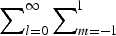 $\sum\nolimits_{l = 0}^\infty \sum\nolimits_{m = - {\rm l}}^{\rm l}$
 $a_{lm} Y_{lm} ({\rm \theta}, {\rm \phi} )$, where θ is the polar angle and ϕ is the azimuthal angle in the hohlraum system, Y lm (θ, ϕ) is the spherical harmonics defined in quantum mechanics and a lm is spherical harmonic decomposition. We define C l0 = a l0/a 00 and C lm = 2a lm/a 00 for m > 0. Shown in Figure 7 is variations of C lm as r S. As shown, C 40 and C 44 dominate the capsule flux asymmetry except at r S = 0.5–0.66 mm, where C4m tends to zero. Within this range, the asymmetry is dominated by C 80, C 84, and C 88, with values smaller than 0.1%. Thus, in contrast to the case for cylindrical hohlraums, the shields do not introduce extra short wavelength asymmetry inside the octahedral hohlraums.
Variations of C lm as shield radius r S inside the octahedral hohlraum.

A high coupling efficiency from hohlraum to capsule is required in indirect drive ICF in order to provide the required radiation energy on capsule with a drive laser of low energy. We denote the coupling efficiency as ηHC. To give ηHC from the results of IMC3D, we firstly present the simulation results of the capsule absorbed power. Inside an octahedral hohlraum with LEH shields, the radiation flux on capsule is contributed by photons from spots, wall, and shields, respectively. In Monte-Carlo simulation, we use N S to denote the number of source photon with intensity of F S, then total radiation power emitted from source photon is P S = F SN S. We use P cap to denote the radiation power accepted by the capsule. In order to give the expression of P cap, we use  $N_{{\rm c - spot}}^{(n_1 )} $ to denote the number of the photons contributed from spot to capsule after the n 1th re-emission,
 $N_{{\rm c - wall}}^{(n_2 )} $ the contribution from wall after the n 2th re-emission, and
 $N_{{\rm c - shield}}^{{\rm (}n_3 {\rm )}} $ the contribution from shields after the n 3th re-emission. Then, P cap is:
 $$\eqalign{P_{{\rm cap}} =& \sum\limits_{n_1 = \,0} {\rm \alpha} ^{n_1} F_{\rm S} N_{{\rm c - spot}}^{(n_1 )} + \sum\limits_{{\rm n}_2 = 1} {\rm \alpha} ^{n_2} F_{\rm S} N_{{\rm c - wall}}^{(n_2 )} \cr & \quad+ \sum\limits_{n_3 = 1} {\rm \alpha} ^{n_3} F_{\rm S} N_{{\rm c - shield}}^{(n_3 )}} $$
Notice that  $N_{{\rm c - spot}}^{(0)} $ is a part of the source photons. Shown in Figure 8 is the radiation power on capsule contributed by, respectively, spots, wall, shield, and their sum. As shown, the contribution from shields increases as the increase of r S. However, the contributions from wall and spots keep invariant when r S is smaller than 0.625 mm, and then begin to decrease as r S. Recall that r S1 = 0.625 mm. It means that the contributions from wall and spots to capsule begin to decrease when r S is larger than the first critical radius, at which the capsule's view of X-rays from wall or spots is more or less blocked by the shields. The total power on capsule keeps increasing till to r S = 0.83 mm when the contribution from the shields is counteracted by its negative effect in blocking flux from wall and spot to capsule. Recall that r S2 = 0.86 mm. It means that the capsule-absorbed power reaches its maximum when r S is taken around the second critical radius. Now we define ηHC = P cap/P S in Monte-Carlo simulation. Shown in Figure 9 is variation of ηHC as r S. As shown, ηHC increases from 13.2% at r S = 0 to its peak of 14% at r S = 0.83 mm, then decrease as r S. Notice that ηHC decreases to 13.2% at r S = 1.1 mm, and then continue to decrease at a larger r S. It means that the shields with an unsuitable size can even make ηHC deduced. As a result, ηHC also reaches its peak at around the second shield radius. Our further study shows that ηHC enhancement using shields is more remarkable for the larger LEHs.
The radiation power on capsule contributed by wall (red), spots (blue), and shield (black), respectively, and their total (green).

Variation of ηHC as shield radius r S.

As we mentioned above, ηHC can reach its maximum, while |ΔF/〈F〉| tends to be minimum when the shield radius is taken around r S2. Recalling our flexibility in designing the shield size for a capsule asymmetry lower than 1%, as presented in Figure 6, we can choose the initial shield radius around r S1 in ignition octahedral hohlraum design, not only to have a low asymmetry during whole capsule implosion process, but also to get both minimum capsule asymmetry and maximum coupling effectively at the main pulse drive after taking the shield expansion under radiation into consideration.
Finally, it is interesting to compare the averaged relative fluxes of wall, spot and shield from our IMC3D simulation results. We use  $N_{{\rm spot}}^{({\rm n})} $,
 $N_{{\rm wall}}^{({\rm n})} $, and
 $N_{{\rm shield}}^{({\rm n})} $ to denote the numbers of the photons which are re-emitted from the spots, the wall and the shields by nth time, respectively. Moreover, we use
 $\bar F_{{\rm spot}} $,
 $\bar F_{{\rm wall}} $, and
 $\bar F_{{\rm shield}} $ to denote the averaged fluxes of the spots, the wall, and the shields, respectively. Notice that
 $N_{{\rm spot}}^{(0)} = N_{\rm S} $. Then, we define
 $\bar F_{{\rm spot}} $,
 $\bar F_{{\rm wall}} $, and
 $\bar F_{{\rm shield}} $ as:
 $$\bar F_{{\rm spot}} = \displaystyle{{\sum\nolimits_{n \,=\, 0} {{\rm \alpha} ^n F_{\rm S} N_{{\rm spot}}^{(n)}}} \over {\sum\nolimits_{n \,=\, 0} {N_{{\rm spot}}^{(n)}}}} $$
 $$\bar F_{{\rm wall}} = \displaystyle{{\sum\nolimits_{n \,=\, 1} {\alpha ^n F_{\rm S} N_{{\rm wall}}^{(n)}}} \over {\sum\nolimits_{n \,=\, 1} {N_{{\rm wall}}^{(n)}}}} $$
 $$\bar F_{{\rm shield}} = \displaystyle{{\sum\nolimits_{n \,=\, 1} {{\rm \alpha} ^n F_{\rm S} N_{{\rm shield}}^{(n)}}} \over {\sum\nolimits_{n \,=\, 1} {N_{{\rm shield}}^{(n)}}}} $$
From simulation results of IMC3D, we have  $\bar F_{{\rm spot}} :\bar F_{{\rm wall}} :\bar F_{{\rm shield}} = 2.2:1:0.6,$ which is almost invariant as r S.
5. SUMMARY
In summary, we have studied the influences of LEH shields on capsule symmetry and coupling efficiency for the octahedral spherical hohlraums designed for ignition using analytical study and 3D Monte-Carlo code. Our results have showed that it has much flexibility in the shield radius design to get a capsule asymmetry lower than 1%. From our study, there two critical shield radii at which the capsule asymmetry tends to minimum, and the coupling efficiency from hohlraum to capsule reaches its maximum around the second critical shield radius. In ignition octahedral spherical hohlraum design, we can take the initial shield radius around the first critical radius, not only to have a minimum initial capsule asymmetry, but also to have a maximum coupling efficiency and a minimum capsule asymmetry during the main drive pulse. In contrast to the case for cylindrical hohlraums, the shields do not introduce extra short wavelength asymmetry inside the octahedral hohlraums. Nevertheless, it should also be noticed that the shields can seriously increase |ΔF/〈F〉| and reduce the coupling efficiency when r S is big enough that capsule's view to wall is badly blocked by the shields. The relative fluxes of laser spot, wall and LEH shield is 2.2:1:0.6 from our Monte-Carlo simulations. In our future work, we will consider the plasma status, including plasma density, temperature and ionization, in our IMC3D simulations, in order to give a detail design of ignition octahedral hohlraum.
Acknowledgments
The authors wish to acknowledge the beneficial help from Professor Dongxian Lai. This work is supported by the National Natural Science Foundation of China under Grant No. 11475033, and the Fundamental Research Program of CAEP under Contact numbers 2012A0102005 and 2013A0102002.



