Introduction
Gabriele d’Annunzio (1863–1938) remains one of the most charismatic and influential public figures in Italy in the late nineteenth century and the first decades of the twentieth century. He was a trendsetter, socialite, arbiter of taste as well as, in the words of Eugenio Montale (who was by no means an apologist for d’Annunzio) one of the most influential poets and writers of his generation.Footnote 1 He was also, crucially for the present discussion, the self-declared imaginifico, the creator of images and ideas, whose influence on Italian culture between the 1880s and 1930s was unparalleled.Footnote 2
During his lifetime there was an enormous interest in d’Annunzio’s life, which is evidenced, for instance, in the number of biographies of the poet: 21 biographical studies were published when d’Annunzio was still alive, and a further nine were published in short succession between 1938 (the year of his death) and the onset of the Second World War; the last biography of the war years was in 1941 (Andreoli Reference Andreoli2000, 634–636). This is not surprising if we consider that, from the very beginning of his budding literary career, d’Annunzio skilfully and very consciously manipulated his own public persona, fostering a veritable cult of his own personality, orchestrating the use of textual and visual strategies which turned him from critically acclaimed writer into national icon.
The present article charts the rise to fame of d’Annunzio by focusing on a number of key moments of the poet’s life, sustained by careful iconographic constructions, and the strategies employed to shape his public image which became a blueprint for the new relationship between public figures and the media.
The aesthete par excellence
As Lucia Re noted: ‘from the very beginning of his career as a poet, d’Annunzio [...] carefully cultivated his “public image”, constructing his life from one day to the next as a theatrical event’ (Re Reference Re1987, 6). No better earlier example exists than the affair of the fabricated death announcement of the young poet, masterfully orchestrated in 1880 by the 17-year-old d’Annunzio (Fatini Reference Fatini1935, 198; Woodhouse Reference Woodhouse1998, 24).
The press picked up the news item and the announcement was published in various newspapers and journals around the country. The result was two-fold: the country mourned the gifted, promising young poet who had passed away before his time and whose poetic gift was very warmly praised by eminent critics, and there was an increase in sales of the collection, Primo vere (1879) which had, by d’Annunzio’s own admission, been fashioned on the example of Giosuè Carducci’s much en-vogue Odi barbare. The combination of the unashamedly impudent act of self-promotion and the imitation of Italy’s foremost national poet, are indicative of the astute and overly ambitious strategy of the young poet to rise to national fame by any means available to him. The anecdote is useful in framing what is in fact a life-long modus operandi. The blurring of the private and public, the performative nature that underpins every public moment for the poet, and the skilful and deliberate construction of the artistic persona in the open public arena characterised d’Annunzio’s entire lifetime. The years spent in Rome, where he lived almost without intermission between 1881 and 1891, were of particular significance because this is when the young poet acquired national status.
There is no doubt that d’Annunzio’s poetic, and later novelistic, talents were real and highly praised by contemporary critics. As Andreoli has noted, d’Annunzio in the late nineteenth century was the only Italian writer to have international stature.Footnote 3 It is however equally accurate to point out that he understood, perhaps more than his contemporaries, the changed and challenging status of artists and writers in the newly unified country. At a time when Italy still did not have an established national press, the Roman press, which d’Annunzio courted since his school years, gave him a near-national stage on which to begin to forge his own persona. D’Annunzio was also quick to build up relationships with the commercial press. In Rome, his choice was Sommaruga, the first publisher in Liberal Italy to believe in the role of advertising and the power of scandal and controversy as advertising tools to sell periodicals and books. D’Annunzio’s later and long-standing relationship with the Milanese publisher Emilio Treves was also motivated by d’Annunzio’s life-long, anxious search for fame and financial gains (d’Annunzio Reference D’Annunzio1999). Treves was a guarantee of big sales and a good source of income for a writer, as well as the only publisher at the time in Italy that could cement a writer’s national fame and, crucially, open up foreign markets.
What d’Annunzio allows us to do, especially in the context of those fin-de-siècle Roman years, is to reflect on the new position of artists, writers and intellectuals in a rapidly modernising world in which the press and commercial publishing had an increasingly central role to play in forming public opinion, conferring celebrity status to individuals, and manipulating information. In this respect, before the introduction of the photographic press, which will herald a new era for public figures, d’Annunzio’s journalistic activity in Rome, and especially his gossip column in the Roman journal Tribuna, is an interesting standpoint to reflect on the power of the image. Through the skilful use of ekphrastic strategies, d’Annunzio created a model for the chronicle of society events in Italy.Footnote 4
D’Annunzio’s sobriquet, Vere de Vere, described an event ‘In casa Orsini’, in La tribuna, 17 February 1895 (d’Annunzio Reference D’Annunzio1996, 261–264). The structure of this piece is typical of many of d’Annunzio’s society reports. A description of the approach to the palazzo is followed by a brief history of the illustrious family. Then, in a slow crescendo, we enter the building, with a characteristic focus on the staircase that leads to the piano nobile: ‘the ample, long marble staircase’ (262). The verbal and visual narrative moves inside and we are presented with a sequence of rooms. The first room has ‘sofas of red damask’ (262); in the second room the decor and objets d’art are described with characteristic attention to detail: ‘large landscape paintings in gilded frames hang against a dark red background; gilded chairs encircle the room; a magnificent china vase is reflected in a mirror laden with ornamentation and cartouches’ (262). Finally we reach the ballroom, which allows the society columnist to offer to his reader an ekphrastic tour de force of the room where great attention is lavished on the celebrated guests, and in particular the toilette of the ladies.Footnote 5 The society chronicler acts also as fashion columnist and arbiter of taste, displaying great attention towards textiles, the decorative arts, furnishings, as well as jewellery and clothing.
The extensive journalistic experience, in the years leading up to the summer of 1889 when d’Annunzio wrote his first acclaimed novel Il piacere (d’Annunzio Reference D’Annunzio1889), accounts for the similarity in themes and language between creative and journalistic prose writing. The presence of autobiographical traces, which can easily lead to a reading of the novel as a portrait of d’Annunzio’s early Roman years, is entirely deliberate and skilfully blends fact and fiction. Andrea Sperelli, the fictional hero of the novel, presented as the seemingly autobiographical alter ego of the writer, is an important step in d’Annunzio’s process of self-invention. The conflation between Sperelli and d’Annunzio sets a precedent for d’Annunzio’s first iconic projection, later distilled in many ekphrastic and photographic images: d’Annunzio as Italy’s foremost aesthete and dandy; a modern arbiter elegantiarum, whose impeccable and exquisite taste became the hallmark of the poet throughout his life.Footnote 6 As Enrico Thovez put it, Italy in the 1880s and 1890s was swept by a veritable dannunzian craze – ‘furore mimetico’ – of the young generations: ‘Ten thousand young men, the hope of Italian literature, who hang on every word of Gabriele and scrutinise the knot of his tie and the length of his waistcoat with the same anxious affection as the colour of his adjectives and the cut of his phrases’ (Thovez Reference Thovez1921, 229). The centrality of the writer’s wardrobe in the orchestration of d’Annunzio’s own myth and public persona went beyond a personal and sustained passion for fashion and clothing (Andreoli Reference Andreoli1988). As Achille Bonito Oliva perceptively noted, D’Annunzio understood the role of the body of the artist as the privileged locus of art: ‘D’Annunzio, before Duchamp, understood that the body of the poet is the body of the artist’ (Bonito Oliva Reference Bonito Oliva1988, 20). This underscores the centrality of performance as well as the characteristic conflation of art and life which d’Annunzio articulated in the central creed of Sperelli: ‘one must fashion one’s life, as one fashions a work of art. A man’s life must be of his own making. There is where true superiority lies’ (d’Annunzio Reference D’Annunzio2013, 35). Sperelli’s performative aestheticism finds its real-life embodiment in the young novelist, photographed since his twenties in ways that recall his fictional hero (Ajello 2008–Reference Ajello2009; Dondero Reference Dondero2008). D’Annunzio favoured a three-quarter profile and bust length framing which captured his characteristically refined clothing. In the 1890s, the soft turned-down collar morphs into the characteristic stiff high collar which became the visual shorthand for d’Annunzio’s aesthetic public persona. A caricature, published in 1906 on the occasion of the Milan World Fair, shows d’Annunzio elegantly attired with an exaggeratedly long neck encased in an impeccable white stiff collar and a trim little moustache, framed by an Art Nouveau cartouche and presented as the chief exponent of ‘L’arte Moderna nella Poesia’ (Traina Reference Traina1986, cat. no. 34).
This correspondence between real and imaginary can be linked to another aspect of d’Annunzio’s life: the lack of distinction between public and private. In his lifelong engagement with the construction of his public image, d’Annunzio constantly blurred the boundaries between private and public, and fictional and factual. In particular, his residences, albeit private domestic spaces, were photographed and talked about in ways that made them the object of public consumption. D’Annunzio actively encouraged this public scrutiny of his life, which he presented as an extension of his own art: ‘I have made my home wholly of myself and I love it in all its parts. If I speak to it in my own words, it answers me in my own words’ (d’Annunzio Reference D’Annunzio2005, 1783).
The journalistic pieces and Il piacere also underscore the tension between representation and self-representation of the Italian aristocracy which was feeling the strain, in the new Liberal Italy, at the time of the growth of Italy’s middle class. It was the new bourgeoisie that read voraciously d’Annunzio’s novels, which afforded them a voyeuristic view of the world of the upper classes, and that also read his society and fashion columns, showing the same appetite for the seemingly unmediated access to the lives and rituals of society figures. On the cusp of the phenomenon of divismo, that produced a cult following of stage and film personalities, d’Annunzio managed to establish the credentials that fed the myth of his own exceptionality and inimitable life (Alberoni Reference Alberoni1973; Jandelli Reference Jandelli1973; Muzzarelli Reference Muzzarelli2013).
The use of images (illustrations, cartes-de-visite, photographs, postcards and caricatures) to create and sustain d’Annunzio’s persona remains to this day almost uncharted territory. The photographic and iconographic archive of the Fondazione Vittoriale degli Italiani has never been properly catalogued. Postcards, with the exception of a small exhibition, remain practically unstudied and are not catalogued (Traina Reference Traina1986; Traina and Veroli Reference Traina and Veroli2003). Besides, illustrated volumes tend to use photographs and postcards uncritically as mere illustrative material to help the reader track d’Annunzio’s often intricate biographical vicissitudes (Album 1990; Di Lallo Reference Di Lallo2004). Piecing together the evidence is complex and still necessarily piecemeal.
The first instance that marks the beginning of d’Annunzio’s more deliberate use of images to feed his growing popularity with the wider public is linked to the beginning of his political career and the campaign for the parliamentary elections in the summer of 1897 (Di Biase Reference Di Biase2013). His first electoral speech was published in Tribuna on 23 August 1897 (D’Annunzio Reference D’Annunzio2003, 266–280). Andreoli suggests a strong link between d’Annunzio’s political activity and his work for the theatre, but performative elements, as we have seen, are present much earlier in d’Annunzio’s literary activity. Filippo Tommaso Marinetti was present at his first electoral speech and described the poet thus: ‘He appeared to me in the distance on the platform, elegantly done up in a black suit, delicate, dainty and fragile, above the vast swell of the crowd’ (Marinetti Reference Marinetti1908, 65). The elegantly tailored black suit, which can be seen in campaign postcards of the time, suited d’Annunzio’s slim frame and made full use of the image of the dandy. Postcards with the portrait of the candidate were accompanied by those that showed d’Annunzio’s ‘casa natale’, on Corso G. Manthoné in Pescara, a not entirely unprepossessing building but far removed from the palazzi of the Roman aristocracy which d’Annunzio frequented and that, via the male protagonists of his novels, had become associated with d’Annunzio’s own lifestyle. What is interesting to note here is that d’Annunzio used his family home as a means to counteract his strong association in the public imagination with the capital and to root his newly-found interest in politics in his native land whilst at the same time using his literary fame as a means to garner support.
Il vivere inimitabile
In November 1895, whilst in Venice to give a lecture on the occasion of the closing of the first Biennale, d’Annunzio met for the second time the Italian actress Eleonora Duse, who was to become his lover and a great artistic influence on his work which, from the late 1890s, turned decidedly towards the theatre. His relationship with Duse, who was at the time one of the true icons of the international stage, resulted, in 1898, in his move to Settignano, to the Villa Capponcina, where he lived until his forced exile to France in 1910 (Guerri Reference Guerri2011). This was an extremely prolific time for d’Annunzio, who wrote some of his most important works for the stage and his most acclaimed collections of poems whilst in Settignano.Footnote 7
Among the most interesting photographs of d’Annunzio taken at the time of the consolidation of his own myth as Italy’s foremost national poet, are those taken by the society photographer Mario Nunes Vais (1856–1932), a member of the Florentine elite who started his activity as photographer in 1894 (Mario Nunes 1974; Vannucci, Reference Vanucci1976; Gli italiani 1978).Footnote 8 He normally used the studios of his professional photographer friends, with only three exceptions: the Italian Royal Family, photographed at the Quirinale; Giacomo Puccini, whom he captured at his residence at Torre del Lago; and, significantly, d’Annunzio, who was photographed at the Capponcina, by then his famed residence. The move from studio photography to a focus on the artist in his private space is a telling indication of the centrality of d’Annunzio’s life as a vehicle to his art. The porous boundary between public and private is turned here into a celebration of the artist in his later iconic incarnation: the aristocratic aesthete who could, at this time, fully rival his fictional heroes, living in lavish splendour in a Renaissance villa. Benigno Palmerio, describing the refurbishment of the villa, pointed out d’Annunzio’s obsessive focus on the creation of an exquisite decor which bore witness to his inimitable life:
The ancient villa della Capponcina had been freed from all the furniture which could not possibly be tolerated by the luxuriating hypersensitivity of the Poet. […] day by day, every room was embellished with rugs, statues, furniture, tapestries, paintings, swathes of cloth, rare books, strange and antique weapons. Every corner has its own physiognomy and an unmistakable spirit. On certain days I saw Gabriele absolutely obsessed with researching for a perfect harmony in the arrangement of objects. (Palmerio Reference Palmerio1939, 35)
The photographs were all taken in 1906 and they can be read as a sequence.
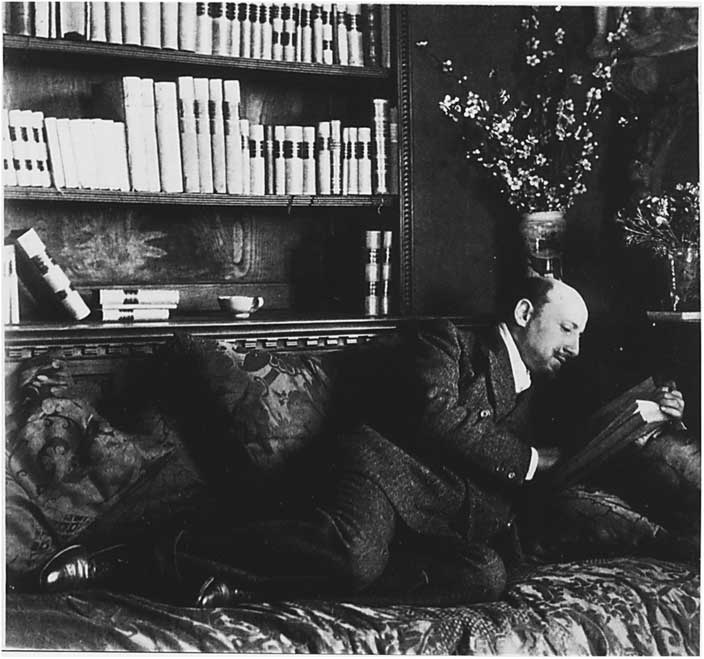
The first one captures the entrance of the villa (Mario Nunes 1974, cat. no. 90). In a fashion similar to d’Annunzio’s society pieces, a central role is given to the crossing of the threshold. The spectator is characteristically made to inhabit a liminal space, just outside the imposing gateway to the villa, looking onto a world which is normally out of reach. The society chronicler becomes the object of our gaze and, similarly to the real-life society protagonists of the cronache mondane, the architectural surroundings provide the first encounter with the secluded world of the poet. Three figures in the far distance enhance the ample proportions of the two buildings framed by the gate. The second photograph, entitled ‘D’Annunzio surrounded by his dogs Gog, Magog, Donovan, Altair, Hierro, Nerissa, Clarissa, Lissa, Teli-Teli’, captures d’Annunzio in the grounds of the villa: spaniels, terriers and greyhounds encircle the poet; large terracotta urns decorated in Renaissance style with festoons stand on high plinths, some adorned with grottesche (Mario Nunes 1974, cat. no. 91). Two more photographs capture d’Annunzio playing with the dogs affectionately and playfully (Mario Nunes 1976, cat. no. 56–57). The sequence continues with the poet in a much reproduced image (Figure 1), reclining on a deep sofa, his back and left arm propped up by large cushions which are scattered liberally and frame the lower portion of the image (Mario Nunes 1974, cat. no. 92).
Gabriele d’Annunzio reclining whilst reading, in a portrait by Nunes Vais. Fondazione Vittoriale degli Italiani – Archivio Iconografico

The photograph is a classical composition, with d’Annunzio’s upper body set against a dark background. His flannel suit provides a textural contrast against the silk brocade of the sofa and cushion covers. Two vases, a delicate Chinese porcelain one with tall stems of blossom and a shorter glass one with carnations, recall d’Annunzio’s many detailed descriptions of flowers and their precious containers, that played a particular role in his journalistic pieces and Il piacere as further signifiers of the aesthetic refinement of the characters (Pieri Reference Pieri2007). A further photograph captures the poet in the same room, known as the ‘studio alto’, a secluded room in a small tower, in which all his writing took place (Mario Nunes 1976, fig. 57). This was d’Annunzio’s inner sanctum, where no visitors were allowed. The final image of the sequence shows d’Annunzio intent on writing at his desk, characteristically standing.Footnote 9 Paper in a deep recess under the desk, a supply of quills, a row of books at the back of the sloping writing ledge, and the general lack of ornamentation, except for a single calla lily in a simple glass bottle, frame the poet as an indefatigable and ascetic worker. Whilst d’Annunzio’s aesthetic persona continued to be central to the way his myth was fashioned and consumed by his many admirers and readers, it is important to note that these are also the years in which d’Annunzio developed the persona of the poeta vate, a Symbolist seer who was the self-appointed voice of the nation. D’Annunzio seemed to be acutely aware of the danger of turning the aesthete into a refined but ultimately vacuous figure, something that his many caricatures at the time hinted at (Gianeri Reference Gianeri1941; D’Annunzio in caricatura 1988; Rassegna di caricature 1990). To counterbalance this, the emphasis shifted increasingly towards a conception of the self and a promotion strategy which underlined the poet as a spiritual and poetic guide of the nation.Footnote 10
One further image taken by Nunes Vais in 1906 needs careful consideration. It depicts the poet against a starkly dark background and is painterly in nature, in its carefully formed chiaroscuro and delicate textural effect (Vannucci Reference Vanucci1976, fig. 54). The iconography is one that punctuates the history of Western art: the poet in full profile rests his head on his left hand, his elbow on an open book. The self-contained expression and pose capture a seemingly private meditative moment. The pose recalls the classical iconography of a thinker, yet the light-coloured suit, the stiff high white collar and cuffs, the subtly patterned tie, complete with minute pin, and the white gardenia that adorns the lapel, are clear marks of d’Annunzio as the arbiter of taste in both life and art. This image was a favourite with d’Annunzio and one that seems to have had much private circulation.Footnote 11 Whilst the circulation of cartes de visite was already well established in the previous century and was common with artists and men of standing, d’Annunzio appears to be one of the first intellectual figures in Italy to have made extensive use of photographs as a means to cement friendships and to fashion his semi-public iconography. Photographs at this time were generally destined for male and female admirers and friends of the poet; their circulation was still private and restricted to selected circles. After the war and during the final season at Gardone, once photography entered the age of mass public consumption, photographs became a means to construct and fashion d’Annunzio’s final iconic transformations.
The war years
In 1925, Ferdinando Pasini, in his autobiography of d’Annunzio, proclaimed d’Annunzio and Mussolini: ‘the two most representative men in Italy at the present time’ (Pasini Reference Pasini1925, 454). Leaving aside the eulogistic tone, typical of many biographers of the national vate in the 1920s and 1930s, Pasini does not hesitate to give equal status to the two men, acclaiming d’Annunzio, with reference to Fiume, as ‘patron saint and presiding god of the most audacious experiment on which Italy is venturing, in its faithfulness to its historical mission, for the salvation of civilisation, and for the good of the entire world’ (454). Religious overtones became increasingly common in the way d’Annunzio was presented to the public by the press and contemporary critics in the 1920s. This rhetoric, which had its roots in d’Annunzio’s own increasingly Messianic pronouncements, was also a direct consequence of the war years which saw a decisive shift in d’Annunzio’s position in Italian politics and culture.Footnote 12
D’Annunzio’s Reference D’Annunzio1915 speech in favour of Italy’s intervention was celebrated on the front cover of one of Italy’s most widely distributed weekly, Domenica del Corriere, in a colour lithograph by illustrator Achille Beltrame.Footnote 13 The illustration showed d’Annunzio addressing an enthralled (and decidedly upper-class) audience. Elegantly dressed in black, left arm outstretched, in a commanding pose, d’Annunzio epitomises the assured leader whose oratory could mobilise crowds. The war did indeed offer d’Annunzio an entirely new platform which combined his formidable public debating skills, a renewed interest in journalism and active combat.
The May 1915 cover was one of several during the war years which depicted d’Annunzio. Whilst some of Beltrame’s illustrations gave d’Annunzio centre stage visually,Footnote 14 many more, in tune with d’Annunzio’s own self-representation during these years, depicted him as an inspiring commander, whose presence roused fierce loyalty in his fellow soldiers, but who was also simply one among many, in line with the overall iconographic interpretation of the conflict in Domenica del Corriere as a collective endeavour. The cover of 19–26 November 1916 showed an Italian battalion on Mount Veliki, on Italy’s Serbian front. An unnamed captain launches the attack carrying the Italian flag which, the caption explains, had been carried to the front by d’Annunzio, shown a few paces behind the captain. D’Annunzio is not the immediate protagonist of the scene, were it not for the caption which singles him out literally as the standard bearer of the Italian nation. Equally interesting are images in which d’Annunzio, albeit not physically present, is still the ideal point of reference. The cover of Domenica del Corriere 21–28 October 1917 depicts a group of aviators sharing a final toast before a mission. The caption recalls d’Annunzio’s centrality during the conflict as the poeta soldato of the nation, who helped to generate many of the most notoriously enduring slogans of the conflict: ‘Eja! Eja! Eja! Alala! Before leaving for a dangerous mission, our pilots chant their war cry invented by Gabriele d’Annunzio’.
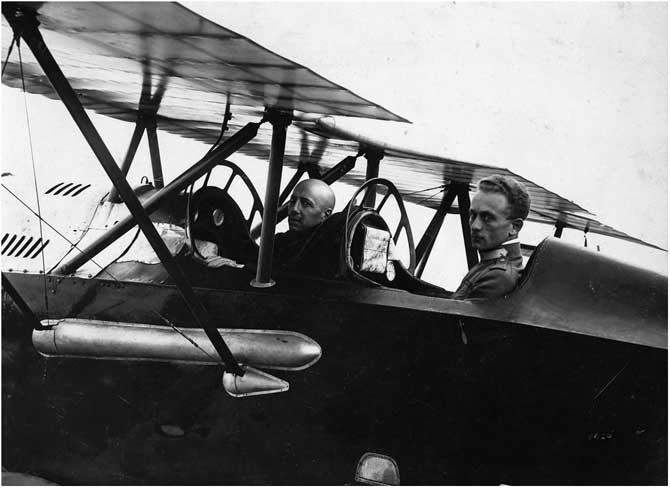
1918 flight over Vienna: d’Annunzio and Palli. Fondazione Vittoriale degli Italiani – Archivio Iconografico

One of the most celebrated images of d’Annunzio during the First World War represents him on the eve of the flight over Vienna on 9 August 1918 (Figure 2). The daring mission, which consecrated d’Annunzio as star of the conflict and captured both the national and international press, allows us to reflect on the alternation between myth and reality and d’Annunzio’s ability to blur the boundaries between the two. The photograph by Attilio Prevost Sr. (Turin, 1890–Milan, 1954), depicts d’Annunzio on the front seat of the S.V.A. biplane, with pilot Natale Palli on the back seat. Whilst the propaganda value of the daring and imaginative mission cannot be put into question, the photograph, often reproduced with d’Annunzio’s distinctive signature and accompanied by the date of the mission, carries a testimonial value which goes against the grain of historical truth. D’Annunzio could not fly an airplane and during this mission it was Palli who piloted the biplane which led ten other monoplanes to fly over Vienna to drop patriotic leaflets designed by d’Annunzio (Mancuso Reference Mancuso2013, 121–144). D’Annunzio’s bravery during the conflict is undisputed and gained him a military cross; yet the performative mould which had characterised his previous decades, his ability to inhabit different personae, and his keen understanding of the power of the image, resulted in an iconic representation which significantly distorted historical truth. Nonetheless, d’Annunzio’s inspiring leadership and his fearlessness in combat meant that his military value remained untarnished, especially within the Italian air force, and was strengthened further during the occupation of Fiume, ‘the apotheosis of d’Annunzio’s theatrical heroism’ (Gundle Reference Gundle1998, 179).Footnote 15
The rhetoric of the collective sacrifice and the levelling impact of trench life became especially powerful after Caporetto. D’Annunzio’s own physical wounds – his life-threatening injury resulted in the loss of an eye – were turned into a powerful symbol of the nation’s lacerations and the distance between those who were offering their own lives in sacrifice for the motherland and the Liberal establishment. An article published in Corriere della Sera in December 1917, when conscription was extended to the so-called ‘boys’ of 1899, carefully positions d’Annunzio between individualism and commonality:
But if I, wounded like any other combatant, with my deadened gaze which has no memory of having enjoyed the privilege of looking upon the world and does not presume to be worth more than the gaze of any other farmhand-turned-infantryman; if I suffer for having given so little and want to give more; if I put on my leather jerkin and cap and get into my plane’s fuselage with my companions and go to shoot down my neighbour at close quarters and fire off all my cartridges; if, not even in that moment of danger, do I consider that my brain is worth more than that of my pilot or that my life in the nose is worth more than that of the little soldier upright in the gun turret in the tail; if I annihilate myself in a nameless courage, if I abnegate the whole of my being in the desire for battle, if I abase myself in my country and exalt myself in my country, unthinking and unaware, then I am the child of the new Italy, I serve the cause of her true soul. And for that reason I, a young man like you, am worthy to stand before you and look you full in the face (d’Annunzio Reference D’Annunzio2003, 713–714).
D’Annunzio’s rhetoric of exceptionality, which had sustained his public persona for decades, is used here to construct a vision of the war as the ultimate self-effacing exercise. References to d’Annunzio’s experience in the Italian air force and navy, as well as the figure of the ‘farmer-turned-infantryman’ – (‘fante contadino’ in the original) a reference to the many infantrymen who came from rural Italy – depict the poet as submitting himself, together with the many who had perished and those who were about to join the war effort, to the cause of the motherland in complete self-denial. The religious language underscores ideas of renouncing of the self, self-abasement and abnegation, which, as we have seen, d’Annunzio had begun to use since the years in Settignano to counterbalance the exclusive focus on his dandyism, in an effort to construct the myth of the ascetic poeta vate, or, using one of d’Annunzio’s own epithets, ‘the tireless scribe of the nation’.
The years of self-imposed exile at Gardone
From 1921, when d’Annunzio first went to live in a villa at Cargnacco, on a hillside above Gardone Riviera, he spent the rest of his life transforming his residence into what Re called ‘an extraordinary “theater of memory” (Re Reference Re1987, 6). Il Vittoriale became d’Annunzio’s final work, a visual text in which the ‘saturation of the literary “space” […] is duplicated in the visual “space” of Il Vittoriale’ (12). Of the characteristic interiors at Il Vittoriale, Re also notes that ‘the accumulation of objects and props in certain settings is so excessive that one gets the sense of a confused bric-a-brac, or of an anguished and unlimited proliferation of signs’ (38). The congested spaces mirror one of the most distinctive traits of these years: the process of compulsive autobiographical rewriting and editing of his oeuvre which occupied d’Annunzio until the end of his life. Yet, in an interview in 1922, d’Annunzio described his new life at Cargnacco thus: ‘I decided to retreat into silence. I decided to be a chief without partisans, a condottiero without followers, a master without disciples’ (d’Annunzio Reference D’Annunzio2003,1490). This is potentially symptomatic of the sense of displacement which many war (and especially Fiume) veterans felt at the end of the conflict. D’Annunzio retreated in his final splendid isolation, and his increasingly complex relationship with Fascism and its leader only served to increase the need to retire into the past.Footnote 16
Whilst the years spent at Il Vittoriale remain synonymous in the public imaginary with the worst excesses of d’Annunzio’s long-lasting penchant for aestheticism, which saw his private apartments turn into a monument to his former persona and a theatrical mise-en-scene in which the memory and performance of aestheticism could be enacted, the photographic images that d’Annunzio sent to both his closest friends and acquaintances, remained inextricably linked with the war experience.
Gabriele d’Annunzio wearing the uniform of the Lancieri di Novara. Fondazione Vittoriale degli Italiani – Archivio Iconografico

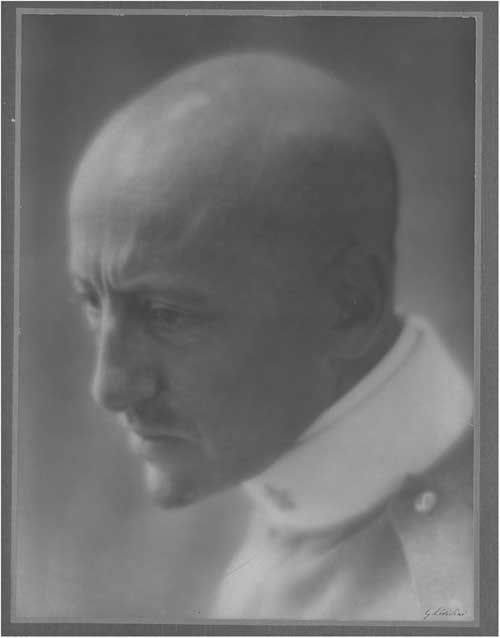
On the border between private and public consumption of images of the poet, sit the photographs sent by d’Annunzio to a variety of people in the years spent at Il Vittoriale.Footnote 17 The archive of Il Vittoriale has several copies of a photograph which found particular favour with d’Annunzio and was sent to a number of his correspondents. It is a near-full profile of d’Annunzio by the photographer G. Lividini (Figure 3).Footnote 18 A strong light cast from the left highlights d’Annunzio’s closely shaven head, creating a ribbon of light all across the side of his face. The whiteness of the high collar recalls the stiff collars seen in countless images of d’Annunzio as Italy’s foremost aesthete. The close-up of the head emphasises the delicate soft focus of the photograph and pensive mood captured by Lividini.
Journalist Renato Simoni, in an interview with d’Annunzio in Corriere della Sera on 15 June 1922, mentions what would become a daily occurrence until d’Annunzio’s death: the pilgrimage to Gardone and the amount of fan mail that the poet received from his admirers, who were an intriguing mix of literati, war veterans and ordinary people such as Addolorata de’ Blasi, who wrote to the poet ‘with anxious heart and enthusiasm in my soul, I long for your photograph’ (d’Annunzio Reference D’Annunzio2003, 1499). That many of his admirers, both male and female, requested photographs of the poet, whilst expressing their devotion to him, is one of the clearest indications of the veritable personality cult of d’Annunzio, which had links with the star system and interesting reverberations in the personality cult of Mussolini (Gundle Reference Gundle2013, 72–92). It also attests to the true iconic status of the poet, whose image, in the words of his fans, was endowed with a quasi-religious devotional function which, in the age of mass media, often transformed secular images into icons that possessed the power of evoking the presence of the person admired.
Conclusions
Regardless of the richness of critical contributions on d’Annunzio, his public and critical reception outside the often close-knit circle of d’Annunzio specialists still remains under the influence of some longstanding tropes and labels: the most famous is probably Benedetto Croce’s 1904 expression ‘a dilettante of sensations’.Footnote 19 For Croce d’Annunzio was a symbol of the fin-de-siècle who never moved beyond the aesthetic persona which he had so skilfully constructed between fact and fiction.
Yet, as we have seen, d’Annunzio did move in a number of directions which shaped steadily and subtly his public iconography. His seamless transformation from fictional aristocratic dandy and aesthete par excellence to real-life Renaissance prince during the years in Settignano, and his subsequent further transformations into the poeta soldato during the First World War and finally the nation’s poeta vate under Fascism, are all testimony to his power of self-fashioned reinvention. D’Annunzio’s autographed photographs are an additional intriguing signal of the active role which he played in the creation of his own myth in the 1920s and 1930s, whilst attesting to his lifelong interest in self-promotion, advertising and his acute awareness of the role of his own public image.
D’Annunzio’s successive iconic incarnations allow us to trace the progression of his skilful branding exercise which began in the pre-mass media cultural landscape. As we have seen, the myth of the inimitable life was paradoxically linked to a desire to reach out to the masses. Individualism and exclusivity were enacted in front of a mass audience which consumed images and narratives that the new media distributed on a large scale. D’Annunzio’s mediatised self-fashioning prefigures the loss of ontological certainties espoused by Gianni Vattimo: ‘reality for us is in fact the result of the intersection and contamination (in the Latin sense) of multiple images, interpretations, re-constructions that, in competition with one another or without any “central” co-ordination, are distributed by the media’ (Vattimo Reference Vattimo1989, 15). D’Annunzio’s deliberate and practised mediatic constructions relied on the complex interaction of fact and fiction, words and images, narrative and visual constructs which he tried to influence and manipulate. His relevance, aside from his fundamental, if controversial, place in Italian literary and intellectual history, is linked to his understanding that the path to modernity was inextricably bound to the influence of the media. The rise of mass communication changed the nature and forms of engagement with the masses and gave rise to ‘manufactured charisma’ (Gundle Reference Gundle1998, 176). D’Annunzio was able to manipulate skilfully ideas of exceptionality and heroism, harnessing the power of the mass media and using careful strategies of image management. The result was a highly successful and thoroughly modern staging of his personality which turned him into a national icon.
Acknowledgments
I am grateful to Professor Jane Everson (Royal Holloway University of London) for her assistance with the translation into English of all Italian quotations in this article. I am also indebted to the staff of the d’Annunzio archives at the Fondazione Il Vittoriale degli Italiani for their continued assistance and unfailing courtesy.
Notes on contributor
Professor Giuliana Pieri’s research interests are in comparative and interdisciplinary studies, especially the intersection of the verbal and the visual, and the role of Italian visual culture in the construction of Italian identity both in Italy and abroad. She is interested in curatorial practice and, in 2010, co-curated the exhibition Against Mussolini. Art and the Fall of a Dictator (London, Estorick Collection of Modern Italian Art) as part of the AHRC-funded research grant The Cult of the Duce. She is currently co-investigator of the AHRC-funded project Interdisciplinary Italy 1900-2020: Interart/Intermedia (http://www.interdisciplinaryitaly.org/).