Introduction
. . .when one man meets another from a distance there is an exchange of presents, among which is a white scarf. The presents indicate the friendship; the white scarf shows how pure is this friendship. If converts come into the presence of a Grand Lama, the presents are vastly increased, and still more lavishly when Lama and Great King meet.Footnote 3
On 28 June 1913, four Tibetan boys and their chaperone went to meet King George V (1865 –1936).Footnote 4 They brought with them an extensive range of gifts and accompanying letters from the thirteenth Dalai Lama Thubten Gyatso (1876–1933). This visit initiated one of the most well-documented and high-profile gift exchanges of the Anglo-Tibetan encounter. Taking place away from the Himalayas – in London, at the heart of the British government, where note taking in the early twentieth century was described as an “intellectual tour de force”Footnote 5 we are given a rare insight into the choices and negotiations accompanying a major gift exchange. This was gift-giving writ large, played out on an international stage.
Few studies have focused on the importance of gift-giving between Tibet and Britain, despite the practice being much recorded and imitated by many Western visitors to the Himalayas in the late nineteenth and early twentieth centuries, and despite it being an important conduit for the importation of Tibetan art and objects and their then eventual deposition in UK museums. With the growing interest in Anglo-Tibetan encounters during this period, small amounts of ethno-historical research have recently been undertaken,Footnote 6 although there is still scant discussion of an exchange process that had the potential to influence the geo-political relations of not only British India and Tibet but also those of the other great emerging superpowers, China and Russia.
British India's gift-giving practices developed as a response to and manipulation of Indian princely court rituals and ceremonials. After 1600 these practices shifted from unsuccessful offerings to “contracted exchanges”Footnote 7 to payments for power,Footnote 8 to mimesis or mimicryFootnote 9 and to the enduring of a “hollow pretence”.Footnote 10 By the turn of the twentieth century, relations between individual ruling princes and their British India diplomatic officer or resident had become more relaxed and familiar, but the ceremonials and rituals observed by Sir Thomas Roe in 1615 at the court of Jehangir were still vitally important to the Indian princes and indeed to their British India counterparts. For the British in India in the early twentieth century, gift-giving was not now a fixed protocol but a negotiated one, determined by place, occasion and, most significantly, by those involved. As Tibet moved further into British India's sphere of influence, the invented rituals and practices of colonial India were to be reworked once again to meet the needs of this new diplomatic relationship.Footnote 11
While the prospect of a gift-giving encounter with Tibet caused some anxiety for the British in India,Footnote 12 the Tibetans had over several centuries refined their own cultural practice of public gift-giving. Tibet's gifting relations, recounted as early as the Tang Dynasty (618–907), spanned vast distances – from the imperial centres of China in the east, to Ferghana in the west, to the Silk Road oases of Dunhuang and Turpan (Turfan) of the north. Acting as both the bearer and receiver of tribute missions, Tibetans gave and received a wealth of luxurious and much sought after gifts enhancing religious, diplomatic and commercial ties.Footnote 13 Administratively speaking, specific treasuries within Tibetan estates, monasteries and palaces existed to meet the demands of gift-giving, with items deposited into these treasuries retaining the status of gift,Footnote 14 thus ensuring there would be an inventoried group of objects available for diplomatic exchanges.
Here, we will see gifts not only in their role as diplomatic mediators, shaping this relatively new relationship between Tibet and the British, but also how certain gifts were selected to represent the very essence, the ‘Britishness’ and the ‘Tibetanness’ shall we say, of the respective powers, giving the other an insight into what each imagined their own country, and their place within it, to be. Both parties may have expected that their particular (and sometimes commonly held) gift-giving practices would to some extent be read by the other. Michael, in discussing the meeting and robe exchange between Major General Sir David Ochterlony and the Gorkha leader Amvar Simha Thapa in 1813, sets the scene for what we shall see taking place exactly a hundred years later, this time not in the Nepalese lowlands but in Whitehall, that bastion of imperial rule,
These early meetings [of British and Gorkhalis] were not unproblematic. Separated by an otherness that revealed itself in unfamiliar language, ideas, institutions, and practices, each came to represent different cultural worlds, and perform actions whose encoded meanings were as much open to understanding as to misunderstanding. Thus, these early encounters often register the many fumbling attempts of these (largely) men to communicate the meanings and practices of their worlds to one other.Footnote 15
These “fumblings” came from a semi-comprehension of each other's practice that on a personal individual level could almost be grasped but was often just out of reach when gift exchange became dislocated, occurring for example unexpectedly or in an alien environment. As Berger astutely observes in her reading of the gift exchanges between the Qianlong Emperor (reigned 1735–1796) and the seventh Dalai Lama, Kalsang Gyatso (1708–1757) and the sixth Panchen Lama, Lobsang Palden Yeshe (1738–1780) these fumblings were to be expected as, “Part of the art of giving from their [gift-givers and receivers] perspective was in creating ambiguities about the real meaning of the gift. “Real meaning” might be understood in a couple of ways - in one sense focusing on the social and political implications of the act of exchange, in the other one a symbolic and even stylistic reading of the gift itself”.Footnote 16 In the case of Britain and Tibet in 1913, the gifts given by both parties did indeed have social and political implications and individual gifts could, as we shall see, be read in multiple ways, but despite this impressive material contact, would, “the [real] meaning fail to reach its destination”?Footnote 17
Arranging the Audience
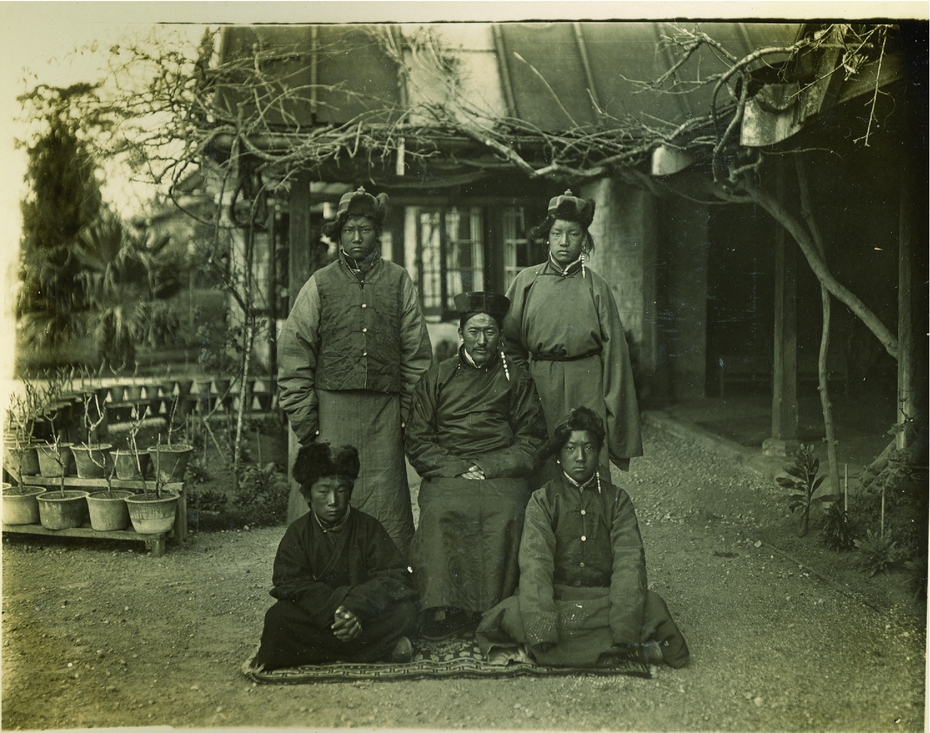
Less than six months after the return of the thirteenth Dalai Lama to Tibet, following his eighteen months’ exile in British India (due to the invasion of Lhasa by Chinese troops), the four Tibetan boys and Kusho Lungshar (personal name, Dorje Tsegyal) (1880–1938) arrived at Charles Bell's (Political Officer, Sikkim 1908–1921) Gangtok Residency door in February 1913 [see Figure 1].Footnote 18 This would not have been an altogether unexpected or unwelcome development as Bell had already made this suggestion.
While he was in Darjeeling . . . suggested to the Dalai Lama and to Shatra [one of Tibet's chief ministers] also, that they should send a few Tibetan boys to England for education, in order that on their return they might introduce such Western accomplishments as would be beneficial.Footnote 19
For the British, this overseas trip would be the first step along the road to developing a modernising agenda for Tibet; for the Tibetans it presented a singular opportunity for the Dalai Lama vicariously to make his feelings known on Tibetan independence before the convening of the pivotal Simla conference that would open in October that same year.Footnote 20
Kusho Lungshar (seated centre) and the four Tibetan boys. Gangtok Residency, Sikkim February 1913. Charles Bell Collection ©National Museums Liverpool.
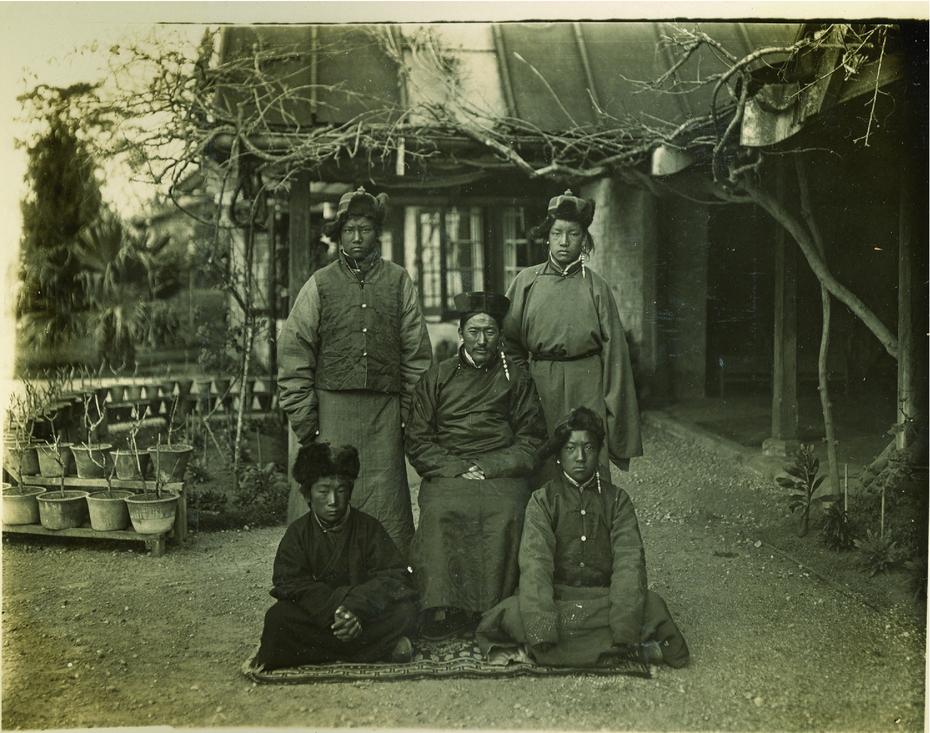
By early April 1913, the Tibetan party and their British India escorts, Basil Gould (1883–1956) and Sonam Wangfel Laden La (1876–1936), were on the P&O SS Arabia, bound for Plymouth on the south coast of England. Gould, who was returning to England on leave from his post as British Trade Agent, Gyantse, was an experienced frontiers officer who would become the Political Officer of Sikkim in 1936 and be present at the installation of the fourteenth Dalai Lama in 1940. Laden La had been schooled in Tibetan at Ghum Monastery and in English at St Joseph's School, Darjeeling. His first job was working under Sarat Chandra Das, the British India covert surveyor of Tibet. He soon moved on to the Imperial Police Force, later acting as head of security during the Dalai Lama's exile; in the 1920s he was promoted to the position of Darjeeling District's superintendant, acting as advisor to the Lhasa government on matters of policing. Here, as assistant to Gould, we will see him prove to be invaluable in the translation of letters, gifts and in the interpretation of Tibetan gift-giving protocol.
Gould recounted that the initial request letter from the Dalai Lama, handed to him at Phari in Tibet, hoped that the group “might be helped to make their way to England and that the boys might there be provided with “four first class educations at Oxford College, London”.Footnote 21 While the boys’ education may have been the primary objective of the trip, there were unresolved issues between the Dalai Lama and the king, and it is unlikely that this would have been the only objective for the Dalai Lama's self-styled envoy, Lungshar. This was not in fact the first time that the Dalai Lama had tried to meet George V. He had hoped to travel to England while in exile to discuss the position of Tibet directly with the King in 1911. He had been so fixated on the idea that no amount of persuasion from Charles Bell, his British India confidant, would change his mind and it finally took a letter from George V himself to put a stop to the Dalai Lama's plans. In no uncertain terms the king informed the Dalai Lama that he was “unable to interfere between him and his suzerain” [China].Footnote 22 This polite snub, particularly on the subject of Tibetan independence, would surely not have been forgotten.
Much had changed in the two years since that request, with the British now seeing the arrival of the four boys as a possible coup, giving them potentially greater influence in Tibet at the expense of the Russians and the Chinese. However, the diplomatic concerns of 1911 had not gone away, nor had the Dalai Lama's insistence on an audience with the King of England. Almost immediately upon the group's arrival, disquiet over Lungshar's conduct and his perceived status began to surface in the memos between the Foreign Office and the Political Department.Footnote 23 Lungshar was an astute and ambitious political operator and it was clear that he had no intention of just being the four boys’ babysitter; instead he viewed himself as a Tibetan diplomatic envoy sent to England to represent the Dalai Lama. On his arrival in England he made a demand to see George V and to have the opportunity to present him with a range of gifts and letters from the Dalai Lama. As Alastair Lamb rightly points out, “The British would have liked to deny that Lungshar possessed any diplomatic status at all”,Footnote 24 but not wanting to lose their new found influence over Tibet an audience was granted.Footnote 25
The Audience
On 15 May 1913, the India Office's Sir James Dunlop Smith (1858–1921), received a message from Buckingham Palace indicating that
His Majesty will be graciously pleased to see the Deputation from Tibet for the purpose of submitting the gifts which the Dalai Lama has been good enough to send for Their Majesties’ acceptance, and which Their Majesties’ will be graciously pleased to accept.Footnote 26
He in turn consulted with Gould, who would surely have consulted with Laden La, and an auspicious (Tibetan) date in the middle of June was suggested. The government memos and notices then become silent for a while and it is necessary to turn to the accounts of Gould and Laden La for an insight into the audience itself. Gould had in fact already begun the four boys’ informal education, and in June 1913 the group was to be found on a tour of England, visiting a variety of industrial and communication sites. A telegram reached them on the 24 June asking them to return to London immediately to prepare for the presentation at Buckingham Palace. A room was rented at the Buckingham Palace Hotel to house all the gifts that would be presented and also to give the Tibetan boys and Lungshar time to prepare their official dress for the day.Footnote 27
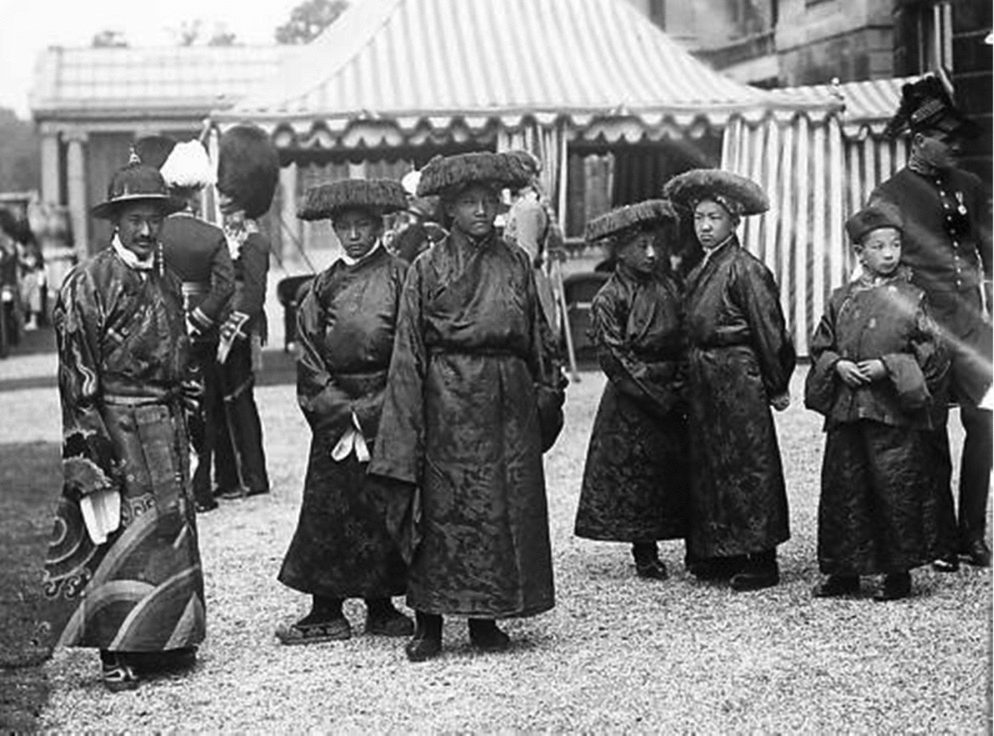
Surprisingly, the day itself goes almost unrecorded. The Times in its court circular reported the meeting in its 30 June edition, but we rely on the account found in Laden La's diary to fill in the details (see Figure 2):
Lungshar, the four boys, Sonam Tobgye and Basil Gould, Buckingham Palace 28 June 1913 © reserved

Gift list from the Dalai Lama to His Majesty the King, as translated by Laden La

At 10.30am entered Buckingham Palace in state with Mr Gould, Lungshar, The Tib[etan] boys and Sonam Tobgye [Laden La's son]. We went to the garden and saw the presenting of colours by the King to the Irish guards. Their Majesties the King and Queen received us in the drawing room both standing. . .As each was introduced he first offered a scarf and raised his hat. . .Lungshar with his head down expressed the messages of the D[alai]. L[ama]. . . and I interpreted. After interview Mr Gould and myself went back to B[uckingham] Palace 3 times, I wrote the definitions of his [the Dalai Lama’s] presents.Footnote 28
On Laden La's return to the hotel later that evening he received the devastating news that his son Norman had died in India. Gould reported that “Poor Laden La could hardly work”Footnote 29 and so there is understandably a two-day delay in discovering the contents of the Dalai Lama's letters and the substance of the gifts as translated and catalogued by Laden La. Two groups of gifts were presented on the day, one to George V (See Text Box 1) and the second to Queen Mary.Footnote 30 A further three gifts were made to the Chief Minister of England (Lord Crewe),Footnote 31 the Chief Minister for Foreign Affairs (Sir Edward Grey)Footnote 32 and finally to the Lord High Commissioner for Education (it was decided this gift would be split between Dunlop Smith and Louis Mallet (later Sir), as both men were responsible for overseeing aspects of the four boys’ education).Footnote 33
Alongside the gifts, a series of letters to the king and queen and the three chief ministers were also presented. These letters not only articulated the significance of the gifts they also provided a very clear indication that these gifts were to be regarded as diplomatic agents in their own right. They had a story to tell that was designed to win over the British, potentially creating an ally who could validate the declaration of independence the Dalai Lama had made in February 1913.Footnote 34
Letters and Gifts: Statements of Tibetan Independence
Your Great Empire affords protection to the small kingdom, so that the inhabitants live in peace. So therefore there has been, and will be, none other than Your Majesty who can afford protection to Tibet, and this protection we have resolutely determined to crave. We beg that you will protect us, and will continue to maintain an unbroken friendship towards us. . . and that the Power, both Temporal and Spiritual may remain with the Tibetan themselves.Footnote 35
This giving of gifts had come at a crucial time for the Dalai Lama and the Lhasa government and for their push for independence. By the time the thirteenth Dalai Lama reached his maturity and came to power in 1895, there had not been a Dalai Lama who had successfully combined the temporal and spiritual leaderships of Tibet, from reaching maturity to death, for almost 250 years. With the proclamation of his five-article edict, it was clear that this situation was to change and that this Dalai Lama's concerns were far more wide-ranging than just the religious stability of his country.Footnote 36 The powers surrounding Tibet – Russia, China and British India – were to varying degrees jostling for closer political ties with the Lhasa government, and this was compelling the Dalai Lama and his advisors to define Tibet geographically, culturally and politically. At that stage the Dalai Lama may have envisaged his edict as an issue of internal clarification for the Tibetan government and the monastic communities, but very quickly it becomes an external one directed at Tibet's neighbouring states.
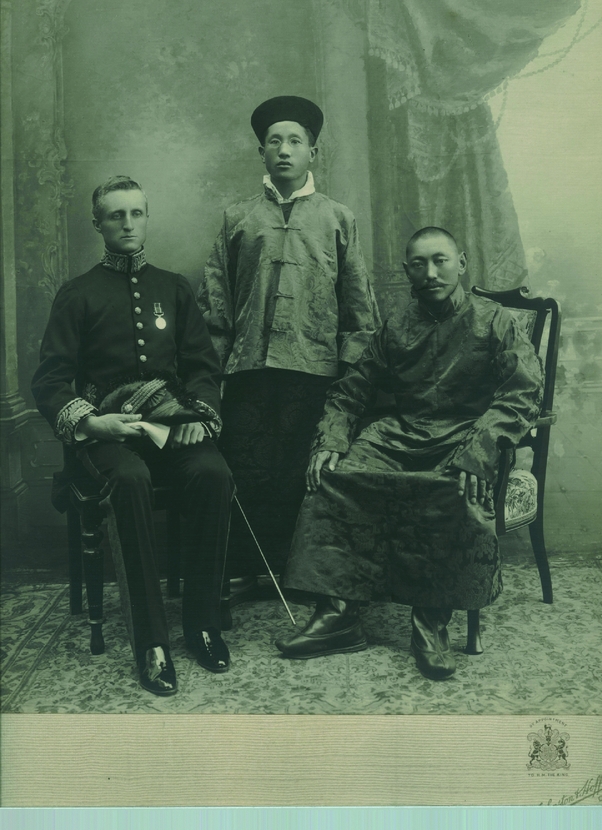
The Dalai Lama's 1895 edict was tested several times during the early years of his leadership,Footnote 37 but his commitment to independence crystallised during his exile in British India from 1910–1912 (see Figure 3). While British India might have seemed like an unpalatable choice for the Tibetan leader's exile (particularly after the massacres and looting carried out by the Younghusband punitive expedition to Lhasa), the Dalai Lama would find there a group of officers who were committed to the area and who had a deep understanding of Tibetan culture and politics. Laden La and British India's Yatung Trade Agent David Macdonald (1870–1962) had both been born and breed within the area of Tibetan cultural influence, but Sir Charles Bell KCIE CMG (1870–1945) must have been a great surprise to the Dalai Lama. Bell spoke good honorific Tibetan and with the assistance of his personal aide, the Tibetan aristocrat Dewan Bahadur Pha lha Se Sonam Wangyal (c.1870–1936), he had long been able to successfully negotiate Tibetan protocol. Bell was careful to entertain his exiled Tibetan guests in the same way that he would have been treated in Tibet, finding accommodation, bringing the party regular gifts of food, alongside organising pilgrimage trips to sacred sites in India. A visit to Calcutta (now Kolkata), and subsequent private conversations spanning close to two years, ensured a close bond developed between Bell and the Dalai Lama. Bell was able to introduce the Dalai Lama to the processes and products needed, in British minds, to create a modern nation. Bell advised and encouraged the Dalai Lama to adopt these institutions with later developments – including a postal service, a secular schooling system (albeit short lived), a government-regulated army, a Tibetan currency and of course a Tibetan flag, created by the Dalai Lama himself, “by modelling it on the standards and colours of ancient Tibet”.Footnote 38
Left to right: Charles Bell, Sidkyong Tulku, the Maharaj Kumar of Sikkim and the thirteenth Dalai Lama By Johnston and Hoffman, Calcutta, March 1910 Courtesy of Private Collection
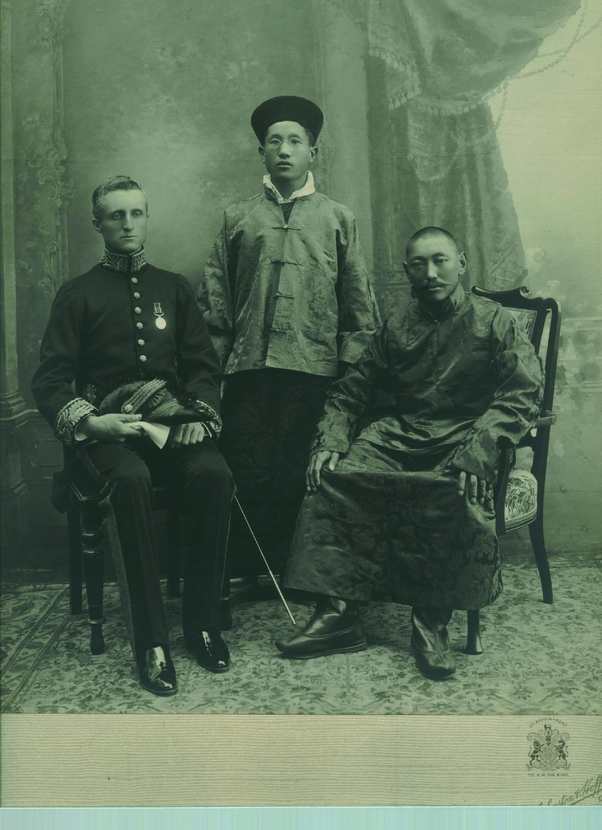
These building blocks of Tibetan nationhood needed a constitutional foundation and this foundation would come in the form of the declaration, delivered shortly after the Dalai Lama's return from British India in February 1913 and only days before Lungshar and the Tibetan boys travelled to England.Footnote 39 This was a clear signal that the Dalai Lama intended to reassert his right to hold both temporal and spiritual roles. Having received Bell's indoctrination into the modern world, the Dalai Lama defined his country as “a small, religious and independent nation”.Footnote 40
The Letters
In the letters to the King and Queen we see this point again (see Text Box 2). These letters, sent to the King to explain the gifts, also articulate the Dalai Lama's wish for Tibet to be recognised as a small independent nation state. They make it clear that this gift exchange was intended to draw George V's attention to the Dalai Lama's understanding of Tibetan independence and to highlight his line of attack at the forthcoming Simla conference. The accompanying letters also offered the Dalai Lama an opportunity to win British support before the official discussions began.
Text Box 2 To: His Majesty the Great and Most Excellent Emperor, King of England, who, by the Wheel of his Merit, exercises universal power.
The reason of submitting this:-
Be pleased to remember that Tibet is related to China as a Priest to his Disciple. Of this I have already informed Your Majesty by letter, from time to time. When I and my Ministers were on our way to India we requested Your Government by telegram through the British Trade Agent at Yatung, to help us, and we received a favourable reply. From the day of our arrival in British Territory, for nearly three years, we were provided with houses to live in; with police to protect us; with a police-officer [Mr Laden La] who assisted us in every way; with a doctor; and with food. These were signal honours which were shown to us. Furthermore, I received great help towards my return to Tibet. All these things are known by all my subjects, and I, and they are filled with great content. Therefore I, the King, my ministers, and my national assembly, have discussed the matter, and have recorded it in a book, that this great kindness may not be forgotten, forever. Therefore, also, we are sending this our man purposely to submit our thanks. . .
Your Great Empire affords protection to the small kingdom, so that the inhabitants live in peace. So therefore there has been, and will be, none other than Your Majesty who can afford protection to Tibet, and this protection we have resolutely determined to crave. We beg that you will protect us, and will continue to maintain an unbroken friendship towards us. We also pray that, if it be possible, Your Majesty and the Emperor of Russia will consult together, and that you and he will Each send a Representative to Lhasa, for the benefit of Tibet, and that the Power, with Temporal and Spiritual may remain with the Tibetan themselves. This cannot be done, we beg that discussion may be held with their Kingdoms [?China] in such a way that the Chinese may not harm the Tibetans and that the Tibetans may enjoy their own power in Tibet.
I am offering prayers for the long life and prosperity of your Majesty, of Your Queen, and of all your Princes, and for the extension of your power.
The Gifts
The gifts themselves show the intention of the Dalai Lama to visualise and map, for the British, Tibet's history, traditions and, to some extent, its borders. These objects were to act as visual markers for Tibetan identity, to be read as material evidence of Tibet's distinct cultural heritage, its long history and the Dalai Lama's right to be recognised as the temporal ruler of Tibet. But what were these objects? Why had they been chosen and what were the layers of ‘knowing’ available to the British, if they had the ability to decipher the messages?
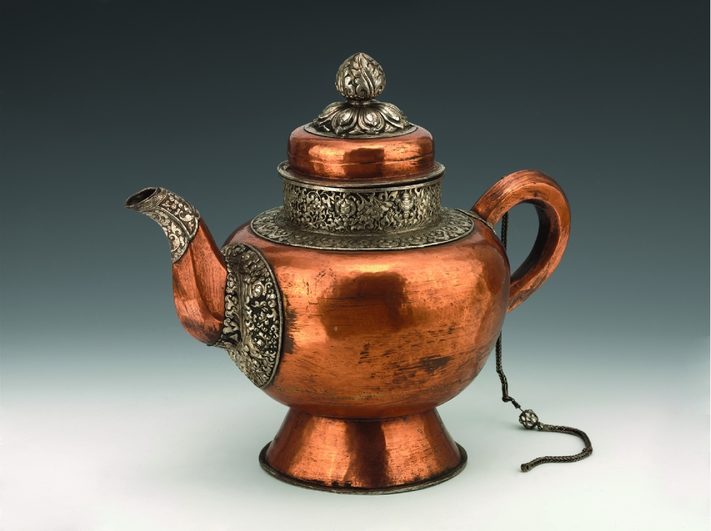
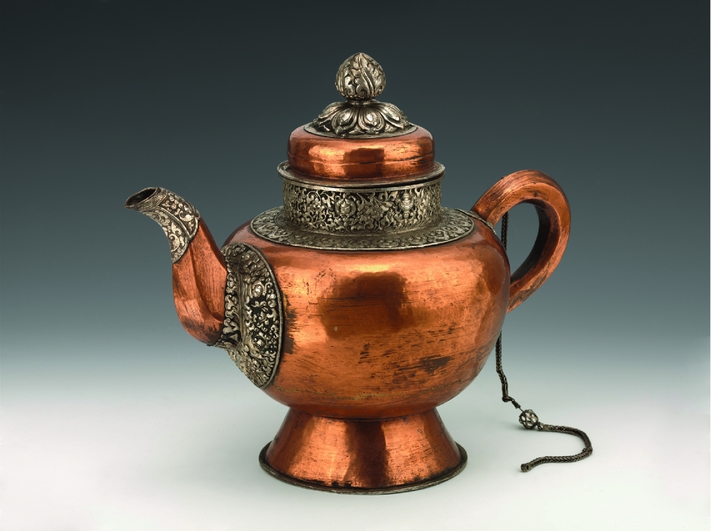
Of the 18 sets of objects given to George V, nine have now been located.Footnote 41 The extant objects now found in the British Museum and the Victoria & Albert Museum will be dealt with in this section; the fate of the rest will be discussed in the final part of this article. The first general note on these gifts is that there were no objects of Chinese origin in this gift exchange. While Chinese jades, cloisonné and ceramics filled many Tibetan homes and were given to individual British India officers in other gift exchanges, the objects in this gift were exclusively Tibetan.Footnote 42 A large metal Tibetan teapot was ubiquitous in Anglo-Tibetan exchanges, and this exchange proved to be no exception, a pair of copper teapots with silver mounts appearing on the gift list. Not only are these vessels particularly distinctive in Tibetan culture, but both the drinking and trading of tea was well recorded by many western travellers to Tibetan areas. This characteristic drink and the vessels that carried it became a culinary symbol of Tibetanness (see Figure 4).
One of a pair of copper teapots with silver mounts. Lhasa, early 20th century V&A Royal Loan 1913.491 RCIN 74480, 74481 Courtesy of Royal Collections/Victoria and Albert Museum, London.@HM Queen Elizabeth II 2013
While this symbol would have been read with little difficulty by the British, there were many more with increasingly complex and multidimensional meanings to come. A third of the objects had specific religious connotations, emphasizing the distinctive path of Buddhism practiced in Tibet and also the integral part it played in Tibetan culture and society. These objects, which include a large pair of men's ga’u (amulet boxes), the Eight Auspicious Symbols and the Seven Jewels of Royal Power appear to have been made specifically for this exchange, most likely in the government workshops in Lhasa. They were brand new at the time of the exchange and when the quality of the workmanship (particularly that found on the Seven Jewels) is compared with other metalwork known to have come out of the government workshops at around that time, it is clear that these objects did not represent the finest quality work available, even if the gift was destined for a king.Footnote 43 However, it must be remembered that the intense fighting between Chinese and Tibetan troops had only just abated and as Shakabpa noted, several of the major treasuries had been looted by the Chinese. It is possible that the craftsmen, materials and tools needed to create the best examples were just not available.Footnote 44 They did however serve their ultimate purpose, denoting the unique form of Buddhist culture found in Tibet, one that was distinct from its Chinese neighbour.
The Thangka
The seven thangka (meditational paintings) also fell into this category, but several thangka played slightly different roles and required increasingly more incisive ‘knowing’ on the part of the receiver, as obvious religious symbolism hid subtle diplomatic messages. The combining of the spiritual and temporal role of the Dalai Lama is first articulated in the Cittavisramana Avalokiteshvara thangka, a manifestation of Avalokiteshvara, the Buddhist Being of Compassion. The fifth Dalai Lama, Ngawang Lobsang Gyatso (1617–1682) – one of the most revered of the Dalai Lamas for his strong religious and political leadership – is known to have strongly identified himself with this manifestation, setting a precedent for future Dalai Lamas who continued and strengthened the link between the Dalai Lama and this bodhisattva.Footnote 45 Here that identification is visualised by the thirteenth Dalai Lama through the sending of this thangka to the British.
Further proof of the Dalai Lama's religious and increasingly political legitimacy could then be found in the thangka representing the seventh Dalai Lama, Kalsang Gyatso (1708–1757). By including the seventh Dalai Lama in this group, the thirteenth Dalai Lama used historical precedent to legitimise his claim to temporal leadership. Like the thirteenth, the seventh Dalai Lama had lived in exile (in Kumbum), and although primarily a spiritual man, he was forced to take the political reigns to ensure Tibet regained independence from the Mongols and remained independent from the Qing in China. Kapstein describes the career of the seventh Dalai Lama as being “played out in the crosscurrents between imperial faith and power”Footnote 46 and there is an argument to be made that the thirteenth Dalai Lama would have felt that his own rule over Tibet was taking a similar path.
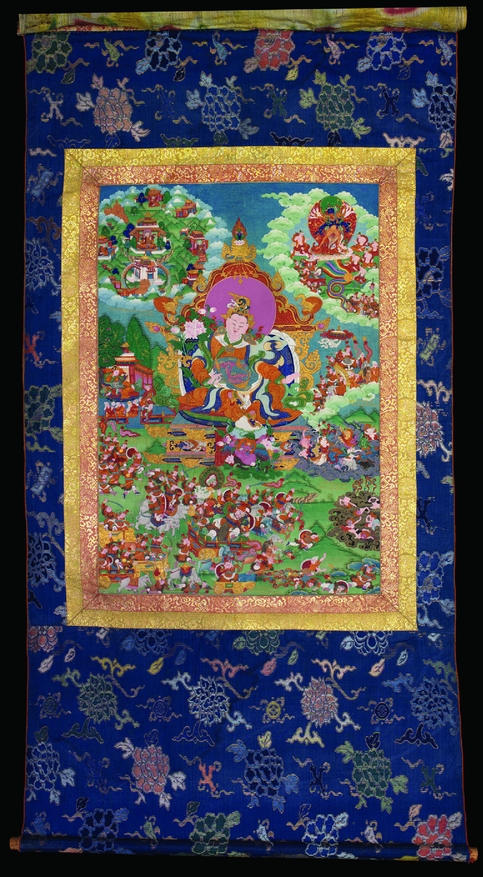
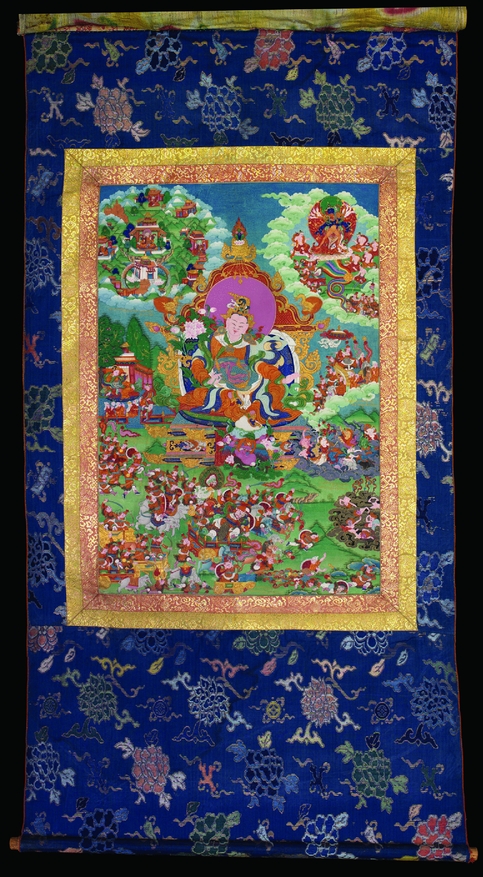
Finally, the thankga of the King of Shambala (Figure 5) features a subject of great scholastic interest to the Dalai Lama at the time of the gift. Shambala, a land to the north of the Himalayas, was said to be home to a pure form of Buddhism, a place where the monastic community preserved the Indian Buddhist teachings. The Dalai Lama, through the influence of his close confident the Buriat monk Dorzhiev, had been persuaded that Tsar Nicholas II of Russia could be the incarnation of the King of Shambala, the protector of Buddhism,Footnote 47 but if we now think back to the content of the Dalai Lama's letter and his request for protection from King George V we are likely witnessing a transformation here. With the Dalai Lama having turned away from Russia and now beginning to place his trust and hopes in the British, we are seeing the King of Shambala becoming George V! These thangka then legitimised the Dalai Lama's personal political and religious credentials, but there were wider issues here that related to the legitimising of an independent Tibetan history and its traditions. To see these messages we must turn to the gifted suit of armour and the Rinpung saddle.
King of Shambala thangka, early 20th century Lhasa, V&A Royal Loan Number unknown Courtesy of Royal Collections/Victoria and Albert Museum, London, @ HM Queen Elizabeth II 2013
Arms and Armour: History, Traditions and Geography
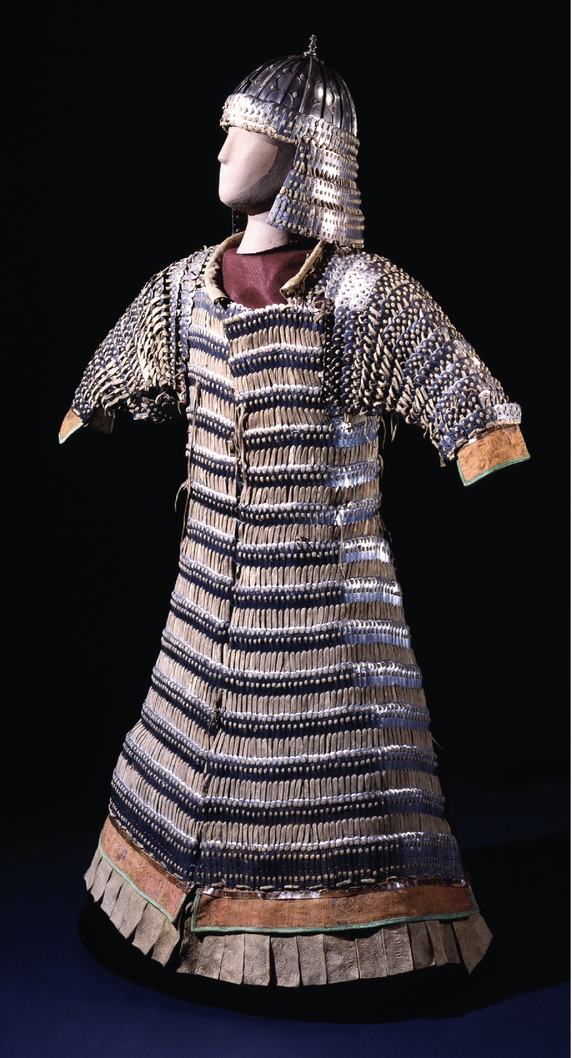
The suit of armour and helmet is described in technical detail in LaRocca (Figure 6), where he identifies the suit and accompanying helmet as of very good quality, dating to the fifteenth or sixteenth century).Footnote 48 For Tibetans, arms and armour appeared regularly in important gift exchanges. The Tang annals tell of incredible tribute gifts presented at the Tang court, among which were Tibetan iron armour, both for men and horses,Footnote 49 most likely of the kind we see given here. These militaristic gifts reference the very earliest known examples of Tibetan and Mongolian gift-giving, particularly the redistribution of war booty and the arrival of silks from sedentary states to conciliate the nomadic warrior bands. Given in the twentieth century to the British, these armours were often accompanied by commentaries that highlighted the traditional skills used in the making of the armours and their historical importance in recording a turbulent part of Tibetan history that had now passed.Footnote 50 In giving this suit of armour the Dalai Lama added a further dimension to the armour's importance. In Laden La's translated description we learn that: “This kind of armour is no longer made, but it is occasionally worn at national festivals.” For the Dalai Lama the wearing of national dress tangibly connected Tibet to its history as a Buddhist nation, to its (royal) creation stories, to the establishment of the Ganden Phodrang or Lhasa government and its rituals and to the development of its major festivals and traditions.Footnote 51 As an object now worn specifically when Tibetan identity was being celebrated, the suit of armour had transposed its original use, beginning a new association with festivals and national identity, thereby ensuring its status as a potent symbol of Tibetanness.
Suit of steel armour and helmet fifteenth to sixteenth century, Tibet, British Museum Royal Loan1880. 725 RCIN 69607 Courtesy of the Royal Collections/The British Museum, London. @ HM Queen Elizabeth II 2013.

While I wish to deal only with the extant objects it is difficult not to at least mention the role of eastern Tibet in the Dalai Lama's vision of his country, as many of the known gifts had a central Tibetan (Ü-Tsang) provenance. The ninth gift listed was a “Tibetan sword, as used by the Khambas”. Not only is the sword an apt choice to represent the Kham people, who were considered by central Tibetans and Europeans alike as great warriors, it would also seem entirely appropriate at this time for the Dalai Lama to impress upon the British that he had political and material control over those areas of eastern Tibet that were most hostilely contested by the Chinese. Lamb felt that Lhasa-centric chauvinism towards eastern Tibet was an early marker of the Dalai Lama's reign,Footnote 52 the Dalai Lama was increasingly referring to Kham as being part of his domain.Footnote 53 Although in reality this was debateable, in making the argument for a unified Tibet, it strengthened the Dalai Lama's claims that he was the legitimate leader of all Tibetans. The Khampa sword gives the Dalai Lama cultural evidence of central Tibet's connections to far-off provinces and those Tibetan areas bordering China that would be disputed during the Simla conference.
The Rinpung Saddle: A Prestigious Gift
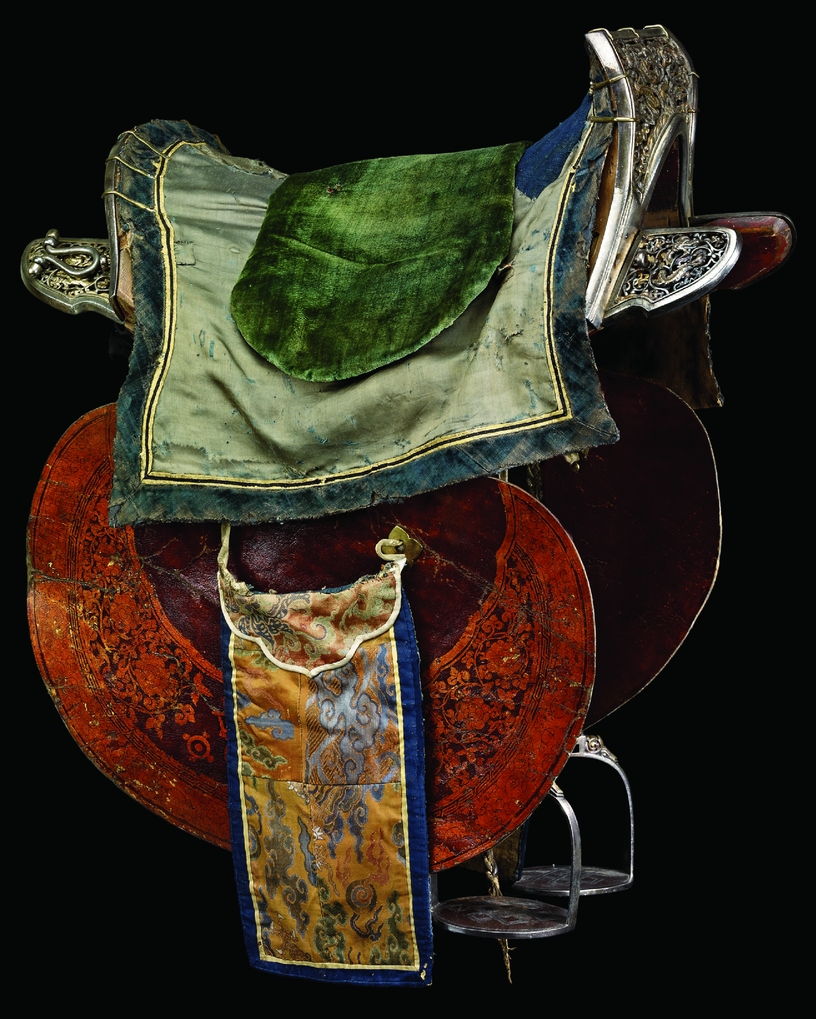
The most multifaceted of all the gifts was the saddle and accompanying trappings (Figure 7), its prestigious nature signposted by the Dalai Lama,Footnote 54 particularly in the lengthy delineation provided in the letter to George V which describes the saddle's owner as
Saddle and trappings, Ringpung reign, sixteenth century Eastern Tibet or China. British Museum Royal Loan 1974.Q54.a-d. Courtesy of the Royal Collections/The British Museum, London, © HM Queen Elizabeth II 2013.
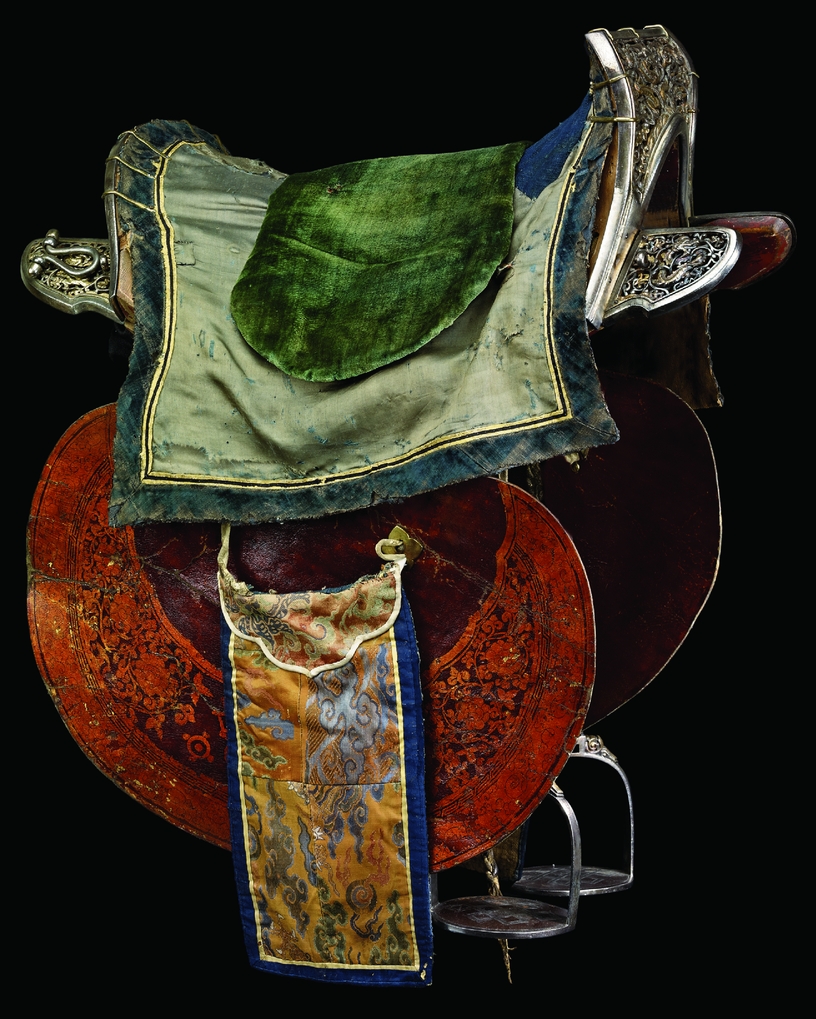
“Rimpung Gyalpo”, a King who reigned at Rimpung 500 years ago. On this saddle the first Dalai Lama is said to have ridden into Lhasa. His immediate successors did so also, and for the last 200 years the saddle has been kept in the Potala at Lhasa as a national relic.Footnote 55
Saddles and accompanying auspicious white horses had long been prestigious gifts given and received by Tibetans.Footnote 56 Heller in her study of artefacts from Tibetan Empire tombs makes note of the number of horse motifs and a fine individual saddle, thought to be from the tomb of a Tibetan statesman, found in archaeological excavations. She very succinctly notes that these “artefacts reflect the importance accorded to horses, and indication of the Tibetan predisposition to nomadic life, their military usefulness and major economic impact of the Tibetan horse trade.”Footnote 57
Gould and Laden La recognised the significance of this particular gift immediately and advised the India Office that: “The [return] present[s] will be especially esteemed if they are antique, or have some sort of symbolic meaning, besides their intrinsic value”.Footnote 58 The Rinpung saddle did indeed weigh heavy with symbolism. It referenced Tibet's history, its past military might and the rise to supremacy of the Geluk school of Buddhism (the Dalai Lama was its spiritual leader).
Rinpung was a seat of learning and power in Shigatse from around 1435, supported by the Karma subschool of the Buddhist Kagyü lineage. In 1481 they seized control of the area from the Nedong and from their base in Rinpung ruled over parts of central Tibet until 1517.Footnote 59 During their rule over Lhasa, the Gelukpa of the Sera and the Drepung monasteries were forbidden to attend the important Mönlam or great prayer festival in Lhasa. Although the Rinpung forces withdrew from Lhasa in 1517, they retained their dominance in parts of Tsang, ensuring that conspiracies and fighting, fuelled by ministers for the respective schools, continued until 1559 when the third Dalai Lama, Sönam Gyatso (1543–1588) was asked to intervene. His intervention activated the eventual rise to power of the Gelukpa over the Kagyüpa.Footnote 60
By giving this saddle the Dalai Lama was not only recalling the long history of the Tibetan nation but also the long history and legitimacy of the Dalai Lama lineage. He was reflecting on the role played by the third Dalai Lama in beginning the process of uniting central Tibet and on the continuing unifying role also performed by the thirteenth Dalai Lama. Here was a blatant reminder for the British: not only that the Gelukpa had been and still was the dominant power in Tibetan politics and religious affairs, but that it was the Dalai Lama who held this unique position – he alone had the ability and the reach to maintain power over the Tibetan nation. This was undoubtedly a prestige gift, but it was also a politically astute one.
The Return Gift: Mimesis and Mistakes
Despite the cultural significance of these gifts, the British had a habit of quantifying everything in terms of pounds, shillings and pence. Cohn notes that the British when dealing with Indian gift exchanges had turned the encounters into “contracted exchanges”),Footnote 61 foregrounding the monetary value of the gifted objects changes the nature and significance of the gift-giving act from one of symbolic incorporation to a financial transaction. The exchange we find here would be no different, with Gould instructed on 30 June 1913 by Dunlop Smith to “make an estimate of the value of the presents”.Footnote 62 It appears that Gould had already made a preliminary financial valuation of the gifts, probably when Laden La was cataloguing them, but as a useful comparator Gould was also able to attend an auction that included a collection of “Tibetan Curios” once owned by Alfred Wallace Paul, CIE (1847–1912), the late Deputy Commissioner of Darjeeling, who had travelled in Bhutan and across Sikkim.Footnote 63 The auction seems to have confirmed Gould's valuation of the Dalai Lama's gifts and he offers, on 2 July, a breakdown of values (which totalled £1,003) for each of the Dalai Lama's gifts to King George and Queen Mary (see Text Box 1).Footnote 64
List of proposed presents from the King to the Dalai Lama with detailed estimates of probable cost.
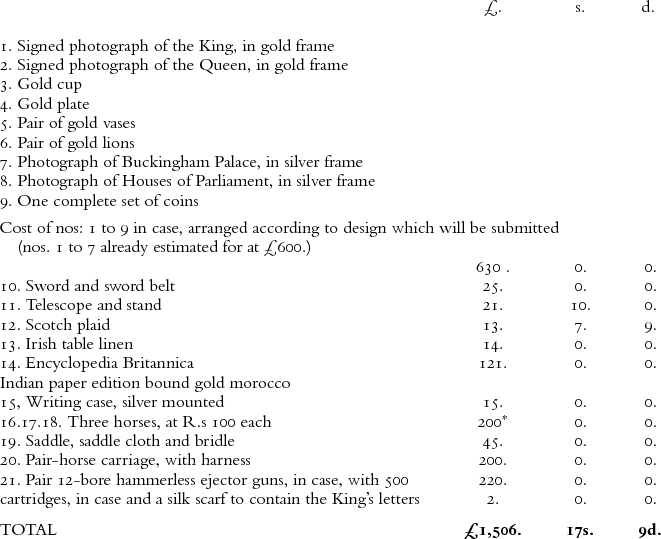
*There is a mistake in the tally. The horses should be £300, thus the final total £1,606.
These monetary valuations might have seemed straightforward to the British government, but for Gould the close relationship these objects had with the Dalai Lama was clearly something to be taken into account. In writing to Dunlop Smith he “suggested that the presents would perhaps sell for £1,000 in ordinary circumstances, but that this estimate might perhaps be doubled in view of the sentimental and historical interest of the gifts”.Footnote 65 Gould understood that the attachment these objects had to the Dalai Lama gave them an intrinsic value; his involvement in the selection of these objects and the historical significance of particularly the saddle and the armour should warrant an additional value being articulated in some way. While Gould realised this wasn't necessarily a financial one but a cultural and spiritual value – something intangible and difficult to put a price on – there was little alternative for articulating this within the confines of Whitehall, so Gould simply doubled the monetary value of the gift. In that same letter, Gould also attached a tentative list of return gifts (see Text Box 3) that he felt would, ‘fully satisfy, and greatly please, His Holiness. I have, of course, only been able to suggest such things as might be purchased by an ordinary individual’.Footnote 66 He is well aware then that this gift would not have the same values attached to it, particularly as George V would not be involved in its selection.
The objects Gould selected for the return gift displayed a diplomatic mimesis or mimicry on Gould's part, as he used a similar (although less sophisticated) language of signifiers and symbols to that used by the Dalai Lama. Here, distinctive products of the regions, including Scottish plaid and Irish linen, are suggested in response to the Tibetan woman's outfit given to Queen Mary. For the Tibetan arms and armour there are items of modern warfare, the ejector guns (inlaid with silver no less!) representing England's military might. But the most intriguing group is that which can only be described as a shrine to Englishness that Gould curated, designed and would have made by the king's jeweller, Garrards.Footnote 67 Gould asked that items 1–9 (see Text Box 3) should be, “mounted in one case, in the form of a triptych”. This instruction is tantalising, but it is not until the list is published in full on 14 October 1913, in The Times, that we find more details of this travelling shrine.
teak-wood case lined with white velvet, specially constructed to be impervious to climatic conditions. When opened the case exhibits in the centre a gold rice cup and cover and a plate, surrounded by two flower vases and two photographs of the King and Queen, guarded on either side by a richly chased gold model of a Trafalgar lion mounted on a white marble pedestal. The cup and cover, a copy of work of Charles II. period, is richly chased with acanthus leaves.Footnote 68
In this triptych we are presented with a visual map of England, presented using quasi-religious constructs, which offers up an essentialised view of English life, incorporating the country's main concerns and its persons of power. The objects within this triptych appear from the description to have been chosen and then positioned so that the Dalai Lama would recognise and interpret the messages conveyed. We see a framed portrait instead of a thangka, gold vessels in place of ritual implements and the Trafalgar lions are clearly an acknowledgment of the Buddhist lion dog, the ubiquitous guardians of Buddhist altars and sacred spaces. Surely, the Dalai Lama was not expected to treat this as a shrine for offerings. Had the British in fact correctly read the King of Shambala's message? Probably not; more likely it reflected an earlier British and later British-Indian ambassadorial tradition that was supported by Warren Hastings, Governor-General of India (1773–1785), of commissioning gift-portraits (of himself in this case) for Indian rulers.Footnote 69 Although we only have the description to guide us, the triptych appears to have been a well-considered piece of cultural mimesis or mimicry on the part of Gould that could only have been made possible with the aid of someone who knew the protocols for creating such a message – i.e. Laden La.
Laden La's Influence
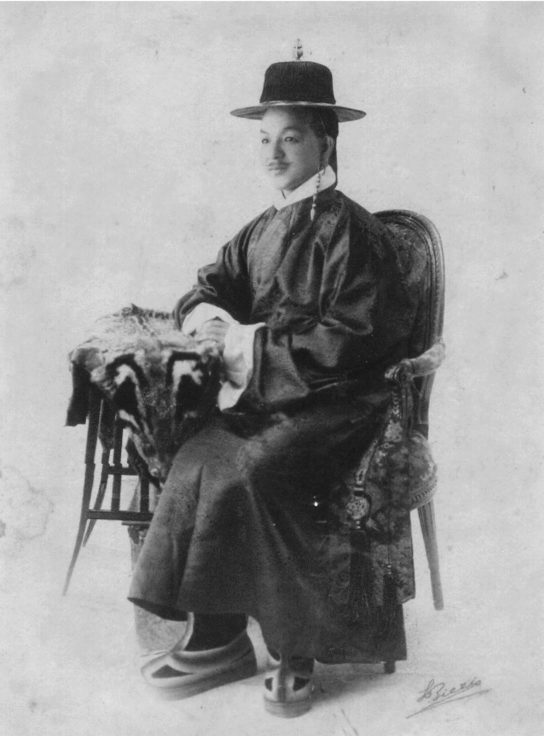
While Laden La remains silent throughout the many exchanges between Gould, the Political Department and the India Office, his presence is evident on several occasions and it seems fitting to acknowledge his part here (Figure 8). As Gould negotiated the British government's procedures, he referred to complex systems of Tibetan gift protocol that would be recognised by the Tibetans and would have enhanced the auspicious nature of the gift (the Buddhist connotations of the triptych can be seen as one such reference). Gould had only been in the Gyantse post for about a year before being sent to England with the Tibetan delegation and it is highly unlikely that he would have mastered these complex protocols in such a short space of time. The actions that Gould suggested, the number of gifts he recommended and the size of the groups to be offered, was undoubtedly the work of Laden La.
Sonam Wangfel Laden La in Tibetan official dress. Courtesy of the Rhodes Family.

Laden La had from a young age been surrounded by Tibetan protocols. He was raised by his aunt and, significantly for this paper, his uncle Rai Bahadur Lama Ugyen Gyatso. Gyatso had, prior to his work with Sarat Chandra Das, the British India pandit, been sent as an envoy to Tashi Lhünpo monastery in Shigatse and then to Lhasa in the late nineteenth century).Footnote 70 To have been chosen for these roles Gyatso would have been highly skilled in Tibetan aristocratic diplomacy and as a Lama would have been well versed in religious etiquette. This in some part was clearly transmitted to the young Laden La.
As a result, in 1913 great care was taken to adhere to certain Tibetan protocols, and on presenting the list of return presents to Dunlop-Smith Gould gives his rationale for selecting the number of gifts, stating that:
It would be convenient if there were either fifteen or twenty-one presents, or groups of presents, since an additional compliment would be implied, their being fifteen virtues or kindnesses, according to the Buddhist doctrine, and twenty-one manifestations of the Goddess Tara, the chief patron goddess of the TibetansFootnote 71
These “additional compliments”, although opaque to the British government, would have been obvious to the Dalai Lama. These actions would have been an easy way for experienced officers like Laden La to maintain and enhance goodwill and the good relations between British India and Tibet. In addition to the use of auspicious numbers and dates, Laden La also guided Gould in his handling of Lungshar, recommending that: “The bearer of presents is usually rewarded, according to Tibetan custom. If His Majesty is pleased to make any present to Kusho Lungshar, perhaps a gold watch and chain would be suitable”. If British protocol had been strictly followed, it would have been unlikely that a presentation of this kind would have been made, causing an already antagonistic Lungshar to feel further alienation towards his British hosts.
The Carriage
Although some aspects of Tibetan etiquette were followed, British protocols did dominate, most notably in the decision (approved by Gould and Laden La) to present a horse and carriage as the British prestige item. During the Dalai Lama's exile in British India, the British India government had sought to negotiate internally how the Dalai Lama would be classified within the wider understanding of British India rule. The National Archives of India clearly show what the British thought of the Dalai Lama during his visit to Calcutta in March 1910. While Charles Bell had requested a 21-gun salute, the highest possible salute for a ‘Native Chief’, the Foreign Office had other ideas. “Mr Bell thinks that His Holiness should get 21 guns as being the head of about 15,000,000 Buddhists and venerated by 100,000,000. . .The Tashi [Panchen] Lama got 17 guns. As he was our friend and the Dalai Lama was not and is a refugee I think 19 guns is enough”.Footnote 72 But within the space of three years the Panchen Lama had fallen out of favour with the British and now they wished to honour the Dalai Lama with a British piece of regalia, a “symbol of British royal ceremonialism”Footnote 73 that would identify His Holiness as the leader of his state, making it an ideal gift for the Tibetan leader. This pièce de résistance of the British gift was to be the ceremonial carriage. The individual British India officers involved in the gift selection thought through every detail of the carriage, with Gould suggesting that the carriage be painted in a particular shade of yellow, used by the Dalai Lama for his palanquin, while Bell (back in Sikkim) modified the coach builders’ designs to ensure that the Dalai Lama's seat was higher than the others and would face the appropriate direction.Footnote 74
After several inspections, the return gift (minus the carriage and horses, which would be arranged in India) was ordered, delivered and finally approved on 10 September 1913. It was then shipped to India along with Gould, who travelled with the gift as far as Gyantse. As for the Tibetan reception for the return gift, we are reliant on a few scattered British Indian sources. Lamb mentions the gifts, but notes: “What the Dalai Lama thought of this assemblage is not recorded”).Footnote 75 Gould however, gives us a glimpse of the gift travelling back to Tibet when he records that: “At every stage of the journey from Sikkim to Lhasa the gifts were received with royal honours, as if they had been the person of the King”).Footnote 76 Gould was obviously pleased with how the gift exchange had played out, but did the Tibetans really understand the return gift in this way?
Unfortunately, despite the attention to detail, a major faux pas was about to be made by the British. The consequences of sending a wheeled vehicle to a country without a system of roads had just not been considered. Tada, a Japanese Buddhist practitioner, who was in Lhasa between 1913 and 1923 witnessed the arrival of the most prestigious part of the gift, the specially commissioned carriage and horses.
The coaches were sent to him [Dalai Lama] in pieces across the Himalayan range. These pieces were reassembled in Lhasa, but there was no suitable road to drive them in Lhasa, so that the Dalai Lama could not utilize the gifts from the king. Therefore, he wished to have the horses put to practical use, and had one of the attendants ride on one of them. The horse got frightened, and the rider fell from the horse and suffered fatal injuries. Small wonder, too, because the horses had been trained as coach horses and not for riding. However, the Dalai Lama took all this in a Tibetan way, and attributing the confusion to British lack of sincerity, never gave another thought to the expensive gift.Footnote 77
Despite Gould's and Laden La's best intentions to present the gifts within the context of Tibetan gift-giving etiquette, Tibetan customs were overridden at crucial moments with the emphasis remaining firmly on British ceremonial protocols. In reality the return gift was at best diplomatically unfortunate. Considered by the Tibetans as lacking sincerity and thought, its impact briefly undermined the work of men like Charles Bell, who sought to bring Tibet under British India's influence.
Disposal and Loss: The Tibetan Gift
Today, foreign gifts such as these would be incorporated into the Royal Collection, often sent on long-term loans to relevant institutions. However, in this particular case finances again played a part in the proceedings. Many of the colonial officers who worked in the Foreign Department built up private collections of objects by retaining the gifts they received during diplomatic encounters. As the gifts were officially seen as British India government property, officers either bought back the gifts they wished to keep or paid for the return gifts themselves, ensuring that the government did not make a loss.Footnote 78 As there were five separate gifts and return gifts to pay for, ranging in value from £50 to £900, the potential cost to the receivers was quite considerable. A precedent was therefore found in an 1895 visit from Afghanistan's Shahzada Nasrulla Khan, which allowed the cost of his visit and the return gifts to be covered by selling parts of the gift given by Khan. This was an agreeable solution for all; consequently the items given to the ‘Chief Ministers’ of England were proposed for sale in order to release them from any financial burden. Apart from depositing a small selection of the gifts given to the king and queen in London museums, the rest would be sold at auction.Footnote 79
The sale appears not to have been a priority, for it is not until 5 May 1914 at a J. C. Steven's auction of “Curiosities” at their Covent Garden showrooms that we find, tucked away on page 12 of the catalogue, a reference to 13 Tibetan items under the heading “Oriental Metalwork etc”.Footnote 80 The most startling omission concerns the objects’ provenance. There was no mention of the Dalai Lama in the entries. We should see this entry within the context of that diplomatic event. For the Tibetans, any suggestion that the gifts presented would not be placed in the royal treasury would have caused great offence. As the British had already fallen foul of this in their gift-giving protocols with Indian princes, they were keen to avoid a repeat performance.Footnote 81 Therefore, the sale was discreetly hidden, hopefully out of sight of the Tibetans.
Concluding Thoughts
Was this gift exchange a resounding success or were the gifts marred by their culturally encoded meanings, their intentions simply lost in translation? Was there, “a gulf in meaning that may simply be a matter of differences in taste, expectations, or custom”?Footnote 82 Or were these, ‘gift-givers. . .particularly talented in choosing the right thing’ and more importantly, “gracious in accepting the wrong thing, eliminating or smoothing over the gap between intent and result”?Footnote 83 With the passing of a century the intentions of both can now be read and understood in a way that may not have been politically possible or desirable in 1913. The Dalai Lama's choices clearly show him involved in the process of creating a Tibetan cultural identity. When viewed in conjunction with the political events that had just taken place and those that were clearly on the Tibetan horizon, these material products offer us an insight into the Dalai Lama's central concerns for Tibet's future and how, at that particular moment, he imagined the geography and history of his country. The fact that he wished Britain to be his major international partner and protector, helping him realise his ambitions, could not have been made clearer in the bold declarations of the letters and the skilfully chosen objects.
But on what level did the British register these signals? On a personal level, the British who worked in the Himalayas clearly did understand the implications. Gould was keen to press that the saddle in particular had a significant narrative encoded within it, although it is not clear if Gould at this early stage in his Himalayan career understood the wider set of meanings found across the gifted group that underpinned the semantics of the saddle. Laden La, in his capacity as mediator, negotiated his way through the protocols of Tibetan and British gift-giving, and in translating the Dalai Lama's letters and gift letter, he did throw light on some of the intended messages. However, his position as chaperone to the Tibetan delegation, temporarily enlisted by the British government, ensured that when the crucial gift decisions came both he and Gould demurred to the more conventional and dominant ceremonials of the British rather than those of the Tibetans.
It was nevertheless the much wider political and diplomatic corps who would finally determine the success of the Dalai Lama's gift to the British. These bureaucratic entities, so far removed from British India, had little concern for Tibet and the waning “Great Game” that had been played out with such intrigue over the previous 50 years. The British in 1913 were now anxiously looking to the near horizon and the soon to be declared First World War that would be a further step towards the dismantling of British India. Their talent in the arena of diplomatic gift giving was to simply pay no attention to the meanings presented to them. This attitude wholly frustrated the British India officers on the Himalayan frontier who saw this rebuttal as detrimental to the burgeoning diplomatic relationship that they were fostering – with some success it should be said – a relationship that a succession of frontier officers continued to work on with their Tibetan colleagues for a further 40 years. Although the British could surely read a number of the messages conveyed in the objects and the accompanying letters, they chose diplomatically to ignore them. In the return letter from George V, written by Gould, the king notes: “Your Holiness is aware that my Government is adopting means to effect a settlement between your country and China, and to establish good relations between the British Empire, China, and Tibet – I trust the meeting between representatives which is to take place at Simla will be fruitful”.Footnote 84 This lack of commitment, and the suggestion that Tibet needed to reconcile with China, was a major blow for the Dalai Lama and would signpost Britain's eventual Tibetan policy, one that was non-committal and framed by avoidance.
For the Tibetans, having finally muscled their way into an audience with George V, they must have thought that surely now they would gain British support. The Dalai Lama may have expected that the king's powers ran in a similar vein to his own theocratic rule and that in gifting a series of national treasures and unique items, some persuading could be effected. Unfortunately, the Dalai Lama had misread the British political situation. Rather than the “universal power” to whom he had addressed his letter, he would find instead a gaggle of bureaucrats who controlled every diplomatic move, their aim to avoid any new diplomatic responsibilities at a time of encroaching war. The carriage's intentions may have been to acknowledge symbolically that the British did recognise the Dalai Lama as the leader of Tibet, but for the Tibetans, the true insincerity of the gift made itself apparent in the death of the coachman.
Gift-giving encounters punctuated all the major diplomatic events involving British India and Tibet in the first half of the twentieth century. While these gift exchanges were considered peripheral, or even on occasion a nuisance by the secretaries of state, in relation to the main diplomatic events, they were crucial in setting the tone of the diplomatic discussions to come. Indeed, these gift exchanges and the appropriateness of the gifts chosen, acted as a barometer – a measure of the relationship and the understanding that was developing not only between the two diplomatic entities but also the individual officials who played their parts in these encounters. On some occasions, including Gould's choices for the infant fourteenth Dalai Lama in 1940, they were perfectly pitched.Footnote 85 However, the handling of diplomatic gifts in Britain, far removed from the protocols and procedures of British India and the Himalayas, produced very different results. Despite the respective gift's multiple layers, intended to emphasis each party's imagining of itself; ultimately the messages were too cryptic, too tied to their respective cultural understandings to make it through the deciphering process. In short, neither set of gifts nor their diplomatic messages reached their intended final destinations.