The rubber-hand illusion (RHI), which is usually induced when a participant's hidden hand is stroked simultaneously and congruently with visible strokes applied to a rubber hand, is regarded by Dijkerman & de Haan (D&dH) as an illusion of ownership over a body part, whereas others have also referred to it in terms of self-attribution (Botvinick & Cohen Reference Botvinick and Cohen1998; Ehrsson et al. Reference Ehrsson, Spence and Passingham2004; Reference Ehrsson, Holmes and Passingham2005a; Ijsselsteijn et al. Reference Ijsselsteijn, de Kort and Haan2006; Tastevin Reference Tastevin1937; Tsakiris & Haggard Reference Tsakiris and Haggard2005; Tsakiris et al. Reference Tsakiris, Prabhu and Haggard2006). However, there are several sub-components of the RHI, which may dissociate under the appropriate experimental conditions. Such dissociation provides additional support for the model proposed by D&dH, distinguishing between perception and action streams in the somatosensory system.
The illusion of ownership in the RHI is typically assessed by means of a questionnaire, in which participants express strong agreement, on average, with the statement: “I felt that the rubber hand was my hand.” Strong positive responses (i.e., ≥75% of the maximum rating on the scale) to this question have been obtained in a number of studies (Armel & Ramachandran Reference Armel and Ramachandran2003; Botvinick & Cohen Reference Botvinick and Cohen1998; Ehrsson et al. Reference Ehrsson, Spence and Passingham2004), while weaker positive ratings are given under several “virtual reality” conditions (≥50 and <75%; Ijsselsteijn et al. Reference Ijsselsteijn, de Kort and Haan2006). Finally, several RHI studies have shown, on average, negative (<50%) responses to the same question (Schaefer et al. Reference Schaefer, Flor, Heinze and Rotte2006a; Reference Schaefer, Noennig, Heinze and Rotte2006b).
Accompanying the strong ratings of the “illusion of ownership,” participants also tend to respond strongly to “it seemed as if I were feeling the touch in the location where I saw it.” Indeed, in the three studies with strong illusions of ownership, and which included both questions, the tactile location illusion (visual capture of touch) was more strongly rated than the ownership illusion (Botvinick & Cohen 1998: approximate values: tactile location=100%, ownership=89%; Ehrsson et al. 2004: 89% vs. 83%; Ijsselsteijn et al. 2006: 80% vs. 72%). In addition to, or instead of, these illusion ratings, researchers have also measured “proprioceptive drift,” in order to quantify the extent to which the felt position of one's real hand changes during the stimulation and illusion period (Botvinick & Cohen Reference Botvinick and Cohen1998; Ehrsson et al. Reference Ehrsson, Holmes and Passingham2005a; Holmes et al. Reference Holmes, Snijders and Spence2006; Tsakiris & Haggard Reference Tsakiris and Haggard2005; Tsakiris et al. Reference Tsakiris, Prabhu and Haggard2006).
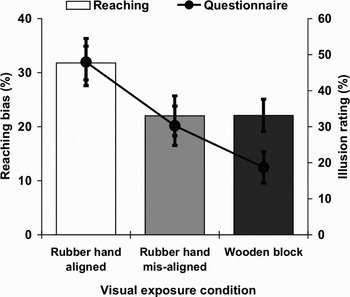
Most interestingly for present purposes, proprioceptive drift can be dissociated from the illusions of ownership and visual capture. For example, simply viewing a rubber hand in a posturally compatible position (optically superimposed over the real hand by using a mirror) for as little as 10 seconds, can induce significant biases in subsequent reaching and pointing movements made with the exposed hand, but without inducing any illusion of ownership or of visual capture (i.e., ratings were <50%, Holmes et al. Reference Holmes, Snijders and Spence2006; see our Fig. 1 here).
Dissociation between reaching biases and illusions of body ownership. Illusory “ownership” of the aligned rubber hand was significantly stronger (although, on average still represented denial of the illusion) than the misaligned hand, which was in turn stronger than the wooden block. However, reaching biases in the aligned hand condition were stronger than both the misaligned and wooden block conditions. The latter two conditions did not differ significantly from each other (data show mean±SEM, redrawn from Holmes et al. Reference Holmes, Snijders and Spence2006).

Similarly, questionnaire ratings of the perceived drift of one's felt hand position (i.e., “I felt as if my hand was drifting towards the rubber hand”) were consistently lower in the aforementioned studies than ratings of the ownership and capture components (drift ratings were only 6%–30%). Reaching and pointing responses made with the illudedFootnote 1 hand (Holmes et al. Reference Holmes, Snijders and Spence2006), or intermanual pointing with the non-illuded hand (Ehrsson et al. Reference Ehrsson, Holmes and Passingham2005a; Tsakiris & Haggard Reference Tsakiris and Haggard2005; Reference Tsakiris, Prabhu and Haggard2006), result in only a partial bias in pointing towards the rubber hand (in all cases, <30% drift towards the rubber hand). Further, proprioceptive drift increases over time-scales as short as 4 to 12 seconds (Holmes & Spence Reference Holmes and Spence2005), and for up to 3 minutes of exposure to a rubber hand (Tsakiris & Haggard Reference Tsakiris and Haggard2005). In contrast to these partial and incremental processes, the visual capture of tactile location in the RHI appears to be an all-or-none phenomenon – when participants were asked whether the touch appeared to come from “somewhere between their own hand and the rubber hand,” they typically disagreed (Botvinick & Cohen Reference Botvinick and Cohen1998: 28%; Ijsselsteijn et al. Reference Ijsselsteijn, de Kort and Haan2006: 32%).
In summary, research on the RHI supports the notion that proprioceptive reaching and pointing responses can be dissociated from the visual capture of tactile location, and from higher-order bodily sensations such as ownership. This dissociation parallels, in part, the classical notions of body schema and body image. Head and Holmes (Reference Head and Holmes1911–1912), although they did not use the terms “body image” or “body schema,” distinguished three elements of bodily processing which may dissociate from one another following lesions of the spinal cord, brainstem, thalamus, or cortex – a postural schema for the appreciation of changes in position and movement of the body (corresponding, perhaps, to the postural and visuo-motor functions of the visual dorsal stream in D&dH's model), a surface schema for the localisation of cutaneous stimuli on the body surface (which is not at present separated from postural or proprioceptive information in D&dH's model), and more conscious visual images of the body (which may correspond to the body image in D&dH's model).
We do not see at present how the model proposed by D&dH accounts in detail for two consistent findings in the RHI literature: (1) that proprioceptive and tactile aspects of the illusion are dissociable, though often correlated; and (2) that postural compatibility of the visible rubber hand is a necessary component for induction of the RHI and related phenomena. At present, the model does not appear to provide a direct link between postural, proprioceptive, or visuomotor processing (related to the body schema) and the conscious recognition and ownership of one's body (related to the body image). The RHI demonstrates that we cannot incorporate rubber hands into our conscious body image unless they are compatible with our unconscious body schema.