

Introduction
On the morning of Sunday, April 23, 2017, Italian-born memoirist and landowner Kuki Gallmann was ambushed and shot while driving in her vehicle on her hundred-thousand-acre ranch in Laikipia County, Kenya. In the previous month, Gallmann’s ranch, called Ol Ari Nyiro, had been taken over by trespassers who looted the property, burned several buildings, and allegedly shot several elephants and giraffes. In 2017, the county of Laikipia made news headlines worldwide as conflict between pastoralists and white ranch owners dramatically escalated. Several of Laikipia’s white-owned ranches were attacked between January and May, with the ensuing violence claiming the life of one white ranch owner, several ranch employees, and several innocent bystanders. An unknown number of alleged invaders and their livestock were also killed by government security forces. Indeed, the shooting of Gallmann was only the most publicized manifestation of tensions that had been building in Laikipia during the preceding months.
As 2016 and 2017 brought drought to Laikipia and several neighboring counties, pastoralists and their livestock converged on Laikipia’s white-owned ranches in desperate search of pasture. Laikipia County is home to some of Kenya’s oldest white settler families, many of whom own significant tracts of land. Though conflict between white landowners and pastoralists was undoubtedly precipitated by drought, residents of Laikipia (white and African alike) believe the violence was aggravated by politicians “using racially charged language and inciting locals to herd their cattle onto privately owned land [to boost] their popularity ahead of an election” (Telegraph, April 23, Reference Sundaresan and Riginos2017). In the run-up to Kenya’s federal election in August of 2017, these conflicts brought scrutiny upon Matthew Lempurkel, the Member of Parliament for Laikipia North, who was accused of exploiting the county’s ethnic and racial divisions during his four-year tenure in office. Lempurkel, an ethnic Samburu from Isiolo County, was a political outlier who gained support in Laikipia by promising to evict white settlers from their land. His tenure was associated with unrest, alienating Laikipia’s pastoralists as well as white landowners. Much of the livestock that converged on Laikipia during this conflict were alleged to be the property of elites from Samburu and other counties to whom Lempurkel offered pasture as a form of political patronage. Promising to shield the owners and herders of these livestock from prosecution, Lempurkel brought a renewed wave of insecurity to Laikipia, the brunt of which has been borne by Maasai communities along Laikipia’s northern border with Isiolo and Samburu. Kenya’s president, throughout the crisis, castigated Lempurkel and the alleged invaders, urging that the land rights of all Kenyans be protected (Daily Nation, January 31, 2017).
This was not the first-time Kenya’s government had come to the defence of Laikipia’s white landowners. In 2004, another land conflict gripped Laikipia, as thousands of pastoralists (mainly Laikipia Maasai) occupied white ranches in a series of relatively peaceful protests that lasted several months. As European settlers arriving in Laikipia in the early twentieth century were granted leases for ninety-nine years, the decade of the 2000s saw these leases begin to expire, and many Maasai were hopeful that land re-distribution would be forthcoming. But after reviewing the case in Kenya’s high court, the government established that these settlers’ leases were in fact valid for 999 years. Security forces moved in to clear protestors from white-owned ranches, and one Maasai was killed in the ensuing skirmishes. Though the 2004 protests brought land inequality in Laikipia to the brief attention of global audiences, it also proved “that Laikipia remains strongly tinged by a colonial legacy” (Little 2014:83)—one that Kenya’s government has little interest in undoing. In recent decades Laikipia has become a mainstay of the country’s conservation landscape, while also hosting a network of British military installations that have brought significant investment to this region of Kenya.
Though the recent conflict in Laikipia County weighed heavily on residents’ minds during the 2017 election, these conflicts may have longer term implications for the white Kenyan community and their longstanding involvement in Kenya’s conservation sector. Recently, Janet McIntosh (Reference Lunstrum2016) has brought unprecedented attention to the experience of white Kenyans and the “unsettled” nature of their belonging in this post-colonial nation. Through in-depth research among European settlers and their descendants throughout Kenya, McIntosh reveals that this population is increasingly cognizant of their problematic position in a country struggling with land shortage, inequality, and corruption. While McIntosh describes how white Kenyan landowners represent conservation as offsetting their privilege, other scholars argue that the role of white Kenyans in conservation is not merely inequitable, but is tantamount to corruption. The Big Conservation Lie, a recent book by John Mbaria and Mordecai Ogada (2016), makes the case that conservation has not only preserved colonial landownership structures, but is also entwined with the politics of donorship and development in ways that exclude Africans from dictating their own economic and environmental futures. Conservation has become a pillar of Laikipia’s economy in the past several decades, upon which whites and select African elites have based lucrative, prestigious, and seemingly apolitical professions. With massive plots of white-owned land replete with wildlife from which subsistence people are excluded, Laikipia is a mecca for foreign investors and conservation scientists who have built lodges, erected fences, and conducted invasive wildlife research and with little or no oversight by Kenya’s government (Evans & Adams Reference Duffy2016; Mbaria & Ogada Reference Little2016). While Gallmann and other white landowners assert that recent conflict portends a threat to wildlife in Laikipia, I argue that conservation has masked and depoliticized the systemic marginalization of pastoralists in this region.
With support from private donors and conservation organizations, white ranchers like Gallmann have ostensibly worked to include pastoralists in the economic benefits of wildlife conservation. In addition to employing several hundred Africans, Gallmann and other landowners support local schools and educate pastoral communities on how to manage natural resources responsibly. A growing body of studies, however, testifies that conservation throughout eastern Africa has failed to compensate pastoral populations adequately for the land alienation they have endured for over a century. Pushed to the drier peripheries of Laikipia in a large-scale relocation scheme in 1914 (Hughes Reference Hughes2006), Laikipia Maasai have experienced significant population growth since the early 1990s, and their small, communally-owned land parcels called group ranches struggle to maintain pasture, water, and other subsistence resources (Lengoiboni et al. Reference Kennedy2010). Pastoralists throughout Kenya are being aggressively incentivized by conservation organizations to forfeit natural resources in exchange for social services and employment, though these benefits are often more meager than promised (Norton-Griffiths Reference Neumann1996; Igoe Reference Hughes2006; Little 2014). When accused of hoarding land, Gallmann has drawn attention to the number of people her ranch employs, and the fact that a corner of Ol Ari Nyiro is permanently allocated for her neighbors during droughts (Telegraph, April 23, 2017).
This article situates the 2017 shooting of Gallmann within the context of white settler studies and recent critiques of conservation in Kenya, highlighting new questions about the role of white landowners in security and development across northern Kenya more broadly. The recent crisis in Laikipia coincides with significant developments in the study of whiteness in Kenya, and a mounting understanding of the racial underpinnings of conservation throughout the African continent (Garland 2008; Hughes Reference Hughes2006; Suzuki Reference Sumba, Warinwa, Lenaiyasa and Muruthi2017). Following a brief survey of white settler studies in Africa, I discuss how conservation has enabled white Kenyans to exert collective influence over Laikipia, while blurring the lines between philanthropic and for-profit activity. I then explain how northern Kenya has seen a burgeoning in community-based conservation projects in recent years, driven by an entity called the Northern Rangelands Trust (NRT), which operates thirty-three conservancies in pastoral areas in ten of Kenya’s northern and coastal counties. Accumulating subsistence communities under a wide rubric of land management programs and financial incentives, the NRT has raised concerns among Laikipia pastoralists that this not-for-profit group is undermining the region’s livestock economy, while bringing insecurity closer to their doorstep.
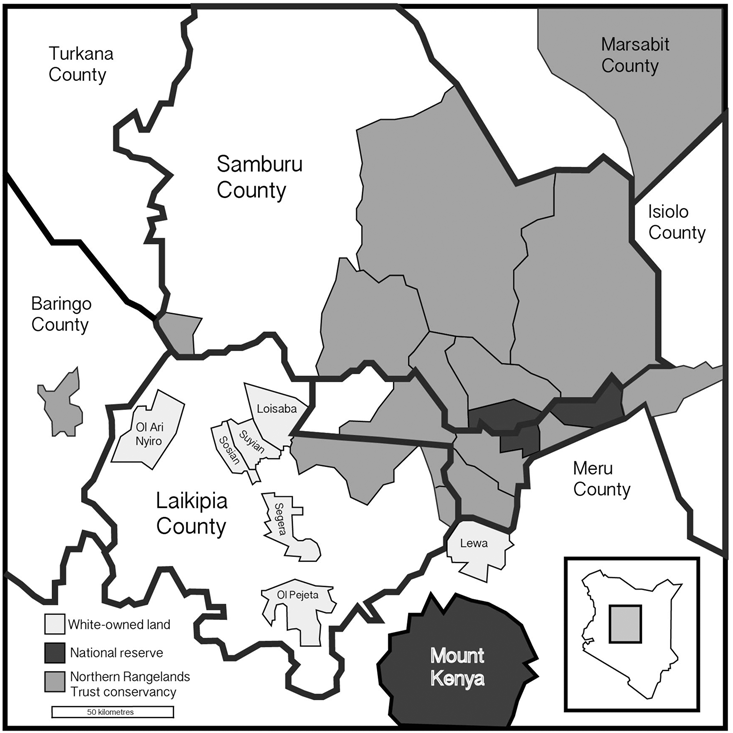
Map displaying the white-owned ranches referenced in the article, as well as National Reserves and Northern Rangelands Trust conservancies in the study region. Map credit: author.
I then describe in detail the conflict that has unfolded in Laikipia since June of 2016, including the perspectives of Laikipia’s Maasai population. The recent conflict has had an underappreciated impact on Laikipia’s Maasai community, which has lost access to pastures on neighboring white ranches as grazing agreements have been cancelled or suspended due to recent violence. As the shooting of Kuki Gallmann brings land conflict in Laikipia to the attention of global audiences, I warn against simplifying the experience of local pastoralists, whom conservation discourse is often inclined to demonize (Neumann Reference Mbaria and Ogada2004). I argue that the diverse groups of pastoralists implicated in these conflicts are all subject to a deepening maelstrom of livelihood stressors, some of which appear aggravated by electoral politics, as well as by the efforts of white Kenyans to expand conservation across northern Kenya.Footnote 1
Whiteness in Kenya
Though everyday life in British colonial societies has been a major focus of historians (Cooper & Stoler Reference Cooper and Stoler1997; Kennedy Reference Hughes1987; Shadle Reference Rutherford2015; Shaw Reference Rutten1995), communities of white settlers who have remained in Africa since independence have rarely been subject to significant scholarly analysis. Apart from the familiar cases of South Africa, Namibia, and Zimbabwe, the nations of Kenya, Zambia, Botswana, and Mozambique remain home to European settlers and their descendants who maintain standards of living far above national averages. Largely absent from elected political office, white citizens of Africa often maintain significant landholdings or business assets. Moreover, as prolific writers both of fiction and non-fiction works, white Africans have drastically shaped how the Global North has understood and interacted with Africa in the twentieth century (Ferguson Reference Evans and Adams2006). Representing Africa as pristine wilderness is central to what David McDermott Hughes (Reference Holtzman2011) calls “the imaginative project of colonialism” (160). Insecure of their position among impoverished populations, white writers represent Africa as devoid of human presence in order to “overcome the feeling of territorial exile” (Hughes Reference Holtzman2011:161).
Even among some of Kenya’s most conservative white landowners, Gallmann has a reputation for being unaccommodating of African neighbors, and of justifying her exclusionary land management approach using racialized rhetoric revealed in her bestselling autobiographical novel, I Dreamed of Africa. Made into a high-budget Hollywood film in 2000, I Dreamed of Africa is Gallmann’s testimony to the sacrifices she has endured in protecting her ranch. Naturalized as a citizen of Kenya after moving there from Italy in the 1970s, Gallmann’s writings have been considered controversial for depicting Africans as profligate land stewards, “polluted by alien religions, by poverty, and a lack of worthy goals” (251).
The hegemonic nature of white privilege in parts of Africa is of mounting interest to scholars, who argue that despite dynamic anti-colonial energies, whiteness remains a dominant mode for imagining power in many African societies (Nyamnjoh 2012). Whiteness emerged as a field of ethnographic inquiry in Africa as the decline of apartheid brought concern that racism had set South Africa on a path to civil war. In Waiting, American anthropologist Vincent Crapanzano (Reference Crapanzano1985) claimed that the racial ideology of apartheid was “often lost to the social actor through the baroque texture of his everyday life” (xii). Crapanzano was concerned primarily with “social entrapment” (xii)—the way in which people’s understandings of the world limit their ability to uproot or to live otherwise. In South Africa, Crapanzano shows, the end of apartheid and looming prospects of war did little to inspire self-reflection among whites, instead leaving them waiting in a posture of strength pervaded by fear of violence or exile. While South Africa’s transition to majority rule was thankfully less violent than many observers had feared, scholars concluded that racism in Africa is often banal, and that Africans must often accept white hegemony if they wish to participate in neoliberal economies (Bonilla-Silva Reference Bonilla-Silva2012).
Today, approximately thirty-five thousand Europeans hold citizenship in Kenya. Many of their families came to Kenya during British rule, while others, like Gallmann, have arrived in recent decades. Approximately fifteen hundred white Kenyans reside permanently in Laikipia and nearby counties, where they represent less than 0.5 percent of the total population. Kikuyu people are the largest demographic ethnicity in Laikipia, which is also home to over one hundred-thousand pastoralists from the Maasai, Samburu, and Pokot ethnic groups. Pastoralists reside mainly on group ranches or abandoned lands in the county’s north, while others migrate to Laikipia seasonally from the counties of Isiolo, Samburu, and Baringo. According to McIntosh (Reference Lunstrum2016), white residents in Laikipia resist quantifying their population numbers or tabulating how much land they own. Laikipia hosts over thirty white-owned ranches in excess of fifteen-thousand acres. Together, white-owned ranches occupy approximately half of Laikipia’s land mass. White landowners actively call attention, however, to their tourism enterprises, which they claim remit over five million USD in taxes each year.Footnote 2 Approximately twenty high-end safari lodges in Laikipia are owned and managed by white Kenyans. Most are located on white-owned ranches, while others are on lands leased from African communities (Sumba et al. Reference Steinhart2007).
In Kenya, the critical study of white communities did not emerge until the late 1990s with an article from Finnish anthropologist Katja Uusihakala (1999): “From impulsive adventure to post-colonial commitment.” Based on fieldwork among an aging community of whites in a small town in Kenya’s Nakuru County, Uusihakala remarked that the settler experience in Kenya was “about a constant negotiation and struggle for the making [of] difference [on] different levels and scopes” (30). She described the unwillingness of an older white Kenyan to tolerate a family member inviting an African friend into his home. Uusihakala claimed that belonging to Kenya’s white community in the 1990s continued to be predicated on segregationist values, which contributed to feelings of isolation among whites and prevented their African neighbors from seeing them as wholly committed to the nation (see also Fox Reference Ferguson2014).
Belonging and commitment have been dominant themes in the study of whites in Africa, particularly concerning the white Zimbabwean community as that country experienced a state-sponsored initiative to re-patriate white farmlands in the late 1990s. Though the whites who remained in Zimbabwe by the 2000s had effectively been excluded from the agricultural sector, many found ways to re-entrench themselves in the landscape through wildlife and environmental conservation. As the “imaginative project” of whiteness in Zimbabwe reached what Hughes (Reference Hall2010) calls a “point of rupture,” conservation “steered the white population away from social engagement and toward environmental engagement” (130). With funding from the United States government and international conservation organizations, white Zimbabweans lobbied for the expansion of protected areas, promising to attract tourists and to generate taxable revenue. Open to safari hunting, which has since been banned in Kenya, Zimbabwe attracted a sizeable number of tourists under the Communal Areas Management Program for Indigenous Resources (CAMPFIRE). Though white entrepreneurs and Zimbabwean authorities claim CAMPFIRE has generated revenue that has benefitted rural communities, critics claim that the program “undermined people’s control over their environment and criminalized their use of game” (Alexander & McGregor Reference Alexander and McGregor2000:605).
While the repatriation of white farmlands in Zimbabwe gave pause to white landowners in Kenya, neoliberal reforms sweeping Africa in the 1990s also helped white Kenyans to entrench themselves deep in the country’s booming economy. White Kenyans became successful in many sectors in the 1990s, including private security, export cash cropping, civil aviation, and safari tourism. To this day, whites are dominant in sectors of the economy where Western or modern standards are of non-negotiable importance. As rates of unemployment are a significant concern in Kenya, permitting whites to participate in the nation’s economy requires their being associated with “modern managerial expertise” that no African worker could reasonably provide (McIntosh Reference Lunstrum2016:3). Overall, white Kenyans have maintained major roles within Kenya’s economy while rarely being subject to anti-colonial hostility. In 1979, Marion Doro remarked that “perhaps the most significant clue to the future of the Europeans in Kenya is that they have attracted little, if any, attention” (Doro 1979:43). While the land crisis in Zimbabwe was catalyzed in part by efforts of white citizens to run for elected office (Hughes Reference Hall2010), settlers in Kenya have largely abstained from politics. The folk explanation for this abstention is that Jomo Kenyatta, the nation’s first president, agreed to let whites keep their land in Kenya if they agreed to excuse themselves from politics forever.Footnote 3
Studies of white Zimbabweans flourished in the 2000s as the country spiraled further into political and economic uncertainty. In Kenya, however, the study of whites remained largely retrospective, focusing on the manner in which the colonial apparatus challenged Kenya’s ability to emerge from British rule as a functioning nation-state (Berman & Lonsdale Reference Berman and Lonsdale1992). This can be attributed, in part, to the captivating nature of ethnic politics in Kenya following the advent of multi-party politics in 1992 (Throup & Hornsby 1998), but also to the fact that some scholars of Kenya are influenced by white Kenyans as they conduct research. While many foreign researchers recognize the privileged position of whites in Kenya, those whites, says McIntosh (Reference Lunstrum2016) often assume other Euro-Americans share their ontological viewpoints, and “take for granted a very particular, hegemonic model of the way the world is or should be” (11). In short, some researchers are more likely to befriend and be guided by white Kenyans than to make them the subject of incisive, critical study (see also Nyamnjoh 2012). In Laikipia, dozens of studies have examined the experiences of pastoralists navigating conservation and ecological politics, though most downplay the role of white landowners because the researchers are aided or hosted by private ranches. Studies in Laikipia often rely on white landowners as sources of data, rather than seeing them as agents in a complex, racialized landscape (see Wade 2015; Gadd Reference Fratkin2005).
Confronting this bias among scholars of Kenya, McIntosh’s recent ethnography Unsettled (2016) casts light on the subjective experiences of white citizens, including many owners and managers of Laikipia ranches. Not only do white Kenyans own a disproportionate amount of land and tourist infrastructure in Laikipia, but they are also, says McIntosh, “disproportionally symbolic” (49) of the economic and social benefits that wildlife conservation can provide. McIntosh (Reference Lunstrum2016) argues that conservation “allows whites to retain their stewardship of the land, while feeling like benevolent patrons to the black Kenyans living nearby” (52). McIntosh’s work is animated by interviews with infamous white settler Tom Cholmondeley as he awaited trial for the shooting of an alleged poacher on his Nakuru County ranch in 2006. The incident enraged many politicians in Kenya, who were concerned that this “trigger-happy” landowner was being treated by authorities as above the law (Sunday Times, June 16, Reference Straight, Lane, Hilton and Letua2006).
Though Gallmann, like Cholmondeley, has become an icon of white landownership in Kenya, she is in fact a relative latecomer to Laikipia, which was first settled by Europeans in the early 1900s. Through a series of deceitful agreements with the Maasai leader Olenana, British authorities pushed Maasai to the margins of Laikipia under pressure from powerful settlers including Cholmondeley’s great-grandfather, the Third Baron Delamere (Hughes Reference Hughes2006). For half a century, Laikipia was the center of Kenya’s commercial beef industry, though cattle ranches often struggled to turn a profit (Van Zwanenberg Reference Throup and Hornsby1975). Security has been a challenge for settlers in Laikipia since their arrival, as the region borders Kenya’s former Northern Frontier District from which conflict and weaponry have seeped into Laikipia for decades (Wepundi et al. Reference Uusihakala2012; Greiner Reference Goldman, Goldman, Nadasdy and Turner2013). When Gallmann arrived in Laikipia with her husband and son in the late 1970s, many white landowners were eager to sell their ranches. By 1983, both Gallmann’s husband and son had passed away, the former in a car accident and the latter from a snake bite. Determined to continue her life at Ol Ari Nyiro, Gallmann claims she “offered the land back to nature” by dedicating the ranch for environmental education. “These children had never seen and been taught to appreciate the beauty of their country,” she wrote. “How could these people make a policy that would enable them to protect the environment and at the same time ensure their survival?” (251). Rebranding her ranch the Laikipia Nature Conservancy, Gallmann established an organizational apparatus to teach schoolchildren about Kenya’s natural history and of the importance of scientifically-informed land stewardship.Footnote 4 With the shooting by Cholmondeley and the land protests in Laikipia bringing renewed public attention to the white community in the mid 2000s, McIntosh (Reference Lunstrum2016) claims that many whites became cognizant of their problematic status, but remained entrapped by an “architecture of elite ignorance” (11).Footnote 5 While Cholmondeley, for example, recognized that his land holdings made him a symbol of injustice, he was confident that history would vindicate his actions and that without him the land he owns would be destroyed forever (McIntosh Reference Lunstrum2016).
Whiteness and Conservation
By the evening of Sunday, April 23, 2017, news sources reported that Gallmann had been shot on her ranch and airlifted to Nairobi for emergency treatment. The headline was shocking but not wholly unexpected, as on March 5, her neighbor, white ranch owner Tristan Voorspuy, had been ambushed and killed while surveying damage to several buildings on his twenty-six-thousand-acre cattle ranch, Sosian. Though respected among the white community for his outspoken nature, Voorspuy was regarded poorly among pastoral rights activists as he treated Sosian as inviolable property and took few measures to support neighboring communities (interview, Nanyuki, August 20, 2016). Following a series of land invasions in preceding days, Voorspuy set out alone on horseback, and encountered a group of men who allegedly shot him execution-style. Hearing news of his death, Voorspuy’s daughter said that “when Tristan set out on his horse, he was doing it for what he loved and believed in most… his honorable dedication to the welfare of wildlife and the safety of us in Kenya …” (The Spectator, March 11, Reference Shadle2017).
The following day MP Lempurkel was arrested in Nairobi, accused of inciting a group of Pokot and Samburu into killing Voorspuy and destroying private property. Transferred to Laikipia and arraigned in County Court, Lempurkel was granted bail and promptly spoke to the media, claiming that the charges were an attempt by the ruling Jubilee Coalition to ruin his reputation and unseat him in August’s election. Lempurkel also directed comments at Britain’s High Commissioner to Kenya, who had urged Kenya’s President to do more to protect the private property of white landowners. Lempurkel claimed he was not responsible for the people and livestock converging on white ranches, claiming the invasions were “the result of drought due to global warming” (Daily Nation, March 9, 2017).
In the following weeks, trespassers entered Gallmann’s ranch as well, and destroyed her lodge called the Mukutan Retreat, a boutique tourist facility specializing in yoga. Following the destruction, Gallmann’s daughter told the media that Laikipia was under pressure from “noxious politics,” in addition to drought. “We remain positive,” said Sveva Gallmann, “that this wave of terror and mayhem will pass once elections and the rains have come” (The Guardian, April 24, 2017). Like Voorspuy, Gallmann was also surveying her ranch alone when she was attacked on April 23. Writing of these incidents, white Kenyan journalist Aidan Hartley represented these ranch owners as motivated by the belief that the security of these ranches was their personal responsibility. In an editorial that appeared in the British newspaper The Spectator, Hartley described Voorspuy as “among the last of the stylishly mad people in Kenya” who turned Sosian from a “dustbowl … into a very successful tourism and ranching enterprise, full of game, employing hundreds [and] paying lashings of tax” (The Spectator, March 11, 2017).
Though Laikipia plays host to many white figures including tourists, British soldiers, and expatriate conservationists, white Kenyan landowners such as Gallmann occupy uniquely influential positions. By investing in their images as conservationists over decades and forging relationships with overseas donors, white landowners have cultivated the notion that conservation in Laikipia is impossible without them. In the wake of Gallmann’s shooting, global media sources referred to her unequivocally as a “conservationist,” without regard for the fact that land conflict in Laikipia is rooted in the very instability of the figure of the white African landowner as a conservationist. Today, throughout Africa, nature conservation and safari tourism remain sectors in which citizens of European descent hold a drastic edge over African competitors (Hughes Reference Hall2010; Hall Reference Gressier2011; Gressier Reference Graham, Adams and Kahiro2011). Since the colonial period, wildlife conservation has been an occupation (both professional and personal) for many of Kenya’s most recognizable white figures. British East Africa was a leading destination for big game hunting, which was used to entice white settlers to the colony (Steinhart 2006). Though colonial hunting significantly contributed to the decline of mega fauna species throughout eastern Africa, conservation did not enter Kenya’s public lexicon until colonial rule was retreating from the continent (Anderson & Grove Reference Anderson and Grove1989).
For years, the scores of wildlife inhabiting northern Kenya were the dominion of a small and poorly resourced group of wardens, including George Adamson, who became famous for his work with lions. With small teams of rangers responsible for stopping Africans from killing wildlife over swathes of isolated landscape, wildlife management in Kenya’s Northern Frontier District was less a grounded practice as a pronouncement that wildlife was the property of the Crown. Colonial game wardens not only hunted wildlife, but sometimes traded illegally in their products, creating a base of wealth for many white families still living in Kenya today (Parker 2004). With the end of British rule, the many white settlers who had comprised the game department feared that wildlife in Kenya faced a gloomy future. Ian Parker (2004), a white Kenyan who worked as a warden in the later years of colonial rule, claimed that “a declining quality of governance was at the forefront of many minds,” and that “the shambles” the Kenya Game Department became at independence “reflected governance in both Kenya and elsewhere in Africa” (385).
Throughout the 1970s Kenya did experience a drastic decline in elephant populations, which by the 1980s were feared to be nearing extinction (Douglas-Hamilton Reference Doro1987). A ban on safari hunting in Kenya in 1977 did little to curb illegal ivory exports, which were allegedly organized by wildlife officials and corrupt politicians (Smith et al. Reference Schroeder2015). In 1989, under significant pressure from the international community, President Daniel arap Moi appointed white Kenyan paleoanthropologist Richard Leakey to run the country’s Wildlife Conservation and Management Department. Bold, confrontational, and intolerant of corruption, Leakey was believed to be the person needed to rid the wildlife department of malfeasance. But Leakey’s hard line against corruption made him an enemy of many politicians in Kenya, and he grudgingly resigned in 1994.
Though elephant populations throughout Kenya have recovered substantially since the 1980s, conservation practitioners continue to struggle to make African people understand the value of conservation first-hand (Norton-Griffiths Reference Neumann1996; Neumann Reference Manji1998; Büscher Reference Büscher2010). “The inequalities that exist between the foreigners (and descendants of white settlers) who are the global face of African wildlife conservation, and the Africans who sacrifice and work to make conservation a reality on the ground,” says Garland (2008), “are a shockingly stable feature of the African wildlife field” (59). Hughes (2005) claims that conservation marginalizes vulnerable communities because its benefits are deferred towards the future and can only be achieved if short term social costs are paid (see also Povinelli Reference Norton-Griffiths2011). Aiding these exclusionary conservation approaches has been the ongoing insistence by global conservation groups that nature preceded (and will outlast) African nations and people (Igoe Reference Hughes, Caminero-Santangelo and Myers2010). Though landowners such as Gallmann have worked to convince communities to equate wildlife protection with livelihood security, conservation remains perceived by many subsistence communities as a new incarnation of colonial land control (Büscher Reference Büscher2010; Garland 2008).
Since acquiring her ranch, Gallmann has invested steadily in her image as a conservationist, and in so doing has managed to channel attention away from the inequity of her landholdings. While remaining the owner of Ol Ari Nyiro, Gallmann has re-registered the ranch as a “trust,” suggesting that the land is not her personal property but is rather being safeguarded as a public asset. Kenya has seen the emergence of hundreds of land trusts since the 1990s, which often involve private, large-scale landowners bringing smaller, neighboring land parcels under the umbrella of a single management strategy. Land trusts, according to the African Wildlife Foundation (2008), “act as a player in the private marketplace, creating economic incentives and brokering agreements to encourage the conservation-friendly use of private lands” (np). But in placing subsistence communities into partnership with elite landowners or foreign investors, trusts, says Peter Little (2014), may represent an attempt by conservationists to secure new areas for their activities “without the political entanglements of creating additional national parks and reserves” (76).
In the 1990s community-based conservation became a policy paradigm in East Africa. As it was recognized that most of Kenya’s wildlife roamed outside of parks across increasingly fragmented landscapes, private landowners became crucial partners in conserving a cohesive network of wildlife habitats (Rutten Reference Parker2002; Western et al. Reference Van Zwanenberg2009). During this decade, international conservation groups (with significant support from the United States government) made a wealth of funding available to landowners like Gallmann, who were positioned to pursue conservation outside of state-managed parks (Little 2014). Experiencing a decline in the commercial beef industry, many white ranchers in Laikipia County were looking for ways to diversify their incomes. Many invested in safari tourism and rebranded their ranches as trusts or conservancies (Sundaresen & Riginos Reference Straight2010). Notable among these is the Lewa Conservancy (formerly Lewa Downs), a sixty-two-thousand-acre ranch in Laikipia’s northeast corner owned by rancher-cum-conservationist Ian Craig. In the early 1990s, Craig, Gallmann, and other major landowners formed the Laikipia Wildlife Forum (LWF), a regional association designed to align members’ different land management strategies and to raise Laikipia’s profile as a destination for tourism. Over the years, LWF has pursued a range of initiatives with tremendous implications for land usage across the region. LWF projects have included the building of large-scale wildlife fences (Graham et al. Reference Georgiadis and Georgiadis2012), creating collective agreements regarding access to water and pastures, and wildlife management plans that have channeled animals towards or away from settlement areas (Evans & Adams Reference Duffy2016; see also Goldman Reference Garland2011). With the support of Britain’s Royal Family, Lewa gained the status of a UNESCO World Heritage Site in 2013, and has excelled in attracting a steady stream of funding. Gallmann, meanwhile, registered her land under the Gallmann Memorial Foundation, making her eligible for tax exemptions and overseas grants for conservation initiatives.
But not everyone in Laikipia saw the aligning of white landowners into a cooperative body as a step forward for the county. Often referred to as the Laikipia “Whites” Forum, LWF has been criticized by Maasai activists and group ranchers as sending the message that whites “know what’s best for the whole county” (interview, Nanyuki, April 10, 2016). Though black landowners and group ranches were originally invited to join LWF, membership dues were unaffordable for most, and Maasai leaders testified that they were hindered from participating in LWF elections (interview, Mukogodo, December 5, 2015). Despite the exclusion of Maasai stakeholders, LWF is often given credit for the conservation successes achieved in Laikipia throughout the 2000s, including an increase in elephant populations and the county’s rise as a tourist destination (Georgiadis Reference Gallmann2011). Though LWF does not have a governance mandate, it has granted white landowners renewed political power by enabling them to negotiate with the government and their neighbors collectively. White landowners dictate LWF’s priorities behind the scenes, while its directors are typically third party professionals represented as neutral brokers of the county’s environmental and economic interests.Footnote 6 White landowners in Laikipia often avoid public engagements, but do speak willingly to international media, especially concerning their conservation efforts. While not formally trained as conservation scientists, Gallmann, Craig, and other Laikipia ranchers exemplify what Garland (2005) calls “charismatic-mega biologists” (58) who bring profile and prestige to regions of Africa to which the West has grown familiar through wildlife documentaries and other forms of media. However, for each of Kenya’s highest profile conservationists, says Garland (2005:59), “there are hundreds, if not thousands, of African people … allowing land and other natural resources to be allocated and used in ways that accommodate these Westerners’ desires and priorities.” Though McIntosh claims that some younger white Kenyans recognize the need to redress these inequities, many have been groomed to assume leadership of their families’ ranches or to earn their livings in safari tourism.Footnote 7
While LWF has been of questionable benefit for pastoral communities in Laikipia, its successes in supporting the growth of Laikipia’s tourism industry have led the organization to be regarded as a leading model for community-based conservation. But the problem in representing LWF as a prototype for the future of conservation in Africa is that its members are not subsistence peoples, but large landowners with a breadth of economic and global social capital. Though Laikipia has entertained unprecedented numbers of foreign tourists in the last decade, locals complain that tourists only visit white-owned ranches, providing little to no economic benefit to subsistence people. Lodges and tourist enterprises indeed provide some jobs, but staff are often recruited from cities where people have experience working in hospitality. Though Gallmann claims to regularly employ over two hundred and fifty staff, most are likely to earn less than eight thousand shillings per month (approx. USD75).Footnote 8 The uneven or inadequate distribution of benefits is the most common criticism levelled at tourism enterprises in Laikipia. In Il Ngwesi, for example, a group ranch-cum-conservancy partnering with Lewa, residents claim that jobs in tourism only go to the families of group ranch leaders (Little 2014). Laikipia County’s former governor Joshua Irungu expressed concern that white landowners were violating Kenya tax laws by failing to declare the profits from tourism. He highlighted the fact that many tourists arrive at white ranches aboard private airplanes, hindering officials from enforcing tax laws (Daily Nation, June 10, 2013). White-owned safari lodges in Laikipia feature some of the highest bed-rates on the continent, with a single night stay for one person costing upwards of USD1000.Footnote 9
The distribution of tourist dollars is of political importance to Laikipia’s elected officials as a significant percentage of the county’s population live on fragmented lands on the margins of white-owned ranches. These include Laikipia’s fourteen group ranches, established in the 1970s with the goal of spurring investment and safeguarding the land rights of pastoral communities (Galaty Reference Gadd1994). Though Maasai communities have worked for decades with white ranchers in helping make the group ranches safe for wildlife, many residents feel loyalties have been betrayed as politicians and white landowners appear increasingly invested in advancing conservation and resource extraction in counties farther north. Following the successes of LWF in the 2000s, Ian Craig (with the close support of other white landowners) founded an organization called the Northern Rangelands Trust (NRT), which has worked to promote tourism, land management, and security in several dozen communities across ten of northern Kenya’s least developed counties. The NRT has won numerous awards for conservation work in recent years and receive substantial funding from the United States Agency for International Development (USAID). The NRT claims to be enhancing security in northern Kenya by funding armed security teams for all communities in their network, which now covers an area of forty-four thousand square kilometres, or approximately 7.5 percent of Kenya’s land mass (NRT Reference McIntosh2015). As insecurity and a lack of infrastructure have made northern Kenya inaccessible to tourism for decades, the NRT is also assisting many communities in building luxury resorts selling exclusive access to areas of Kenya where tourists have rarely, if ever, ventured. With weak access to services and a high reliance on livestock, additionally affected often by small-scale armed conflict, Samburu communities are represented by Laikipia’s white landowners as urgently in need of livelihood interventions (Straight 2009). Several communities in Samburu County are now generating revenue from tourism enterprises, though these endeavours come with restrictions on where communities can graze, and have allegedly prevented some community members from sustaining their livestock through periods of drought (interview, Lerata B, January 7, 2016).
As the livestock that have flooded Laikipia during recent droughts have originated from areas under the NRT’s mandate, Laikipia residents are confounded by the number of both livestock and weapons they have witnessed entering their county. Pastoral rights activists in Samburu County claim the recent rise in livestock wealth and in deadly weaponry are the result of monies received by politicians and community leaders from proponents of recent tourism and infrastructural projects (interview, Archer’s Post, January 5, 2016). Bilinda Straight (2009) claims that livestock are the leading currency of political patronage in Samburu, where conflict over cattle and grazing resources “can tip the balance for or against a particular election candidate” (24). In addition to initiatives by the NRT to allocate community land for conservation and tourism, Samburu, Isiolo, and Turkana counties are the site of a large-scale pipeline and railway project that will connect South Sudan with Kenya’s port of Lamu (Lamu Port South Sudan Ethiopia Transport Corridor or ‘LAPSSET’). This corridor is being built across large stretches of pastoral lands, with activists alleging that politicians and local leaders are being paid by foreign investors and the government for their cooperation (interview, Archer’s Post, January 5, 2016). While conservationists and investors see Samburu County as crucial to tourism and infrastructure development, critics caution that this region’s propensity for conflict could be aggravated as investors align themselves with local elites (Mbaria & Ogada Reference Little2016). For decades, Kenya’s government has struggled to quell violence between Samburu, Pokot, and other groups in this region. While foreign media coverage of the conflict in Laikipia has largely cast Samburu and Pokot as aggressors, incidents in which pastoralists are killed or displaced by Kenya’s government often fail, says Straight (2009), to “register on the global radar” (25).
Meanwhile, concerns about the imbrication of conservation and extraction are mounting among residents of Turkana County, for whom the failure of conservationists to make their position on natural resource development clear has led to the assumption that a conspiracy is afoot. Mbaria and Ogada (Reference Little2016), for example, allege that Richard Leakey has provided scientific support to oil exploration in northern Kenya, where his family has conducted archeological research for many decades. Tullow Oil, a global resource conglomerate, has been the primary funder of several NRT conservancies in Turkana County, leading to speculation that conservationists are not intending to compensate communities for extraction, but rather to create local governance structures that undermine the ability of communities to resist it. While claims by Kenyan activists that the NRT is conspiring with foreign oil companies must be subject to more thorough investigation, “is it by coincidence,” ask Mbaria and Ogada (2016:179), “that so many recently discovered mineral deposits are in areas now controlled by the redoubtable Northern Rangelands Trust [?]” (see also Büscher & Fletcher Reference Büscher and Fletcher2015). Though there is no formal relationship linking Leakey, the NRT, and LAPSSET authorities, a recent move by Turkana officials to ban the NRT from operating in the county has only elevated suspicions that recent conservation and exploration are connected. Though Turkana County officials stated to the media that their shutdown of the NRT was because the NRT had not obtained proper permits (Business Daily, January 21, 2016), area residents claimed that county officials feared that the presence of white Kenyan conservationists would turn communities against them and force the county into unfavorable relationships with foreign investors (interview, South Horr, January 9, 2016).
In 2015, USAID extended NRT a five-year funding package of twenty million USD, an unprecedented amount of funding for conservation in northern Kenya. USAID regard the NRT’s efforts in northern Kenya as “hugely successful,” and credit them with reducing illegal wildlife killing in the region by 43 percent from 2012 to 2014 (USAID Reference Suzuki2015). Mbaria and Ogada (Reference Little2016) claim the funding NRT receives from donors far surpasses the scope of their activities, some of which are not strictly charitable in nature but appear to generate profit for the organization. In a bid to help pastoral communities diversify their livelihoods and ease pressure on the environment, the NRT is purchasing large numbers of cattle from communities across northern Kenya and moving them to Laikipia to be fattened, slaughtered, and sold. Ol Pejeta, a ninety-thousand-acre ranch owned by Flora and Fauna International, provides the NRT free use of its industrial abattoir and access to meat markets in the central Kenyan region. The Nature Conservancy, another of the NRT’s donors, recently purchased a fifty-six-thousand-acre ranch called Loisaba, which serves as a quarantine area for northern cattle before being moved to Ol Pejeta and other white-owned ranches for fattening. The NRT claims this program (called “Linking Livestock Markets to Wildlife Conservation”) is an incentive to pastoralists to be wildlife friendly, as they only purchase cows from areas that are upholding their agreements on rangelands management, conflict resolution, and wildlife-friendly behavior. The NRT further claims that buying livestock from communities provides local stakeholders with a dependable cash income, and insulates them against the dangers of trekking their livestock to public markets hundreds of kilometres away.
But experts on the livestock economy of northern Kenya argue that the NRT’s cattle purchasing program is potentially an attempt to destock communities in order to free up space for conservation and tourism (Little 2014). Cattle trading in northern Kenya has been the foundation of the region’s economy for millennia, and experts fear that this purchasing program is driving down livestock prices and undermining the livelihoods of thousands of herders, butchers, and traders.Footnote 10 Maasai in Laikipia are also apprehensive of the NRT’s cattle purchasing program, as they fear it is exacerbating pre-existing land pressures by populating Laikipia with livestock from northern counties. Under recurrent pressure to grant Maasai neighbors access to pastures during times of drought, one ranch owner claimed the NRT is undermining what little moral currency white ranchers have among their Maasai neighbors (interview, Segera Ward, July 6, 2016). The NRT has offered to include Laikipia group ranches in their cattle purchasing program, though most Maasai have declined to sell their livestock to the NRT, claiming they offer far below what cattle are worth at Laikipia markets. The NRT points out that their livestock buying program is geared towards northern counties where cattle prices are lower (interview, NRT, July 2, 2016), though Maasai group ranchers feel marginalized by this program, as white ranches like Loisaba turn them away, citing their obligation to fatten NRT cows. And while Laikipia Maasai find their access to dry-season grazing in white ranches shut off, Samburu are also excluded from large tracts of their land allotted by leaders working with the NRT to promote conservation in the north. Residents allege that the NRT’s program is not reducing the large herds belonging to the region’s elites, but is instead targeted at smaller scale livestock owners without the money or weaponry to take pasture forcefully in areas farther afield. Though the NRT claim the profits from their livestock program are returned to communities through services and subsidies, this system remains unclear to many pastoralists, who are mainly selling cattle to meet short-term financial needs.
Gallmann’s Laikipia
Gallmann’s first turn in the global media spotlight was in 1989 when she appeared alongside Richard Leakey at Kenya’s first public ivory burning. With bleached-blonde hair and a t-shirt reading “Say No to Ivory,” Gallmann was a focus for international media outlets, who depicted few Africans other than Kenya’s President Moi. The ivory burning was staged by Leakey, who had recently assumed the role as head of the Wildlife Conservation and Management Department (a predecessor to the Kenya Wildlife Service or KWS) and was looking to send a strong signal to the international community about what his stance on the ivory trade would be. Following the release of I Dreamed of Africa in 1991, Gallmann became synonymous among Western audiences with the fight to save elephants. Her writings have made common use of the trope of the black poacher, the product of Malthusian thinking in which poverty is associated with criminality and danger (Neumann Reference Mbaria and Ogada2004). Gallmann’s visibility accompanied a sea change in Kenya’s anti-poaching regimes, as Leakey introduced a strict shoot-to-kill policy, turning the Kenya Wildlife Service into a highly militaristic entity.Footnote 11 Today, in Laikipia, nearly every white-owned ranch maintains a team of private armed security, who often work in cooperation with the KWS. The Lewa Conservancy has attracted attention for the value and the power of the arms its private ranger team carries, vastly outmatching the equipment of Kenya’s police, who struggle under a widespread shortage of resources (Abrahamsen & Williams Reference Abrahamsen and Williams2010). Though ranch owners argue that security efforts provide stable employment and enhance safety for all, critics warn that the militarization of conservation is perilous for communities living in politically charged locations (Duffy Reference Duffy2014; Mbaria & Ogada Reference Little2016).
Though authorities and conservationists agree that illegal wildlife killing is declining in Laikipia thanks to a robust security network (LWF Reference Igoe2012), Lempurkel’s tenure as Laikipia North MP has seen an inflammation of racial and ethnic tensions between many of the region’s groups. For years Laikipia North was the political home turf of Francis Ole Kaparo—a lawyer turned politician from one of Laikipia’s group ranches, who served for fifteen years as the Speaker of the National Assembly of Kenya. Kaparo’s ascension to the position of house speaker was a significant achievement for a Maasai politician, and group ranches saw a modest increase in funding to their areas for schools and clinics. But by the late 2000s, rivals began accusing Kaparo of leaving his community behind on his climb to the heights of power. It was revealed that Kaparo had made private grazing deals with white ranchers while his fellow Maasai were losing livestock to drought. Though an outsider to the group ranches, Lempurkel managed to turn public opinion against Kaparo, becoming eligible to run for office when he acquired a small land parcel located within the constituency in 2012. Once he took office in 2013, Lempurkel ran afoul of many colleagues, including president Uhuru Kenyatta and senior officials in neighboring counties. Investigations into violent skirmishes and land invasions in several counties concluded that the assailants were armed, paid, or instigated by Lempurkel (Standard Media, November 25, Reference Shaw2016). One white Kenyan landowner called Lempurkel an “anarchist,” the ultimate insult from a member of a community that believes law and order are its greatest contributions to Kenya (McIntosh Reference Lunstrum2016).
In June, 2016, violence erupted at the center of the Laikipia plateau on the border of a fifty-thousand-acre ranch called Segera, owned by German billionaire Jochen Zeitz. Moving south from Isiolo with hundreds of cattle in tow, Samburu herders converged near the border of Segera and a smaller, subdivided region called Endana. Allegedly breaking fences to access pastures inside Segera, the herders were confronted by the ranch’s security team, and one young herder was killed in the standoff. As the herders retreated, pledging revenge against the ranch owners, residents of the Maasai group ranches grew concerned that the actions of these outsiders were giving all pastoralists in the region a bad name. Though group ranchers realized these Samburu had come to Laikipia in search of grass, they worried that Lempurkel had emboldened them by providing them weapons. Some ranchers, including Gallmann, do permit pastoralists to use sections of their land under strict conditions that they not carry weapons and that wildlife be respected (Wade 2015). But by the summer of 2016, Maasai group ranchers were being turned away by white landowners who claimed that Samburu had “stolen their grass already,” or that security had to be tightened in light of events at Segera.
As the month of December typically brings rainfall to Laikipia and neighboring counties, the failure of rains well into January forced livestock owners throughout the region to converge on Laikipia in desperate search of pasture. These pressures reached a climax on January 30, 2017, when several dozen pastoralists with hundreds of cattle in tow entered a forty-three-thousand-acre white-owned ranch called Suyian, looting several buildings before burning them to the ground.Footnote 12 Kenya’s president Uhuru Kenyatta spoke out against the invasions, warning Lempurkel not to engage in “reckless rhetoric.” Kenyatta said that “politicians encouraging invasions of privately-owned property or attacks on individuals can expect strong deterrent action in terms of the law” (Telegraph, April 23, 2017). Kenyan security forces also became the subject of public outrage when news emerged that they had shot hundreds of cattle that were grazing illegally (Standard Media, March 30, Reference Smith, Biggs, Freya St. John and Barrington2017).
Meanwhile, at their homesteads and on the message platform WhatsApp, residents of Laikipia’s Maasai group ranches anxiously debated the effect that these conflicts would have on their ability to subsist in this divided landscape. As the group ranches have also been invaded by livestock from northern counties in recent months, many Maasai support the white ranchers insofar as agreeing that security forces must expel illegal grazers and protect property rights. But as conservation groups are sidestepping the group ranches and investing in conservation efforts farther north, Maasai are disillusioned by what they see as hypocrisy in how white landowners have enticed pastoralists into supporting conservation. Though Maasai group ranchers are being turned away from white ranches due to security concerns linked to recent invasions, some have seen their access to white-owned pastures decline already as other livestock have crowded Laikipia under the NRT’s cattle purchasing program. Though Lempurkel’s alleged use of Laikipia’s pastures to enrich his political allies caused upset, especially among white landowners, the issue appears rooted in a combination of recent wealth accumulation by northern elites and a loss of traditional livelihood resources among the region’s pastoralists. Alleging that politicians in Samburu have been enriched and empowered by recent conservation and infrastructure projects, activists in Samburu claim land invasions in Laikipia are the result of increasing inequality in Kenya’s north (interview, Archer’s Post, January 5, 2016). Though drought and mounting climate change have certainly played a role in the recent Laikipia crisis, we must remain attuned to the socio-political structures underpinning it, especially as conservation enters less charted territories.
Conclusion
Within weeks of Gallmann’s shooting, rains fell over Laikipia, as well as in Samburu and other counties from which so-called invaders had migrated. Though rains allayed the conflict as Gallmann’s daughter predicted, the “noxious politics” she believed to be driving it have not dissipated as quickly. Facing a barrage of concerns from white landowners and politicians that their programs in Samburu and other counties were exacerbating this conflict, the NRT published a statement following Voorspuy’s death seeking to clarify “misconceptions and misinformation.” They claimed that the conflict was “not driven by the exclusion of pastoralists from NRT community conservancies,” and that “drought, the high numbers of livestock and illegal weapons, and the serious long-term degradation of the northern rangelands [were] contributory factors” (NRT Reference Neumann2017:7). Though the role of the NRT in this crisis remains unclear, it is certain that recent conflicts have problematized the ability of pastoralists to trust conservationists, and further imbued whiteness in this region of Kenya with power, accumulation, and even conspiracy.
In a hundred years of efforts to reclaim native lands, Maasai have been subject to repeated re-writings of laws that favor elite landowners. As a result, the promises by NRT’s leadership that conservation played no role in this conflict does not allay the worries of Laikipia Maasai. Though recent violence against white ranchers has attracted media attention and calls for action by foreign governments, Laikipia’s Maasai residents have been plagued by noxious politics for many years. The 2017 conflict in Laikipia revealed that this region’s economic prosperity in recent decades does not insulate it from the political, environmental, or social problems that may be churning in neighboring counties. With Samburu, Isiolo, and other counties of northern Kenya seeing unprecedented foreign investment in infrastructure and conservation, regional inequality appears to be increasing, upsetting the region’s social and economic networks (see Holtzman 2009). Though conservationists are not directly involved in these processes, they are part of the broader development of northern Kenya in which there will be both winners and losers, the latter of which are often pastoralists with little land or livestock to spare.
The 2017 Laikipia crisis has also been happenstantial to the emergence of outspoken writings on the role of white Kenyans within the country’s conservation landscape. As a former director of the Laikipia Wildlife Forum, Ogada’s contributions to the book, The Big Conservation Lie, have been touted by activists and Kenyan scholars as articulating the frustrations they have felt with wildlife conservation for many decades (Borona Reference Borona2017). While conservationists and their organizations ardently assert that the preservation of nature is a not-for-profit and non-political activity, for most Kenyans “conservation is now almost exclusively associated with whiteness” (Mbaria & Ogada Reference Little2016:8). As tension simmered in Laikipia in 2016, Kenya would once again host a public ivory burning, which again attracted significant international media attention. Recently returned to KWS as the chairman of its non-partisan board, Richard Leakey told reporters that the event was intended to send the message that ivory would no longer be a commodity. But as this spectacle, once again, demonized poachers and emphasized white leadership in conservation, critics observed that sale of the ivory could have generated critical funding for communities on the margins of conservation areas (Al Jazeera, March 5, 2015).
The recent land conflicts in Laikipia and their potential connection to development in Kenya’s north are forcing this nation, as well as Africanist scholars, to revisit the question of whether minority landownership is politically tenable in post-colonial Africa. With their immense wealth under intensifying scrutiny, white Kenyans continue, as McIntosh (Reference Lunstrum2016) describes, to “presume that a person’s intentions are or should be crucial to the adjudication of their morality” (11). But as Crapanzano argued in 1985, the banality of whiteness fails to reveal the bitter sentiments sowed by generations of structural racism. When I met Ian Craig at an NRT information session in Laikipia’s group ranches, for example, my Maasai friends made jokes about the man’s small stature and the simplicity of his clothes, despite the fact that he was, in their eyes, the wealthiest and most powerful man in northern Kenya. Though Kenya’s president has expressed a commitment to protecting white Kenyan land rights, recent conflicts reveal that white landowners are nevertheless targets for politicians willing to use violence to further their own power. Though Lempurkel failed to retain his parliamentary seat in the August 2017 election, his actions have enlarged political cleavages in the county that other leaders may choose to either repair or use to their own benefit. Before August’s election, Lempurkel’s eventual successor claimed the solution to the conflict was to “blame it all on Lempurkel and let him take it with him when he loses and goes off to prison” (interview, Naibor, February 10, 2017).
In the months following Gallmann’s shooting, the international press corps flocked to Laikipia, eager to capitalize on the sensationalism of the conflict. In one piece, Gallmann claimed she was “unbowed” by the violence and pledged to “outlast” the herders occupying her land (The Guardian, June 18, 2017). As with other tragedies in her life, Gallmann’s shooting appears to have inspired a renewed commitment to her ranch and the wildlife that inhabit it. The perseverance of white landownership in Kenya will undoubtedly please the global conservation community, but it will remain discomfiting for vulnerable pastoralists struggling to subsist in a fragmented landscape. One of the most troubling prospects, already experienced by some Maasai group ranchers, is that white landowners will sever their relationships with their African neighbors out of fear or frustration stemming from recent conflicts. With land pressures in Laikipia becoming more tense every year due to rising populations and a higher frequency of drought, any large land parcels with inflexible boundaries are likely to inspire resentment or hostility. As debates continue as to whether recent unrest in Laikipia was driven by drought or electoral politics, Straight et al. (2016) remind that pastoral forms of land use always “invite encounter and potential conflict” (182). Though stakeholders in tourism hope that the world forgets about the violence that befell Laikipia in 2017, this conflict—if given equitable media attention—could help pastoralists “turn perpetually scarce resources at the local level into political and economic leverage at national and global [levels]” (Straight 2009:27).
Moreover, recent conflicts coincide with a growing realization by the Kenyan public that white landowners in Laikipia are extending their influence beyond the former white highlands, and are doing so through institutions whose non-political branding is now being vigorously questioned by foreign scholars and Kenyan critics alike (Mbaria & Ogada Reference Little2016; Little 2014).
The fact that this recent crisis appears to stem, in part, from pressures of poverty in Samburu and other northern counties has made Laikipia Maasai fear that recent conservation programs, of which they have shared the cost, are creating regional insecurity by empowering elites and undermining the livelihoods of pastoral communities to the north. Though conservationists are unlikely to contribute deliberately to conflict or inequality in Kenya, the occupation of vast lands and the burning of luxury lodges reminds many Kenyans of how exclusive and racialized the benefits of conservation truly are.
Acknowledgments
This article would not have come to fruition without the input and encouragement of many great thinkers: Glennys Egan, Arvind Eyunni, Elliot Fratkin, John Galaty, Kathleen Godfrey, Male Ole Kaunga, Kariuki Kirigia, Nicolas Kosoy, Saverio Krätli, Klerkson Lugusa, Mordecai Ogada, Jacques Pollini, the Schlee family, and Annemiek Pas Schrijver. I am also grateful to the British Institute in Eastern Africa (BIEA) and l’Institut Français de recherche en Afrique (IFRA) for sponsoring the research. My doctoral fieldwork in Kenya was funded primarily by the Wenner-Gren Foundation for Anthropological Research. Most of all, I am grateful for the insight of participants in Laikipia, Samburu, and elsewhere in northern Kenya.


