In the first book of De partibus animalium, Aristotle takes aim at a particular group of philosophers who practice the method of division, whom Aristotle dubs ‘dichotomizers’ (dichotomountes). Understanding who these dichotomizers are and what their precise views were is an important part of understanding the earliest reception of Plato’s Sophist–Statesman, since it is in these dialogues where Plato most conspicuously applies the method of division. Indeed, the vast majority of the divisions in these two dialogues are dichotomous and thus it has seemed likely to many scholars that Plato is the target. What will transpire in the course of this chapter is that matters are significantly more complicated. Careful attention to both Plato’s text and Aristotle’s arguments reveals that there had to have been at least one other thinker who thought carefully about dichotomy, and triangulation allows us to reconstruct a fascinating debate in the Early Academy about the nature and norms of classification.Footnote 1
In this chapter I will aim to establish four connected, but hitherto underappreciated points:
(1) Speusippus, not Plato, is most likely the direct target of Aristotle’s criticism of dichotomy in De partibus animalium i.2–3.Footnote 2 By contrast, Topics vi.6, which criticizes negative division, originated as a Speusippean argument against Platonic forms.
(2) Aristotle’s response to Speusippus in the PA involves rejecting a Platonic norm of division that is explicitly argued for in the Statesman and plausibly applied in the Sophist. Thus Plato is nevertheless an indirect target.
(3) The challenge faced by all three philosophers in this debate stems from the question: what to do about cross-cutting divisions?
(4) Aristotle’s goal in PA i.2–4 is to establish general norms of division for the purposes of discovering essences, just like his Academic contemporaries.Footnote 3
Together, these theses show the continuity of the conception of the role of division in scientific inquiry between Plato and Aristotle.
3.1 Division in Plato’s Sophist–Statesman and the Target of PA I.2–3
Most scholars writing on Aristotle’s biology today assume,Footnote 4 more or less without argument, that the target of PA i.2–3 is primarily Plato. In a way, this is not unreasonable. A short glance at the two dialogues in which division is most prominent, the Sophist and Statesman, reveals an overwhelming number of dichotomous divisions, along with the ever-present suggestion that they must ‘cut in two’ whatever kind they happen to meet. Unfortunately, this view does not survive scrutiny and it has become standard among Plato scholars to think that not all Platonic divisions are dichotomous.Footnote 5 Not only are there any number of divisions (in both the Sophist and Statesman) that are into more than two subkinds, the Eleatic Visitor even calls attention to this fact:
[T1] Visitor: Now do you know that it is difficult to divide these in two? The reason, I think, will be no less apparent to those who continue.
Young Socrates: Then it is necessary to do it thus.
Visitor: Now let us divide limb by limb, like a sacrificial animal, since we are unable to divide in two. For one ought to always divide as nearly as possible into that number (i.e. 2).Footnote 6
Ξένος: οἶσθ᾽ οὖν ὅτι χαλεπὸν αὐτὰς τεμεῖν δίχα; τὸ δ᾽ αἴτιον, ὡς οἶμαι, προϊοῦσιν οὐχ ἧττον ἔσται καταφανές.
Νεώτερος Σωκράτης: οὐκοῦν χρὴ δρᾶν οὕτως.
Ξ: κατὰ μέλη τοίνυν αὐτὰς οἷον ἱερεῖον διαιρώμεθα, ἐπειδὴ δίχα ἀδυνατοῦμεν. δεῖ γὰρ εἰς τὸν ἐγγύτατα ὅτι μάλιστα τέμνειν ἀριθμὸν ἀεί.
In this passage, we can see two things: first, the Visitor from Elea explicitly denies that it is always possible to divide into two (ἀδυνατοῦμεν), while simultaneously claiming that one ought always to approximate dichotomy as much as possible. It is plausible to understand this as meaning that one should always divide into the fewest subkinds possible, which is a strictly weaker norm than the dichotomy norm and which I will henceforth refer to as the minimization norm. I understand the minimization norm to provide a principle of selection for divisions when given a set of possible ones: choose that which divides into the smallest number of subkinds. How exactly to determine the set of possible ones is not specified in the text. It may be that Plato imagines further norms constraining the set of possible divisions before one gets to this norm. But we must plead ignorance to a certain degree. However, this is not a big cause for concern – how exactly to formulate the possibility point is not particularly important for what follows.
The status of dichotomy, then, is a bit tricky. On the one hand, Plato seems to privilege it when it is available. On the other hand, it seems like division into more subkinds can be what one ‘ought’ to do, not merely as a sort of second-best approximation of an ideal dichotomy. That’s because it seems that the Visitor thinks in many situations there is no possible dichotomy, although his reasons for this are left unexplained in this passage. So while dichotomy is something to aspire to produce in one’s divisions, it isn’t necessarily a failing if one does not divide dichotomously, since it may in fact have been impossible all along.
Thus we can see quite clearly that, as a matter of descriptive fact, Platonic divisions are not exclusively dichotomous.Footnote 8 Moreover, the Eleatic Visitor does not even seem to claim that Platonic divisions must be dichotomous in order to be scientifically sound, since the norm articulated in T1 clearly allows for non-dichotomous divisions to be what one ‘ought’ to do if that is the smallest number possible. Thus it seems to me especially unlikely that Aristotle would so badly misread Plato. While he clearly is not the most charitable interpreter,Footnote 9 Aristotle nowhere, as far as I know, so blatantly contradicts a claim that Plato explicitly makes.
David Balme (Reference Balme, Gotthelf and Lennox1987) makes the most sophisticated defense of the claim that Plato is Aristotle’s target. He agrees that, in the sense of dichotomy assumed above (dividing into exactly two subkinds), Plato is not a dichotomizer. However, he has suggested that there is another sense in which Plato is a dichotomizer and that this is the sense relevant for Aristotle’s discussion. According to Balme, Plato is a dichotomizer in the sense that he divides by just one sort of difference at a time. This form of dichotomy is strictly weaker than the first sense of dichotomy. I do not think that this is a natural way to understand what Aristotle means by that term (see later in this chapter), although Balme is correct that Aristotle does reject even this weaker form of dichotomy. But that does not mean that Aristotle is not attributing the stronger form to his opponent. More to the point of the present discussion, however, Plato is not a dichotomizer even in the weaker sense, as we can see from this division:
[T2] Visitor: Now since the mimetic craft encompasses it, it is clear that first productive itself should be divided in two. For mimesis is somehow a sort of production, but of images (we claim), but not of the things itself, right?
Theaetetus: Absolutely.
Visitor: Now let there be two parts of the productive.
Theaetetus: Which?
Visitor: One part is divine and the other human.
Theaetetus: I had never noticed that.
Visitor: The productive, if you recall what was said at the beginning, we say to be the power that becomes the cause of the coming to be for those things which did not previously exist.
Theaetetus: I remember.
Visitor: Now all mortal animals, and also plants and whatever grows upon the earth from seed and root and whatever inanimate bodies composed in the earth, the meltable and unmeltable, surely we do not say anything other than that these they came to be after not having previously existed when a god acted as a craftsman? Or else, using the beliefs and words of the many—
Theaetetus: Which?
Visitor: —that nature produces these from some spontaneous cause and is by nature without thought. Or else with divine reason and knowledge, having come from a god?
Theaetetus: Perhaps on account of my age, I find myself changing my view often in both directions. But now looking at you and understanding that you think these come to in accordance with god at least, I also think this.
Visitor: Very good, Theaetetus. And if we think you to be one of those who think differently at a later time, we would now try to make you agree by means of argument with necessary persuasion. But since I know your nature and that without arguments from me it goes in the direction of those things which you now say you incline towards, I will let it go. For it would be a waste of time. But I will set down that some things by their nature are said to be produced by divine craft, but others from these are composed by humans with human craft and according to this argument now there are two kinds of productive craft: the human and the divine.
Theaetetus: Correct.
Visitor: Now divide each again by two things that are.
Theaetetus: How?
Visitor: Just as then one was cutting all the productive breadthwise, now again [cut it] lengthwise.
Theaetetus: Let it be cut.
Visitor: In this way now all four parts come to be: two human ones related to us and again two divine ones related to the gods.
Theaetetus: Yes.
Visitor: But these are again divided in a different way: one part of each portion is productive of things, while the two remaining are surely most of all said to be productive of images—and again according to these the productive is divided in two.
Here we have production divided along two dimensions.Footnote 10 We can see this from the fact that Plato divides the productive into human and divine, identifying these as kinds. Then at the end of our passage he proposes to do the same with production of things and images. Thus, in addition to the four bottom kinds (for example, divine production of things), we also get four intermediate kinds (for example, divine production). This is inconsistent with precisely the sort of dichotomy that Balme rightly thinks Aristotle rejects. But then Plato too cannot be the target, even if we have this unusual conception of dichotomy, since Plato agrees with Aristotle on this point. Indeed, I quoted the entire passage to make clear just how precisely and elaborately the Eleatic Visitor makes the division, which suggests that this is not some offhand remark but rather something deep and important, a point further underscored by the content of the division. The distinction between human and divine production, including the claim that the natural world is a product of divine craftsmanship, is about as significant a claim as one gets in Plato’s mature philosophy. The same can be said for the distinction between appearance and reality, the foundation of the second dimension of the division.
The results of the foregoing discussion show that Plato cannot be the target because Plato agrees with Aristotle on the very points that Aristotle is supposed to be criticizing Plato. Then who is Aristotle’s target? One might object that the question here is misguided. Perhaps this was not Plato’s view or indeed anyone’s in particular, but merely a possible view that was ‘in the air’ in the Academy.Footnote 11 We might compare this to passages in the Topics, where there was perhaps someone who held the view that is attacked by a particular topos, but it is probably impossible to figure out exactly who, and it also adds nothing to our understanding of that topos.
I believe the situation in this passage is quite different. Here we have an introduction to the study of zoology – not a collection of argumentative strategies – and Aristotle spends a significant portion of that developing no fewer than eight objections to dichotomy before using this critique to motivate his own conception of scientific division. Moreover, he repeatedly refers to the people who hold the view and their works (which he calls ‘written divisions’). This is a major contrast to the sorts of cases we find in the Topics, where Aristotle often doesn’t even mention people, or only in a very bland way (tines phēsin etc). The natural inference to draw from this is that Aristotle is not merely interested in a certain position within logical space but in a broader approach exemplified by certain particular people. So it seems to me that, even though our excavation of the view under attack will be more difficult now that we have ruled out Plato as Aristotle’s target, it will be philosophically fruitful to make the attempt.Footnote 12
So now to return to our question of Aristotle’s target, the two most natural contenders are Plato’s successors Speusippus and Xenocrates. Both are attributed books on or of divisions by Diogenes Laertius, which is significant, because Aristotle in this passage refers to their ‘written divisions’ (642b13), which presumably are books that contain examples of divisions and not a book of theory. Moreover, the comic poet Epicrates relates an interest in division in the context of botany in the Early Academy, explicitly naming Speusippus alongside Plato (Athenaeus ii.59D–F = Fr. 11 Kock = T33 Tarán = T48 IP2). Between these two, Speusippus seems the much more likely ‘dichotomizer’. Decisive in this regard is the fact that three of Xenocrates’ best-preserved divisions are not dichotomous: the division of beings into good, bad, and neither (SE M xi.4–5 = F49 IP2), the division of substances into perceptible, believable, and intelligible (SE M vii.147–149 = F2 IP2), and the division of philosophy into logic, physics, and ethics (SE M vii.16 = F1 IP2). Although Xenocrates is credited with a dichotomous division of beings into per se and relatives (Simp., In Cat 63.22–25 = F15 IP2),Footnote 13 it seems less likely that someone who is such a famous trichotomist would be Aristotle’s dichotomist. Thus by process of elimination, the balance of probabilities leaves us with Speusippus.Footnote 14
This process of elimination argument gets further corroboration from the only well-attested Speusippean division: the division of names.Footnote 15
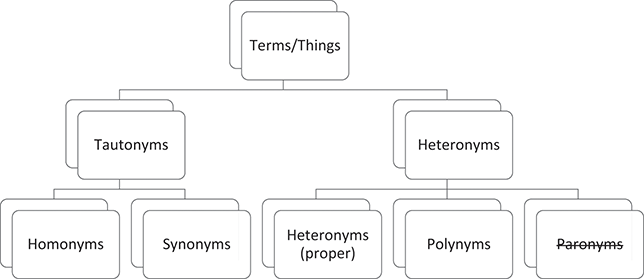
[[T3] Boethus recounts that Speusippus transmits such a division encompassing all the words. For he [Speusippus] says, some are tautonyms, others heteronyms. Of tautonyms, some are homonyms, others are synonyms (if we understand ‘synonyms’ according to the custom of the ancients). Of heteronyms, some are properly heteronyms, others are polynyms, others are paronyms.
Σπεύσιππον τοίνυν ἱστορεῖ Βόηθος τοιαύτην διαίρεσιν παραλαμβάνειν τὰ ὀνόματα πάντα περιλαμβάνουσαν. τῶν γὰρ ὀνομάτων, φησί, τὰ μὲν ταὐτών-υμά ἐστιν, τὰ δὲ ἑτερώνυμα· καὶ τῶν ταὐτωνύμων τὰ μὲν ὁμώνυμά ἐστιν, τὰ δὲ συνώνυμα, κατὰ τὴν τῶν παλαιῶν συνήθειαν ἀκουόντων ἡμῶν τὰ συνώ- νυμα· τῶν δὲ ἑτερωνύμων τὰ μὲν εἶναι ἰδίως ἑτερώνυμα, τὰ δὲ πολυώνυμα, τὰ δὲ παρώνυμα.
The problem here for the view being entertained is that the final division of heteronyms is trichotomous. However, as Barnes has pointed out, ‘the “division” is spoilt by the presence in it of paronyms’ (Reference Barnes1971, 75). He takes it as evidence that Boethus is wrong to have imposed the divisional structure onto the passage at all. But it could be taken the other way around as well, to show that paronyms should instead be excised. This seems to me not completely crazy.Footnote 16 The following passage, which explains the division, makes no reference to paronymy, and the inclusion of paronymy breaks what would otherwise be an easily understandable symmetry between the discussion of tautonyms and heteronyms. Moreover, from the passage we understand nothing about paronymy in Speusippus beyond what Aristotle says about it in the Categories. It is thus a reasonable assumption that paronymy gets lumped into the discussion as a result of being discussed within the commentary tradition on Aristotle’s Categories, perhaps by Boethus himself.
I think this is more likely than Barnes’ hypothesis that the divisional structure is a Boethan intervention. Suppose all that we had from Speusippus was something like an exhaustive list of (kinds of) words: tautonyms, two kinds of heteronyms, synonyms, homonyms, polynyms, and possibly also paronyms. While there is certainly nothing logically incoherent about such a hypothesis, such a list begs for some kind of organization. And a classification seems very natural. Tautonyms are clearly opposed to heteronyms (in the broad sense). Tautonyms, synonyms, and homonyms have more in common with one another than they do with the rest of the items on the list. The two senses of heteronym that Speusippus discusses are very plausibly related to one another as genus to species. Why would Speusippus have come up with a list with all these features and not decided to organize them into a division, which in his context is the standard way of organizing this kind of information? One need only point to the Divisiones Aristoteleae, which, since Mutschmann (1907), scholars have known to have originated in the Academy itself.Footnote 17
Furthermore, it seems to me that paronymy is unnecessary if our goal is mere exhaustivity, since two words in a paronymous relationship differ both as strings of symbols and in terms of the account of their essence. Thus paronymy is a special case of heteronymy in the strict sense and the list without paronymy would therefore be just as exhaustive as the list with it. Tarán (Reference Tarán1981, 413) suggests that heteronyms in the strict sense have ‘different and unrelated meanings’, but as our text continues (Simp. In Cat 38.26–39.16 Kalbfleisch), there is no suggestion that the meanings need be ‘unrelated’. Thus the accounts of Isnardi Parente (Reference Isnardi Parente2004 comm. ad F13) and Benati (Reference Benati2023, 55) on this point are correct. But if that is so, the goal of exhaustivity is not furthered by the inclusion of paronyms, and even if we do not want to attribute a division to Speusippus here, it seems to me preferable to excise paronyms. But once we do that, we have no more reason not to think that the divisional structure originates with Speusippus. So if I am right, we have an elaborate and clearly self-conscious case of iterated dichotomous division (see Figure 3.1).
Speusippus’ division of terms/things
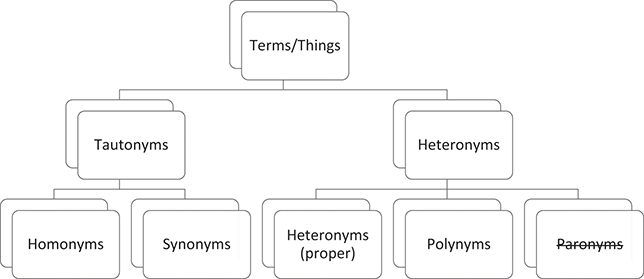
Figure 3.1 Long description
Tautonyms are subdivided into Homonyms and Synonyms; Heteronyms into Heteronyms in the strict sense and Polynyms (Paronyms are expressly exluded).
We might have ended this section here, if it were not for Andrea Falcon’s arguments that Speusippus did not practice the method of division. Falcon reasonably claims that the book title on divisions attributed to Speusippus, the fragments on similarities, and the Epicrates fragment are not decisive evidence that Speusippus had a theory of division. The most we could say, according to Falcon, is that this provides evidence that Speusippus used division. But it is surely true that they give prima facie grounds for thinking that he had a theory of division. In Plato and Aristotle, indeed, examples of divisions are not just listed out, but very often also explicitly theorized as they give those examples. Why should Speusippus be different in this regard? It would be strange if, while all his contemporaries were theorizing about the right way to perform division, Speusippus was simply sitting in a corner writing them out, without any regard for the theoretical underpinnings.
In addition to these more negative points, Falcon claims that another testimony of Aristotle’s, from Posterior Analytics ii.13, shows that he could not have had such a theory, instead having a different theory of definition entirely. But Falcon’s argument here only shows that the account of definition Speusippus has does not itself require dichotomous division. Thus someone like Tarán is wrong to infer on the basis of the An. post. ii.13 passage that Speusippus is a dichotomizer. So, while Falcon is right that An. post. ii.13 does not provide evidence that Speusippus is the dichotomizer Aristotle talks about in PA i.2–3, he gives no reason to suppose that Speusippus could not be the dichotomizer.Footnote 18
The same point can be made about the last bit of evidence that has been propounded for Speusippus as a dichotomizer: the fragments on similars preserved in Athenaeus (Tarán F6–10, 12–26 and Isnardi Parente2 F96–120). I follow de Cesaris (Reference De Cesaris2025, 169 ff.) in thinking that these passages do not provide strong evidence of dichotomy. They are compatible with dichotomous division, but without further context, they do not suggest any kind of classification at all, much less a dichotomous one. What we have in these passages are, at best, remnants of the practice of division, and we cannot infer from this anything significant about the theory without independent evidence.
In sum, none of Falcon’s arguments positively show that Speusippus was not the dichotomizer of PA i.2–3. Rather, they show that various reasons given in the previous literature do not suffice. But the argumentative strategy I have outlined differs from the others in several significant respects. First, we assume that the target must have been a member of the Academy of some prominence, for otherwise it would be a mystery why Aristotle devotes such significant time to refuting them. Second, there is strong evidence ruling out two of the three main contenders: Plato and Xenocrates. Finally, the only detailed division that we have of Speusippus seems to be dichotomous. While I accept that this is an argument from probability, it seems reasonable to conclude that the balance of odds favors Speusippus as the target of PA i.2–3 over anyone else. It seems to me there is no decisive evidence against it and several individually weak but independent and mutually supporting pieces of evidence for it.
So we have arrived at the following preliminary results. Plato was not a dichotomizer but a minimizer. He thought one should always divide into the smallest number possible, but that it was not always possible to divide into two (T1). Speusippus evidently disagreed about this impossibility claim, but agreed with Plato about minimization (since dichotomy implies minimization). Putting those two results together, Speusippus would be the dichotomizer we are looking for as a target.Footnote 19
3.2 Plato as Indirect Target of PA I.2–3
Or so it would seem. In fact, however, while Aristotle takes direct aim at Speusippus, he will end up taking Plato down along with him, since Aristotle disagrees with Speusippus not only about the possibility point but also about the minimization. That is, for Aristotle, one should not aim to divide into the smallest number possible. To see this, we must delve more deeply into the text.
Aristotle begins his argument with a brief description of the opposing view and his fundamental objections to it:
[T4] Some people grasp the particular [kind? animal? part?] by dividing the genus into two differences. In one respect this is not easy, in another it is impossible.
Λαμβάνουσι δ’ ἔνιοι τὸ καθ’ ἕκαστον, διαιρούμενοι τὸ γένος εἰς δύο διαφοράς. Τοῦτο δ’ ἐστὶ τῇ μὲν οὐ ῥᾴδιον, τῇ δὲ ἀδύνατον.
This opening strongly suggests that Balme (Reference Balme, Gotthelf and Lennox1987) is wrong about what Aristotle means by ‘dichotomizing’, since here what is precisely at issue is the number of differences, which is elsewhere identified with the number of species (643a7–9). An easy way to see this is to consider the Xenocratean division of beings into good, bad, and neither. This seems to satisfy Balme’s requirement, since Xenocrates was dividing by one difference at a time. It does not, however, qualify as dichotomous in Aristotle’s sense, since it is into three subkinds.
To be sure, later on Aristotle will disagree with dichotomy as Balme construes it. That does not mean, however, that this is what Aristotle understands by the term. Nor is it at all the idea one would get from reading the many Platonic passages where various interlocutors are said to ‘cut’ (temnein) or ‘divide’ (diairein) in twain (dichēi) or ‘into two kinds’ (eis duo eidē). Indeed, the most striking thing about T4 is how closely it corresponds to what the Eleatic Visitor himself claimed about dichotomous division in T1. Both Aristotle and the Visitor claim that dichotomy is difficult (chalepon/ou radion) and that it is impossible (adunaton/adunatoumen) into two (temnein dicha/diairoumenoi eis duo diaphoras).
This point also exposes a difficulty that we will need to resolve in Aristotle’s claim. How are we to read τῇ μὲν/τῇ δὲ? Whereas the Visitor does not highlight an important difference between difficulty and impossibility claims,Footnote 21 Aristotle seems to be making a distinction that can be understood in one of two ways. Either he is saying that in some situations dichotomy is difficult, while in others it is impossible – thus conceding that sometimes dichotomy is possible – or else he is claiming that in one way it is difficult and in another way it is impossible. If the latter option is the case, he would be saying that in all situations dichotomy is both difficult and impossible. Only consideration of the arguments that follow will allow us to determine which of these readings is correct; the grammar does not suffice on this front.Footnote 22
It seems to me most likely that Aristotle intends for us to understand τῇ as modifying the manner, not the situation. He gives perfectly general arguments but of two kinds. Sometimes he emphasizes how it is impossible to divide in two in certain situations. In other arguments, he claims something weaker: it is not at all clear how a dichotomous division will work in certain cases. Thus, at the very end of his discussion of division in i.4, he repeats this initial claim as saying that he showed ‘the reason why dichotomizing is in one way impossible and in another empty [kenon]’ (644b20–21). While this clearly picks up T4, it also helps us to understand what was initially meant by difficult. As Kelsey (Reference Kelsey and Ebrey2015) has made clear, when Aristotle accuses people of kenologia in his scientific and philosophical writings, it is because they consider things only in the abstract and not based on any sort of real experience. This indeed makes it difficult to actually perform the divisions in a satisfactory way when dealing with a given subject matter.
The first set of objections that we see from Aristotle concern precisely this sort of difficulty. The first objection raised is that successive divisions will be reduced to one fundamental (kuria) difference, but we get no reason why this must necessarily happen with dichotomy, nor why it is necessarily a problem. But if we think that it is hard to see how certain kinds can be reduced in this way to just one difference, then this compressed argument makes some sense. Next Aristotle argues that division by dichotomy disperses genera into different branches. Again, it is not clear why this is always so, but it is not hard to see how it may be difficult to avoid, as in the case of birds being distributed into water-dwellers and land-dwellers. Indeed, Cherniss (Reference Cherniss1944, 55) and Lennox (Reference Lennox2002, 154) have pointed out that Plato in the division of the angler in the Sophist precisely divides water-dwellers into swimmers and flyers, suggesting that there are indeed specific examples of this sort that are on Aristotle’s mind.Footnote 23 If one is always dividing into two, it is hard to see how to keep all the familiar groups together on one side or another of each division, especially if they are made with any sort of principle that could be independent of those traditional groupings.
With the beginning of i.3, Aristotle shifts gears, from making objections in the style of ‘difficulty’ to ‘impossibility’ objections.Footnote 24 His first (642b21–643a26)Footnote 25 concerns the use of the privative terms and the consequences of using them. As Lennox has emphasized, Aristotle endorses the use of privations in division, but claims that dichotomizers do not use them properly. The fundamental issue is that a privative difference itself cannot be subdivided, so that, if a dichotomist divides a genus initially into species with a positive and a privative difference, they can no longer subdivide the latter. The next three objections (643a27–643b9) show that dichotomous division is inconsistent with three general rules of division: divide by essential attributes, divide by opposites, and do not divide ensouled things by things common to body and soul. If we are to take these rules for granted, then we see again how it is impossible to divide dichotomously.
The last stage of the pars destruens is introduced by Aristotle with a generalization (holōs, 643b9). Here is where the fundamental problem with dichotomy is diagnosed and where Aristotle begins to move towards a solution:
[T5] Generally, this will necessarily happen to anyone dividing by any one difference. Instead one ought to try to grasp the [kinds of] animals genus by genus, as the many lead the way when they distinguish the genera of birds and fish. For each of these is distinguished by many differences, not in accordance with dichotomy. For in this way, it is either completely impossible to grasp [the kind/animals] (for the same thing falls into many divisions and contraries fall into the same division) or there will only be one difference, and the terminal kind will either be simple or made from a weaving together. But if one were not to grasp the difference of a difference, it would be necessary to make the division continuous in the same way as those who make a discourse one by conjunction. I mean, for example, that it would happen for those dividing wingless and winged, [to have to say] of the winged some are wild and some are tame or some are light and some dark. For neither tame nor light are a difference of winged, but the starting-point of another difference and accidental in this place. Thus the one is to be divided straightaway by many differences, as we say. For in this way privations also produce a difference, while they don’t in dichotomy.
Ὅλως δ’ ὁποιονοῦν διαφορᾷ μιᾷ διαιροῦντι τοῦτο συμβαίνειν ἀναγκαῖον. Ἀλλὰ δεῖ πειρᾶσθαι λαμβάνειν κατὰ γένη τὰ ζῷα, ὡς ὑφήγηνθ’ οἱ πολλοὶ διορίσαντες ὄρνιθος γένος καὶ ἰχθύος. Τούτων δ’ ἕκαστον πολλαῖς ὥρισται διαφοραῖς, οὐ κατὰ τὴν διχοτομίαν. Οὕτω μὲν γὰρ ἤτοι τὸ παράπαν οὐκ ἔστι λαβεῖν (τὸ αὐτὸ γὰρ εἰς πλείους ἐμπίπτει διαιρέσεις καὶ τὰ ἐναντία εἰς τὴν αὐτήν), ἢ μία μόνον διαφορὰ ἔσται, καὶ αὕτη ἤτοι ἁπλῆ, ἢ ἐκ συμπλοκῆς τὸ τελευταῖον ἔσται εἶδος. Ἐὰν δὲ μὴ διαφορᾶς λαμβάνῃ τὴν διαφοράν, ἀναγκαῖον ὥσπερ συνδέσμῳ τὸν λόγον ἕνα ποιοῦντας, οὕτω καὶ τὴν διαίρεσιν συνεχῆ ποιεῖν. Λέγω δ’ οἷον συμβαίνει τοῖς διαιρουμένοις τὸ μὲ ἄπτερον τὸ δὲ πτερωτόν, πτερωτοῦ δὲ τὸ μὲν ἥμερον τὸ δ’ ἄγριον, ἢ τὸ μὲν λευκὸν τὸ δὲ μέλαν· οὐ γὰρ διαφορὰ τοῦ πτερωτοῦ τὸ ἥμερον οὐδὲ τὸ λευκόν, ἀλλ’ ἑτέρας ἀρχὴ διαφορᾶς, ἐκεῖ δὲ κατὰ συμβεβηκός. Διὸ πολλαῖς τὸ ἓν εὐθέως διαιρετέον, ὥσπερ λέγομεν. Καὶ γὰρ οὕτως μὲν αἱ στερήσεις ποιήσουσι διαφοράν, ἐν δὲ τῇ διχοτομίᾳ οὐ ποιήσουσιν.
The lesson, Aristotle suggests, is that one must divide simultaneously by many differences and that this is impossible to do if you are a dichotomizer. It is only at this point, I suggest, that Plato has come into the picture. For, as I have argued, he agrees with Aristotle that one should not dichotomize. However, he still retained the idea that one should minimize. Once we divide by many differences, however, it is clear that we are giving up minimization. For example, if one divides by three pairs of differences, the Platonist will divide into six proximate kinds, the Aristotelian into eight.
3.3 Cross-Cutting Division
The difference between these three positions comes out most clearly when we look at cross-cutting divisions. These divisions are like the one in T2, where a kind is divided along two different dimensions. This sort of division figures prominently in PA i.2–3, since it is here that Speusippus has to violate one of Aristotle’s most important norms of division: that one must always divide by a difference of a difference.Footnote 26 So let us look at how each of the theories on offer would deal with this kind of situation.
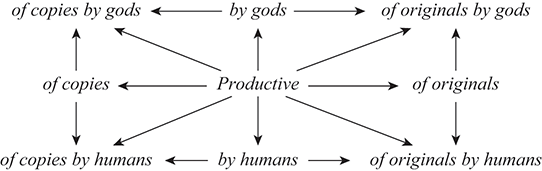
We begin with Plato in the Sophist (see Figure 3.2). This division of productive (craft) goes in two directions (arrows represent the relation of a kind to its subkind): on the one hand it splits into productive of copies/originals, and on the other hand into human and divine production. The Visitor gives examples to fit in all four of the infimae species of this division, thus showing that the two divisions of the productive craft are independent from one another. As I have argued elsewhere, this division is dichotomous in neither the traditional nor the Balmean senses. It is, moreover, a natural way to try to minimize the proximate subkinds that one divides into, thus satisfying the minimization norm of T1, as well as another norm mentioned in the Statesman, that of not skipping steps (on which, see Vlasits Reference 91Vlasits2021).
Cross-cutting division of productive craft in the Sophist
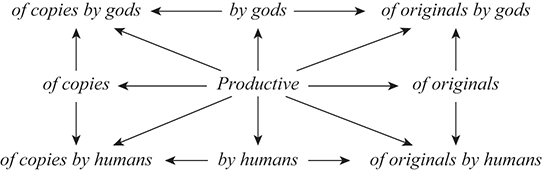
Figure 3.2 Long description
The diagram is a grid-like structure showing the division of productive [craft] along two independent dimensions. One dimension divides productive [craft] into productive of originals and productive of images. The other, crossing it, divides productive [craft] into productive by gods and by humans. This creates four bottom kinds at the intersections: of copies by humans, of copies by gods, of originals by humans, and originals by gods.
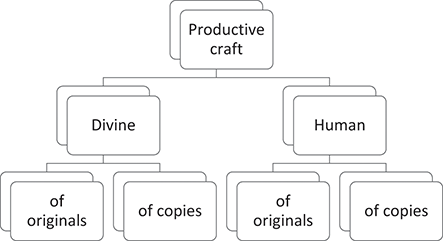
A dichotomist like Speusippus would take a different approach to this situation. He cannot divide the productive craft into four proximate subkinds as the Visitor did. Instead, he has to pick an order and divide successively (see Figure 3.3). Here we see Aristotle’s point that the dichotomist must make their division unified in just the same way as those who make their speeches by using conjunctions do (643b9–26). The problem for the dichotomist here is that their division would not be continuous in the sense that, each time one makes a division, the topic under discussion would change. In a way, this is just what is implied by Aristotle’s commitment to the difference of a difference norm. When one doesn’t divide by a difference of a difference, the lower subdivisions are disconnected from what comes above them. That is just another way of saying that they lack continuity.Footnote 27
Dichotomous Speusippean division of productive craft
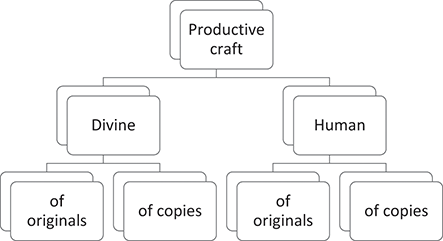
Figure 3.3 Long description
The diagram shows a standard branching tree. The first division splits Productive Craft into (e.g.) Divine and Human. The next division then splits both Divine and Human Production into Production of Originals and Production of Images. This results in the same four final kinds, but through a linear, hierarchical sequence that prioritizes one difference (divine/human) over the other (originals/images).
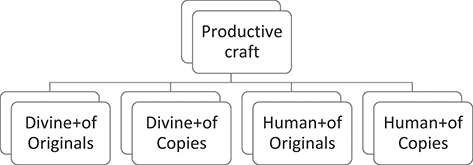
What would Aristotle’s division look like in this case? Here we must try to capture his notion of dividing immediately by many differences (643b9 ff.). I suggest that his division would look something like Figure 3.4. In essence, Aristotle abandons the idea that one must try to maximize intermediate kinds, which from a global perspective is equivalent to minimizing proximate subkinds.Footnote 28
Aristotelian division of productive craft
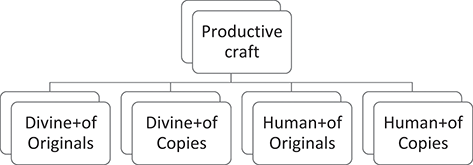
Each of these approaches to cross-cutting divisions has advantages and drawbacks. The Platonic approach maximizes the number of kinds mentioned in the division and this could be seen as a major advantage, since we have a complete representation of all the mereological relations between the kinds. But that same feature could be a disadvantage if we don’t think all of that information is interesting or helpful when trying to understand the essence of the subkind. Speusippus can solve that problem by prioritizing one difference over the other and dividing successively. Here we lose some of the mereological representations that Plato has, but we have achieved minimization of the number of subkinds in a way that Plato did not. On the downside, Speusippus must make what seems to be a completely arbitrary decision to prioritize one difference over the other, and the resulting divisions produced will not be continuous except in a merely linguistic sense. Aristotle’s division gives up on minimization completely and thus has the least information built into the graph. But he does not have to make the arbitrary choice Speusippus has, nor does he include what he takes to be irrelevant information about intermediate kinds. Instead of Plato’s or Speusippus’ intermediate kinds, he uses information packed into the differences themselves. That means that the real informational load is borne by these differences, rather than by the divisional structure itself.
My point in this section is to try to show how the views articulated in the first part of the chapter diverge in a clear way when it comes to cross-cutting divisions, which were clearly at the heart of the Academic debate. Moreover, each of the positions described seems to me to be defensible.
3.4 Negative Division in Topics VI.6
At this point, we have seen direct, textual motivation for Plato and Aristotle to reject dichotomy. Plato rejects it because he does not always think it is possible, but Aristotle rejects it for a variety of more complex reasons that lead him to reject Platonic minimization along with it. What we have not yet seen is a motivation for Speusippus, which is of course natural, since we have only triangulated onto his position via the critical remarks of Plato and Aristotle. Here, I want to discuss one last text, again in Aristotle, that I believe may shed some light here. I should note that here we venture deep into the woods of speculation. Given what has come before, I hope we can see the trail of breadcrumbs that led me here.
[T6a] Furthermore, see whether someone divides by negation, just as those who define line as a breadth-less length. For this indicates nothing else then that it does not have breadth. Then it will follow that the genus participates in the species. For every length is either breadth-less or having breadth, since for everything either the affirmation is true of it, or the negation, so that the genus of line (which is length) is either breadth-less or having breadth. But breadth-less length is the definition of one of its species and likewise length having breadth [is the definition of one of its species], since breadth-less and having breadth are differences. But the definition of the species is composed of the difference and the genus, so that the genus might allow the definition of the species. And similarly the definition of the difference, since one or the other of the aforementioned differences is necessarily predicated of the genus.
Ἔτι ἐὰν ἀποφάσει διαιρῇ τὸ γένος, καθάπερ οἱ τὴν γραμμὴν ὁριζόμενοι μῆκος ἀπλατὲς εἶναι· οὐδὲν γὰρ ἄλλο σημαίνει ἢ ὅτι οὐκ ἔχει πλάτος. συμβήσεται οὖν τὸ γένος μετέχειν τοῦ εἴδους· πᾶν γὰρ μῆκος ἢ ἀπλατὲς ἢ πλάτος ἔχον ἐστίν, ἐπεὶ κατὰ παντὸς ἢ ἡ κατάφασις ἢ ἡ ἀπόφασις ἀληθεύεται, ὥστε καὶ τὸ γένος τῆς γραμμῆς, μῆκος ὄν, ἢ ἀπλατὲς ἢ πλάτος ἔχον ἔσται. μῆκος δ’ ἀπλατὲς εἴδους ἐστὶ λόγος· ὁμοίως δὲ καὶ μῆκος πλάτος ἔχον. τὸ γὰρ ἀπλατὲς καὶ τὸ πλάτος ἔχον διαφοραί εἰσιν· ἐκ δὲ τῆς διαφορᾶς καὶ τοῦ γένους ὁ τοῦ εἴδους ἐστὶ λόγος, ὥστε τὸ γένος ἐπιδέχοιτ’ ἂν τὸν τοῦ εἴδους λόγον. ὁμοίως δὲ καὶ τὸν τῆς διαφορᾶς, ἐπειδὴ ἡ ἑτέρα τῶν εἰρημένων διαφορῶν ἐξ ἀνάγκης κατηγορεῖται τοῦ γένους.
We can reconstruct this argument in the following way:
(1) For any x and any F, x is either F or not-F. (Principle of Excluded Middle)
(2) A genus G will be either F or not-F. (from 1)
(3) If one divides G by F and not-F, the proximate species of G will be defined as GF and G not-F.
(4) If one divides G by F and not-F, G will admit the definition of its species and difference. (from 2 and 3)
(5) It is impossible for a genus to admit the definitions of either its species or differences.
(6) Therefore, one cannot produce a definition by dividing G by F and not-F.
The use of the Principle of Excluded Middle here may simply be a presupposition of the defenders of division by negation. It seems that part of the point of doing this sort of division is to ensure that the division is exhaustive. Premises 3 and 5 further seem to be presuppositions for any use of division for the purposes of defining. Finally, Premise 5 is especially carefully worded. Aristotle does not claim that the species will have both F and not-F in the definition, since Premise 1 and its consequence Premise 2 are talking not about essential predication but about predication in general. Thus all that we know for sure is that F and not-F will be predicated of the species.
So far so good. Now Aristotle states a restriction on the argument just given:
[T6b] And the topos just mentioned is useful against those positing ideas. For if there is a ‘length itself’, how will it be predicated of the genus: that is has breadth or that it is breadth-less? For one or the other of them must be true of every length, if it is going to be true of the genus. But this does not happen. For there are both breadth-less lengths and lengths having breadth, so that this topos is useful only against those who say that every genus is one in number. But those who posit ideas do this. For they say that length itself and animal itself are genera.
ἔστι δ’ ὁ εἰρημένος τόπος χρήσιμος πρὸς τοὺς τιθεμένους ἰδέας εἶναι. εἰ γὰρ ἔστιν αὐτὸ μῆκος, πῶς κατηγορηθήσεται κατὰ τοῦ γένους ὅτι πλάτος ἔχον ἐστὶν ἢ ἀπλατές ἐστιν; δεῖ γὰρ κατὰ παντὸς μήκους τὸ ἕτερον αὐτῶν ἀληθεύεσθαι, εἴπερ κατὰ τοῦ γένους ἀληθεύεσθαι μέλλει. τοῦτο δ’ οὐ συμβαίνει· ἔστι γὰρ καὶ ἀπλατῆ καὶ πλάτος ἔχοντα μήκη. ὥστε πρὸς ἐκείνους μόνους χρήσιμος ὁ τόπος οἳ πᾶν γένος ἓν ἀριθμῷ φασιν εἶναι. τοῦτο δὲ ποιοῦσιν οἱ τὰς ἰδέας τιθέμενοι· αὐτὸ γὰρ μῆκος καὶ αὐτὸ ζῷον γένος φασὶν εἶναι.
(1) If the disjunction F or not-F is true of G, every G that is one in number must be either F or it must be not-F.
(2) The ideas are one in number.
(3) Therefore, if G is an idea, then it must be either F or it must be not-F.
(4) But that is incoherent.
(5) This topos is useful against those who posit ideas.
Aristotle explicitly says the topos is useful against those who posit ideas and that it is only useful against those who make the genus one in number. My suggestion is that in the following sentence he identifies ‘making the genus one in number’ with ‘positing forms’. Note the emphatic placement of τοῦτο and compare Metaph. 999b33–34, where Aristotle equates being a particular and being one in number. The alternative interpretation would have it that the topos is useful against a broader range of positions – all those who make the genus one in number – but that the most prominent version of this view is the theory of ideas. I am unclear what exactly the broader view would amount to on this interpretation. I don’t think too much hangs on how one resolves this, but I would be interested if Aristotle elsewhere identifies a theory of genera and species like this one that is implied by the theory of ideas but does not imply it. The claim here seems to be that the crucial move in T6a had to do with the application of PEM to the genus. Aristotle thinks that this is only permissible under very specific assumptions. The move here seems reminiscent of the move in the Third Human argument. There too the Platonist is accused of treating universals just like particulars.
Now, however, we begin to have a problem:
[T6c] Perhaps in some cases it is necessary and useful to define by negation, for example in the case of privations. For blind is not having sight, when it is natural to have it. It makes no difference to divide the genus by negation or by such an affirmation by which the negation is necessarily coordinately divided, for example if length having breadth is defined. For not having breadth is coordinately divided from having breadth, but nothing else [is coordinately divided], so again the genus is divided by negation.
Ἴσως δ’ ἐπ’ ἐνίων ἀναγκαῖον καὶ ἀποφάσει χρῆσθαι τὸν ὁριζόμενον, οἷον ἐπὶ τῶν στερήσεων· τυφλὸν γάρ ἐστι τὸ μὴ ἔχον ὄψιν, ὅτε πέφυκεν ἔχειν. διαφέρει δ’ οὐδὲν ἀποφάσει διελεῖν τὸ γένος ἢ τοιαύτῃ καταφάσει ᾗ ἀπόφασιν ἀναγκαῖον ἀντιδιαιρεῖσθαι, οἷον εἰ μῆκος πλάτος ἔχον ὥρισται· τῷ γὰρ πλάτος ἔχοντι τὸ μὴ ἔχον πλάτος ἀντιδιῄρηται, ἄλλο δ’ οὐδέν, ὥστε ἀποφάσει πάλιν διαιρεῖται τὸ γένος.
The first sentence of this passage seems to me very important. For here Aristotle seems to reveal that the point is not after all to reject division by negation. In particular, he seems to accept the use of negation to characterize lacking. The second part of the passage argues that certain positive terms (all positive terms?) imply a negative coordinate division, so you can’t get out of the problem by simply saying that one is dividing by a positive term. Here we can begin to see what is puzzling. In T6a, Aristotle describes a mistake in division to be on the lookout for: division by negation. He claims that one ought not to divide by negation because if you do so, one of the differences will be predicated of the genus and then we will have incoherence. For example, if we divide length into length having breadth and breadth-less length, we are in the awkward position of saying that length itself is a breadth-less length, since it is false to predicate ‘having breadth’ of it. This seems straightforward enough. But in T6b, Aristotle announces a severe restriction: this topos works against all and only those who take the genera in question to be ideas. In T6c, he claims that it is in fact useful to divide by negation in the case of privations.
This train of thought is strange, even by the low standards of the Topics. While it is not uncommon for Aristotle to state a topos and then state some kind of restriction for it, this situation is different. By the time we get to T6c, we no longer think that negative division is not universally valid; we seem to get the idea that, as a rule, negative division is fine. This about-face is puzzling. There isn’t a logical problem here, since the intervening T6b clarifies that the Verbot in T6a applies only to Platonists. But there still remains a tension. Why would Aristotle give an elaborate and apparently general argument against division by negation, then drastically qualify it, and then suggest that division by negation is pretty great after all, with almost no elaboration on this last point? This just seems too strange not to look for an explanation.
My very, very, very tentative idea of how to resolve the puzzle is this: T6a–c derives from Speusippus and explains his original motivation for the kind of dichotomy he practices.Footnote 29 Speusippus would naturally have considered the kind of objection raised by Plato that division into two is not always possible. A natural route for him to go would be to endorse division by negation, indeed something that we implicitly see in the division of names discussed earlier (T3).Footnote 30 Dividing by negation guarantees that one will always be dividing into two. But we also independently know that Speusippus rejected Platonic forms (Metaph. 1085b36= Fr. 35 Tarán). So if we run with the idea that it is Speusippus here, we would see that one motivation for proceeding as he did is that he would have a good argument against forms, indeed one that Aristotle himself seems to endorse. Thus rearranging the ideas of T6a–c, we would get the following argument:
(1) One should divide by negation. (T6c)
(2) If genera were ideas, PEM would apply to genera. (T6b)
(3) If PEM applies to genera, then one cannot divide by negation. (T6a)
(4) Therefore, genera are not ideas.
‘But Justin, you are crazy!’ I hear you say. ‘Why not just attribute this argument to Aristotle? Have you ever heard of parsimony? Can you just shut up about these weird early Academic philosophers?’ To which I reply: it would be bizarre to think Aristotle would dream this up, even for the Topics, for the following reason. Aristotle is of course no friend of the forms, but he is also no friend of the kind of division described here. While he is comfortable with using privations along with positive differences (so long as only the latter are subdivided), he does not generally advocate the use of negation in this way. So it seems to me that if Aristotle were to have a topos about avoiding division by negation, it should not be restricted in scope in the way that it is, since for Aristotle, the prohibition is largely independent of general metaphysical issues of the kind that are mentioned here. It seems to me that the line of thought makes most sense coming from a defender of negative division, paradoxically enough. Since we already have evidence of Speusippus’ dichotomy and rejection of forms, there is some reason to think he may have put together such an argument in precisely this way.
This interpretation has the benefit of seeing why Aristotle would include all of these pieces in the way that he did. He was repurposing an important argument from Speusippus that connected issues in the methodology of division with the metaphysics of genera and species. While Aristotle is sympathetic to Speusippus’ conclusion, he is not so committed to the premises, particularly the first premise in the argument.
There are other hypotheses that one could entertain, of course. One is to think T6a, b, and c should be separated. For example, perhaps Aristotle used the former to argue against specific Platonic divisions (such as his division of animals into horned and hornless in the Statesman) before he came to reject Platonic forms. Once he reached his more mature metaphysics, he appended T6b because he realized this argument no longer works against his new view. This is to postulate some sort of Jaegerian developmentalism, which has many well-known problems that I here set aside. With this particular passage, however, we are still faced with the question: what do we do about T6c? This only makes sense in the light of b and thus came after it as a further reconsideration; we would have to think that Aristotle moved from rejecting dichotomy to accepting it in certain cases. But there is absolutely no evidence for this, and the Jaegerian would agree.
Another thought is that Aristotle is really targeting a conjunctive view: those who both think that there are ideas and divide by negation. The thought would be that he is showing that conjunction to be incoherent and then saying in T6c that the ‘divide by negation’ conjunct is not so bad, leaving the reader to infer that the problem has more to do with ideas. But in that case, one would have expected mention of the theory of ideas in the original statement of the topos in T6a, since that would be the argumentative focus.
I don’t mean to be saying here that a text of Speusippus got plagiarized by Aristotle or something like that. Rather, I want to suggest that Aristotle appropriated this line of thought as a whole from Speusippus’ arguments against Plato. In effect, I am advocating for the same sort of procedure that Hambruch (Reference Hambruch1904) did when he claimed more than a century ago that the Topics is a storehouse of ‘logical rules’ of the Early Academy. I don’t think that, suitably qualified, the topos is indeed inconsistent with Aristotelian doctrine, with the exception of T6c. Rather, a–b seem to be, if anything, too weak a complaint about division by negation to make sense as coming from Aristotle. If what I say is right, then we have hit upon motivations for the norms on cross-cutting division for Plato, Aristotle, and Speusippus. In so doing, we can also see why Plato may not have thought dichotomous division was always possible. Recall that Plato divides into forms (Plt. 263b). While it is a matter of controversy whether he accepted negative forms at all,Footnote 31 he certainly rejected some negative forms, such as not-ten thousand, barbarian, and beast (Plt. 262b–e). This partial rejection is sufficient to call into question Speusippus’ recipe for dichotomous division, which (on the interpretation I am proposing) relied on negation. Thus Plato could not guarantee that in every case there would be a possible division into two, even if he would have liked to.
3.5 The Hunt for Essence
The Eleatic Visitor famously takes dialectic to consist partly in the ability to divide properly:
[T7] Visitor: Don’t we say that it is characteristic of the dialectical science to divide kind by kind and to consider neither the same kind to be different, nor the different to be the same?
Ξένος: τὸ κατὰ γένη διαιρεῖσθαι καὶ μήτε ταὐτὸν εἶδος ἕτερον ἡγήσασθαι μήτε ἕτερον ὂν ταὐτὸν μῶν οὐ τῆς διαλεκτικῆς φήσομεν ἐπιστήμης εἶναι; (Soph 253d1–2)
The norms for division that Plato articulates in various dialogues seem to be attempts to give perfectly general norms about how to divide in order to discover the essence of anything whatsoever (Vlasits Reference 91Vlasits2021). Does Aristotle also take division to be in this business? I will argue that he does.
The suggestion gets prima facie support from inside and outside the PA. For example, when he is in the middle of his argument that the dichotomizer cannot use privations properly, he uses examples drawn from outside of the biological sciences, for example geometry (643a27 ff.). And this makes perfect sense, since his arguments that dichotomy is impossible do not in general rest on particular features of the animal kingdom, but on general methodological considerations (see later in this chapter). In the Posterior Analytics, especially ii.13, there is plentiful evidence that Aristotle thought division quite useful:
[T8] But it is necessary, whenever one is dealing with some whole, to divide the genus into the indivisibles in species …
Χρὴ δέ, ὅταν ὅλον τι πραγματεύηταί τις, διελεῖν τὸ γένος εἰς τὰ ἄτομα τῷ εἴδει …
[T9] Divisions according to the differences are useful for going about in this way [i.e. investigating the essence].
αἱ δὲ διαιρέσεις αἱ κατὰ τὰς διαφορὰς χρήσιμοί εἰσιν εἰς τὸ οὕτω μετιέναι·
It is particularly instructive to read T8 alongside Aristotle’s own summary of his discussion in PA i.2–4:
[T10] Further, concerning division, it has been said in what manner it is possible for those going about it to grasp [their object] in a useful way and why dichotomizing is in one way impossible and in another way empty.
ἔτι δὲ περὶ διαιρέσεως, τίνα τρόπον ἐνδέχεται μετιοῦσι λαμβάνειν χρησίμως, καὶ διότι τὸ διχοτομεῖν τῇ μὲν ἀδύνατον τῇ δὲ κενόν, εἴρηται.
The parallels here, down to the linguistic level, are quite striking, so it would be very surprising to think that, whereas in the Posterior Analytics things are very general, in the Parts of Animals the project is restricted to zoology.
However, according to Lennox (Reference Lennox2021), the norms articulated in the PA and An. post. are fundamentally different: the latter are general norms of inquiry and the former are domain-specific. While I don’t want to engage with the broader question of whether PA i contains domain-specific norms in addition to the general norms (that may well be true), what I do aim to suggest is that Aristotle’s arguments here about division do not turn in any way on the zoological application that is envisioned. He is here making perfectly general claims applicable to any domain of inquiry. Therefore, at least in PA i.2–4, we are seeing something of a piece with the Posterior Analytics. The interpretation here is not a totally new one – it was already found in Galen:
[T11] It isn’t possible for any Tom, Dick, or Harry to do this [= divide correctly], but only someone greatly practiced in the method of division, as anyone would realize if he read everything that Plato wrote at the beginning of his Philebus about this method, and if he has also thumbed through the Sophist and the Politicus. And the matter will seem even more complex to him if he has read the first book of Aristotle’s De partibus animalium: for Aristotle tries in that book to enumerate all the differentiae of animals; and since he meets with many impasses, he dares to assert things only with great care and circumspection.
So Aristotle and Plato thought it so large and difficult an enterprise to cut genera accurately into their proper divisions (as subsequently did Theophrastus and the other philosophers who tried to bring the method to completion) that it was not yet completely accomplished even by them.
Galen clearly sees a strong continuity between Aristotle’s PA i and Plato’s Sophist–Statesman and Philebus, as well as with the lost works of Stoics and later Peripatetics. Moreover, the sorts of issues that are relevant in his context are not ones specific to animal differentiae, but the fact that Thessalus is completely ignorant of logical method in general. Thus when he says that Aristotle tries to enumerate the differentiae of animals in the PA, he is not claiming that this is what Aristotle is doing in PA i, but that it is what is going on in the treatise as a whole, for which PA i.2–4 serves as part of a general theoretical introduction.
To support this, we might look at what sort of claims Aristotle endorses in the course of his argument. The norms for division that seem more or less straightforwardly extractable from the passage include:
Do not split up a genus into two coordinate genera (642b10–20, 643b4).
Divide by means of privation (642b21–22).
Divide into exclusive and exhaustive subkinds (642b30–35, 643a12–15, 643a32–33).
Divide by essential and not merely accidental attributes (643a28).
Divide by a difference of a difference (643b16 ff.).
These all seem to me to be very general norms of division – I see no reason to think that Aristotle would say that they applied only in the animal domain, nor do any of his reasons for them depend on specific claims about zoology.
Further support for this claim comes from the fact that three of the main norms of division that Aristotle endorses in PA i are treated elsewhere by Aristotle as completely general:
Divide into exclusive and exhaustive subkinds: An. post. 96b36–97a4 for exhaustivity, 97a14–22 for exclusivity.
Divide by essential and not merely accidental attributes: An. post. 97a24–25.
Divide by a difference of a difference. As is well known, in Metaph. Z.12 Aristotle uses this norm to solve a puzzle about the unity of definition on behalf of the Platonists. While I do not want to wade into this difficult passage, what is important for my purposes here is that Aristotle in this passage does not envision any restriction on that norm to the subject matter of zoology.
One might still wonder, if this view is correct, why Aristotle did not discuss these norms from PA i in An. post. ii.13, where he discusses two norms for division: covering and exclusivity. Elsewhere (Vlasits Reference Vlasits2017) I have argued that these two norms were only introduced in this context in response to specific objections to the utility of the method of division and the possibility of definition and division without being omniscient. Aristotle does not set out to give a complete set of norms in that passage, but only to introduce those necessary for his discussion. Along with Lennox, I would speculate that the treatise where these topics would have been more thoroughly covered would have been in the lost Methodika.
3.6 Conclusion
The picture that emerges here is one of deep continuity between the projects of Plato, Speusippus, and Aristotle. They were all on the hunt for essence and they took the method of division to be a key tool in the scientific inquirer’s arsenal to find it. Despite this, they disagreed on exactly how the method is supposed to work in order to achieve its goal. Reconstructing the lost target of Aristotle’s PA i.2–3 thus helps us better uncover a debate about scientific classification in which Plato’s Sophist–Statesman played a key role. Not only do we see Aristotle making interesting objections to both Plato’s and Speusippus’ views, we are also led to reconsider what Plato’s aim was in presenting those divisions in those dialogues. Indeed, it seems to me that they provide strong evidence that they were intended to, as the Eleatic Visitor puts it, ‘make us more dialectical concerning all subjects’ (Plt. 285d4–6).