1. Introduction
In the recent literature on language comprehension, many authors assume that language comprehension is based on mentally simulating experiences (e.g., Barsalou, Reference Barsalou2008; Glenberg & Kaschak, Reference Glenberg and Kaschak2002; Richter, Zwaan, & Höver, Reference Richter, Zwaan and Hoever2009; Zwaan, Reference Zwaan and Ross2004). While interacting with the world, people encounter objects, states, or events together with the words used to refer to these entities. The idea is that words get associated with experiential traces in the brain, which are related to the referents of these labels. When later hearing or reading these words in the absence of their referents, the corresponding traces presumably get re-activated, and the reactivated memory traces are considered to provide the comprehender with the meaning of the respective word. When words appear in larger phrases or sentences, the individual memory traces are assumed to be integrated to yield a complex ‘simulation’ that is consistent with the meaning of the larger phrase or sentence (Zwaan & Madden, Reference Zwaan, Madden, Pecher and Zwaan2005). There is a lot of evidence supporting the general idea that language comprehension involves re-activating experiences, with evidence coming from both behavioral studies (e.g., Borghi, Glenberg, & Kaschak, Reference Borghi, Glenberg and Kaschak2004; Estes, Verges, & Barsalou, Reference Estes, Verges and Barsalou2008; Zwaan & Taylor, Reference Zwaan and Taylor2006; Zwaan & Yaxley, Reference Zwaan and Yaxley2004) as well as from neuropsychological studies (e.g., Buccino, Baumgaertner, Colle, Buechel, Rizzolatti, & Binkofski, Reference Buccino, Baumgaertner, Colle, Buechel, Rizzolatti and Binkofski2007; Hauk, Johnsrude, & Pulvermüller, Reference Hauk, Johnsrude and Pulvermüller2004; Pulvermüller, Reference Pulvermüller1999). However, concerning the proposed mechanisms of comprehension, many important issues are still unclear. In particular, as of yet there is little direct evidence for the claim that comprehenders routinely create simulations of complex situations or events as described in sentences or discourse, let alone evidence for the view that they arrive at these simulations by combining the experiential traces that are activated by the individual words in the sentence (Kaup, de la Vega, Strozyk, & Dudschig, Reference Kaup, de la Vega, Strozyk, Dudschig, Fischer and Coello2016).
To illustrate, the finding that a sentence describing a hand- or foot-related action such as He threw/kicked the ball modulates motor-evoked potentials recorded from hand and foot muscles (e.g., Buccino, Riggio, Melli, Binkofski, Gailee, & Rizzolatti, Reference Buccino, Riggio, Melli, Binkofski, Gailee and Rizzolatti2005; Glenberg, Sato, Cattaneo, Riggio, Palumbo, & Buccino, Reference Glenberg, Sato, Cattaneo, Riggio, Palumbo and Buccino2008) might reflect that comprehenders simulate the sentence meaning, namely a person throwing or kicking a ball, which is associated with hand or foot movements. However, the finding may just as well reflect word-based processes that are triggered by the verb to throw or to kick, respectively. Likewise, if a sentence such as John is looking at a beautiful sunset facilitates an approach response, such as pulling a lever towards oneself, then this may reflect sentence-based simulation processes, because the described situation is positive and therefore activates traces of experiencing something positive (and we typically have the tendency to approach positive events, in contrast to the avoidance of negative events; Chen & Bargh, Reference Chen and Bargh1999). However, the finding may just as well reflect word-based processes that are triggered by the positive word beautiful which is mentioned in the sentence. A similar argument can be made for many of the studies, and even applies to studies in which there is not one individual word in the sentence that could trigger the effects. For instance, in the often-cited study by Stanfield and Zwaan (Reference Stanfield and Zwaan2001), participants read sentences such as The carpenter hammered the nail into the wall/ceiling and afterwards were faster to respond to a picture of a nail in a matching orientation (horizontal nail for wall, vertical nail for ceiling). As the orientation is not mentioned explicitly in the sentences, an account that attributes the effect to an individual word of the sentences is not possible. However, the effect may still be word-based rather than sentence-based: in principle it seems possible that the word nail in combination with the word wall activates an experiential trace of a nail that is horizontally oriented simply because this combination of words has occurred more often in situations in which the nail was horizontally oriented.
As there are only few studies directly concerned with the distinction between word- and sentence-based simulation processes, it is currently difficult to judge how much evidence there is for the view that comprehenders indeed simulate the situations and events described in sentences during comprehension. There is some indirect evidence for sentence-based simulation processes from studies that manipulated grammatical features of sentences, such as for instance person or aspect (e.g., Bergen & Wheeler, Reference Bergen and Wheeler2010). However, one of the few studies that were directly concerned with this distinction found clear evidence for word-based compatibility effects during reading while failing to find evidence for sentence-based effects during normal reading (Bub & Masson, Reference Bub and Masson2010). If simulations are necessary for language comprehension, however, sentence-based simulation processes should clearly be observed. In the present paper, we are concerned with the issue of distinguishing between word- and sentence-based accounts. We will focus our considerations specifically on spatial attributes of meaning.
Spatial attributes are crucial for almost all our everyday experiences (Levinson, Reference Levinson and Nadel2003). It therefore comes as no surprise that much of the evidence in favor of the experiential–simulations view of language comprehension stems from studies investigating spatial aspects of experience. For instance, when presenting participants with words that refer to an entity with a typical location in the upper versus lower vertical space (e.g., roof vs. root), and having them subsequently respond with an up versus down movement, then congruent manual responses are facilitated relative to incongruent manual responses. Effects of this type were observed in a variety of tasks with different requirements concerning the level of processing, such as in a part-verification task (e.g., Borghi et al., Reference Borghi, Glenberg and Kaschak2004), a lexical-decision task, and even a Stroop-task in which participants only respond to the font color (Lachmair, Dudschig, De Filippis, de la Vega, & Kaup, Reference Lachmair, Dudschig, De Filippis, de la Vega and Kaup2011; Thornton, Loetscher, Yates, & Nicholls, Reference Thornton, Loetscher, Yates and Nicholls2013) or during second-language processing (Dudschig, de la Vega, & Kaup, Reference Dudschig, de la Vega and Kaup2014). In addition, other studies have suggested that these words also serve as spatial cues for involuntary attentional orientations (e.g., Dudschig, Lachmair, de la Vega, De Filippis, & Kaup, Reference Dudschig, Lachmair, de la Vega, De Filippis and Kaup2012; Estes et al., Reference Estes, Verges and Barsalou2008) and even influence eye-movements (Dudschig, Souman, Lachmair, de la Vega, & Kaup, Reference Dudschig, Souman, Lachmair, de la Vega and Kaup2013; Dunn, Kamide, & Scheepers, Reference Dunn, Kamide and Scheepers2014). Studies employing sentences have also provided relevant evidence. For instance, in a study by Kaschak and colleagues (2005), participants listened to sentences such as The rocket blasted off or The confetti fell on the parade and simultaneously watched a visual display depicting an upwards or downwards motion. Responses to the sentences were influenced by the congruency between the depicted and described motion, suggesting that comprehenders had mentally simulated the described motion when hearing the sentences. However, as of yet the contribution of word- versus sentence-based processes to the respective effects is not clear in all cases, as only very few studies have directly addressed the distinction between word- and sentence-based simulation processes, as was outlined above.
However, some studies employing sentences as materials have at least provided indirect evidence for the involvement of sentence-based processes. For instance, in a study by Bergen, Shane, Matlock, and Narayanan (Reference Bergen, Shane, Matlock and Narayanan2007), simulation effects were obtained for literal sentences describing real space (e.g., The patient rose) but not metaphoric sentences involving the same spatial verbs (e.g., The amount rose). In an fMRI-study by Raposo, Moss, Stamatakis, and Tyler (Reference Raposo, Moss, Stamatakis and Tyler2009), equivalent differences were found for action verbs in literal versus idiomatic sentences. However, maybe readers process words in non-literal sentences differently than words in literal sentences, in particular if these occur relatively late in the sentence. In the present study we therefore decided to investigate the question whether simulation effects beyond the word level can be observed in literal sentences with spatial attributes.
In a previous study conducted in our lab, in which we pursued a similar goal, we did not find evidence for simulation effects beyond the word level (Kaup, De Filippis, Lachmair, de la Vega, & Dudschig, Reference Kaup, De Filippis, Lachmair, de la Vega and Dudschig2012). In that study, participants read sentences with nouns referring to entities with a typical location in the upper or lower vertical space (see above). Sentence contexts in this study either supported or reversed the typical location of the target entity (e.g., for an up-word such as bird the sentence The father of the boy points to the gliding bird constitutes a supporting context describing a situation in which the bird is located in the upper part of vertical space, whereas the sentence The woman nurses the sick and badly injured bird is a reversing context, describing a situation in which the bird is located lower in vertical space. One reason for not finding sentence-based simulation effects in this study may be related to the fact that the sentences were rather complex, mentioning several different entities and their inter-relations. In addition, sentences with reversing contexts for ‘down-words’ were considered implausible by many of the readers (e.g., The protestor shies back from the approaching stone). In principle it seems possible that with these difficult to understand sentences, readers were still busy creating sentence-based simulations shortly after the end of the sentences when they performed the up or down response movement. If so, then this might well explain why no evidence for sentence-based simulation effects was observed. One possibility for a follow-up study would be to change temporal aspects of the experimental task to give participants more time for sentence processing prior to responding. Another possibility is to investigate comprehension processes with less complex sentences. In the present study, we chose this latter option.
In order to simplify the experimental sentences, we decided to use only target words with an implicit up directional cue (e.g., bird). We also decided to use sentence pairs instead of individual sentences to manipulate word- vs. sentence-based location information. Each sentence pair consisted of a target sentence mentioning a target entity with a typical location in the upper vertical space, and a context sentence that either supported this typical location or not (e.g., Anna looks to the sky / Anna looks to the ground and the coherent target sentence There she sees a bird). Sentence pairs were used for two reasons: First, with sentence pairs it is possible to measure response times for one and the same target sentence in different contexts, instead of comparing response times across different sentences. Second, and more importantly, using sentence pairs allows us to create two different item groups, one with coherent pairs (see example above) and one with incoherent pairs (e.g., Anna looks to the sky / Anna looks to the ground and the incoherent target sentence On the poster one sees a bird). We expect an effect of the context sentence only for coherent sentence pairs, because only for these has the context sentence implications with respect to the location of the target entity in the target sentence. As the incoherent pairs were made up of the same context sentences as the coherent pairs, they allow us to control for effects of different wording in the context sentences.
2. Experiment 1
Sentence pairs were presented auditorily, except for the final word in the target sentences, which was presented visually, centered on the screen in one of two colors (lilac and orange). The experimental task for the participants was to respond to the font color of the target word with an up- or downwards directed response movement, depending on color. We expected a main effect of response direction with faster response times for upwards compared to downwards movements because we only used target words with an implicit up directional cue that should facilitate upwards responses (see Lachmair et al., Reference Lachmair, Dudschig, De Filippis, de la Vega and Kaup2011, Thornton et al., Reference Thornton, Loetscher, Yates and Nicholls2013). If comprehenders indeed create simulations beyond the word level, then we should also see an effect of the context sentences. For sentence pairs with context sentences implying a down-situation, the target entity mentioned in the target sentence is not in its typical up location. In this condition, the facilitation of the upwards response should be attenuated relative to the context sentences implying an up-situation.
2.1. method
2.1.1. Participants
Thirty-two right-handed German native speakers (10 male, M age = 26.03 years, SD = 3.73) took part in the experiment for course credit or financial reimbursement of €8 per hour.
2.1.2. Materials and apparatus
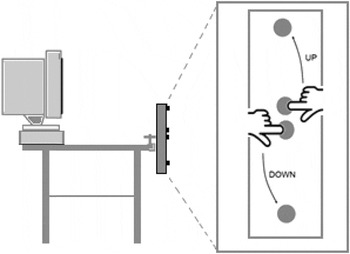
One hundred and eight coherent German sentence pairs (12 practice trials) were created (for the 96 experimental items, see ‘Appendix A’). Every target sentence was presented two times (one time with a context sentence with an implicit up directional cue and one time with a context sentence with an implicit down directional cue). The target word of the target sentence was presented visually in one of two colors (lilac and orange, balanced across the target words between participants), centered on a 17´´ CRT monitor. The relevant context words and target words were taken from an earlier study of our lab where they were rated according to their implicit directional up or down cue (Lachmair et al., Reference Lachmair, Dudschig, De Filippis, de la Vega and Kaup2011). Responses to the target words in the experiment proper were recorded using a vertically mounted keyboard with a self-constructed overlay (see Figure 1).
Experimental setup: the keyboard is implemented on a vertical plane in front of the participants. It was modified by a locally constructed overlay. The response procedure is to release with one hand one of the middle buttons and press a button above or below.

2.1.3. Coherence-rating
A group of fifteen German native speakers (1 male, M age = 20.06), who did not participate in the actual experiment, rated the 96 coherent experimental sentence pairs employed in this experiment plus the 96 incoherent experimental sentences employed in Experiment 2 according to coherence, using a seven-point Likert-scale ranging from ‘coherent’ to ‘incoherent’. The coherent sentence pairs received a coherence rating of M coherent = 1.44, SD = 0.64, which was significantly more coherent than the incoherent sentence pairs employed in Experiment 2 (M incoherent = 5.57, SD = 0.99; t(95) = –36.63, p < .001).
2.1.4. Procedure and design
Participants were seated in a sound-attenuated booth and listened to the auditory presentation of the sentence pairs while simultaneously looking at a black fixation cross centered on a screen with white background. The target word at the end of the target sentence was not presented auditorily but visually centered on the screen in one of the colors lilac or orange. Participants were instructed to listen to the sentence pairs while holding down the middle two keys on the keyboard, one with the right and one with the left hand (see Figure 1). Once the target word of each target sentence appeared on screen, participants had to respond within 3 seconds to the color that the target word was presented in. For one color, the response was an upwards directed key press, and for the other a downwards directed key press. The four different color/keyboard/hand mappings were balanced across four groups between participants (Group 1: lilac/up response with right hand, orange/down response with the left hand; Group 2: orange/up response with right hand, lilac/down response with the left hand; Group 3: lilac/up response with left hand, orange/down response with the right hand; Group 4: orange/up response with left hand, lilac/down response with the right hand).
After responding, the performing hand returned to the released middle button on the keyboard and the next trial began. Sentence pairs were presented to the participants in a random order. Response times (RTs) were measured as the time from stimulus onset until pressing the upper or lower response button on the keyboard. Each target word of the target sentences was presented four times (2 context-locations × 2 colors), resulting in a total of 192 experimental trials, subdivided into 4 blocks, separated by a self-paced break with error information. The design was a 2 (context location: up vs. down) × 2 (response: up vs. down) design with repeated measurement on the variables ‘context location’ and ‘response’ in the by-participants analysis (F 1) and repeated measurement on ‘context location’ in the by-items analysis (F 2).
2.2. results and discussion
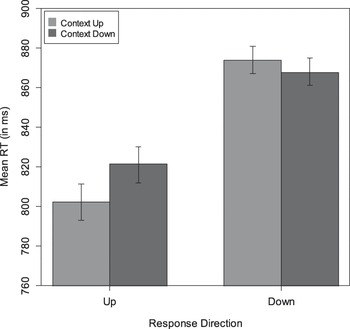
Responses faster than 200 ms and incorrect responses were excluded (1.31%). Mean RTs for both item groups are displayed in Figure 2. Analyses showed a main effect of response (F 1(1,31) = 22.23, p < .001, np 2 = 0.42; F 2(1,94) = 142.10, p < .001, np 2 = 0.60) with up responses being significantly faster (812 ms) than down responses (870 ms). There was no main effect of context location (both Fs < 1.6, ps > .20). However, most importantly, the results revealed a significant interaction of context location and response (F 1(1,31) = 7.95, p = .008, np 2 = 0.20; F 2(1,94) = 5.31, p = .02, np 2 = 0.05), with responses being significantly faster in compatible compared to incompatible trials (see Figure 2): upwards directed responses were facilitated significantly by an upwards directed context location and were hindered by a downwards directed context location (t(1,31) = –2.49, p = .02). Numerically, the reverse pattern held for downwards directed responses but this difference was not significant (t(1,31) = 1.05, p = .30). Moreover, to exclude a speed–accuracy trade-off we conducted an error analysis, showing a marginal effect of response direction (F(1,31) = 3.99, p = .055; 3% for up responses compared to 3.7% for down responses) and no effect of context location (F < 1, p >.64), nor of their interaction (F < 1, p > .94).
Mean response times (ms) of correct responses for coherent items in Experiment 1 as a function of response direction and context location. Error bars represent the 95% confidence interval for within-participants designs (Masson & Loftus, Reference Masson and Loftus2003).
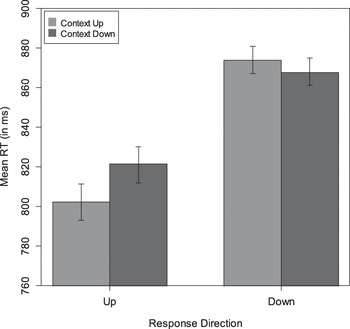
Results in this experiment were as expected if one assumes that comprehension can be characterized by two sorts of simulation processes: simulation processes at the word level and simulation processes beyond the word level. The main effect of response, with faster response times for up- compared to down responses, fits well with the idea that words referring to entities that are typically located in the upper part of vertical space automatically activate experiential traces stemming from looking up, pointing up, etc., that then facilitate responding with an upwards compared to a downwards movement. This effect can be interpreted as a word-based effect that is similar in nature to the effect that is observed when the corresponding words are presented in isolation outside of a sentence context (Lachmair et al., Reference Lachmair, Dudschig, De Filippis, de la Vega and Kaup2011; Thornton et al., Reference Thornton, Loetscher, Yates and Nicholls2013). Of course, there may be other reasons why up responses are faster than down responses in this paradigm. However, note that we counterbalanced between participants whose response was given with the dominant and the non-dominant hand. Thus, up responses in this paradigm involved right- and left-hand responses to the same extent. We therefore feel relatively safe when interpreting this effect as reflecting meaning-related processes at the word level. In addition to the main effect of response, we also observed an interaction of response and context, indicating that responding was affected by whether the context sentence supported or reversed the target entity’s typical location. More specifically, up responses were significantly faster for context sentences that supported the target entity’s typical location in the upper vertical space, compared to context sentences that implied a location in the lower vertical space. This result is very much in line with the idea that comprehenders engage in simulation processes beyond the word level, for which they combine the experiential traces activated by the individual words to yield a simulation that is consistent with the meaning of the larger context. However, before interpreting the context-by-response interaction as evidence for simulations beyond the word level, we first need to make sure that the coherent sentence structure is the critical factor for this effect.
3. Experiment 2
In Experiment 2, we presented participants with sentence pairs involving the exact same context sentences and the exact same target words as in Experiment 1, only this time, the sentence pairs were incoherent. Thus, the context sentences did not communicate any implications with respect to the actual location of the target entity. We therefore do not expect that processing the target sentences would be affected by processing the preceding context sentences in this experiment.
3.1. method
3.1.1. Participants
Thirty-two subjects (2 male, M age = 20.47 years, SD = 1.64) participated in the experiment for course credit or financial reimbursement of €8 per hour.
3.1.2. Materials and apparatus
The materials and apparatus were the same as in Experiment 1, except that the sentence pairs were incoherent. More specifically, 108 German sentence pairs (12 exercises) were created, consisting of a context sentence and a target sentence (for the 96 experimental sentence pairs, see ‘Appendix B’). The context sentences were taken from Experiment 1, as were the final words of the target sentences (target words). Context and target sentences together made up an incoherent sentence pair such that the context sentence could not be interpreted as specifying information concerning the target entity’s actual location (e.g., Anna looks to the sky / Anna looks to the ground and the incoherent target sentence On a poster one sees a bird).
3.1.3. Procedure and design
This was identical to Experiment 1.
3.2. results and discussion
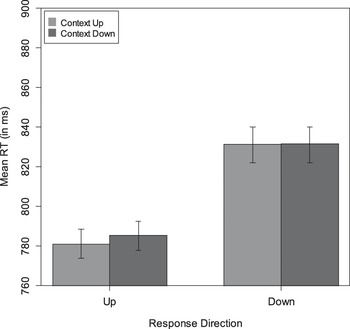
Responses faster than 200 ms and incorrect responses were excluded (< 1.0%). Mean RTs are displayed in Figure 3. As in Experiment 1, there was a main effect of response, with faster latencies for up responses (783 ms) than for down responses (831 ms). This effect was significant (F 1(1,31) = 12.44, p = .001, np 2 = 0.29; F 2(1,94) = 85.87, p < .001, np 2 = 0.48). As in Experiment 1, there was no main effect of context location (Fs < 1, ps > .66). Importantly, as expected, and in contrast to Experiment 1, there was no interaction between context location and response direction in this experiment (Fs < 1, ps > .6). Additionally, to exclude a speed–accuracy trade-off we conducted an error analysis, showing no effect of response direction (F < 1, p > .89) and no effect of context location (F < 1, p >.68), nor of their interaction (F < 1, p > .56).
Mean response times (ms) of correct responses for incoherent items in Experiment 2 as a function of response direction and context location. Error bars represent the 95% confidence interval for within-participants designs (Masson & Loftus, Reference Masson and Loftus2003).
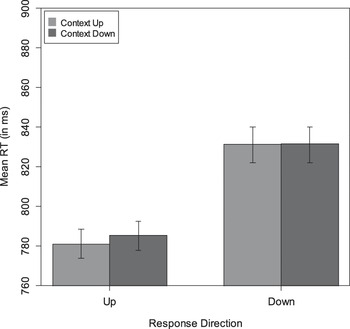
In this experiment, we used the exact same context sentences as in Experiment 1, as well as the same target words in each sentence pair. The fact that we again found a main effect of response direction with faster RTs for up compared to down responses, but did not find the response by context interaction, seems to support our interpretation of these two effects in terms of simulation processes at and beyond the word level, respectively. Word-based simulation processes that reflect an automatic activation of experiential traces by the individual words in a sentence should be independent of the coherence of the sentence pairs presented in the experiment. In line with this assumption, the main effect of response that presumably reflects word-based simulation processes was observed in this experiment, just as it was in Experiment 1. In contrast, simulation processes directed at the meaning of the sentence or larger discourse should be highly dependent on the coherence of the linguistic input. Influences of the context sentences on the resulting simulation can only be expected for coherent sentence pairs in which two sentences together describe one situation (please compare with the coherence rating above). In line with this prediction, the response direction by context location interaction, presumably reflecting simulation processes beyond the word level, was not observed in this experiment.
4. Experiment 3
The fact that a context by response interaction was observed in Experiment 1 with coherent sentence pairs, but not in Experiment 2 with incoherent sentence pairs, provides indirect evidence against a lexical explanation of the interaction effect. According to such a lexical explanation, the interaction effect is driven by the different words used in the context sentences, namely the use of an up-word in the up-context (sky) and a down-word in the down-context (ground). In principle, the interaction effect could thus reflect the combined influence of the context and the target word. If so, we could not interpret the observed interaction effect in Experiment 1 as evidence for simulation processes beyond the word level. However, as no context-by-response interaction was observed in Experiment 2, despite the fact that the same context and target words were used as in Experiment 1, a lexical explanation of the interaction effect seems unlikely to us. Nevertheless, one might of course claim that the incoherence of the sentence pairs somehow prevented lexical influences from having their effect in Experiment 2. Another reason for the missing interaction in Experiment 2 might have to do with the slightly different target sentences used in this experiment. Maybe these sentences were more complex than those in Experiment 1 and therefore reduced the influence of the context sentences. We therefore decided to conduct an additional, more direct test of a lexical account for the observed interaction effect in Experiment 1.
In Experiment 3 we presented participants with word pairs instead of sentence pairs. The word pairs were made up of a context word (e.g., ground vs. sky) and a target word (e.g., bird), similar to the materials in Experiments 1 and 2, except that we only presented the words which according to a lexical account are responsible for the interaction effect, and omitting all the other words in the sentences. The two words of a word pair were presented with an inter-stimulus interval of 2.6 seconds, which is equal to the average temporal distance between the beginning of the last word of the context sentences and the beginning of the last word of the target sentences in Experiment 1. If the lexical account is correct, then we should observe an interaction effect in this experiment. If again no interaction effect is observed then this would support our interpretation that the interaction effect observed in Experiment 1 depends on the coherent sentence structure that keeps the simulation alive.
4.1. method
4.1.1 Participants
Thirty-six right-handed German native speakers (10 male; M age = 24.7 years, SD = 3.83) took part in the experiment.
4.1.2. Materials and apparatus
The apparatus was the same as in Experiments 1 and 2. Eighty auditory context words and 20 visual target words were combined to yield 160 German word pairs (for the experimental items, see ‘Appendix C’). The words were all nouns taken from the sentence pairs in Experiment 1 and 2 and additional nouns with an implicit directional up or down cue taken from the study by Lachmair et al. (Reference Lachmair, Dudschig, De Filippis, de la Vega and Kaup2011). The context word was presented auditorily in stereo on a high-quality headset in a sound attenuated booth. The target word was presented visually again in one of two colors (lilac and orange), centered on a 17´´ CRT monitor.
4.1.3. Procedure and design
The design was the same as in Experiments 1 and 2. The procedure was almost the same as in Experiments 1 and 2 (with 8 practice trials), except that we presented context words instead of context sentences and, after an interstimulus interval (ISI) of 2.6 seconds, target words instead of target sentences. Each target word was presented eight times, resulting in a total of 160 experimental trials, subdivided into 4 blocks, separated by a self-paced break with error information.
4.2. results and discussion
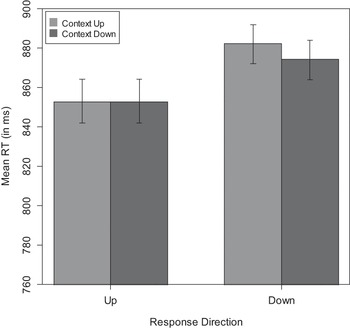
Responses faster than 200 ms and incorrect responses were excluded (< 2.0%). Mean RTs are displayed in Figure 4. As in Experiments 1 and 2, there was a main effect of response direction with faster latencies for up responses (853 ms) than for down responses (878 ms). This effect was significant (F 1(1,35) = 6.24, p < .02, np 2 = 0.15; F 2(1,38) = 16.06, p < .001, np 2 = 0.30). In line with Experiments 1 and 2 there was no main effect of context location (Fs < 1, ps > .53). In contrast to Experiment 1, but in line with Experiment 2, there was no interaction between context location and response direction in this experiment (Fs < 1, ps > .46). Additionally, to exclude a speed–accuracy trade-off, we conducted an error analysis, showing no effect of response direction (F < 1, p > .59) and no effect of context location (F < 1, p > .81), nor of their interaction (F < 1, p > .90).
Mean response times (ms) of correct responses for the word pairs in Experiment 3 as a function of response direction and implicit directional cue of the context words. Error bars represent the 95% confidence interval for within-participants designs (Masson & Loftus, Reference Masson and Loftus2003).
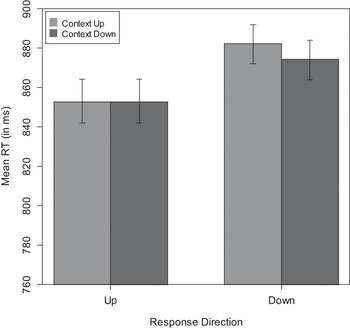
This result shows that responses to the target words were not affected by the preceding context words with an ISI of 2.6 seconds and thereby rules out a lexical explanation of the observed interaction effect in Experiment 1. Given that the time gap between the context and the target words was even slightly larger than 2.6 seconds in Experiment 2, the current result also provides evidence against the view that differences concerning the target sentences that were used in Experiment 2 were responsible for the missing context-by-response interaction in Experiment 2. Rather, the current results support our interpretation of the interaction effect that was observed in Experiment 1. Reaction times are shorter in supporting context locations compared to incongruent context locations if and only if target sentences were presented in the context of coherent sentence pairs. This clearly speaks for simulation processes beyond the word level. Moreover, all experiments showed a main effect of response direction upwards. Given that responses were equally given with the dominant and the non-dominant hand, we interpret this effect as simulation effects on the word level due to the target words implicit directional cue upwards.
5. General discussion
In this study, participants were presented with pairs of sentences in Experiments 1 and 2, consisting of a context sentence and a target sentence, the latter always ending with a noun referring to an entity with a typical location in the upper part of vertical space (e.g., bird). The context either supported this typical location, with the described situation as a whole being one in which the target entity was indeed located in the upper part of vertical space, or instead reversed this typical location, with the described situations as a whole being one in which the target entity was atypically located in the lower part of vertical space. Sentence pairs were presented auditorily to the participants except for the last word, which was presented visually on the screen in one of two colors. Participants responded to the font color with either an upwards or a downwards movement. All in all, response movements were thus either compatible or incompatible with the typical location of the target entity, and either compatible or incompatible with the location implied by the sentence pair as a whole. The results showed an influence of both variables. Up responses were generally faster than down responses, suggesting that the typical location of the target entity affected the responses in this paradigm. In addition, responses were affected by whether or not the response direction matched the location of the target entity as implied by the sentence pair as a whole. Faster responses were observed in conditions in which the response movement matched the implied location of the target entity compared to conditions in which there was a mismatch between the implied location and the direction of the response. Critically, in incoherent sentence pairs with the same context sentences and the same target words, no such context effect was observed. In this case, responses were only affected by the typical location of the target entity. The same result was obtained in another control experiment, in which participants were presented with word pairs consisting of up- or down-context words and up-target words. Although these words were presented with an ISI that was comparable to the mean time lag between the respective words in the sentence experiments, no interaction effect was observed. These results allow ruling out a lexical explanation of the observed interaction effect and supports an interpretation in terms of simulation effects beyond the word level.
Finding evidence for simulation processes beyond the word level is of high relevance for the experiential simulations view of comprehension. According to this view, comprehension is tantamount to mentally simulating the objects, events, and situations described in sentences and texts. Two mechanisms have been proposed to explain how comprehenders create these simulations. First, readers build associations between individual words and experiential memory traces that stem from directly experiencing the referents of these words. These experiential memory traces are later automatically re-activated when the respective words are being processed. Second, when the words appear in larger phrases or sentences, the individual memory traces are presumably combined to yield a complex simulation that is consistent with the meaning of the larger phrase or sentence. In the present paper, we obtained evidence for both kinds of processes, for word-based simulation processes probably reflecting a passive re-activation of experiential traces, and for sentence-based simulation processes reflecting an integration of information from larger linguistic units.
However, it should be noted that the present study does not provide evidence for the view that sentence-based simulation processes were indeed the result of combining experiential traces to yield a complex simulation consistent with the meaning of the sentence or text. In principle, it seems possible that comprehenders have available different kinds of meaning representations (multimodal simulations and amodal propositions) and that the composition process itself operates on amodal propositional representations. If so, comprehenders might engage in an active simulation process after the meaning of the larger phrase or sentence has been determined. Further research is necessary to determine whether sentence-based simulation processes such as the ones investigated in the present paper are the result of an experiential combinatory process or rather a strategic secondary step that builds on a propositional meaning representation.
APPENDIX A
Coherent sentence pairs of Experiment 1

APPENDIX B
Incoherent sentence pairs of Experiment 2

APPENDIX C
Context words and target words of Experiment 3