Introduction
Termites (Blattodea, Termitoidae) are essential components of soil communities in terrestrial ecosystems of warm regions. While producing positive effects on soil structure and productivity because of their ability to degrade wood matter, they can be a serious pest for human wooden artifacts: the termite-derived annual damage, in fact, is estimated about 3–5 billion US$ in the USA and about 1 million € in the EU (Jeffery et al., Reference Jeffery, Gardi, Jones, Montanarella, Marmo, Miko, Ritz, Peres, Römbke and van der Putten2010).
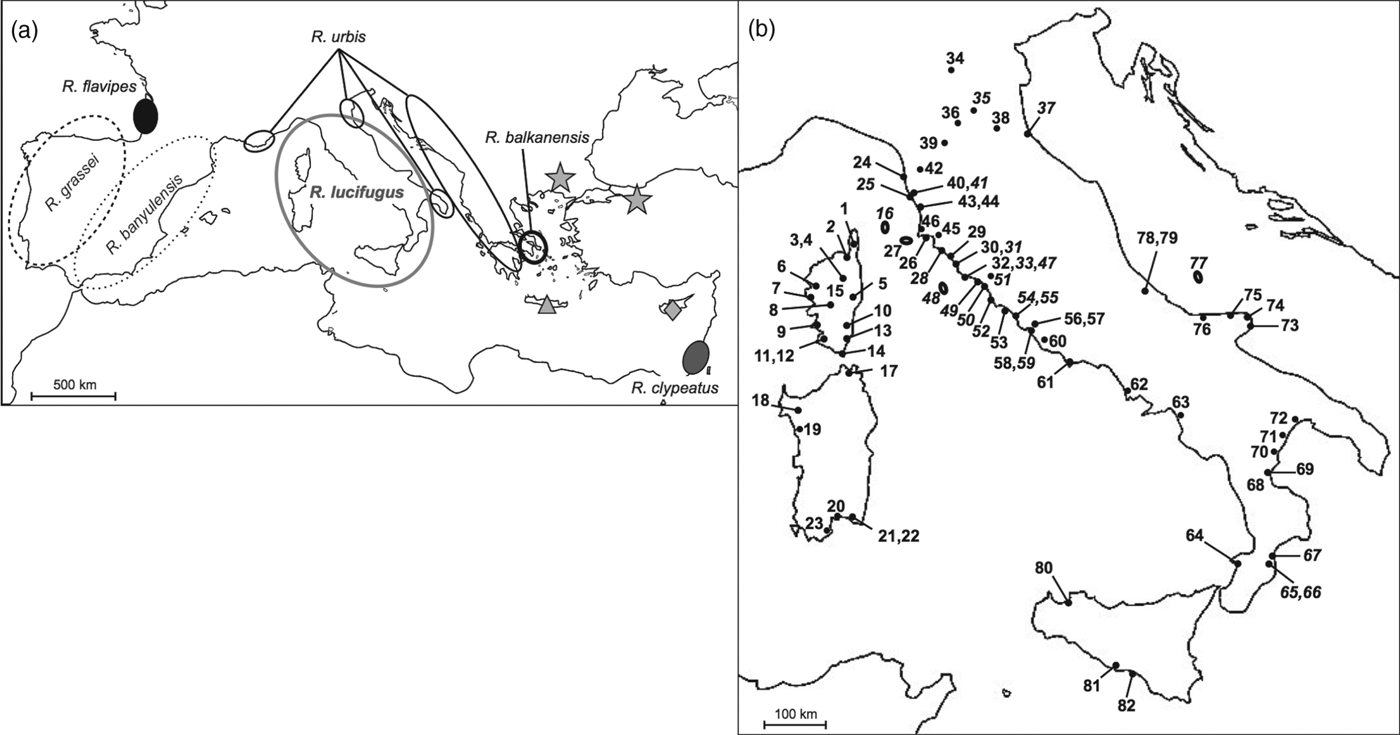
Subterranean termites of the genus Reticulitermes Holmgren belong to the Rhinotermitidae family, the apical clade of the so-called lower termites, which includes most of the invasive termite species (Vargo & Husseneder, Reference Vargo and Husseneder2009; Evans, Reference Evans, Bignell, Roisin and Lo2011). The genus is Holarctic and in Europe it is present in the Mediterranean Basin with seven species (R. flavipes Kollar, R. grassei Clément, R. banyulensis Clément, R. lucifugus Rossi, R. urbis Bagnères, Uva & Clément, R. balkanensis Clément and R. clypeatus Lash), plus three mitochondrial DNA (mtDNA) lineages whose taxonomic rank has not been determined yet (Lash, Reference Lash1952; Clément et al., Reference Clément, Bagnères, Uva, Wilfert, Quintana, Rehinard and Dronnet2001; Austin et al., Reference Austin, Szalanski, Uva, Bagnères and Kence2002, Reference Austin, Szalanski, Scheffrahn, Messenger, Dronnet and Bagneres2005; Marini & Mantovani, Reference Marini and Mantovani2002; Bagnères et al., Reference Bagnères, Uva and CléLment2003; Kutnik et al., Reference Kutnik, Uva, Brinkworth and Bagnères2004; Luchetti et al., Reference Luchetti, Trenta, Mantovani and Marini2004, Reference Luchetti, Marini and Mantovani2007, Reference Luchetti, Velonà, Mueller and Mantovani2013a; Uva et al., Reference Uva, Clément, Austin, Aubert, Zaffagnini, Quintana and Bagnères2004a, Reference Uva, Clément and Bagnèresb; Lefebvre et al., Reference Lefebvre, Châline, Limousin, Dupont and Bagnères2008; Leniaud et al., Reference Leniaud, Dedeine, Pichon, Dupont and Bagnères2010; Velonà et al., Reference Velonà, Ghesini, Luchetti, Marini and Mantovani2010; Ghesini & Marini, Reference Ghesini and Marini2012a, Reference Ghesini and Marinib; Perdereau et al., Reference Perdereau, Bagnères, Bankhead-Dronnet, Dupont, Zimmermann, Vargo and Dedeine2013; fig. 1a). The high diversity observed for this termite genus within the Mediterranean region, compared with the other naturally occurring genus Kalotermes (Velonà et al., Reference Velona’, Luchetti, Ghesini, Marini and Mantovani2011; Luchetti et al, Reference Luchetti, Dedeine, Velonà and Mantovani2013b), mirrors the complex paleogeographic–paleoclimatic history of Southern Europe that comprised significant landmasses movements, since 30–40 Myr ago, and recent climatic oscillations (Webb & Bartlein, Reference Webb and Bartlein1992; Hewitt, Reference Hewitt1996; Rosenbaum et al., Reference Rosenbaum, Lister and Duboz2002; Meulenkamp & Sissing, Reference Meulenkamp and Sissing2003). Previous studies on the phylogeny and evolution of European Reticulitermes termites agreed to interpret the observed taxonomy and phyletic relationships as a consequence of the Quaternary climatic oscillations (population range contraction/expansion and physical barriers fluctuations; Clément et al., Reference Clément, Bagnères, Uva, Wilfert, Quintana, Rehinard and Dronnet2001; Uva et al., Reference Uva, Clément, Austin, Aubert, Zaffagnini, Quintana and Bagnères2004a; Luchetti et al., Reference Luchetti, Marini and Mantovani2005; Lefebvre et al., Reference Lefebvre, Châline, Limousin, Dupont and Bagnères2008). However, more recently, a wide phylogeographic study anticipated cladogenetic events back to the Oligocene (∼20–30 Myr ago; Velonà et al., Reference Velonà, Ghesini, Luchetti, Marini and Mantovani2010), even if the role of climate fluctuations on the evolution of R. grassei and R. urbis populations, in particular, cannot be disregarded (Kutnik et al., Reference Kutnik, Uva, Brinkworth and Bagnères2004; Luchetti et al., Reference Luchetti, Marini and Mantovani2007; Velonà et al., Reference Velonà, Ghesini, Luchetti, Marini and Mantovani2010).
Geographic distribution of Reticulitermes taxa and sampling sites. (a) Map of European Reticulitermes species distribution. Main mtDNA lineages are also represented: triangle=Cretan lineage; diamond=Cypriot lineage; stars=Eastern Greece–Turkish lineage. (b) Map showing sampling localities of the considered R. lucifugus colonies. Numbers refer to table 1; numbers in italic indicate presently analyzed samples.

Only few studies focused specifically on the Italian range, mainly concentrating on the evolution of R. lucifugus corsicus or on localized samples of R. lucifugus lucifugus (Uva et al., Reference Uva, Clément and Bagnères2004b; Lefebvre et al., Reference Lefebvre, Châline, Limousin, Dupont and Bagnères2008; Ghesini & Marini, Reference Ghesini and Marini2012b). These studies, while pointing out a certain degree of differentiation within the peninsular R. lucifugus, gave only a partial view of the whole scenario.
In this study, we provide the widest analysis of the Italian R. lucifugus populations based on the mtDNA marker cytochrome oxidase II (COII), integrating the information of newly investigated samples together with previously obtained R. lucifugus sequences. The analyses are also widened to the Iberian taxa: these show, in fact, a closer relationship to the Italian ones, opposite to the high divergence with Eastern-Mediterranean clades (Uva et al., Reference Uva, Clément, Austin, Aubert, Zaffagnini, Quintana and Bagnères2004a; Luchetti et al., Reference Luchetti, Marini and Mantovani2007; Velonà et al., Reference Velonà, Ghesini, Luchetti, Marini and Mantovani2010; Luchetti, unpublished data). On the whole, we provide the most comprehensive dataset regarding both the genetic variability and the geographic distribution of considered samples, aiming to understand the origin and evolutionary dynamics of R. lucifugus.
Material and methods
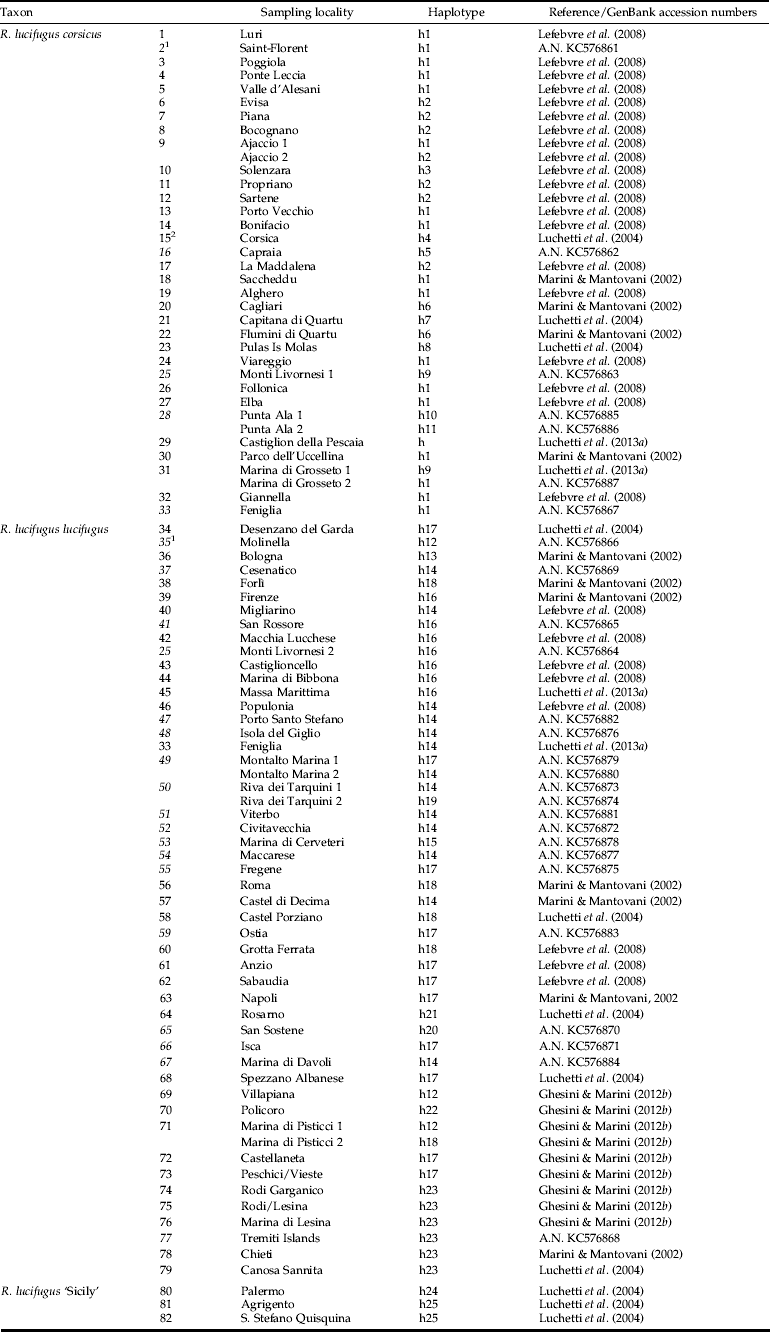
Twenty-seven colonies were field sampled. Collected specimens were preserved in absolute ethanol until molecular investigation (table 1, fig. 1b).
List of the complete R. lucifugus sequence dataset here considered, with all pertinent information. Numbers refer to map position in fig. 1.
1 Field-collected and kindly gifted by M. Marini.
2 Laboratory-reared colony, kindly gifted by J.-L. Clément.
Total DNA was isolated from single termite heads with the CTAB method (Doyle & Doyle, Reference Doyle and Doyle1987); two workers for each colony were used for PCR amplification of mitochondrial COII gene with primer TL2-J-3034 (5′-AAT ATG GCA GAT TAG TGC A-3′) and TK-N-3785 (5′-GTT TAA GAG ACC AGT ACT TG-3′; Luchetti et al., Reference Luchetti, Trenta, Mantovani and Marini2004). PCR amplification was performed on 20 ng of template DNA in a 50 μl mixture with Go-Taq polymerase (Promega, Madison, WI, USA), following the manufacturer protocol. Thermal cycling was as follows: an initial denaturation step at 94 °C for 5 min, 30 cycles of denaturation at 94 °C for 30 s, annealing at 48 °C for 30 s, extension at 72 °C for 30 s, a final elongation step at 72 °C for 7 min. PCR products were purified using the Wizard SV PCR and Gel cleaning kit (Promega) and both strands were directly sequenced at Macrogen Inc. – Europe Laboratory. Newly scored haplotypes were deposited into GenBank (table 1).
To the newly obtained sequences, we added GenBank-derived ones from colonies analyzed in Marini & Mantovani (Reference Marini and Mantovani2002), Luchetti et al. (Reference Luchetti, Trenta, Mantovani and Marini2004), Kutnik et al. (Reference Kutnik, Uva, Brinkworth and Bagnères2004), Lefebvre et al. (Reference Lefebvre, Châline, Limousin, Dupont and Bagnères2008), Ghesini & Marini (Reference Ghesini and Marini2012b) and Luchetti et al. (Reference Luchetti, Velonà, Mueller and Mantovani2013a) (table 1 and Suppl. Table S1), for a total data set of 90 R. lucifugus samples and 29 Iberian colonies. Haplotype numbering is here redefined following samples’ West–Eastern geographic distribution. In order to avoid confusion with entities whose taxonomic status is still uncertain or debated, they will be referred as: the Sicilian form=R. lucifugus ‘Sicily’; the divergent R. grassei clade (Kutnik et al., Reference Kutnik, Uva, Brinkworth and Bagnères2004)=R. grassei-B.
Sequence alignment with Clustal algorithm, the search for the best substitution model (HKY+Γ) and the computation of the Maximum-likelihood tree, with 100 bootstrap replicates, were done using MEGA v. 5 (Tamura et al., Reference Tamura, Peterson, Peterson, Stecher, Nei and Kumar2011).
Median-joining network (Bandelt et al., Reference Bandelt, Forster and Röhl1999) was calculated with Network v. 4.611 (available at http://www.fluxus-engineering.com/sharenet.htm). Statistical parsimony network (Templeton et al., Reference Templeton, Crandall and Sing1992) was obtained with TCS v. 1.21 (Clement et al., Reference Clement, Posada and Crandall2000); parsimony connection limits between potential sub-networks was set to 95%.
Haplotype diversity (h D±SE), nucleotide diversity (π±SE) and the number of polymorphic sites (S) were obtained with DnaSP v. 5.1 (Librado & Rozas, Reference Librado and Rozas2009).
Results
The 27 colonies studied had 13 COII haplotypes (table 1), differing by one to 25 substitutions for a total of 34 variable positions. Seven haplotypes were already scored in previous analyses (h1, h9, h12, h14, h16, h17, h23; Mantovani & Marini, Reference Marini and Mantovani2002; Luchetti et al., Reference Luchetti, Trenta, Mantovani and Marini2004; Lefebvre et al., Reference Lefebvre, Châline, Limousin, Dupont and Bagnères2008; Ghesini & Marini, Reference Ghesini and Marini2012b; Luchetti et al., Reference Luchetti, Velonà, Mueller and Mantovani2013a).
Newly obtained haplotypes have been combined into a larger dataset containing all COII sequences so far produced for R. lucifugus lucifugus, R. lucifugus ‘Sicily’ and R. lucifugus corsicus (Marini & Mantovani, Reference Marini and Mantovani2002; Luchetti et al., Reference Luchetti, Trenta, Mantovani and Marini2004, Reference Luchetti, Velonà, Mueller and Mantovani2013a; Lefebvre et al., Reference Lefebvre, Châline, Limousin, Dupont and Bagnères2008; Ghesini & Marini, Reference Ghesini and Marini2012b). COII sequences of R. grassei and R. banyulensis (Marini & Mantovani, Reference Marini and Mantovani2002; Kutnik et al., Reference Kutnik, Uva, Brinkworth and Bagnères2004) were also included, so that 119 colonies, collected from 111 localities, have been analyzed for a total of 45 haplotypes (table 1 and Suppl. Table S1). The sequence alignment showed 97 variable positions (76 parsimony informative sites) out of 677: 73 substitutions fall in the third codon position, 19 in the first and 5 at the second codon position. Haplotypes differ from each other by one to 42 substitutions.
Maximum-likelihood phylogenetic analysis (fig. 2a) recognizes two main clades: one embodying the Iberian R. grassei and R. banyulensis, and the other comprising R. lucifugus sequences. The first clade, as already evidenced by Kutnik et al. (Reference Kutnik, Uva, Brinkworth and Bagnères2004), further splits in the sub-clusters given by sequences obtained from R. grassei, R. banyulensis and R. grassei-B samples.
Phylogenetic analysis on the COII dataset. (a) Maximum-likelihood tree (−ln L=1808.53); numbers at nodes are bootstrap values >60%. Rg=Reticulitermes grassei; Rg-B=R. grassei-B divergent lineage; Rb=R. banyulensis; Rlc=R. lucifugus corsicus; Rls=R. lucifugus ‘Sicily’; Rll=R. lucifugus lucifugus with A, B and C indicating the three R. lucifugus lucifugus lineages; symbols as in panel (b) are also reported; (b) Map showing the distribution of R. lucifugus subspecies/lineages, as resulted from maximum-likelihood tree. R. lucifugus taxa/lineages are indicated by symbols as follows: R. lucifugus corsicus, reversed triangle; R. lucifugus ‘Sicily’, diamond; R. lucifugus lucifugus lineage A, circle; R. lucifugus lucifugus lineage B, square and R. lucifugus lucifugus lineage C, triangle; (c) Median-joining network; the magnitude of circles is proportional to the haplotype frequency; haplotypes are as in table 1. Dotted lines define sub-networks obtained with statistical parsimony 95% limit.
The three known R. lucifugus taxa can be recognized in the second clade; the R. lucifugus lucifugus cluster is of particular interest as it is further structured in three, geographically partitioned lineages (fig. 2b). The first one (henceforth referred to as A lineage) is in sister relationship with the other two R. lucifugus lucifugus lineages and comprises colonies collected in Southern Italy, from the Tyrrhenian side (Rosarno) to the Ionian coast, up to the Tremiti Islands and on the Southern Adriatic side of the peninsula; a colony belonging to this lineage was also collected from an infested building in the Northern town of Molinella. The second lineage (the B lineage) comprises colonies collected along the Central/Southern Tyrrhenian coast and on the Ionian one; two colonies of the B lineage have been found infesting buildings in the Northern cities of Forlì and Desenzano del Garda. The third lineage (the C lineage) embodies samples collected along the Central/Northern Tyrrhenian side of the peninsula, but three: one from Bologna (infested building), one sampled in the Cesenatico pine wood (on the Adriatic side) and one collected in the very South of Italy, on the Ionian side (fig. 2b). The three lineages partially overlap in the contact zones (fig. 2b). Median-joining and statistical parsimony networks give strictly congruent results (fig. 2c). On the 95% parsimony connection limit, statistical parsimony networks analysis produces seven sub-networks, each representing a recognized species, sub-species or lineage. R. grassei haplotypes are directly linked to the R. lucifugus corsicus sub-network, which is equally separated from the sub-networks of the Sicilian taxon and of R. lucifugus lucifugus. The haplotypes distribution in the R. lucifugus lucifugus sub-network agrees with the clustering observed in the maximum-likelihood analysis. In comparison with the Iberian sub-network(s), the R. lucifugus complex ones are characterized by few, high-frequency haplotypes.
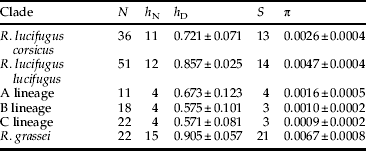
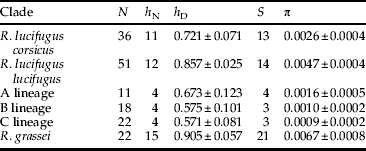
Intra-taxa genetic diversity (table 2) indicates R. grassei as the more variable (h D=0.905±0.057; π=0.0067±0.0008) followed by R. lucifugus lucifugus (h D=0.857±0.025; π=0.0047±0.0004). Among Italian peninsular lineages, the A one is the more variable (h D=0.673±0.123; π=0.0016±0.0005), whereas the C lineage shows the lowest genetic diversity (h D=0.571±0.081; π=0.0009±0.0002).
Genetic diversity of the analyzed Reticulitermes samples. Number of sequenced colonies (N), number of haplotypes (h N), haplotype diversity (h D), polymorphic sites (S) and nucleotide diversity (π) are reported.
Discussion
Phylogeny and evolution of Reticulitermes species in Europe has been deeply investigated (Clément et al., Reference Clément, Bagnères, Uva, Wilfert, Quintana, Rehinard and Dronnet2001; Austin et al., Reference Austin, Szalanski, Uva, Bagnères and Kence2002; Marini & Mantovani, Reference Marini and Mantovani2002; Luchetti et al., Reference Luchetti, Trenta, Mantovani and Marini2004, Reference Luchetti, Marini and Mantovani2007; Uva et al., Reference Uva, Clément, Austin, Aubert, Zaffagnini, Quintana and Bagnères2004a, Reference Uva, Clément and Bagnèresb; Velonà et al., Reference Velonà, Ghesini, Luchetti, Marini and Mantovani2010; Ghesini & Marini, Reference Ghesini and Marini2012b), as well as phylogeography and population genetics of both Iberian and Balkan clades (Kutnik et al., Reference Kutnik, Uva, Brinkworth and Bagnères2004; Luchetti et al., Reference Luchetti, Marini and Mantovani2007; Leniaud et al., Reference Leniaud, Dedeine, Pichon, Dupont and Bagnères2010). On the other hand, the biosystematics of the Italian R. lucifugus has been only partially studied, with particular attention just paid to the trans-Tyrrhenian distribution of R. lucifugus corsicus (Uva et al., Reference Uva, Clément and Bagnères2004b; Lefebvre et al., Reference Lefebvre, Châline, Limousin, Dupont and Bagnères2008).
In this paper, we provide the most comprehensive genetic analysis of R. lucifugus colonies (N=90) based on both new and previously produced COII mitochondrial marker data, taking also into account the data on Iberian taxa (29 colonies). Despite possible limitations imposed by the use of a single mtDNA marker, this study allowed us to evidence: (i) a well-defined phylogeographic pattern explaining the origin of Italian Reticulitermes and (ii) the presence of three well-differentiated lineages among the Italian peninsular populations.
On the origin of R. lucifugus taxa, two hypotheses have been put forward so far. The first one suggested vicariance due to the contemporary separation of the Iberian, Italian and Balkan taxa in their Mediterranean peninsulas during the Quaternary climatic oscillations. The second hypothesis explained R. lucifugus speciation by dispersal after a post-Ice Age northward recolonization originating from the Iberian refugium and followed by the invasion of the Italian peninsula from the North (Clemént et al., Reference Clément, Bagnères, Uva, Wilfert, Quintana, Rehinard and Dronnet2001). The latter hypothesis has been considered as the most likely, being supported by subsequent phylogenetic analyses highlighting the closer relationship between Iberian and Italian taxa and the higher divergence of Eastern-Mediterranean clades (Uva et al., Reference Uva, Clément, Austin, Aubert, Zaffagnini, Quintana and Bagnères2004a; Luchetti et al., Reference Luchetti, Marini and Mantovani2007; Velonà et al., Reference Velonà, Ghesini, Luchetti, Marini and Mantovani2010; Luchetti, unpublished data). Following the cladogenetic event leading to the peninsular R. lucifugus lineage, R. lucifugus corsicus and the Sicilian entity would have evolved during the Pleistocene cycles of separation/connection of the mainland with the Corse, Sardinia and Sicily islands (Luchetti et al., Reference Luchetti, Marini and Mantovani2005; Lefebvre et al., Reference Lefebvre, Châline, Limousin, Dupont and Bagnères2008). Recently, the origin of R. lucifugus corsicus has been predated to the separation of the Sardo-Corsican microplate from the mainland's Northern part, at the end of its anticlockwise rotation (8–5 Myr ago; Velonà et al., Reference Velonà, Ghesini, Luchetti, Marini and Mantovani2010). Data presented here evidence a slightly different scenario: the maximum-likelihood tree and haplotype networks evidenced a relationship between R. grassei and R. lucifugus corsicus closer than that with the two other R. lucifugus taxa and, remarkably, R. lucifugus corsicus is further strictly related to the Sicilian entity and to the Southernmost R. lucifugus lucifugus A lineage. This implies that the Italian peninsula was colonized by an ancestral R. lucifugus lineage from the South rather than from the North and therefore we suggest a revision of the previous hypothesis on the origin and differentiation of the R. lucifugus complex.
The Sardo-Corsican microplate separated from the Iberian region between 30 and 25 Myr ago, as a part of the so-called Hercynian belt; it then drifted eastward and collided with the Apulian microplate (∼18 Myr ago) (Rosenbaum et al., Reference Rosenbaum, Lister and Duboz2002; Meulenkamp & Sissing, Reference Meulenkamp and Sissing2003). Successively, the Sardo-Corsican microplate separated again from the Apulian one, leaving a fragment (the Calabrian one) connected to the mainland (Rosenbaum et al., Reference Rosenbaum, Lister and Duboz2002). This paleogeographic pattern and our data suggest the following scenario: after the separation of the Sardo-Corsican microplate, the ancestral Iberian Reticulitermes taxon split into two entities, one corresponding to the present-day R. grassei (left on the Iberian area) and the other to R. lucifugus (trapped within the eastward-rotating microplate). The timing of these geological events well reconciles with the timing of cladogenetic events estimated by Velonà et al. (Reference Velonà, Ghesini, Luchetti, Marini and Mantovani2010), i.e., between 24 and 10 Myr ago. Once the microplate collided with the Apulian block, the ancestral R. lucifugus spread on the new land from the Southern side before the subsequent separation, accordingly to the closer relationship between the Sardo-Corsican subspecies, the Sicilian taxon and the R. lucifugus lucifugus A lineage. The origin of the R. lucifugus complex from a small subset of the R. grassei ancestors appears also reflected by the difference in the genetic variability between the two taxa. Indeed, with respect to the Iberian taxon, both R. lucifugus corsicus and R. lucifugus lucifugus exhibit lower values of h D and π: it is likely that, when Hercynian belt separated from the mainland, the populations living on that plate fragment embodied just a fraction of the whole genetic variability. Notably, even if to a limited extent, the R. lucifugus lucifugus A lineage appears more variable than the Northernmost B and C ones (table 2): this is consistent with the hypothesis of the Italian peninsula colonization from the South we propose here.
Cladogenetic events that followed the break off of the Sardo-Corsican microplate from Iberia have been described, until now, in only two terrestrial organisms: the plant family Araceae (Mansion et al., Reference Mansion, Rosenbaum, Schoenenberger, Bacchetta, Rossellò and Conti2008) and the ground-dweller spider genus Parachtes (Bidegaray-Batista & Arnedo, Reference Bidegaray-Batista and Arnedo2011). Therefore, our data confirm this peculiar pattern, providing a new evolutionary scenario for the R. lucifugus complex origin.
Maximum-likelihood analysis evidence a genetic structuring of peninsular Italy populations, with three divergent lineages: one distributed to the very South, another one scattered on the West side spanning from Southern to Central Italy and the last one occurring from Central- to North-Western Italian coasts. Following the cladogenesis timing calculated by Velonà et al. (Reference Velonà, Ghesini, Luchetti, Marini and Mantovani2010), the splitting of the Sicilian-peninsular clade dates back, approximately, to the Messinian salinity crisis (∼5.3 Myr ago); this means that the separation of the peninsular populations took place not later than the Pliocene period. Then, from the R. lucifugus lucifugus ancestral populations: (i) the A lineage branched out, at present occurring under the geographic barrier given by the Southern Apennine chain (Ghesini & Marini, Reference Ghesini and Marini2012b), and (ii) lineages B and C underwent northward range expansion along the Tyrrhenian coasts, eventually producing the observed South-North cline (Uva et al., Reference Uva, Clément and Bagnères2004b; Lefebvre et al., Reference Lefebvre, Châline, Limousin, Dupont and Bagnères2008). It is to be noted, although, that the distribution areas of the three peninsular lineages are not well delimited, with overlaps in the contact zones. This may be explained by subsequent, recent dispersion.
The study of the biogeography and of phylogeographic patterns of subterranean termites can be difficult for two main reasons: first of all, they have cryptic nesting habits, making the taxon sampling difficult; second, they can be easily dispersed by human-mediated movement of wooden artifacts/materials (see for example, Jenkins et al., Reference Jenkins, Dean, Verkerk and Forschler2001; Perdereau et al., Reference Perdereau, Bagnères, Bankhead-Dronnet, Dupont, Zimmermann, Vargo and Dedeine2013). This latter feature may mask the correct phylogeographic signal when the taxon sampling is not enough representative. In the present analysis, we provide the first comprehensive study of the R. lucifugus complex, using both originally produced and literature-derived molecular data, able to highlight previously unnoticed phylogeographic patterns. The utility of the wider taxon sampling was particularly evident in the definition of the three R. lucifugus lucifugus lineages even if some haplotypes are scattered outside the presumed distribution area: for example, one A and two B lineages’ haplotypes can be found in Northern localities, as well as one C lineage haplotype has been detected in the very South of the peninsula. The geographic isolation of these haplotypes as well as their presence in Northern localities within cities but not in the field, where natural condition would not allow the termite survival, speak in favor of secondary introduction events.
As a general consideration, this paper point out that when tackling the phylogeography of organisms closely associated with human trades, a wide taxon sampling considering both infestation and natural sites is required to obtain reliable biogeographic and biodiversity patterns.
The supplementary materials for this article can be found at http://www.journals.cambridge.org/ber.
Acknowledgment
This work was supported by Canziani funds to BM and AL. We are grateful to J.-L. Clément and M. Marini for kindly gifting samples. We also wish to thank the Editor and anonymous reviewers whose useful suggestions helped in improving the manuscript.