INTRODUCTION
In their recent book, God's Century, Monica D. Toft, Daniel Philpott, and Timothy S. Shah (Reference Toft, Philpott and Shah2011, 2) argue that “over the past four decades, religion's influence on politics has reversed its decline and become more powerful on every continent and across every world religion.” This is not an isolated claim. This type of claim has been present in the literature for at least two decades. However, to date, few studies have examined it using a significant amount of data from the 21st century.
This study uses new data from the Religion and State Round 2 (RAS2) dataset to examine the patterns of religious support and discrimination between 1990 and 2008. These aspects of state religion policy significantly influence the daily lives of the inhabitants of the 177 countries included in the dataset and provide a test of whether religion's influence on politics is increasing and whether it is truly “God's century.” I also examine competing theories and the genesis of the argument for religious resurgence.
IS IT GOD'S CENTURY OR IS GOD DEAD?
Before discussing why religion has returned, one must discuss whether and why it declined in the first place. Secularization theory, which many consider to have been the dominant social science theory on religion for most of the 20th century (Appleby Reference Appleby2000, 3; Casonova 1994, 17; Gorski and Altinordu Reference Gorski and Altinordu2008; Toft et al. Reference Toft, Philpott and Shah2011; Philpott Reference Philpott2009) predicts religion's decline. The extent and nature of this decline is hotly debated, ranging from predictions of religion's complete irrelevance in the modern era to, at a minimum, a significant decline in religion's influence in the public sphere. A particularly dramatic version of this argument is Steve Bruce's 2002 book, God is Dead: Secularization in the West, which borrows its title from Nietzsche's famous quote. Similarly, sociologist Peter Berger in 1968 predicted that by “the twenty-first century, religious believers are likely to be found only in small sects, huddled together to resist a worldwide secular culture.”Footnote 1
The reasons behind this expectation are numerous and include: urbanization undermining the traditional communities where religion thrived; universal literacy and education undermining the clergy's monopoly on knowledge; science and rationalism challenging religion as a source of knowledge and understanding; secular political ideologies taking over religion's role in legitimizing the state; the increasing power of modern states relative to religious institutions; mass participation in politics undermining political control by religious elites; economic prosperity reducing the reliance on the afterlife as a place of happiness and satisfaction; and geographic mobility undermining religiously homogeneous societies (Bruce Reference Bruce and Haynes2009; Gorski and Altinordu Reference Gorski and Altinordu2008; Lambert Reference Lambert1999; Norris and Inglehart Reference Norris and Inglehart2004; Voicu Reference Voicu2009; Wilson 1982).
Whilehe secularization literature focuses mainly on the predicted decline in individual religiosity,Footnote 2 there is also a strong strand which focuses on religion in the public sphere. This public sphere influence has been variably defined as the “power” (Lechner Reference Lechner1991) or scope of religious authority in the public sphere (Chaves Reference Chaves1994, 750; Yamane Reference Yamane1997), religion's influence over social institutions (Dobbelaere Reference Dobbelaere1999) or society as a whole (Gauchet Reference Gauchet1997), the boundaries between the secular and religious (Hallward Reference Hallward2008), the public role of religious institutions (Finke Reference Finke and Bruce1992; Minkenberg Reference Minkenberg2009, 1193) “the state, the economy, and science” (Casanova Reference Casanova1994, 20), and state religion policy (Finke Reference Finke and Bruce1992; Fox Reference Fox2008; Lambert Reference Lambert1999). Stark (Reference Stark1999, 252) notes that in the secularization literature, individual religiosity and religion's public influence are “so linked that a decline in one necessitates a decline in the other.”Footnote 3
A common version of secularization theory's public sphere aspect is the “differentiation” argument. Differentiation is a process where religion shifts from being a dominant influence on all aspects of society to one social institution which competes with others (Bruce Reference Bruce and Haynes2009; Casanova Reference Casanova2009, 1050; Dobbleare Reference Dobbelaere1985; 1999; Kaspersen and Lindval 2008; Lambert Reference Lambert1999, 319–320; Stark Reference Stark1999). While this argument does not focus on political issues, its predictions clearly include a decline in political influence. Thus, the predictions of secularization theory apply to government religion policy.
Since the early 1990s, there has been increasing discussion of religion's global resurgence, prompted by world events including the Iranian Revolution and the numerous religious insurgency movements subsequent to it. These events were not limited to those involving Muslims. The increasing influence of religious actors in United States politics, the influence of Buddhism on the conflicts in Tibet and Sri Lanka, and the rise of Hindu nationalism in India were also prominent. While explanations for the causes of religion's return to the political arena vary, they can be placed into five categories.
First, secularization theory successfully identifies pressures faced by religion in modern times but it does not account for religion as a dynamic social force that is capable of evolving. Under the pressures created by modernity, religion evolved, revitalizing its political relevance in the process (Eisenstadt Reference Eisenstadt2000). For example, many explain the rise of religious fundamentalism as an evolutionary reaction against modernity (Almond et al. Reference Almond, Scott Appleby and Sivan2003; Esposito Reference Esposito1998; Haynes Reference Haynes2009, 159). Toft et al. (Reference Toft, Philpott and Shah2011, 7) similarly argue that religion's political influence “has resurged with the help, rather than the opposition, of the very same forces that secularization theorists thought would spell its demise.”
Second, while secularization was dominant for much of the 20th century, it has failed especially in the Third World, leaving a vacuum which religion can fill. Governments guided by secular ideologies failed to produce economic prosperity and social justice. They are perceived as foreign, illegitimate, corrupt, and perhaps the continuation of colonialism by proxy. In contrast, religion is seen as legitimate, uncorrupted, and indigenous, making it an effective challenger (Haynes Reference Haynes1997, 714; Juergensmeyer Reference Juergensmeyer1993; Reference Juergensmeyer2008; Thomas Reference Thomas2005).
Third, Samuel Huntington's (1993; 1996) “clash of civilizations” argument posits that religion is replacing the Cold War's East-West ideological clash as the dominant international political paradigm. His arguments do not directly address religion but he argues that several “civilizations” which happen to be religiously homogeneous, will be the dominant basis for identity and alliances in the post-Cold War era. This theory is both highly controversial and highly influential.Footnote 4
Fourth, some argue that secularization is an ideology rather than a theory. Religion never declined but secularization theory's dominance among Western academics obfuscated religion's influence (Berger Reference Berger1996/1997, 9; Thomas Reference Thomas2005; Wald and Wilcox Reference Wald and Wilcox2006). For example, Muslims never accepted religion's is irrelevance and see history as a century's long clash between Christianity and Islam. For the West, the 1683 defeat of the Ottomans at the gates of Vienna ended the religious threat to Christianity and, combined with the Treaty of Westphalia, can be seen as the end of religion in international politics. Muslims see 1683 as the beginning of centuries of defeat and humiliation by Christians. Russia conquered Muslim Central Asia. European colonialism controlled much of Muslim South Asia and North Africa. Greece, Bulgaria, and Serbia conquered the Muslim Balkans. The continuing influence of Western states in the Muslim world, including recent military interventions, underscores this humiliation. From this perspective, the recent resurgence of Islamic violence against the West and regimes perceived as being influenced by the West is not a religious resurgence. Rather it is a shift in the tides of a centuries old war (Miles Reference Miles2004).Footnote 5
The fifth argument is a hybrid of several of the above arguments by Toft et al. (Reference Toft, Philpott and Shah2011, 49–78). For a time religion declined but not in the manner predicted by secularization theory. Temporal governments became more powerful between 1450 and 1750, shifting their power balance with religious institutions from the previous balance where religion shared power with the state. In a “friendly takeover,” the increasingly powerful state became the dominant partner and protected the existing religious monopoly by enforcing and financing religion. From the late 18th century through the late 20th century, many states became more hostile to religion. Religion became fully subordinated to the state and was often restricted in the public sphere. In extreme cases, such as some Communist and fascist states, religion was banned altogether. Fifty percent of the world's population lived under anti-religious regimes at some point between 1917 and 1967.
Beginning in the 1960s secular regimes began experiencing setbacks, allowing religion's return. Essentially, secularism did not deliver the “coup de grace” to religion. Rather, religious institutions became independent from the government and found non-state sources of financial support. Until this shift people remained religious but focused that religion inward. From the 1960s, the failures of many secular states facilitated increasing political assertiveness by the now increasingly strong and independent religious institutions. Two additional trends facilitated this process. First democratization made it easier for religion to compete in the political arena. Second, globalization has made many of these religious actors transnational actors, improving their negotiating position with the state. Thus, religion has returned, not as the state's partner but as a powerful, influential, and independent actor with a political agenda (Toft et al. Reference Toft, Philpott and Shah2011, 49–78).
Interestingly, earlier versions of the argument that religion is returning mostly focus on either conflict (Juergensmeyer Reference Juergensmeyer1993; Fox Reference Fox2002; Huntington Reference Huntington1993; Reference Huntington1996) or religious fundamentalism (Appleby Reference Appleby2000; Esposito Reference Esposito1998; Marty and Appleby 1991). More recently this discussion has expanded to include religious freedom (Grim and Finke Reference Grim and Finke2011; Fox Reference Fox2008) state religion policy (Fox Reference Fox2008; Philpott Reference Philpott2007; Toft et al. Reference Toft, Philpott and Shah2011), and international relations (Fox and Sandler Reference Fox and Sandler2004; Madeley Reference Madeley2009; Philpott Reference Philpott2002; Reference Philpott2007; Thomas Reference Thomas2005). Others focus almost exclusively on why political scientists ignored religion, with little discussion of whether religion had resurged or has always been present (Philpott Reference Philpott2009; Wald and Wilcox Reference Wald and Wilcox2006).
While debate over whether religion was ever in decline continues, a consensus that religion remains relevant is emerging. Even current arguments supporting secularization theory do not posit that religion will disappear. For example, differentiation theory posits that religion will lose some public power but will retain some influence. Similarly, many argue that religion no longer has an overarching authority and people can choose their own beliefs (Bruce Reference Bruce and Haynes2009, 147–148; Dobbelaere Reference Dobbelaere1999, 236–241; Lambert Reference Lambert1999, 315, 322; Pollack and Pickel Reference Pollack and Pickel2007). That is, religious beliefs still influence behavior but this is determined by individuals rather than at the societal level.
Another common argument is that secularization is limited to the West. For instance, Berger (Reference Berger1996/1997; Reference Berger2009) argues that religion is resurging worldwide but Western and Central Europe and certain intellectual circles are still secularizing. Marquand and Nettler (Reference Marquand and Nettler2000, 2) argue that “Western Europe appears to be an exception … Organized religion almost certainly plays a smaller role in politics in 2000 over most of the territory of the European Union than it did in 1950.”
Haynes (Reference Haynes1997; Reference Haynes1998; 2009) attributes this to government equality policies and the co-optation and subordination of religious institutions. Crouch (Reference Crouch2000) argues that increased individualism has caused Europeans to reduce ties to their churches' more restrictive collective identities. Also, increased liberalism has forced European churches to focus more on tolerance, further undermining their ability to maintain exclusivity. Taylor (Reference Taylor2007) argues that the ideology of secularism has provided a potent tool to those that choose not to be religious, undermining religion's former dominance. Halman and Draulans (Reference Halman and Draulans2006), Kaspersen and Lindvall (Reference Kaspersen and Lindvall2008), and Voicu (Reference Voicu2009) focus on classic explanations for secularization but apply them only to the West, ignoring the non-West.
Be that as it may, there is no agreement on the timing of religion's resurgence. Most date it to the 1970s around the time of the Iranian revolution and the religious right's rise in United States politics (Juergensmeyer Reference Juergensmeyer1993; Roof Reference Roof2009). Fox (Reference Fox2007) finds that a rise in religious conflict beginning in 1977 led to it becoming a majority of conflict in 2002. Fox (2004) found that in 1980 the levels of violence in religious separatist conflicts began to increase relative to those in non-religious separatist conflicts.
Toft et al. (Reference Toft, Philpott and Shah2011) and Philpott (Reference Philpott2009) trace this resurgence to the 1960s. “If the Bolshevik Revolution of 1917 was the inaugural ball for the peak period of secularization, the [1967] Six Day War between Israel and Egypt signified the beginning of religion's global resurgence … It both awakened religious conscience among Israeli Jews and crippled the prestige of secular nationalism among Arab Muslims” (Philpott Reference Philpott2009, 190). This event was complimented by others including the rise of India's Hindu Nationalist Parties in the 1960s and the Second Vatican Council of 1962–1965. This process gained momentum in the 1970s with the rise of Islamic nationalism in the Islamic world, Evangelical Protestantism in the Americas, Africa, and parts of East Asia and “engaged Buddhism” in Asia (Philpott Reference Philpott2009, 190–191; Toft et al. Reference Toft, Philpott and Shah2011, 4–7).
Collectively this literature makes four contradictory predictions regarding the trend of religion's influence on politics. Essentially classic secularization theory expects a decline in all aspects of religion. More recent theorists continue to make the same claim but argue it applies only to the West. Others feel that secularization theory has obfuscated our view of religion and religion and been constantly present. Finally, increasingly more scholars argue that religion has been resurging.
As the data used in this study begins in 1990, the issues of timing are not relevant to the tests performed here. Accordingly, the alternate hypotheses below do not take this issue into account.
Hypothesis 1 (secularization theory): The extent of religious support and discrimination will be uniformly low and declining.
Hypothesis 2 (secularization in the West): The extent of religious support and discrimination in the West will be low and declining.
Hypothesis 3 (religion as a constant): The extent of religious support and discrimination will be significant and constant over time.
Hypothesis 4 (religious resurgence): The extent of religious support and discrimination will be uniformly significant and increase over time.
These hypotheses do not include a fifth relevant relationship discussed in the literature. The supply-side theory of religion, as presented by Stark and Finke (Reference Stark and Finke2000) and Iannaccone (Reference Iannaccone1995), among others, argues that state support for religion is related to individual religiosity. However, rather than predicting that changes in individual religiosity influence state support for religion, they predict that as states more strongly support religion people become less religious. The reasons for this include less choice in choosing a religion, which makes people less likely to find a religion that appeals to them, clergy that serve governments more than their congregants, and resentment of government enforcement of religion. However, this theory is not directly relevant to the tests performed here because it uses state support for religion as an independent variable whereas in this study it is the dependent variable.
This study focuses on one aspect of the public sphere, government religion policy. Specifically, it examines government support for religion — which includes financial support, the enforcement of religious precepts, and the intertwining of religious and government institutions — and government policies which limit the religious practices or institutions of minority religions. While support for religion clearly indicates an increased relevance of religion in the public sphere (Fox Reference Fox2008), the reason that religious discrimination also indicates this importance is less obvious. The religious discrimination measure used here measures limitations placed on minority religions that are not placed on the majority religion. Thus, in a zero-sum-game this privileges the majority religion. Put differently, Stark and Finke (Reference Stark and Finke2000) would likely argue that religious discrimination creates an uneven playing field.
COMPARISON TO PREVIOUS EMPIRICAL STUDIES
There have been few longitudinal tests of this relationship. As noted above Fox (2004; Reference Fox2007) finds that conflict patterns support this predication. Toft et al. (Reference Toft, Philpott and Shah2011) find similarly for civil wars between 1940 and 2010. Madeley (Reference Madeley2009) finds that a similar number of states in Europe support religion in 2000 as did in 1900 but there are more “secular” states in 2000. However, this study focuses primarily on whether or not states have official religions. Fox (Reference Fox2008) examines an earlier version of the data used here and finds an increase in religious support and discrimination between 1990 and 2002. However, as described in more detail below the variables in Fox (Reference Fox2008) are less extensive and cover a shorter time span. This is especially relevant because this includes only a few years from the 21st century limiting the ability to test post September 11, 2001 results and make generalizations about whether it is God's century.
Finally, Grim and Finke (Reference Grim and Finke2011) collect similar data but it is not optimal for this study. Their data covers only 2001, 2003, 2005, and 2008, a shorter time span with no 20th century data, making longitudinal analysis less attractive.Footnote 6 Also, they focus on the narrower topic of religious freedom and include far fewer components than the variables used in this study.Footnote 7
THE RAS2 DATASET
This study uses data from the Religion and State round 2 (RAS2) dataset. RAS2 expands on round 1 (RAS1) which includes data from 1990 to 2002. RAS2 includes yearly data from 1990 to 2008 for 177 countries. This includes all countries with a population of 250,000 and a sampling of less populous countries. When countries became independent after 1990, the coding begins with the year of independence. In rare cases such as Afghanistan until 1992 and Iraq in 2003 when there was effectively no government, these years were not coded as a government is required for there to be a government religion policy.
Religious discrimination measures limitations on the religious practices or religious institutions of minority religions that are not placed on the majority religion. This distinction is important because limitations placed on all religions represent general hostility to religion or perhaps a government desire to keep religion out of the public arena. In contrast, restrictions placed exclusively on religious minorities, in effect, represent a state preference for a certain religion or certain religions. This index contains 30 components,Footnote 8 which is expanded from 16 in RAS1. Each component is measured on a scale of 0 to 3,Footnote 9 creating an index of 0 to 90.
Religious support measures government support for religion including legislating and enforcing religious precepts as law, financially supporting religion, and otherwise giving preference or support to the majority religion. Preferring one religion over another can be considered a form of inequality because it creates an uneven playing field for minority religions (Stark and Finke Reference Stark and Finke2000). However, it is not religious discrimination because supporting a majority religion, unless it involves making aspects of that religion mandatory, does not limit a minority religion's religious institutions or ability to practice. This index contains 51 components,Footnote 10 which is expanded from 33 in RAS1, creating an index which ranges from 0 to 51.
Each of these variables measures an important aspect of government religion policy. Government support for religion demonstrates both willingness to generally support religion and a preference for one or a small number of religions. Religious discrimination represents the other side of the coin of government support for religion. In relative terms, a majority religion has a superior status when minority religions are limited. Religious discrimination also represents a clear government decision to involve itself in religion, something that should be scarce if religion is becoming a solely private issue.
Fox (Reference Fox2008; 2011) discusses the construction of these variables. The RAS2 process for creating the components for both variables is based on the research from RAS1. Essentially, the RAS1 coding process uncovered all identifiable types of religious support and discrimination present in a significant number of states that could be found in a wide range of sources. This information was used to create the expanded lists in RAS2. As a result the components included in these indexes are as complete and comprehensive a list as currently exists.
The variables were coded based on multiple sources including, primary sources such as constitutions and laws, reports by governments (e.g., The US State Department International Freedom Reports), reports by inter-governmental organizations such as the European Union and United Nations, academic articles and books, reports by human rights organizations such as Human Rights without Frontiers and Amnesty International, news articles from the Lexis/Nexis database and other sources.Footnote 11 This is a wider range of sources than was used for data collections of a similar scale measuring human rights such as Grim and Finke (Reference Grim and Finke2011) and Abouharb and Cingranelli (Reference Abouharb and Cingranelli2006). I argue that this broad range of sources has at least three advantages. First, few sources include all relevant information, so a wider range of sources increases accuracy. Second, multiple sources allow for cross-source confirmation of facts increasing reliability. Third, the legitimacy of a particular source can be questioned. If a dataset uses a single source or a small number of sources, this can undermine the legitimacy of the dataset whereas confirmation across multiple sources significantly mitigates, if not eliminates, this type of challenge (Fox, Reference Fox2011).
The variables were coded based on the following criteria:
(1) If there was a relevant national law. In cases where this law was on the books but rarely enforced (a relatively rare occurrence), this was taken into account in the scaling of the variable when possible but always coded unless there is clear and positive information that the law has not been enforced at all for at least several decades. (2) If there was a relevant national policy … (3) If there is no national policy or law but a significant plurality of local or regional governments had such policies or laws the relevant variable was coded. In such cases, the proportion of the country's population which was under the rule of these regional or local governments was taken into account both with regard to whether the variable was coded and, when relevant, how high a coding on the scale was assigned. (4) The project codes only actions taken by government and their representatives. Societal actions are not coded.Footnote 12
These rules recognize that government policy can manifest in actions other than laws. For example, if coding was based only on laws, a government which had a law banning proselytizing that was rarely enforced would be coded on this variable as positive but a government that had no such law but regularly arrested missionaries the variable would not be coded. Clearly, taking the government's actions into account provides a more accurate picture of the true government policy.
Fox (Reference Fox2011) tests the reliability and validity of both of these variables. First, inter-coder reliability tests show a correlation between primary and backup codings of 0.982 or higher for both variables for all years. Second, the RAS2 indexes, which weight each component equally, were compared to alterative indexes with weighted components. The correlations between indexes weighed using factor analysis and the unweighted indexes for religious discrimination and support were 0.997 and 0.968, respectively. Another index based on weighting by 17 experts and the unweighted indexes for religious discrimination and support both had a correlation of 0.999 with the unweighted index. Thus, weighting these two indexes produces indexes which are nearly identical to the unweighted indexes.Footnote 13 Accordingly, this study uses the unweighted indexes, as do most studies which use this indexing methodology (e.g., Abouharb and Cingranelli Reference Abouharb and Cingranelli2006; Fox Reference Fox2008, Grim and Finke Reference Grim and Finke2011; Gurr Reference Gurr2000). Finally, the RAS2 indexes are compared to similar indexes such as the RAS1 indexes and Grim and Finke's (2011) religious freedom measure showing a high degree of correlation.Footnote 14
RESEARCH DESIGN
In order to test the pattern of change in the dependent variables between 1990 and 2008, I do as follows. First, I test the change in their means over time. Second, I assess whether any changes are driven by change in only some world regions or religious traditions using the same control categories as Fox (Reference Fox2008): six world regions — Western democracies, the former Soviet bloc, non-Soviet Asia, the Middle East (including North Africa), sub-Saharan Africa, and Latin America — and five religious traditions — Catholic, Orthodox Christianity, Other Christian traditions, Muslim, and other. While each of these categories contains diverse traditions, these are the most detailed categories feasible while still maintaining the minimum number of cases in each category for statistical assumptions to hold. Despite the diversity within traditions, the cases in each category have sufficient commonalities to justify placing them into a single category. I test these means at four time points, 1990, 1996, 2002, and 2008 to examine whether any changes which occur do so consistently over time or within a short period.
Third, I test the robustness of the model using multi-variate analysis (ordinary least square regressions). The unit of analysis is a case-year so each country is included once for each year for which there are codings. I account for time by subtracting 1990 from the year of the observation. I control for the same factors as Fox (Reference Fox2008):
The majority religion, these are the same categories as used in the previous test using dummy variables for each religious tradition (coded as 1 if a state belongs to the tradition). The excluded variable is “other” religious traditions. Numerous studies have found that the majority religious tradition influences important political variables. (e.g., Midlarsky Reference Midlarsky1998; Fisch Reference Fisch2002).
Majority percent measures the percentage of the country's population belonging to the majority religion. # minority religions measures the number of minority religions which are at least 5 percent of the country's population. Both of these variables are from Fox (Reference Fox2008). These measures are important because religious demography is an important determinant of state religion policy. For example, Fox (Reference Fox2008) found the majority percent variable increased levels of religious support.
Polity measures the extent of autocracy and democracy in a state on a scale of −10 (most autocratic) to 10 (most democratic) (Jaggers and Gurr Reference Jaggers and Gurr1995). I use this variable because democracies are expected to maintain religious freedom and perhaps separation of religion and state. While many studies also use the Freedom House measure to measure democracy, as the measure includes civil rights, it is unacceptably covariant with religious discrimination.
Regime stability, also taken from the Polity project, measures how many years a regime has persisted without a change in the Polity measure. This variable used because stability of the country may influence government religion policy.
Log-per-capita GDP is taken from the United Nations Statistics Division websiteFootnote 15 and measures economic development.Footnote 16 This is important because secularization theory predicts economic development will result in more secularization. On the other hand, developed countries have more resources. This can result in more powerful states with a higher capability to make and enforce policies, including religion policies.
The log-of-population variable controls for population size. States with small populations will have different methods of organizing their government than larger states. This variable is from the United Nations Statistics Division website.
Official religion is a 14 category variable which measures whether the state officially or unofficially prefers a single religion.Footnote 17 Fox (Reference Fox2008) demonstrates that while an earlier version of this variable is correlated with religious discrimination and support it represents an official declaration of policy as opposed to the actual policies in practice measured by the two dependent variables. Its correlations with religious discrimination and support are 0.300 and 0.640, respectively. Thus, due to the theoretical and statistical connection between this variable and the dependent variables, I use two models — one using this variable and one without this variable.
All but one pairing of other independent variables have correlations of 0.552 or lower. The only exception is majority % and # minority religions that are mathematically related and have a correlation of 0.785. Accordingly, multicolinearity is not an issue.
DATA ANALYSIS
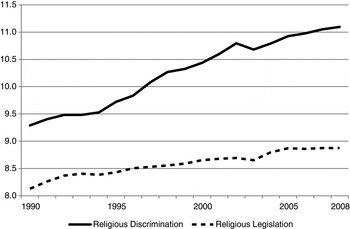
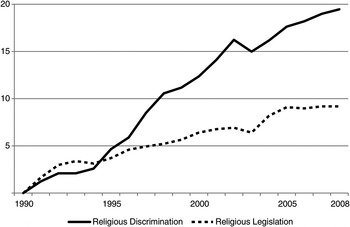
Figure 1 presents the means for religious discrimination and support over time. Figure 2 presents the same data showing change over time using 1990 as a baseline. The results show a clear increase over time in both measures. The rise in religious discrimination is statistically significant at the 0.05 level in 1992, 1994, and 1995, at the 0.01 level in 1996 and 1997, and at the 0.001 level from 1998 onward. The rise in religious support is statistically significant at the 0.05 level in 1991, at the 0.01 level in 1992, 1993, and 1994, and at the 0.001 level from 1995 onward.
Religious Discrimination 1990 to 2008, Raw Scores.

Religious Discrimination 1990 to 2008, Percentage increase since 1990.

With the exception of 2003, the mean levels of both variables increased each year. The drop in 2003 is due to the regime change in Iraq after the United States-led invasion which overthrew Saddam Hussein. Under Hussein, religious discrimination and support were high with scores of 43 and 24, respectively. In 2003, Iraq had no government so there were no codings, causing an immediate drop. In 2004, when the government began to reconstitute, the codings, while high, were considerably lower at 11 and 15, respectively.Footnote 18 Thus, the single largest drop in both religious discrimination and support for any country between 1990 and 2008 is attributable to a rare invasion by outside forces rather than internally initiated change.
While both religious discrimination and support increased overall, this rise was not uniform. Discrimination dropped in 25 (14.1 percent) countries, remained constant in 66 (37.3 percent), but increased in 86 (48.6 percent). Similarly, support decreased in 17 (9.6 percent) countries, remained constant in 80 (45.2 percent), but increased in 79 (44.6 percent). Thus, neither religious discrimination nor support increased in a majority of countries but the increases were 3.44 and 4.65 times more common, respectively, than decreases. This can certainly be considered a robust trend.
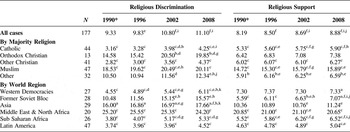
The results in Table 1 demonstrate further robustness when controlling for world region and majority religion. In each religious tradition, both variables increased over time. These changes were statistically significant for Catholics, Muslims, and “other” religions for both variables and Orthodox Christianity for discrimination only. Both variables increased over time for all world regions other than the Middle East-North Africa region. The drop in this region can be attributed to the invasion of Iraq, otherwise the means for both variables increased even in this region. The increase in religious discrimination was statistically significant for Western democracies, the former Soviet bloc, and Asia. The increase in religious support was statistically significant for the former Soviet bloc, Asia. Sub-Saharan Africa, and Latin America.
Mean Levels of Religious Discrimination and Support, 1990 to 2008

a = significance (t-test) between marked mean and all other means in same category and year < 0.05.
b = significance (t-test) between marked mean and all other means in same category and year < 0.01.
c = significance (t-test) between marked mean and all other means in same category and year < 0.001.
d = significance (t-test) between marked mean and mean for 1990 < 0.05.
e = significance (t-test) between marked mean and mean for 1990 < 0.01.
f = significance (t-test) between marked mean and mean for 1990 < 0.00.
g = significance (t-test) between marked mean and mean for 1996 < 0.05.
h = significance (t-test) between marked mean and mean for 1996 < 0.01.
i = significance (t-test) between marked mean and mean for 1996 < 0.001.
j = significance (t-test) between marked mean and mean for 2002 < 0.05.
k = significance (t-test) between marked mean and mean for 2002 < 0.01.
l = significance (t-test) between marked mean and mean for 2002 < 0.001.
These results confirm Hypothesis 4 (religious resurgence), that the extent of religious support and discrimination will be uniformly significant and increase over time. Furthermore, it predates September 11, 2001, the event that brought religion as a potent political force to many people's attention. The results clearly contradict Hypotheses 1 and 2 that predict low and declining levels of religious support and discrimination in general and in the West in particular.
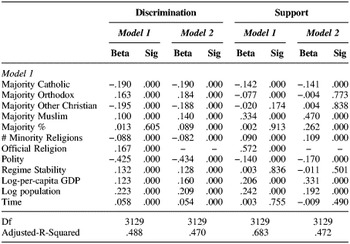
The multivariate analysis, presented in Table 2, shows a statistically significant increase in religious discrimination but not in religious support over time when controlling for other factors. Since the bivariate analysis shows that both increased over time, this can likely be explained by the increase between 1990 and 2008 in the average population, regime durability, and per-capita-GDP.Footnote 19 All three of these variables increase levels of both religious discrimination and support. The Polity variable, which shows a trend toward more democracy over time, was negatively associated with both dependent variables.
Regressions for Religious Discrimination and Support, 1990 to 2008

Religious demographics also played a significant role. The majority percent variable was significantly and positively associated with both dependent variables in regressions not including the official religion variable. As the majority percent and official religion variables have a correlation of 0.512 (p = 0.000) this is not surprising. All of the majority religion identity variables are significant in the regressions for religious discrimination with Muslim and Orthodox Christian majority states engaging in higher levels of religious discrimination and Catholic and “other” Christian majority states engaging in less. In both regressions, for religious support Catholic countries engage in significantly less religious support and Muslim majority states engage in more. In model 1 only, Orthodox Christian majority states engage in significantly less religious support. These results are consistent with the bivariate analysis which shows differing levels of religious support and discrimination across states with different majority religions.
The multivariate analysis has implications for secularization theory's prediction that secularization is linked to modernization. This is because, the results here show that as countries develop economically, religious discrimination and religious support both increase, exactly the opposite of secularization theory's predictions. In contrast many, including Toft et al. (Reference Toft, Philpott and Shah2011), Almond et al. (Reference Almond, Scott Appleby and Sivan2003), Esposito (Reference Esposito1998), and Haynes (Reference Haynes2009), predict that the very modern processes that are purported to lead to secularization are contributing to religion's resurgence. This result supports this argument.
It is also important to note that secularization theory predicts religion's decline. The bivariate analysis demonstrates definitively that this has not occurred between 1990 and 2008. The multivariate analysis, while providing insight into the correlates of religious discrimination and support, does not modify this result.
CONCLUSIONS
The evidence presented here is consistent with the God's Century argument but is not in and of itself sufficient to definitively prove that argument. Both religious discrimination and support have increased significantly between 1990 and 2008. This increase is robust. It remains consistent across world regions and major religious traditions. States where levels of religious discrimination and support increased greatly outnumber states where it dropped. Robustness tests examining these patterns in specific religious and regional contexts support these results. A multivariate analysis demonstrates that the factors predicted by secularization theory to lead to religion's decline actually contribute to higher levels of religious discrimination and support. This strongly confirms Hypothesis 4's prediction that the extent of religious support and discrimination will be uniformly significant and increase over time. It also seriously undermines the other three competing hypotheses.
These results are based on a longer (19-year) time span using more comprehensive variables than previously available. They provide the most definitive proof to date that several of the core results of the comparative analysis provided by Toft et al. (Reference Toft, Philpott and Shah2011), among others, are correct. These include that “religion's influence on politics has reversed its decline and become more powerful on every continent and across every world religion” (Toft et al. Reference Toft, Philpott and Shah2011, 3) and that “what is remarkable about all of these cases … is not only that religion has resurged in its political influence but that it has resurged with the help, rather than the opposition, of the very same forces that secularization theorists thought would spell its demise” (Toft et al. Reference Toft, Philpott and Shah2011, 7).
This has significant implications for our understanding of the relationship between religion and politics. Toft's et al. (2011) perspective of the evolution of religion and politics depicts a century's long process in which the forces of secularism gained strength. And by this I mean secularism as an ideology which competes with religion in the manner described by Philpott (Reference Philpott2009) and Taylor (Reference Taylor2007). Secularism is not an inevitable process. It is an ideology which seeks to play a role in guiding society and politics that was formerly exclusive to religion. Thus, religion and secularism are inevitably political competitors (Juergensmeyer Reference Juergensmeyer1993; Reference Juergensmeyer2008). Until some point between the early 1960s and late 1970s, depending on the historical narrative one accepts, secularism was gaining ground. Since this indeterminate point in time, religion has been coming back.
However, the God's century question is complicated. This study measures one aspect of a larger and inter-connected religious economy. Supply-siders like Stark and Finke (Reference Stark and Finke2000) and Iannacconne (1995) would argue that this increase in religious discrimination and support will likely result in people becoming less religious. While I do not examine the religiosity issue, this exact type of link has been established in other studies (Fox and Tabory Reference Fox and Tabory2008). Thus, while this study supports the God's century argument, it cannot by itself be considered definitive proof. Yet, as Stark (Reference Stark1999) points out, all aspects of secularization are theoretically linked so if one aspect of religion is proven to remain important, much less to be increasing, this would undermine the theory. So while it is difficult to prove that the 21st century will be God's century, any predictions of religion's demise are clearly premature.
Be that as it may, this finding has wider implications. It demonstrates that every country is essentially a battleground between the supporters of secular and religious ideologies. The forces of secularism prefer that religion be relegated to the private sphere, and in extreme cases that it disappear altogether. At the same time many religious actors want to influence the political arena. The extent of this desired influence varies from having religious ideals and morals being part of the political discourse to the establishment of theocratic governments (Grim and Finke Reference Grim and Finke2011; Toft et al. Reference Toft, Philpott and Shah2011). Each state is unique, with a religion policy which in some manner differs from that of every other state. Yet each state experiences a tug of war between religious and secular forces.
This description simplifies the true complexity of the situation in several ways. First, religious actors within a single tradition are not homogeneous and have different views on both what religious ideals and precepts should be influencing state policy and to what extent (Appleby Reference Appleby2000). Second, in many states the tensions also include tensions between different religious traditions. In 2008, 82.5 percent of the states in the RAS2 dataset engaged in some restrictions on the religious practices or institutions of at least some religious minorities.Footnote 20
Third, secularism is not a homogeneous ideology. Ideas regarding separation of religion and state vary significantly. While the terms for these competing models differ in the literature I rely on those developed by Fox (Reference Fox2008), Madely (2003), and Raz (Reference Raz1986). The secularist-laicist model bans state support for any religion and restricts the presence of religion in the public sphere. Religion is a wholly private matter. The state enforces this by restricting public religious activities and religious institutions (Kuru Reference Kuru2009; Haynes Reference Haynes1997; Stepan Reference Stepan2000; Esbeck Reference Esbeck1988). This model allows restrictions on religion as long as they are applied equally to all religions. The absolute separation of religion and state model requires that the state neither support nor restrict any religion but does not restrict religious expression in the public sphere (Esbeck Reference Esbeck1988; Kuru Reference Kuru2009). The United States is often considered the prime example of this model.Footnote 21 The neutral political concern model “requires that government action should not help or hinder any life-plan or way of life more than any other and that the consequences of government action should therefore be neutral” (Madeley Reference Madeley2003, 5–6). Thus, both support for religion and restrictions on religion are allowed but they must be applied equally to all religions. Finally, the exclusion of ideals model has a similar conception of neutrality but focuses on intent rather than outcome. It mandates that “the state be precluded from justifying its actions on the basis of a preference for any particular way of life” (Madeley Reference Madeley2003, 6). Thus, its influence is similar to that of the neutral political concern model but inequality between religions in practice is allowed as long as none was intended.
Thus, it is not exactly God's Century but neither is God dead. Rather the 21st century will more likely host a battle between religious and secular forces, each seeking advantage in the political arena. This is part of a slow evolution of religion's role in politics that Toft et al. (Reference Toft, Philpott and Shah2011) date back to more than half a millennium ago (1450) and is likely to continue to play out for centuries to come. What is important is that both scholars and practitioners of politics recognize that religion remains a potent political force and no government can avoid making policy on the issue, even if that policy is to scrupulously avoid religion. Otherwise states must choose between supporting religion or limiting and controlling it. As of 2008, 82.5 percent of governments engaged in religious discrimination and only one, South Africa, had none of the 51 types of religious support coded in the RAS2 dataset making governments which are able to fully avoid religion rare. Given this, it is impossible to avoid the conclusion that religion is for the foreseeable future, inextricably intertwined with politics across the globe.