INTRODUCTION
Many children's early utterances are shaped by rhythmic preferences. For instance, French-speaking children prefer iambic phrases, and add fillers (i.e. seemingly meaningless syllables) to their utterances to yield an iambic rhythm (Veneziano & Sinclair, Reference Veneziano and Sinclair2000; Kilani-Schoch & Dressler, Reference Kilani-Schoch and Dressler2001). English-speaking children tend to drop articles in utterance-initial position and when adjacent to another unstressed syllable in order to obtain a regular rhythmic beat of alternating strong and weak syllables (Gerken, Reference Gerken1996).
Other studies suggest that children's individual word productions are shaped by rhythmic preferences as well. At the earliest stages of phonological development, English- and Dutch-speaking children apply a rhythmic output template that consists of one (bisyllabic) trochaic foot, i.e. a predefined pattern of a strong and a weak syllableFootnote 1 onto which they map their words (e.g. Fikkert, Reference Fikkert1994; Demuth, Reference Demuth and Beckman1995; Fee, Reference Fee, Bernhardt, Gilbert and Ingram1996). Many target words already conform to this rhythm in trochaic languages such as English and Dutch, but target words that do not fit the output template are accommodated by truncating one or more syllables, as in (1a), or by shifting stress, as in (1b), or by means of epenthesis, i.e. the addition of a syllable, as in (1c).
(1a) flamingo (/flaˈmɪηɡo /, ‘flamingo’) → [ˈhɪxɔ] (Cato, 2 ; 1.3)
(1b) gitaar (/χiˈtar/, ‘guitar’) → [ˈsiːtaː] (Robin, 2 ; 1.7)
(1c) aap (/ˈap/, ‘ape’) → [ˈapə] (Tom, 1 ; 4.14)
There are some doubts about whether these phonological operations in Dutch and English child language always emerge from a rhythmic preference for trochees. Kehoe (Reference Kehoe1995), Lewis, Antone & Johnson (Reference Lewis, Antone and Johnson1999), and Taelman & Gillis (Reference Taelman and Gillis2003) reported patterns of syllable truncation that could not be accounted for by a trochaic rhythmic preference. Moreover, Kehoe (Reference Kehoe1995) did not find more stress reversals from iambs into trochees (the expected pattern) than the reverse pattern.
In this note, we will assess whether epenthesis is really a means of obtaining bisyllabic trochees. More specifically, we will reanalyze the data used by Fikkert (Reference Fikkert1994) in support of this hypothesis. In what follows, we will briefly discuss the main components of Fikkert's theory and then elaborate the reasons for our reanalysis.
Epenthesis in Fikkert (Reference Fikkert1994)
Fikkert (Reference Fikkert1994) analyzed the development of word rhythm in the longitudinal data of 12 Dutch children aged between 1 ; 0 and 2 ; 11 within the framework of Metrical Phonology (Dresher & Kaye, Reference Dresher and Kaye1990). The children first produced words consisting of one trochaic foot (stages 1 and 2 in her model). A trochaic foot was conceptualized as a binary unit of a strong branch followed by a weak one. Whereas the strong branch must be filled, the realization of a syllable in the weak branch is optional. Hence, trochaic feet can contain a strong syllable and a weak one, as in auto (/ˈɑuto/, ‘car’), or a single stressed syllable, as in aap (/ˈap/, ‘ape’). Fikkert found that in the case of a monosyllabic trochee, children often maximized the foot size by adding an extra weak syllable after the strong one. For instance, in (2a) the child added a vowel to the target word, thus creating a syllable that constitutes the weak branch of a bisyllabic trochee. In (2b), the child truncated the target word's first syllable, which did not belong to a foot (it was ‘unfooted’), and then created an additional syllable after the target's last syllable by means of reduplication, thus constructing a bisyllabic trochee. Such additional syllables with reduplicated segmental material were regarded as genuine instances of epenthesis (Fikkert, Reference Fikkert1994: 212–14). This preference for bisyllabic trochees turned out to be especially strong early in development, but it continued to play a role later in development as well.Footnote 2 Even after expanding their rhythmic template from a single trochee to a sequence of two trochees (stages 3 and 4 in her model), children inserted syllables in order to change monosyllabic feet into bisyllabic trochees, as in (2c–2d). In (2c), the child created a new syllable at the word end, which changed the original word-final monosyllabic trochee into a bisyllabic one. The target in example (2d) starts with a weak, unfooted syllable. The child turned it into a monosyllabic trochee by means of stress assignment, and then changed this monosyllabic trochee into a bisyllabic one by adding a new syllable with segmental material of the target's second syllable.
(2a) nog (/ˈnɔx/, ‘still’) → [ˈnɔxɑ] (Leon, 2 ; 7.22)
(2b) konijn (/koˈnɛin/) → [ˈnɛɲɛ] (Tom, 1 ; 5.14)
(2c) indiaan (/ˌɪndiˈjan/, ‘Indian’) → [ˈɪndiːˈjaːnə] (Tirza, 2 ; 5.5)
(2d) ballonnen (/bɑˈlɔnə/, ‘balloons’) → [ˈbɑulowˈlɔmə] (Elke, 2 ; 4.29)
Fikkert pointed out that epenthesis also occurred, though rather infrequently, in consonant clusters, as in (3). Such instances did not always result in bisyllabic trochees, but were presumably a means of avoiding complex onsets or codas.
(3) blauw (/ˈblɑu/, ‘blue’) → [pəˈlɑw] (Tom, 1 ; 6.25)
Conflicting findings and empirical drawbacks
Fikkert's rhythmic analysis of epenthesis in Dutch-speaking children was applied successfully to other languages, among others English and Hungarian (Demuth, Reference Demuth and Beckman1995; Fee, Reference Fee, Bernhardt, Gilbert and Ingram1996), and has become one of the main explanations of this process (Bernhardt & Stemberger, Reference Bernhardt and Stemberger1998). However, not all studies were in harmony with Fikkert's findings. Wijnen, Krikhaar & den Os (Reference Wijnen, Krikhaar and den Os1994) found only a few instances of epenthesis in their data of two Dutch-speaking children. Nearly all cases of epenthesis resulted from vowel insertion in consonant clusters. In Kehoe's (Reference Kehoe1995) experimental study of 18 English-speaking children, epenthesis was also rare. Moreover, epenthesis did not often change a monosyllabic foot into a bisyllabic trochee. Unfortunately, a comparison of the incidence of epenthesis in these studies with the frequencies in Fikkert's analysis is impossible since no quantitative data are available in her study. She described the frequency of epenthesis in very general terms like ‘often’ (concerning word-final epenthesis (Fikkert, Reference Fikkert1994: 208)) or ‘sometimes’ (concerning word-internal epenthesis (Fikkert, Reference Fikkert1994: 231)) without further quantitative details.
A second problematic aspect in Fikkert's analysis is that many examples that were analyzed as cases of epenthesis allow alternative interpretations. For instance, [ˈapə] in (1c) can be seen as a genuine case of epenthesis: the child utters the noun aap (/ˈap/, ‘ape’), and adds a targetless vowel [ə] in order to create a trochee. However, in adult Dutch the plural of /ˈap/ is /ˈapə/ (‘ape-PL’), and its diminutivized form is /ˈapjə/ (‘ape-DIM’). Hence, the child's [ˈapə] may equally well represent an attempt at one of these suffixed forms. In fact, the child's word is formally indistinguishable from the adult plural form, and children have been shown to reduce the diminutive suffix often to a schwa (Taelman, Martens & Gillis, Reference Taelman, Martens and Gillis2005). In addition, Dutch-speaking children often utter filler syllables with a schwa, and they produce what appear to be attempts at the Dutch articles (/ən/, /də/, /hət/) in the form of a schwa (Wijnen et al., Reference Wijnen, Krikhaar and den Os1994). Very frequently, these little words are attached as clitics to the preceding or following word, which makes them phonetically indistinguishable from epenthetic vowels. The net result is that cases such as [ˈapə] are ambiguous: on formal grounds it is difficult, if not impossible, to decide whether they are an instance of a meaningless epenthetic vowel that is added to the end of a word for phonological (metrical) reasons only, or whether the child is actually uttering a suffixed word form or a filler with the interesting side effect that a final trochee is created.
We are not the first to point out this interpretation problem: Lohuis-Weber & Zonneveld (Reference Lohuis-Weber and Zonneveld1996) provided some ambiguous examples of epenthesis, but a quantitative analysis of the phenomenon is still lacking. The aim of this note is to fill this gap. We will quantify the incidence of unambiguous and ambiguous cases of epenthesis in Fikkert's original data (without trying to disambiguate the latter) and we will evaluate whether her hypothesis that epenthesis is a means to optimize feet applies to these unambiguous and ambiguous cases. If epenthesis has a rhythmic motivation, it should be evident in the unambiguous instances in the first place.
METHOD
Data
Fikkert's analysis was based on the CLPF database (Fikkert, Reference Fikkert1994; Levelt, Reference Levelt1994; available through CHILDES (MacWhinney, Reference MacWhinney2000)).Footnote 3 It comprises longitudinal observations of 12 Dutch children between age 1 ; 0 and 3 ; 0, who were audio-recorded in their homes during spontaneous interactions with an investigator and a parent. All child utterances were transcribed orthographically, phonetically, and prosodically (marking primary and secondary word stress) by two transcribers, who sought consensus in cases of discrepant transcriptions. Adult utterances were not transcribed. The transcripts do not include contextual information.
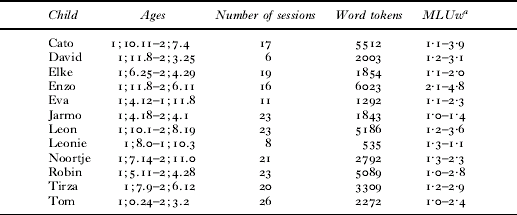
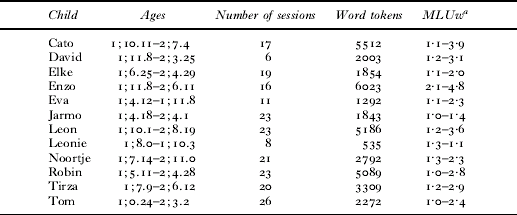
The ages of the individual children at the start and the end of the period studied and the number of observation sessions are displayed in Table 1. The table also shows the overall number of word tokens per child, and their Mean Length of Utterances counted in words (MLUw) in the first and last observation sessions.
Overview of the CLPF database
a: Mean Length of Utterance in words in the first and final session.
Identification of epenthesis
In a first parse of the data, we identified the instances of epenthesis on the basis of the original transcripts (temporarily neglecting the ambiguity problem described in the Introduction). A case of epenthesis was defined as a (sequence of) syllable(s) in the child's word that could not be mapped onto any syllable in the target word. In all, 1621 instances fitted this definition: 376 cases (23%) were instances of vowel insertion into a consonant cluster. In 48 cases (3%) the additional syllable resulted from the vocalization of a liquid, as in (4), which reflects a common phenomenon in adult Dutch (Booij, Reference Booij1995). We excluded these instances from further analysis since Fikkert's hypothesis did not target them. Eventually 1197 cases of epenthesis were left.
(4a) keer (/ˈker/, ‘time’) → [ˈkejɑ] (Leon, 1 ; 10.1)
(4b) wil (/ˈwɪl/, ‘want’) → [ˈfewə] (Noortje, 2 ; 11.0)
Analysis of rhythmic effect
The rhythmic effect of each instance of epenthesis was categorized as either ‘optimizing’ or ‘non-optimizing’ by comparing (1) the rhythm of the child's word without the added syllables with (2) the rhythm of the child's word with the added syllables.Footnote 4 In (5a) for instance, we compared the rhythm of [ˈkɑˈmeu], i.e. SS (‘S’ stands for a syllable with primary stress, ‘s’ stands for a syllable with secondary stress, ‘w’ stands for weak syllable), with the rhythm of [ˈkɑnəˈmeu], i.e. SwS. Three instances were removed from this analysis since their phonetic transcription lacked a rhythmic annotation.
Optimizing
In the examples in (5), the rhythm changes in accordance with Fikkert's predictions: epenthesis results in a bisyllabic trochee, and hence ‘optimizes’ the word's prosodic structure. Utterances (5a–5b) are prototypical examples of weak syllable insertions (5a: SS→SwS; 5b: S→Sw). In (5c) a strong syllable instead of a weak one is inserted (Sww→swSw). As a result, the word's last syllable is not unfooted anymore, but fills the weak branch of a bisyllabic trochee. Such cases are not mentioned in Fikkert (Reference Fikkert1994), but they may be regarded as alternative ways of creating a bisyllabic trochee by means of epenthesis.
(5a) kameel (/kaˈmel/, camel) → [ˈkɑnəˈmeu] (Tirza, 2 ; 11.0)
(5b) trein (/ˈtrɛin/, ‘train’) → [ˈtɛinə] (Noortje, 2 ; 5.23)
(5c) schommelen (/ˈsxɔmələ/, ‘swing-INF’) → [ˌfuməˈmɛijə] (Robin, 1 ; 11.20)
Non-optimizing
Other instances of epenthesis result in an additional unfooted syllable, as in (6a–6b). Example (6c) contains a string of extra unfooted syllables. In (6d) the new syllable constitutes an additional monosyllabic trochee.
(6a) brug (/ˈbrʌχ/, ‘bridge’) → [buˈbuχ] (David, 1 ; 11.7)
(6b) dierentuin (/ˈdirəˌtœyn/, ‘zoo’) → [ˈtirəsiˌtein] (Leon, 2 ; 4.15)
(6c) locomotief (/ˌlokomoˈtif/, ‘locomotive) → [ˈpopənənəˈpufˈpif] (Robin, 2 ; 1.25)
(6d) paard (/ˈpart/, ‘horse’) → [ˈpraˈpat] (David, 2 ; 2.28)
Identification of ambiguous cases
Ambiguous instances of epenthesis were identified by means of two tests: (1) Is the added syllable really targetless? (2) Does the added syllable belong to this particular word?
Is the added syllable really targetless? This question aims at identifying the extra syllables that can be considered as (an attempt at) a suffix.
(7a) [ˈtæinə] [ˈtæinə] (Robin, 1;6.22)/ˈtrɛin/ /ˈtrɛintjə/ or /ˈtrɛinə/trein treintje or treinen‘train’ ‘train-DIM’ or ‘train-PL’
(7b) [ˈxotə ˈfisˌtʌyx] [ˈxotə ˈfisˌtʌyx (Robin, 2;4.28)/ˈxrot ˈflixˌtʌyx/ /ˌxrotə ˈflixˌtʌyx/groot vliegtuig grote vliegtuig‘big airplane’ ‘big-DECL airplane’
(7c) [ˈkɛikə] [ˈkɛikə] (Noortje, 2;9.12)/ˈkɛik/ /ˈkɛikə/kijk kijken‘look’ ‘look-INF’
This type of ambiguity frequently occurs in nouns to which a vowel, often a schwa, was added at the end, as in (7a). The schwa possibly represents an attempt at the most frequent allomorph of the Dutch plural suffix /ə/, or a simplified attempt at one of the diminutive suffix allomorphs (/jə/, /tjə/, /pjə/, /kjə/, /ətjə/). These alternative interpretations are indicated at the right of the original analysis in (7a). Attached to an adjective, the schwa possibly represents an attempt at the declination suffix /ə/, as in (7b). In the case of verbs, the schwa could represent the most common allomorph of the infinitive and plural suffix /ə/, as in (7c). These reinterpretations were also applied to extra full vowels at the word end, and not restricted to extra schwas.
We took into account each child's level of morphological proficiency: as long as we did not have independent evidence that a child used a particular suffix, we did not consider that suffix as a possible interpretation in case of epenthesis. However, most children already used these suffixes before the time that the ambiguities occurred. This does not mean that their usage was always adultlike: they overgeneralized the adjective's declination suffix, and tended to produce verbs as infinitives. Hence, we did not take into account grammaticality in order to exclude a morphological interpretation of the ambiguous instances.
It might be argued that situational cues could have helped us in distinguishing ambiguous from unambiguous cases of epenthesis in nouns. For instance, contextual information could have provided cues as to whether the child intended a singular noun or a plural one. However in the case of diminutives, contextual information is hardly useful, since the non-compulsory diminutive marking has no clear denotative meaning: Dutch-speaking adults use diminutivized nouns abundantly, apparently for pragmatic reasons. Children adopt this usage from very early on (Gillis, Reference Gillis and Dressler1997). Hence, we decided to categorize all instances of extra vowels at the end of a noun as ambiguous.
Finally, we identified ambiguous cases such as the one in (8). In this example the word with the epenthetic vowel is an existing Dutch word, ikke, which is the emphatic variant of the Dutch first person singular nominative pronoun. Ikke is common in child language (De Houwer, Reference De Houwer1990).
(8) [ˈɪkə ˈda ˈsɪtə] [ˈɪkə ˈda ˈsɪtə] (Robin, 1 ; 11.20)[ˈɪkə ˈdar ˈsɪtə] [ˈɪkə ˈdar ˈsɪtə]ik daar zitten ikke daar zitten‘I there sit-INF’ ‘I there sit-INF’
Does the added syllable belong to a word? In instances such as (9a–9b), the extra syllable can be considered as a different word that is appended to its host through cliticization. In (9a) the extra schwa possibly stands for an article or a filler; (9b) may contain a filler.
(9a) [t ˈɪsə ˈfup] [t ˈɪs ə ˈfup] (Robin, 2 ; 0.4)het is soep het is de/filler soep‘it is soup’ ‘it is the/filler soup’
(9b) [ˈmɑx ɪ ˈoxə ˈmi] [ˈmɑx ɪ ˈox ə ˈmi] (Robin, 2 ; 2.27)mag hij ook mee mag hij ook filler mee‘may he also come-with’ ‘may he also filler come-with’
Fillers appear frequently in Dutch child language (Wijnen et al., Reference Wijnen, Krikhaar and den Os1994). So far, Dutch children's use of fillers has not been investigated in depth, but studies in other languages suggest that they are inserted for rhythmic, pragmatic, and morphosyntactic purposes (Peters, Reference Peters2001). This broad array of functions entails that fillers can in principle appear everywhere. Hence, this interpretation is difficult to exclude in the case of a word-final or word-initial epenthetic vowel. Consequently, whenever a vowel was attached at the boundaries of a word, we categorized this instance of epenthesis as ‘ambiguous’.
Unambiguous cases of epenthesis were defined as those instances where the added material was embedded in the word, as in (10). In the child's pronunciation of /ˈzik/ in (10a), the extra segments [jə] are inserted in front of the word's coda consonant /k/. Similarly, segments are inserted after the word onset in (10b). Example (10c) contains an additional syllable that repeats one of the word's original syllables.
(10a) ziek (/ˈzik/, ‘ill’) → [ˈsijək] (Noortje, 2 ; 8.29)
(10b) kijk (/ˈkɛik/, ‘look’) → [ˈkɑhɑik] (Noortje, 2 ; 7.2)
(10c) lezen (/ˈlezə/, ‘read-INF’) → [lɪˈlesə] (Tirza, 2 ; 2.25)
Reliability
The identification of ambiguous instances of epenthesis was performed by the first author of this study. In order to determine the reliability of her decisions, a second annotator processed a random selection of 26% of all instances. The two annotators yielded an agreement of 90·1%, suggesting good inter-rater reliability.
RESULTS
The entire corpus contains 1197 instances of epenthesis, of which the majority is ambiguous (n=1064). In 455 cases, the added syllable is not necessarily targetless. In 609 cases, it does not necessarily belong to the word. This means that the problem of ambiguity is large and important. We will now investigate its impact on the frequency of epenthesis and its rhythmic outcome.
The frequency of epenthesis
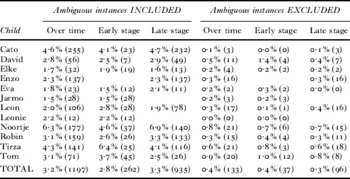
Is epenthesis still a frequent phonological process, as Fikkert described it, if we take into account the difference between ambiguous and unambiguous instances? For each child, we computed its frequency relative to the total number of word tokens over time. The second and fifth column of Table 2 display the resulting frequency rates. The frequencies in the second column are based on an analysis of the original transcripts (including both ambiguous and unambiguous instances), whereas the frequencies in the fifth column are based on the unambiguous instances only. In each case, the absolute number of instances is indicated in parentheses. The second column in Table 2 shows that the incidence of epenthesis lies between 1·5% and 6·3%. This is a moderate frequency rate compared to other phonological processes in Dutch-speaking two-year-olds’ speech (Beers, Reference Beers1995). However, the frequency of the unambiguous instances displayed in the fifth column of Table 2 is much lower, between 0% and 0·9%.
The frequency of epenthesis relative to the total number of word tokens

In order to investigate if epenthesis occurs more frequently early in development, as suggested by Fikkert (Reference Fikkert1994), we divided the entire observation period in two parts, on the basis of the children's general language development as measured by their MLUw. For each child, an ‘early stage’ and a ‘late stage’ was identified with MLUw=1·5 as the dividing point. This comparison was possible for all children except for Enzo, who had already a MLUw above 1·5 at the very start, and for Leonie and Jarmo because they did not reach that MLUw level. Table 2 displays the frequency of epenthesis in the ‘early stage’ and the ‘late stage’. The third and fourth column display the frequencies of all cases, including the ambiguous ones, the sixth and seventh column display the frequencies of the unambiguous instances only. Whether or not the ambiguous instances are included, the frequency of epenthesis is not systematically higher in the early sessions (ambiguous instances included: t(8)=0·03, p=0·98; ambiguous instances excluded: t(8)=1·28, p=0·24). Thus, we have no evidence that the children produced more instances of epenthesis early in development.
The rhythmic outcome of epenthesis
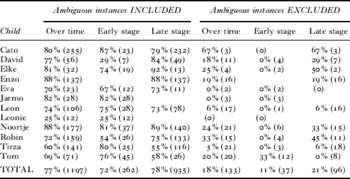
What is the empirical strength of the rhythmic explanation of epenthesis if we distinguish ambiguous from unambiguous instances? If epenthesis really is a means of creating bisyllabic trochees, we expect to observe a rhythmic effect in the unambiguous cases in the first place. Table 3 provides the percentage of optimizations per child. The total number of instances of epenthesis is indicated in parentheses. Similar to Table 2, Table 3 contains two parts: the first part provides the results on the basis of the original transcripts including both ambiguous and unambiguous instances; the second part takes only the unambiguous instances into account. For each part, the percentage of optimizations is measured across sessions, in the ‘early stage’ (MLUw <1·5), and in the ‘late stage’ (MLUw ⩾1·5).
Following the analysis of the original transcripts (the second column of Table 3), all children except Leonie have a percentage of optimizations above 60% over time. Across children, the percentage of optimizations is 77%. But when the ambiguous cases of epenthesis are excluded (in the fifth column), all percentages are below 40%, except in Cato's speech (67%, but based on three productions only). Across children, the percentage of optimizations is now only 18% over time. These two results are rather discordant: epenthesis predominantly leads to rhythmic optimization only when the ambiguous instances are included in the analysis. When only the unambiguous cases of epenthesis remain, rhythmic optimizations are infrequent.
The frequency of rhythmic optimizations

According to Fikkert (Reference Fikkert1994), the rhythmic function of epenthesis is especially clear in the early stages of prosodic development, and hence we expect more optimizations early in development. However, the analysis including ambiguous and unambiguous cases (proportions displayed in the third and fourth column of Table 3) does not reveal a significant difference between the ‘early’ and the ‘late stage’ (t(8)=0·77, p=0·47). Unfortunately, after exclusion of the ambiguous instances, we have insufficient data to compare the two stages per child (the sixth and seventh column in Table 3). But across children, we do not observe much more optimizations in the early sessions: the percentages of optimizations are below 25%, in the early as well as in the late stage.
The results indicate that the inclusion or exclusion of ambiguous instances crucially affects the outcome of the rhythmic analysis. When ambiguous instances are included, epenthesis often results in a bisyllabic trochee. But the analysis of unambiguous instances reveals only a very low percentage of rhythmic optimizations. This discrepancy weakens the empirical base for the rhythmic optimization hypothesis: if epenthesis were a rhythmic process, it is expected to show up in the unambiguous instances in the first place. Moreover, the data do not support the claim that rhythmic optimization is typical for an early stage in development since the frequencies in the early sessions are not really higher than the frequencies in the later ones.
The source of the difference between ambiguous and unambiguous cases
Why do the ambiguous instances of epenthesis often result in binary trochees whereas the unambiguous ones rarely do? This rhythmic effect can be explained in an elegant way by reference to two assumptions. The first assumption holds that many of the ambiguous instances were (mis)interpreted by the original transcribers as meaningless syllables, while the children actually aimed at articles, fillers, and suffixes. The second assumption entails that children's realizations of articles, fillers, and suffixes are constrained by a rhythmic preference for binary trochees, whereas their insertions of meaningless syllables to words are not affected by this factor. From these assumptions it logically follows that those instantiations of suffixes, articles, and fillers that were misinterpreted as meaningless syllables were influenced by a preference for binary trochees. As a consequence, the entire group of ambiguous instances of epenthesis displays a rhythmic effect that cannot be found in the unambiguous instances.
As to the first assumption, there is no way to uncover with absolute certainty what the children actually aimed at when producing the ambiguous instances of epenthesis. But we have evidence to support the second assumption. A large body of research on Dutch and English child language indicates that articles and fillers tend to occur as part of a binary trochee: Dutch and English children prefer to insert fillers and articles in non-initial positions and when not adjacent to another weak syllable (Wijnen et al., Reference Wijnen, Krikhaar and den Os1994; Gerken, Reference Gerken1996; McGregor & Johnson, Reference McGregor and Johnson1997; Peters, Reference Peters2001).
In order to estimate whether this rhythmic constraint also affects the occurrence of suffixes, we tested whether monosyllabic noun suffixes are produced more often if they are part of a binary trochee, as in (11a), than if they are not, as in (11b).
(11a) ballon-en (/bɑˈlɔn ə/, ‘balloon-PL’) → [pɑˈpɔmə] (Noortje, 2 ; 8.29)
(11b) appel-tje (/ˈɑpəl tjə/, ‘apple-DIM’) → [ˈwapɑwə] (Noortje, 2 ; 5.23)
To this end we classified all common nouns in the children's speech according to the prosodic status of their base form's last syllable: strong or weak. Only nouns with a strong final syllable, such as ballon in (11a), are optimized by appending a monosyllabic suffix. Nouns ending in a weak syllable, such as appel in (11b), become rhythmically less optimal when a monosyllabic suffix is appended. Hence, we expected more monosyllabic suffixes in words such as ballon than in words such as appel. This prediction was confirmed: the percentage of monosyllabic suffixes in the first group was 23% (out of 9320) across all children versus 6% (out of 3248) in the second group. There was no considerable variation between children in this respect.
DISCUSSION
In this note we have shown that the evidence for the rhythmic explanation of epenthesis is fragile, since it depends heavily on debatable decisions taken during transcription: most instances of epenthesis in the Dutch CLPF database can be interpreted as attempts at grammatical morphemes, and if these ambiguous cases are discarded, rhythmic optimizations are infrequent. Moreover, the data can be accounted for by a simple and solid explanation that situates the rhythmic preference for bisyllabic trochees at the level of grammatical morphemes instead of epenthetic syllables.
Our reanalysis solves the apparent conflict between Fikkert's explanation of epenthesis, and two other studies of epenthesis by Wijnen et al. (Reference Wijnen, Krikhaar and den Os1994) and Kehoe (Reference Kehoe1995). In these studies epenthesis was qualified as a rare phenomenon that could not be explained by reference to a preference for bisyllabic trochees. Our results show that methodological differences may have caused the discrepancy: our analysis of the unambiguous cases confirms Kehoe's and Wijnen's results. Furthermore, our analysis is in keeping with other studies that question the idea that English and Dutch children's word productions are shaped by a rhythmic preference for bisyllabic trochees (Kehoe, Reference Kehoe1995; Lewis et al., Reference Lewis, Antone and Johnson1999; Taelman & Gillis, Reference Taelman and Gillis2003). Together, these studies support the view that rhythmic changes in words are merely accidental by-products of phonological processes applied for different reasons and that the core domain of rhythmic preferences is the grammatical morpheme.
Finally, this study shows once more that decisions taken during transcription can affect the outcome of the analysis (Johnson, Reference Johnson, Menn and Ratner2000). In the case of Dutch child language, transcribers have to deal with a high amount of homophony in affixes, articles, and fillers and the potential confusion with epenthetic vowels. In this note, we did not choose between alternative transcriptions, but tackled the problem by identifying the ambiguous cases as such and taking their ambiguous character into account in our analysis.