This article provides an account of the aesthetic and technical ideas that underpin the music of Helmut Lachenmann, with particular reference to Accanto (1975–6) for clarinettist and orchestra, and its response to the work on which it draws, Mozart's Clarinet Concerto.Footnote 1 Although it is not the first text in English to examine these ideas, the framework of concepts within which Lachenmann's music operates remains sufficiently unfamiliar outside German-speaking circles to warrant some introduction.Footnote 2 In addition, the article argues that some of Lachenmann's values are implicitly indebted to certain concepts associated with Adorno that were in general circulation during the composer's formative years. In particular, it suggests a way in which Adorno's understanding of the language-character of music might have informed Lachenmann's relationship to tonal conventions. The article also probes the composer's central theoretical beliefs in order to show that his creative practice is richer and more multifaceted than his more dogmatic theoretical assertions would lead one to believe. On the one hand it contrasts his production-based model of listening with the perspective taken by more recent work on the sociology of music in everyday life, which considers listening to be part of a more active process of reception. On the other hand it situates his approach in the cultural and ideological cross-currents of its time and place, demonstrating especially its idiosyncratic response to contemporary performing and recording practices. Throughout the article Accanto provides a specific focus for these debates.
Musical material
When Lachenmann, born in 1935, attended Darmstadt for the first time in 1957, the post-war momentum associated with the summer courses was in full swing. After meeting Luigi Nono on this occasion, the young composer went to study with him in Venice from 1958 to 1960. Lachenmann taught for the first time at the Darmstadt Ferienkurse in 1972, and has remained closely associated with them ever since. Although his earliest published works date back to 1956, it was the music and ideas he produced from the late 1960s onwards that made him a leading musical voice in what was then West Germany.
These innovative scores were rooted in years of considerable social and cultural change. The widespread political unrest of 1968 challenged the values that had held sway since 1945, and in West Germany, as elsewhere in Europe and in the USA, the protest movements of the 1960s conflated a number of issues: American military action in Vietnam; the emergence of a youth culture linked to rock music and associated with more permissive attitudes towards sexuality; frustration with discipline and authority, whether experienced in the workplace or the family; and a questioning of the model of economic prosperity that had prevailed in the post-war years.
It was no coincidence, then, that the mid-1960s also marked the end of the first wave of post-war experimentation in music.Footnote 3 Symptomatic of this change was the fact that Karlheinz Stockhausen's composition seminar at the 1969 Darmstadt summer course was devoted to realizations of intuitive texts from his Aus den sieben Tagen. It was not until 1970, however, that a crisis arose at Darmstadt stemming from a number of causes: a loss of the momentum that had sustained the institution since 1946; a generational shift, which manifested itself in concern over the continued prominence of Stockhausen; a desire to make the courses more participatory; frustration at the power held by Ernst Thomas, who directed the courses from the early 1960s and was perceived first and foremost as an administrator; and the impact of the events of 1968 on thinking about music and politics.Footnote 4
Although Lachenmann's innovations from this time were conceived primarily in terms of musical material, there was also a sociopolitical edge to them. Air (1969), a work in which the composer's ideas about creating structure through timbre and instrumental energy were realized on an orchestral scale, features shots from starting pistols which, Rainer Nonnemann suggests, for the audience at the 1969 Frankfurt première might have brought to mind the shots fired at the student Benno Ohnesorg and the leading student activist Rudi Dutschke.Footnote 5 Significantly, Air was performed at Darmstadt in the same year as Stockhausen's Aus den sieben Tagen, which, by contrast, eschewed any sense of political engagement. The obvious polarization between the stances of the two composers no doubt aided the rise of Lachenmann at Darmstadt and increased a sense of frustration with the authority invested in Stockhausen at the institution, a sentiment which continued until his departure from the Ferienkurse in 1974, the year he made what was to be his last contribution until 1996.Footnote 6
The essay ‘Klangtypen der Neuen Musik’ (Sound-Types in the New Music) constitutes the first theoretical exposition of Lachenmann's compositional and aesthetic approach. It derives from 1966 but was revised in 1993, which explains the presence of examples from the composer's own Kontrakadenz (1971) in the version of the essay that appears in Lachenmann's collected writings, Musik als existentielle Erfahrung. ‘Klangtypen’ represents an attempt to generate a creative interaction between the serialism of the 1950s and the sonorism of the 1960s by taking the connection found in serial music between detail and form as the basis for developing structural interactions between sonorities. In an attempt to invert the serial approach of the 1950s to the structuring of sound (Strukturklang), the essay argues that sounds, or sonorities, should become the medium through which structure, or form, is achieved (Klangstruktur), so that timbral sonorities become so intrinsic to the music that they are inseparable from its conception. Music conceived according to this principle cannot, therefore, be arranged for different instrumentation: Klangstruktur specifies timbre in a way that makes it part of the musical fabric. The preoccupation, though, is not so much with timbre itself as with how to create timbral processes – how to enable transitions from one energy state to another. The structure of the music is conceived in terms of the transitions between elaborations of basic gestures. The notion of Klangstruktur has remained present in all of Lachenmann's subsequent activity, even though it was quickly subjected to modification at a crucial stage in the composer's career, with the writing of such scores as temA (1968) and Pression (1970), which are strongly associated with the development of the idea of musique concrète instrumentale.
Lachenmann derived the notion of musique concrète instrumentale from Pierre Schaeffer's concept, originating in the 1940s, of musique concrète, music that deploys recorded natural or environmental sounds as opposed to sounds generated from electronic sources. Lachenmann's nomenclature, which stems from the late 1960s, differs significantly from Schaeffer's understanding of musique concrète by signifying not recorded events but a type of music in which the kinetic action required to produce instrumental sounds is paramount. It thereby draws a direct link between the mechanical production of a sound and its associated energy. In addition, then, to turning the serialist preoccupation with organizing sounds into a preference for putting structures at the disposal of sonorities, Lachenmann places a high value on the energy generated by the production of these sounds.
In the mid-1970s Lachenmann's aesthetics started to take on a different hue as he became more intrigued by the idea of engaging with the bourgeois tradition. The essay ‘Zum Problem des musikalisch Schönen heute’ (On the Problem of the Musically Beautiful Today) indicates that he was exercised by what he considered to be the unwelcome return of the bourgeois concept of beauty in the 1970s, whether in sonorism, meditative music, tonalism, or academicism.Footnote 7 This critique led him to develop a more general notion of ‘aura’ in the lecture ‘Bedingungen des Materials: Stichworte zur Praxis der Theoriebildung’ (Conditions of the Material: Notes on the Practice of Theory Building), which was delivered at the Darmstadt summer course of 1978, the year that came to be most strongly associated with the arrival of neo-Romanticism.Footnote 8 In this text the domains of tonality and tradition, which Lachenmann had previously subsumed under the bourgeois category of beauty, became linked to the idea of ‘aura’, conceived in a later essay as ‘associations, memories, magical predeterminations’.Footnote 9 In parallel with his development of this concept of ‘aura’, Lachenmann sought to extend techniques of defamiliarization so that they came to be applied not only to musical materials but also to ingrained musical conventions.
An unexpected outcome of the political turmoil of the late 1960s and early 1970s was that a new generation of composers reacted against their predecessors’ disdain for tradition.Footnote 10 This tendency became evident around 1974, as younger figures such as Ulrich Stranz, Hans-Christian von Dadelsen, Manfred Trojahn, Hans-Jürgen von Bose, Wolfgang von Schweinitz, and Detlev Müller-Siemens sought to establish connections with Germany's illustrious cultural past. The most prominent exponent of this trend was Wolfgang Rihm, who produced a string of scores with allusions to Romantic repertoire during the 1970s and who, along with Lachenmann, emerged as a leading figure in subsequent years. Like the essay ‘Zum Problem des musikalisch Schönen heute’, and like Accanto, Rihm's Third String Quartet, Im Innersten, dates from 1976. It provides an example of the sort of music that Lachenmann considered to have succumbed to the bourgeois concept of beauty.Footnote 11 What his judgement misses, however, is that Rihm's score also represents a response to the problem of established conventions, in this case using semiotic reconfiguration as a way of turning apparently stable meanings into something new. Such connections are, however, easier to find with hindsight, since some members of the neo-Romantic generation undoubtedly did pursue a beauty ideal.
Lachenmann's dispute with Hans Werner Henze in 1982 and 1983 indicates that he considered Henze to be a confirmed believer in the younger generation (that is, Rihm's generation),Footnote 12 and thereby to be aligned with a compositional approach that Lachenmann saw as dependent on outmoded conventions. The position Henze adopted in this exchange, though he did not put it in quite these terms, is that social contradictions neither completely control subjectivity nor reify the conventions of the bourgeois tradition. Nevertheless, Henze too experienced frustrations with the German tradition, as indicated by his comment about Wagner: ‘I simply cannot abide this silly and self-regarding emotionalism.’Footnote 13 Notwithstanding the personal animosity that informed this dispute, the central issue at stake was substantial: whether or not the expressive norms of bourgeois music had become an obsolete currency. The answer to this question would seem to be very much dependent on the ways in which those norms are negotiated in specific compositional contexts. Neither Henze's nor Lachenmann's approach is intrinsically likely to produce better results. In general terms, while Henze is right to assert that existing meanings can be reworked, Lachenmann is also correct to claim that a refusal of these meanings can access hitherto unenvisaged domains of expressivity.
Accanto
In keeping with these theoretical developments, Accanto (1976), for orchestra with solo clarinettist (playing a B♭ clarinet, a bass clarinet, and a further B♭ or A clarinet without mouthpiece), marked a change of direction in Lachenmann's oeuvre, whereby the concern with sonorities and actions was applied to the classical canon, in this case engaging one of the pinnacles of the repertoire, Mozart's Clarinet Concerto in A major K622. Written in the last months of his life, this was Mozart's final instrumental composition and one that, appropriately, possesses the distinctive aura of a late-style work. The Italian title of Lachenmann's score, Accanto (meaning ‘nearby’ or ‘next door’), suggests a proximity to Mozart's masterpiece; the manner in which this nearness manifests itself is that a recording of the concerto plays throughout the score's duration, often subliminally but occasionally breaking through to the foreground of the texture in a variety of ways. Lachenmann specifies that the tape should be assembled without spaces between the movements so that it always sounds when needed, and that it should contain back-to-back recordings of the concerto in order to ensure that the Mozart strand does not finish before the end of Accanto. Although his instructions are for now-outdated playback equipment, his intentions are clear: enabling ‘very sudden fade-in and fade-out effects’ and the ‘transmission of extremely short durations of tape segments’.Footnote 14 The latter are heard, though not recognized, as early as bars 2 and 3 of the score, where the tape is played in semiquaver bursts.
As a recorded object the concerto, instead of emanating from within the ensemble, occupies a space different from that of the orchestra. In this respect Accanto perhaps shows the multimedia influence of the earlier score Kontrakadenz.Footnote 15 Nevertheless, because it functions as an underlay and not as a structural template, the tape can be phased in and out of the texture as if it were another orchestral instrument. Initially the tape insertions register as something additional but unfamiliar in the orchestral texture. Then, at bar 194, we hear enough of the Mozart for it to become recognizable, at which point the underlying conceit comes into focus. Once the score has yielded its secret, the subsequent fragments of the recording are heard as semantically richer than their predecessors.
The work can be divided into four sections, as Rainer Nonnemann has suggested:Footnote 16 part 1 (bars 1–79) is characterized by wispy fragments that are gradually consolidated into scalic patterns, with much of the initial clarinet writing consisting of scarcely audible gestures; part 2 (bars 80–193) is characterized by pulsating textures, leading to a far-from-flamboyant cadenza; part 3 (bars 194–259) contains the main insertion of the Mozart, plus two others at bars 243 and 247, as well as phonetic outbursts from the solo clarinettist; and part 4 (bars 260–333) bears some resemblance to part 1 in its subdued textures and scalic passages. There is, therefore, the outline of a traditional arch form to the piece, with the breakthrough at bar 194 registering as the most remote material in the score. However, like the later Ausklang (1985) for piano with orchestra, the music does not offer the confrontations between soloist and orchestra that are expected of a concerto.
A pulsating beat, Lachenmann mentions in passing, is ‘the foundation for every familiar tonal regulation of time’.Footnote 17 When he devotes a whole section of the score to pulsating textures, therefore, he is engaging with this association, simultaneously revealing a tonal convention and alienating it, because he also describes this section in terms of ‘chopped’ time, suggesting that the music is organized according to a principle that is far removed from the more discrete metre of tonal music. The pulsating section, which is initiated by the electric guitar, enables Lachenmann to treat the whole orchestra, including the soloist, as a percussion instrument, deploying a range of string pizzicato effects and instructing wind players to slap mouthpieces with the flat of their hands. As the resulting overlapping textures thicken, Lachenmann deploys the tape in pulsed rhythmic bursts, in a manner that is governed by the surrounding textures rather than by the metric norms of Mozart's idiom.
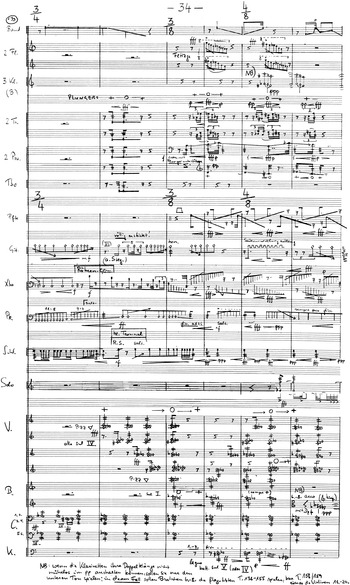
Having asserted its presence in this estranged form, the tape is then used in more extended gestures until bars 133 to 138, at which point the pulsating breaks down and more substantial stretches of the recording are played. Although these excerpts are in principle long enough to be recognizable, the tape continues to function as a sound object because in practice it contributes to an orchestral eruption, featuring extended glissandos on the piano (performed with plastic pots) and trombones (Example 1), which makes identification difficult. After this outburst, the textures thin and lead to the solo cadenza. In light of the title of the earlier score mentioned above, Kontrakadenz, it is no great surprise that the clarinet cadenza is a contra-cadenza as well. It evokes the formulae of a traditional cadenza by referring back to earlier material – the hesitant, scalic shapes heard at the end of the first section of the score – and by ending with a trill; but its quiet, tentative manner eschews the expected bravura display of instrumental virtuosity.
Lachenmann, Accanto, bars 133–8, the tape as part of a larger orchestral texture. © 1984 by Breitkopf & Härtel, Wiesbaden.

In an essay on Accanto, first given as a talk six years after the score was completed, Lachenmann wrote of removing the language context of familiar musical material and of establishing connections through a renewed ordering of its elements.Footnote 18 The ‘language-context’ (Sprachzusammenhang) of music is a phrase so redolent of what Adorno, referring to the accepted syntax of the tonal tradition, calls the ‘language-character’ (Sprachcharakter) of music – the conventions of harmony and counterpoint and their associated expressive formulae – that it is plausible to assume that Adorno's thoughts in this area had achieved general currency; indeed, it is worth dwelling on his formulation of the idea for a moment.
The notion of referring to music as a language is not, of course, unique to Adorno, though the idea does acquire a particular sense in his work because it is linked to an awareness of social meaning. What is significant about the concept, though, is that Adorno considered the loss of the ‘language-character’ of music to be a defining feature of new music. In the essay ‘Musik, Sprache und ihr Verhältnis im gegenwärtigen Komponieren’ (Music, Language, and Their Relationship in Present-Day Composition) he states: ‘The movement that is subsumed under the name of the new music could easily be represented from the perspective of its collective allergy to the primacy of similarity to language.’Footnote 19 What makes Accanto interesting in the context of Adorno's argument, therefore, is that it actively engages with the language-character issue, initially by subverting it and subsequently by re-encountering it in an estranged manner.Footnote 20
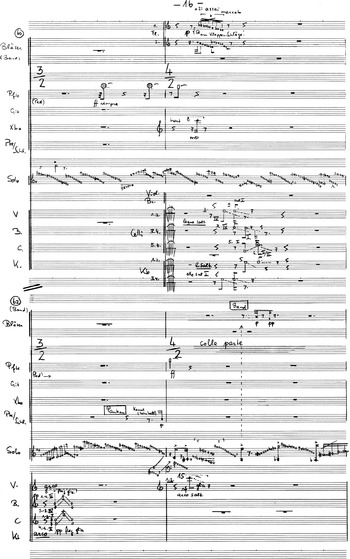
As the composer describes the piece, ‘the music, as already subverted language, gradually lets in such familiar speech clichés, in order finally to lay open its secret relationship to Mozart's work’.Footnote 21 In support of this explanation he provides examples of this seepage, drawing attention to scale patterns (starting in the solo clarinet part at bar 52, see Example 2) and triadic shapes in both the orchestra and the solo part (starting in bar 37). His approach to Mozart's concerto is aimed more at salvage than transgression; indeed he even bears witness to a sense of loss, arguing that the toneless breathing heard in a passage from the final part (bar 294, which is repeated ten times) evokes the rocking accompaniment figure at the beginning of the slow movement of Mozart's concerto, thereby enabling the prospect of a concept of beauty that is capable of recognizing our contradictions and anxiety.Footnote 22
Accanto, bars 60–63, showing scalic passages in clarinet and brief tape insertion. © 1984 by Breitkopf & Härtel, Wiesbaden.

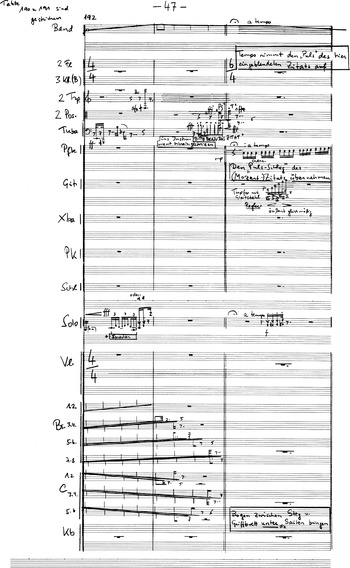
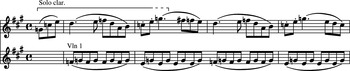
Of course the principal intertextual event occurs when Mozart's concerto makes its decisive appearance in the texture, a moment that the composer considers to be a disconcerting confrontation.Footnote 23 Put differently, it represents in the score the point of transition from the tape's deployment as a sound-object to its assumption of a hermeneutic presence. This quotation is approached by a quiet passage in the strings in which the texture is characterized by what Lachenmann calls a ‘rattling effect’, produced by pressing the bow against the string and drawing it in a sharp upward motion towards the player. In the score (bar 192) it is possible to see that the soloist has a passage derived, as Nonnenmann points out, from the C major idea that starts on the upbeat to bar 86 of Mozart's first movement (see Examples 3 and 4). There are, however, two reasons why this allusion will not be heard in performance: first, Lachenmann has reproduced the intervallic pattern so that the tonal origin of the passage can be recognized, but not the melodic shape; and second, this snippet is distorted because the composer asks for what might be called ‘instrumental Sprechstimme’ at this point.Footnote 24 A comparable idea is found in the tuba part which, just after the recording breaks through, requires the player to shout rhythmically into the instrument ‘please add the excerpt’, registering the trauma of collision.Footnote 25
Accanto, bars 192–4, the moment at which Mozart's concerto emerges. © 1984 by Breitkopf & Härtel, Wiesbaden.

Mozart, Clarinet Concerto in A major, K622, first movement, bars 85–8 with anacrusis.

In Eduard Brunner's 1977 recording it is the first episode from the rondo that is playing when the tape breaks through, a passage that provides a strong pulse for Lachenmann's percussive textures to pick out. Indeed, it seems that Lachenmann intended some decision-making, since Accanto is a few minutes shorter than the Mozart, making the instruction to record the concerto twice somewhat redundant unless it is envisaged starting the tape somewhere other than at the beginning of the concerto. Accanto takes up the tempo of the Mozart insertion, but it does so by means of a kind of pulsating that is not only timbrally removed from the concerto, but also rhythmically incongruent in its directness, harking back to the second section of the score, in which pulses are stacked in emerging and receding timbral layers. Shortly after the excerpt the solo clarinet writing becomes agitated and quite raucous, perhaps in response to competition from another concerto and another soloist.
Lachenmann's efforts to salvage Mozart through estrangement extend to what he calls the ‘customary instrumental codex’, by which he means the methods of production required for the (beautiful) sounds that instrumentalists traditionally try to achieve.Footnote 26 One such requirement for playing wind instruments in the Western tradition is that the air column is heard only in its transformation into instrumental sound, unlike in the playing of the Japanese shakahachi flute, in which escaping air is very much part of the sonority of the instrument.Footnote 27 In Lachenmann's writing for wind instruments this sound of ‘extraneous’ breath is extended to become a fundamental playing technique, with air often blown through the instrument without a pitched tone being produced at all. The solo writing in Accanto is no exception to this practice. It features a compendium of techniques, including tapping the mouthpiece to agitate the air column, playing rhythmically through the instrument without the mouthpiece, rattling the keys, playing multiphonics, and articulating phonemes through the instrument in a sort of speech.Footnote 28
Accanto and tradition
Lachenmann argues that he is concerned in Accanto less with Mozart's Clarinet Concerto itself than with what it stands for in contemporary society.Footnote 29 One of the things the score stands for, in his estimation, is a commodity fetish predicated on beautiful sounds, a view that is indebted to the concept of commodity fetishism found in Western Marxism, whereby the appearance of the object obscures the social conditions of its production.Footnote 30 Accordingly, in Accanto and other pieces Lachenmann resists the seamless, detached quality of the commodity by relating sounds directly to the actions that produced them. His intention in Accanto, then, is to attempt to recover what might be called the truth value of Mozart's concerto, which has become obscured by its institutional status. His hope, which is not unfounded, is that the fragments heard in Accanto will acquire a new vitality because they are experienced in a context that removes the gloss of what he calls the ‘oohs and aahs’.Footnote 31
The impulse underlying Lachenmann's approach to Mozart is similar to Adorno's approach to Bach, as found in the essay ‘Bach gegen seiner Liebhaber verteidigt’ (Bach Defended against His Devotees), which was published in 1951, the year after Bach's tricentenary. The critical impetus behind the essay is that of protecting Bach from those who ‘have made him into a composer for organ festivals in well-preserved Baroque towns, into ideology’.Footnote 32 By revealing Bach's music to be part of the dynamic process of modernity, rather than something immutable and universal, Adorno argues that just as Bach challenged the conventions of his own day, so modern interpretations of Bach should confront accumulated customs. In fact, Adorno goes so far as to suggest that perhaps ‘his heritage has passed on to composition, which is loyal to him in being disloyal; it calls his music by name in producing it anew.’Footnote 33 Notwithstanding the sweeping nature of this remark, not much ingenuity is required to adapt it to Lachenmann's encounter with Mozart, and even less to apply it to the Baroque dance forms used in his Tanzsuite mit Deutschlandlied, which is discussed below.
Adorno's approach to Bach achieves a more general perspective in the late essay ‘Über Tradition’ (On Tradition), the sentiments of which are equally close to Lachenmann's desire to realize the potential of bourgeois aesthetics by breaking free of largely invented traditions. As Richard Leppert comments on this text, ‘tradition is invoked as a form of reassurance that nothing has really changed in the face of the myriad and fundamental social disruptions that define late modernity’.Footnote 34 Indeed, Accanto might be heard as an attempt to find a musical form for the following remark from Adorno: ‘As soon as genuine traditional aspects of culture – significant art works of the past – are idolized as relics they degenerate into elements of an ideology which relishes the past so that the present will remain unaffected by it, at the cost of increasing narrowness and rigidity.’Footnote 35 What for some, then, would be Lachenmann's denigration of Mozart is intended precisely to ensure that the present and the past do not remain unaffected by each other. ‘Only that which inexorably denies tradition may once again retrieve it’:Footnote 36 this is the chiselled dialectic with which Adorno chooses to end his essay – and while its perspective may not apply universally, it is certainly revealing when applied to the critical practice embedded in Accanto.
Since I have drawn a number of parallels between Adorno's aesthetics and Lachenmann's approach to composition, it is worth noting that the latter was undoubtedly familiar with the former's thinking, not least because he would have met the philosopher at the Darmstadt summer courses (Adorno was present the year of Lachenmann's first visit in 1957, and both men attended in 1965 and 1966), though he is keen to assert that he is not a follower of Adorno.Footnote 37 Rather than attempting to embody Adorno's ideas in his compositions, it seems more likely that Lachenmann absorbed his central aesthetic tenets and then allowed them to inform his own encounters with musical material. Nevertheless, Adorno was not the only influence on Lachenmann's understanding of tradition. The dialectical tension generated by a concept of music that has shed its language-character but wants to remain true to the past is also engaged when Lachenmann says that he chose his teacher because ‘Nono was the only one whose path consciously involved tradition, as redefined by him’.Footnote 38
Subjectivity
Much of Lachenmann's critique of what Mozart's Clarinet Concerto stands for is predicated on the notion that the subjectivity of the concerto has become swamped by its function as a luxury item of consumption. Consider the following statement from a recent interview:
For the majority of people today, our traditional art and classical music in particular is used as this sort of magical paradise. A Mozart piano concerto might be offered as ‘music to dream by’, usable like a drug, an artificial paradise, which might help us to forget about our not-so-paradisiacal reality.Footnote 39
The problem with this stance is that it assumes that production and reception map closely onto each other, creating a self-perpetuating cycle of false consciousness. At a theoretical level, it is difficult to maintain that the two domains are capable of achieving such a good homology, and it is even harder to do so at the level of the everyday.
Instead of focusing on the ways in which music transmits subjectivity – what Tia DeNora calls the ‘grand tradition’ of understanding music socially – music sociology draws attention to the ways in which individual human subjects use music to create and shape meanings in their lives – what she calls a ‘little tradition’ attuned to the issue of social action. Building on the work of Antoine Hennion, DeNora comments: ‘while music may be, seems to be, or is, interlinked to “social” matters – patterns of cognition, styles of action, ideologies, institutional arrangements – these should not be presumed. Rather, their mechanisms of operation need to be demonstrated.’Footnote 40 Such a demonstration might, for example, discuss the ways in which people utilize music to trigger or enhance a particular mood.
Indeed, one of the participants in DeNora's influential study of music in everyday life talks about interacting with Schubert's Impromptu in G flat major, Op. 90, which is characterized by a slow, consistent broken-chord texture whose interest derives mainly from harmonic shifts intertwined with the overlaid melody line. Using information obtained from an interview, DeNora writes: ‘Lucy's listening is conducted in a quiet room. She sits in a rocking chair placed between the speakers and so is almost nestled in the, as she perceives it, calm and nurturing music.’ DeNora concludes that ‘the music's power to “soothe” derives not only from the musical “stimulus” but also from the ways in which Lucy appropriates the music, the things she brings to it’.Footnote 41 What might appear, then, to be a passive mode of listening is more of a deliberate act than it might seem. It is easy to imagine an individual interacting with the slow movement of Mozart's Clarinet Concerto in a comparable way, and thereby initiating a mode of subjectivity in a more planned manner than Lachenmann envisages – maybe even in anticipation of being lulled by the rocking accompaniment figure to which he refers.
Nevertheless, this move from the ‘social subject’ to the ‘individual subject’ brings problems of its own, for what DeNora dubs ‘the things she [Lucy] brings to it’ are very much determined by the music's semiotic codes. Even though neither Schubert nor Mozart lived to see the advent of recording technology, they deployed and shaped semiotic codes depicting calmness and intimacy; recording technology simply builds on this potential, taking it into a domestic space that permits an individual to be alone with the music.Footnote 42 What is more, these semiotic codes may well take on an ideological dimension in a particular social configuration, as is recognized by Lachenmann's insistence that when people relate to music they may well be relying on pre-formed opinions without always being aware that the process is taking place. In that Accanto is designed as a remedy for such passive consumption, few would listen to it without wondering what it is all about. At the same time, however, DeNora's approach offers the valuable corrective that when people engage creatively with music in order to understand their own lives they are not necessarily the unwitting victims of ideology. It is neither possible nor desirable to remove all the tensions between these models of musical reception, for all experiences of music touch on both dimensions. The challenge, which can often be approached only on a case-by-case basis, is to tell where the one stops and the other begins.
Part of Lachenmann's ideology critique is directed at the concept of bourgeois subjective wholeness, which is why he wants to dislodge the standard practices of what he calls ‘affect’ (expressive conventions) by placing taboos on their encoded associations.Footnote 43 Nevertheless, he remains loyal to a model of subjectivity based on interiority: a world-shaping subject that is capable of unmasking the false wholeness of the bourgeois subject. Thus he speaks in terms of essence and appearance (or false consciousness), and of authenticity and inauthenticity. In other words, he views the subject as a producer of meanings – a model that has been persistently criticized by poststructuralist approaches, which instead consider the subject to be the result of meanings, and hence itself produced by an intersection of discourses.
Even so, Lachenmann resists neat categories because he lays significant emphasis also on the idea of intensity – a mode of experience that does not sit easily with the notion of a centred subject. In an interview he comments: ‘To me, as important as beauty is the word intensity. I search for this in music.’Footnote 44 This is appropriate terminology because it is indeed possible to hear Accanto, and other scores, not so much in terms of a refusal of habit as involving fields of intensity that threaten to disperse a connecting subjectivity. The effect is well described when Deleuze and Guattari talk of ‘bands of intensity, potentials, thresholds and gradients’,Footnote 45 though it is not necessary to follow them in associating these experiences so strongly with schizophrenia. Accanto's efforts to engage processes of perception do not subscribe to one model of subjectivity; instead they offer a range of experiences that may well meander from a focus on the defiance of convention to a less centred immersion in a variety of intensities – a state that is not commensurate with the so-called ‘grand tradition’ of understanding music socially. It is appropriate, therefore, to understand Accanto as enabling a stimulating interplay between various modes of subjectivity.
There are a number of sometimes conflated strands, distributed between his work as a composer and as a theorist, involved in Lachenmann's critique of the bourgeois concept of beauty. Musical subjectivity is the principal idea, manifesting itself first in revealing the calcified condition of surviving pre-twentieth-century bourgeois values and institutions, and second in a critique of the commodity form, from which arises the aspiration for music to embody subjectivity in ways that are not predetermined. This concern with musical subjectivity in relation to the concept of beauty became linked to three historical tendencies of the 1970s: the compositional styles and values of that decade, which have already been discussed; the performance practices of the time, with their emphasis on a homogenous sound; and the associated recording conventions of the era.
Recording
Lachenmann's notion of aura and his critique of the conventions of beauty are strongly influenced by the recording industry; and although this shaping force is not specifically acknowledged in his theoretical formulations, the presence of the tape in Accanto means that it is addressed in the compositional realm. Accanto was written at the height of classical music's success with vinyl LP recording, challenging the prestige of the glossy objects manufactured by this market and the hi-fi cult that was so closely associated with its image of luxury and affluence.
There is a precedent for this attack on the record industry as an institution in Mauricio Kagel's TV film Ludwig van (1969), commissioned for the Beethoven bicentenary. In one scene the Beethoven character, who is represented by stockinged calves, buckled shoes, and gloved hands, stops at a record store during his visit to Bonn. After browsing the display of Beethoven recordings in the shop window, the character enters the store, where we witness customers listening to LPs through what look like telephone connections, with the tinny sound on the film soundtrack indicating that we too are listening diegetically to those headphones playing the Scherzo from the Ninth Symphony. The next scene offers footage from a record factory, thereby juxtaposing the élite object with its conditions of mass manufacture. Later the film includes Kagel's staging of a topical TV discussion show, during which the musicologist Heinz-Klaus Metzger argues, along the same lines as Lachenmann, that the conductor Herbert von Karajan's pursuit of beauty masks the critical impulse in Beethoven.
In Accanto the glossy recording is placed beside a live performance that is not seeking to emulate its prestige qualities at all; one, in fact, where the live clarinettist is attacking the conventions of the recording studio. This duality brings into force the interplay of acousmatic sound (that heard through speakers without access to the performers who produced the sound) and acoustic sound (that in which the sound heard is directly related to the actions of the performers on stage). It also generates a potential confrontation between what would often be the private experience of listening to a recording and the public space of the concert hall.Footnote 46 In addition, Accanto itself can, of course, be recorded, thereby bringing the score back into the acousmatic realm. However, even a recording of Accanto is unlikely to provide the sort of sit-back-and-enjoy experience in which a listener is rewarded for consuming quality music on a quality hi-fi in quality domestic surroundings, as a way of confirming individual economic achievement. Instead, a recording of Accanto is likely to function as a framing device subject to reflection, not least because the Mozart stratum becomes a recording of a recording, potentially subject to a double dose of reverb from the recording studio.
A precedent for the multimedia aspect of Accanto is found in Kontrakadenz, a large orchestral work that calls for radios tuned to VHF or shortwave, which are to be turned right down when they are not in use. The scoring for these forces is akin to that for instrumental lines: the rhythms are precise and a range of dynamics serves to fade the radios in and out of the texture. Although the interjections are often too brief to be recognizable, some of them do enable snippets of music and speech to emerge. A section in which the radios feature prominently concludes (bar 187) with a radio-style announcement from a tape of ‘Kontrakadenz von Helmut Lachenmann’, along with the names of the orchestra and the conductor for the specific performance. Cleverly switching the role of the radios from that of instruments back to that of a broadcasting medium, this announcement directly invokes the institutions of new music in particular, which at that time depended heavily on radio stations as a means of dissemination.Footnote 47 More broadly, the device transgresses the barrier between the construction and reception of music by bringing an institutional practice into the materials of the score.
Using sound reproduction technology to provide instrument-like rhythmic bursts of sound is an idea that found a direct outlet in Accanto, which also invokes the dissemination of music, only this time it is the institutional conventions associated with the production and reception of Mozart's concerto that come in for scrutiny through the category of aura.Footnote 48 An important precursor for the sound technology used in Kontrakadenz is John Cage's Imaginary Landscape no. 4 (1951), for twelve radios. Nearer in time and place, it is possible too that Accanto was influenced by the similar fade-in and fade-out effects in Stockhausen's Kurzwellen mit Beethoven – Opus 1970.
Lachenmann's critique of recording conventions is astute and aesthetically stimulating, drawing attention to the differences between performance and recording. Indeed it is understandable that a composer who makes a virtue of the connection between actions and sounds would draw attention to the dimension lost in recording, arguing that his music is ‘sometimes difficult to understand when listened to on CD without having had the experience of a live performance’.Footnote 49 Nevertheless, it is not sufficient to posit recording simply as a pale reflection of performance; one that produces a loss of ‘presence’, to use a word that brings to mind Jacques Derrida's related deconstruction of the supposed naturalness of speech versus the alleged artificiality of writing.Footnote 50 It can be more fruitfully understood as a medium which by not hiding its constructed, mechanical qualities offers a different kind of listening experience – having, as Georgina Born points out, ‘the potential to extend the ambit of human musical perception and aesthetic response’.Footnote 51 (In the case of much popular music, of course, the recording is the only trace we have of something that may well have been assembled in the studio.)
This prospect is particularly evident with regard to MP3 players, notwithstanding their tendency to encourage an individualized intensification of the consumption process. Using these machines, listeners are able to initiate circumstances, such as listening to Mozart in a tree house, that are not completely controlled by the values of the recording industry. Such situations have the potential (though Lachenmann could not have envisaged it in 1976) to enhance the perceptual experience of Mozart's music by placing it in unfamiliar surroundings, which is part of the compositional aim of Accanto.Footnote 52 In short, they can create a situation in which, as Eric Clarke argues, ‘auditory perception can be more or less at odds with the rest of the environment’.Footnote 53 Of course, such situations are created by the listener, facilitating the sort of practices described by DeNora,Footnote 54 whereas Lachenmann's aesthetic is primarily directed at the production of musical material.
The dynamic of performance and recording, and the associated emphasis on reception, bears comparison with the relationship between autonomous art and photographic reproduction, as portrayed famously by Walter Benjamin, whereby the new technology erodes the ‘aura’ of autonomous art.Footnote 55 The contours of Benjamin's argument certainly lend support to the idea that recording offers a transformed experience, rather than simply a weak reflection of the original, because it has the capacity to draw attention to detail and away from a larger sense of organic form. What is more, it would seem inconceivable that Lachenmann chose the term ‘aura’ to describe engagement with tradition without having Benjamin's famous usage of the term in mind to describe the sense of distance created by autonomous art, though in his version the composer modifies the meaning slightly in order to strengthen the notion of engagement with musical tradition.Footnote 56
Nevertheless, his deployment of Benjamin's term does not align him with the drift of Benjamin's essay, because Lachenmann implies that recordings, as commodity, actually serve to reinforce the beauty concept. Thus, for him, this form of mechanical reproduction maintains aura rather than challenging it, because the aura of autonomy transfers to the gloss of a luxury item. In making this argument he is much more closely aligned with Adorno's insistence that the conditions of production dominate reception.Footnote 57
There is a sense, then, in which the aesthetic force-field of Accanto reopened, in a different medium, the dispute between Benjamin and Adorno forty years after the publication of Benjamin's essay. On the one hand there is an inversion of expectations, because it is the acousmatic, commercially recorded tape that achieves the moment of breakthrough in Accanto, as the audience hears Mozart with new ears. On the other hand this reorientation happens because the fact that the tape is embedded in Lachenmann's extended sonorities means that the whole acoustic paraphernalia of sound production is restored to the recording.
In this way Accanto's critique of the bourgeois concept of beauty draws attention to the centrality of recording to modern perceptions of music. Although Lachenmann talks mainly in terms of the production of musical material, the problem he is tackling is also concerned with the reception of Mozart, and in this sense it is also possible to consider Accanto as a sort of critical practice in its attempt to challenge the conventions of Mozart reception.
Performance
All scores are built around the physical constraints and possibilities of their means of realization; but in the case of Lachenmann's compositions, this dimension is so much part of the music that it would make no sense to analyse a work simply as a printed entity, as indicated by his notion that composition means ‘building an instrument’.Footnote 58 Equally, these pieces cannot be detached from their conceptual contexts; it would, for example, be inconceivable to examine Accanto without considering why a chunk of Mozart's Clarinet Concerto has been placed in the middle of a timbral composition.
Many of Lachenmann's comments about performance practices, especially in relation to the concept of beauty and with regard to Accanto, relate specifically to the customs and values of the 1970s, which were epitomized in West Germany by the rich, smooth style of the Berlin Philharmonic in the era of Karajan, who was at the helm of the orchestra from 1955 until his death in 1989. This was a style of playing in which vibrato and dynamics, under the control of a steady beat, carried expression and projected the music as a luxury item. Of course, the norms of performance were heavily influenced by the recording studio (which was at the core of the Karajan project), with audiences expecting performers to reproduce the glossy engineered sound in the concert hall.
Lachenmann was not alone in expressing reservations about this approach to performance, for the reaction under the banner of what is now known as the historically informed performance movement also gathered pace between the late 1960s and the 1980s – in other words, during the formative years of Lachenmann's career, even though this development does not figure in the composer's accounts of performance style. It is worth noting that Frans Brüggen (conductor and recorder player) and Roger Norrington (conductor) were both born in 1934 – the year before Lachenmann – and Nikolaus Harnoncourt (conductor and cellist) in 1929. With a rejection of the technical advances in instrument making that enabled a more homogeneous sound, the elimination of vibrato, and a preference for fast tempos, this new style was created on the premise of historical accuracy. Despite this claim to authority, however, there was an experimental aspect to this transformation, as noted in Daniel Leech-Wilkinson's observation that ‘a new style was made by reading, thinking and playing, proceeding by trial and error until something worked’,Footnote 59 a description that could well be applied to many practices in new music.
Harnoncourt emerged in the early 1960s and became the most influential advocate of historically informed performance in the German-speaking nations. In 1971 he released the first volume of his pioneering recorded collection of Bach cantatas, completed in 1990, and in subsequent years he remained a high-profile figure. Some of the views found in his essay ‘Origin and Development of Music as Speech’ are close to those expressed by Lachenmann:
We turn to Mozart in order to savour, to be enchanted by beauty. In reviews of especially beautiful Mozart performances, we read again and again of ‘Mozartian bliss’, a frequent cliché. But if we take a closer look at works about which this cliché is used, we must ask ourselves: Why ‘Mozartian bliss’? His contemporaries describe Mozart's music as extremely rich in contrasts, vivid, stirring, heart-wrenching; qualities which were the focus of contemporary critics’ attacks on his works. How could such music be reduced, in 150 years, to ‘bliss’, to aesthetic enjoyment? […] We have discarded the attentive listening attitude, and perhaps we no longer even wish to hear what its music has to say to us.
Is our musical culture really to exhaust itself in a wish to find in music a short moment of beauty and relaxation after a busy, stressful day? Has music nothing more to offer us?Footnote 60
Lachenmann for his part comments:
Perhaps our love for a calming beauty is something that has nothing to do Mozart's work, with the subjective position of Mozart's music: namely the despairing yearning for an intact world in contrast to an outer and inner deeply troubled reality.Footnote 61
Moreover, he refers elsewhere to ‘Mozart's subversive use of the elements of Empfindsamkeit’.Footnote 62
It is striking that both Lachenmann and Harnoncourt wish to reveal an unsettling element in Mozart and to resist a passive consumption of his music governed by an ideology of beauty. The affinity between the two men's views can be seen in terms of their responding, albeit in very different practical ways, to the performing and recording conventions of the moment and the pursuit of a particular beauty ideal. It is possible that Lachenmann read Harnoncourt's ‘Origin and Development of Music as Speech’ before formulating his essay on Accanto, which was initially presented as a pre-concert talk in 1982, and then published in 1988; but Accanto itself and ‘Zum Problem des musikalisch Schönen heute’ were written before Harnoncourt's book appeared in 1982, and it seems more likely that any knowledge the composer had of Harnoncourt would have arisen from the latter's high media profile. The crucial difference between their respective approaches is that Harnoncourt's somewhat aristocratic counter-cultural tendencies are driven by a distrust of modernism and modernity, whereas Lachenmann's Marxist-influenced attitudes find in modernism an opportunity to renew perception.
Like the change in direction of new music at this time, the burgeoning of historically informed performance may have its roots in the post-1968 re-evaluation of the model of post-war reconstruction that had prevailed for the previous two decades. Certainly a parallel between contemporary music and historically informed performance was noted implicitly at an early stage by Kagel in his Music for Renaissance Instruments (1966), a timbral composition scored for early instruments which may well have influenced Lachenmann.Footnote 63 There is little doubt that historically informed performance, at least in the 1970s, and musique concrète instrumentale share a strong interest in timbre: once unfamiliar instrumental sounds are a strong signifier of the former, and extended timbres are, of course, the essence of the latter.
In this context it is interesting to note that Mozart's concerto has an intricate timbral history: written for the virtuoso Anton Stadler, it was initially conceived as a basset horn concerto in G before Mozart opted for Stadler's ‘basset clarinet’ in A (which extends the lower register of a clarinet by a major third). It was not until the 1970s that there was a substantial revival of the basset clarinet, with Hans Deinzer's recording of 1973 on a reproduction boxwood instrument representing a significant event.Footnote 64 Especially as Deinzer was also involved in the performance of new music, it would have been possible for Lachenmann to have heard that recording, which offers an alternative to the polished sound he deplored, and even to have used it in Accanto. Certainly, there is nothing to stop the piece incorporating a tape (or the digital equivalent) of a period-instrument performance, which would have the effect of rebalancing its conception and making the Mozart strand distinguished more by its tonal syntax than by its polished timbre.
Like historically informed performance, Accanto tries to strip away the accumulated traditions associated with the classical repertoire, including the expectation, nurtured by the record industry, of a smooth instrumental sound. One gets the sense, then, that Lachenmann wanted to restore the truth value (the authenticity) of Mozart's music by peeling away the layers of commodification associated with the ‘beauty concept’. In its own way historically informed performance also aimed to recover authenticity under the banner of the composer's intentions in relation to the performing conventions of the time – although the term ‘authentic performance’ has now fallen out of use, in recognition of the problems associated with authorial and textual authority.
Similarities between Accanto and historically informed performance do, nevertheless, stop at a certain point, because nobody would claim that Accanto represents the true sound of Mozart's Clarinet Concerto. In addition, Accanto seeks not to recreate the past but to use the rubble of Mozart's style to defamiliarize the present: it is not authentic Mozart we hear in Accanto, but a contemporary response to the discourses that envelope Mozart. (That said, the critical dimension of the score places it neatly, if unexpectedly, in line with Richard Taruskin's view that historically informed performance is not an authoritative version of the past but a modernist invention of the present.)Footnote 65 Finally, Accanto is firmly at odds with those aspects of historically informed performance practice which fit all too comfortably with the reactionary tendencies of a heritage industry dedicated to offering a packaged, modern version of the past.Footnote 66 Despite such caveats, Accanto and historically informed performance do nonetheless share a desire to break away from the conventions that had dominated performances of the classical canon in the 1960s and 70s.
Related scores
Even someone who does not know Mozart's Clarinet Concerto would recognize that ‘classical music’ breaks through in Accanto. However, in those other Lachenmann scores in which the idea of engaging with tradition is also a significant factor, such allusions are concealed to a greater extent, and composed into the score rather than occurring on tape. Like Accanto, these works form part of Lachenmann's idiosyncratic response to the exploration of the past that was a dominant characteristic of music in Germany during the 1970s and 80s. Nevertheless, it is noticeable that Lachenmann's reach extended beyond the Romantic repertoire that fascinated other composers at this time.
The underlying impulse of Salut für Caudwell: Musik für zwei Gitarristen (1977) is the same as that found in Accanto: to estrange familiar patterns and to develop new perceptual possibilities, in accordance with the composer's explanation of how music since Schoenberg has responded to the bourgeois tradition in terms of ‘beauty experienced as the overcoming of habit’.Footnote 67 Unlike Accanto, however, which is concerned exclusively with the bourgeois art music tradition, Salut takes in not only the guitar's classical, historical connections, but also its geographical associations. Moreover, by drawing on dance rhythms that are associated with popular and folk idioms in the guitar repertoire, the piece breaks away from the preoccupations of the post-war avant garde. The vernacular associations of the guitar are evident in the final section of the work, where brushing movements of the hand, sometimes along as well as across the strings, produce allusions to the tango, while the rapid triplet interjections at the end hint at flamenco rhythms.
Tanzsuite mit Deutschlandlied (1980), scored for orchestra and amplified string quartet, is in five parts, with seventeen sections based on various dance forms. Like Accanto, Tanzsuite engages with existing music from the classical tradition, while also following Salut für Caudwell in drawing on a wider range of musics. The main source of material in this score is Baroque dance forms, primarily those found in Bach's suites and partitas, though not exclusively, because a polka, a tarantelle, and a galop are also included. These dances appear in barely recognizable guises, and Lachenmann draws attention more to the kinetic qualities of their roots than to their accreted associations.
In the same way that Accanto unpicks a certain representation of Mozart, Tanzsuite confronts the comfortable (commodified) associations of the dance forms on which it draws, with a view to locating their lost aesthetic potential. In an interesting argument, Lachenmann considers that the shapes of these dance forms embody, consciously and unconsciously, memories of a collective security, which he also associates with concepts such as home, tradition, and yearning for childhood. By dismantling these shapes, the music attempts to reveal the illusory quality of these connections and to allow them to be experienced outside their usual context; it also intervenes in the embodied immediacy of such pre-established elements.Footnote 68
Staub (1985–7), for orchestra, shares Accanto 's ambition of confronting a heavyweight of the classical canon, in this case Beethoven's Ninth Symphony, though, as one might expect, this context is not immediately obvious. The work's Beethovenian residue is hinted at in the title, ‘dust’, which, according to Lachenmann's programme note, is intended to signify an accumulated temporal deposit.Footnote 69 Some specific allusions are to be found in the score, though these prompts are unlikely to be heard by an audience – even one familiar with the Ninth. At bars 194–6 a skeletal reference to the concluding phrase of Beethoven's first subject is penned in beneath the percussion parts, as a way of showing the conductor, presumably, how this rhythm is to be picked out in the wind and percussion. Likewise, bars 203–4 contain a comparable reference to the ‘Ode to Joy’ theme, which is used to determine the rhythmic onsets, some of which are heard as string clusters, across the whole orchestra. The aim is to set in motion the aesthetic force-field of Beethoven's symphony so that it is not reduced to a set of stagnant formulae.
Mixed strands
At times Lachenmann's notion of music as a critique of the social status quo can seem rather generalized, especially since the hermeneutics of past and present would remain something to be negotiated under even the most benign social conditions. On close inspection it becomes clear that his claim to be revealing the truth content of Mozart's concerto is far more embedded in the historical dynamics of the 1970s than is initially evident. The score engages specifically with the commercial conventions of the vinyl era; with the smoothness of tone characteristic of associated performance practices (a smoothness challenged also by the historically informed performance movement); and with the turn to the past in German music of the 1970s.
It would not, however, be fair to conclude that either Accanto or Lachenmann's scores in general derive their sustenance primarily from negation. It would be more accurate to say that Lachenmann is in favour of music creating situations that require active critical engagement: he wants to generate conditions in which performers and listeners become actively aware of their perceptual practices, perhaps challenging some established ‘language-character’ habits in the process. There is the prospect, then, not only of resisting dominant, possibly repressive, conventions but of releasing latent experiences from the same tradition. Certainly there is no denying the force of Accanto 's engagement with a particular representation of Mozart: when the extended fragment emerges, it does so with renewed intensity precisely because Lachenmann has defamiliarized its linguistic norms. However disconcerting and challenging this response to Mozart might seem, the appearance of the concerto in an unfamiliar environment does enable an enhanced awareness of what Lachenmann calls ‘existential experience’.Footnote 70Accanto represents a flexible meeting point of Lachenmann the theorist and Lachenmann the practical composer, whereby the theoretical edifice of his ideology critique is offset by a more supple compositional awareness of music's multifaceted meanings and functions. Understood in this way, Accanto relates to issues that are very much of current concern, such as recording conventions, performance practices, and modes of reception.
There is little doubt that Lachenmann pursues a production-based aesthetic that underestimates the role of critical reception, whether through interpretation of semiotic codes, through the mediation of recording technology, or through performance practice. However, investigating the aesthetic environment of Accanto reveals the extent to which its approach to compositional technique is rooted in a specific response to the musical canon and the ways it is represented by recording and performance practices – a response, moreover, that can be challenged. When Accanto is understood as a compositional mode of reception, it becomes possible to release it from the grip of a production-based aesthetics, so that it can be construed as a form of critical response to a particular set of values associated with the classical canon. For such an interpretation Accanto is stimulating precisely because it offers an unstable blend of compositional logic and critical reception.