Clostridium difficile infection (CDI) is one of the most frequent healthcare-associated infections (HAIs) in the United States;Reference Magill, Edwards and Bamberg 1 its prevalence more than doubled in US hospitals from 2000 to 2009.Reference Lucado, Gould and Elixhauser 2 Meanwhile, the US National Vital Statistics indicate that deaths due to CDI increased nearly 10-fold between 1999 and 2010, when it had become the eighteenth leading cause of death for people aged 65 and older.Reference Murphy, Xu and Kochanek 3 In addition, CDI poses a major economic burden.Reference Dubberke and Wertheimer 4 , Reference Tabak, Zilberberg, Johannes, Sun and McDonald 5
Several studies have investigated the risk for developing CDI based on various combinations of patient, treatment, and environmental factors present at the time of hospital admission or occurring after admission.Reference Dubberke, Yan and Reske 6 Factors that reflect ongoing modification in host susceptibility to CDI, such as antibiotic use, and factors that reflect ongoing risk of transmission, such as Clostridium difficile–associated disease (CDAD) pressure, may be followed throughout the entire hospital stay and, as such, may be considered as care process variables that are at least partially under the control of providers and the hospital. Such risk-predictive models that incorporate both patient and care process risks throughout the hospital stay can be useful for internal hospital quality-improvement purposes. On the other hand, there are advantages to a risk score system that restricts candidate variables to those brought in by patients when they are admitted to an acute care setting.
One purpose of on-admission risk stratification of individual patients is to assist hospitals in directing more specific, costly, or difficult to implement prevention strategies (eg, probiotics, passive immunization, or more stringent avoidance of high-risk antibiotics) to those identified as high-risk patients. Another use of an on-admission risk score is to adjust rates of hospital-onset (HO)-CDI by underlying patient risks that are beyond the control of hospitals, thereby advancing more fair inter-hospital comparisons. The objective of our study was to devise an HO-CDI risk predictive model using patient data available at the time of acute care admission only.
METHODS
Data Source
We analyzed clinical data in a Clinical Research Database from CareFusion (San Diego, CA). This data set consisted of electronically captured daily census, location, clinical, and microbiology data (eg, specimen collection date/time, location, and test results), general laboratory test results, demographics, admission sources, and other clinical and administrative data from CareFusion’s electronic HAI surveillance system MedMined® and its former MediQual® research database, which have been previously described elsewhere.Reference Tabak, Zilberberg, Johannes, Sun and McDonald 5 , Reference Brossette, Hacek and Gavin 7 – Reference Tabak, Sun, Nunez and Johannes 9 The data set used for this study was a deidentified limited data set. The study protocols were approved by the New England IRB (Wellesley, MA).
Study Cohort
Adult patients (age 18 or older) discharged from 6 acute care hospitals between January 1, 2007, and June 30, 2008, were included in this study.
Definition of HO-CDI
We defined HO-CDI among adult inpatients (≥18 years of age) as a nonduplicate positive C. difficile stool diagnostic assay (EIA toxin assay A&B) collected >48 hours after inpatient admission. For practical purposes, nonduplicate CDI was defined as no prior positive results within 14 days, according to the definition of the Centers for Disease Control and Prevention (CDC). 10 Nonrecurrent CDI cases were defined as a positive result after >8 weeks without another positive. Recurrent CDI cases were identified as the second positive result between 2 and 8 weeks following any previous positive result.Reference Tabak, Zilberberg, Johannes, Sun and McDonald 5 , Reference Zilberberg, Tabak and Sievert 8 If a patient had >1 HO-CDI incident in a single admission, it was counted only once in the model fit process because the analytic unit was hospital admission.
Candidate Predictor Variables
Candidate predictor variables included intrinsic patient risk factors that decreased the immune function, increased risk of C. difficile colorization, and exposure to antibiotics: (1) demographics (age, gender); (2) previous healthcare exposure (admitted from another acute care hospital, a skilled nursing facility, and discharge from the same hospital within 30 days); (3) CDI during previous hospital stay; and (4) potential infections in the current or previous hospitalization (identified with Nosocomial Infection Marker [NIM] or Community Infection Marker [CIM] status. A NIM or CIM is defined as a positive microbiologic specimen with a nonduplicate hospital isolate, where the specimen is collected from a single source. This algorithm-based system accounts for timing of specimen collection in relation to patient admission and location. It excludes common contaminations. For NIM, the specimen is collected 3 calendar days after admission. For CIM, the specimen is collected within 3 calendar days from admission).Reference Brossette, Hacek and Gavin 7 Other candidate predictor variables included the need for intensive care (admission to an intensive care unit (ICU), need for mechanical ventilation) and admission laboratory testing results within 24 hours (ie, serum chemistry, blood gas, cardiac markers, hematology, and coagulation parameters) as additional indicators of clinical severity. For continuous laboratory variables, we used previously published cutoff levels for the categorization.Reference Tabak, Sun, Nunez and Johannes 9 , Reference Tabak, Sun, Derby, Kurtz and Johannes 11 , Reference Tabak, Johannes and Silber 12 Patients who did not have a particular laboratory measure on admission were treated as not clinically indicated and were added to the reference group.
In previous studies, CO-CDI pressure was associated with increased risk of HO-CDI,Reference Dubberke, Yan and Reske 6 , Reference Zilberberg, Tabak and Sievert 8 one of the hospital-level risk factors adjusted by the CDC National Healthcare Safety Network (NHSN) C. difficile LabID Event Standardized Infection Ratio (SIR).Reference Dudeck, Weiner, Malpiedi, Edwards, Peterson and Sievert 13 Hence, in addition to the individual’s potential intrinsic risk as measured by the clinical presentation outlined above, we also devised 2 community-onset (CO) CDI pressure variables, defined a priori, to represent environmental risk: First, CO-CDI pressure was calculated as the rolling average number of CO-CDI 14 daysReference Dubberke, Reske and Olsen 14 prior to and 3 days after the patient’s index admission divided by the total number of hospital admissions during this period. The CO-CDI pressure only accounted for CO-CDIs in patients who were not previously discharged from the same hospital within 12 weeks. Second, all CO-CDI pressure was calculated as all CO-CDIs, including those in patients discharged from the same hospital within 12 weeks. We evaluated the distribution of both CO-CDI pressure variables in relation to the CDI rate and determined the cutoff point for categorizing these variables to simplify the model application.
Development and Validation of Predictive Model
We conducted univariate analyses of candidate variables. Variables with significant association to HO-CDI (P<.05) were included in the multivariable logistic regression analysis. We also tested our model using P<.10 for eligible candidate variables. We fit the logistic regression model using the step-wise approach, and we tested the backwards section approach. We reiterated the model-fitting process and reviewed models among the research team for this study, including a CDI expert, a gastroenterologist, an intensivist, and 2 biostatisticians. We combined multiple levels of certain general laboratory data to create a more robust estimate in the model when the coefficients were similar and the numbers were small. The final model was determined by clinical plausibility and statistical significance.Reference Hosmer and Lemeshow 15 , Reference Bursac, Gauss, Williams and Hosmer 16 We used P<.05 as a general criterion for model variable retention, but we also forced in certain variables with a P value nearly significant for the final model based on theoretical importance. We converted the model coefficients into a risk score system. Specifically, we divided each variable coefficient by the smallest coefficient in the model and rounded this ratio to the nearest integer.Reference Sullivan, Massaro and D’Agostino 17 We summed up all pertinent variable points for each patient into an aggregated HO-CDI risk score. We then validated this risk model by conducting 1,000 bootstrap simulations.Reference Efron and Tibshirani 18 The bootstrap process randomly samples with replacement the study cohort. It fits the model and generates the c-statistic for each random sample. We used the 2.5th and 97.5th percentiles as the lower and upper limits of c-statistic 95% confidence intervals from the 1,000 simulations.
To simplify the clinical application, we devised a risk score grouping that approximated a linear relationship between the HO-CDI risk and the HO-CDI rates by varying the cutoff points of the groups.
RESULTS
Patient Characteristics
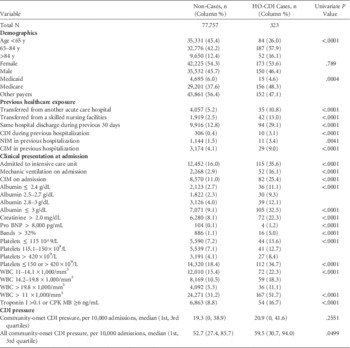
Among 78,080 adult admissions, 323 HO-CDI cases (including 310 nonrecurrent and 13 recurrent CDIs) were identified (a rate of 4.1 per 1,000 admissions, Table 1). Patients with HO-CDI were older and more likely to have had previous healthcare exposures, to have been admitted to the ICU, and to have had abnormal laboratory test results on admission.
Patient Characteristics

NOTE. CDI: Clostridium difficile infection; NIM: nosocomial infection marker; CIM: community infection marker; BNP: brain natriuretic peptide; WBC: white blood cell count.
HO-CDI Model
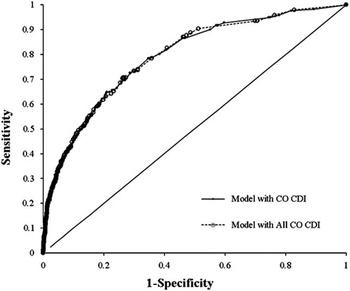
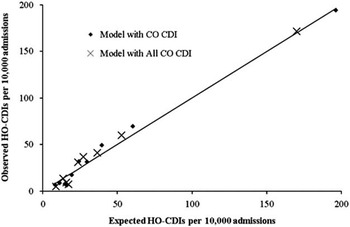
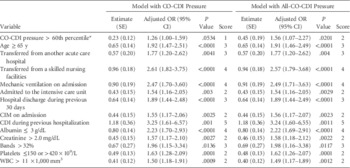
The logistic regression model yielded 14 independent predictors (Table 2). Risk factors included CO-CDI pressure above the 60th percentile, age >64 years, transfer from another hospital or skilled nursing facility, CDI during previous hospital stay, previous hospital discharge within 30 days, admission to the ICU, albumin ≤3 g/dL, creatinine >2.0 mg/dL, bands >32%, platelets ≤150 or >420×10Reference Tabak, Sun, Nunez and Johannes 9 /L, and/or white blood cell counts >11,000 mm3. The model had a c-statistic of 0.78 (95% CI, 0.76–0.81) (Figure 1). The Hosmer-Lemeshow χ2 was 12.6 (P=.13), indicating goodness of fit (Figure 2).
Receiver operating curve for HO-CDI Risk Score Models. The model with CO-CDI pressure had a c-statistic of 0.78; the model with all CO-CDI pressure had a c-statistic of 0.79.

Hosmer-Lemeshow Calibration

Hospital-Onset Clostridium difficile Infection (HO-CDI) Risk Score Model

* CO-CDI pressure, community-onset Clostridium difficile infection pressure, which was dichotomized at 60th percentile of >24.8 CO-CDI per 10,000 admissions. All-CO-CDI pressure was dichotomized at 60th percentile of >64.1 of all CO-CDI per 10,000 admissions.
NOTE. CIM, community infection marker; CDI, Clostridium difficile infection; WBC, white blood cell count.
The model that incorporated the all CO-CDI pressure yielded a slighted greater measure of association than the model using the CO-CDI pressure based only on those patients not recently discharged from the measurement hospital. The remaining variables displayed similar estimates. The model c-statistic was 0.79 and the Hosmer-Lemeshow χ2 was 15.8 (P=.03).
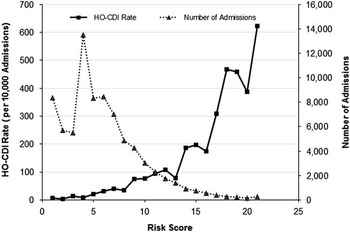
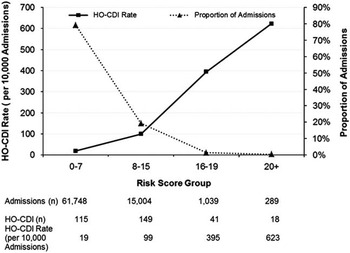
The risk score ranged from 0 to 28, with a median of 4 and an interquartile range of 2–7 for the model with CO-CDI pressure variable. The risk score distribution and corresponding admission volume are shown in Figure 3. The linearization of the risk score resulted in a nearly linear relationship of increased scores and higher observed HO-CDI rates (Figure 4). The Cochran-Armitage trending test was significant (P<.0001). For patients with risk scores between 0 and 7, the observed HO-CDI rate during hospital stay was 19 per 10,000 admissions. In contrast, for patients with a risk score of 20 or higher, the observed HO-CDI rate was 623 per 10,000 admissions. Approximately 79% of all admissions had a HO-CDI risk score ≤7; these accounted for 35% of all HO-CDI cases. Patients with a HO-CDI score ≥8 accounted for 21% of all admissions but 65% of all HO-CDI cases.
Distribution of HO-CDI risk score and corresponding admission volume. *Scores ≥20 were collapsed because of small numbers. **Model shown with CO-CDI pressure; the model with all CO-CDI pressure yielded similar distribution (data not shown).

Linearization of HO-CDI risk and corresponding proportion of admission. Model shown with CO-CDI pressure; the model with all CO-CDI pressure yielded similar distribution (data not shown).

DISCUSSION
We have developed a risk stratification score for CO-CDI based on parameters available at the time of admission. We found that the 21% of patients within the higher risk strata accounted for 65% of all HO-CDI cases. While validation of this scoring system should be performed in other hospitalized patient populations, preferably in settings with available electronic health data to allow automation, this scoring system could be an important tool for prioritizing more specialized, resource-intensive prevention strategies. If aggregated across a facility, it could also function as a risk adjustment tool for HO-CDI rates to allow interhospital comparisons that better reflect the effectiveness of intrahospital prevention efforts.
The principal epidemiologic risk factors for CDI arise from antibiotic exposure, which perturbs the lower intestinal microbiota and thus impairs an important host defense mechanism, and factors that reflect the likelihood of acquiring C. difficile such as admission to a ward with high colonization pressure.Reference Dubberke, Yan and Reske 6 Other risk factors include age and underlying illness that may be markers of decreased immunocompetence. Among the 14 factors in our risk scoring system, several may be surrogates for both increased transmission risk and likely exposure to antibiotics. For example, both admission to an ICU and mechanical ventilation may serve as dual surrogates. The ICU is a location of increased exposure to antibiotics as well as to other patients who are either colonized or infected with C. difficile; mechanical ventilation is an additional marker of disease severity that increases likely exposure to antibiotics and is associated with longer ICU stays.
The incubation period of C. difficile (ie, the period between the most recent exposure and symptomatic infection) is generally thought to be <1 week and, except for those patients previously symptomatic with CDI (who are at risk for recurrence), patients who remain asymptomatically colonized for a prolonged period with C. difficile are thought to be at paradoxically decreased, rather than increased, risk for developing symptomatic infection.Reference Kelly and Kyne 19 This decreased risk is thought to be due to a boosting of antitoxin antibodies in such asymptomatically colonized patients. Because of this phenomenon, it is likely that the association of HO-CDI with previous healthcare exposures in our model (ie, previous admission, transfer from a nursing home or outside hospital), independent of previous CDI, reflects preceding antibiotic exposure. Metagenomic studies of the lower intestinal microbiota demonstrate dysbiosis that persists for up to 6 months after relatively short single antibiotic exposures, repeated exposures, or more intense exposures lead to even more severe and persistent dysbiosis.Reference Huse, Dethlefsen, Huber, Mark Welch, Relman and Sogin 20 Meanwhile, epidemiologic studies have suggested that the risk for CDI increases 7–10-fold while patients are on antibiotics and in the month following cessation, and that the risk remains elevated 2–3-fold in the following 2 months.Reference Hensgens, Goorhuis, Dekkers and Kuijper 21
Predicting the likelihood of HO-CDI at the time of admission may help clinicians devise early preventative strategies. Although application of our risk score needs to be tested prospectively, preferably in hospitals with advanced electronic health records, restricting data requirements to patient risk factors at the time of admission simplifies risk score application. Incorporation of environmental risk factors, such as the risk of exposure to C. difficile during the entire hospital stay, would be more complex and challenging in terms of implementation, especially across institutions. Nonetheless, development of such a dynamic risk index, even to the point of daily calculation of CDI risk, could be an important future demonstration of how an advanced electronic health record contributes to risk reduction.
Dubberke et alReference Dubberke, Yan and Reske 6 showed that “CDAD pressure,” measured as each patient’s total exposure to infectious CDI patients divided by the patient’s length of stay at risk for CDI, was the most predictive factor for HO-CDI with an odds ratio of 13. We restricted the CDI pressure to community-onset only, which is more suitable for aggregating patient risk at the facility level and thus facilitates interhospital comparisons; CO-CDI unrelated to a previous hospitalization is outside the control of a given hospital and therefore is more appropriately included in facility-level risk adjustment. In the future, if a more dynamic CDI patient-focused risk model were developed that accounted for daily intrahospital exposures, it could incorporate the HO-CDI rate on a given patient ward to facilitate more precise prediction of daily transmission risk. However, including the HO-CDI rate would render the model no longer appropriate for risk adjustment at the facility level because hospital-onset infections reflect, in addition to a facilities baseline risk, the degree to which intrahospital prevention strategies have been successfully implemented.
In addition to factors that serve as surrogates for either antibiotic exposure or exposure to patients who are colonized or infected with C. difficile, our model included several factors that reflect an increased intrinsic patient risk for infection following colonization. Given the aforementioned importance of humoral immunity as a host defense, this intrinsic infection risk is likely mediated via compromising host immune-responsiveness. Previous studies have found that advanced age, hypoalbuminemia, and an elevated creatinine were associated with HO-CDI.Reference Dubberke, Yan and Reske 6 Meanwhile, abnormal platelets, elevated bands, and white blood cell counts may reflect underlying infections at other body sites that increase the likelihood of the patient becoming exposed to antibiotics.
Limitations
Our study has several limitations. First, although we used data from multiple sites, which is an improvement over a single-center study in terms of diversity of patients, the number of hospitals and number of HO-CDI cases were still relatively small. The small number of hospitals may not represent the diversity of nationwide CO-CDI pressure. This limitation may partially explain the relatively small impact of this variable in the model. More representative data are needed to further validate the HO-CDI risk score. Second, application of the HO-CDI risk score needs to be tested in a prospective setting, preferably in an automated electronic medical record environment. Third, our risk score restricted data use to electronically captured data that are widely available, such as microbial results, general laboratory test results, previous hospitalization status, and source of admissions. Future studies may test additional predictive ability when more patient clinical data at admission, such as vital signs, become more readily available through electronic automation process. Fourth, the database did not include outpatient information regarding antibiotic use prior to admission, a known risk for C. difficile. We opted to identify surrogates of potential antibiotic exposure, such as clinical severity, ICU admissions, exposure to healthcare prior to admission, and infection markers, which were found to be significant risk factors. Finally, for use as a risk identification tool, both the number of patients needed to screen, and, based upon the estimated prevention efficacy of an intervention, the number needed to treat with an intervention to prevent 1 case of HO-CDI, will be required to determine the overall cost effectiveness of the tool.
Using patient clinical parameters available at the time of admission, this HO-CDI model demonstrates good predictive ability. Although further analyses will be required to determine its feasibility and cost-effectiveness, it may have utility as a real-time early risk identification tool for HO-CDI preventive interventions. Once aggregated across a facility, it could also function to improve risk adjustment for interfacility comparisons.
Acknowledgement
The findings and conclusions in this report are those of the authors and do not necessarily represent the official position of the Centers for Disease Control and Prevention.
Financial support: No extramural funding was provided to support this analysis other than employment status of authors acknowledged. No writing assistance was provided for this manuscript.
Potential conflicts of interest: Dr McDonald has no conflict of interest to disclose.
Drs Tabak, Johannes, Sun, and Nunez are employees of CareFusion. There are no other conflicts of interest to disclose.