Introduction
Costa Rica suspended payments on the debt it owed in London in 1901, the year that marks the beginning of its democratisation process. By contrast, Nicaragua honoured its debt during the dictatorship of José Santos Zelaya (1894–1908). This article assesses why democratising Costa Rica defaulted while autocratic Nicaragua paid up. It highlights that such results are important because they are at odds with the highly influential hypothesis that democracies make better borrowers, first presented by Douglass North and Barry Weingast.Footnote 1 A number of historians have challenged this democratic-advantage hypothesis, but their work is limited to Europe and, to a lesser extent, Asia.Footnote 2 Historians of Latin America, by contrast, do not fully address the relationship between polity and state finance.Footnote 3 Hence, the existing literature cannot fully explain the association between democratisation and default in Costa Rica and autocracy and creditworthiness in Nicaragua.
Based on new archival evidence, this article shows that the combination of democratisation and a politically strong coffee elite created the conditions for default in Costa Rica. During the 1890s the legislature had voted for the end of a tax on coffee that the government had used to pay its obligations. Yet President Rafael Iglesias (1894–1902) ignored the legislators and continued raising that tax, even though coffee prices were falling. Meanwhile, the president decreed a tax exemption on the banana exports to benefit Minor Cooper Keith's United Fruit. Keith was a US investor who happened to be one of Iglesias’ cronies. Such authoritarian rule antagonised the coffee sector, radicalised the opposition and pushed Costa Rica to the edge of a civil war. A political compromise then calmed the situation and opened the way for democratisation in 1901. As part of the deal, the president accepted the result of a new legislative vote abolishing the coffee tax. Barred from raising revenue from Costa Rica's two main staples, coffee and bananas, the Treasury was left with insufficient funds to honour the sovereign debt. Overall, the outcome was fortunate for Costa Ricans but costly for its creditors in London. Matters were rather different in Nicaragua: the coffee elite was weaker and President Zelaya imposed a militarised dictatorship, ruling without legislative constraint. The tyrant continued taxing the coffee sector despite low prices, using that revenue to service the foreign debt. With a clean record, Zelaya borrowed abroad to build a modern army, the backbone of his autocratic regime.
The article makes several contributions to the literature. It proposes that the democratic-advantage hypothesis does not apply to Costa Rica and Nicaragua because their governments borrowed mostly abroad. Foreign bondholders were not represented in the Costa Rican Congress but were crucial to finance the guns that sustained Nicaragua's autocratic regime. The contrast with North and Weingast is evident, since the British Crown borrowed at home. This comparative study is also at odds with a literature that evolved from the Dependency School, according to which foreign shocks caused financial crises in Latin America.Footnote 4 Both countries were exposed to the same coffee market, so domestic conditions must have played a more important role than commodity prices in determining debt management. Finally, the article provides the most complete narrative to date of Costa Rica's and Nicaragua's sovereign debt during the first financial globalisation.
The article is divided into four sections, besides this introduction and a conclusion. The first section provides a brief literature review on polity and state finance. The second section describes the political and financial history of Costa Rica. The third section analyses the relationship between democratisation and default in that country. The fourth section addresses the political economy of Nicaragua's sovereign debt under Zelaya. The narrative of Costa Rica's experience is more detailed due to the limited availability of primary material on Zelaya's dictatorship.
The Historical Literature on Polity and Sovereign Debt
The seminal article by North and Weingast proposes that the empowering of the British Parliament following the Glorious Revolution reduced borrowing costs. Creditors and taxpayers represented in the legislature forced the executive to tax and spend responsibly, lowering the risk of default on the public debt.Footnote 5 This democratic-advantage hypothesis has been extensively debated in the literature. Garry Cox and Mark Dincecco support it with quantitative evidence.Footnote 6 Kivanç Karaman and Sevket Pamuk find that war and economic structure were as important as polity in determining taxation.Footnote 7 Stephan Epstein shows that parliaments had become powerful elsewhere in Europe before the Glorious Revolution.Footnote 8 Bartolomé Yun-Casalilla and Patrick O'Brien stress the role of centralisation of the British state.Footnote 9 David Stasavage makes the case that the rise of the Whig Party rather than democratisation reduced borrowing costs in that country.Footnote 10
That literature studies early modern Europe, where the first fiscal states appeared, taxing consistently and borrowing long-term. Thus, it does not address the first financial globalisation, from the 1870s to the First World War. During that half-century capital flew from Europe and, to a lesser extent, the United States to the rest of the globe on a scale without precedent.Footnote 11 Globalisation was particularly intense in Latin America, which received more capital than Asia and Africa combined.Footnote 12 Besides place and location, a fundamental feature of state finance differentiates early modern Europe from the peripheries of the first financial globalisation: in the former, governments borrowed mainly at home, while in the latter debt was mostly external. This distinction is relevant because domestic lenders were represented in the British Parliament, but foreign creditors did not vote or hold legislative seats in Costa Rica or Nicaragua, for example. As a consequence, the political economy of the sovereign debt described by North and Weingast may not be applicable in the first financial globalisation.
By showing that democratic Greece was a worse borrower than the Ottoman Empire, an autocracy, Ali Coşkun Tunçer has produced one of the few works that revisit the democratic-advantage hypothesis in the context of the first financial globalisation.Footnote 13 Yet his book is on international financial controls, which were committees composed by creditors that took over governments’ accounts. Hence, his results do not apply to Costa Rica and Nicaragua, where governments controlled economic policy.
Similarly, the existing literature on state finance in Latin America can hardly explain the cases of Costa Rica and Nicaragua at the turn of the twentieth century. Studying a more recent period, Barbara Stallings and Robert Kaufman argue that democratisation delayed the return of Argentina, Brazil and Peru to the world credit market in the 1980s, in contrast with Mexico, where the Partido Revolucionario Institucional (Institutional Revolutionary Party, PRI) ruled as a single party, and Pinochet's Chile, a repressive dictatorship.Footnote 14 However, historians of Latin America only tangentially address the democratic-advantage hypothesis during the first financial globalisation. William Summerhill claims that parliamentary rule protected creditors in monarchic Brazil. Yet his book addresses a different question: why creditworthiness did not deliver economic development.Footnote 15 My previous work shows that Brazil and Mexico became worse borrowers after the fall of the monarchy and the Revolution, respectively, increased popular participation. But I focused on lending negotiations rather than the financial consequences of regime change.Footnote 16 Sebastián Saiegh's article presents evidence that Argentine credit improved following the introduction of a constitutional system in 1859.Footnote 17 Nevertheless, his work does not provide a detailed description of that country's political economy to explain why a stronger legislature delivered more sustainable state finance.
The remainder of this article does that for the case of Costa Rica and Nicaragua: it presents a detailed analysis of the political economy of these countries’ sovereign debt to assess how their different polities and political groups may explain their distinct debt management. As shall become clear below, results for these countries are quite different from what Saiegh found for Argentina.
Dictatorship, Democratisation and Sovereign Debt in Costa Rica
Costa Rica was not only the first Central American democracy, it was also the most peaceful country in the isthmus. In large part, this was because post-independence Costa Rica lacked a large colonial elite, so liberals were stronger than conservatives. Moreover, a small Indigenous population did not pose a significant threat to the status quo. Facing a low risk of civil wars, the country's leaders built a relatively demilitarised state.Footnote 18 President Tomás Guardia (1870–82), himself a military officer, professionalised the army, but kept it small and apolitical.Footnote 19
Yet relative peace did not lead to democratisation automatically. Guardia was a dictator, closing Congress and staying in office for over a decade. The presidents who followed him – the liberals Próspero Fernández (1882−5) and Bernardo Soto (1885–9) – were less repressive, allowing Congress to function. Yet they ran for office as single candidates. The 1871 Constitution empowered the executive branch by limiting the period during which Congress assembled to three months. A permanent commission composed of only five deputies legislated in the remainder of the year, often allowing the government to suspend constitutional rights and interfere in the electoral process.Footnote 20 The opposition reacted to the government's authoritarian rule in the 1889 elections, in which José Rodríguez (1891–4) received the majority of votes thanks to his alliance with anti-liberal clerics. President Soto declared his fellow liberal Ascensión Esquivel victorious, precipitating a rebellion that forced the government to capitulate. The liberals avoided what could have become a civil war by accepting Rodríguez as the new president.Footnote 21 James Mahoney speculates that matters would have been solved more violently if the army had been stronger.Footnote 22
Rodríguez governed as a true dictator. Besides suspending constitutional rights and exiling rivals, he also closed Congress in 1892, after liberals had won a majority in the midterm elections. Unchecked by the legislative branch, the president increased the government's grip over the electoral process. Rodríguez's Partido Civil (Civil Party, PC) unsurprisingly won a majority in the 1894 elections, guaranteeing a more docile group of deputies after reopening Congress. Although moderate liberals formed an opposition, the government prevented several politicians identified as radicals from running.Footnote 23 Rodríguez also interfered in that year's presidential election, in which a clergy-appointed candidate won against the PC. The government declared the interference of the Catholic Church illegal, which allowed Iglesias (1894–1902), Rodríguez's son-in-law and political heir, to take office the following year.Footnote 24 In his autobiography, Iglesias acknowledged that his first election was not ‘the genuine wish of the majority’.Footnote 25
Iglesias also governed in an authoritarian manner, although he never resorted to the same degree of despotism as his predecessor. The new president suspended civil rights several times, but Congress remained open and the press was free. Iglesias passed a constitutional amendment authorising presidential re-election ahead of the 1898 election, which the liberals boycotted in protest, leaving Iglesias as the sole candidate. Political conditions deteriorated as a radical wing of the Partido Liberal (Liberal Party, PL) plotted revolts.Footnote 26 In early 1901, one year before the scheduled general elections, Iglesias called for a new Constitutional Assembly upon which he intended to impose an autocratic charter that would expand his powers and remove all restrictions on re-election. Stakes were so high that contemporaries feared for the imminent breakout of civil war. Instead of turning himself into an autocrat, however, Iglesias reached a compromise with the opposition and supported the candidature of Esquivel (1902–4), the moderate liberal who had run against Rodríguez in 1889. The president justified his political U-turn in the following words: ‘Esquivel is the person who can best synthesise the idea of a transition in Costa Rica.’Footnote 27
The presidential elections of 1901–2 mark the beginning of a long and tortuous democratisation process in Costa Rica.Footnote 28 Democratisation was in jeopardy when President Esquivel declared a state of siege and intervened in the following presidential elections, making sure that his protégé Cleto González (1906–10) would win.Footnote 29 Yet matters improved when González was in power: his administration preserved civil rights and supported reforms such as the introduction of independent electoral authorities, the abolition of the permanent commission, and the empowering of the legislature as a whole. Freer and fairer elections allowed the opposition Partido Republicano Nacional (National Republican Party, PRN) to form a parliamentary majority and elect Ricardo Jiménez (1910–14) for office.Footnote 30 Under Jiménez, the franchise was expanded to include all male adults and a new electoral law replaced the two-stage system with direct voting.Footnote 31 Elections were not perfect in the 1900s, but turnout was about 50 per cent and there were only scattered accusations of fraud.Footnote 32
According to Fabrice Lehoucq, competing political forces fostered democratisation when building compromises especially designed to avoid violence. The end of authoritarianism ‘depended upon the willingness of incumbents to exchange public office for political stability’.Footnote 33 That was precisely what Iglesias did in 1901–2: the threat of an uprising was credible enough to make him step down. The legislature played a crucial role in this arrangement, for the opposition could hold seats in Congress, maintaining its chances of eventually taking office after renouncing violence. The limited size of the army was also important, since it reduced presidents’ ability to defeat opponents by force. Finally, the relations among classes were more harmonious than elsewhere in Central America, making the elite more supportive of laws that empowered common voters.Footnote 34 As will become clear later in this article, the contrast with Nicaragua could not be more evident.
Coffee, the Gold Standard and Debt Mismanagement
Costa Rica borrowed £2.5 million in London in 1871 and 1872 to finance the building of a railway from the coffee-producing Central Valley to Limón, on the then remote Atlantic coast. Construction turned out to be costlier than expected, forcing the government to look for extra sources of revenue. The Guardia administration increased several taxes and imposed a duty on coffee exports, which had been specified in the borrowing contracts.Footnote 35 Yet that revenue was not enough to cover both the railway and the debt, and Costa Rica suspended payments on the latter.Footnote 36 With the London market closed, the government resorted to expensive domestic credit and printing money to finance its deficits.Footnote 37
In 1884 President Fernández commissioned Keith, a US contractor involved in the railway's building, to negotiate a debt settlement and a new loan in London. As payment for his services, the government granted Keith 800,000 acres of public land, which corresponded to about 7 per cent of Costa Rican territory, all of it on the Caribbean coast. Not only did the deal transform Keith into the country's largest landowner, but it also transferred to him the control of the railway and the port of Limón, then under development.Footnote 38 That was the founding stone upon which Keith would build the empire that made him the ‘regent of Costa Rica’Footnote 39 or, more broadly, the ‘uncrowned king of Central America’.Footnote 40 Keith grew rich by building a banana-exporting enclave on his vast lands, a business that eventually became the United Fruit Company, which he founded in 1899. It is worth noting that, just before arranging the deal of 1884, Keith married Cristina Castro, the daughter of the former president José María de Castro and aunt of the future president Iglesias.Footnote 41
The 1884 settlement consolidated the new debt at £2 million and established the rather generous commission of £700,000 for Keith. What is more, Costa Rica needed to pay £2.1 million as interest in arrears until 1886, when it would start to service the current interest. The government made these payments by selling shares of the newly created Costa Rica Railway Company, which Keith chartered in London. It was also agreed that the country would amortise 1 per cent of the principal of the whole debt annually, commencing in 1888.Footnote 42 Keith failed to arrange a new loan in London and the government borrowed domestically from Banco de la Unión, which eventually became Banco de Costa Rica. The arrangement involved the transfer of a 15-year monopoly on monetary emission and the privilege of managing all state transactions, which made the bank a semi-official institution. In return, Banco de Costa Rica lent to the government at 6 per cent interest, cheaper than the credit then available in the country.Footnote 43 The bank belonged to members of the coffee elite, who were thus the main domestic creditors of the state.Footnote 44
The contract limited emissions at four times the bank's capital; nonetheless, Banco de Costa Rica overprinted and the number of notes in circulation increased fourfold in 1887, when the monopoly began. That printing machine financed an almost sixfold rise in the public domestic debt from 1886 to 1892.Footnote 45 Yet it also depreciated the peso, increasing the cost of servicing the gold-denominated foreign debt. The Corporation of Foreign Bondholders (CFB) correctly understood that ‘the excessive issue of paper money is the chief cause of the financial difficulties of the Republic’ because ‘the principal difficulty [the government has] encountered [in servicing the debt] has been the high rates of exchange’.Footnote 46
Under such difficult financial conditions, Rodríguez re-imposed the tax on coffee, along the lines of the 1884 debt conversion.Footnote 47 Iglesias continued raising that duty, but he suspended payment on the London debt in the first year of his administration. The new president defended the default as a way to put Costa Rica on gold. Instead of remitting hard currency to London, the government would use the revenue from the coffee tax to amortise the domestic debt it owed to Banco de Costa Rica. The bank would then reduce the notes in circulation, strengthening the exchange rate until it was pegged to gold at a predetermined appreciated rate. Costa Rica would resume servicing the debt once the operation was completed and the country was on gold.Footnote 48
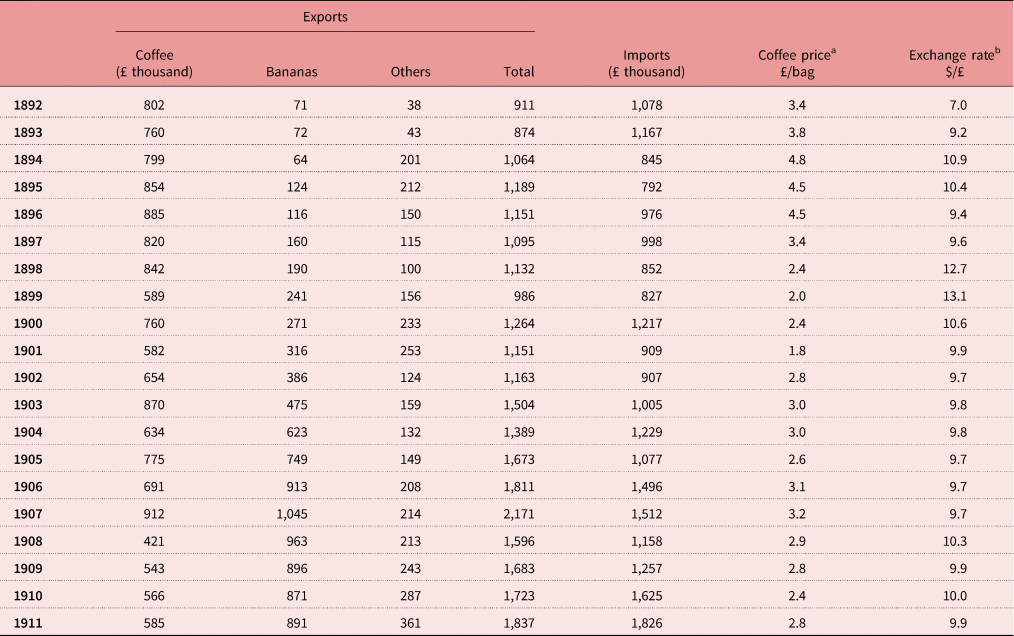
The fall in coffee prices forced Iglesias to change plans, delaying the adoption of the gold standard. Only the introduction of the colón, which replaced the peso as the country's new currency in 1896, went according to plan.Footnote 49 But the colón quickly lost value as decreasing exports reduced the inflow of foreign exchange into the country.Footnote 50 Meanwhile, the government arranged a settlement in London in 1897, before completing the monetary reform. The arrangement converted interest in arrears into new bonds worth £100,000, which the government would amortise in annual instalments of £5,000 with the revenue from the coffee tax.Footnote 51 With a clean record, Costa Rica borrowed £150,000 from Barclays in 1899 and deposited the credit in the Banco de Costa Rica, in order to allow it to withdraw money from circulation.Footnote 52 Finance Minister Eloy Truque regretted that the bank continued printing money, avoiding the pegging of the colón to gold.Footnote 53 Iglesias had to wait for the end of the bank's monopoly on monetary emissions to do so. The monetary reform finally happened in 1901 – with the approval of Congress, as will be analysed in the next section.Footnote 54
It stands out from these tortuous developments that Iglesias was particularly keen to put Costa Rica on gold: he suspended payments on the sovereign debt to achieve that outcome. It is striking that the country finally joined the gold standard in 1901, the same year it defaulted on its sovereign debt. This result is the opposite of what one would expect according to Hugh Rockoff and Michael Bordo, who argue that currencies pegged to gold were a ‘seal of approval’ that reduced the cost of credit abroad.Footnote 55 The following section will show that domestic politics explains this odd combination of gold standard and debt mismanagement. For now, it is enough to state that the adoption of the gold standard was part of a deal that made Iglesias accept democratisation, which forced the government into default.Footnote 56
The Political Economy of Coffee, Bananas and Sovereign Debt in Costa Rica
Coffee was the most important staple in Costa Rica. The inflow of foreign exchange depended on the price of that good, and, crucially for this article, the decisions of the government to tax coffee exports defined its capacity to pay the sovereign debt. As explained above, that duty first appeared in the early 1870s, in line with the contracts of the loans Costa Rica issued in London.Footnote 57 Coffee exports only became free from taxation in 1881, reflecting the political rise of liberal coffee growers. Most liberals were well-educated sons of the families that had grown rich in the coffee business: that was the case of Fernández and Soto, the presidents who ruled Costa Rica in the 1880s, as well as a significant share of congressmen.Footnote 58
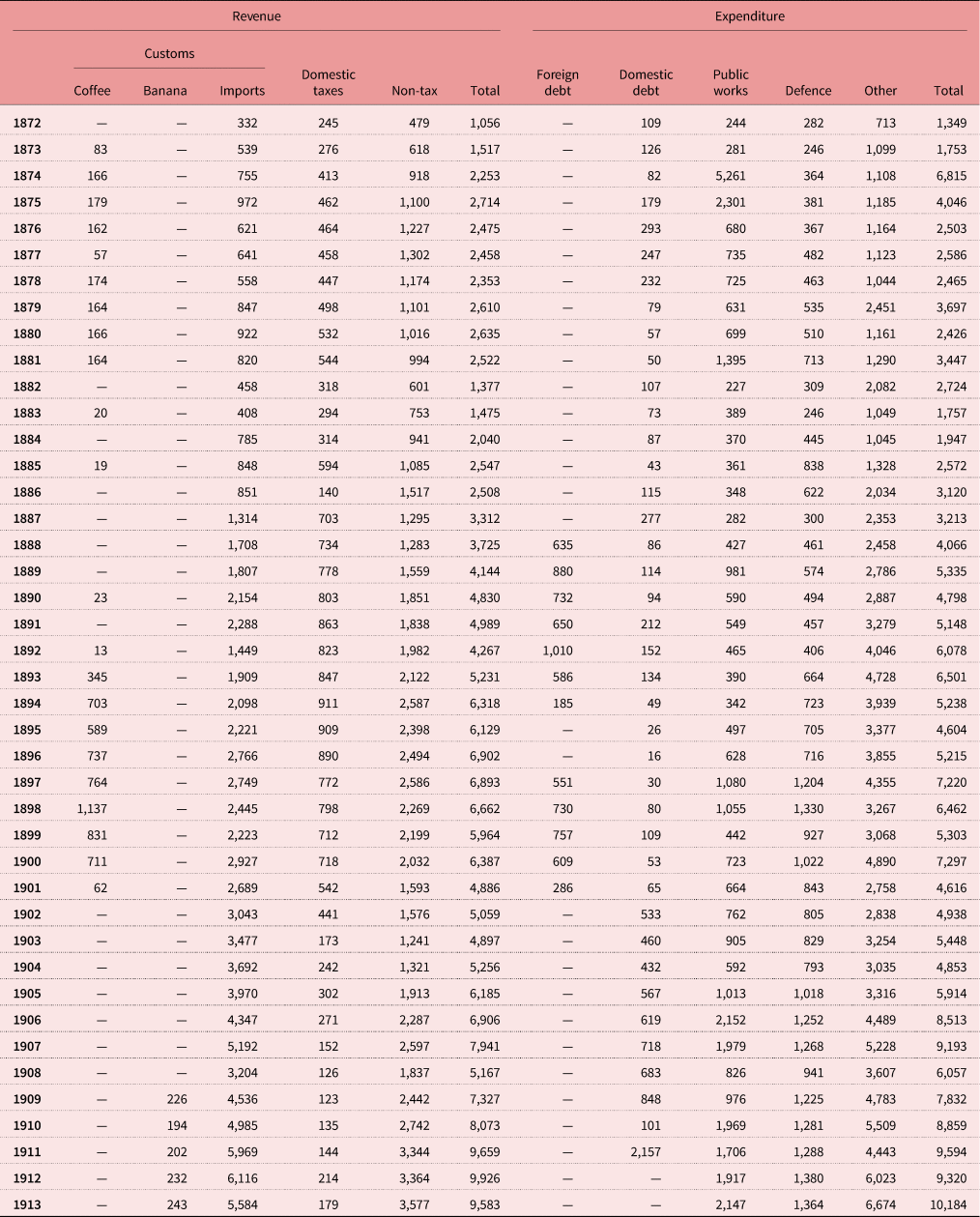
The Fernández administration raised the coffee tax, although for only two years, 1883 and 1885, collecting a remarkably low revenue.Footnote 59 These years are telling: they correspond to the period during which Keith negotiated a settlement of the sovereign debt with the London bondholders, which suggests that the government taxed coffee to signal that it was willing to honour the contracts it intended to sign. The commitment was insincere, since the tax disappeared after the creditors signed the debt conversion. Between fiscal austerity and the profitability of the coffee sector, Fernández chose the latter. Costa Rica only resumed taxing coffee in 1893, under Rodríguez, who had no business interests in coffee. A law stipulated a duty of 4 shillings per 46-kilogram bag of coffee, which was enough to make it the most important source of tax revenue in the country, larger than all domestic taxes put together.Footnote 60 Rodríguez took advantage of his unlimited powers and autocratically approved the law while Congress was closed.
Given the strong presence of the coffee sector in Congress, the dictator could not have approved the coffee tax had the legislative branch been in full operation. This conclusion is clear from the opposition to the duty after Congress reopened in 1894. Already in that year, Deputy Zacaríaz García, from the coffee-producing province of Cartago, proposed its elimination.Footnote 61 García's bill was supported by three deputies (Manuel Brenes, Ramón Loría and Antonio Segura), who were from the coffee provinces of Cartago and Alajuela.Footnote 62 The bill was opposed by another three deputies (Félix Pacheco, Víctor Orozco and Carlos Sáenz), who were members of Iglesias’ PC and had been elected in San José.Footnote 63 The coffee sector was financially and politically less important in San José than elsewhere in the Central Valley, since that province contained the capital city, which made it relatively more urbanised.Footnote 64 However, Carlos Sáenz had businesses in the coffee sector, which suggests that his partisanship was (for now, as we will see shortly) more important than his financial interests.
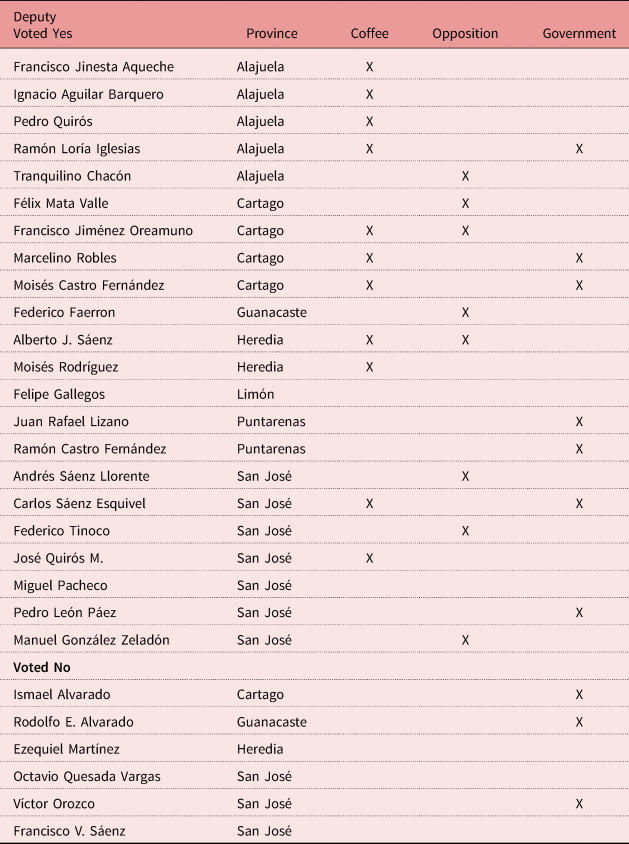
Congress discussed and this time voted for a similar bill in 1898. Coffee prices were at a record low, and the deputies approved the end of the tax by a landslide: 22 against six.Footnote 65 This time, Deputy Carlos Sáenz switched sides and voted ‘yes’, reflecting the importance of the bill to the struggling coffee sector. With the exception of two votes from Cartago and Heredia, all representatives from the coffee provinces (these plus Alajuela) voted in favour of the bill. The support of the coffee sector appears to have been unanimous: a total of 11 deputies had businesses in the coffee sector, all of whom voted ‘yes’. Party politics also played a role. Deputy Manuel González, a prominent liberal who was not in the coffee business, presented the bill.Footnote 66 It has proved possible to find links between seven deputies and the liberal opposition, which voted unanimously in favour of the bill. While the opposition voted in a single block, though, the members of the government's PC were divided: of ten deputies who belonged to that party, seven voted in favour of the bill and only three against it.Footnote 67
The few congressmen who voted ‘no’, against the bill and in favour of the coffee tax, had strong reasons to do so. Two were from or had businesses in Guanacaste (Rodolfo Alvarado and Octavio Quesada, respectively), the only province that did not produce or export coffee.Footnote 68 Guanacaste benefited from public investments, since the government was building the railway to the Pacific coast, where the province is located. Two other deputies were closely linked to Iglesias: Ismael Alvarado, the only ‘no’ vote from Cartago, invested in the banana region, where the president was popular and owned land;Footnote 69 and Orozco was a leader of the PC in the labour movement in San José.Footnote 70 The remaining votes were apparently ideological: Francisco Sáenz, from San José, had delivered speeches in favour of higher taxation not only on coffee, but also on land, bananas and railways, which made him a fiscal orthodox;Footnote 71 and Ezequiel Martínez, the only ‘no’ vote from Heredia, was a priest who had initiated his political career against anti-clerical liberal laws, which suggests that he had an anti-coffee elite bias.Footnote 72
Summing up, the bill against the coffee tax received the support not only of the entire coffee sector and the opposition, but also from the majority of Iglesias’ supporters. Nevertheless, the president vetoed the bill and continued to tax coffee. His only compromise was the suspension of taxes on the inferior class of coffee, which suffered direct competition from Brazil but only accounted for a small share of Costa Rica's output.Footnote 73 The revenue from the coffee tax fell by a quarter between 1898 and 1899, mainly due to falling prices.Footnote 74
Iglesias blocked the original bill against the coffee tax because of the negative impact it would have had on the government's capacity to service the sovereign debt. This appears in reports published by La República, a major Costa Rican newspaper that supported Iglesias.Footnote 75 La República criticised the parliamentary vote, stressing that it did not consider the sustainability of the fiscal accounts. The paper asked: ‘how will the bill replace that revenue?’Footnote 76 At the other end of the political spectrum, the newspaper La Prensa Libre supported the bill, claiming that it would ‘reduce the effects of the crisis caused by the fall in [the price of] coffee’. The article encouraged the government to cover the eventual fall in revenue by ‘using its credit abroad’.Footnote 77 A few days later, the editors of that newspaper explained that they were not in favour of further borrowing, but that the government should ‘postpone the payments of the debt abroad’.Footnote 78 In response, La República criticised that ‘arbitrary’ suggestion, stating that such action would close the international market to Costa Rican debt.Footnote 79
The interconnected issues of debt payment and coffee taxes appeared, although not as explicitly, in the speech by Deputy González, who launched a third attempt to abolish taxes on all classes of coffee. In his petition, the deputy recognised that the ‘Public Treasury is in an afflicted circumstance’ because ‘the country needs to meet strong commitments that one does not know for sure how it will honour’. However, González declared that ‘before this consideration [that is, the need to pay the debt], there is the unwavering priority of the preservation of the taxpayer's own life, and that of unblocking sources of national wealth’. This time the bill was not voted on, or at least there is no record of a vote in the archives.Footnote 80
Congress finally abolished the coffee tax in 1901, the last year of the Iglesias administration. Deputy Félix Mata presented a new bill in May 1901. There are no records of votes, but the discussion on the matter indicates a division across legislators that resembles the voting carried out three years earlier. Deputy Alberto Sáenz, a coffee exporter, supported Mata's project, which was criticised by Pacheco and Martínez.Footnote 81 Pacheco was a member of Iglesias’ party and a labour leader from San José, and Martínez was the priest who had voted against the same project in 1898.Footnote 82 Iglesias acted differently this time: he accepted the bill entirely and the abolition of the coffee tax came into effect the following month.Footnote 83
Congress had thus consistently voted against the coffee tax. Falling prices made that position even more pronounced until the government finally accepted the legislature's decision in 1901, just before Iglesias stepped down. Many changes happened at once in that crucial year. Yet one thing seems clear: the empowerment of Congress launched a sequence of events that resulted in default.
The Democratising Compromise: Coffee, Bananas, Gold and Default
Why did Iglesias accept Congress’ decision to abolish the coffee tax in 1901 and not in 1898? Why did he respect the 1901–2 presidential election and step down instead of pushing for re-election, as he had done in 1897? A chain of events suggests that the democratisation breakthrough followed a multi-dimensional compromise that led to the end of the coffee tax and, consequently, default on the London debt. In early May 1901, Congress approved a bill abolishing the coffee tax. Towards the end of May, President Iglesias threatened to impose a constitution that would grant him dictatorial powers, and Congress approved Iglesias’ project for the gold standard.Footnote 84 Iglesias apparently changed his mind and never mentioned the new constitution again; instead, in June, he ratified the parliamentary bill suspending the tax on coffee. In August, Iglesias invited the moderate liberals to form a coalition in the coming election. They formalised the alliance in September, when the government suspended payments on the sovereign debt.Footnote 85 The first-stage voting took place in November 1901, and Iglesias handed the presidency to Esquivel in May 1902.
Evidence suggests that the national compromise had two dimensions. In the first, Congress traded the adoption of the gold standard for the end of the coffee tax. The gold standard would maintain the exchange rate pegged, stopping a depreciation that had been increasing exporters’ incomes when converted to colones, partially sheltering them from falling prices abroad. Hence, by putting Costa Rica on gold, the government imposed a cost upon the coffee sector, which used its representation in Congress to push for a compensation: the end of the coffee tax. This appears in Mata's bill against the coffee tax presented to Congress in 1901, according to which:
The tax on coffee exports should have disappeared when gold was put in circulation, for while it was justified when coffee was the only important product sold for gold abroad and the only one that benefited from high rates of exchange, with costs to all other national industries, it is logical that today, as gold in circulation has solved the unbalance that used to exist, the coffee industry has borne all the burden of the tax.Footnote 86
In more simple language, the adoption of the gold standard squeezed the profit margin of coffee exporters, making them more eager to get rid of the tax, a measure that precipitated the default on the sovereign debt. Finance Minister Truque confirms the connection between the gold standard and default in the following tortuous but revealing passage, which was part of his annual address to Congress in 1901:
Until now, the service of the external debt has been paid regularly with the product of the tax on exports of coffee. Having abolished that tax, because of the conditions of that industry, the terms of exchange have been levelled out in respect to all other industries in the Republic, since, due to the circulation of gold, that same exchange has been regularised at a level that does not grant, as it did before, superior advantage to exported goods, and because that industry peremptorily demands efficient support in the crisis it faces, the service to that debt now implies a serious difficulty for the Government, at least until there is economic regeneration in the country.Footnote 87
The minister openly announced a default that would happen three months later, which makes little economic sense: he anticipated the penalties the London creditors were bound to impose on Costa Rica following the suspension of debt payments. However, that striking announcement did make sense politically: the government was keen to show its commitment to the national compromise of 1901, which depended on the abolition of the coffee tax and its financial consequence, the suspension of debt payments.
On the other side of the market, the connection between the end of the coffee tax and the suspension of payments appears in a letter the CFB sent to Iglesias, which expressed:
surprise and regret that the Government of Costa Rica should have again suspended the payment of the interest on its foreign debt […]. Your Excellency further stated that the export duties on coffee had been specially assigned as security for the service of the Foreign Debt […] the Council and Committee have therefore been astonished to hear that the coffee export duty has been abolished.Footnote 88
The question, then, is why Iglesias was so eager to put Costa Rica on gold, which brings us to the second dimension of the compromise of 1901: the relationship between the president and Keith. Without any parliamentary approval, the Iglesias administration had lent money to Keith in 1899 so that he could deal with losses caused by a hurricane in Cuba. According to Jason Colby, that loan was essential to the founding of United Fruit, which occurred a few months later.Footnote 89 Iglesias’ support for Keith's businesses became even more evident the next year, when the government bypassed Congress to grant a ten-year tax exemption on banana exports. Deputy José María Castro Fernández, a member of Iglesias’ PC, proposed the measure in parliament and the bill received the support of Deputy Felipe Gallegos, from the banana province of Limón, but, in the end, Congress rejected it. Given the importance of coffee in Costa Rica, it was not a surprise that most deputies were for the abolition of taxes on that good rather than on bananas. In an authoritarian move, Iglesias subsequently exempted banana exports from taxation by decree.Footnote 90
Not only did the government benefit Keith's banana enclave with tax breaks and loans; it also protected his railway company from a weak colón when it put Costa Rica on gold. Latin American railways imported capital goods, which meant that their costs soared every time the national currency depreciated. While the gold standard benefited Keith's railway, it was neutral for his banana exports because United Fruit hired mainly Caribbean migrants at foreign-denominated wages.Footnote 91 The adoption of the gold standard was part of a broad governmental support package for Keith's business. It seems that Iglesias rushed to implement that whole package (tax break, state credit and gold standard) between 1899 and 1901, just before stepping down. In doing so, he made sure that United Fruit would prosper before handing power to the liberals. Thus, the family and business connections between Iglesias and Keith shaped a less obvious but also important side of the compromise of 1901: it explains why Iglesias was such an ardent defender of the gold standard.
A family relative of the president, Keith thus received governmental favours. By contrast, the London creditors, most of whom probably never set foot in Costa Rica, stopped receiving payments. Keith and the British bondholders were all foreigners, but their different degrees of influence in domestic politics placed them at opposite extremes of the 1901 democratising compromise.
The Democratising Compromise: Winners and Losers
The politically powerful coffee sector lost out from the gold standard but managed to get rid of the tax on their exports. The moderate liberal opposition won the 1901 election, and the radical liberals took office later in the decade, which makes them indirect winners from the democratising compromise. Iglesias stepped down but avoided being the target of a conflict that could have escalated into civil war. Before leaving office, he approved the gold standard and guaranteed the banana tax exemption, making Keith – and indirectly Iglesias himself – another winner. The losers of that national compromise were the foreign creditors, who stopped receiving the revenue from the coffee tax in 1901.
The law that abolished the coffee tax included a 50 per cent rise across all import duties, which the government presented as a way to mitigate the fall in revenue.Footnote 92 However, the measure was too little and too late. The customs receipts from imports did increase in 1902, but the extra revenue was the equivalent of only half of the funds the government had collected from coffee in 1900, the last year it did so, and even less if one considers the previous years. Most importantly, the debt had already gone into default in 1901, before the collection of higher customs on imports.Footnote 93 The government had no intention of paying the foreign debt: domestic groups had shaped the compromise that stabilised Costa Rica politically in such a way that the government had no choice but to penalise the British bondholder. Without representation in Congress and with no credible threat apart from a financial embargo, foreign creditors were the weak players in the political economy of Costa Rican public finance. This explains why the government did not suspend payments on the domestic debt, which was held by creditors such as Banco Nacional de Costa Rica: an internal default would have alienated the economic elite of the country, putting the 1901 compromise at risk. Besides imposing a financial embargo, the London bondholders could do no more than grumble, complaining that ‘these obligations [the domestic public debt] are paid in full while the External Debt received nothing’.Footnote 94 This result suggests that the empowering of the legislature made the government prefer to honour the domestic rather than the foreign debt.Footnote 95 In other words, democratisation empowered Costa Rican creditors, who were represented in Congress, at the expense of those who owned the country's gold-denominated bonds in faraway London.
Polity and Sovereign Debt Default in Costa Rica
Costa Rica defaulted in the 1870s, during Guardia's dictatorship, and settled the debt in 1911, when the country was already a democracy. Taken at face value, these two events are consistent with North and Weingast's claim that democracies produce better borrowers than autocracies because of the legislature's capacity to limit the executive. Nevertheless, one should be careful when comparing the 1870s with the early 1910s, since world markets were depressed in the earlier and booming in the later period. What is more, the transatlantic railway system and the banana sector did not exist in Costa Rica when Guardia was in power. Financial conditions were much worse in the 1870s than in 1911, which meant that the incentives officials faced when deciding how to manage the sovereign debt varied across time. Instead of comparing these distinct periods, this article focuses on the rise of limited government in 1901–2, which is analytically important because it provides an identifiable discontinuity: the national compromise that led to the end of the coffee tax and, as a consequence, default on the sovereign debt. This article argues that a domestic political economy peculiar to Costa Rica was the force behind the outcome of democratisation combined with default.
The cleavages that divided Costa Rican politics explain why the government suspended payments in 1901. The followers of presidents Rodríguez and Iglesias opposed the liberals who governed the country in the 1880s and returned to power in the 1900s. The coffee sector was pivotal in the dispute between the two groups. Most liberals were involved in coffee, but not everyone in that sector was a liberal – as shown in the previous section, a deputy who owned coffee farms initially supported the coffee tax because he was loyal to Iglesias’ party. Matters changed as international prices slumped and, on top of that, the government taxed coffee to pay the sovereign debt and appreciated the national currency to put Costa Rica on gold. The combination of these three events (low prices, a new tax and the gold standard) created a perfect storm that antagonised the whole politically influential coffee sector against the Rodríguez−Iglesias group. The banana tax exemption strengthened the opposition even more, for it made clear that Iglesias governed in favour of Keith's interests at the expense of coffee growers. The only pressure groups that continued supporting the government were the labour movement from San José and Keith's banana enclave in Limón. The problem for Iglesias was that they elected only one deputy each, while the liberal opposition and the coffee sector formed a majority in Congress.
With nearly everyone in Congress against Iglesias, some liberals took to arms to depose the president. Violence created a new cleavage that separated those radicals from the moderate liberals, which left Iglesias with two options: he could either have (i) imposed an autocratic regime that would have given him powers to continue taxing coffee (and paying the debt), or (ii) built a compromise with the moderate liberals and the coffee sector to isolate the radicals. While the first choice could have escalated into civil war, the second choice necessarily involved the end of the coffee tax and, as a consequence, default on the sovereign debt. Fortunately for Costa Ricans (but unfortunately for their foreign creditors), the president chose the latter option. As a result, Costa Rica defaulted when it started to democratise, at odds with the democratic-advantage hypothesis proposed by North and Weingast.
Autocracy and Creditworthiness in Nicaragua
At this stage, one may ask whether Costa Rica would have continued taxing coffee and paying the foreign debt had Iglesias imposed an autocratic constitution in 1901, as he had initially envisaged. Perhaps the world market for coffee was so depressed that Iglesias would have defaulted on the debt had he become dictator, as occurred under limited government. There is no way to know what would have happened in such a counterfactual, but the case of neighbouring Nicaragua suggests that, if anything, Costa Rica would most likely have continued taxing coffee and paying the debt had it become an autocracy in the 1900s.
Several similarities united Nicaragua and Costa Rica: both were small Central American coffee exporters that depended on that commodity to pay the foreign-denominated sovereign debt. Yet they also had three major differences. Firstly, Nicaragua was a latecomer in the coffee market and the coffee elite was less influential than in Costa Rica. Groves only expanded in the last quarter of the century in the provinces of Carazo and Managua.Footnote 96 Secondly, at the same time as Costa Rica was launching its democratisation process, President Zelaya was building a militarised and expansionist regime unheard of in demilitarised Costa Rica.Footnote 97 Fiscal accounts reflect the military character of Nicaragua under Zelaya: the budget of the armed forces (the army, the navy, the police and some vaguely defined ‘war expenditure’) accounted for, on average, 38 per cent of total expenditure while the dictator was in office, against only 16 per cent in Costa Rica in the same period.Footnote 98 The final contrast refers to debt management: while Costa Rica defaulted, Nicaragua paid its foreign creditors. This section explains how autocracy conditioned this latter outcome.
The Rise and Fall of Zelaya's Belligerent Autocracy
Nicaragua was a failed state for most of the nineteenth century. In 1865, the elites of the country's main cities, León and Granada, were too divided to prevent the invasion of US mercenaries led by William Walker, who proclaimed himself president. Liberals from León at first supported the intruders but switched sides once Walker imposed laws such as the reintroduction of slavery. Aided by troops coming from other Central American republics, the Nicaraguans finally defeated the interlopers and re-established sovereignty the following year.Footnote 99 The association with Walker weakened the liberals and the conservatives ruled the country until the rise of Zelaya in 1893. The conservative administrations did introduce some reforms advocated by liberals elsewhere, such as land privatisation and the promotion of foreign trade. Yet the reforms were limited and the economy remained backward.Footnote 100
The three decades of conservative rule were more stable than the previous era, but the strife among opposing conservative groups kept politics turbulent. The progresivos were more inclined to introduce liberal reforms than the auténticos. Both groups alternated in power, excluding younger discontents generally known as the radicales, who promoted a series of revolts in the 1880s. Zelaya was a young radical when he was arrested and expelled from Nicaragua, following a putsch in 1885. Two years later the future president returned to Nicaragua burnished with a military reputation. Zelaya fought El Salvador alongside Justo Rufino Barrios, the former president of Guatemala, in the name of the reunification of Central America, a goal that he would continue to pursue in the future.Footnote 101
Zelaya was already the liberal leader of Managua when President Roberto Sacasa (1889–93), a progresivo, imposed his unconstitutional re-election. An alliance between radicales and auténticos empowered the opposition, threatening the government's stability. In an attempt to isolate his conservative foes, Sacasa offered a seat in his cabinet to Zelaya, who refused the offer and joined the revolt that deposed the president. Zelaya's troops conquered Managua and, in association with auténticos and liberals from León, subsequently conquered Granada, the progresivos’ stronghold. Zelaya took office thanks to a pact with the Leonese, according to which a conservative would be the vice-president and the new government would call for a new constitution.Footnote 102 However, once in office, Zelaya imposed martial law before the election of the Constitutional Assembly, making it entirely composed of liberals.
The 1894 Constitution included liberal principles such as civil guarantees and limited government.Footnote 103 Nevertheless, Zelaya used a series of wars to rule as a dictator. His first significant victory was the invasion of Mosquito, then a former British protectorate that was legally but not de facto part of Nicaragua.Footnote 104 Zelaya's early expansionism also included border disputes with Honduras, the first of several conflicts with other Central American countries. As Nicaraguan troops fought wars, the president imposed a state of siege to crush his domestic rivals.
Vice-President Francisco Baca attempted to depose Zelaya, who fought and defeated his former allies, the auténticos from León, in 1896. Following that victory, the president approved a new authoritarian constitution that abolished the vice-presidency, suspended the independence of municipal administrations and curtailed the capacity of the Supreme Court and Congress to limit the government.Footnote 105 Nicaragua became more autocratic as time passed. In 1902 Zelaya replaced the state of siege with a state of war, which enabled him to confiscate property and combat his domestic enemies. A new fully autocratic constitution was imposed in 1905, after which Congress merely became a device for rubber-stamping Zelaya's diktats.Footnote 106
As will be discussed in greater detail below, loans imposed on the opposition (which were essentially expropriation) and the sale of public land financed the building of infrastructure, including railways and telegraphs, which allowed Zelaya to promote his rule as an ‘honest dictatorship’.Footnote 107 The government also imported guns and ammunition and conscripted the poor by force, building an army that had no contender in Central America.Footnote 108 Under Zelaya's direct control, the armed forces persecuted political enemies, preventing revolts from escalating into civil wars. According to Benjamin Teplitz, Zelaya's ‘martial emphasis’ was a response to the fact that, in Nicaragua, ‘it was always violence, rather than a process of voting, which changed political regimes’.Footnote 109
Internationally, the Nicaraguan army was the tool that Zelaya used to pursue his most grandiose goal: the creation of a unified Central American Republic. After annexing Mosquito, the dictator occupied Honduras, where he imposed a puppet administration in the late 1890s. Nicaragua also contested its southern border and threatened to invade Costa Rica, but the fall of Iglesias, who Zelaya regarded as a personal enemy, helped to maintain peace.Footnote 110 While Costa Rica escaped its neighbour's expansionism, Nicaraguan troops invaded Honduras (again) and El Salvador in 1904. As a result, Nicaragua was at war in 12 of the 16 years during which Zelaya was in office.Footnote 111
Nicaragua's armed forces managed to supress domestic and regional enemies, but the country was especially vulnerable to the conflicting interests of great powers and Zelaya eventually clashed with the United States.Footnote 112 In an attempt to pacify Central America, the US government forced Guatemala, Honduras, El Salvador and Nicaragua to sign a treaty recognising their respective sovereignties.Footnote 113 Yet Nicaragua did not stick to the agreement: Zelaya sent troops to invade Honduras one more time in 1907.Footnote 114 The conflicts with the United States also involved financial diplomacy. Zelaya negotiated the building of an interoceanic canal with Japanese and German investors, blowing a hole in the Monroe Doctrine and challenging the monopoly power of the Panama Canal, then under construction. The Nicaraguan government borrowed in Britain in 1909, at odds with President William Taft's goal of expanding US financial influence in Central America at the expense of European capital. Secretary of State Philander Knox was especially keen to depose Zelaya: his law firm represented the Fletcher family, who had business in the country and financed a rebellion carried out by Nicaragua's conservative opposition and locals in Mosquito. The pretext for invasion happened when the Nicaraguan authorities executed two US mercenaries, who had allegedly tried to blow up an army convoy deployed to Mosquito. Taft sent gunboats in early December 1909 and, before the end of the year, Zelaya resigned, leaving the country for exile.Footnote 115
Nicaragua became a semi-US protectorate after Zelaya's fall. The dictator was followed by a succession of weak presidents who failed to preserve the country's sovereignty. The United States supported the presidency of Adolfo Díaz (1911–17), who handed the control of tax collection to US envoys in exchange for fresh loans. From then on, the government remitted increasingly large sums to creditors in the United States, which reached about half of the national budget by 1917.Footnote 116
Coffee and Sovereign Debt in Nicaragua
The history of the Nicaraguan sovereign debt starts in 1886, when the government borrowed £285,000 in London to build a railway. Zelaya's first administration defaulted on that debt after the 1894 coup, but the president arranged a settlement the following year.Footnote 117 Though underwritten by City Bank of New York, the 1886 bonds were floated in Britain, which explains why the London-based CFB negotiated the settlement. The conversion stipulated a tax on coffee exports of US$1 gold (the equivalent of £0.20) per quintal, which the government would dutifully use to service the converted debt.Footnote 118
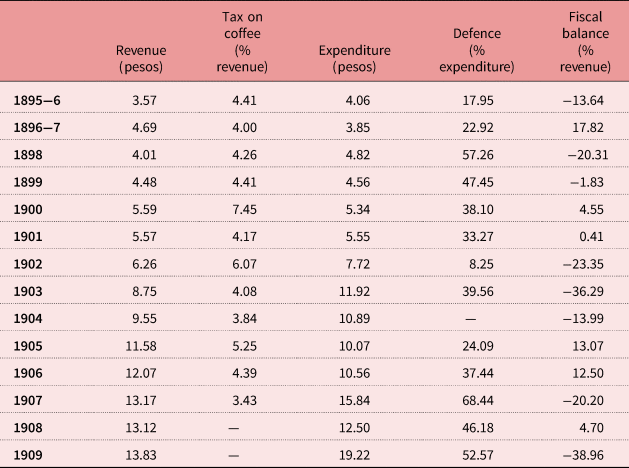
In comparison with Costa Rica, political and financial stakes were lower in Nicaragua: the coffee sector was less influential and accounted for a lower share of total government revenue, which fluctuated between 4 and 7 per cent.Footnote 119 Yet that tax still involved high political and financial costs, since prices were falling and coffee accounted for 44 per cent of national exports during the Zelaya era.Footnote 120 The effort to pay the debt under challenging conditions did not go unnoticed among foreign creditors. In 1899 the CFB stated that: ‘The decline in the price of coffee had inflicted a particularly heavy blow on Nicaragua's principal source of wealth, both public and private [but] the service of the External Debt had been paid off […] and funds [are] more than sufficient to meet all the engagements of the Government […] abroad.’Footnote 121
Three years later, when prices had stabilised at low levels, the CFB reproduced the annual presidential speech to Congress, according to which ‘the Service of the External Debt has been maintained, even when the rate of exchange reached a point disastrous to Central American trade’. The Nicaraguan peso depreciated 27 per cent vis-à-vis sterling in the second half of the 1890s.Footnote 122
Nicaragua's unending wars raised the defence budget and generated large deficits, introducing an extra layer of financial difficulties to a country that was already suffering from the depressed coffee market. The finance minister (whose name does not appear in the CFB's report) attributed the fiscal deficits of 1898 and 1899 to the ‘suppression of the revolutionary movement’.Footnote 123 In 1903 he stated that without the ‘exceptional expenditure that the War Department had been forced to incur’ because of a ‘civil war […] there would not only have been an equilibrium between the General Receipt and Expenditure, but a considerable credit balance’. The government financed the deficit with two ‘forced loans’ whose victims are unknown but whose total revenue was significant: the equivalent of 24 per cent of that year's total revenue.Footnote 124 Such forced loans were at the same time a source of revenue and a political instrument. Zelaya firstly imposed them on the elite of Granada and, when relations with the auténticos deteriorated, on the rich of León.Footnote 125 The dictator relied on forced loans while he was in power, expropriating his citizens’ wealth to finance the armed forces; but he never failed to pay what his administration owed to foreign creditors.Footnote 126
Besides punishing his foes with expropriation, Zelaya also used his autocratic powers to support allies by distributing monopolies and selling public land. Similar to forced loans, land privatisation was a source of revenue that played a political role, especially when dealing with the coffee sector. Nicaraguan coffee growers were divided along regional and political lines: those in the mountains of Managua were overall aligned with Zelaya, who was himself part of that local elite; the farmers in Carazo, by contrast, were mainly connected with the conservatives from Granada. The growers from Managua acquired cheap land in that province as well as in the northern highlands, a densely populated region where people were forced to labour on new plantations. This carrot mechanism co-opted part of the conservatives, who changed sides to benefit from land privatisation. The coffee sector expanded – at the expense of the oppressed workers – and became politically more docile to Zelaya, which helps to explain why it continued to pay taxes on exports as prices plummeted.Footnote 127 Yet a significant share of the coffee sector remained unaligned with Zelaya, creating the potential for political instability, so the dictator remained eager to militarise the society.Footnote 128
The sacrifice of servicing the external debt kept Nicaragua in the international financial market, allowing Zelaya to borrow abroad twice more to finance wars. In 1904 the government issued a loan for US$1 million in New York to pay for the war with Honduras and El Salvador. Four years later, it borrowed £1.25 million in London, the equivalent of 1.5 times that year's exports.Footnote 129 The credit financed the redemption of the 1904 bonds, the construction of a railway connecting the Nicaragua Lake to the Atlantic coast, and ‘general purposes of the government’, which most likely included expenses pending since the 1907 war and the cost of mobilising troops in 1909.Footnote 130 The banks that underwrote the loan probably did not anticipate the US intervention that would topple Zelaya. Yet Nicaragua continued honouring the debt after his regime collapsed, as mentioned in the previous section. The contrast with demilitarised and democratising Costa Rica could not be clearer, in terms of both polity and debt management.
Polity and Sovereign Debt in Nicaragua
Geopolitics created strong incentives for Zelaya to stick to the sovereign debt contracts. Wars were expensive and involved the importation of guns and ammunition, raising the government's need for foreign-denominated credit. Thus, the imposition of a financial blockade following an eventual default would have weakened Nicaragua militarily, threatening the survival of the regime. Zelaya's expansionism was also diplomatically vulnerable to foreign powers. Had the dictator succeeded in uniting Central America in a single republic, the founding of such a new state would have depended on the diplomatic blessing of both the United States and Britain, whose markets traded Nicaraguan bonds. What is more, foreign powers could have used an eventual suspension of payments as an excuse to put an end to Nicaragua's expansionism. Defaults seldom triggered military interventions, but when they did, such debt-related gunboat diplomacy was normally used on small but geopolitically important countries, such as Nicaragua.Footnote 131 Therefore, Zelaya had greater incentives to pay the external debt than the leaders of more peaceful countries, such as Costa Rica, for whom defaults involved lower stakes.
Domestically, militarism created a particularly autocratic rule that enabled the government to force Indigenous communities and other underprivileged peoples to work in the coffee groves that appeared in recently privatised lands. Although penalised by the tax on exports, the coffee elite did benefit from state support.Footnote 132 Besides foreign creditors, who got paid, the other winner of Nicaragua's debt management was the military, since the government borrowed abroad to finance a large defence budget. The oppressed labourers were the greatest losers in the arrangement.
War in this way generated incentives for Zelaya to pay the London debt and autocracy provided the means through which his administration raised the funds to do so. Had Nicaragua developed a democratic regime, bellicose expansionism would not have been as important as it was and the coffee elite would have been more resistant to taxation, in which case a default would have been more likely. However, given the country's turbulent political tradition, Zelaya resorted to force and built an autocracy to defend his presidency. Unfortunately for the Nicaraguans but fortunately for the bondholders, Zelaya was a tyrant who was ready to punish his fellow citizens so that he could maintain a clean financial record abroad.
Conclusion
Contrasting political regimes and power groups explain why Costa Rica defaulted while Nicaragua paid its foreign-denominated sovereign debt at the turn of the twentieth century. Democratisation empowered the already influential Costa Rican coffee growers and exporters to the point that they forced the government to stop taxing that good, leaving the Treasury short of funds to honour its debt.
Foreign bondholders were not represented in Congress, and hence lost influence over Costa Rican finance as the country moved away from authoritarianism. In Nicaragua, the combination of autocratic rule and a politically weaker coffee sector enabled Zelaya to raise a similar tax, which it used to maintain a clean financial record. The government could then borrow abroad to finance the armed forces that sustained the regime's stability. Dissimilar political economies led to different outcomes in these two countries: the army was irrelevant, the coffee sector was strong, and the London bondholders were losers in Costa Rica; the contrary applies to Nicaragua.
The democratic-advantage hypothesis did not apply to democratising Costa Rica or to autocratic Nicaragua. In contrast to the kings of early modern Europe, whose finances have been extensively analysed in the literature that followed North and Weingast, both the Costa Rican and Nicaraguan governments mainly borrowed abroad. Bondholders in London and New York did not have the right to vote in those Central American republics. Domestic taxpayers, on the other hand, were represented in Congress; in Costa Rica, that included the influential coffee sector, which pushed for the end of the coffee tax and, as a consequence, for a default. The losers of democratisation were people who did not have a say in domestic politics: the foreign creditors. Most governments in the peripheries of the first financial globalisation (which included the whole of Latin America) borrowed significantly more abroad than at home. Hence, these combinations of democratisation and debt mismanagement and autocracy and creditworthiness may apply to other borrowing countries in that period. However, cross-country research and additional case studies are needed to confirm that generalisation.
The comparative case study presented here also suggests that domestic political economy was more important than external shocks in determining whether governments of capital-importing and commodity-exporting countries defaulted on their foreign debt. Both Costa Rica and Nicaragua were exposed to the depressed international coffee market, where prices slumped around the turn of the twentieth century. As has been shown here, these countries’ distinct political conditions (democratisation versus autocracy, an influential versus a weak coffee sector, a small army versus a militarised state) explain why they managed their debt so differently.
Acknowledgements
This article is part of the research project Democracy, Autocracy and Sovereign Debt: How Polity Shaped Government–Creditor Relations in the First Financial Globalisation, which is financed by the Newton Advanced Fellowship, British Academy. The author is indebted to Ali Coskun Tunçer, William Summerhill, Joe Francis, Fernando Limongi, Marcos Nakaguma, and the participants of the Politics of Finance Workshop (Graduate Institute, Geneva). The usual disclaimers apply.
Appendix
Costa Rican Fiscal Data, 1872−1913 (Costa Rican pesos until 1894, colones thereafter)

Costa Rican Foreign Trade, Exchange Rates and Coffee Prices, 1892−1911

Costa Rican Deputies in the Parliamentary Vote on the Bill to Abolish the Tax on Coffee Exports, 1898

Nicaraguan Fiscal Data, 1895−1909 (Nicaraguan pesos)