LESSONS LEARNED IN 2008
As part of their ongoing efforts to address frontloading and other perceived problems, both the Democratic National Committee (DNC) and Republican National Committee (RNC) proposed revised schedules and rules for 2008. The major changes for the Democrats were that two new states were allowed to join Iowa and New Hampshire in violating the official February 5 start date. The idea was that these states—Nevada from the West and South Carolina from the South—would enhance participation by more diverse populations (Latinos and African Americans). While the Republican rules called for states to lose half of their delegate vote if they violated the timing rules, the Democrats implemented a “death penalty” requiring any state violating the timing rules to lose all of its delegates. The New York Times called these changes the biggest shift in the way Democrats have nominated their presidential candidates in 30 years. Yet in the end these changes did little to lessen frontloading, as 70% of all delegates were actually chosen by the beginning of March. Two large states (Michigan and Florida) defied both national parties and voted before February 5.
Events in 2008 (and previous elections) have led to a developing sense among policymakers, elected officials, scholars, and the general public that the system for nominating presidential candidates in the United States is in need of reform (Mayer and Busch Reference Mayer and Busch2003; Donovan and Bowler Reference Donovan and Bowler2004). There is disagreement on the type of reform. In this paper we briefly explore the history of political reforms that resulted in the current nominating process. We discuss the goals for reform and briefly summarize some of the most salient reform proposals. We then turn to our unique national and state public opinion data drawn from Iowa caucus voters, registered voters nationally, and in Pennsylvania to explore what factors shape mass support for reforming American's method of selecting presidential candidates. We focus on state-based electoral losers in understanding support for reform of the nomination process.
UNINTENDED CONSEQUENCES OF PRESIDENTIAL NOMINATION REFORM (1824–2008)
In the twentieth century, “the American presidency became the single most powerful political institution in the United States” (Donovan and Bowler Reference Donovan and Bowler2004, 102), although this was likely not the vision of the founding fathers who assumed the legislature would be supreme. The framers of the Constitution were silent on the issue of presidential nominations, for they did not see the rise of political parties. The Electoral College process was designed to make it difficult for any one candidate to get a majority, instead acting as a nominating group that would then forward only the top candidates to the U.S. House of Representatives for election. Once parties developed and began nominating candidates, processes were needed to determine the nominees. The result was a hodgepodge of rules and processes guided largely by the self-interest of individual state legislatures, secretary of states, and state parties who determine the timing of caucuses or primary elections and whether independents can participate in these party events. Institutionally, nominating U.S. presidential candidates was never rationally designed. Instead a number of reform efforts were made; each determined to make the nomination process more democratic. By 2008 the system that existed had been largely structured by three historical reform movements that took place over nearly 200 years.
The presidential candidacy of Andrew Jackson in 1824 and his election in 1828 marked the first mass political movement and popular-vote contest in the United States. The first national convention was held in 1832 to choose a new running mate for Jackson, nominating Martin Van Buren for vice president and endorsing the re-election of Jackson. By 1832 the two-major-party system was in place, and the mass public participated indirectly in nominations through national conventions that chose party candidates for president. The Progressive Era (1896–1920) marked a second reform movement ushering in a wave of anti-corruption laws and democratizing electoral procedures including the secret (Australian) ballot, direct election of U.S. senators, direct democracy (initiative, referendum, and recall), and women's suffrage (Tolbert Reference Tolbert2003). Hoping to create a more democratic nominating system, reformers in the early twentieth century pressed states to hold presidential primaries. By 1916 20 states had adopted primaries allowing all members of a party to vote directly for their nominees, taking control away from the political-party bosses and elites and giving it to rank-and-file members (Donovan and Bowler Reference Donovan and Bowler2004).
Iowa and New Hampshire draw massive attention from presidential candidates and the media every four years because they hold the first caucus and primary election, respectively, and are perceived to provide needed momentum. But it was not always that way. The third major reform of the nomination process was the result of both new state laws and changes in the nomination rules by the national parties in the 1970s. These rules changed how delegates to the nominating conventions were selected, for the most part opening up the process even further. After 1972, most delegates were elected directly by voters in primary elections or caucuses rather than being hand picked by state party leaders and elected officials. A dramatic increase in state primaries resulted, from 16 choosing 38% of the delegates in 1968 to 23 choosing over 60% in 1972 to 30 state primaries choosing 72.6% in 1976. In 2008, 37 states plus the District of Columbia (and for the Democrats Guam and Puerto Rico) held some form of primary, while the remaining states used caucuses and conventions to select their delegates, or some combination of both (e.g., Texas).
As direct primaries proliferated, participation in presidential nominating events increased significantly. Estimated turnout grew from 12 million in 1968 to 22 million in 1972 to over 35 million in 1988 (Altschuler Reference Altschuler2008). These turnout numbers were shattered by 2008 nominating contests in which over 55 million votes were cast in primary elections alone (not counting caucuses).Footnote 1 The Democrats set turnout records in 23 states while the Republicans set records in 10 states. Turnout was higher in most states in 2008 than in 2004 (McDonald Reference McDonald2008).
The 1970s also mark the era when Iowa became important in the process, due largely to decisions by the state parties and the state legislature (Squire Reference Squire1989). In 1972 Iowa Democrats moved their caucus to late January to accommodate rules changes that required at least 30 days between official party events in order to foster participation. The end of January was the last day the precinct caucuses could be held given the new 30-day rule because electing delegates in Iowa requires four steps—caucuses, county conventions, district conventions, and finally the state convention. The rules were not adopted so that Iowa could be the first nominating event, ahead of even the New Hampshire primary, but that is exactly what happened in 1972 (Squire Reference Squire1989, 2). While the McGovern campaign noted the new potential of Iowa, it was Jimmy Carter's successful drive to be the 1976 Democratic nominee that made the Iowa caucuses important. Carter emerged as the winner of the Iowa Democratic caucuses (defying expectations, though technically he lost to “uncommitted”) and went on to win the White House, making the Iowa caucuses significant to campaigns and media. Over the years the Iowa caucuses have gained in importance in selecting candidates (Hull Reference Hull2007), including Barack Obama's successful nomination in 2008.
As it became clearer that early states received the most candidate and media attention, more states decided to hold nominating events earlier rather than later. One result was the development of Super Tuesday, a single date when a large number of states hold nominating events (Norrander Reference Norrander1992). A group of southern states decided in 1988 to create a regional primary, and Super Tuesday was born. By 2008 it had reached a zenith, approaching a national primary with primaries or caucuses in 23 states on the first officially sanctioned primary date, February 5. This dramatically frontloaded 2008 nominating schedule gave many states—including large ones like California, Florida, New York, and Illinois—an unprecedented opportunity to vote in the early weeks of the primary season. Given the competitive nature of both parties nominations in 2008, Super Tuesday gave much of the nation a chance to have a meaningful voice in the process that had not been possible before.
Without constitutional guidance or the wisdom of the founding fathers the presidential nominating has evolved over nearly 200 years expanding participation through national party conventions, direct primary elections, and Super Tuesday, while simultaneously enhancing the influence of a few key states with the earliest nominating events. It is a process increasingly distorted by a massive frontloading effect and a condensed timeline where nearly three-quarters of the state delegates are selected in just two months (January 3–March 5, 2008). It is a hybrid process that combines elements of a national primary (Super Tuesday) with sequential state primaries and caucuses. This largely unregulated, if not wild and wooly, nomination process is the result of unintended consequences from reforms layered upon one another over time.
REFORM GOALS
As discussed in the introduction of this symposium, reform of the presidential nominating process has been discussed in some form or another since the process began. Yet systematic empirical analysis has often been missing from these discussions. A common theme is that “something” must be done to restore order and fairness in state primary elections and caucuses. Here we focus on reform in terms of its ability to promote four goals: candidate quality, voter information, participation, and voter equality. A presidential nomination system should elect quality candidates, not simply those who are the most well known or the best financed. A sequential election system can allow voters in early nominating events to create information for voters in later states. A nomination system should encourage voter participation so that the electorate is representative of the eligible voter population. Finally, a nomination system should strive for equality among the states in terms of allowing all Americans to cast a meaningful vote.
CALLS FOR REFORM
A major criticism of the current presidential nomination schedule is that it gives undue weight to the few states with early primaries or caucuses, as those states often build momentum for leading candidates while ruling out trailing candidates long before the rest of the country has a chance to vote (Winebrenner Reference Winebrenner1998). Iowa, South Dakota, and Montana are three small relatively homogeneous states and yet the choices faced by voters in nominating elections are vastly different. In 2008 the field of presidential candidates (both Republican and Democrat) was reduced from 16 with active campaigns at the beginning of the Iowa caucuses battle to just two viable Democratic candidates by the South Dakota and Montana primaries (June 3). The Republican nomination was decided soon after Super Tuesday, leaving Republicans voting in later states no meaningful choice, while Democrats were limited to either Obama or Clinton.
While a large number of proposals have been advanced for reforming the presidential nomination process (Mayer and Busch Reference Mayer and Busch2003 Donovan and Bowler Reference Donovan and Bowler2004), including regional primaries (Norrander Reference Norrander1992)Footnote 2 in which groups of states from different regions vote together, the most salient proposals involve (1) rotating which states vote first, starting with the least populous states and (2) a national primary. The American plan, or graduated random presidential primary system, begins with contests in small population states where candidates do not need extensive financial resources to compete (see http://www.Fairvote.org). An unknown candidate's surprise successes in the early rounds may attract money from many small contributors for the campaign to spend in later rounds of primaries. Ten election dates would be scheduled, spaced two weeks apart, during which randomly selected states would hold their primaries. Early contests would be held in small states, while larger states would have to wait until later. Every four years the order in which the states vote would change, potentially giving every American a chance for a meaningful vote in selecting presidential candidates. Proponents argue the structure would be non-biased in that the schedule would favor no particular region or state, and yet would bring order to the process. The claim is also made that the process would increase the likelihood that voters in all states would have an effective voice in the selection of the nominees as rotating states would extend the competitiveness of the nominating process for a longer period of time. Most importantly, unlike a national primary, the process preserves grassroots politics in small states early in the season.
Opponents argue changing the sequence every four years might be confusing and complicating and that large-population states would be prevented from having a real voice in the outcome as they must vote in later rounds (Altschuler Reference Altschuler2008). In addition, a major change to the existing primary schedule would be the elimination of the tradition of Super Tuesday. Such a reform might face resistance from small states that currently have privileged positions, but also large states who would be required to vote in later rounds.
Another popular reform option is a single national primary where all states would vote on the same day, similar to simultaneous elections for midterm and presidential elections. Such a process is used in many European nations. Theodore Roosevelt offered to use a national primary in the 1912 Republican nomination but incumbent president William Howard Taft declined (Altschuler Reference Altschuler2008). Despite many years of polls indicating overwhelming support for a national primary, it has never been seriously considered by Congress or the parties. Proponents argue a national primary would eliminate many of the serious flaws of the current system, including frontloading and might increase turnout and representation (Altschuler Reference Altschuler2008). There is some evidence of higher turnout with the onset of Super Tuesday. A national primary would be simple and make all votes equally meaningful. Opponents argue a national primary would restrict the presidential nomination to candidates who were already well known or well financed (Mayer and Busch Reference Mayer and Busch2003). It would also eliminate the possibility of dark horse candidates building momentum on early successes in small states and could increase the influence of money needed to purchase mass media. Candidates with the most name recognition and resources early on would likely win. It could also weaken state political parties who use caucuses and primaries for party-building activities (Stone, Atkeson, and Rapoport Reference Stone, Atkeson and Rapoport1992). Simulating outcomes from the 2004 nomination process, economists have found both a national primary or rotating which states vote first would produce difference party nominees, so we know these rules matter (Knight and Schiff Reference Knight and Schiff2008).
LOSING, STRATEGIC VOTING, AND SUPPORT FOR REFORMING PRESIDENTIAL NOMINATIONS
How might we expect Americans to respond to proposals for reforming presidential nominations? We can learn from a growing literature on election reform (Cain, Donovan, and Tolbert Reference Cain, Donovan and Tolbert2008). While partisanship is one of the strongest predictors of voting behavior in candidate races, it is unlikely to explain support for reforming America's presidential nomination process. Rather, nominations are focused on a series of sequential state elections, and we suspect state context should matter more in shaping mass evaluations than for other political reforms. Perceptions of living in a state that is either a loser or winner may provide a rich account of why citizens support or oppose various proposals to change the primary schedule.
Electoral losers are often defined in the literature as out-of-power politicians, but here we define citizens who vote late in the nomination process or are from small states as potential losers. As with recent cross-national research examining the relationship between winners and losers and their attitudes toward political institutions at the elite level (Anderson et al. Reference Anderson, Blais, Bowler, Donovan and Listhaug2005; Bowler, Donovan, and Karp Reference Bowler, Donovan and Karp2002; Reference Bowler, Donovan and Karp2006), we are interested in whether winners and losers at the mass level are more or less likely to support changing institutions. Recent studies drawing on national opinion data find that citizens who are electoral losers under a current set of institutional rules are more likely to support overhauling those procedures (Anderson et al. Reference Anderson, Blais, Bowler, Donovan and Listhaug2005; Anderson and LoTempio Reference Anderson and LoTempio2002; Bowler and Donovan Reference Bowler and Donovan2007). Following Tolbert, Smith, and Green (Reference Tolbert, Smith and Green2009), we examine losers at the state level.
We take as our starting point the assumption that individuals base their attitudes about potential reforms in rational self-interest; in other words, ceteris paribus, individuals prefer reforms that maximize their own power in determining the major party nominees. Voter self-interest during the primary process is dominated by state self-interest. Voters residing in states with “influence,” as determined by several factors such as the relative timing of the primary compared to other states, proportion of total party delegates to be assigned to a state, and the importance of the state to the party's ability to win in the general election, we predict, should be less likely to support changing the process than those residing in states with little influence.
There are two, potentially contradictory, intervening factors that reduce the role of self-interest on support for presidential nomination process reforms: perceptions of fairness and support for political tradition. We suggest Americans do care about the perceived fairness of a system, particularly when it comes to the “one person, one vote” democratic ideal (Mansbridge Reference Mansbridge1986). Even if one state benefits an extraordinary amount from existing rules (for example, in the current system Iowa and New Hampshire), not all respondents from that state would necessarily support such a system since the system may be perceived as being unfair to voters from other states. We expect fairness to play a moderating role on state self-interest.
Tradition also certainly plays a role, with some respondents supporting status quo processes, even when doing so reduces their state's role in determining nominees vis-à-vis other states. Tradition may manifest itself by reducing support for changing the electoral system that rejects traditional roles certain states play, particularly the role of Iowa and New Hampshire as first-in-the-nation nominating contests.
The above two caveats notwithstanding, we hypothesize self-interest drives attitudes toward reforms. Three criteria determine assessments of a state's role in deciding party presidential nominees: (1) the timing of the primary or caucus relative to other states, (2) the size of the state (which largely determines the number of delegates to be pledged), and (3) individual perceptions of the importance of their state, separate from actual importance. These three factors provide the opportunity to test our theory that support for electoral reforms is motivated largely by self-interest determined by state importance in the nomination process.
DATA AND METHODS
To answer the question of who supports reforming the presidential nomination process, we draw on three University of Iowa Hawkeye Polls conducted during the 2008 nominations containing identical survey-question wording. Each random-digit-dialed telephone survey has a different sample population providing snapshots of attitudes about political reform at different times in the nomination process. The first is a survey of 533 Iowa caucus attendees conducted immediately after the Iowa caucuses from January 5–10, 2008. The second is a national survey conducted pre and post February 5 (Super Tuesday); it included responses from voters in 40 states (respondents from states that had already voted where omitted, as were Alaska and Hawaii) and yielded a sample of 1,285 registered voters. The final survey of registered Pennsylvania Democrats was conducted just before the Pennsylvania primary (April 15–20, 2008). The data analysis draws largely on the national survey, using the Iowa and Pennsylvania data only for contextual leverage. Since the sample populations differ, comparisons between the surveys can only be suggestive of trends and not conclusive proof of causal arguments.
Respondents in all three surveys were asked if they supported rotating the order of primaries: “There are proposals to change the presidential nomination process. One would rotate states so a different state goes first each time. Would you strongly favor, favor, oppose or strongly oppose such a plan?”Footnote 3 The next question specifically prompted respondents about the role of Iowa and New Hampshire: “How about if such a plan eliminated Iowa and New Hampshire's traditional first in the nation status?” Respondents in the national February 5 and Pennsylvania surveys were asked an additional question about support for a national primary: “Other have proposed a national primary, similar to Super Tuesday, where every state would hold their caucuses or primaries on the same day. Would you strongly favor, favor, oppose or strongly oppose such a plan?” Taken together, these opinion data provide a unique window into presidential nomination reform across very different states, and at different times of the nominating process. They provide an opportunity to test the principle of state-based self-interest.
FINDINGS
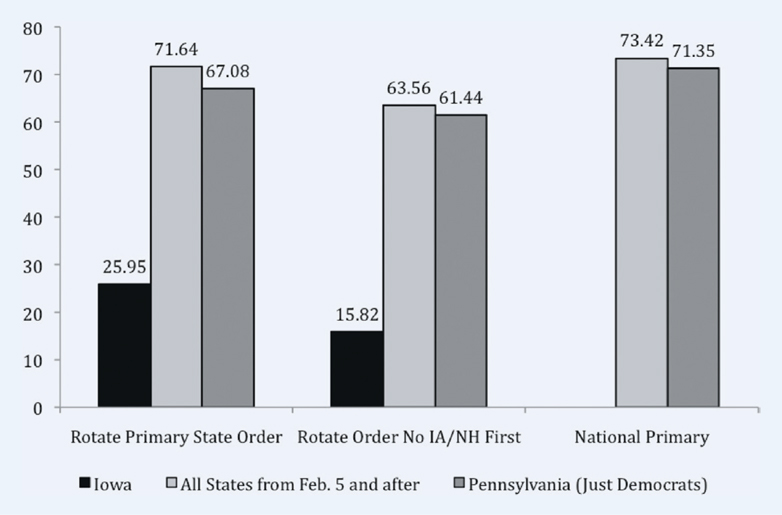
Table 1 and Figure 1 display support for electoral reform among the three sample populations: Iowans, national sample, and Pennsylvania Democrats. Strikingly, over 70% of Americans support a reform to rotate the primary order and almost three-quarters of Americans support a national primary (see column 2). Reforming the presidential nomination process appears to have wide support across the United States. Interestingly, however, there appears to be some evidence that Americans have come to view the role of Iowa and New Hampshire as at least partly legitimate, given the drop in support for rotating primary order when Iowa and New Hampshire lose their first-in-the-nation primary and caucus. Over 8% fewer respondents nationally and 5.5% fewer Pennsylvania Democrats are willing to support rotation if Iowa and New Hampshire lose their traditional position. And, as the third column of Table 1 shows, it is immediately clear that Iowans recognize their own self-interest. Support for rotating the primary order is approximately 50 percentage points lower among Iowans than voters nationally. Iowa caucus goers know that their unique position is of value to the state, and their political attitudes appear to be shaped by state self-interest.
Percent Supporting Reforming the Presidential Nomination Process: Comparing Iowa, National Sample, and Pennsylvania

Support for Presidential Nomination Reforms: Comparing Iowa, National, and Pennsylvania Samples

Figure 1 graphs the percentage of each sample that answered either “strongly favor” or “favor” for the three reforms. As expected, Iowans clearly do not want to rotate primary order (only 26% favored this reform) compared to 72% nationally and 67% of Pennsylvania-registered Democratic voters. While a question on support for a national primary was unfortunately not asked of Iowa voters, close to three-quarters of respondents nationally and from Pennsylvania support a national primary. These survey data suggest opinions about presidential nomination reform are colored by individual self-interest about one's state.
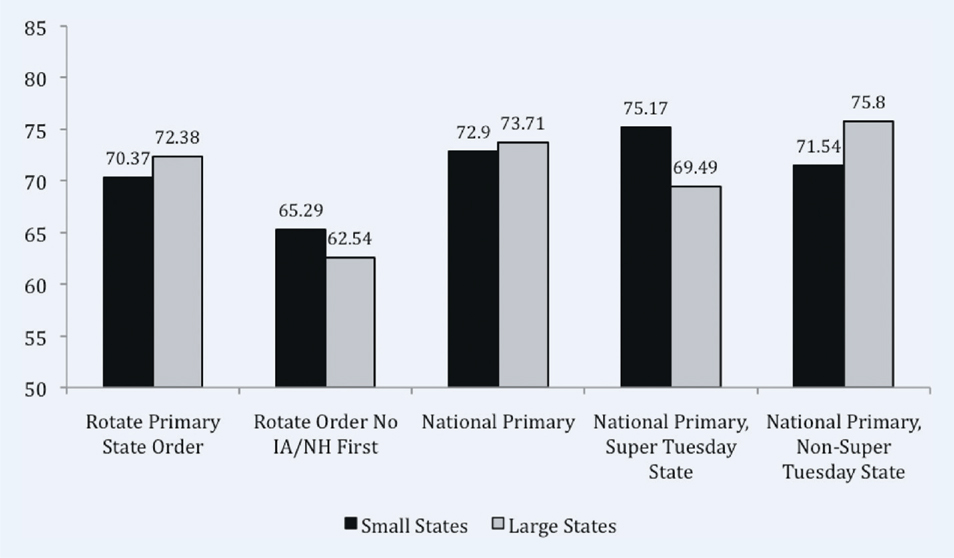
The percentage of respondents either strongly favoring or favoring the reforms, split into small and large states, is presented in Figure 2.Footnote 4 There is little difference between support for rotating primary order among respondents from small states and large states. Support for rotating primary order drops among both small states and large states when the question specifically mentions that Iowa and New Hampshire will lose their first-in-the-nation status, although the drop is greater for voters in large states. In fact, respondents from small states are actually more likely to favor rotation when Iowa and New Hampshire lose their position than are respondents from large states. This suggests small-state respondents might prefer Iowa and New Hampshire not go first. There is little difference between respondents from small states and those from large states support for a national primary. This result, however, appears to mask the true relationship between population size and support for a national primary. The last two columns of Figure 3 show support for a national primary by small and large states and by whether the state's election was held on or after Super Tuesday. As hypothesized, the effect of population size is conditional on timing. Small Super Tuesday states, clearly “losers” since they are easily overshadowed by large Super Tuesday states, want reform. Three-quarters of respondents from small Super Tuesday states express support for it. Respondents from large Super Tuesday states, on the other hand, are over 5% less likely to support a national primary (only 69% favor it). The inverse of this relationship can be found among respondents from states holding their nomination contests after Super Tuesday: those from large states have over a 4% greater probability of supporting a national primary than those from small states.
Support for Various Presidential Nomination Reforms by State Population Size and Super Tuesday Voting State or Later

Support for Reforming the Presidential Nomination Process by Electoral Losers (Individual Perceptions of State Importance in Selecting Candidates—“My State is …”)

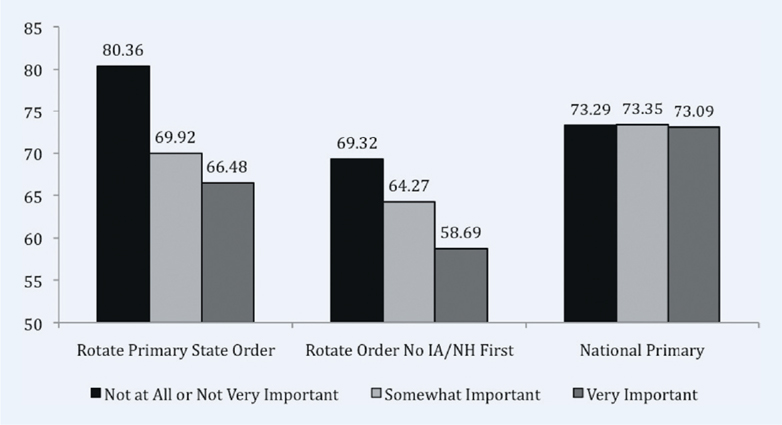
Finally, Figure 4 displays support for the three reforms by individual perceptions of the role of the respondent's state in choosing the presidential nominees. Respondents were asked: “I'd like to ask you to think about the role that your state plays in determining who the presidential candidates will be”; 80% of respondents who think their state is not important in the nomination process support rotating which states go first. This compares to 70% among those who think their state is somewhat important in the process and only 66% who want reform if they think their state is very important in the process.
Predicted Probability of Supporting a National Primary by Timing and State Population Size (log)

This stands in stark contrast to the levels of support for the national primary, where assessments of state role make no difference in support for the reform. Almost identical percentages (73%) of respondents from states that think their state is not important, somewhat important, and very important in the process favor a national primary. We believe this result is capturing perceptions of fairness. A national primary would certainly decrease the role of some states that are privileged under the current system, but may do so in a way that is perceived as fair, compared to rotation of primaries.
Descriptive statistics are suggestive of relationship, but do these results remain when the impact of other demographic and attitudinal factors are taken into account? To answer this question we turn to logistic regression analysis of support for a national primary reported (DV coded 1 = yes, 0 = no national primary). Since both individual-level and state-level effects are considered, we cluster the model coefficients' standard errors by state to account for spatial autocorrelation. To test the hypotheses presented earlier, three primary explanatory variables are used. To measure the impact of population size we use the log of the respondents' state population.Footnote 5 Sequence is measured with a dichotomous variable, where respondents are coded 1 if their state's primary or caucus was held on Super Tuesday and 0 if their primary was after Super Tuesday. Perceptions of the importance of the respondent's state is measured by the variable state role, which is coded 1 if the respondent thought his or her state was very or somewhat important in the nomination process and 0 if not important.
Two interaction terms are included in the models. The first tests if the effect of population varies depending on whether the respondents think their state is important by including an interaction term of the log of population multiplied by perceptions of state importance. The second tests whether the effect of population is conditional on timing by multiplying population size by a Super Tuesday voting state. Several political and demographic variables are included in the models as control variables.
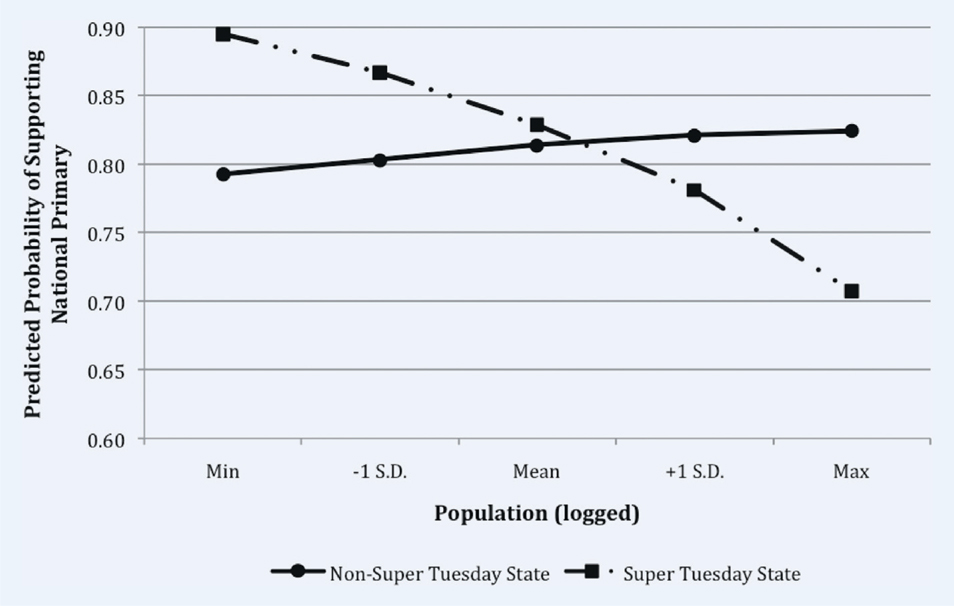
Table 2 presents the results for support for a national primary (parallel models for rotating primary order are available from the authors but omitted here due to space constraints). Consistent with the descriptive statistics, none of the three key explanatory variables (population, perceived state role, sequence) are significant in the base model presented in column 1. In column 2, interacting state population and perceptions of state importance, the interaction term is significant and positive, while the constituent terms of population (log) and state role are also statistically significant but negative. In column 3, the coefficient for the interaction term (population size multiplied by Super Tuesday state) is significant and negative. Predicted probabilities from the logit coefficients holding other explanatory variables at their mean/modal values aids in interpretation. Sequence or timing was found to have larger effect on support for a national primary than it does on support for rotating primary order. Figure 4 shows that the effect of population on support for a national primary is found among residents from Super Tuesday states only. Among individuals from states voting after Super Tuesday roughly the same 80% favor a national primary, and this does not vary by state population size. However, respondents from large states voting on Super Tuesday are less likely to favor a national primary: 10% fewer residents of large states voting on Super Tuesday want a national primary compared to those from large states voting after Super Tuesday. Residents from large states voting early have a privileged position. A probability graph (not shown due to space constraints) shows that among those who feel their state does not play an important role in the process, respondents from small states are much more likely to support a national primary than are those from the largest of states. Population (logged) accounts for over a 20-point increase in the probability of supporting the reform going from the largest states to the smallest among those who feel left out.
Who Supports a National Primary?

The dependent variable is coded 1 if the respondent favors a national primary and 0 if otherwise. Unstandardized logistic regression coefficients with robust standard errors in parentheses and probabilities based on two-tailed tests. Since both individual and state level effects are considered, we cluster the model coefficients' standard errors by state to account for spatial autocorrelation. Source: National Super Tuesday Survey surrounding February 5, 2008, primaries, University of Iowa Hawkeye Poll.
CONCLUSION
We find empirical evidence that large proportions of Americans favor reforming the presidential nomination process; the overall high levels of support for reform is noteworthy. There is, however, significant variation in support for reform based on an individual's state context and whether that state wins or loses in the current process. Individuals residing in small states who believe their state is not important in the current system are significantly more likely to support reform. Similarly, individuals from large states voting late in the nominating process are also highly supportive of reform. Unlike much of the published literature, we provide empirical evidence that winning and losing under different reform proposals shapes public opinion about reform of presidential nominations.
These opinion data can be best understood by viewing voters as rational decision makers who seek to influence the presidential nomination. Their influence is tied to the role their state plays in the process, thus defining their interest by the interest of their state. Population, sequences of primaries and caucuses relative to other states, and individual perceptions of state importance all play important roles in determining support for reforms of the presidential nomination process at the same time. These data show Americans are willing to adopt a different nomination process but reformers should be cautious. We find evidence that the American public is indeed motivated by self-interest, and will not likely support changing the system if it entails a reduction in influence for their state. These data suggest that reasoning about institutional change by the mass public is more sophisticated than previously understood. Not only can the mass public reason strategically about election rules, but their state context matters. ■