Disasters are human-made or natural events that cause massive damage, severe injuries, and loss of life throughout the entire community.Reference Bonanno, Brewin, Kaniasty and Greca 1 They can and will happen at any time and any place, often without warning. In 2015, there were 10 natural disaster events with over 1 billion dollars of damage in the United States (NOAA, http://www.ncdc.noaa.gove/billions). Human-made disasters and terrorist events are no less significant. Recent incidents include the terror attacks at the Boston Marathon (2013), the sniper attacks in the greater Washington, DC area (2002), the 9/11 attacks (2001), and the anthrax attacks (2001). In 2015, there were 5 incidents of terror in the United States alone, as illustrated by news reports.Reference Costa, Bever, du Lac and Horwitz 2 - Reference Shoichet and Tuchman 5 Other recent human-made disasters include the Deepwater Horizon oil spill (2010), the 2010 power plant explosion in Connecticut, and the recent fatal subway malfunction in Washington, DC (2015). These large-scale emergencies have far-reaching negative psychological, physical, and economic consequences.
It is possible, to some extent, to prepare for various natural and human-made disasters. Emergency preparedness has been defined as “preimpact actions that provide the human and material resources needed to support active response at the time of the hazard.”Reference Lindell, Prater and Perry 6 “City, county and state disaster management plans hinge on individuals’ abilities to survive independently for 72 hours without public assistance.”Reference Mack, Spotts, Hayes and Warner 7 The Federal Emergency Management Agency 8 reinforces this statement, noting that assistance to those in need may be delayed during a disaster and that individuals should be prepared to provide for themselves for at least 3 days. Individuals with disabilities or families with children may need additional help, and those in rural areas may need to prepare for longer waiting times for assistance.Reference Hamann 9 Thus, emergency preparations can mean the difference between life and death.
Nonetheless, few individuals are aware of these suggestions and most are unprepared to manage during an emergency without government assistance.Reference Mack, Spotts, Hayes and Warner 7 The 2007 American Preparedness Project showed that over a third of people surveyed erroneously believed that help would arrive within an hour of a major terrorist event, and two-thirds believed it would only take several hours.Reference Redlener, Abramson, Stehling-Ariza, Grant and Johnson 10
Individuals should be informed of possible disasters, make a plan for what to do before and after an emergency, and put together a kit with emergency supplies. 8 These actions help to keep them safe and also reduce the burden on emergency response and health-care systems in a time of chaos. Research has shown that populations that are more prepared for emergencies react better during emergencies, and are more resilient.Reference Bodos, Siman-Tov, Kreitler and Peleg 11 Emergency preparedness “facilitates a capability for coping with the temporary disruption” brought about by the disasterReference Paton and Johnston 12 and may reduce negative consequences during a disaster.Reference Diekman, Kearney, O’Neil and Mack 13
Parents and Preparedness
Although scholars have determined what is entailed in emergency preparedness, the psychosocial elements of actually becoming prepared are not well understood.Reference Bodos, Siman-Tov, Kreitler and Peleg 11 Knowledge of individual differences in preparedness can help guide interventions to reach those who are not yet prepared or who could be better prepared. A variety of factors have been associated with emergency preparedness—for example, age, gender, education, ethnicity, and income.Reference Redlener, Abramson, Stehling-Ariza, Grant and Johnson 10 , Reference Levac, Toal-Sullivan and O’Sullivan 14 , Reference Sattler, Kaiser and Hittner 15 However, parenthood has not been adequately investigated and there is reason to believe that it might be an important predictor of emergency preparedness. Parenthood can be defined in several different ways, including whether or not one has had a child in the past, whether one currently cares for a child, and, as a continuous variable, by the number of children one cares for. Researchers have noted the important role that parents play in helping their children adapt post disasterReference Pfefferbaum and North 16 and the degree to which parents feel unprepared before a disaster,Reference Kubicek, Ramirez, Limbos and Iverson 17 but they have not adequately empirically examined effects of parenting on preparedness. It has been assumed that parents prepare more than non-parents, but that it is not clear whether that is due to the gender of the primary parent or other characteristics of the family.
It is critical to know about caregivers’ preparedness because children are a vulnerable population with specific needs after an emergency—for example, the need for a plan to reunite with caregivers if separated.Reference Cicero and Baum 18 In addition, children face an increased risk for both physical and psychological consequences after emergency events.Reference Lemyre, Gibson, Zlepnig, Meyer-Macleod and Boutette 19 Until recently, disaster services rarely incorporated children into their plans and designs were based on able-bodied adults.Reference Hamann 9 Children have been considered a special population, and thus are “considered only as time and resources permit.”Reference Markenson 20 Given the concern caregivers most likely feel about their dependents, this study proposes that parents will engage in more preparedness behaviors than individuals without caregiving responsibilities, and specifically that those with more children will be more prepared.
This hypothesized difference in preparedness planning between parents and non-parents may occur because of a higher perception of the threat of disasters by parents compared with non-parents. Perception of threat involves beliefs about whether or not a disaster could happen, is likely to happen, and whether or not it will have major consequences if it does happen. It also includes consideration of personal risk to both self and possessions.Reference Bateman and Edwards 21 A particular individual’s perception of threat has roots in various cultural and social factors and includes a sense of dread, familiarity with potential emergencies, exposure to past disasters, and willingness to experience personal consequences.Reference Shaw, Shiwaku Hirohide Kobayashi and Kobayashi 22
Parenthood appears to make the world seem more dangerous. It increases the salience of threats to children’s well-beingReference Ruddick 23 and/or increases the range of events that parents perceive as dangerous.Reference Warr and Ellison 24 For example, parents perceive greater risks from sports and criminal victimization.Reference Eibach, Libby and Ehrlinger 25 , Reference Eibach, Libby and Gilovich 26 Similarly, in a study after the Chernobyl disaster, parents perceived nuclear energy to be more dangerous than non-parents.Reference Drottz-Sjöberg and Sjoberg 27 According to the evolutionary theory, parents are compelled to see that their children survive and carry forward their unique genetic characteristics. Children are highly dependent and vulnerable, which may also explain why parents’ fears for their children’s safety are greater than fears for themselves.Reference Warr and Ellison 24 Research indicating that parents’ concern about children continues as children age may be partly due to the significant economic investment in children.
Threat, Self-Efficacy, and Preparedness
Studies have shown that perceived threat is related to emergency preparedness and is sometimes considered the first step to emergency preparedness: “individuals must first believe that the hazardous threat is valid, if they are to respond at all.”Reference Lemyre, Gibson, Zlepnig, Meyer-Macleod and Boutette 19 For example, 1 study indicated that the willingness of homeowners to prepare for disasters depended on the perceived threat to themselves, their families, and their homes.Reference Shaw, Shiwaku Hirohide Kobayashi and Kobayashi 22 Before Hurricanes Emily and Fran had an impact on South Carolina, participants in 2 studies showed relationships between perception of threat and advance emergency preparation; both studies were included in Sattler et al.Reference Sattler, Kaiser and Hittner 15 In addition, a Canadian study showed that worry about terrorism independently predicted behavioral responses such as preparedness.Reference Lee and Lemyre 28
Though perception of threat may be a necessary predictor of emergency preparedness, it is not a sufficient one; simply increasing perception of threat does not automatically lead to increased preparedness.Reference Lindell and Hwang 29 A study in Australia showed that most residents thought they were likely to experience a terrorist event in the next 5 years, but overall were still unprepared for an attack.Reference Caponecchia 30 A survey of preparedness by the America Preparedness Project showed that more than 80% of Americans are very concerned or concerned about more terrorist attacks in the United States, but that only 50% have a household emergency plan in place.Reference Petkova, Schlegelmilch and Sury 31 This discrepancy between perception of threat and preparedness suggests that other cognitive processes are involved in preparedness behaviors besides the perception of threat. Self-efficacy, one’s belief in his or her ability to perform in a particular domain or situation, could be such a belief. In the context of disasters, if individuals have high emergency preparedness self-efficacy (believing that they have the ability to become prepared), they may then take action to become prepared, thus reducing the negative consequences of a disaster.Reference Benight and Bandura 32 Research has shown that families with greater preparedness self-efficacy are more prepared for disasters.Reference Hamann 9 Strong self-efficacy beliefs protect people by increasing their motivation to generate and use resources when faced with dangerous situations; these are the same behaviors encouraged by emergency preparedness advocates.Reference Benight and Bandura 32
Risk perception attitude (RPA) theory,Reference Rimal and Real 33 combined with Bandura’s social cognitive theory,Reference Bandura 34 supports a moderation hypothesis between threat, self-efficacy, and preparedness: individuals who perceive disaster threat are motivated to respond adaptively to the threat by preparing—but only if they have the confidence that they can acquire and possess the resources necessary to meet the demands of the situation.Reference Rimal and Real 33 If they do not have that confidence, they can begin to exhibit maladaptive cognitions as well as a sense of helplessness.Reference Ozer and Bandura 35 To date, there is no research showing that these relationships are supported for parents, and in addition, that parents’ increased preparedness may be mediated by their perception of threat and moderated by their level of emergency preparedness self-efficacy. Such research could lead to interventions to improve preparedness for parents and their children.
Therefore, this study tests 4 hypotheses: (H1) people caring for more children engage in more preparedness behaviors; (H2) people caring for more children see the threat of terrorism as higher compared with others; (H3) perception of threat mediates the relationship between the number of children and preparedness behaviors (more children leads to higher perception of threat, which leads to greater preparedness); and (H4) self-efficacy moderates this relationship such that parents who perceive threat as higher and who have a higher level of self-efficacy prepare more. Thus, the link between number of children and preparedness is hypothesized to be, at least partly, a function of the higher threat perceived by those parents who have sufficiently high self-efficacy to engage in emergency preparedness.
Methods
Sampling
This study’s sample included 296 individuals, 66% female and 34% male, aged 18-71 years (M=32 years, SD=10.4) from the greater Washington, DC area (roughly one-third each from Virginia suburbs, Maryland suburbs, and the District of Columbia). The sample was 54% Caucasian, 23% African American, 11% Asian or Asian American, 5% Latino, 5% biracial or multiracial, 1% Native Hawaiian or Pacific Islander individuals, and <1% self-identifying as “other.” Gross incomes ranged from under $25,000 (19%), $25,000-$50,000 (26%), $50,000-$75,000 (22%), $75,000-$100,000 (12%), $100,000-$125,000 (4%), $125,000-$150,000 (4%), $150,000-$175,000 (3%), $175,000-$200,000 (3%), and over $200,000 (7%). Most individuals were single (60%), 33% were married or partnered, 4% were divorced, and 3% were separated. Employment status was self-reported as 61% full time, 17% part time, 14% not employed (and looking for work), and 8% not employed (and not looking for work). With regard to education, 3% did not graduate from high school, 10% obtained a high-school diploma, 20% had attended some college, 47% graduated from college, 13% completed a master’s degree, and 7% held a terminal graduate degree (eg, medical and law degrees). Relevant to this study in particular, 82 individuals stated that they had a least 1 child. The number of children included 1 child (30%), 2 children (29%), 3 children (32%), and 4 or 5 children (9%). Most participants (69%) had not experienced a non-human-made disaster, whereas 31% had.
Procedure
Data used in this study were drawn from a previously collected sample of adults from Washington, DC, including the surrounding areas (defined as a 60-mile radius from the District of Columbia). After IRB approval, participants were recruited for a study on disasters and emergency preparedness through a “Paid research opportunity” on the Washington Metropolitan Craigslist website (at the time, opportunities for research participation were included in the “jobs” and “part-time” sections of Craigslist). Interested potential participants sent an e-mail to the study coordinators, requesting the study link. A consent form that included a URL linked to a SurveyMonkey web-based survey was then sent by e-mail to each individual. Participants were compensated for their time with $10 Amazon.com gift cards.
Measures
Parental Status
Parental status was measured using 2 questions: first, whether or not participants had any child in their household at least 50% of the time, and second, how many children lived in their household at least 50% of the time. Because of low frequency, participants with 4 children and 5 children (n=2) were combined into 1 group for the analyses; thus, the number of children ranged from 0 to 4.
Perceived Threat
Threat was measured using a single item based on research by Slovic, Finucane, Peters, and MacGregorReference Slovic 36 : “How concerned or worried are you about the possibility of another terrorist attack (eg, hijacking, bioterrorism, subway/train bombing, school/civilian hostage crisis) occurring in the United States in the next 6 months?” Responses were scored on a Likert scale from 1 (no worry) to 5 (extreme worry).
Emergency Preparedness Self-Efficacy
The Emergency Preparedness Self-Efficacy Scale (EPSE) was developed to assess individuals’ self-efficacy across a variety of emergencies, particularly those resulting from natural and human-made disasters. The EPSE was based on established recommendations for creating a domain-specific self-efficacy scaleReference Bandura 37 as well as on information gathered from government sources regarding emergency preparedness and ways of coping with various natural and human-made disasters, such as the website of the Federal Emergency Management Agency on preparedness, www.ready.gov.Reference Rohrbeck and Burns 38 A total of 7 items reflect the physical, emotional and informational self-efficacy beliefs relevant to natural disasters (eg, tornados) or human-made disasters (eg, terrorism). The instructions ask participants to rate how confident they are in their ability to successfully carry out each item on a Likert scale from 0 (not at all capable) to 4 (totally capable). An emphasis was placed on assessing oneself in the present moment to allow for measurement within the context of ongoing risk, as well as on following self-efficacy scale development recommendations.Reference Bandura 37 , Reference Friedman 39 Sample items include “I can protect myself and my property in an emergency” and “I can keep close with loved ones in an emergency.” Internal consistency for this scale (Cronbach’s α=0.89) and test-retest reliability (r=0.83, P<0.001)Reference Rohrbeck and Burns 38 is strong.
Emergency Preparedness Behaviors
The emergency preparedness checklist (EPC) assesses participants’ level of emergency preparedness. Items were drawn from terrorism and emergency preparedness literature and websites, including the American Red Cross and FEMA, which include recommendations for individuals and households preparing for a human-made or natural disaster. The 21-item checklist was then piloted and revised. Instructions ask participants to indicate if they have “taken the action in the last year” by marking Yes or No for each item. Sample items from the EPC include “Have stored a 3-day supply of bottled water,” “Have a map of local area (with shelters) in the car or close by,” and “Have fire, police, hospital phone numbers readily available.”Reference Marceron, Rohrbeck and Burns 40 The number of items marked Yes were summed to create a total score. Cronbach’s α coefficient for this sample was 0.85.
Control Variables
Demographic information was obtained at the end of the survey. Relevant to this study, participants reported their age, ethnicity, gender, education, income, and relationship status (partnered or single). Given that this research focused on terrorism, participants were also asked about their experience with other disasters: “Have you ever been personally involved in an emergency situation due to a natural disaster (eg, Hurricane, earthquake, flood) or man-made emergency (eg, large-scale accident, long term power outage) other than terrorism?” The answer was dichotomous, either Yes or No. All of these variables have been related to preparedness in previous research on disasters.Reference Kohn, Eaton, Feroz, Bainbridge, Hoolachan and Barnett 41 , Reference Lindell and Perry 42 In addition, a shortened 8-item version of the Marlowe-Crowne scaleReference Ray 43 was used to control for social desirability as recommended for disaster studies.Reference Kohn, Eaton, Feroz, Bainbridge, Hoolachan and Barnett 41
Mediation and Moderated Mediation Analyses
In the mediating and moderating analyses, age, ethnicity, gender, education, income, relationship status (partnered or single), past exposure to non-human-made disasters, and social desirability were treated as control variables for the regression analyses. We first tested the mediation hypothesis. Mediation analysis is used to explicate the relationship between a dependent variable (emergency preparedness) and an independent variable (number of children) by way of an indirect path through a mediating variable (perceived threat).
Second, we conducted a moderated mediation analysis to observe the effect of perceived threat on emergency preparedness, conditioned on the level of preparedness self-efficacy. For this analysis, both self-efficacy and perceived threat (ie, the 2 variables composing the interaction) were centered. Using Hayes’ PROCESS macro, we generated 10,000 bootstrap samples (with replacement) and calculated the lower and upper bounds of a bias-corrected confidence interval for the Index of Moderated Mediation.Reference Hayes 44 If the resulting interval excludes 0, it provides compelling statistical evidence for a moderated mediation effect, which can be further explored by observing the indirect effect of number of children on emergency preparedness through perceived threat at specific levels of self-efficacy. In order to better display the moderated mediation effect, conditional indirect effects were examined at the 10th, 25th, 50th, 75th, and 90th percentiles of preparedness self-efficacy. At each of these individual self-efficacy levels, the lower and upper bounds of a CI around the mediation effect were calculated; here too, if the resulting interval excludes 0, it provides compelling statistical evidence of a mediation effect at that specific level of the moderator (preparedness self-efficacy). For specific calculation details, see Hayes.Reference Hayes 44
Results
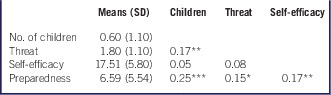
The first hypothesis (H1) that number of children is significantly related to preparedness behaviors was supported (r (294)=0.25, P<0.0001). Also, as hypothesized (H2), number of children was related to perceived threat (r (294)=0.17, P<0.01). Threat was also related to preparedness behaviors (see Table 1 for means, SD, and Pearson’s correlation coefficients of study variables).
Correlations of Parental Status Variables, Threat, Self-efficacy, and Preparedness

*P<0.05, **P<0.01, ***P<0.0001. n=296 for all analyses.
Results of Hayes’ PROCESS macro showed an indirect, mediating effect statistically different from 0 (b=0.1004, SE=0.0928, CI: 0.0028-0.3381), supporting hypothesis H3 that perception of threat mediates the relationship between number of children and preparedness.
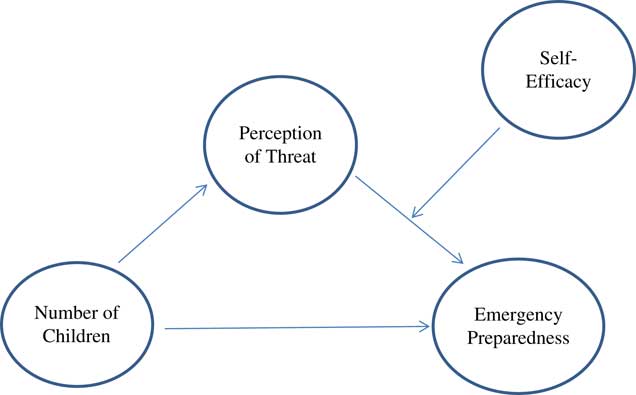
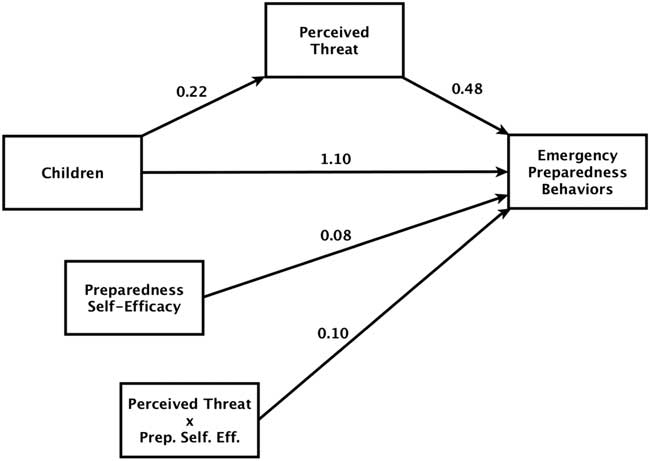
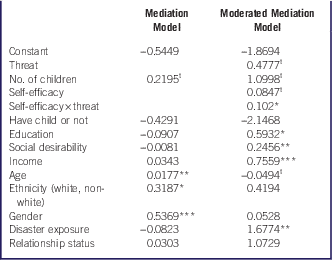
Next, the moderated mediation hypothesis—that self-efficacy moderates the relationship between threat and preparedness—was tested. Hypothesis (H4) was confirmed; this analysis resulted in a significant moderated mediation indexReference Hayes 44 with b=0.0224, SE=0.0208, CI: 0.0012-0.0769 (Figure 1). The parameters of that test are included in Table 2; see Figure 2 for a graphical representation of these effects. To facilitate interpretation, the conditional indirect effect(s) of number of children on preparedness behaviors was calculated at 5 levels of self-efficacy: the 10th, 25th, 50th, 75th, and 90th percentiles. There was no significant conditional effect at the 3 lowest levels of self-efficacy. At the 10th percentile, b=−0.03, SE=0.12, CI: −0.3203 to 0.0968; at the 25th percentile, b=0.03, SE=0.09, CI: −0.0731 to 0.2127; and at the 50th percentile, b=0.09, SE=0.09, CI: −0.0001 to 0.3108. However, as self-efficacy levels increased a conditional indirect effect emerged (ie, a moderated mediation). For individuals at the 75th percentile of self-efficacy, b=0.1829, SE=0.1424, CI: 0.0253-0.5319; and for individuals at the 90th percentile of self-efficacy, b=0.3172, SE=0.2557, CI: 0.0412-0.9473.
The Study’s Conceptual Model. This model shows a moderated mediation relationship. Threat mediates the relationship between number of children and preparedness; self-efficacy moderates the relationship between threat and preparedness.

Conditional Indirect Effect of Parental Status on Emergency Preparedness Behaviors Through Perceived Threat, Moderated by Preparedness Self-Efficacy. Perceived threat and preparedness self-efficacy were centered around their respective means.

Parameter Estimates for the Moderated Mediation Model

t P<0.10, *P<0.05, **P<0.01, ***p<0.0001.
Discussion
Building on previous research suggesting relationships between parental status and preparedness behaviors as well as between parental status and a higher perceived threat of disasters, this research study tested the hypothesis that parental status (number of children) was indirectly related to preparedness behaviors through the perceived threat of disasters. In addition, we hypothesized that self-efficacy would moderate the relationship between threat and preparedness such that parents who perceived a threat from terrorism as being higher and who had a higher level of emergency preparedness self-efficacy would show higher levels of preparedness. In other words, we hypothesized that the link between number of children and preparedness would be, at least in part, a function of the higher threat perceived by parents who also had sufficiently high self-efficacy to engage in preparation for emergencies.
The results of this study indicate that emergency preparedness is, as hypothesized, related to parental status; there was a relationship between the number of children and preparedness behaviors, supporting the first hypothesis (H1). The number of children was also related to perceived threat, supporting the second hypothesis (H2). To better understand the difference in preparedness, we looked at cognitive processes involved in preparedness behaviors, including perception of threat and self-efficacy.
This study supported the third hypothesis (H3), namely that perceived threat partially explains the relationship between the perception of parents, number of children, and preparedness. In addition, it was shown that adults were able to translate that threat into higher levels of preparedness when they believed they had sufficient levels of self-efficacy to do so. In summary, the hypothesized moderated mediation model was supported (ie, our fourth hypothesis, H4). For those individuals with low self-efficacy scores who did not believe that they had the ability to prepare, perceived threat, even at high levels, did not predict preparedness. This echoes Lindell and Hwang’sReference Lindell and Hwang 29 finding that perception of threat might be a necessary step toward preparedness, but not a sufficient one. It also provides support for both RPA theoryReference Rimal and Real 33 and Bandura’sReference Bandura 37 social cognitive theory.
These results were found with potentially important control variables included in the model. Age, ethnicity (white, non-white), and gender were significant predictors in the test of the mediation hypothesis. Similar to other studies in the literature, older participants and males reported more preparedness.Reference Kohn, Eaton, Feroz, Bainbridge, Hoolachan and Barnett 41 In contrast to some studies, ethnic minority participants reported more preparedness than whites in this sample. Education, social desirability, income, and disaster exposure were significant predictors in the moderated mediation model such that more education, greater social desirability, higher income, and past exposure to disaster were positively related to preparedness. These demographic variables have been related to preparedness in other studies.Reference Kohn, Eaton, Feroz, Bainbridge, Hoolachan and Barnett 41 Because social desirability would logically play a role in self-reporting preparedness, past reviewers have recommended its inclusion in such studies; this study’s results suggest that it is worth including.
These results have implications for intervention—we need to improve peoples’ (especially parents’) sense of self-efficacy (specifically emergency preparedness self-efficacy in this case) in order for them to respond to perceived threat. If parents are already predisposed to perceive greater levels of terrorism threat (as these results suggests they do), then it is important to be able to translate that increased perception of threat into greater preparedness. Although the number of children was related to preparedness behaviors, the average number of preparedness behaviors was still low. This study suggests that one way to increase preparedness behaviors in families is to increase parents’ emergency preparedness self-efficacy because parents with the strongest self-efficacy showed the strongest relationships between threat and preparedness. Given the inability of most children to prepare for disasters, it is important to increase parents’ preparedness, by focusing on their emergency preparedness self-efficacy.
This study had several limitations. Perception of threat was a single indicator item assessing worry and concern, and was specific to terrorism rather than a broader definition of disaster. In addition, our definition of parents was conservative and did not include parents who may have had children in their household <50% of the time. Future research should include a broader definition of parenting. Because the data were self-reported, there is always the danger that participants did not provide an accurate picture of their preparedness. Parents, in particular, might feel social pressure to seem more prepared than they are. This concern was partially controlled for in this study by including social desirability in the model, but a more objective measure—such as having people show their emergency preparedness supplies to an observer—could be used in the future to potentially eliminate this confounder. This study was cross-sectional; longitudinal research is necessary to determine the causal directions between variables. Because our sample was recruited via Craigslist, it may not be representative of the DC metropolitan area, particularly with regard to age. Ours was a volunteer convenience sample and also included a higher percentage of women than the population in the region. It is important that future research studies obtain larger samples and test our hypotheses in order to replicate these results.
These weaknesses notwithstanding, the results of this study suggest an important cognitive process that, if replicated in future studies, could serve as the basis for a potentially important intervention. If, as this study suggests, parents naturally perceive greater threat, and if (also as this study suggests) greater threat results in greater preparedness among those with a high level of emergency preparedness self-efficacy, then it becomes important to focus attention on factors that can improve parents’ sense of self-efficacy. It is for this sort of intervention that future research might fruitfully be applied.
Funding
No outside sources of support.