Mounting tension among the world’s great powers has directed scholarly attention to exploring how corporations mitigated political risks in response to shifting geopolitics.Footnote 1 Nationality of investors could arouse suspicion, especially in times of regime change. Although the requirement of national ownership of key businesses is prevalent in numerous countries in different eras, the case of post–World War II Hong Kong posed a particularly tumultuous situation as the city experienced the rapid succession of political regimes in a few short decades. Regarded as Hong Kong’s airline, Cathay Pacific, with a controlling stake in the hands of British investors, faces pressure from the People’s Republic of China (PRC) regime that facilitates the routing of many of its flights. Indeed, this situation is not unique to Cathay Pacific or the airline industry. As financial capital wields power in directing commercial flows, political regimes insist on specific investor profiles in industries they consider strategic. The state could challenge the nationality of investors in such industries, especially those with a controlling stake. In the international nexus of Hong Kong, the strategic industry of commercial aviation has remained in private hands. Focusing on Cathay Pacific, this article examines how the privately owned airline fashioned its corporate nationality in a bid to negotiate with political forces that affected its business development.
Time and again, Cathay Pacific proactively crafted its ownership and management profile in response to varying political demands. After a short stint as an enterprising American-Australian venture, the airline came under the ownership of a British Commonwealth conglomerate (1948–1970). Thereafter, its British Hong Kong shareholding endured in the 1970s and early 1980s. As the conclusion of Sino-British negotiations in 1984 sealed the fate of Hong Kong past 1997, the airline assumed a local Hong Kong façade. That symbolic local representation proved insufficient, and a series of capital infusion from mainland entities ensued. After the shareholding reshuffling in 1987, British shareholders managed to hold onto an aggregate two-third majority. By 1992, the airline’s British backer Swire could barely retrain a simple majority, a position that proved indefensible in 1996, a year before the 1997 Handover.
International businesses and multinationals convey their “corporate nationality,” often to accommodate the needs of their host country. Rather than a calibrated specification that confers politically defined labels, “corporate nationality” is a cultural construct that management projects to suit their business exigencies.Footnote 2 This issue is especially acute in the age of decolonization. In the case of Cathay Pacific in Hong Kong, unlike businesses repositioning for survival in a decolonizing context, the airline did not have to focus on combatting a rising national consciousness either in its early years or in the run-up to the 1997 Handover. Instead, the airline had to respond to intensifying state demands emanating from beyond the city. Cathay Pacific followed strengthening colonial contour as British forces returned in the aftermath of World War II. In an about-face decades later as the city prepared for a transfer of sovereignty, Cathay Pacific faced the challenge of a new state on which the airline had to rely for continued operational success. Rather than moving from a colonial setting to a national formation, Cathay Pacific’s home base was transformed from a British colony to a Special Administrative Region (SAR) in the PRC. In other words, the airline had to prepare to operate under the auspices of an incoming political regime that was to underwrite its business prospects. Not only was the PRC the state in whose name routes were to be negotiated and under whose airspace Cathay Pacific had to fly, but the business opportunities China in reform afforded also compelled the Hong Kong carrier to signal its commitment. The resulting relationship between Cathay Pacific and the PRC was one that acknowledged mutual benefits. Negotiated more by a careful calibration of shareholding than through the perception of a local identity, Cathay Pacific constructed its corporate nationality as a “local Hong Kong,” if not “Chinese,” airline.
Throughout its history, Cathay Pacific reshaped its corporate nationality repeatedly, less so to respond to the local conditions of its host city than the demands of faraway state powers who were to bankroll the airline’s success. To date, business history literature on political risk has focused primarily on how multinational enterprises dealt with the outbreak of war.Footnote 3 The case of Cathay Pacific demonstrates how, in the absence of warfare, companies still need to mitigate political risks in a fluid geopolitical setting.
Cathay Pacific underwent various rounds of ownership transfer. This article focuses on the airline’s later transformation from a British airline to an ownership structure that responded to the shifting political climate of Hong Kong. Contrary to the conventional view of Cathay Pacific as a quintessential British concern, the changing investor profile of the airline reveals a pragmatic business approach. Paralleling the flexible practice of citizenship that Hong Kongers mastered,Footnote 4 the airline showcased its agility in constructing its corporate nationality during a period of swift geopolitical shifts that both engendered business opportunities and presented challenges of commitment to Cathay Pacific as well as Hong Kong.
Introduction
Often celebrated as a laissez-faire economy, Hong Kong was touted as the prime example of economic success with minimal government intervention. Perhaps this narrative is most often cited as Milton Friedman’s assessment of Hong Kong as an economy operating mostly on the basis of market dynamics.Footnote 5 Other scholars who have echoed Friedman’s observations and analyses of Hong Kong’s development have also privileged economic freedom as a facilitator of growth.Footnote 6 Such narratives of nongovernment intervention in Hong Kong have been challenged for the state involvement in specific activities. Early studies of industrial development in Hong Kong underscored the government’s role in the process.Footnote 7 Similarly, scholars have analyzed government intervention in economic activities that involved social issues such as housing in Hong Kong.Footnote 8 Recent studies seem to focus on the government’s role in regulating the financial markets.Footnote 9 Situating the analysis in a comparative framework, some scholars have analyzed the different paths taken by the Little Dragons.Footnote 10 Yet these studies often emphasized the function of the government in solving coordination problems and overcoming market imperfections.Footnote 11
National ownership has attracted scholarly attention for different reasons. Some studied the role of national ownership in the process of economic reconstruction or reconfiguration against a shifting geopolitical context.Footnote 12 Others assessed the impact of state ownership on economic performance.Footnote 13 National ownership of companies in sensitive industries is but one mechanism through which the state could exercise regulatory control over economic activities it deems critical.Footnote 14 In the process of reversing state ownership, privatization in different forms and to varying degrees could also affect business structures.Footnote 15
Besides the dichotomy of state-owned enterprises and privately held businesses, corporations have also assumed various shareholding profiles to suit specific purposes. Scholars have studied how a big corporation could organize a subsidiary to broaden ownership and develop political and cultural identities among small investors.Footnote 16 Broadening the discussion beyond shareholding to other stakeholders’ involvement, companies employ business strategies such as corporate social responsibility to enhance negotiating and bargaining positions while maintaining control of their assets.Footnote 17 Building on existing scholarship, this article explores the instrumentality of crafting “corporate nationality” through shareholding in allaying political risks and managing business relationship with the state.
Deemed vital to the ruling regime, the airline industry relies on diplomatic intervention in expansion and growth and often operates under state ownership, at least partially. However, on the issue of nationality in the airline industry, scholarly coverage has been sporadic. Levine explored government involvement in the aviation industry in mainland China, but his analysis addresses mostly the hardware issues of aircraft construction.Footnote 18 Pirie studied British imperial aviation, whereas Hickson, as well as Heracleous, Wirtz, and Pangarkar, published celebratory accounts of Singapore Airlines.Footnote 19 In the case of Hong Kong, Dunnaway examined the history of the city’s aviation industry and argued that the success of Cathay Pacific caused Hong Kong to become a world city and the gateway to China.Footnote 20 State involvement received scant attention in the studies of Lau, who detailed the collective memory of Hong Kong airports, and Ng, who chronicled the development of aviation in Hong Kong.Footnote 21
Rather than accepting the ownership of airline companies by the state (e.g., British Airways) or in private hands (e.g., Pan American) as simple divergence in business strategies, this analysis investigates Cathay Pacific’s changing shareholding as an active negotiation process between the airline and the state over the issue of corporate nationality. Ownership and control of Hong Kong’s flag carrier, Cathay Pacific, remained in private hands. The airline crafted its shareholding at critical junctures to respond to shifting geopolitics, and exercised control of the company to accommodate the needs of various political regimes. Impressions of corporate nationality bore significant implications not only for the accruals of economic profits but also for the state’s effort in steering air traffic to specific participants.
This analysis builds on the studies of businesses operating in a decolonizing context in which enterprising operators construct legitimacy against the backdrop of changing political configurations.Footnote 22 The political reconfiguration of Hong Kong did not follow precisely a decolonizing pattern. Cathay Pacific performed “geopolitical jockeying” nonetheless.Footnote 23 In the early years, the airline jockeyed for British representation as the returning British regime returned to Hong Kong. In the 1980s and 1990s, as the 1997 Handover neared, an emerging rival did pose a challenge to Cathay Pacific’s legitimacy as an authentic local Hong Kong concern. However, the overriding threat stemmed from an unusual state issue—the incoming political regime from without. In a manner that paralleled the strategy of other British concerns in the waning days of colonization, Footnote 24 the carrier did reinforce its local identity through ascending Hong Kong shareholding. Nevertheless, the challenges Cathay Pacific faced extended beyond the city of Hong Kong. Focusing on the evolving shareholding of Cathay Pacific, this article explores the airline’s strategy in crafting its corporate nationality for its “license to operate”—legitimacy and state sponsorship—during a period of swift geopolitical shifts.Footnote 25
From Commonwealth Holding to British Hong Kong
Cathay Pacific owes its establishment to two enterprising pilots, one American and one Australian, who spotted the needs of air transport in post–World War II Asia. The company was incorporated in Hong Kong as a private limited company on October 18, 1948.Footnote 26 However, as the British reinforced their colonial power in Hong Kong, the airline had to shed its non-British founders in favor of a contingent led by the British conglomerate Swire to secure the designation as Hong Kong’s flag carrier. Under the leadership of Swire, a Commonwealth conglomerate financed the early growth of the airline at the height of the Cold War. This alliance of British Commonwealth interests served Cathay Pacific well in its early decades, both financially and operationally. In particular, Australian National Airways (ANA), a founding member of that alliance, offered significant operational guidance to the fledging airline. In the late 1940s, ANA seconded two of its experts with extensive experience in the industry to “get [Cathay Pacific] established on the right line.” They returned to Australia only when the Swire-led team was deemed to have acquired sufficient experience on their own.Footnote 27 The tutelage of ANA extended into cabin service as well. In 1950, Cathay Pacific dispatched its newly appointed superintendent hostess to Australia for training by ANA so as to equip her with the skills, on her return to Hong Kong, to “undertake the training of locally engaged hostesses.”Footnote 28 In these early years, ANA even lent the services of their senior personnel to serve as Cathay Pacific’s check pilot from time to time.Footnote 29
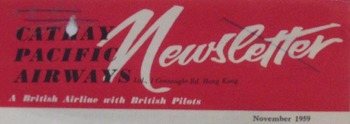
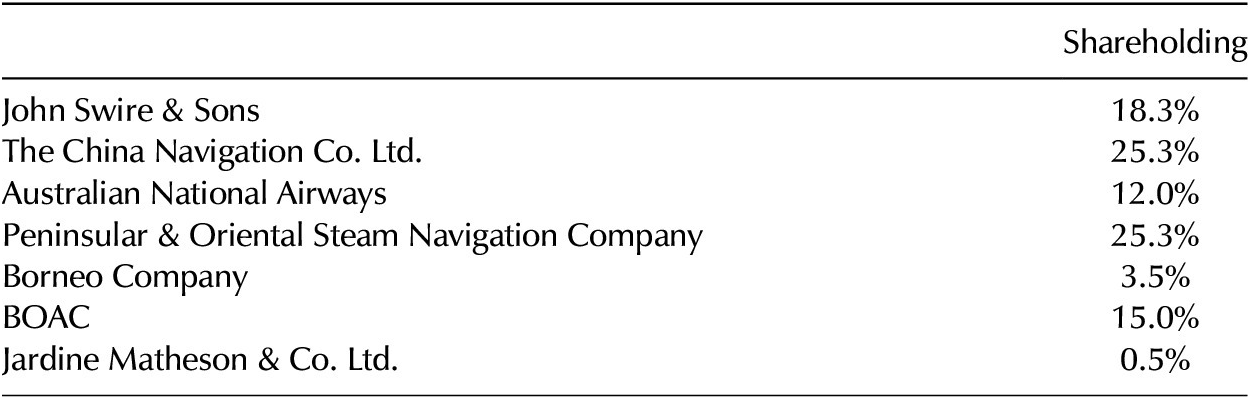
As the industry consolidated in Hong Kong, Cathay Pacific absorbed in 1959 its rival, Hong Kong Airways, which was backed by British Overseas Airways Corporation (BOAC) and Jardine Matheson Figure 1. After this consolidation, Swire and its subsidiary, the China Navigation Co. Ltd., held 43.6 percent of the shares of Cathay Pacific. ANA owned 12.0 percent. Peninsular & Oriental Steam Navigation Company (P&O), a British shipping company that had operated in the Far East since the nineteenth century, “through their association with Australian National Airways Pty. Ltd,” became a shareholder of Cathay Pacific and held 25.3 percent. BOAC held 15.0 percent, with the rest held by Jardine Matheson and a small shareholder, The Borneo Company (Table 1).Footnote 30
“A British Airline with British Pilots.” Cathay Pacific Airways Newsletter, November 1959, Swire HK Archive.

Percentage shareholding after the merger with Hong Kong Airways in 1959

Source: Cathay Pacific Airways Limited Board Minutes, 8 December 1954; Annual General Meeting, 7 April 1959, Swire HK Archive.
The special relationship with ANA endured even the tumultuous industry conditions in Australia and ANA’s takeover by Ansett in 1957.Footnote 31 The situation only began to change early in the ensuing decade with further developments in the aviation industry in Australia. Quantas’s introduction of the Boeing 707 on the Hong Kong/Sydney route in 1961 rendered Cathay Pacific uncompetitive. Cathay Pacific exited the Australian market and left BOAC as the only operator designated by the British government for the British share of this route.Footnote 32
The Commonwealth conglomerate that controlled Cathay Pacific gradually gave way to a concentration of British ownership centered on the metropole and the colony. In November 1970, Cathay Pacific recalibrated its share count.Footnote 33 Shortly thereafter, in April 1971, the airline welcomed The Hongkong and Shanghai Banking Corporation (HSBC). Assuming a 25 percent stake of Cathay Pacific, HSBC, the prominent British bank in Hong Kong, surpassed BOAC’s 15 percent ownership. The public reacted positively to the deal, which “undoubtedly adds considerably to the strength of Cathay Pacific by broadening its capital base and backing for the future.”Footnote 34 “With expansion, it has become apparent that we should be more broadly based financially,” the airline explained. “As noted at the last Board Meeting, The Hong-kong and Shanghai Banking Corporation have indicated their willingness to take up a 25% share of the equity of the Company, while BOAC (AC) wish to maintain a 15% position.” The remaining 60 percent stayed in the hands of the early investors, but by then ANA/Ansett had dropped off the list. The Borneo Company and Jardine Matheson & Co. Ltd. had also sold their small holdings;Footnote 35 Swire’s interest stood at 22 percent, held in the name of two affiliates. Its subsidiary, China Navigation, held an additional 19 percent. P&O also held 19 percent.Footnote 36
The consolidation continued when Swire took over the shares of China Navigation (then 50 percent owned by Swire) on May 29, 1975, and “Cathay Pacific effectively came under the control of Swire Pacific Ltd. from that date.”Footnote 37 Soon after, P&O expressed their interest in disposing of their holdings “subject to their receiving similar price to that paid recently to C.N.Co.” “The Hong Kong Bank” indicated that it did not wish to increase their holding. BOAC, by then renamed British Airways, expressed some interest in increasing their stake to 20 percent “but this was a matter for their Board decision.”Footnote 38 In the end, British Airways and HSBC maintained their percentage ownership while Swire acquired 87.5 percent of the remaining 60 percent (effectively a majority of 52.5 of Cathay Pacific’s equity) with P&O retaining a small stake. This distribution of shares lasted only until July 3, 1978, when Swire Pacific announced that it would purchase all of P&O’s remaining shares. As a result, Swire increased its shareholding in Cathay Pacific to 60 percent. The remaining 40 percent remained unaltered with HSBC holding 25 percent and British Airways 15 percent (Table 2).Footnote 39
Percentage shareholding in 1978

Source: CPA/7/4/1/1/162 Newsletter [August 1978], Swire HK Archive.
Turning Local Hong Kong
Although the tripartite of Swire, HSBC, and British Airways appeared to present a clear representation of commercial interests in the aviation industry in the British colony of Hong Kong, an undercurrent threatened to disturb the equilibrium. The British government in London had recognized a potential conflict as early as 1972. As they initiated air service negotiations with Beijing, the authorities in London acknowledged that “the interests of Hong Kong based British [inserted in handwriting] airlines (e.g., Cathay Pacific) diverge from those of BOAC.”Footnote 40 However, the issue did not come to a head until 1979. Submitted to authorities in both London and Hong Kong, Cathay Pacific’s application to operate scheduled passenger and cargo services between Hong Kong and London in 1979 pitted the colony-based airline against the British flag carrier. Cathay Pacific’s chairman issued a press release in which he expressed the airline’s position that for the Hong Kong/London route, “a reciprocal service to British Airways should in all equity be operated by Hong Kong’s airline.”Footnote 41 (emphasis added) Although a British Airways officer had attended, in August 1979, Cathay Pacific’s board meeting as a director when the airline discussed the London route application,Footnote 42 he declared a conflict of interest in the next meeting and excused himself when the board discussed the application.Footnote 43 The divergence of the two airlines’ interests resulted in British Airways notifying Cathay Pacific of its intention to sell its shares in 1980. In the end, British Airways sold its 15 percent stake, held since 1959, for 6.3 million pounds sterling.Footnote 44 Their respective purchases from British Airways made Swire and HSBC holders of 70.6 percent and 29.4 percent of Cathay Pacific’s shares.Footnote 45 Rights offering and other share adjustments resulted in a clean 70/30 split in Cathay Pacific’s equity ownership by Swire and HSBC respectively by 1983.Footnote 46 Thus concluded the process by which the airline consolidated its ownership in the hands of local British Hong Kong firms.
The powerful duo of Swire and HSBC worked effectively as local British interests in Hong Kong in resolving conflicts with the metropole. However, even as they represented the local presence of British power, the sustainability of such British interests came to be challenged in the 1980s as political uncertainty over the future of Hong Kong mounted. In this turbulent period, the management of Cathay Pacific launched a series of restructuring measures. Management transformed the ownership of this Hong Kong airline to reflect a new definition of local identity and to embrace a new alliance in accordance with shifting geopolitical realities.
In the negotiations leading up to the signing of the Sino-British Joint Declaration on December 19, 1984, which prescribed the return of Hong Kong sovereignty to the PRC in 1997, the market postulated that mainland Chinese investors would take up majority ownership of the Hong Kong carrier.Footnote 47 The carrier’s chairman acknowledged that in light of the 1997 issue, Beijing would determine traffic rights for the Hong Kong/London route. “It might also be assume that, in due course, some part of the share capital would pass to Beijing.”Footnote 48 At the same time, Cathay Pacific strove to reaffirm its commitment to Hong Kong. Featured in the airline’s newsletter in September 1984, Managing Director Peter Sutch said that “come 1997 and well into the 21st century,” he expected “the familiar red and blue flag of the Swire Group [to fly] over Hong Kong.” He discounted rumors that Cathay Pacific would move from its home base of Hong Kong and pledged that the airline would “stay up to and well beyond 1997.” Remarkable in Sutch’s statement is the emphasis of Swire’s “house flag” at the expense of the Union Jack. International businesses created in the heyday of colonialism had learned to be pliable in constructing their corporate nationality. “We believe we still have a major contribution to make to the future.” He anticipated that Cathay Pacific would cooperate with China and displace British Airways on the Hong Kong-Beijing route. “Why should BA enjoy the rights to the Hong Kong-Beijing route? Shouldn’t it be served by Hong Kong’s own carrier?”Footnote 49 (emphasis added) Cathay Pacific was not alone in its claim to be the city’s carrier. Within months of the signing of the Joint Declaration, Dragonair arose as its home base rival as it applied to operate charter flights from Hong Kong to China.Footnote 50
Without any time to waste, Cathay Pacific made a dramatic gesture to reinforce its roots in Hong Kong. On November 28, 1985, the airline announced that it would seek to list its shares in Hong Kong “with a view to introducing direct public participation in the Company.” Although Swire would remain the majority shareholder with the two existing shareholders retaining their existing share proportions, the public offer to be made in the first half of 1986 was to “achieve the maximum widespread distribution among individual Hong Kong investors” even though it would give preferential treatment to the airline’s staff.Footnote 51
There had been considerable speculation that Swire would list its airline subsidiary separately on the stock exchange.Footnote 52 In fact, Cathay Pacific had studied the possibility for a year with input from the London management of Swire. While Hong Kong presented its own political issues, Cathay Pacific was to be in the good company of privatizing airlines (Singapore Airline, Malaysian Airways, and British Airways). As airlines flew under traffic rights granted by governments, it might be politically wise to allow “nationals … to participate directly in the airlines.” However, Michael Miles, chairman of Swire and Cathay Pacific, insisted that management was “not just following fashion. We are doing this for our own very good reasons, and have had it under active consideration for more than a year.”Footnote 53 Up to 25 percent of the airline’s share was to be offered to the public and HSBC had given its consent. Management stressed the importance to indicate to the public that “this exercise was not in any way diminishing Swire’s commitment to Hong Kong.” Rather, going public was to be considered the airline’s increasing “commitment to the people of Hong Kong.”Footnote 54 Commentators were quick to call the offer “a political rather than a commercial move,” as Swire had no immediate plan for the proceeds from the offering and must have recognized “the need to rectify the image of Cathay as a British airline operating out of Hongkong.”Footnote 55 Management’s statements confirmed such suspicion. While refuting rumors that Cathay Pacific’s flotation was a response to Dragonair’s claim of Cathay Pacific’s local identity, former chairman of Cathay Pacific Duncan Bluck asserted, “Cathay Pacific is Hongkong’s airline and has been Hongkong’s airline for many years. If anybody questions this, we have to make sure we satisfy the question.”Footnote 56
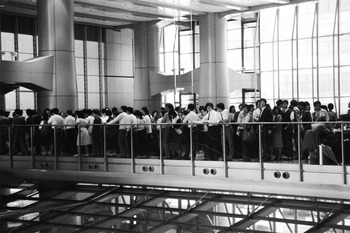
“People scramble for Cathay shares,” South China Morning Post, April 23, 1986. Photo credit: David Wong, South China Morning Post.
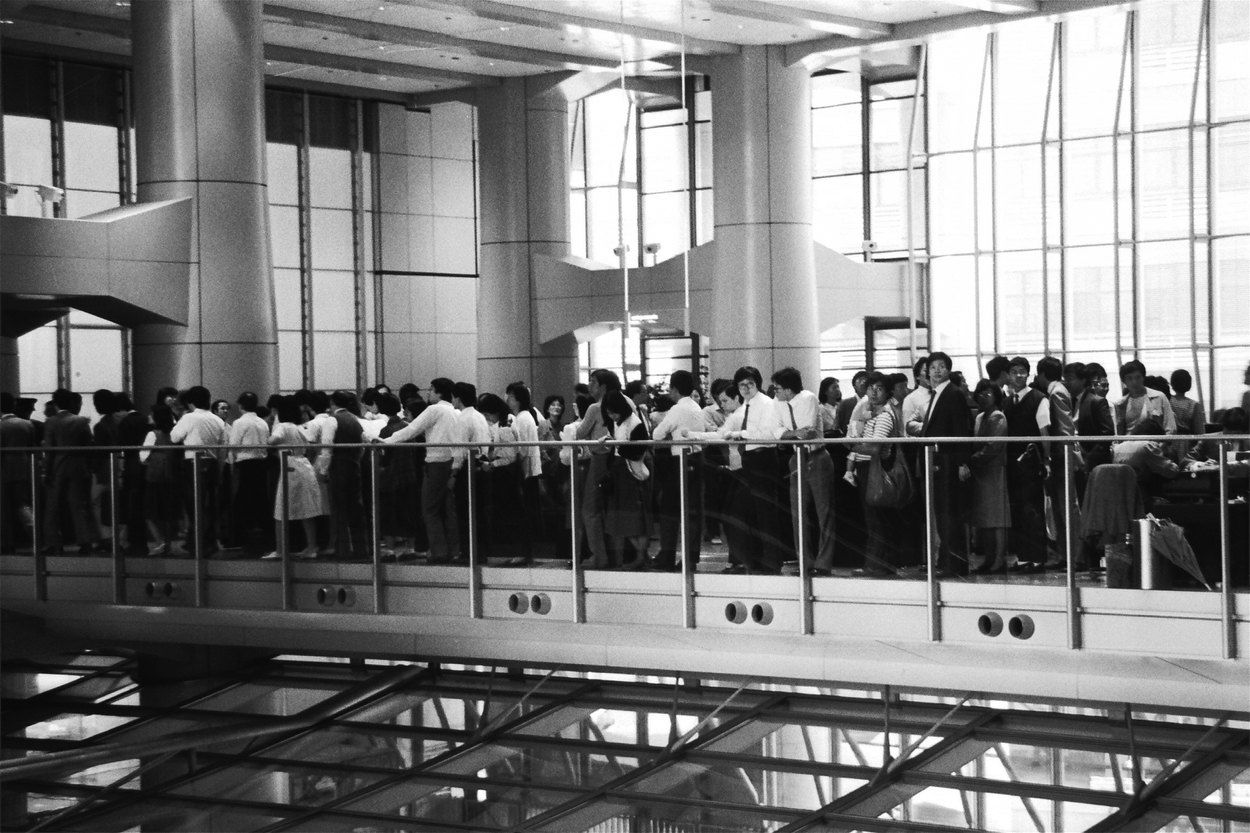
Political motivations of the airline’s management notwithstanding, Cathay Pacific’s flotation generated phenomenal enthusiasm among Hong Kong investors Figure 2.Footnote 57 “Turnover Soars as Cathay Takes Off,” read a South China Morning Post headline the day after the offering. The stock opened at HK$5.10 and registered a high quote of HK$5.35. The stock closed at HK$5.15 on the first day of trading, “a hefty 33 per cent premium” on the offer price of HK$3.88.Footnote 58 Pro-Beijing newspaper Ta Kung Pao noted the enthusiastic reception of Cathay Pacific’s shares in an otherwise lackluster day in the Hong Kong stock market, lauding the performance of the pathbreaking listing for its support of trading volume in Hong Kong.Footnote 59
The airline was eager to promote the offering in its own newsletter. “CX Share Offer Breaks All Records” read the headline of Cathay News in August 1986. Called “a resounding success,” the public share offer was said to have broken financial records on the Hong Kong Stock Exchange. The offering was 32.6 times oversubscribed. Excluding the shares allotted to the airline’s staff (10 percent of the total) and “certain Hong Kong institutions,” the offering was subscribed “a staggering 56.4 times.” Not merely an indication of public interest in aviation shares on an international basis, the results underscored “the Hong Kong public’s growing identification with Cathay Pacific as Hong Kong’s airline.” The offering attracted over HK$ 51 billion in applications, which “amounts to almost HK$10,000 for every man, woman, and child in the territory.”Footnote 60 The airline noted that the amount generated was “significantly higher than Hong Kong’s money supply” and exceeded by a considerable margin the size of any corporate transaction in the territory’s history. Managing Director Peter Sutch called the success of the public offer “a huge vote of confidence in the airline.”Footnote 61 In its travel magazine, the Discovery, the airline also emphasized that the public offer “shattered records in Hong Kong,” highlighting that “a total of 22.5 per cent of Cathay Pacific shares are now in the hands of Hong Kong residents, businesses or institutions.”Footnote 62
Interestingly, in this calculation, the list of “Hong Kong residents, businesses or institutions” did not include Swire or HSBC. In conjunction with the share offer to the general public, Swire and HSBC agreed to sell 5.0 percent and 2.5 percent of the airline, in proportion of their existing holdings, to a group equally owned by Cheung Kong (Holdings) Limited and Hutchison Whampoa Limited (both under the control of Hong Kong magnate Li Ka-shing), and to Hysan Development Company Limited (of a prominent Lee family [Chinese surname differs from Li Ka-shing’s] in Hong Kong), respectively. The two purchasers, who bought the shares at the same price as the offer price for the general public, had expressed their intention to hold the shares as a long-term investment. Footnote 63 The market had speculated earlier that shipping tycoon Sir Yue-kong Pao would take a substantial stake in the airline to accentuate a local character and to distance itself from “the British identity that some observers believe may already have been a disadvantage.”Footnote 64 Pao was a member of the board of Cathay Pacific, but he also chaired Dragonair, Cathay Pacific’s budding rival. That he did not belong to the final lineup of local investors in Cathay Pacific was not surprising—he had resigned from Cathay Pacific’s board in March, ahead of the flotation.Footnote 65
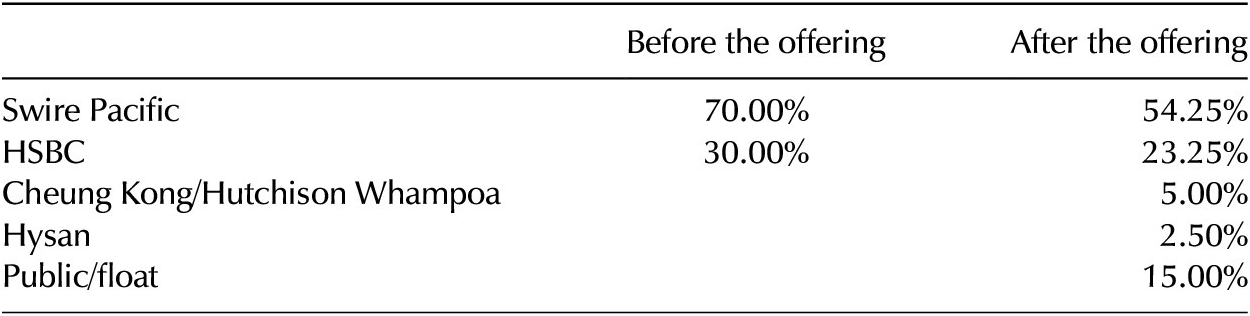
The conspicuous inclusion of local Chinese investors in this round of shareholding restructuring reflected more than the impact of the recently executed Sino-British Joint Declaration. Ethnic Chinese entrepreneurs had risen in profile in Hong Kong, most notable in Li Ka-shing’s assuming control of the British conglomerate Hutchison Whampoa in 1979 and taking over its chairmanship in 1981. As part of this profound change in the distribution of power in the world of commerce in Hong Kong, Cathay Pacific arrived late to the party in its restructuring of the airline’s shareholding.Footnote 66 Further, the restructuring did not result in a yielding of British control.Footnote 67 After the public offering, Swire Pacific continued to be the largest shareholder with a 54.25 percent stake, followed by HSBC’s 23.25 percent (Table 3). In the August 1986 issue of the travel magazine, the editor underscored the airline’s new tagline, “Hong Kong is the home base of Cathay Pacific Airways.”Footnote 68
Percentage ownership before and after the initial public offering, April 22, 1986.
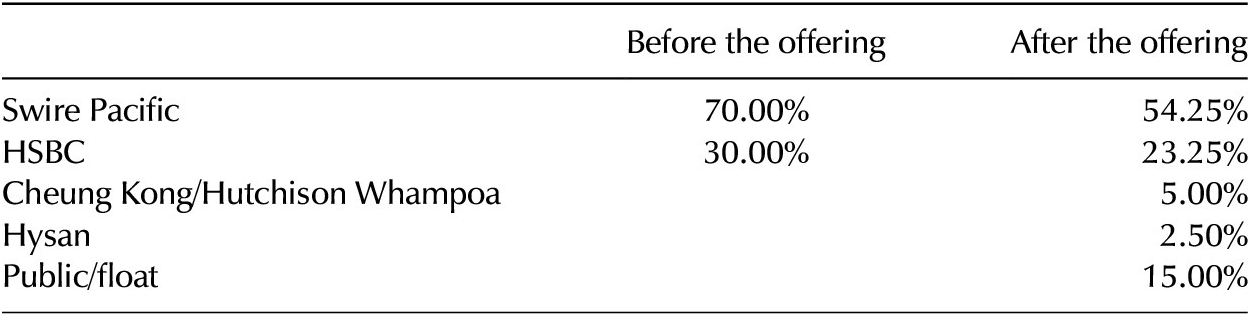
Source: Cathay Pacific Airways Offer for Sale, 22 April 1986, Swire HK Archive.
The airline could not readily dispose of its British ties but, at the same time, needed to develop a claim to serve the Hong Kong SAR that was to be formed after the 1997 Handover. It had to continue to operate under bilateral air service agreements and the designation of airlines “effected by the British government acting with the advice of the Hong Kong government.”Footnote 69 The Joint Declaration specified that it was the PRC government’s policy to “maintain the status of Hong Kong as a centre of international and regional aviation” and that Cathay Pacific, as well as “airlines incorporated and having their principal place of business in Hong Kong … may continue to operate.”Footnote 70 After the public offering, the airline took on more local Hong Kong, non-British investors, and to echo the requirements of the Joint Declaration, it promoted prominently Hong Kong as its home base.
Embracing Mainland Chinese Investments
Unfortunately for Cathay Pacific, these provisions did not include services that connected Hong Kong to, from, or through mainland China,Footnote 71 for which Dragonair remained a formidable home rival. The Air Transport Licensing Authority had approved the license application of Dragonair to fly to eight cities in China on Christmas Eve 1985, giving “official recognition to Cathay Pacific’s first domestic competition,” which Cathay Pacific acknowledged in its newsletter. Dragonair still needed to apply to British and Chinese governments for traffic rights. To fend off unnecessary competition, Cathay Pacific appealed to the public by citing the “40 years of hard work and substantial investment to reach its position as one of the world’s leading carriers.” The carrier asked all involved to remember: “CX has been providing Hong Kong with a sound, competitive, and high quality of air services for some considerable time” and so “perhaps … deserve[s] at least some credit for that.” Sutch asserted, “The arrival of Dragonair has been a sober reminder that we have no God-given right to earn a profit and that we have really got to live up to our promises of helping people arrive in better shape if we are going to continue to be Hong Kong’s airline—which I can assure everybody is very much our intention.” (emphasis added) He considered Dragonair more of an “irritant” than a threat “on the realization—albeit somewhat misguided—that there is a greater need for air service between Hong Kong and China.” Claiming that Cathay Pacific was not anticompetitive, Sutch maintained that the airline “probably have as much if not more competition to face than most airline in our home base.”Footnote 72 Even after Cathay Pacific’s public offering, Dragonair, which one op-ed in the local English newspaper called “Hongkong’s unrelenting new airline,” continued to challenge Cathay Pacific, “the territory’s long-standing sole carrier,” by purchasing additional aircraft, planning to “operate to 12 points in China” by autumn 1987, and expressing its determination to offer scheduled services.Footnote 73
In its defense against Dragonair, Cathay Pacific needed to be mindful of Dragonair’s investor base, which included not only Pao and other Hong Kong shareholders but also “mainland Chinese heavyweights.”Footnote 74 Cathay Pacific’s public offer might have rendered the airline more local Hong Kong as measured by its shareholder base, but it had yet to facilitate mainland Chinese ties for the airline. The market soon speculated that mainland state-run China International Trust and Investment Corporation (CITIC) would buy a stake in Cathay Pacific and that such a politically inspired bargain would allow the airline to win mainland Chinese support in its bid to thwart Dragonair’s mounting challenge to its position in Hong Kong.Footnote 75
“Beijing Buys $2B Stake in Cathay,” the news came on January 28, 1987. CITIC acquired 12.5 percent of the shares of Cathay Pacific, “whose aircraft still carry the Union Jack on their tails.”Footnote 76 CITIC bought 212,186,040 new shares for HK$5 per share. The market reacted favorably, as the airline’s stock price rose steadily. In addition, CITIC acquired 145,877,902 shares from HSBC at HK$6 per share. A joint announcement explained that the shares HSBC sold would accrue dividends for the year 1986, unlike the new shares sold at the lower price.Footnote 77
The transaction reduced Swire’s ownership from 54.25 percent to 50.23 percent, and HSBC’s from 23.25 percent to 16.43 percent. Spokespeople for Cathay Pacific explained that ownership must remain in the hands of British owners because Cathay Pacific was still “a British airline for the purposes of international air transport licence consideration.” Chairman Miles also said that a dilution of British ownership below 50 percent would be harmful to the airline’s interest.Footnote 78 The airline was quick to point out that Swire and HSBC “still hold 66.66 per cent of the airline.”Footnote 79 That the two biggest shareholders owned two thirds of the airline was intentional, said the chairman.Footnote 80
In a press conference, Miles underscored Swire’s long-term intention to maintain its majority shareholding in the airline. He added that “the addition of a minority mainland Chinese shareholding was felt by the Board of Directors of Cathay Pacific, Swire Pacific, and the HSBC to be beneficial to the long term future of the airline” and that “CITIC had fully accepted the existing policies of the airline, particularly with regard to staff.” “We are very conscious of the necessity of building relations with the People’s Republic of China in a sensible balanced way,” Miles said. “In 1997, sovereignty over Hong Kong reverts to China and it will be very necessary to have the active support of Beijing. A $2 billion investment by the PRC in Cathay Pacific makes it very very clear that we do indeed have Beijing support,” Miles added.Footnote 81
The airline explained that the local and international media generally considered the transaction “as a logical step for the airline in the long term, and a positive one for Hong Kong as a whole.” CITIC’s purchase “lift[ed] the threat of political favour from clouding the aviation scene in Hong Kong and allowing that sector to continue to develop with renewed confidence.” CITIC officials issued a press statement that stated the development of the airline industry was “of great importance to Hong Kong’s stability and prosperity” and that the investment demonstrated CITIC’s “full confidence in the bright future of Hong Kong.” As part of the investment, the vice chairman of CITIC Hong Kong (Holdings) Ltd. joined the board of Cathay Pacific.Footnote 82
The deal was said to have “largely laid to rest Dragonair’s claims that it is the only genuine Hong Kong airline in terms of ownership.”Footnote 83 Cathay Pacific claimed that both of its major stakeholders, Swire and HSBC, to be “substantially owned by Hong Kong shareholders.” At the same time, their being “British owned and controlled” also allowed Cathay Pacific to continue to operate from Hong Kong and have their traffic rights negotiated by the British government. The airline hastened to add that Cathay Pacific had “one of the largest registers of local shareholders of any public company in Hong Kong” and in that regard was “more substantially a Hong Kong airline than Dragonair.”Footnote 84
Managing Director Sutch asserted that “as a group”—Cathay Pacific, as well as Swire—they had always been sensitive to the environment in which they operated and “if political or economic changes in Hong Kong called for a change in the shareholding structure, such might take place.” The airline’s embrace of CITIC as a 12.5 percent shareholder was thus “totally consistent with that stated policy,” and for Cathay Pacific, it was “business as usual.”Footnote 85
CITIC’s investment in Cathay Pacific might have engineered a détente between the two rival Hong Kong carriers. However, the financial performance of Dragonair remained lackluster. It was reported that the fledging carrier remained a loss maker and that the June 4 crisis in Beijing in 1989 dimmed hopes just as its performance approached breakeven.Footnote 86 It was from that context that the unlikely partnership between the two rival carriers emerged. On January 17, 1990, Cathay Pacific and its parent, Swire Pacific, announced their acquisition of 30 percent and 5 percent of DragonairFootnote 87 for HK$294 million and HK$49 million respectively.Footnote 88 The press release stated the two airlines’ intention to cooperate, “with Dragonair initially concentrating on the development of routes between Hong Kong and the People’s Republic of China.” As part of the deal, Cathay Pacific also entered into an agreement to provide management, technical, and administrative services to Dragonair.Footnote 89 At the same time, CITIC, through its subsidiaries, increased its Dragonair ownership to 38 percent,Footnote 90 from 16.6 percent according to one report. Although CITIC’s 12.5 percent investment in Cathay Pacific was public knowledge, the mainland Chinese concern had not previously confirmed its investment in Dragonair. The Chao family, a founder of Dragonair, which had recently purchased Pao’s shares, trimmed its holdings in the carrier to 22 percent. After the deal, businesspeople “from Hongkong and Macau with strong links to Beijing” held the remaining 5 percent of Dragonair.Footnote 91 While reports circulated that CITIC had pressed Cathay Pacific into the transaction,Footnote 92 Cathay Pacific’s spokesperson insisted that the move was purely “commercial.”Footnote 93
“Commercial” or “political,” the deal made sense as an international airline requires the support of the governing political body to negotiate for it and grant it traffic rights. A newspaper report called it the “nationality” or “citizenship” of an airline—“the country or territory in which it is owned and based.”Footnote 94 The preponderance of the consideration pivoted not on the local situation in Hong Kong but on the insistence of state administrators from afar. The alliance of CITIC-Swire in Cathay Pacific and Dragonair formulated the Sino-British joint venture that enabled the transition of air service rights negotiation and assignment in the years leading up to the Handover. Aviation sources believed that Cathay Pacific’s coalition with Dragonair would “pave the way for the bigger carrier’s smooth operation after 1997.”Footnote 95
Shortly after the Dragonair deal in 1990, mainland Chinese shareholdings in Cathay Pacific came to eclipse the stakes of its major local Hong Kong investors. The HSBC had sold large chunks of its holdings, mostly recently in 1991, to raise some HK$1.7 billion. This lowered the bank’s holdings to a 13.78 percent stake in the airline.Footnote 96 Gone was the two-third majority that Swire/HSBC had crafted between them in 1987 as they admitted CITIC into the Cathay Pacific. Also, by 1992, Li Ka-shing’s companies and Hysan did not register significant holdings in Cathay Pacific.Footnote 97 This should probably come as no surprise. Even though these investors who received their allocation in the flotation had claimed to be long-term holders of Cathay Pacific shares, according to a newspaper report, Hysan’s managing director, Mr. H. C. Lee, had conceded shortly after the allocation that “in Hongkong six months could be construed as long term.”Footnote 98
The year 1992 witnessed the loss of one of Cathay Pacific’s longstanding shareholders. As the HSBC Holdings chairman asserted that “aviation is clearly not a core business for a financial services group,” the bank ended its twenty-one-year-old equity tie to Cathay Pacific. HSBC “shed the last vestige” of its stake in Cathay Pacific, reported the local English newspaper. This sale of the remaining shares of Cathay Pacific held by HSBC amounted to 10 percent of the airline’s total. The bank sold half of its holdings to China National Aviation Corp (CNAC; a reincarnation of the enterprise by the same name in the prewar Republican era) and half to China Travel Service (CTS). These two entities, CNAC, a subsidiary of the Civil Aviation Administration of China that regulated mainland China’s airlines, and CTS, the local arm of mainland China’s official travel bureau, bolstered tremendously Cathay Pacific’s ties to the PRC. Mainland Chinese holdings in Cathay Pacific increased from the 12.5 percent already held by CITIC to a total of 22.5 percent for the three mainland-controlled entities.Footnote 99
Cathay Pacific Chairman Peter Sutch said that the airline was “sorry” to lose HSBC but was “pleased to have CNAC and CTS as shareholders” and believed their involvement reflected “increasing co-operation between airlines in Hongkong and aviation and tourism in the People’s Republic of China.” As part of the transaction, the chairpersons of the two new investors joined the board of Cathay Pacific. “Participation by CNAC and CTC as shareholders in Cathay Pacific will also help to assure one objective of the Joint Declaration: that the Hongkong Special Administrative Region should remain—and indeed be further developed—as a centre for international and regional aviation,” read a joint statement issued by Cathay Pacific and its two new investors. The statement called this deal a positive development both for the airline and for the future of Hong Kong. The vice director of the Hong Kong branch of the New China News Agency echoed the positive sentiments, calling the deal “good for the stability and prosperity of Hongkong.”Footnote 100 At the conclusion of this transaction, Swire barely retained its majority shareholding of 51.8 percent.Footnote 101
Swire did hold onto its majority stake in Cathay Pacific for a few more years, but even under its watch, the airline needed to mute its British shareholding ahead of the Handover. “Going Native: Cathay Strives to Shake Off Vestiges of Colonial Times,” read an Asian Wall Street Journal article in 1993, which reported that the airline had erased the Union Jack from its livery. “We’re taking a good, hard look at ourselves and seeing we’re no longer a British airline,” said a senior executive at Cathay Pacific. “We’re a Hong Kong airline. There’s really no point in having a British flag.” Shedding the airline’s colonial image, the article noted, would “require a lot more than a few buckets of paint.” The article cited an Asian aviation veteran and former chief executive of Dragonair: There is “no alternative to Chinese shareholders acquiring the major controlling interests at the very latest by 1 July 1997.”Footnote 102
Cathay Pacific strove to dispel rumors of Swire reducing its stake. News articles on May 5, 1995, reported Swire’s intention to maintain its majority holding in the airline. The carrier’s managing director was quoted as saying, “We have three mainland shareholders who hold a 22.5% stake. I think it’s about right.”Footnote 103 In August, however, the Swire chairman admitted that CNAC was in negotiations with Swire and Cathay Pacific to buy a stake in Dragonair.Footnote 104 The partial sale of Swire’s and Cathay Pacific’s interests in Dragonair would come to fruition the following year. In April 1996, CNAC announced its purchase of 35.9 percent of Dragonair from Swire, Cathay Pacific, and CITIC. The Dragonair deal was but a component of a major reshuffle of mainland Chinese interests in the airlines of Hong Kong. Along with CNAC becoming Dragonair’s largest shareholder, CITIC bought new shares of Cathay Pacific, increasing its stake to 25 percent. As a result, although it retained all its shares, Swire saw its holding diluted to 43.9 percent,Footnote 105 below a simple majority.
It was a deal for Cathay Pacific. CNAC had announced plans to set up its own airline in Hong Kong to compete with Cathay Pacific, but as part of this transaction, it agreed to drop those plans and would instead pursue its interests in Hong Kong through Dragonair. To finance their purchase, CNAC would sell some of its shares in Cathay Pacific.Footnote 106 CITIC’s stepping up its interests in Cathay Pacific also represented a reversal in its strategy. Earlier, the CITIC chairman had left the board of Cathay Pacific, causing concerns that ties between the two companies had fractured. Late in 1995, CITIC had even sold 2 percent of Cathay Pacific. CITIC’s increased stake signaled a resolution of any issue. The transaction entitled CITIC to two more board seats (which had included twenty directors before the transaction) and two representatives to the airline’s executive committee (which had eight members).Footnote 107
A securities analyst commented that the deal afforded Swire and Cathay Pacific “a political guarantee that their future is much more safeguarded after 1997.” The Asian Wall Street Journal went as far as to say that “Swire Pacific Ltd. is swapping a big chunk of its airline empire for post-1997 political insurance.”Footnote 108 The Wall Street Journal reported, “Hong Kong Airline Protects Its Turf with Sale to China.”Footnote 109 Although a headline in London’s newspaper The Independent lamented that “Swire Loosens Grip on Cathay as Chinese Move In,”Footnote 110 the same newspaper carried a report a few days later that celebrated “Happy Landings for Hong Kong: The Swires Have Shown That It Pays to Kowtow to China’s Capitalists.”Footnote 111 Hong Kong’s own South China Morning Post celebrated “Cathay on Course to Brighter Future as Share Accord Clears Political Clouds.”Footnote 112 Swire sold control of the airline “on the cheap, but this is the price of political accommodation with the 1997 hand-over looming,” said another article in the local newspaper. Footnote 113 “Airline Pact Seen as a Neat Solution” read a headline, as yet another journalist reported on the “historic shakeup.”Footnote 114
The Hong Kong government readily accepted the deal. A spokesperson confirmed that both Cathay Pacific and Dragonair would continue to be designed as Hong Kong carriers even though British ownership in them would fall below 50 percent. The clause that Hong Kong’s airlines must be “substantially owned and effectively controlled by British nationals” would not have to apply after the Handover, as the territory had negotiated with all major countries.Footnote 115 Hong Kong governor Chris Patten called the decision “commercial” and highlighted Cathay Pacific’s investment in the new Chek Lap Kok airport as an indication of its determination to remain a forceful player in Hong Kong’s aviation industry.Footnote 116 In Beijing, the deal won the accolades of Qian Qichen, the vice premier, who praised Swire for “striking the historic deal that marked the end of British domination of the local aviation industry.”Footnote 117
In preparation of the Handover, Cathay Pacific assumed new ownership proportions: Swire 43.9 percent, CITIC 25.0 percent, and other shareholders (including CNAC’s 4.2 percent) 31.1 percent. As for Dragonair, CNAC owned 35.86 percent, CITIC 28.50 percent, Cathay Pacific 17.79 percent, Swire 7.71 percent, the Chao family 5.02 percent, and others 5.12 percent.Footnote 118 “We believe that the [Cathay Pacific] share placement and the Dragonair transaction are in the best interests of the shareholders as well as the employees of Swire and Cathay Pacific,” said Cathay Pacific’s Chairman Peter Sutch.Footnote 119 Swire’s simple majority shareholding in Cathay Pacific was finally eclipsed a year before the 1997 Handover.
Conclusion
This analysis of the varying shareholding of Cathay Pacific underscores the dynamic interactions between the state and the investment market in an ever-changing geopolitical landscape. In its first three and a half decades of operations (1946–1981), Cathay Pacific witnessed the resumption of British control of the colony, the economic growth of the city into a regional hub, and its coming of age as a nexus of British interests in the Far East. During this period, the airline developed from a startup of American and Australian mavericks, to a British Commonwealth conglomerate, and finally a partnership of local British interests in Hong Kong. By the early 1980s, as the sustainability of British interests in Hong Kong became questionable, the carrier raised the local profile of its investor base by soliciting shareholders from among prominent business families in Hong Kong while offering additional shares to the investing public in the city. This refashioning of the airline as a local company did not adequately satisfy the requirement of the incoming regime, especially as Dragonair garnered the support of investors with mainland ties and competed with Cathay Pacific for genuine local status.
In the end, local qualities did not guarantee Beijing’s backing. To continue to rule the airways over Hong Kong, Cathay Pacific embraced red capital from mainland-controlled enterprises with direct connections to Beijing. Throughout this process, the carrier’s dominant shareholder, Swire, demonstrated considerable agility and resilience against a rapidly shifting geopolitical backdrop. Swire’s “Britishness” had allowed its assumption of control from the airline’s Australian-American founders and facilitated investments in the airline by those with ties that London deemed appropriate. Ironically, the same “Britishness” came to haunt the group’s investment in the airline when the political tides turned. Perception of such British roots would not dissipate readily. Even as the airline restructured, its shareholder base could not develop a local Hong Kong identity that Beijing would find palatable. The incremental infusion of mainland Chinese investment in and influence over the Hong Kong carrier, calibrated to reflect a comfortable compromise, enabled a seamless transition over the Handover, which entailed a change of sovereignty (and the attendant air service rights) overnight on July 1, 1997—no mean feat in light of the delicate diplomatic sensitivity and vast financial interests involved.
The dexterity of Cathay Pacific in crafting its ownership structure at different points of its history tested the application of “gentlemanly capitalism” in a transnational setting.Footnote 120 The carrier’s challenges before the 1980s might have been confined to the greater British circles. However, its transformation in the transition era ahead of 1997 stretched the shareholder base beyond its comfortable social network to encompass investors with a radically different background. Among these new investors are some that represented mainland Chinese state interests critical to the continuing success of the airline. Not unlike the British, the incoming political regime exercised its state influence within the framework of the free market. Just as BOAC, the longstanding investor in Cathay Pacific, was a state-owned enterprise, CITIC, CNAC, and CTS represented the interest of the mainland Chinese state in the Hong Kong carrier.
Historical precedents could engender apprehension about state intervention in the marketplace, but state actions vary according to the agenda of the times. The PRC’s assumption of sovereignty over Hong Kong inaugurated a major shift in the development of the city’s aviation industry. Compared with the experience in the early years of the PRC, the ascending control of mainland Chinese interests in Hong Kong’s primary carrier unfolded more subtly and involved none of the open conflict that state seizure entailed in the 1950s.Footnote 121 The difference reflected not only the particular arrangements of the Handover but also the drastically transformed posture of the PRC government in the reform era. However, the airline industry remains a critical sector for the state, and a carrier’s success relies heavily on its ability to garner political support.Footnote 122 Unlike its longtime investor HSBC, which chose to transform its profile from the colony’s largest bank to a global financial conglomerate,Footnote 123 Cathay Pacific deepened its mainland connections in its many rounds of shareholder realignment in the transitional years leading up to the 1997 Handover.
In colonial Hong Kong, Cathay Pacific was both foreign and local—foreign because its shares were not primarily locally held but also local because its routes radiated from its home base in Hong Kong. That peculiar combination provided the airline its legitimacy as a British concern in Hong Kong. This source of legitimacy was becoming obsolete with the looming sovereignty transfer in 1997.Footnote 124 In response, Cathay Pacific first accentuated its local shareholding to minimize its “liability of foreignness” with certain concession of British ownership.Footnote 125 As increased local Hong Kong shareholding would not suffice, the airline accepted another source of “foreign” (read from outside of Hong Kong) ownership and yielded to ascending representation of the incoming political regime among its shareholders.
In the multirounds of shareholding reshuffling, Cathay Pacific’s preemptive efforts, as well as the persistence of the PRC state in escalating its representation in the Hong Kong carrier, point to an understanding that economic decolonization often lags behind political decolonization.Footnote 126 Indeed, British shareholding remained dominant in Cathay Pacific even after the Handover, but British endurance was tolerated for not only its instrumentality in ensuring operational efficiency locally in Hong Kong but also its connections to the budding industry in mainland China. Changing the perspective, in relation to the PRC, Cathay Pacific’s shareholding indicates that economic nationalization lags political nationalization.
Cathay Pacific was not a simple local operator. From its longstanding home base in Hong Kong, the airline commanded a multinational presence that extended first to a regional network encompassing East and Southeast Asia, and in due course, to Europe and America. This analysis underscores that in our examination of the transnational setting of such business enterprises as Cathay Pacific, the role of the state is crucial.Footnote 127 Firms operating in a transnational setting altered the sociopolitical landscape within which they run their business.Footnote 128 Conversely, geopolitical powers also condition and influence business choices and enforce jurisdictional boundaries that endure in spite of globalizing forces. The case of Cathay Pacific’s restructuring of its shareholding underscores business exigencies for operating in the crevices between shifting definitions of states. Set against a global backdrop, the business of Cathay Pacific pivots not only on its resonance with the local (but not quite national) circumstances but also on the agreement of a changing cast of state actors.
The role of the state is all the more important in industries that the state deems strategic and over which the state maintains oversight. The case of Cathay Pacific in the run-up to the Handover was unusual: Unlike multinationals that leverage their operations in the host and home countries, the airline constructed a local presence in Hong Kong and muted its British roots in a bid to appease its new host in Beijing. In that round of their shareholding restructuring, Cathay Pacific adopted “aspirational political practices” to address the requirements of a new governing regime.Footnote 129 Although less precarious than global businesses in times of warfare,Footnote 130 Cathay Pacific needed to restructure its shareholding more fundamentally than simply masking its British roots in order to manage its political risks and earn the trust of the incoming power that was to underwrite its continued success. It does not require warfare or open conflict for a business to experience existential threat stemming from political risk. In the protracted process through which Britain yielded jurisdictional power of Hong Kong to the PRC, Cathay Pacific responded preemptively, first by enhancing its local profile and then by appealing to economic nationalism of the sovereign state poised to take charge.
Whereas the people of Hong Kong are known for their practice of “flexible citizenship” in their negotiation with nation states,Footnote 131 the transformation of Cathay Pacific’s investor profile demonstrates that its corporations, too, are equally adept in adjusting their ownership structure to function effectively under different political regimes. Equally importantly, Cathay Pacific’s ability to vary its image along a shifting political spectrum attests to the pliability of the notion of “corporate nationality.” Scholarly focus on national ownership presumes too much of a binary (state-owned versus private enterprises) to appreciate sufficiently corporate agility, as in the case of Cathay Pacific; nor does unbridled celebration of the free market in Hong Kong recognize the influence of the state (in its different formations) in the economic activities of the city. Instead of the mobility of global capital,Footnote 132 this article focuses on the corporate nationality that Cathay Pacific projected through its shareholding at different points in its history. Although capital as calibrated by denominations could transcend, within limits, divides by foreign exchange in the global marketplace, the presumed identity of the investor, individual or corporate, confers corporate nationality on the business, along with certain implications of political allegiance.
Through the lens of Cathay Pacific’s changing shareholding, the free market of shareholding, rather than being a polar opposite of state control, facilitated the negotiation of state claims and enabled the fluid transfer of business interests between political regimes. In charting its course through the turbulent waters of geopolitics that did not spark fires, Cathay Pacific adroitly constructed its corporate nationality through shareholding on numerous occasions, mitigating political risks that threatened to destabilize the ascent of its business.